
By Thapelo Molefe
South Africa’s education system is failing to move young people into skilled work, with government and sector leaders warning that vocational pathways remain underdeveloped despite growing demand from both learners and the economy.
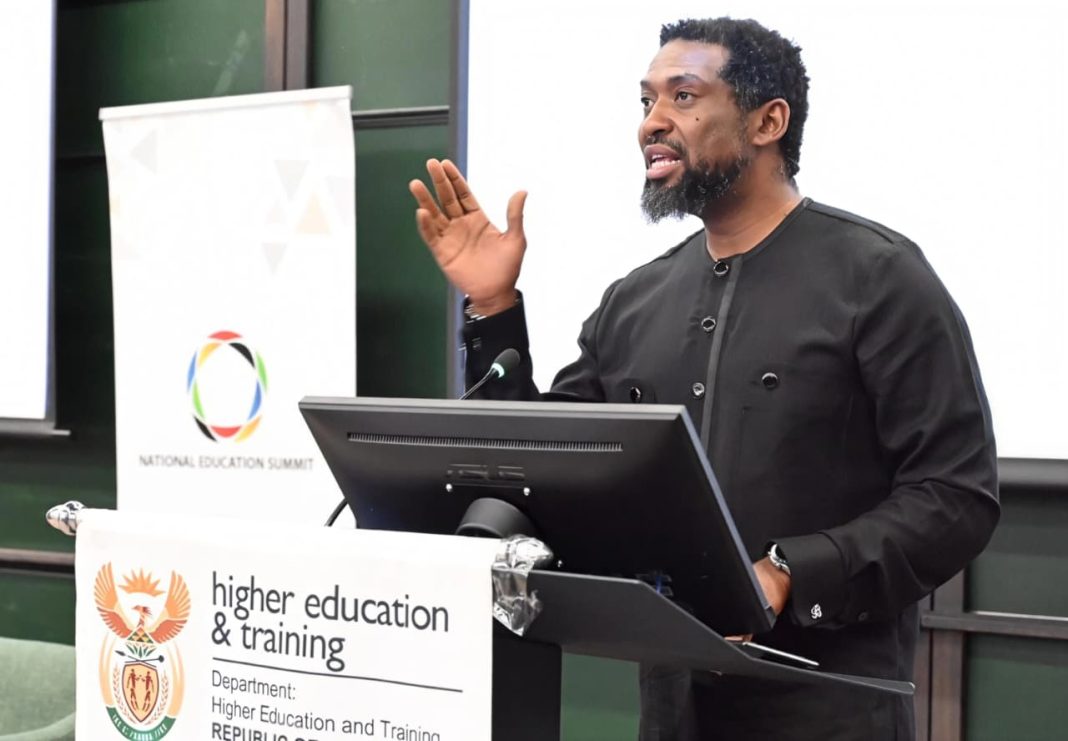
This emerged at the National Education Summit 2026 hosted by Inside Education in Sandton on Monday, where policymakers, academics and industry representatives focused on the urgent need to rebuild the link between learning and employment.
Delivering the keynote address, Higher Education and Training Minister Buti Manamela framed the crisis as systemic, saying the country’s challenge goes beyond unemployment.
“Our crisis is not only unemployment. It is a crisis of pathways,” he said, pointing to the 3.4 million young people not in employment, education or training.
Manamela said vocational education must play a central role in addressing this gap, warning that the country is not producing enough skilled workers.
“South Africa does not have a shortage of young people. We have a shortage of pathways into skilled work,” he said.
He noted that while the economy requires about 30,000 artisans annually, the system is producing only around 20,000, calling the shortfall “a constraint on growth” and industrial development.
“Vocational education is not a second choice. It is a central pillar of our development,” he said.
The minister outlined plans to expand Centres of Specialisation, increase artisan training and scale up work-based learning opportunities, with targets of 37,000 artisan registrations this year and over 200,000 workplace learning opportunities.
However, discussions at the summit revealed deep concerns about whether the current system can deliver on these ambitions.
Professor Mary Metcalfe, a National Planning Commissioner, warned that while the policy vision is sound, implementation remains weak and poorly understood.
“The design of the system is ambitious… and I would argue that most South Africans don’t understand it,” she said.
She added that vocational pathways are still not seen as desirable by the public, with university education continuing to dominate aspirations.
“Vocational pathways should be aspirational,” she said, noting that most families still believe success lies in obtaining a bachelor’s degree and going to university.
Metcalfe also raised concerns about the effectiveness of institutions meant to support these pathways.
“At the moment, I’m not confident about saying, go to a TVET… we need to strengthen our TVET,” she said.
College of Cape Town administrator Dr Robert Nkuna said the sector spends too much time on policy discussions without addressing implementation.
“We never grapple with implementation as to what implementation will look like,” he said, calling for a shift towards clear plans on “what needs to be done by whom, when, how, and at what cost”.
Nkuna also highlighted the slow pace at which the system adapts to economic changes, particularly in high-demand fields like artificial intelligence.
“If it’s going to take us 10 years… this misalignment continues in perpetuity,” he said.
The Quality Council for Trades and Occupations (QCTO) said curriculum reform is already underway to address some of these challenges.
CEO Vijayen Naidoo said that new occupational qualifications are designed to produce job-ready graduates by combining theory, practical training and mandatory workplace experience.
“Without those three, the learner would not get access to what is the final assessment,” he said.
He added that previous TVET programmes were too theoretical, leaving students unable to secure employment.
“Less than 10% of learners… have achieved the diploma to date,” Naidoo said, referring to those who completed N6 programmes but failed to obtain the required workplace experience.
Despite these reforms, uptake remains slow, with only about 30% adoption of the new occupational qualifications.
Industry representatives also stressed the need for stronger alignment between skills training and economic demand.
FP&M SETA representative P.K. Naicker said learners must be guided towards skills linked to growth sectors such as digital technologies, renewable energy and advanced manufacturing.
“You cannot study qualifications that would lead to dead-end jobs,” he said, warning that misaligned education contributes to high unemployment.
The panel further highlighted structural barriers, including limited workplace opportunities for students and bottlenecks in accreditation processes.
Naidoo said that accreditation applications surged from 25,000 to 66,000 in a year, creating delays and exposing capacity constraints.
“That is where a major blockage is,” he said.
Participants also raised concerns about the lack of skills development at school level, saying that vocational exposure comes too late.
“It’s a sin… that a young adult leaves the schooling system without any skills,” said one participant during the discussion.
There were calls for vocational training, including technical and digital skills, to be introduced earlier in the education pipeline to ease the transition into work.
Manamela acknowledged these systemic weaknesses earlier in his address, saying fragmentation across the education system is a major obstacle.
“Our challenge is not a lack of programmes but fragmentation… too many initiatives, too little alignment,” he said.
He stressed that no single institution can fix the problem alone, calling for coordinated action between government, industry and training institutions.
A clear consensus emerged that vocational pathways are critical to addressing youth unemployment, but require urgent reform to become accessible, credible and effective.
“The contract we must make is simple: that every young person must have a pathway into skills, into work, into dignity,” Manamela said.