


By Lebone Rodah Mosima
More than 100 University of South Africa (UNISA) students have lodged complaints over delayed National Student Financial Aid Scheme (NSFAS) allowance payments and the scaling back of data support, Deputy Minister of Higher Education and Training Yusuf Cassim said on Thursday.
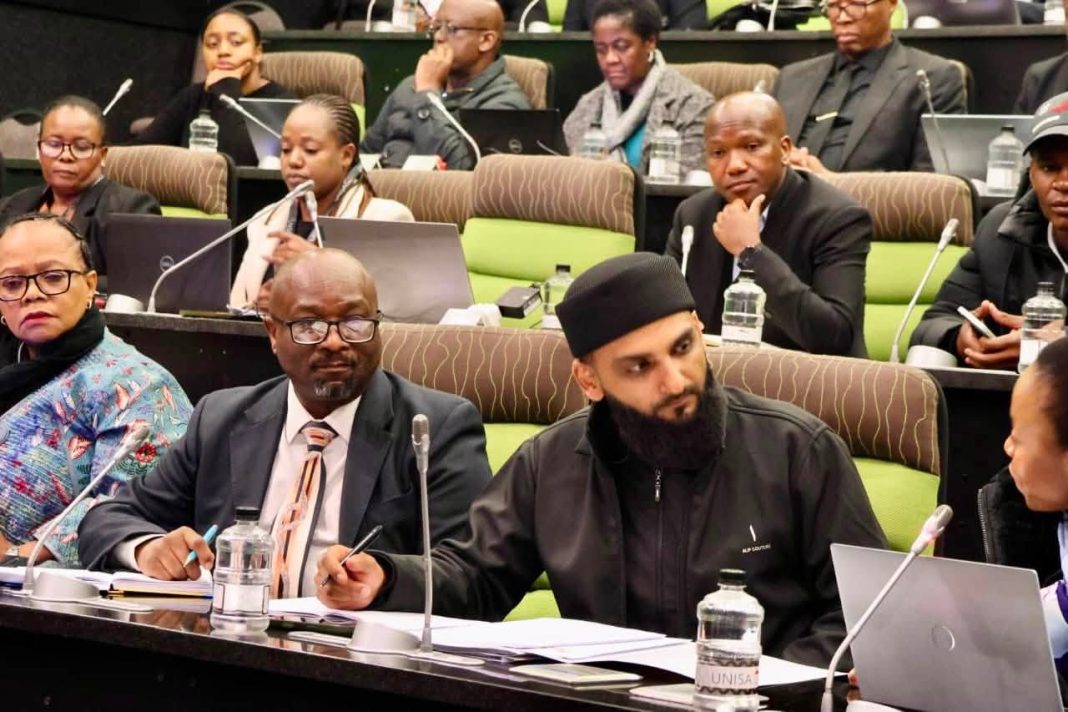
Cassim made his first official visit to UNISA’s Muckleneuk Campus in Pretoria, where he met students and university management to hear concerns over NSFAS funding and institutional support.
He said more than 100 students had submitted complaints through a helpdesk established during the visit.
“These are the personal testimonies that we are handing over to both the NSFAS senior manager as well as the institution so that, where they are individual issues, those can be attended to and that students receive a response and that they are satisfied that some of those issues are being dealt with,” Cassim said.
He said the main concerns related to delays in the payment of the monthly Personal Care Allowance for NSFAS-funded students and the discontinuation or reduction of data allowances.
“Overall, if you look at the main themes, it was the delay in the payment of the Personal Care Allowance for NSFAS beneficiaries of UNISA, and it is really trying to get to the bottom of the payments from NSFAS to the institution because the institution still needs to process payments to students after receiving the funds,” he said.
Cassim said he had been informed that NSFAS transferred funds to the university on 2 July, despite receiving student registration data at the end of March and an updated file in April. He questioned why the process had taken so long.
“I think these are important questions. As you know, NSFAS has been put under administration, and some of my findings here I will raise with the administrator because it is now his responsibility to deal with the issues that may have led to the late payment,” he said.
“If you’re only going to pay the institution or transfer the funds on 2 July, you can’t expect that the institution can push a button immediately and the money will go to students. There has to be a reasonable time.”
Cassim said discussions with the NSFAS administrator indicated that institutions generally receive payments about a week after the start of each month, a schedule he suggested should be reviewed.
He also raised concerns about the value of allowances paid to distance-learning students, saying the current Personal Care Allowance of R316 per month was insufficient.
“R316 per month for a distance-learning student, which is less than the Social Relief of Distress grant, is simply not enough when you consider the resources students need to succeed academically,” he said.
Cassim further argued that UNISA receives lower state support than contact-learning institutions despite serving one of the country’s largest student populations.
“These are some of the big issues, and it is important that government listens carefully and provides meaningful input.”
He said several pieces of legislation governing the post-school education and training sector would be reviewed over the next year, providing an opportunity to address long-standing funding and policy challenges.
Cassim also said data support for UNISA students had been reduced over time, including during examination periods.
“The purpose is not to point fingers between the different institutions, but to find ways to prevent this from happening again,” he said.
“Students have to wait so long for such a small allowance in the first place. We need to find practical solutions to avoid this in the future, though many of these issues are policy issues.”
Acting Vice-Chancellor and Vice-Principal for ICT, Mathabo Nekene, said UNISA shared the department’s commitment to placing students at the centre of its teaching, learning, research and community engagement.
“We have around 180,000 students funded by NSFAS, and as the Deputy Minister indicated, there is a disjuncture in the policy because our students receive the least funding from NSFAS,” Nekene said.
“These are matters that require structured engagement, and we appreciate the Deputy Minister’s willingness to build a relationship with UNISA so that we can work collectively towards meaningful outcomes for students.”
Nekene said the university supplements NSFAS funding from its own resources while awaiting additional transfers from the scheme.
She said UNISA also provides data support from its own budget because neither the Department of Higher Education and Training nor NSFAS funds data allowances specifically for distance-learning students.
“Students receive data through zero-rated UNISA sites every month, including during examination periods,” she said.
She added that the university was reviewing how to sustain data support while balancing its teaching, research and community engagement responsibilities.
“This provisioning of data is an opportunity cost for the institution because it places additional pressure on the council budget and our core business of teaching, learning, research, commercialisation and community engagement,” she said.
UNISA Chief Financial Officer Liana Joubert said policy reforms had not been matched by corresponding increases in funding.
“There are policy shifts, but no corresponding funding changes,” Joubert said.
“Our students are the ones who bear the impact.”
In a statement, NSFAS confirmed it transferred funds to UNISA on 2 July after completing payment and reconciliation processes, after which responsibility for disbursing allowances shifted to the university.
The scheme said it was informed of technical problems affecting UNISA’s payment process, but these had been resolved.
“We continue to engage with UNISA to monitor progress and ensure that all affected students receive their allowances as quickly as possible,” NSFAS said.
The scheme said UNISA had reported that payment processing had begun following the transfer of funds.
It said technical system challenges affecting some payments were resolved by 6 July, with the remaining payments currently being processed.
Approximately 93,093 students receiving the monthly Personal Care Allowance were affected by the delays.
“The university has further indicated that some students have already received their allowances, while the remaining payments are expected to be finalised during the course of this week,” NSFAS said.
NSFAS clarified that the delays related only to the Personal Care Allowance.
“UNISA students do not receive meal allowances under the NSFAS funding model. Eligible students receive support through the Book/Study Material Allowance and the Personal Care Allowance,” the scheme said.
NSFAS said it currently funds 168,480 UNISA students for book allowances at a cost of R425.6 million and 93,910 students for Personal Care Allowances amounting to R148.6 million.
The scheme said it understood students’ frustrations and apologised for the inconvenience.
“We remain in close engagement with UNISA and continue to monitor progress to ensure all eligible students receive their allowances as soon as possible,” it said.
INSIDE EDUCATION