


By Charmaine Ndlela
Three University of Johannesburg (UJ) researchers have been recognised at the 2026 National Research Foundation (NRF) Awards, with Professor John Maina receiving his fourth A-rating and two emerging scholars honoured for research excellence.
The awards ceremony was held at the Boardwalk Hotel and Casino in Gqeberha, Eastern Cape, under the theme “Building an Inclusive, Impactful and Transformed Research Future”.
The theme reflects the NRF’s Vision 2030 and its five strategic pillars of Transformation, Innovation, Sustainability, Excellence and Impact.
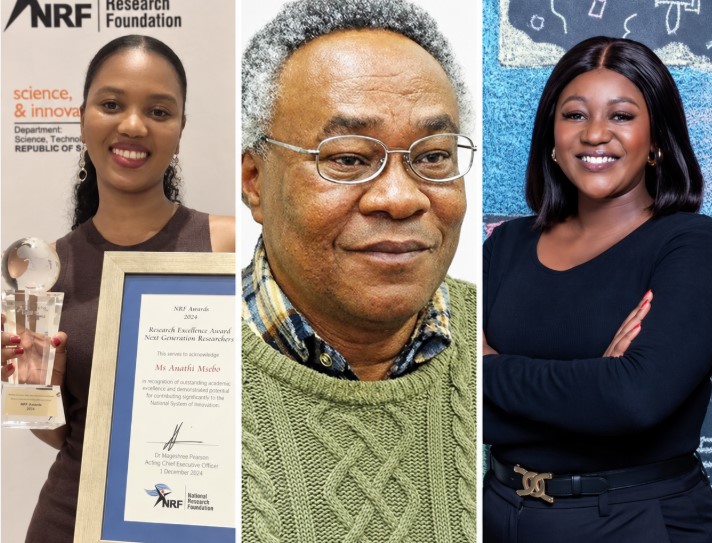
Among this year’s UJ recipients were Maina and PhD researcher Anathi Msobo from the Faculty of Science, as well as Digital Media Design lecturer Nthabiseng Mabale, who is pursuing a PhD in Media Studies at the University of the Witwatersrand.
Maina, a researcher in UJ’s Department of Zoology, received his fourth NRF A-rating.
An A-rating is awarded to researchers recognised by their peers as leading international scholars in their fields, based on the quality and impact of their recent research. Each rating is valid for six years.
Maina’s work focuses on respiratory systems in animals and how they have evolved and adapted. He studies how different species exchange oxygen and carbon dioxide across aquatic and terrestrial environments.
His research uses technologies including three-dimensional computer reconstructions, micro-computed tomography scanning, microscopic cell imaging and detailed physical measurements.
More recently, he has been investigating the use of bird lungs and fish gills as bioindicators of environmental pollution. He is also studying ostrich eggshell structures and the development of the chorioallantoic membrane, which enables an embryo to exchange gases while developing inside the egg.
The work could help identify structural factors contributing to poor ostrich egg hatchability, with potential benefits for South Africa’s ostrich farming industry.
Mabale, a lecturer in UJ’s Department of Multimedia, received a Research Excellence Award for Next Generation Researchers.
She is pursuing a PhD in Media Studies at Wits University titled Fortification of Self-Reliance and Independence of Black South African Women in Informal Businesses.
Her research examines how digital tools can support women traders operating in Johannesburg’s Kwa Mai-Mai community.
She works with the traders as co-creators of knowledge, documenting their experiences, business practices and challenges while exploring ways digital technologies can strengthen economic self-reliance.
The research is funded through the NRF-FirstRand Empowerment Foundation Black Academics Advancement Programme, which supports Black academics pursuing doctoral qualifications.
Msobo, a PhD researcher in UJ’s Department of Biochemistry, also received a Research Excellence Award for Next Generation Researchers.
Her NRF-funded work investigates antiviral compounds in South African medicinal plants, including natural compounds with the potential to inhibit the SARS-CoV-2 main protease, a protein the virus relies on to replicate.
She combines artificial intelligence, computational science, advanced chemistry and laboratory testing to accelerate the identification of potentially useful compounds.
The approach could contribute to antiviral drug discovery and pandemic preparedness while building expertise in biotechnology, metabolomics and computational drug discovery.
Delivering the keynote address at the ceremony, Minister of Science, Technology and Innovation Professor Blade Nzimande raised concerns about the concentration of research funding and infrastructure at historically stronger institutions.
According to Nzimande, about 63% of NRF funding goes to the 10 universities with the highest research outputs, while 83% of South African Research Chairs Initiative Chairs are hosted at top-output universities.
He said efforts were being made to broaden participation at historically disadvantaged institutions, universities of technology and newer universities.
Earlier this year, 41 new SARChI Chairs were awarded specifically to these institutions. The NRF has also begun implementing its University Programmes and Collaborations initiative to strengthen research and human-capital capacity at historically disadvantaged institutions.
“The issue is crucial not for posterity, but for practical reasons: to ensure our country, with its scarce resource base, makes full use of its institutional resources to reach deeper and wider into every corner of South Africa and unleash its full potential,” Nzimande said.
The 2026 NRF Awards also included Lifetime Achievement Awards for Professor Jonathan Jansen of Stellenbosch University’s Department of Education and Professor Helen Rees of the University of the Witwatersrand’s Department of Obstetrics and Gynaecology.
UJ Vice-Chancellor and Principal Professor Letlhokwa George Mpedi said the awards reflected the university’s growing research profile.
“The NRF Awards represent a wonderful and prestigious recognition for any scholar; it is something to treasure. UJ has over the years shown a stronger performance in these prestigious awards, and this year is not different,” Mpedi said.
UJ Deputy Vice-Chancellor: Research and Innovation Professor Refilwe Phaswana-Mafuya said the recipients reflected the work being done by established and emerging scholars at the university.
“The awards show the quality of the research, not only for its own sake but for societal impact and sustainability. As a university, we are immensely proud of the achievements and of the work of our scholars, and we hope the awards will inspire more students,” she said.
INSIDE EDUCATION