
By Charmaine Ndlela
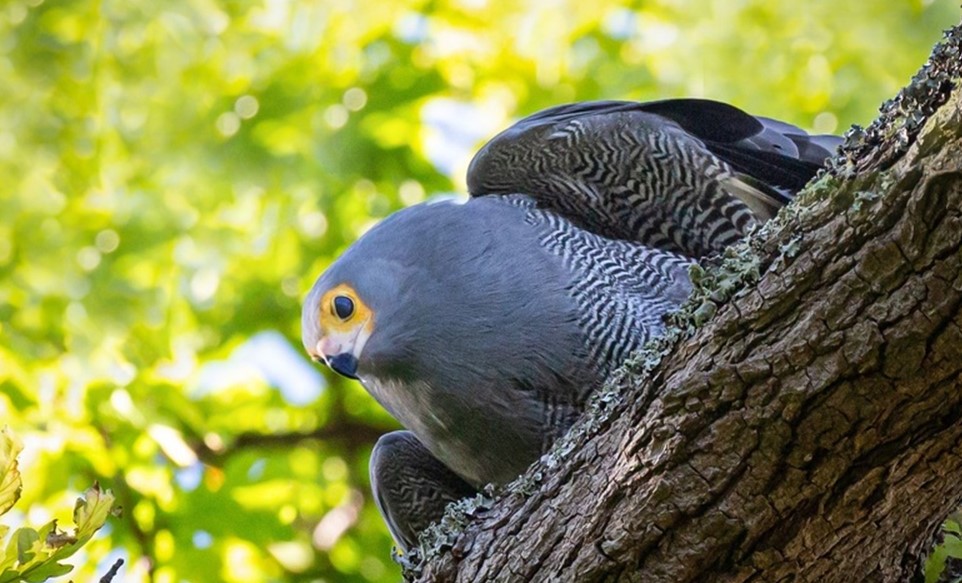
University of Cape Town (UCT) researchers have confirmed 13 African harrier-hawk nests across Cape Town after receiving more than 1 000 public sightings, revealing how the bird of prey is adapting to urban life.
The discoveries follow a public appeal launched in September as scientists investigate how the species, which was not known to breed in metropolitan Cape Town until the early 2000s, has established itself in the city.
The nests have been identified across an area stretching from Simon’s Town to Durbanville, including leafy suburbs, densely built-up neighbourhoods and the city centre.
The project, led by master’s student Lorcan McHarry in collaboration with UCT’s FitzPatrick Institute of African Ornithology, is trying to establish how many breeding pairs live in Cape Town and what conditions allow them to reproduce successfully.
“Historically, the species was fairly common across southern Africa but was not breeding in metropolitan Cape Town,” McHarry said.
He said that the 13 confirmed nests represented only a minimum count, rather than an estimate of the city’s total breeding population, as researchers believe more nests remain undiscovered.
The African harrier-hawk, also known as the Gymnogene, has unusual physical adaptations that allow it to reach food sources inaccessible to many other birds of prey.
Its narrow skull enables it to reach into small spaces, while its legs can bend in both directions at the intertarsal joint, allowing it to remove eggs and chicks from nest holes.
The bird can also manoeuvre slowly through dense tree canopies and cling to tree trunks and buildings while hunting.
“In a city, those skills open up a huge number of food sources that are typically out of reach for most other birds of prey,” McHarry said.
These include nests in roof cavities, gutters, underneath solar panels and in palm and ornamental trees.
The birds appear to feed on chicks of common urban species such as weavers, pigeons and starlings, as well as rats, lizards and insects.
Researchers will examine prey brought to nests to establish whether their diets differ between leafy suburbs and densely built-up neighbourhoods.
“The African harrier-hawk seems to treat the built environment itself as hunting ground,” McHarry said.
The first phase of the research will examine nesting sites, breeding times, clutch sizes, hatching success and the number of chicks that successfully leave their nests.
A central question is whether the birds have adapted their breeding season to Cape Town’s winter-rainfall, Mediterranean climate.
Most published research on the species comes from African regions with summer rainfall.
Longer-term plans include using GPS tracking to study the birds’ movements, territories and breeding success across different levels of urbanisation.
The research forms part of an effort to understand how birds of prey are adapting to cities. Black sparrowhawks are now established in Cape Town, crowned eagles breed in Durban’s suburbs, and peregrine falcons increasingly use buildings as alternatives to natural cliffs.
Although the African harrier-hawk is classified as Least Concern globally, UCT says its population is suspected of declining in parts of its range. Research has also documented substantial declines among several African raptor species outside protected areas.
“Habitat loss is a major driver,” McHarry said.
“If some cities can support healthy breeding populations, understanding why could become an important part of how we look after this species, and other wildlife, as Africa becomes more urbanised.”
Public participation has become an important part of the research because many nests are located high in dense trees or on private properties, making them difficult for scientists to identify independently.
“Residents see these birds every day,” McHarry said.
“The public is effectively an extension of the research team, and their response has had a significant impact.”
Researchers are encouraging residents to report sightings of birds carrying sticks or food, repeatedly returning to the same tree, or pairs regularly seen together.
Photographs and videos of large stick nests high in trees, particularly gum trees, could also help identify breeding sites.
Sightings can be submitted through the project’s website, urbanharrierhawk.org, preferably with photographs or videos and location details.
However, residents have been warned not to disturb nesting birds, climb trees, fly drones near nests or use recordings to attract them.
“Exact nest locations should be reported to the project rather than shared publicly. Residents planning to prune or fell trees should check for active nests first and, where possible, wait until the breeding season has ended,” McHarry said.
INSIDE EDUCATION