
By Thapelo Molefe
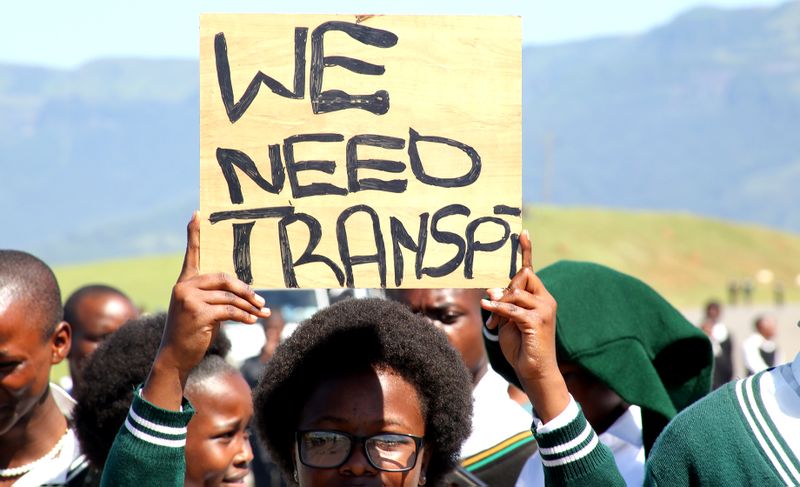
More than 40,000 qualifying learners in the Eastern Cape remain without scholar transport despite a court ruling declaring the provincial government’s failure to provide the service unconstitutional, prompting the South African Human Rights Commission (SAHRC) to return to court.
The commission, together with affected parents and caregivers, has launched an urgent application in the Makhanda High Court seeking an order compelling the relevant provincial departments and financial authorities to address the continued failure to provide transport.
The matter is scheduled to be heard on 12 November.
In December 2024, the High Court declared the province’s failure to provide scholar transport to qualifying learners unconstitutional. However, thousands of learners continue to struggle to access education, with some unable to attend school and others forced to walk long distances in unsafe conditions.
Speaking to Inside Education, SAHRC Eastern Cape provincial manager Dr Eileen Carter said the commission remained concerned that significant numbers of qualifying learners were still without transport despite the court ruling.
According to Carter, the Eastern Cape Department of Transport confirmed in an affidavit filed in January that 49,504 qualifying learners remained without scholar transport at the end of 2025.
Carter said the commission’s court papers included evidence from affected families whose children were unable to attend school, while others were forced to walk considerable distances or rely on costly private transport.
She said the commission did not have a verified province-wide figure for learners who were entirely unable to attend school.
The SAHRC is seeking practical and enforceable relief requiring provincial departments and financial authorities to take coordinated steps within specified timeframes to secure funding and ensure that all qualifying learners receive scholar transport.
Carter said the application also sought measures to monitor compliance with the court order.
She reiterated that the right to basic education was immediately realisable and that administrative and financial challenges could not indefinitely deprive children of access to education.
“The Commission’s position is that administrative and budgetary constraints must be addressed in a manner consistent with the constitutional right to basic education,” Carter said.
Eastern Cape Department of Transport spokesperson Unathi Binqose acknowledged that more than 35,000 qualifying learners remained without scholar transport, although he said the department could not establish an exact figure because the number of qualifying learners was constantly changing.
He said the department did not dispute the SAHRC’s figure of more than 40,000 but maintained that its own reports put the number at approximately 35,000.
Binqose attributed the shortfall largely to growing demand for scholar transport, which he said was not matched by the funding allocated to provide the service.
The province currently provides scholar transport to approximately 115,000 learners, while about 35,000 qualifying learners are still waiting to receive the service, he said.
“One of the major challenges that have and continue to face scholar transport in the Eastern Cape is a huge demand for the service that is not quite matched by the allocation of funds to render that service,” Binqose said.
He said the demand for scholar transport also pointed to broader challenges within the education system, arguing that learners should ideally have access to schools within a safe and reasonable walking distance.
“So the fact that we have scholar transport as an intervention will also point to some challenges within the education system itself,” he said.
Binqose said the department was working with the provincial departments of education and treasury, as well as the Office of the Premier, to address challenges affecting the programme.
He said the latest court application also placed responsibility on the provincial treasury to make funding available, adding that the legal teams of the relevant departments were consulting to determine the next course of action.
The province has allocated R880 million towards scholar transport, which Binqose described as a substantial amount that nevertheless remained insufficient to meet demand.
“The fact that it’s not enough and or rather the fact that such a huge sum of money has been allocated, it speaks to the willingness of the department to go far to cater for scholar transport, but the fact that it’s not enough is a testament to the massive demand for scholar transport within the province of the Eastern Cape,” he said.
Binqose said the provincial government also needed to examine why so many learners could not access schools within a safe and reasonable walking distance.
“We have to look at every possible avenue, are there challenges in the schooling system? Why is it that so many learners are not within a safe walking distance to and from school? and why do we have such a huge demand for scholar transport,” he said.
He added that scholar transport had played a significant role in supporting the province’s improving matric pass rate and that the department remained committed to extending the service to every qualifying learner.
The SAHRC said the continued lack of transport was deepening the educational disadvantage experienced by affected learners, leaving them increasingly behind in their schooling.
INSIDE EDUCATION