
By Lebone Rodah Mosima
Basic Education Minister Siviwe Gwarube has called for stronger education cooperation between South Africa and China, focusing on skills development, technical and vocational education, Mathematics and Science, and language learning.
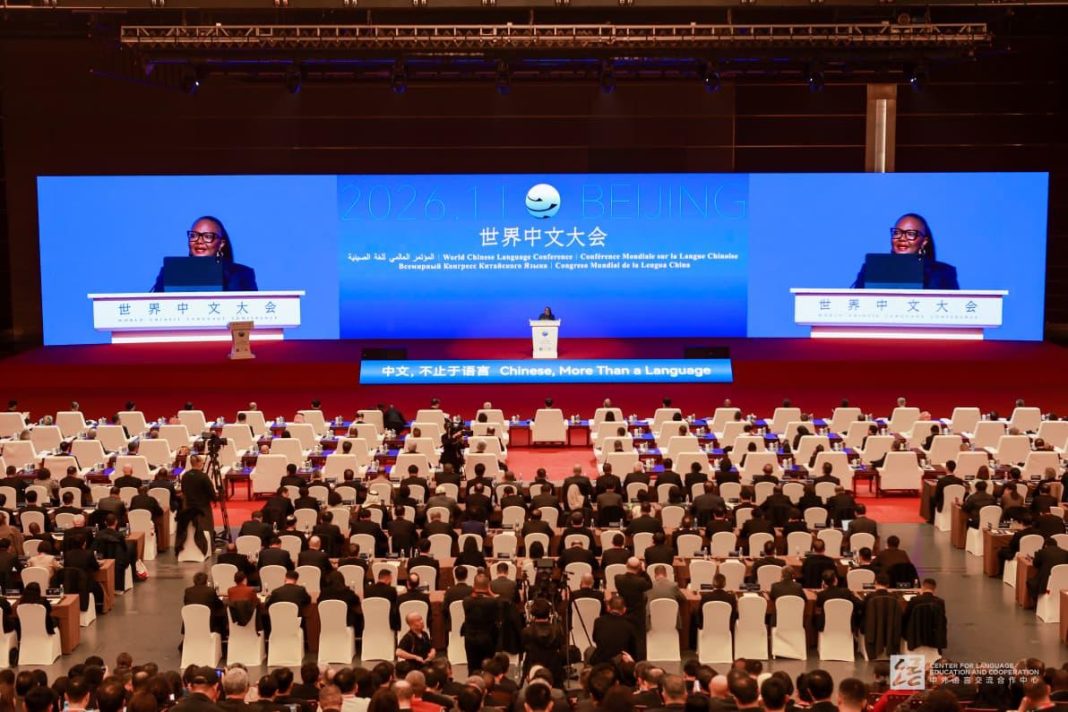
Speaking at the World Chinese Language Conference in Beijing on Friday, Gwarube said South Africa valued its longstanding relationship with China and the opportunities it had created for teachers, education officials and learners through knowledge-sharing, cultural exchanges and educational partnerships.
“China and Africa are partners whose economic and strategic importance will continue to grow,” Gwarube said.
“China has emerged as a global economic powerhouse, while Africa is poised to become the world’s fastest-growing economic region and home to its largest working-age population.”
She said the relationship between one of the world’s largest economies and a continent with enormous economic and demographic potential presented opportunities of historic significance.
Gwarube said China-Africa trade reached approximately US$348 billion in 2025, representing growth of 17.7% from the previous year.
“China’s industrial capacity, infrastructure development and technological expertise offer important opportunities for African countries seeking to industrialise, strengthen manufacturing and participate more meaningfully in global value chains,” she said.
However, she said the full potential of China-Africa relations could not be measured through trade and investment alone.
“Our partnership must also be built on education, culture, knowledge exchange and the development of human capabilities,” she said.
Gwarube said education offered enormous potential for a deeper and more strategic partnership between the two countries.
She pointed to China’s investment in education, science, technology and skills development, saying it had helped build the human capabilities underpinning its economic and industrial advancement.
“This offers important lessons for Africa,” she said.
“Our continent cannot realise its economic ambitions without deliberately investing in the skills required to support them.”
She said South Africa saw significant opportunities to strengthen cooperation in early childhood development, foundational learning, teacher development, and Mathematics and Science education.
“We are equally interested in learning from China’s experience in technical and vocational education and the pathways it creates between schooling, further study and employment,” she said.
School partnerships, teacher exchanges and institutional collaboration could translate these opportunities into meaningful improvements in classroom practice and educational outcomes.
Turning to language education, Gwarube said language carried histories, preserved cultures, communicated values and enabled the exchange of ideas. It also had an important economic dimension.
“As our economies become increasingly interconnected, multilingualism creates opportunities for international trade, diplomacy, tourism, innovation and investment,” she said.
She said language education needed to respond to the demands of an evolving global economy, raising questions about how learners could be equipped with language skills that opened doors to international opportunities.
She also raised the role of digital platforms and artificial intelligence in making language acquisition more accessible, as well as the need to strengthen teachers’ ability to deliver effective language instruction.
“These are practical questions that should inform our cooperation,” she said.
Gwarube said South Africa recognised the importance of promoting Chinese language learning as part of a broader commitment to multilingualism and international understanding.
She added that South Africa welcomed opportunities to share its linguistic and cultural diversity with Chinese learners and institutions.
“Such exchanges should produce tangible outcomes: stronger institutional partnerships, expanded student and teacher exchanges, improved language teaching capacity and greater opportunities for young people,” she said.
Addressing Africa’s youthful population, Gwarube warned that a large young population did not automatically translate into prosperity.
“The demographic dividend is realised when young people are healthy, educated, skilled and economically productive,” she said.
She said governments had a responsibility to ensure that the demographic transition became a dividend rather than a burden.
“The future of China-Africa relations must be built on the understanding that the prosperity of one partner can contribute to the prosperity of the other,” she said.
“Our shared future begins with investing in people. It begins in our classrooms, universities, technical colleges and research institutions. It begins with the languages we teach, the knowledge we share and the opportunities we create for the next generation,” she said.
Gwarube said the World Chinese Language Conference should strengthen efforts to place education and language at the centre of the next chapter of China-Africa cooperation.
INSIDE EDUCATION