
By Charmaine Ndlela
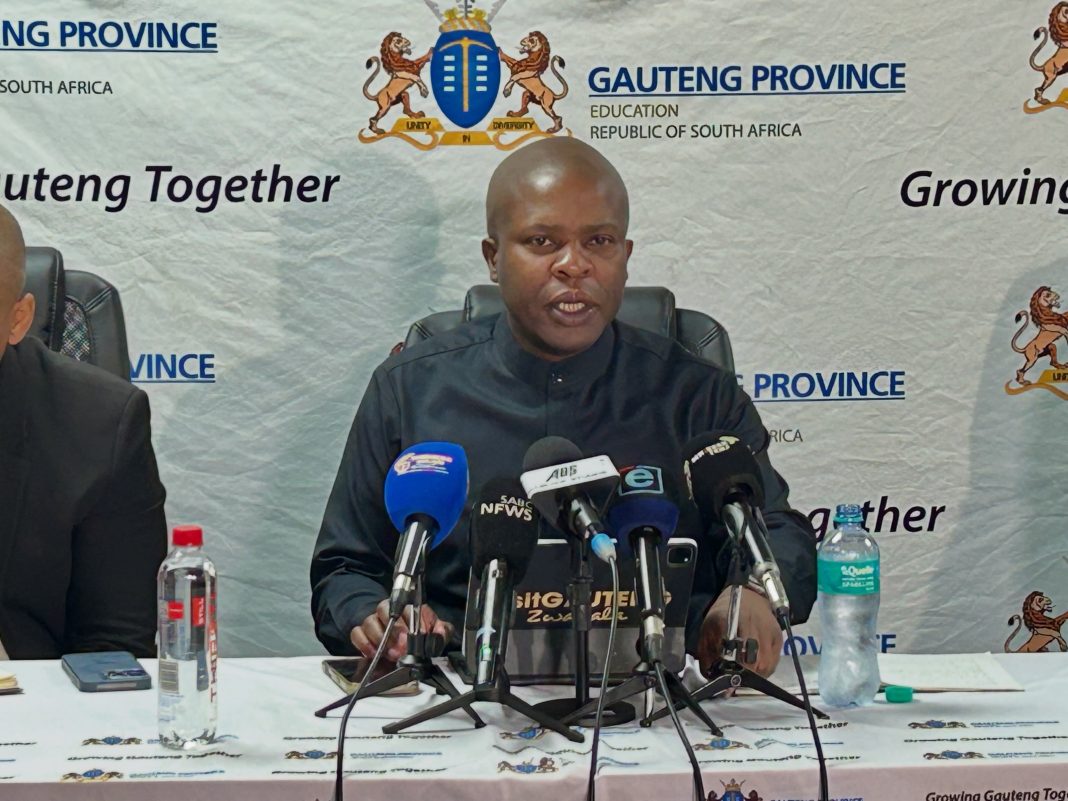
Gauteng Education MEC Lebogang Maile has vowed that no learner will be left without a school placement for the 2027 academic year, as 77,414 Grade 1 and Grade 8 applicants remain unplaced in the province.
Maile gave the assurance during a media briefing on Sunday, where he outlined progress on learner admissions, scholar transport, school funding and preparations for the reopening of schools in January.
The Gauteng Department of Education received 346,495 applications for Grade 1 and Grade 8 placements for 2027, with 267,742 learners placed as of 11 November.
Of those placed, 137,471 are Grade 1 learners and 130,271 are Grade 8 learners, representing an overall placement rate of 77.27%.
However, 31,277 Grade 1 applicants and 46,187 Grade 8 applicants are still awaiting placement, with the department acknowledging that demand continues to exceed capacity at some of the province’s most sought-after schools.
“We want to complete placement as soon as possible, but we are not going to rest until the last learner is placed. So what we must say is that all learners will be placed. That must be clear,” Maile said.
He cautioned that not all learners would necessarily secure admission at their parents’ preferred schools because of limited space.
“Unfortunately, not all learners will be placed where their parents prefer. That’s the set reality. And that’s because of the practical issues about availability of spaces in schools,” he said.
The department has identified 139,024 available spaces across the provincial schooling system, but Maile explained that these were not necessarily located in areas experiencing the highest demand.
A total of 278 schools, comprising 174 primary schools and 104 secondary schools, have reached capacity.
The districts experiencing significant placement pressure include Ekurhuleni South, Ekurhuleni North, Tshwane South, Johannesburg East and Tshwane West.
Maile said Gauteng’s growing population and continued migration were placing additional pressure on the education system, requiring improved planning to ensure infrastructure kept pace with demand.
The province’s population is growing at an annual rate of 1.6%, compared with the national average of 1.2%.
The department said it was working to secure placements without compromising the quality of teaching and learning through overcrowded classrooms and inadequate resources.
Maile also appealed to parents who had received placement offers to respond within the stipulated period, warning that outstanding responses were affecting the department’s ability to allocate spaces to other learners.
As of 11 November, 10,983 offers had not received responses, while 1,339 had been provisionally accepted but not finalised.
This brought the total number of offers awaiting final confirmation to 12,322.
The MEC explained that spaces could remain temporarily unavailable to other applicants until parents accepted or declined their offers.
Parents generally have seven days to respond to placement offers, while those dissatisfied with their allocations may lodge objections or appeals through the department’s established processes.
The department began issuing transfer offers on 13 November to learners whose preferred schools had reached capacity, giving parents seven days to accept or decline alternative placements.
Maile urged parents who had not completed their applications to use the additional window, which will run from 23 November to 4 December.
The late application period is scheduled to run from 17 December 2026 to 31 January 2027.
He said the department wanted to establish how many learners would be entering the schooling system before January to ensure sufficient educators, desks and learning materials were available.
On school safety, Maile said the department had invested R165 million in school patrollers to protect learners and create safer learning environments.
He emphasised that the safety of citizens remained the responsibility of the South African Police Service, but said the department also had a duty to protect learners within schools.
“The safety of all citizens is the responsibility of the South African Police Service, not the Department of Education. However, we care for our learners and that’s why we spent R165 million having patrollers in schools,” he said.
Maile said the department had developed a school safety plan that would be implemented across all schools.
He called on parents and communities to work with schools to address incidents affecting learners, adding that schools needed sufficient professionals to whom children could report problems and seek support.
“We will definitely work hard to ensure that every learner is able to express themselves and we create a conducive environment in those schools,” he said.
He stressed the importance of engaging parents, educators and learners to ensure that children did not feel isolated when reporting sensitive matters.
Maile also agreed that sign language interpretation should be provided during departmental media briefings, describing the request as fair.
The MEC raised concerns about schools insisting on cash payments from parents instead of accepting electronic funds transfers (EFTs) or card payments.
Responding to questions about the practice, Maile questioned why schools would refuse electronic payments, arguing that keeping cash on school premises created unnecessary security risks.
“Why would people have a problem with EFT unless they want to steal the money? The only explanation is that they want to steal that money,” he said.
He said the department did not encourage schools to keep cash and wanted to introduce a cashless payment system.
“We need to get to a point where we introduce this policy. We need a cashless system in our schools,” Maile said.
He also urged parents who could afford school fees to meet their financial obligations, saying non-payment placed additional pressure on schools.
Parents who could not afford fees were encouraged to apply formally for exemptions through their school governing bodies rather than withholding payment without communicating with schools.
On scholar transport, Maile confirmed that the recent impasse between the department and transport providers had been resolved, assuring parents that the department remained committed to maintaining the service.
The department currently provides scholar transport to approximately 256,186 learners across 757 schools in all 15 education districts.
The programme supports learners who face difficulties accessing schools because of distance and other circumstances, including those attending special schools.
Maile said the department was working with the Gauteng Provincial Treasury to review the programme’s financial sustainability, beneficiary information, eligibility requirements and payment arrangements.
The department is also considering integrating GPS technology into its Education Management Information System to improve the accuracy of learner location information and transport route planning.
It has identified the need for stronger monitoring of service providers, improved beneficiary verification and better supervision, including the availability of monitors and conductors on transport services.
Maile stressed that transport providers were expected to comply with their contractual obligations, particularly regarding punctuality.
He urged parents to report specific incidents of late transport or service failures so that the department could take appropriate action.
He also dismissed concerns that learners arriving late because of transport delays would be denied school meals.
“No learner will be denied food because they arrived late,” he said.
Meanwhile, Maile said the 2026 National Senior Certificate examinations were progressing well despite disruptions caused by the scholar transport strike that began on 2 November.
The province has registered 203,794 matric candidates, comprising 152,527 full-time candidates and 51,267 part-time and repeater candidates.
This represents an increase of 11,049 candidates compared with the 192,745 registered in 2025.
The department said no candidate had missed an examination paper because of the strike, crediting cooperation between departmental officials, school management teams, school governing bodies, parents and community members.
Attendance for Physical Sciences and Technical Sciences Paper 2 stood at 98.7%, matching the rate recorded for Paper 1.
Religion Studies recorded attendance of just below 98%.
The province has 1,065 registered and audited examination centres, with 1,700 monitors deployed to oversee the examinations and protect their integrity.
Candidates are also receiving additional academic support through the Just-in-Time Programme, which provides daily revision opportunities ahead of scheduled examination papers.
With the final paper scheduled for 26 November, Maile urged parents and communities to continue supporting matric learners and avoid activities that could interfere with their preparations.
The briefing also addressed concerns about the phased payment of the second tranche of the National Norms and Standards for School Funding (NNSSF).
The department previously announced that the second tranche would be paid progressively between November 2026 and March 2027, following the settlement of the first tranche by 31 October.
The phased arrangement has raised concerns among schools that rely on government allocations to cover essential operational expenses, particularly no-fee schools and those serving disadvantaged communities.
Maile said the department was working with the Gauteng Provincial Treasury to improve the predictability of payments and ensure that essential education obligations were prioritised.
He said a further briefing would be held early next year to provide a comprehensive account of school funding and readiness for the 2027 academic year.
The assessment would include whether schools had sufficient educators, desks, textbooks, laptops and other essential learning materials.
Maile said the department was working around the clock to ensure schools were ready to receive learners when the new academic year began.
He also urged parents to return borrowed textbooks to schools as part of preparations for reopening.
“People should be bringing textbooks back to school, those that we have borrowed,” Maile said.
INSIDE EDUCATION