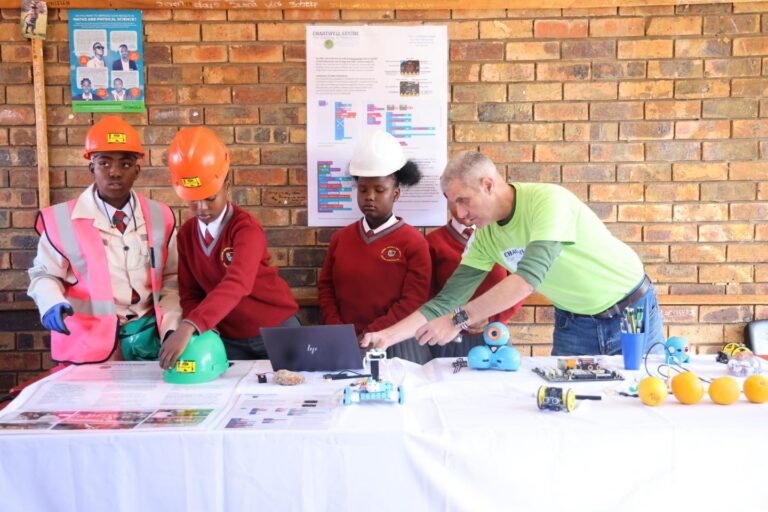
GAUTENG Department of Education (GDE) has launched the Mandisa Shiceka Maths, Science, and ICT School of Specialisation with a focus on mining in Kagiso, Mogale City on the West Rand.
The GDE hopes that the new School of Specialisation in Krugersdorp, will pave the way forward for future scientists, entrepreneurs, and mathematicians.
Schools of Specialisation (SoS) seek to advance learners’ skills through a modernised, immersive and dynamic curriculum. Each SoS achieves this by specialising in one of the following fields: Engineering; Maths, Science, and ICT; Commerce and Entrepreneurship; Performing and Creative Arts; and Sports.
In line with the development of Gauteng’s economic corridors, the location and curriculum emphasis present at each SoS is influenced by the specialty of each corridor. Gauteng West has been identified as an area most suitable to establish a school specialising in mining.
The school is named after Mandisa Shiceka who was a well-known anti-apartheid activist in Kagiso and was also a member of the Gauteng Provincial Legislature from 1995 until 1999.
Gauteng Education MEC Matome Chiloane says the launch of schools of specialisations seeks to change the path of the system.
“When we say there is a focus on mining, we are not saying we will move away from the standard syllabus but we will enhance it. In every grade, all learners are going to acquire vocational skills,” said Chiloane.
“As a department, we want to create a model citizen in the community. Young people who are able to ask critical questions that are challenging the mining sector.”
MINISTER of Sport, Arts and Culture Zizi Kodwa is determined to ensure that school sports remain the bedrock for development, cascading into a solid pipeline for the future for national teams in various sporting codes building on work which began a decade ago.
The Department of Sport, Arts and Culture (DSAC) and the Department of Basic Education (DBE) have partnered in spearheading the National School Sports Championships since its inception in 2012.
Soon after his appointment, Kodwa made clear his intention to ensure that the country returns to basics in unearthing the missing gems in the sports, arts and culture sectors. School sport is pivotal to his vision, with Kodwa telling the media that he wants to “catch them young” and lay a stronger foundation for the future.
As such, the National School Sport Championships (NSSC), the foundation of sport development, is the premier event in the South African school sports calendar.
Kodwa and Basic Education Minister Angie Motshekga have agreed on a partnership agreement endorsing schools’ sports as the incubators for sports development and talent identification.
“The primary aim of the school sports programme is to ensure that every one of South Africa’s schools, primary and high schools, are allowed to participate in at least one sporting code,” he said.
According to Kodwa, the National School Sport Championships remains the natural stimulant of the rollout of the school sports league programme, where children are provided with access to participate in an organised sports programme as endorsed at the 2011 Sports Indaba.
School sports operational structures were established in March 2012 at the National and Provincial levels to coordinate and roll out the schools’ sports program. The programme further seeks to address all the barriers of entry currently inhibiting broad-based participation in school sports by providing the necessary support material, personnel, and competition opportunities.
Kodwa believes that children must be given the tools to learn and play within a conducive environment. Although early in his tenure, Kodwa has been visible, visiting Kgamanyane High School in Moruleng, Rustenburg in the Northwest Province in March, as part of the buildup programme to the annual South African Sports Awards.
Accompanied by the Northwest Provincial Department of Arts, Culture, Sports, and Recreation, MEC Kenetswe Mosenogi, Kodwa, handed over the netball and football equipment and attire to local schools and clubs as part of the ministerial outreach programme.
Kodwa is committed to ensuring that the partnership between his Ministry and the DBE makes tracks of developing of sporting talents in public schools. The future Bafana Bafana or Banyana Banyana stars may not be too far – if Kodwa has his way and his vision is realised.
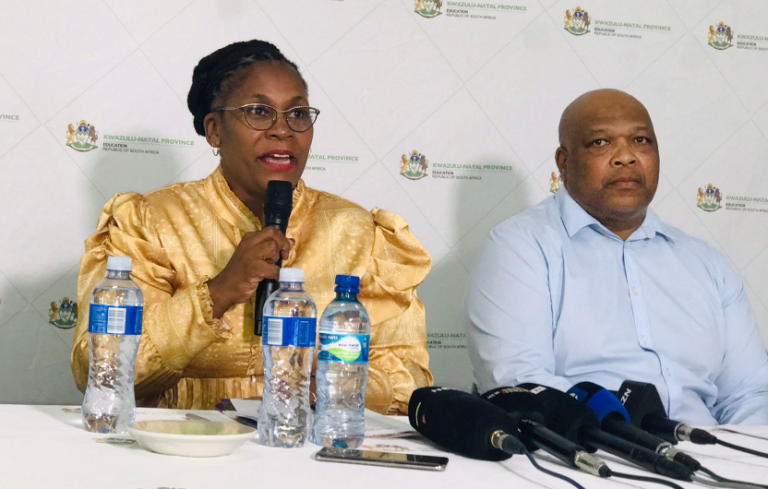
MEC for Education in KwaZulu-Natal, Mbali Frazer, says some schools in the province are facing closure due to low learner enrolment, which makes it difficult to achieve a high quality of teaching and learning.
This decision was based on a report by the department which identified 900 schools that did not meet the minimum requirements outlined in the minimum uniform norms and standards for public schools.
The report states that primary schools with enrolment of less than 135 learners and secondary schools with less than 200 learners do not meet the minimum standards.
However, in KwaZulu-Natal, the province has decided to focus on schools with less than 50 learners in primary schools and less than 100 learners in secondary schools as not meeting the minimum requirements.
The process excludes Special Schools, Schools of Specialisation and Technical Schools, according to the head of department, Nkosinathi Ngcobo.
“This points to the fact that the Department is not ‘trigger happy’ to ‘close’ schools as it has relaxed the minimum requirements of schools which can be deemed as viable,” said Ngcobo.
Mergers and closures of schools is a standard practice that occurs when schools are identified as non-viable and too costly to operate.
There are 3 000 schools nationwide that have been identified as non-viable.
He said the merger and closure of schools is part of the Transformation of the Schooling System programme (TSS) which has six pillars of change; eliminating inequality, creating schools as centres of excellence, streamlining schools into primary and secondary schools, renaming of schools, consolidating small, non-viable schools and Section 14 schools as well as optimal utilisation of human and material resources.
The enrolment drop in some schools is caused by the fact that some schools are built in privately owned land and some land owners are reluctant to sign the Permission to Occupy (PTO) and some chase learners away.
Faction fights and violence where schools are situated, poor school academic performance and parents deciding to move their children elsewhere, urbanisation in search of better economic opportunities, communities fighting educators and chasing them away and slow pace of infrastructure development in areas where schools are located, are amongst the factors causing the drop of enrolment in the identified schools.
Section 20 (1) of the South African Schools Act (SASA) states that the MEC can merge two or more schools into a single mega school if the enrolment of the school does not meet minimum requirements.
Section 33 of SASA also gives the MEC the authority to close small schools provided that the interests of learners to education and representation from interested and affected parties are considered, thorough consultation of stakeholders has been done, and that safety of learners and educators is prioritised.
Ngcobo said a notice of intent to close the said schools was issued and officials are currently meeting and engaging with the interested and affected parties from the schools affected by School Rationalisation and Re-alignment Process (SRRP).
Learners from the identified schools will be moved to the nearby schools and learner transport will be provided where needed.
Educators from these schools will be redeployed to the schools where their services will be gainfully utilized.
Frazer said: “No learner will be without a teacher during the school period, and no learner will be forced to stay at home because of the closure of non-viable schools.”
Once the school has been closed, the infrastructure is handed over to the Department of Public Works.
She said some of the schools will be used as schools of skills, focus schools and special schools.
Moreover, other departments may use the schools for community projects. The department said furniture and other assets will be distributed to other schools.
PARENTS of children being home-schooled in the Ekurhuleni Metropolitan Municipality have proposed a self-regulating mechanism independent of the Department of Basic Education to assist in monitoring learning within the home-schooling environment.
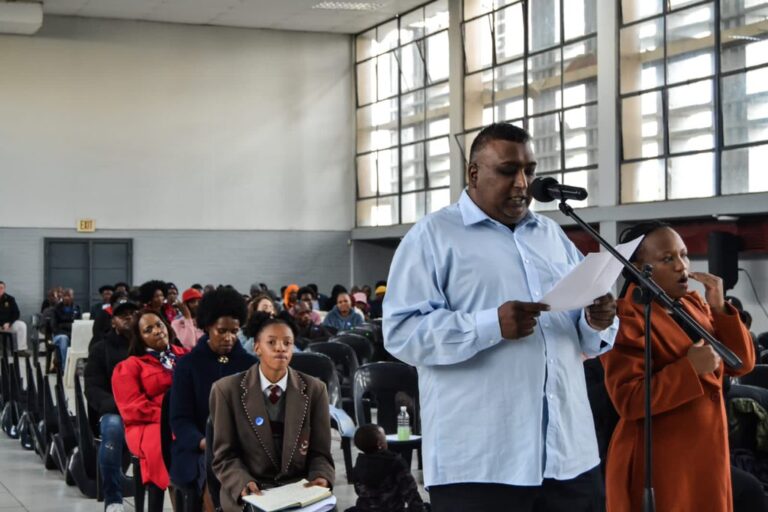
This was one of the suggestions made during the public participation meetings in Gauteng on the Basic Education Laws Amendment Bill.
The proposal was premised on the argument that a self-regulating mechanism, similar to the Health Professions Council of South Africa, would be better suited as it will include people who understand the environment and insulate the system against the use of National Curriculum and Assessment Policy Statement (CAPS) standards.
An argument was also made that structures exist within the home-schooling environment that supports families that have opted for homeschooling.
Another proposal suggested that instead of Clause 37 (b) (iv), which proposes assessment reporting, home-schooled learners could produce a work portfolio indicating their competence standard. This would be in line with international best practices, they further suggested. But parents and learners rejected clause 37 within the home-schooling environment.
Similarl to other public hearings held to date far, the sale of alcohol on school premises was rejected, even if it was for fund-raising purposes. Participants insisted that that selling alcohol sends the wrong message to learners, especially in a country currently struggling with substance abuse. Other avenues can be used to raise funds, they said.
Meanwhile, other participants in the public hearings highlighted that, despite general support of the objects of the Bill, they are against Clause 2(c), which criminalises any person who unlawfully and intentionally interrupts, disturbs or hinders school activity.
This person will be guilty of an offence and liable to a fine or imprisonment for a period not exceeding 12 months. The view was that due to substandard service delivery, communities are forced to take drastic measures to force action from the government.
Those who supported the Bill also called for an independent body to oversee school governing bodies (SGBs), especially on finance issues. This would assist SGBs that lacked financial experience.
There were opposing views with regard to the language and admission policy in Gauteng. Those that supported the Bill underscored that there is a lingering culture of exclusion in previous Model-C schools. These people believe that the Bill will address this problem.
However, those against it said that the Bill will marginalise mother-tongue education and take power away from School Governing Bodies (SGBs) to determine language and admission policy. They argued that SGBs remain the most relevant entity to determine language and admission policies because of their proximity to the school.
The committee welcomed the inputs made in Gauteng and assured participants that their views would be considered when the committee deliberated on the inputs made at the hearings.
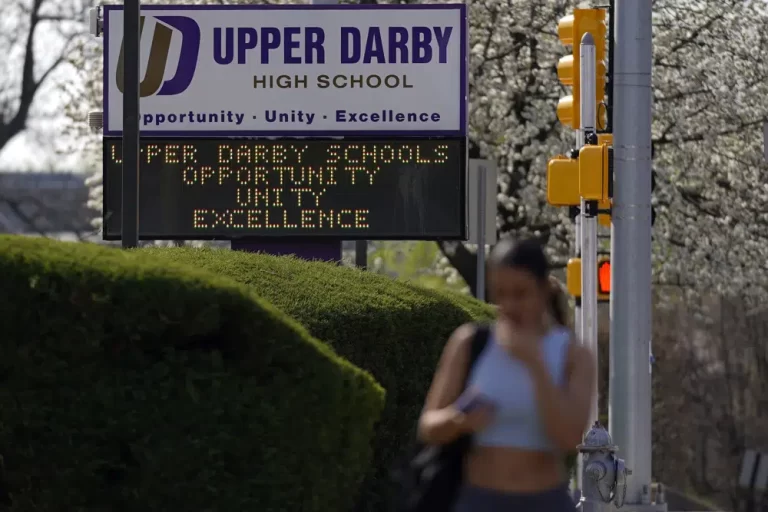
IN the hours before he’s due at Upper Darby High School, senior Khalid Doulat has time to say prayers, help his mother or prepare for track practice. It’s a welcome shift from last year for him and thousands of students at the school, which pushed its start time back by more than two hours — from a 7:30 a.m. start time to 9:45 a.m. One goal for the change: to ease strains on students that were more visible than ever coming out of the COVID-19 pandemic.
“I’ll be honest, I’ve been much happier in the mornings,” Doulat said. “I’ve been more positive, and I’ve come to school smiling more rather than, you know, grudging out of bed and stuff like that at 7:30.”
The idea of later school start times, pushed by many over the years as a way to help adolescents get more sleep, is getting a new look as a way to address the mental health crisis affecting teens across the U.S.
For some schools, the pandemic allowed experimentation to try new schedules. Upper Darby, for one, initially considered later start times in 2019. Ultimately, it found a way to do it this year by using distance learning as a component of the school day.
As students first came back to in-person learning, many dealt with mental health struggles and behavioral issues, Upper Darby Superintendent Daniel McGarry said. Officials saw a breakdown in students respecting the authority of teachers in the classroom.
“We had a lot of those things that we were facing and we’re still working our way through it; we’re in a much better place,” McGarry said. “I think our kids feel better. They’re not 100% better.” But, he said, much of the social anxiety students felt after being in online school has dissipated.
During the pandemic, soaring numbers of high school students expressed persistent feelings of sadness or hopelessness, with girls and LGBTQ+ youth reporting the highest levels of poor mental health and suicide attempts. It doesn’t help that research suggests middle and high school students aren’t getting enough sleep.
“These mental health challenges are already going to happen and then, with the absence of sleep, are much worse,” said Orfeu Buxton, director of the Sleep, Health & Society Collaboratory at Penn State University. “The same with decision making, suicidal ideation, those kinds of things.”
The reasons why high schools start as early as they do — many begin their day before 7:30 a.m. — are “lost to the sands of history,” Buxton said. But now, he said, ”everything is baked into that: traffic light patterns, bus schedules and adults’ work.”
Nationally, at least nine states are considering legislation related to school start times, up from four the previous year, according to the National Conference on State Legislatures. California in 2019 became the first and only state to dictate school start times.
Large school systems including Denver, Philadelphia and Anchorage, Alaska, have been looking into later start times.
It can require innovation to forge a new schedule.
At Upper Darby High, the school day technically still begins at 7:30 a.m., with students assigned coursework to be done remotely that ties into their lessons for the day. But they can use the early morning hours as they see fit — they can meet with teachers during office hours, sleep in or finish other homework. Ultimately, the work assigned for the early morning needs to be done, but when is up to students.
“I think getting more sleep is definitely helping,” Elise Olmstead, a junior. “I would be more irritable throughout the day, especially later, because I have a lot of after-school things. I would just have a harder time getting through the day.”
The school day still ends by 3 p.m.
Fatima Afrani, a freshman, said that when she gets home, she’ll usually relax, then help her mom or do homework.
“If I’m tired I go to sleep, which was not something I was able to do last year. Last year I just had to get my homework done because there wasn’t an option of being able to do it later,” she said. “And so I liked that if I was tired, I could listen to my body and just let myself sleep.”
Principal Matthew Alloway said educators have noticed fewer students sleeping in class. The new schedule also has allowed “kids to go to school for exactly what they need,” he said. About 400 of the school’s 4,250 students attend only through virtual learning — an option it offered to compete with online schools.
Critics have argued students have less instruction time in the new schedule. The original 80-minute periods have been shortened, but Alloway said that it’s not as if lectures always took up the full 80 minutes.
“It was sometimes a 60-minute concentrated instructional time. But then there was time to write. There was time to read. There was time to view a video,” he said.
Other challenges wrought by the pandemic — teacher shortages, for one — have also benefitted from the schedule change, administrators said. Teachers can take care of themselves and their families in the morning. Administrators have more time to replace staffers who call out sick.
Doulat, the Upper Darby senior, said that even if students can’t see the effects every day, there’s been a big positive impact.
“It’s such little changes in our daily lives that we don’t notice it,” he added. “But they slowly start building up, and we actually see the difference within our own lives.”
Brooke Schultz is a corps member for the Associated Press/Report for America Statehouse News Initiative. Report for America is a nonprofit national service program that places journalists in local newsrooms to report on undercovered issues.
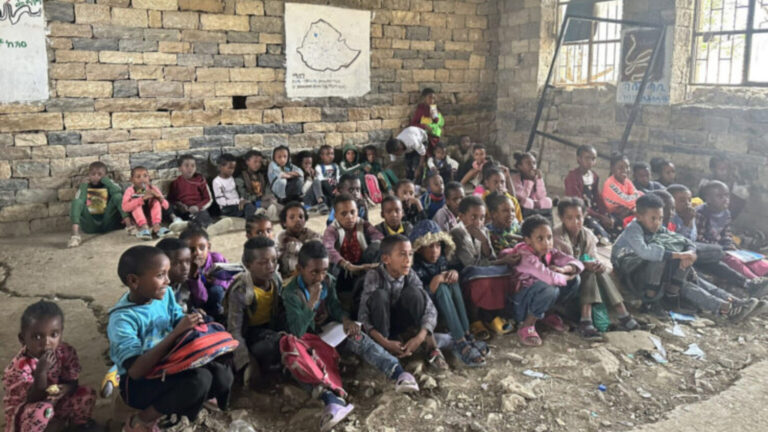
THE severe and worsening drought in Ethiopia’s Oromia region has impacted school retention as pupils are forced to drop out of school to support their parents in the search for food, pasture, and water.
More than 5,000 students from different zones of the region have been forced to drop out of school due to the devastating drought, the regional education office announced on 13 March.
The drought has affected schools in Bale, Arisi and West Hararge zones, resulting in the closure of 18 schools.
The Oromia Education Bureau has provided over USD 200 000 to help support damaged schools and bring the students who have dropped out back to school.
An additional USD 26 000 was paid in salaries. On top of that amount, USD 93 000 has been given to support the damaged schools, while about USD 37 000 has been used to purchase a water tank.
Despite these efforts, the situation remains dire for many affected by the drought, and this is not the first time the drought has caused students to drop out of school in Ethiopia.
Two weeks ago, the Education Office of the drought-hit Borana Zone of the Oromia region in southern Ethiopia said more than 7,800 students had been forced out of school as the impact of the drought got severe.
According to the office, 174,000 students enrolled in 490 schools in the zone have been affected by the drought, resulting in a significant decline in their results. This is despite the regional government’s efforts to introduce dormitory and school feeding services to mitigate the impact of the drought by allocating over USD 800 000.
Meanwhile, children were forced to drop out of school due to the drought in the Konso Zone of the southern region. Out of the 73,000 students attending 119 schools in the area, 13,000 have dropped out since last January, Deutsche Welle reports, citing the zone’s education department.
The Department of Education also indicated that the admission process had been started in 85 schools to allow the students to continue their studies with financial support from Save the Children. According to data, nearly three million people have entered the food aid framework due to the drought in the southern region.
Ethiopia’s drought continues to worsen following five consecutive failed rainy seasons and the looming “lean season” (the period between harvests), with the southern and eastern parts of the country mainly affected. According to the latest report from OCHA, 11 million people out of 24 million living in drought-affected areas are estimated to be food insecure, and about 6.85 million livestock deaths since late 2021.
As of February, 379 schools across 71 woredas in the Somali Region were closed due to the prolonged drought, with 81,556 students dropping out of school. In general, the recent drought has disrupted the education of 1.6 million children, including close to 500,000 forced out of learning, according to data from Education Cannot Wait (ECW).
AN incomplete classroom next to the principal’s office, meant to be a science laboratory, is a stark reminder of the challenges facing teachers and learners at the City of Life Christian School in Brits.
School principal and passionate educator Mam Ncalo says the small private school registered with the North West Department of Education, whose curriculum it follows, battles with having all the resources it needs to make teaching and learning seamlessly.
Formed seven years ago to provide education for children in the community, the school does not receive a government subsidy, meaning it relies on school fees for survival. Unlike the traditional private schools, City of Life subscribes to the government curriculum and seeks to offer education to children in and around Brits and nearby Letlhabile.
While private schools in the country belong to the Independent Schools Association of Southern Africa, the largest, oldest and most inclusive independent schools association, critics allege that while they have opened doors to Black pupils, the principals are primarily white, and so are the majority of staff. But their results ensure that their high fees with excellent resources usually give their learners a superb springboard for success.
The main difference between public and private schools is that private schools are run independently of the government and are in charge of their curriculum, ethos and funding, often thriving through contributions of parents, students, alumni and donors.
The City of Life Christian School is different from your typical private school. Set on the dusty ground opposite a busy filling station, the school operates in a church hall, with 168 pupils from grade R to matric, although it can accommodate up to 400 learners.
The school is staffed by 17 teachers. Four classes meet in the large church hall, while the remaining children are spread across four small classrooms on the church property. But when it comes to performing science experiments, funds ran out when building the laboratory, thwarting efforts to show children experiments about chemical reactions.
In 2022, 14 pupils wrote the matric exams. Half of the learners failed, while the remaining seven were allowed to rewrite papers during the supplementary examinations. One out of four candidates writing matric in 2021 passed, while in 2020, out of seven, only one passed. Last year 14 pupils sat the examinations, with just one pupil passing. Seven matriculants were allowed to write supplementary examinations.
“We worked hard throughout the year; it was disappointing when the results came out. I do feel that the parents did not play their part,” says Ncalo, who has been teaching for 34 years and is still passionate about her profession.
“If parents work with teachers, we can achieve more to ensure what is being taught in the classroom is reinforced by extra work and parental supervision at home,” she adds.
Ncalo says that with five matric pupils enrolled in 2023, the school has reorganised teaching staff and resolved to understand why they had not done well in the past three years and work towards ensuring learners and teachers are on the same page this year.
Asked what would help the school on the path to success, Ncalo, who drives daily from Pretoria to Brits, says more resources are needed. We want to appeal to businesses to support us by investing in education, finish the building so we can teach and conduct science experiments, for example,” she pleads.
Ncalo says she loves teaching and engaging with pupils, especially in the classroom. However, she has observed that teachers are less committed to their careers, with some leaving because they could earn more money elsewhere.
But she hopes that despite limited resources and with the support of businesses, the school can step up and do better with the five candidates in the matric class of 2023.
Regarding physical education, the school has a playground and children participate in volleyball, athletics and soccer. Infrastructure, learning facilities such as laboratories and libraries, playgrounds and teaching resources continue to differentiate between public and township schools, which shows disparities when results are announced.
But little seems to have changed in bringing about parity for learners, although all provinces had shown improvement in their overall Grade 12 final exam results.
“We worked hard throughout the year; it was disappointing when the results came out. I do feel that the parents did not play their part,” says Ncalo, who has been teaching for 34 years and is still passionate about her profession.
“If parents work with teachers, we can achieve more to ensure what is being taught in the classroom is reinforced by extra work and parental supervision at home,” adds Ncalo.
She says that with five matric pupils enrolled in 2023, the school reorganised teaching staff and resolved to understand why they had not done well in the past three years and work towards ensuring learners and teachers are on the same page this year.
Asked what would help the school on the path to success, Ncalo, who drives daily from Pretoria to Brits, says more resources are needed. We want to appeal to businesses to support us by investing in education, finish the building so we can teach and conduct science experiments, for example,” she pleads.
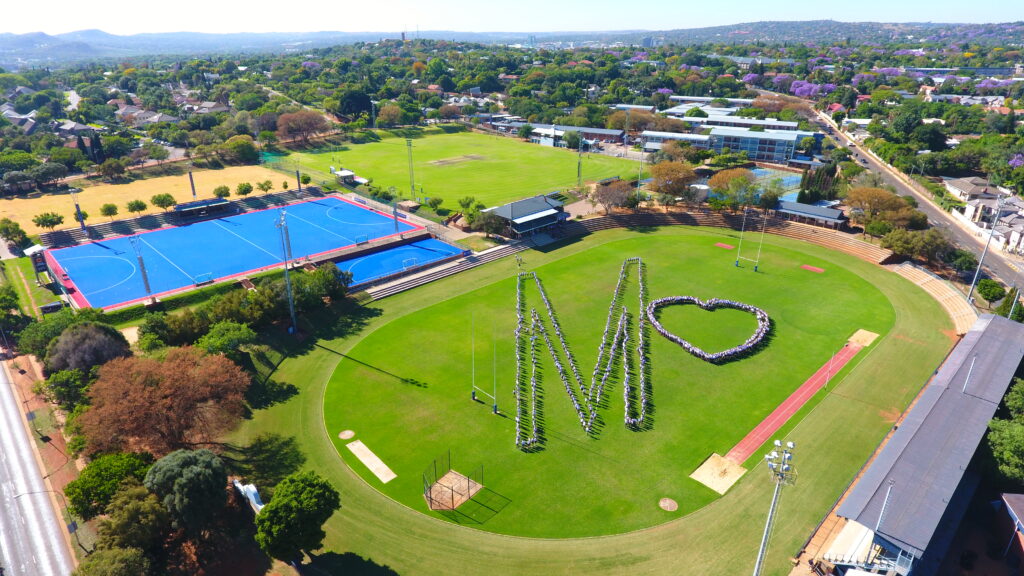
DCIM\100MEDIA\DJI_0630.JPG
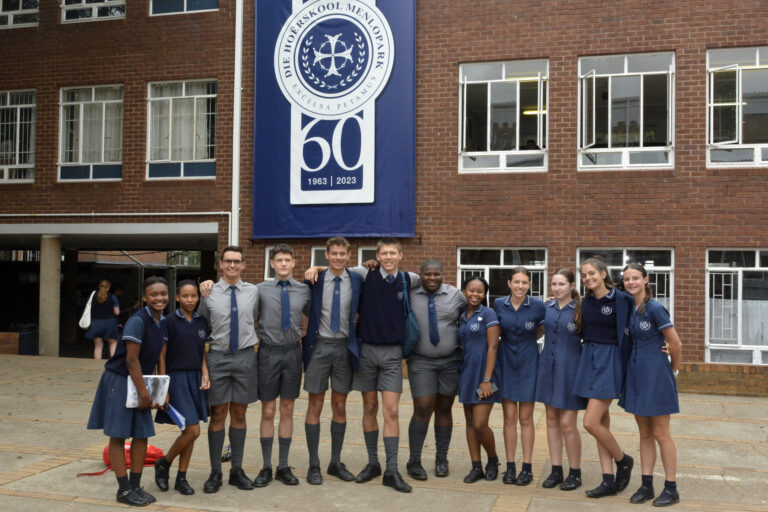
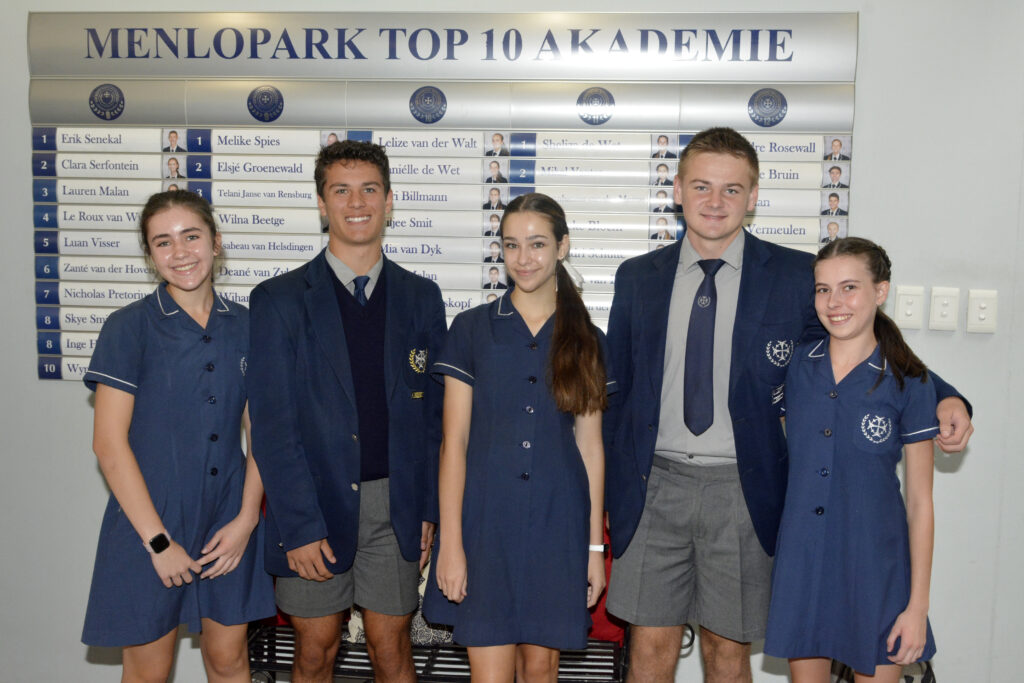
About 80 kilometres from the Brits school is the Hoërskool Menlopark in Pretoria, the top performing public school in Gauteng. Last year they had 330 pupils who wrote matric with a 97% pass rate. Only three learners failed to obtain a bachelor’s pass.
The school was founded in 1963 by renowned painter Bettie Cilliers-Barnard. Initially, it had 12 classrooms and 372 pupils. But they’ve grown substantially since and now have 1 650 pupils with an average class size of 22 and 25 learners.
The school is on an expansive property with luscious green fields comprising three rugby fields, hockey courts, athletics fields, five tennis courts, five netball courts, a sports stand over- looking at the ground and a gym. The school also has a golf academy.
They have well-equipped laboratories and multi-media library facilities, ensuring pupils have the best learning tools.
To cope with the growth in the number of learners, the school also built residences and is still considering the expansion of facilities as part of an ongoing pro- cess determined by budget and availability of resources.
“In everything we do, we in still in pupils the desire to have a strong work ethic to be the best when it comes to academic work,” says Nico Erasmus, the deputy principal in his 33rd year at the school.
Erasmus was a former pupil, completed matric in the seventies and joined the school in 1992. “Our values are based on integrity, respect, diligence and loyalty,” he adds.
“Our focus is to ensure that not only are they academically strong when they leave, but they are responsible adults,” Erasmus says. Most of their matric pupils pursue further studies at universities with a high success rate of students who complete their degrees.
Their former pupils include André de Ruyter, the former Eskom boss, who matriculated in 1985.
Founder of the Firstrand Group Laurie Dippenaar finished matric in 1966, actress Jana Cilliers was in the class the year before, while Springbok coach and player Rudolf Straeuli matriculated in 1981, soapy actress Amalia Uys in 2002, Olympics swimmer Gideon Louw in 2010, and three recent national cricket players Rassie van der Dussen (2007), Heinrich Klassen (2009) and Theunis de Bruyn (2010).
“If you want to be a successful school, there’s nothing we do that is extraordinary. We have and continue to maintain a strong culture, ensuring learner buy-in, and get strong parental support to assist in our planning,” notes Erasmus.
He says one of their proudest achievements was helping learners acclimate to online studies during the COVID-19 pandemic with no failure at the end of the year.
Erasmus says that as a state school, half of the contribution from the government is used on salaries. At the same time, parents contribute to the purchase of sporting facilities so they can ensure their children are given the best.
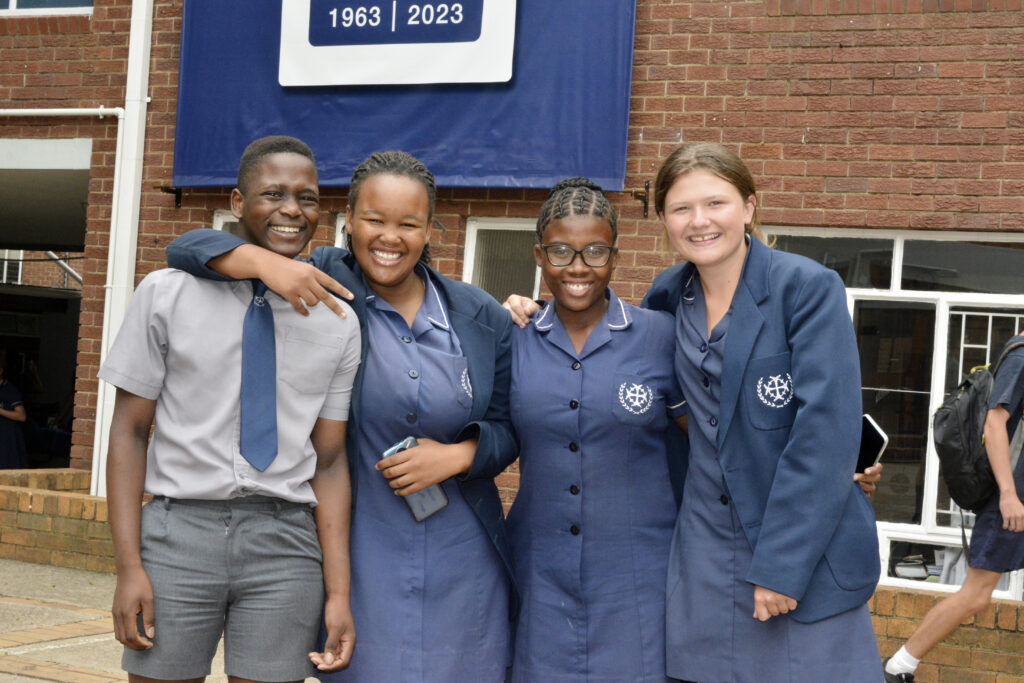
Happy Monday: Learners pose for Inside Education. PHOTO: Eddie Mtsweni
National Pass Rate
The 80.1% pass rate in the 2022 National Senior Certificate exam pass rate was the second highest in South Africa since 2019.
But for the country’s best and the worst performing schools, it remains a case of the “haves” continuing to stay ahead of the “have-nots” in almost three decades of democracy.
Inside Education visited four schools in Gauteng and the North-West to probe the conditions of the best and worst performing schools to provide a window into the disparities and how they affected their performance. Hoërskool Menlopark was the top performing public school in Gauteng, followed by Hoërskool Waterkloof, Hoërskool Garsfontein, Afrikaanse Hoër Meisies.
Gauteng’s worst-performing public schools were Simunye Secondary School, Sehopotso Secondary School, Dinoto Technical Secondary, Lefa-Ifa Secondary School and Dr BW Vilakazi Secondary School.
Gauteng Department of Education Spokesperson Steve Mabona says the department wants accountability for results, particularly in underperforming schools, with the purpose not to punish the management, teachers and learners but rather to provide the right combination of incentives, support and resources that will bring the changes to improve the quality of education in those schools.
Mabona says that the department will meet the public schools that performed below 65% to put into place interventions to prove the performance of these schools. improve
“We are accelerating interventions in underperforming schools to ensure the future success of all learners,” he adds.
According to Mabona, the Secondary Schools Improvement Programme (SSIP), a GDE supplementary tuition programme being implemented across the province, is a core programme focusing on poorly performing schools and schools that have experienced disruptions.
Overall, KwaZulu-Natal had the most significant improvement at 6.2% from last year, which puts them at an 83% pass rate in the matric examination in 2022. But 20 schools in Zululand, Uthukela, Umzinyathi, Umgungundlovu, Pinetown, Umlazi and King Cetshwayo districts achieved pass rates of 10% to 37,8%.
The Mgwempisi Combined School in the Umzinyathi district achieved a 10% pass rate, with only one of the ten pupils who wrote matric passing the exams. The Mthaniya Combined School in the Uthukela District recorded a 14.9% pass rate, and the Zithume High School in the King Cetshwayo District attained 18.2%. Mthaniya and Zithume have yet to achieve a pass rate of more than 40% in the past three years.
In March, all schools that achieved a pass rate of less than 40% in the 2022 matric results were ordered to account to the MEC for Education, Mbali Frazer and the head of the department Nkosinathi Ngcobo for their poor performance and outline plans to improve in 2023.
But while having top-class facilities and playgrounds are critical, Deputy head of Hoërskool Garsfontein, Maggie Holliday, says the staff at the school are incredibly hard-working and caring towards the children.
“They go the extra mile. We have many children who are academically weak, but for me, the biggest achievement is getting the average child to move up one symbol you don’t see in the papers”.
She adds that as a state school, it is sponsorship and support of businesses that have made it possible to upgrade facilities and sporting amenities without which they could not afford it.
The school governing body is integral as a partner with the school management in setting goals for learners and teachers. “Being in Pretoria East, we have many poorer pupils. When there’s no money, parents – be they plumbers or whatever – try and get all things done for the good of the school,” says Holliday.
Losing out to Hoërskool Menlopark was disappointing as the school finished Number 1 in 2021 as part of a hat- trick of top spots.
“When they say you’re number one or three, or whatever because there were only 12 points between the top three schools. But you are excited and say yes, you are number one, but does that matter? My challenge is to get those children, your average child, to improve not only the top, but we cannot only focus on those children,” adds Holliday.
Learners at Menlopark High School. PHOTO: Eddie Mtsweni
WHEN it comes to Technical and Vocational Education and Training (TVET), for Deputy Minister of Higher Education, Science and Innovation, Buti Manamela, no subject arouses as much enthusiasm as the prospect of TVET colleges transforming the workplace and attacking the swathes of unemployment for the country’s youth.
Manamela passionately describes the potential for shifting the dial for South African youth through these skills-based learning institutions geared towards contributing to the economy.
He reckons that graduates from TVET are more employable than university products.
If it is going to make a dent in the country’s unemployment figures, Manamela’s optimism must translate into positive results.
According to Statistics South Africa, (Stats SA), youth unemployment refers to the share of the labour force aged between 15-24 without work but available for and seeking employment.
This figure has gone up since 2017. Of the 7.2 million unemployed people in the first quarter of 2021, 52.4 percent had education levels below matric, followed by those with matric at 37.7 percent. This means there were 2.6 million matriculants in the unemployment queue, says Stats SA.
As a product of Mamelodi TVET College, Manamela knows what he’s talking about. His youthful face, not masked by the distinguished beard he now sports, lights up when TVET is discussed, particularly its impact on the future.
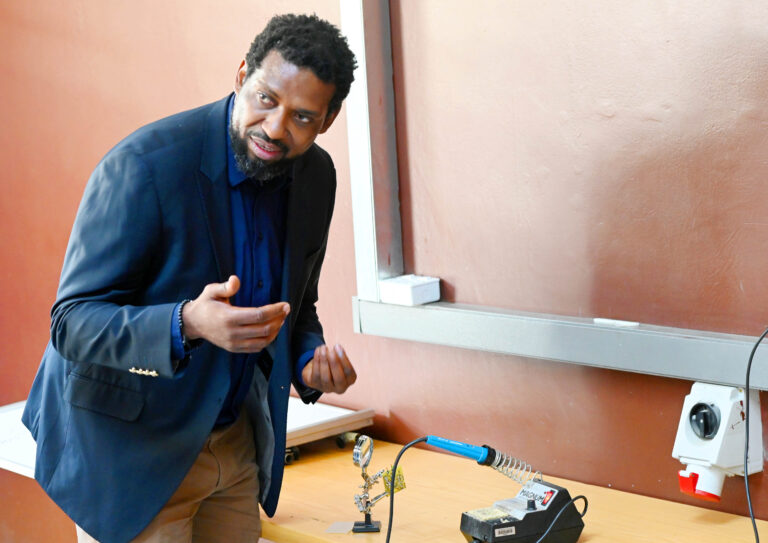
During a recent interview, Manamela rescheduled time in his busy diary to take Inside Education on a walkabout through the corridors of a TVET similar to one where he once walked. Manamela completed matric at Phagameng High School in Modimolle, then studied towards his N-Certificate in Electronics at Mamelodi College until 2001, completing his Post-Graduate Diploma (2014) and Master of Management in Public Policy at the University of the Witwatersrand (2017).
Taken through the TVET College in Pretoria East, Manamela was shown the broad extent of the offering to students. Here students can obtain qualifications in tourism, business studies, civil engineering, electronics, economics and accounting, information technology and computer science, among other options. Students can learn about industrial electronics, power machines, control systems, electro-technics and clothing industry career options.
TVET colleges throughout the country also offer coding, programming and robotics to broaden the skills for the 21 st century. The Tshwane North TVET Tshwane North Technical and Vocational Education and Training College (TNC) is situated in the Greater Tshwane Metropolis of Gauteng. It consists of a corporate (Central) Office in the inner city of Pretoria and 6 Campuses: Mamelodi; Pretoria; Rosslyn; Soshanguve North; Soshanguve South, and Temba.
The College has a closed hostel at Soshanguve South Campus which could accommodate 300 students. The College has about 327 lecturers with a student population of between 20 000 and 21 000. Students spend half their time during their studies obtaining practical experience.
Sophisticated machinery, donated by the Indian government, has pride of place and gives students specialised skills in learning how to operate them. A single CNC machine can cut, drill and mill replacing what one in the past used to perform manually.
Manamela was impressed by what he had seen during the hour-and-a-half walkabout, recalling his days when studying electronics.
“It’s important to focus on TVET colleges and our work there consistently. Of course, there’s some of the challenges that we’re confronted with, policies that we’ve put in place to improve the quality of TVET colleges,” he says.
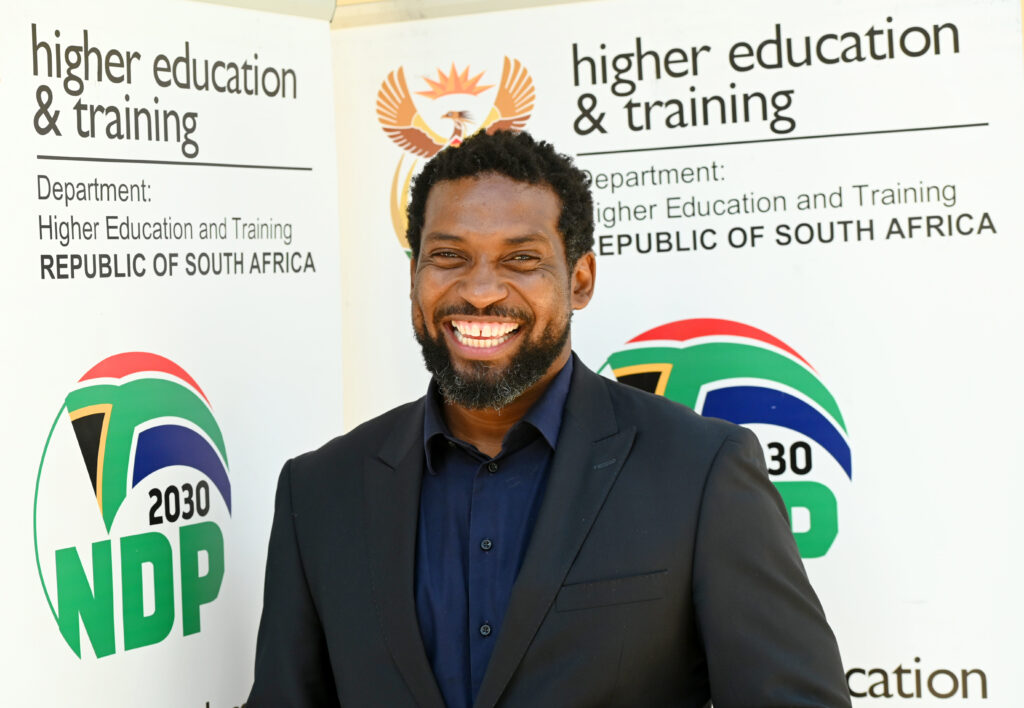
Buti Manamela, himself a product of TVET college education, Higher Education, Science, and
Innovation second-in-charge is passionate about equipping youth with skills to shape the
country.
PHOTOČ EDDIE MTSWENI
Manamela says apprenticeships have been reintroduced at TVET institutions.
“In the past, apprentices were mostly trained by Eskom, SAA, state-owned enterprises, and some of the private sector, but most of them shut down. So to re-introduce them, we’ve got about 80,000 students across the country who are spending some time in the workplace. They spend some time in the classroom, too, which is similar to the jewel in Germany.”
This initiative, says Manamela, has been received positively by the industry. “People in the industry who are involved are very excited about this kind of project. We’ve collaborated with, some like the car manufacturing company in India, we’ve collaborated with Chinese and German companies to help build infrastructure,” he adds.
Manamela says German car manufacturing companies have shown an interest, particularly in TVET colleges in Pretoria and invested in the training of artisans and apprentices.
However, the Deputy Minister notes that South Africa finds itself in an unfortunate situation where universities are deemed more privileged than other institutions.
“We’re trying to reverse that. If you look at countries such as Germany, Russia, and Brazil, even in the early days, some of the countries in the continent, Mozambique, did quite well, where they focused on giving young people a skill. So they could be a carpenter, a bricklayer, or an electrician.
“Most of those countries are focused on investing resources at TVET colleges, and their TVET sector is twice the number of students than those who go to universities. So we’re working on that. I mean, the TVET sector has significantly increased over the last year. But of course, a lot more money is required for it to happen.”
Manamela says it’s about changing the mentality. “People don’t regard it as sexy. It is precisely because the kinds of professions that are posed, particularly in mainstream media, are the sexy ones.
Someone wants a corner office, to wear a tie and all of that. But we try and consistently remind everyone that we still need cooks, plumbers, welders.”
Along with the work done by Sector Education Training Authorities (SETAs), Manamela says, there is a growing change in the perception of young minds. “We are now churning out 90 000 artisans a year. The NDP target is at 20000 per year by 2030. Before the COVID-19 pandemic, we had reached 22,000 artisans per year. “
“We need to remind parents, teachers and students themselves that if they believe that their child should go to an institution of training so that they go and immediately find work, TVET colleges are the solution. You get experiential training; you get 90% of students who go to TVET colleges, you know, NSFAS funded, you get exposed to industry-based standards facilities in the 26 centres of specialisation.
“TVET colleges are essential, and I believe that one must encourage parents, teachers and students themselves, those who are in grade nine and those who are doing their grade 12, to look at some of the programs being offered at TVET colleges.
“Some students who go to university, studying mechanical engineering, probably would not see an engineer in their life because that’s not how universities are designed in terms of the curriculum. So if you want to be a mechanical engineer who fixes cars, go to a TVET college, at best, go to a university of technology,” he adds.
Manamela insists all 50 TVET institutions are good colleges, offering a diverse range of programmes on 256 campuses, with many embarking on expansive infrastructure development.
“It’s about looking at the kind of program that you want to do and look at how that college has performed in terms of that particular program.”
He says the career opportunities from studying at a TVET are varied and can be enrichening, whether one wants to become a welder or work in the hotel or tourism industries. The former Mamelodi College student has come a long way since his student days. Now, he’s particularly keen for TVET colleges to start getting a good rap so that South Africans start to see how it can benefit the nation.
THE former president of Mauritius and the first woman to be elected to that position, Ameenah Gurib-Fakim, is a biodiversity scientist and recipient of both a L’Oréal UNESCO For Women in Science Award for Laureates and the African Union Commission Award for Women in Science.
Gurib-Fakim says it is thanks to her motivated teachers who made understanding science easier. As a result, she did well in the subject because of that demystification.
But when she wanted to study science at school, her career guidance teacher asked why she wanted to do science because that subject is for boys.
The former president, who was on the Forbes List for the 100 ‘Most Powerful Women in the World’ and first among the Top 100 Women in Africa Forbes List 2017, has been recognised as one of the foremost voices on the Continent.
Last month she participated in a South African seminar on human rights in Africa.
In a Q&A, Gurib-Fakim shares the story of her favourite teacher with Inside Education.
Q: What was her name? A: Sister Anne Q: Name of School attended and year/s? A: Loreto Convent School (between 1977 -1978), Quatre Bornes Q: How did your favourite teacher endear herself to you? A: She had a no-nonsense attitude to teaching and was highly disciplined…always insisting on punctuality. This has shaped my perspective in later life. Q: What subject/s did she teach you? A: Mathematics Q: Did you look forward to her subject? A: Yes, I did, and what I liked best (now, with hindsight) is how she trained us mentally. She would start her class with mental arithmetic, firing quick questions and expecting instant answers! Q: What did you like about your teacher? A: Her humanity! Q: What was your favourite subject at school? A: Chemistry Q: Has this influenced your choice of career? A: I have always been fascinated by chemistry, especially the chemistry of Carbon, which is understanding the chemistry of life itself. It eventually underpinned my career. Q: What was the one phrase from any teacher that stuck with you or inspired you? A: Never leave for tomorrow what you can do today. Q: Have you kept in touch with your favourite teacher? If so, what was the first meeting like beyond being a learner in the classroom? A: Unfortunately, she returned to Ireland, and I lost touch with her. But before she left, she would engage in one-to-one conversation and give advice. She was also always available when one wanted her advice. Q: Why are teachers so important to society? A: Teachers provide you with the necessary instructions, and they help complement the education we receive at home.
REACHING for the stars, the new CEO of Sci-Bono, Professor Mfanelo Pat Ntsobi, has great plans for Africa’s largest world-class science centre in Newton, Johannesburg. Ntsobi wants Sci-Bono to become the most visited and talked about science centre on the Continent, a learning hub that also becomes a research home.
Passionate about the sciences, Ntsobi wants Sci-Bono to build on its solid foundation by attracting learners beyond Gauteng, ensuring the institution’s sustainability, bringing on board more pro- grams and bolstering its service offerings by integrating ICTs.
He wants to expand on the plans for Sci- Bono, which supports maths, science and technology education and offers innovative and dynamic learning experiences.
As part of our vision and primary objective, Sci-Bono seeks to promote a society capable of competing in the global world of science and technology and equally equipped with the requisite skills, attitudes and values needed to improve the lives of all South Africans.
Ntsobi said Sci-Bono carried out this mandate in collaboration with schools as viable platforms and further supported learners and educators in Science, Technology, Engineering, Arts and Mathematics (STEAM), thus ensuring mastery of these subjects as well as harnessing the capability for global competitiveness.
This also means being creative and looking at other skills, for instance, introducing elementary civil engineering skills training in partnership with the Department of Education.
“We are champions in digital literacy, as well as pedagogical integration of ICTs in teaching and learning, not just to improve learning outcomes, education outcomes, as well as learner attainment, so it is it is incumbent upon us to ensure that we use all available resources to reach these objectives,” he told Inside Education in an interview.
“This is where I see Sci-Bono moving to in the next few years. I am lucky because I found a powerful organisation. My predecessors, David Kramer and Dr More Chakane, have laid a solid foundation. So for me, it’s about improving the institution’s sustainability, building on the work of my predecessors, both of whom I hold in high esteem,” Ntsobi added.
Seated in the boardroom adjoining his office, Ntsobi, who assumed the CEO role on 1 November 2022, said he was determined to ensure that Sci-Bono, continues to contribute to building South Africa’s science, engineering, and technology capacity.
When I joined, I got my cue and mandate from the board to strengthen specific areas in the science, technology, mathematics and engineering spaces,” he said.
The organisation, founded by the Gauteng Department of Education (GDE) and private sector representatives, has several core goals. These include building a competent society in the world of science; improving and strengthening financial viability and sustainability; improving organisational sustainability; enhancing operational efficiency and optimising agility of service delivery and building a solid research and development capacity.
As a policy analyst, management scientist and communication strategist, Ntsobi’s scholarship is characterised by his association with research organisations and his contribution to numerous publications, including book chapters, articles and presentations at conferences.
He is continually developing pedagogies for education and its integration with ICT and web-based strategies for optimum educational system functioning.
Ntsobi’s PhD, entitled “Pedagogical Integration of Technology as an enhancement to Teaching and Learning in Gauteng Public Schools”, is a manifestation of his interest in the use of digital applications and scientific approaches for the provision of pragmatic solutions.
This explains the passion he brings to his role at Sci-Bono.
But he is keen to ensure that the team he leads are given the tools they need as experts.
“These are professionals, scientists, the best educators assembled to broadcast these lessons, and we want these lessons to be shared with the rest of the schools, especially the quintile one to quintile three schools, but it’s not limited to Gauteng,” he adds.
“We should be able to provide this support to learners outside Gauteng. During COVID-19, learners from other provinces had access to our content platform, just like Gauteng. So we must get support not only from Gauteng but also from other provinces and national departments.”
“As champions in digital literacy, as well as ensuring pedagogical integration of ICTs in teaching and learning, not just to improve learning outcomes, but education outcomes as well as learner attainment, so it is incumbent upon us to ensure that we use all available resources to reach these objectives.
This is where I see Sci-Bono moving in the next few years,” said Ntsobi.
While the emphasis is on science, stimulating interest in the subject and, through the careers centre, encouraging learners to embark on careers in the matter, Ntsobi does not want Sci-Bono to sit on its laurels.
“We are also tapping into the manufacturing sector as there are learners across the value chain. We are negotiating with Sector Education Training Authorities (SETAs) and industry players to groom learners on furniture manufacture.
Another program we will be looking at is interior design, so many other skills fall within our scope,” he said.
Science is not just about being in a laboratory. It is the simple skill that one can use in various ways.
“We are even thinking about food security, using artificial intelligence to make meaningful agricultural interventions and contributing positively to food security.
“We want to prepare learners to start thinking about solutions for complex challenges facing society. Now energy is one of our key challenges. Water is another. If you walk around, we have some of these exhibits relating to energy and water. But we want them to be current. We want cutting-edge solutions, ideally coming from learners,” he said.
Sci-Bono hosts competitions to tap into the potential of learners, paying for transportation of those from outside the province – and the country – to ensure inclusivity.
Welcoming Prof Ntsobi to Sci-Bono, the chairperson of the board, Mr Witbooi, Ab- bey, acknowledged the impeccable role and contribution of former Chief Executive Officer Dr More Chakane.
“A special welcome to the newly appointed Chief Executive Officer, Prof Mfanelo P. Ntsobi. We are honoured to have you lead this institution; we welcome in advance the inestimable value, insights, and leadership fortitude you will be investing in the Company in the coming years.
“I look forward to us collectively continuing to break barriers in 2023 as well as attaining unprecedented heights of excellence and the apex of exponential growth.”
On a mission: Sci-Bono CEO Professor Mfanelo Ntsobi says the strategic goals for Sci-Bono are to make a tangible difference in society. Photo: Eddie Mtsweni.