Home Blog Page 211

South Africa and Germany strengthen ties in science, technology and innovation

EDWIN NAIDU

THE Minister of Higher Education, Science and Innovation, Dr Blade Nzimande, met with German Minister of Research and Education, Bettina Stark-Watzinger, during her recent two-day visit to South Africa.

The Ministers signed a declaration to establish a joint Research Chair on Just Energy Transition.

Ahead of the signing, which took place in Cape Town last week, the German Minister visited the Hydrogen Catalysis (HYSA catalysis) Centre of Competence at the University of Cape Town.

Both Ministers addressed the Research Networks for Health Innovation in Sub- Saharan Africa (RHISSA) conference, which took place at the Vineyard Hotel in Newlands Cape Town.

The German Minister’s visit is aimed at, among others, strengthening bilateral relations and celebrating the success of the German-funded Research Networks for Health Innovation in Sub-Saharan Africa (RHISSA) programme.

The RHISSA has seen an investment of 50 million Euros over five years.

The programme is in its second phase.

Minister Stark-Watzinger also visited the Square Kilometre Array site in the Northern Cape in anticipation of full German membership of SKAO.

INSIDE EDUCATION

Umalusi launches online system to replace lost or damaged certificates

EDWIN NAIDU

UMALUSI has launched a newly implemented Online Application System for Replacement Certificates.

Candidates can access the system from anywhere (home or office) via a cellphone or personal computer to apply directly to Umalusi to replace their lost or damaged certificates.

Umalusi Council sets and monitors standards for general and further education and training in South Africa.

The Council is tasked with developing and managing a sub-framework of qualifications for general and further education and training and for the attendant quality assurance.

The new system was launched during a webinar, “Innovatively replacing your lost or damaged certificate issued by Umalusi”, on 30 March.

The purpose was to reduce the turnaround time and costs of replacing a lost or damaged certificate.

At the cost of R137.00, a candidate can collect a replacement certificate from Umalusi within two workings days of the application. Alternatively, a candidate can pay R202.00 (R137.00 for the certificate and R65.00 for courier fees) to have the certificate sent within 7 working days to their chosen physical address anywhere within the borders of South Africa.

The webinar was attended by officials from education stakeholder organisations in South Africa, Botswana Examinations Council (BEC) and Kenya National Examinations Council (KNEC).

INSIDE EDUCATION

Using stories beyond word problems to teach Mathematics

CRYSTAL FROMMERT

STORYTELLING has its natural place in humanities subjects such as literature and history. Stories capture learners’ attention and help them connect facts (figures, dates, and events) more fluidly and meaningfully. Storytelling can also teach science concepts.

The University of Texas at Arlington published examples of storytelling that include a chemical change salt lab delivered through the Japanese tale of “The Stonecutter.”

But what about storytelling in math class? 

In the Edutopia article “Using Stories to Teach Math,” L.L. Barkat wrote about how literacy can teach young students mathematical concepts such as counting and number lines. In addition to math-themed picture books, concepts can come in the form of teacher anecdotes (real or not real). “Last night I ordered 3 pizzas. I had 10 friends over. What part of each pizza did each of the 11 people get?“ (One of my students answered with a cheeky joke, “You really have 10 friends?!”) 

Stories can relate to students’ interests, lives, and culture to make the concepts relevant and interesting. “New ballet shoes cost $37.25, and new tights cost $18.50” will speak directly to the ballerina in your class, more than “Add $37.25 and $18.50.” 

Even older students can benefit from storytelling in the math classroom. Consider the following examples of classroom-tested stories to teach middle and high school math concepts.  

6 Math Topics to Teach Using Stories

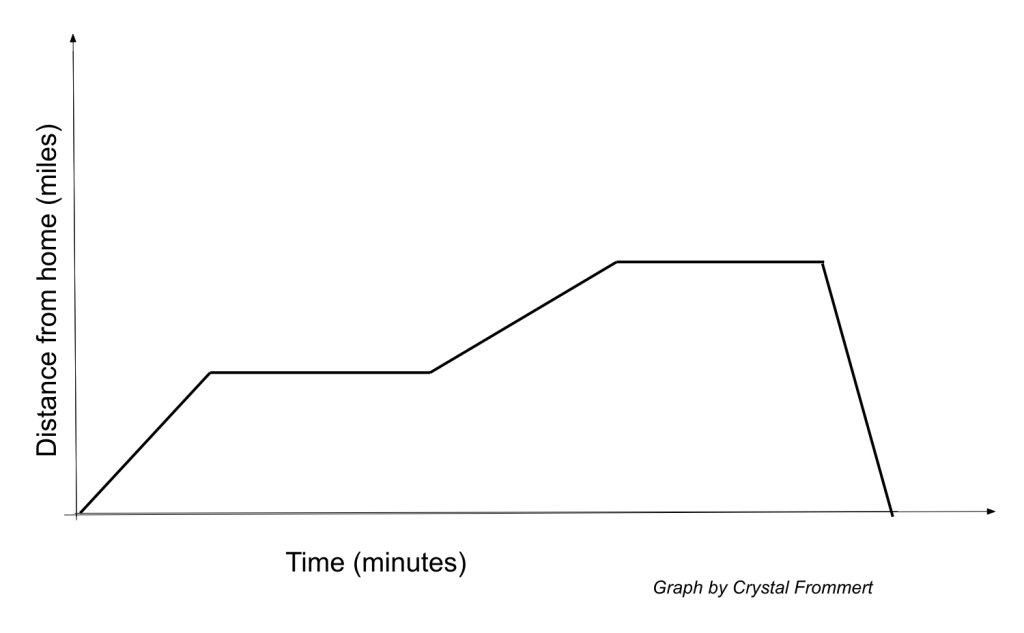
1. Graphs of functions. Students learning the relationship between time and a distance on a coordinate plane might relate to a story. In the example below, the teacher can discuss concepts such as intercept and slope (negative, positive, and zero), all while telling a story about walking from home to the ice cream shop.

Students will come up with the most imaginative stories while solidifying their understanding of algebraic concepts. This also extends to stories of throwing an object for projectile motion functions. 

graphic

2. Exponential growth. I told my class one day that I saw the principal in the elevator. “Hey, good news! Mrs. Soto just told me that I can choose between a 4 percent raise or making 98 percent of my current salary for next year. Which choice should I take?” Hopefully, the students will catch on quickly that this story is facetious. However, this introduction story can spark a discussion of exponential growth, decay functions, and their related graphs.   

3. Solving equations. When solving equations, I ask my students to imagine the variable x being a grumpy neighbor who wants to be alone. All he wants is to be isolated from all the operations happening to him. “Consider 4x – 3 = 5. The variable x wants to be alone, but he has been multiplied by 4, then subtracted by 3. How can we undo these operations to give x the isolation he desires?” 

4. Polygon characteristics. A polygon love story makes middle school students laugh every time. “Rhombus and Rectangle fell in love. Rectangle says he noticed how ‘congruent’ the beautiful Rhombus was, and it was love at first sight. They later have a baby named ‘Square,’ who has the same polygon characteristics as Mom and Dad.” I refer back to this story when students forget the classification of polygons, specifically that all squares are rectangles but only some rectangles are squares. 

5. Adding/subtracting integers. When students are first learning how to combine positive and negative integers, the concept of “zero pair” can be too abstract. However, if a positive ninja represents a positive one and a negative ninja represents a negative one, they have equal but opposite strength and will fight to a zero pair.

When a student is stuck on –5 +16, I ask, “If 5 negative ninjas encounter 16 positive ones, who will win out in the end?” Students often visualize the zero pairing and answer promptly, “11 positives are left!”

6. Angle classification. Just like the aforementioned salary raise story, this one is facetious. I draw an acute angle and tell my class that this is the layout of my first apartment. “It was a cute apartment!” (Pause for laughter.) The story goes on that my neighbor “Jason” lived “adjacent” to me—we shared a wall. When I was able to supplement my income, I moved to a much bigger place (drawing an obtuse angle that creates a straight line with the original acute angle).

The students always get a kick out of the story, and they don’t forget angle vocabulary. 

A Warning About Math Stories

Be cautioned: Storytelling can get too detailed and complicated, which risks losing the math concept. You want the students to remember the math, not the cute details of Rectangle and Rhombus’s first date. Be mindful to keep the math content correct in the stories. 

For example, a popular trick for converting fractions into decimals is the “cowboy/horse” story. The horse (the denominator) is on the bottom and sleeps outside the house (the division bracket), and the cowboy (the numerator) sleeps inside the house.

The horse and cowboy have nothing to do with math concepts. It’s far more effective to actually teach why the numerator is divided by the denominator. Tina Cardone’s book Nix the Tricks is an excellent resource for math teachers wanting to avoid non-math-related tricks. 

Give storytelling a try in your next math unit. Start with your own anecdote (real or imagined), and see how the students connect with the math in the story.

Your students can flex their creativity and critical thinking by creating their own math stories.

Stories in math class set the stage for contextualizing complex concepts while also making the math a little more human. 

Edutopia.org

Best wishes over the autumn break from Minister Motshekga – DBE

STAFF REPORTER

BASIC Education Minister Angie Motshekga has wished various education stakeholders a happy autumn school holiday 

“As we close out the first term in ordinary public schools, I want to express my heartfelt appreciation for your unwavering commitment to ensuring that all learners are allowed to receive a quality basic education,” she said last Friday.

Despite the complexity of the task amid rising potential learners and fewer available places, Motshekga said teachers have gone “above and beyond to ensure that all learners who want to learn are placed in ordinary public schools.

“I am truly grateful. Our teachers, principals, and education managers, such as district directors, have shown remarkable resilience and determination in dealing head-on with daily challenges. In the same vein, I would also like to give a special shout-out to the parents, schooling communities, and caregivers who have supported learners and us following the devastations of families due to the COVID-19 pandemic.”

Motshekga said the term has been a resounding success, with all schooling days being utilised for learning and teaching, except in unique circumstances where there were disruptive service delivery protests.

“Despite the challenges faced in the basic education sector, provincial education departments have taken proactive measures to address the issue. Specifically, they have allocated funds to identified schools in Gauteng and Western Cape to build additional brick-and-mortar classrooms,” she said.

INSIDE EDUCATION

Google Chrome and Classroom add new features for educators and students, including ‘reading mode’

AISHA MALIK

GOOGLE is rolling out new Chrome and Classroom features for teachers and students, the company announced on Tuesday. The tech giant is adding a new “reading mode” for Chrome, an AI-powered Hand Raise Gesture Detection feature for Meet and more.

The new “reading mode” is a customizable reader view coming to the side panel in the company’s browser.

The new feature is designed to help students with dyslexia and ADHD. Reading mode reduces distracting elements on the screen, like images and videos, to help users focus on a page’s primary content. You can also customize settings like the typeface, font size and spacing, along with the text and background color. Reading mode will be available in the Chrome browser in ChromeOS in M114.

The new AI-powered Hand Raise Gesture Detection feature, which is coming to all Google Workspace for Education users, is designed to make meetings more natural.

When you physically raise your hand, Meet will automatically raise the Hand Raise icon and move you to the main grid. The new feature will roll out in the coming months.

Google is also launching the ability for two or more teachers to manage slides together through a new “co-presenting” feature that’s rolling out in the coming months.

Another new Google Classroom feature will give educators the ability to add interactive questions to a YouTube video and assign it to students. As the video plays, students can answer the questions, get real-time feedback on their responses and rewatch the video again if needed.

Educators can receive insights about their students’ progress, like which questions they struggled with.

The beta version of this feature will be available in English, Japanese, Malay, Portuguese and Spanish.

In addition, Google announced a new “practice sets” feature that uses AI to help educators turn their existing teaching content into interactive assignments and provide more personalized support. Practice sets will be available globally in English in the coming weeks, with plans for additional languages in the future.

“As teachers add questions to their practice set, they’ll see suggestions for skills to focus on — like solving equations with decimals or writing thesis statements,” the company wrote in a blog post.

“Based on the skills selected, students will receive helpful hints if they get stuck. Through auto-generated insights, practice sets also help educators quickly identify gaps in understanding at both the class and student level, so they can tailor their approach. Educators can even share practice sets with other verified teachers in their domain.”

Google also announced that it’s adding new updates for Screencast, which is its tool that lets educators record and share lessons.

The company is expanding recording and transcription support to a dozen new languages, including Italian, Japanese, Spanish and Swedish.

In addition, Google is releasing a web player so students and teachers can watch screencasts in any browser on any device. Lastly, Google is introducing demo tools that allow users to animate clicks and taps and highlight any keyboard shortcuts they use on the screen. The new updates will begin rolling out to ChromeOS 112 users in early April.

Google initially launched a slew of new features for teachers and students during the pandemic when schools closed, but has since still steadily been introducing new online-based education features for both teachers and students.

Techcrunch

Get Ready for the World Table Tennis Championships in Durban

STAFF REPORTER

COUNTING down on Friday to 50 days before South Africa plays host to the World Table Tennis Championship Finals, Minister of Sport, Arts and Culture, Zizi Kodwa, said the tournament is a significant event in the sporting calendar.

“We are grateful to the International Table Tennis Federation for granting us the honour of hosting the event, and we have no doubt that Mr Joe Carrim’ and his colleagues at the South African Table Tennis Board, will leave no stone unturned to make it a great African experience,” Kodwa said.

“Sport, Arts and Culture are important levers of social cohesion and nation-building and play a major role in promoting tourism and boosting the economy of our country hence we are grateful to host this prestigious sporting competition,” he said.

The ITTF World Table Tennis Championships Finals is returning to Africa for the first time since Egypt in 1939, and Durban, South Africa, is gearing up to host this year’s event.

A hippopotamus, named Takuma, which embodied the strength and abundance of Africa’s cultural heritage and was chosen as the official mascot for the World Championships.

Takuma was designed by Tumelo Nkoana, a 13-year-old from Mogogelo Village north of Pretoria, who won a nationwide competition to select a mascot for the Africa Cup of Nations tournament in 2013, beating over 180 other entries. Since then, Takuma has become the mascot for all sports in South Africa.

INSIDE EDUCATION

The shocking state of education in South Africa 

SOUTH Africa has one of the worst-performing education systems in the world, plagued by incompetence and corruption, and the Centre for Development and Enterprise (CDE) is calling for the head of the minister of basic education, among other things. 

The CDE released several reports on South Africa’s education system, outlining its failings, the factors responsible, and recommendations for the actions that need to be taken to improve education in the country. 

“The President speaks of a ‘silent revolution’, while the minister talks of a ‘system on the rise’. The truth is that we face a silent crisis in our schools: South Africa has one of the worst performing education systems in the world,” said CDE’S Executive Director Ann Bernstein.

South Africa devotes a significant proportion of government revenue to basic education – roughly 13%, noted the report. 

To justify such outlays in the context of rising fiscal pressures in 2023, we should expect globally competitive learning levels, a reduction in learning inequality, new opportunities for children from poor households, and a large, trainable workforce. 

However, Bernstein said that, in reality, very little of this is evident.

Levels of education are circling the drain

According to professor Lant Pritchett, a specialist in education reform, South Africa is the single biggest learning underperformer relative to GDP per capita among low and middle-income countries.

South Africa does worse than Kenya or Tanzania, which have a GDP per capita of less than one-fifth of South Africa. The report states that our spending commitments are equivalent to some high-performing Scandinavian countries, but our learning outcomes are worse than neighbouring Eswatini. 

To put it into perspective, the distance between our performance and Singapore’s, one of the world’s richest and best learning-outcome performers, is equivalent to “a whole generation of schooling loss”. 

This is evident in the several international benchmark assessments South Africa have participated in over the past two decades, with some of the most notable results being:

  • After a year of school, more than 50% of Grade 1 learners don’t know all the letters in the alphabet.
  • 78% of Grade 4 learners could not read for meaning in any language.
  • Out of 39 participating countries, South Africa’s Grade 9 learners – on a test designed for Grade 8s – placed 38th (second last) in mathematics proficiency and last place (39th) in science proficiency. 
  • Covid 19 lockdowns devastated learning in South Africa (as elsewhere). Experts believe the average 10-year-old knows less than the average 9-year-old before the pandemic.

Many countries poorer than South Africa outperform us in these tests, including Morocco, Egypt, Georgia, Kosovo and Albania.

The report noted, for example, that the typical Grade 6 child in Kenya is around two to three years of learning ahead of a Grade 6 learner in the Eastern Cape. 

“South Africa’s comparative performance is shocking. When our learners take international tests, we are either last or in the bottom three countries. Even more devastating, while other countries test Grade 4s, we test Grade 5s; when they test Grade 8s, we test Grade 9s,” said Bernstein.

Quality of teachers and corruption

While the poverty of learners and their families and ongoing infrastructural deficits play a role, the report highlighted that a significant contribution to the state of education in South Africa is the quality of teachers and corruption within its system. 

Two primary factors contribute to poor teaching levels. First, many teachers lack the capabilities (content knowledge and pedagogical skills) to teach better. The second is that a non-trivial number is unwilling to do so, said the report. 

Four out of five teachers in public schools lack the content knowledge and pedagogical skills to teach their subjects.

In maths, for example, the proficiency levels of South African teachers (41%) rank far below that of their peers in Kenya (95%) and Zimbabwe (87%).

Moreover, the report revealed that 79% of Grade 6 maths teachers in the country scored below 60% on a Grade 6 maths test.

Compounding the issue is that South Africa has the highest teacher absenteeism rate of all SADC countries, which stood at 10% in 2017. 

Corruption adds to the pile of obstacles in the education system’s way. 

A report by the National Education Evaluation and Development Unit (NEEDU), released in 2015, assessing rural literacy found extensive union involvement in corrupt teacher hiring and promotion processes.

This was known as the “jobs for cash” scandal, implicating SADTU – the country’s dominant teacher union – where members would coordinate to get favoured individuals onto the school governing body (SGB) to ensure those who paid for positions could land them. 

The report noted examples of this in Kwa-Zulu Natal, where principal and deputy principal positions were routinely sold for between R30,000 and R45,000.

In 2016, the Miniter of education appointed a ministerial task team (MTT) to investigate the issue, which found that in six or possibly more of the nine provinces, SADTU was in charge of the management, administration and priorities of education in the country. 

The MTT found that all deputy directors general of the DBE were SADTU members, frequently attending union meetings.

Despite findings of criminality by the MTT, no government official implicated in the 2014-2015′ jobs for cash’ scandals has been prosecuted or suspended, said Bernstein. 

She added that not one of the key MTT recommendations to fight corruption and push back state capture has been implemented to this day.

CDE recommendations

CDE recommendations focus on five areas for action to improve education outcomes:

  • Tackle corruption and state capture in education by prohibiting cadre deployment and introducing measures that remove SADTU’s stranglehold on education departments.
  • Raise accountability levels by bringing back the Annual National Assessment (ANA) tests for Grades 1 to 9, reinvigorating an independent National Education Evaluation and Development Unit (NEEDU), and giving principals more power over the appointment and management of teachers in their schools.
  • Improve teacher performance by introducing higher teacher training standards, more effective support for existing teachers and the urgent recruitment of skilled foreign teachers in areas of shortage (maths and science).
  • Install fresh leadership in public education. South Africa needs a new Minister of Basic Education, DG and the top team at national and provincial levels to achieve systemwide reform. The President’s full support for tough political decisions is essential.
  • Set realistic national and provincial performance goals. Stretch targets are required to move off the bottom of international tests. Ensuring all 10-year-olds can read for meaning by 2030 is another worthy goal, but a plan, a budget and regular reporting on progress must accompany this presidential aspiration dating back to 2019. 

According to the report, evidence from global studies shows that successful reform programmes can start producing meaningful results in three to five years. 

“The time has come for civil society, business, all political parties, parents and the public to up the pressure on government: we all need to push for systemwide reforms that significantly improve the quality of teaching in the classroom,” said Bernstein.

Business Tech

Nashville shooter who killed 6 drew maps, surveilled school

0

A former student shot through the doors of a Christian elementary school Monday and killed three children and three adults after elaborately planning the massacre by drawing out a detailed map and conducting surveillance of the building, police said.

The massacre at The Covenant School in Nashville was the latest in a series of mass shootings in a country that has grown increasingly unnerved by bloodshed in schools.

The victims included three 9-year-old children, the school’s top administrator, a substitute teacher and a custodian. Amid the chaos a familiar ritual played out: Panicked parents rushed to the school to see if their children were safe and tearfully hugged their kids, and a stunned community planned vigils for the victims.

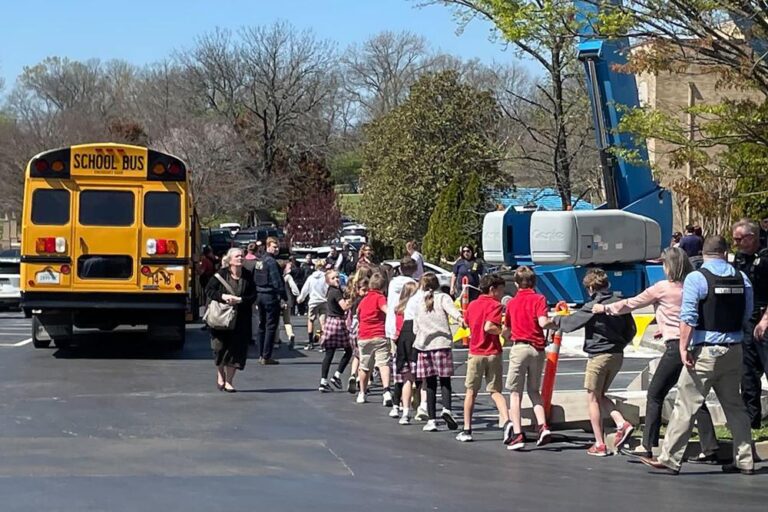
“I was literally moved to tears to see this and the kids as they were being ushered out of the building,” Metropolitan Nashville Police Chief John Drake said during one of several news conferences.

Police gave unclear information on the gender of the shooter, who police say was fatally shot by two responding officers at the school. For hours, police identified the shooter as a 28-year-old woman and eventually identified the person as Audrey Hale. Then at a late afternoon press conference, the police chief said that Hale was transgender. After the news conference, police spokesperson Don Aaron declined to elaborate on how Hale currently identified.

Drake did not give a specific motive when asked by reporters but gave chilling examples of the shooter’s prior planning for the targeted attack.

“We have a manifesto, we have some writings that we’re going over that pertain to this date, the actual incident,” he said. “We have a map drawn out of how this was all going to take place.”

He said in an interview with NBC News that investigators believe Hale had “some resentment for having to go to that school.”

The shooter gained entry by firing into glass doors on the building, shattering them, police later said in a tweet.

The shooter was armed with two “assault-style” weapons as well as a handgun, authorities said. At least two of them were believed to have been obtained legally in the Nashville area, according to the chief.

Police said a search of the shooter’s home turned up a a sawed-off shotgun, a second shotgun and other unspecified evidence.

The victims were identified as Evelyn Dieckhaus, Hallie Scruggs, and William Kinney, all 9 years old, and adults Cynthia Peak, 61; Katherine Koonce, 60; and Mike Hill, 61.

The website of The Covenant School, a Presbyterian school founded in 2001, lists a Katherine Koonce as the head of the school. Her LinkedIn profile says she has led the school since July 2016. Peak was a substitute teacher and Hill was a custodian, according to investigators.

Students held hands as they walked to school buses, which drove them to a nearby church to be reunited with their parents.

Rachel Dibble, who was at the church as families found their children, described the scene as everyone being in “complete shock.”

“People were involuntarily trembling,” said Dibble, whose children attend a different private school in Nashville. “The children … started their morning in their cute little uniforms, they probably had some Froot Loops and now their whole lives changed today.”

Communities around the U.S. has suffered through one mass killing after another in recent years, with school shootings taking an especially painful toll.

Recent tragedies nationwide include the massacre at an elementary school in Uvalde, Texas, last year; a first grader who shot his teacher in Virginia; and a shooting last week in Denver that wounded two administrators.

President Joe Biden, speaking at the White House on Monday, called the shooting a “family’s worst nightmare” and implored Congress again to pass a ban on certain semi-automatic weapons.

“It’s ripping at the soul of this nation, ripping at the very soul of this nation,” Biden said.

Biden later ordered the U.S. flag to be flown at half-staff on all federal buildings through March 31. He also spoke to Tennessee Gov. Bill Lee and Nashville Mayor John Cooper about the shooting, officials said.

Founded as a ministry of Covenant Presbyterian Church — which is affiliated with the conservative evangelical Presbyterian Church in America — The Covenant School is located in the affluent Green Hills neighborhood just south of downtown Nashville that is home to the famed Bluebird Café – a spot typically beloved by musicians and songwriters.

The school has about 200 students from preschool through sixth grade, as well as roughly 50 staff members.

“Our community is heartbroken,” a statement from the school said. “We are grieving tremendous loss and are in shock coming out of the terror that shattered our school and church. We are focused on loving our students, our families, our faculty and staff and beginning the process of healing.”

Before Monday’s violence in Nashville, there had been seven mass killings at K-12 schools since 2006 in which four or more people were killed within a 24-hour period, according to a database maintained by The Associated Press and USA Today in partnership with Northeastern University. In all of them, the shooters were males.

The database does not include school shootings in which fewer than four people were killed, which have become far more common in recent years. Just last week alone, for example, school shootings happened in Denver and the Dallas-area within two days of each other.

Monday’s tragedy unfolded over roughly 14 minutes. Police received the initial call about an active shooter at 10:13 a.m.

Officers began clearing the first story of the school when they heard gunshots coming from the second level, Aaron said during a news briefing. Police later said in a tweet that the shooter fired at arriving officers from a second-story window and had come armed with significant ammunition.

Two officers from a five-member team opened fire in response, fatally shooting the suspect at 10:27 a.m., Aaron said. One officer had a hand wound from cut glass.

Late Monday night, police released approximately two minutes of edited surveillance video showing the shooter’s car driving up to the school from multiple angles, including one in which children can be seen playing on swings in the background. Next an interior view shows glass doors to the school being shot out and the shooter ducking through one of the shattered doors.

More footage from inside shows the shooter walking through a school corridor holding a gun with a long barrel and walking into a room labeled “church office,” then coming back out. In the final part of the footage, the shooter can be seen walking down another long corridor with the gun drawn. The shooter is not seen interacting with anyone else on the video, which has no sound.

Aaron said there were no police officers present or assigned to the school at the time of the shooting because it is a church-run school.

Jozen Reodica heard the police sirens and fire trucks blaring from outside her office building nearby. As her building was placed under lockdown, she took out her phone and recorded the chaos.

“I thought I would just see this on TV,” she said. “And right now, it’s real.”

Nashville has seen its share of mass violence in recent years, including a Christmas Day 2020 attack where a recreational vehicle was intentionally detonated in the heart of Music City’s historic downtown, killing the bomber, injuring three others and forcing more than 60 businesses to close.

A reeling city mourned during multiple vigils Monday evening. At Belmont United Methodist Church, teary sniffling filled the background as vigil attendees sang, knelt in prayer and lit candles. They lamented the national cycle of violent and deadly shootings, at one point reciting together, “we confess we have not done enough to protect” the children injured or killed in shootings.

“We need to step back. We need to breathe. We need to grieve,” said Paul Purdue, the church’s senior pastor. “We need to remember. We need to make space for others who are grieving. We need to hear the cries of our neighbours.”

AP

Free School Lunch for All – What the Pandemic Taught Us

0

WILLIAM HATCH

GOOD news! Colorado recently passed a law that made school meals free for every student, regardless of financial eligibility. Starting late in 2023, the Healthy School Meals for All program will officially launch in most Colorado school districts. This state-funded program aims to ensure that every kid attending school will have the nutrients they need to continue learning and thriving in their classes.

Let’s explore Colorado’s lead and others as they follow to bring free school lunches to all students. 

The Reason for the Introduction of Free School Lunches

The progenitor to this program was brought on by the recent pandemic—students relied on meals provided by the school, but as schools shut down, their access to these meals was cut off. Then, as schools slowly reopened, Colorado school districts offered free lunches via waivers to relieve some of the financial pressure that many felt during the pandemic.

State officials saw a 10% – 40% rise in students across several districts partaking in school lunches during this period, then decided that it should be more permanent. Voters agreed—55.1% of Colorado citizens voted “yes” on Proposition FF: to create and fund the Healthy School Meals for All program. But where does the funding come from? The measure promises to generate more than $100 million annually by reducing tax breaks to households earning more than $300 thousand per year.

However, there is bound to be some confusion among parents, as some of their kids may have to fill out an application to opt-in for the free meals, while their siblings that attend other schools may not. This is because many Colorado schools are already participating in the Community Eligibility Provision, which has provided students with free meals since 2020.

All this said, not every school district in Colorado has guaranteed that they will participate in the Healthy School Meals for All program. If you live in Colorado and have a child attending public school, be sure to check with your school district and stay informed.

Leveling the Playing Field

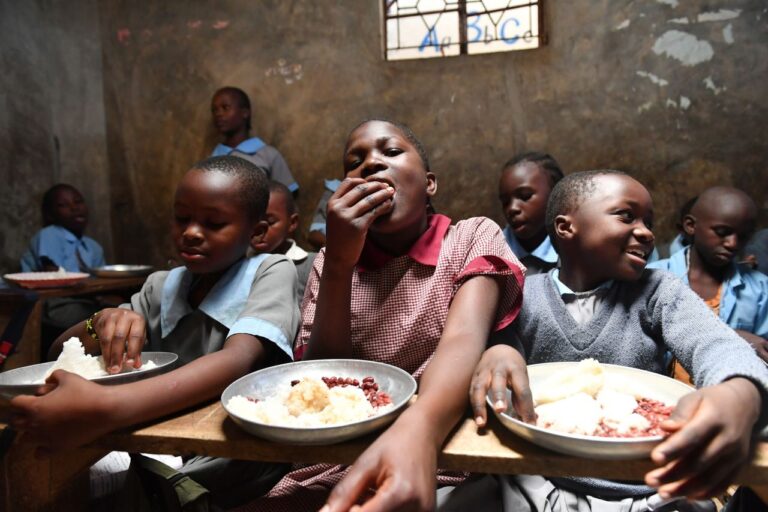
Introducing a free meal program is helping to alleviate peer pressure and stigma against the less fortunate kids who rely on free lunches or cannot afford to buy a meal every day. Since every student, regardless of status, is eligible for a free meal, it levels the playing field in that aspect—no one worries about any child going hungry, at least while at school.

Hunger Free Colorado

GlendaRika Garcia works for Hunger Free Colorado, a nonprofit organization that seeks to end hunger and provide nutrition to children all over her state. As a mom of four teenage boys, she’s seen first-hand the positive impact the Healthy School Meals for All program has had on children.

“I think that the kids being able to eat for free at school is really important, for all families, all kids,” she said. “Kids can’t learn if they don’t have good nutrition.”

How Other States are Following Suit

Colorado isn’t the only state that chose to continue providing free lunches for students. Some states like Nevada, Vermont, and Massachusetts have also decided to extend their free lunch programs to the end of 2023, though some still need to pass bills to make it permanent. 

California and Maine were the first to pass measures similar to Colorado’s last year. In Arizona, meanwhile, officials have invested almost $7 million to extend their free school meal program, and it’s happening much faster—it’s set to launch its benefits for students this month!

Three Cheers for School Staff

The pandemic has been tough on all of us—but especially for those who are either in school, have kids, or have jobs at a school. Teachers, students, and their parents had to transition to virtual and online learning overnight, and they deserve major kudos for blazing through that adjustment so quickly. Suddenly, everyone was homeschooled, putting a lot of pressure on teachers and parents.

Another one of the pandemic’s lasting effects was on our supply chain, directly impacting the food supplied to schoolchildren and the staff that prepared it. We’re still processing the past few years, and while things are getting better, the pandemic has left a lasting mark on our history. The pandemic has taught us what incredible things teachers are willing to do to continue their work to educate young minds. They are passionate about teaching and learning, and their example should be held in the highest honor.

Educationworld.com

Principals honoured as top achievers from Gauteng schools

Many of Wits University’s top learners come from important feeder schools, which produce quality students that easily adjust to the academic demands at Wits.

In celebration of the class of 2023, the Wits’ Schools Liaison Office (SLO) hosted over 49 feeder school principals and teachers from Gauteng at the annual Principals’ Function. The SLO visit a vast number of schools each year and advise learners about admission requirements, career opportunities, degree courses offered at Wits, fees and funding, student life on campus and the University’s core function.

Educators from Gauteng’s feeder schools were congratulated on the excellent work they do in nurturing learners through their 12 years of schooling, preparing learners for post-secondary education and supporting learners in securing a spot at a leading global institution like Wits.

“We at Wits pride ourselves as a place of intellectual debate, free expression, diversity of views and ideology. In partnership with your schools, we look forward to the next 100 years of mutual collaboration and contributing to leading this country and continent. Our goal at Wits is to weave in academic excellence in naturing the young minds, contributing to dialogue and discourse and becoming a beacon of what this country strives to be,” said Wits Vice-Chancellor and Principal, Professor Zeblon Vilakazi, who welcomed representatives at the event.

Wits received a record number of first-year applications for the 2023 academic year. Majority of those applications were from feeder schools. The relationship with schools is an important one in ensuring the success of learners, the University said.

Three schools were singled out and received certificates for being the top feeder schools in their respective sectors.

Greenside High School, Al Aqsa School and St Matthews Private Secondary School all walked away as Wits University’s 2022 top-feeder schools.

“Our learners, parents and community appreciate the relationship we have with Wits, the support we receive from the University is fantastic,” said Al Aqsa School’s principal Hamida Moosa. She further acknowledged the relationship with Wits, adding that the two have a long history and a shared vision.

Principal Craig Strauss received the award on behalf of Greenside High School and praised the work done by the SLO.

“The school visits and time spent with our learners help to broader our learners’ minds, exposing them to different opportunities and broaden their horizons on what is available at University.”

The principals were also captivated by guest speaker Professor Benjamin Rosman, School of Computer Science and Applied Mathematics who delivered an insightful talk titled Generating the Future: The Power of ChatGPT. Rosman took a deep dive into the advantages and disadvantages that the artificial intelligence model presents.

Artificial Intelligence (AI) tools have been developing for many years, but the release of ChatGPT, a powerful natural language chatbot, in November 2022 has created a global stir.

INSIDE EDUCATION