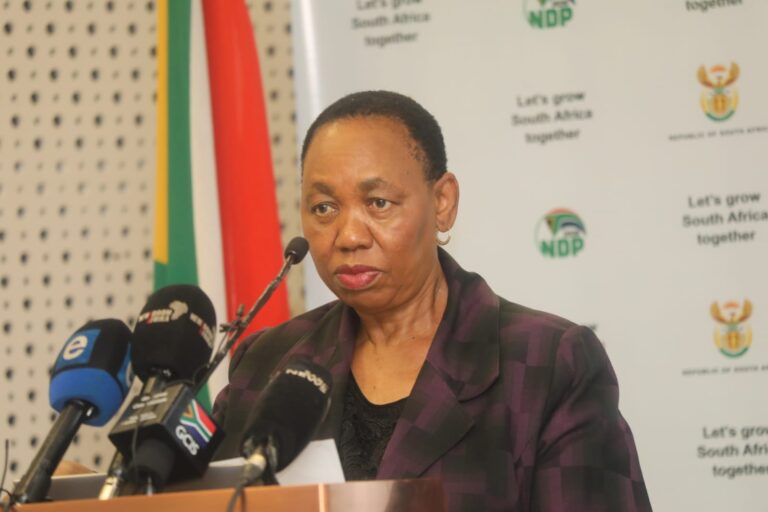
MINISTER of Basic Education Angie Motshekga has confirmed that four educators out of 191 reported cases of sexual misconduct were successfully struck off the roll.
Motshekga revealed this in an answer to a written parliamentary question by the Democratic Alliance (DA).
The number of cases of sexual misconduct reported to the SA Council of Educators (SACE) last year, has risen quite dramatically from 92 in 2019/20 to 169 in 2020/21 and 191 in 2021/22.
This could potentially mean that for the 199 school days last year, a single case of sexual misconduct a day took place at a particular school.
The 2022 crime statistics indicates a total of 294 rapes reported to have occurred on the premises of educational institutions – schools, universities, college, and day care facilities.
SACE said it instituted 23 disciplinary proceedings in 2022 alone, this is 12% of the reported cases of sexual misconduct.
About 19 educators were found guilty of sexual misconduct, only four were struck off the roll indefinitely.
SACE indicated that some cases were closed due to lack of evidence to substantiate the allegations, deliberate unavailability of complainants to assist with the investigation/disciplinary proceedings, and witnesses refusing to cooperate with the Council.
“The complainants’ reluctance to cooperate with SACE in investigating and disciplining their alleged abusers indicates a perceived bias against the victims of abuse. SACE must take responsibility for this perception and ensure that disciplinary hearings are environments where alleged victims and witnesses feel safe, are protected from further trauma, and where evidence and testimony from both parties are examined in an objective and sensitive manner,” DA MP Desiree van der Walt said.
Van der Walt said SACE must take appropriate steps to better categorise cases to ensure effective oversight of processes and procedures.
Without a thorough analysis of data, no institution can critically access its effectiveness.
“The Council must ensure that victims of sexual abuse are protected when reporting these crimes and that guilty abusers suffer the consequences for their heinous actions,” Desiree said.
FOUR-YEAR-OLD Langalam Viki drowned in a pit latrine toilet in Vaalbank in Eastern Cape early in March. The tragedy highlighted the failure of the Department of Basic Education to get rid of pit latrine toilets, despite adopting the minimum uniform norms and standards for public school infrastructure, which banned them at schools in 2013.
The norms and standards created a legal responsibility for the department and provincial departments to eradicate pit latrines at schools. However, 3,398 schools countrywide still have pit latrine toilets. Over the past decade, there have been many horror stories like that of Viki.
This is one tragedy, too many.
On Sunday, the Minister of Basic Education, Angie Motshekga, pledged to tackle the problem within two years. While the Minister’s commitment is welcomed, one wonders how the department, which has failed to tackle this problem over the past decade, will address it in two years.
Basic Education has made a dent in the outstanding number, fixing a paltry 117 toilets.
Credit for raising awareness of this problem must go to civil society organisations, like Equal Education and Amnesty International, both of which have consistently raised the issue, highlighting the tardiness of the department in swiftly eradicating pit latrine toilets.
In a year, South Africans will go to the polls. Politicians are mindful of the mood of the people.
One can easily label the Democratic Alliance leader John Steenhuisen as opportunistic in visiting the dead child’s parents. But Nelson Mandela did not own the trademark on compassion.
Sadly, the leaders left behind have not adopted his caring nature.
Yet, one cannot disagree with his saying that schools should be safe spaces for our children, not gravesites. Steenhuisen argues that Human Rights Day could not be commemorated until every child had access to safe and dignified sanitation at school. The parents of little Viki would agree.
“The drowning of our children in pit toilets goes far beyond a human rights violation; it is a horror that no South African should ever be forced to contemplate,” Steenhuisen lamented.
While Motshegka told the media that it would eradicate pit latrines by 2025, the DA went further, proposing a two-point plan to eliminate pit toilets at schools across the country.
In two years, Motshekga, one of the longest-serving education ministers in Africa, is unlikely to remain in her job. Who will be held accountable should the Department of Basic Education not deliver on its promise? It is not an option one would like to contemplate.
Therefore, one hopes that the DBE will pull out all the stops to eradicate at least half the pit latrines by the time democracy celebrates its 30th year in 2024. While the grieving parents of Langalam Viki mourn their little girl whose promising life was snuffed out, Motshekga must act with urgency.
MINISTER of Higher Education, Science and Innovation, Dr Blade Nzimande, opened a computer lab at Moloke Primary School in Sekhukhune last Friday, connecting learners and young people studying to the Internet.
The computer lab consists of two connected 12-meter upcycled storage containers, with computers powered by solar energy, to bridge the digital divide for learners in disadvantaged communities.
Limpopo MEC of Education, Mavhungu-Lerule Ramakhanya, and the Fetakgomo Tubatse Mayor, Eddie Edwin Maila, joined Nzimande in handing over the computer lab to the community of Sekhukhune.
This off-grid media lab project is initiated and funded through the department of science and Innovation’s Renewable and Sustainable Energy Research Hub and Spokes Programme.
Apart from assisting in teaching and learning, the National Youth Development Agency also used the lab to train 30 young people in business development. This demonstrates that government departments and entities can work closely to deliver services to the nation.
The media lab project is the culmination of a long-standing investment by the Department of Science and Innovation in the development and application of scientific knowledge domains.
“These media labs are also meant to advance publicly funded Intellectual property to enable technology localisation, job creation and service delivery to our people,” he said.
Through this project, Stellenbosch University will train interns from the Technical and Vocational Education and Training (TVET) colleges.
The University has already recruited and trained one TVET College Graduate on solar PV and monitoring of the media labs.
This project will enable interns to secure Diplomas as part of their internship training for 18 months before they can get their qualification from the TVET college.
“What is also important is that our interns will get their qualification equipped with the scarce skills in the renewable energy sector where most people in rural areas do not normally participate,” the Minister said.
With the media laboratory at Moloke school, Sekhukhune TVET College is also involved.
This partnership will unlock the training of TVET college graduates in the scarce skills area of renewable energy.
The media lab is off-grid, which was done to relieve the school from the pressure of buying electricity to power the computers.
BASIC Education Minister Angie Motshekga has congratulated provinces on their improved academic performance during 2022 in the National Senior Certificate (NSC) examination during her first meeting with district directors and senior DBE and Provincial Education Department (PED) officials earlier this month.
The Minister expressed gratitude to all district directors for their resilience during this challenging period as the first line of defence.
“Along with our circuit managers, you remain the heartbeat of the sector. We must now shift our focus towards quality. To this end, I am pleased to announce that the National Assessments and Public Examinations analysis is moving away from league tables towards the inclusive basket. As we celebrate the anniversary of the function migration, there is a lot to do with ECD, our new baby in the house. We have embarked on many projects to ensure better and more effective resourcing of early childhood education,” she said.
These include the ECD Census, which is helping the Department establish more robust planning systems, and the Thrive by Five Index, which is assisting the Department in strategically targeting its support.
“We are also driving the process of redrafting the Children’s Second Amendment Bill to make registration and access to funding more easily accessible to all ECD programmes. Guided by our anticipated Integrated ECD Service Delivery Model and Framework, based on the Five Pillars of Early Learning to bring all stakeholders on board, we need to prioritise access and quality,” the Minister said.
“We must continue with the Learning Recovery Plan and pay attention to Home Languages, emphasising languages in the Foundation Phase. The National School Nutrition Programme, which has successfully offered meals and created jobs for the local communities, should be expanded to fight malnutrition and stunting.”
“I am confident that this will be another great year for education, and I wish you all the best in today’s deliberations and the year ahead,” the Minister concluded.
SOFTWARE developer training academy WeThinkCode and Ekurhuleni West TVET College (EWC) will pilot a coding skills programme for youth with no prior experience.
This, after the organisations entered into a public-private partnership aimed at creating a pipeline of in-demand technical skills.
In a statement, WeThinkCode says the initial phase of the training programme will see two cohorts of 50 students learning the academy’s curriculum at the EWC campus.
The academy further sees the collaboration with EWC as an opportunity to close the gap between unemployed youth and market demand for skilled software developers.
“This pilot programme represents a pivotal opportunity to produce digital skills at scale,” says Ruvimbo Gwatirisa, WeThinkCode campus director: Cape Town, and lead of the TVET expansion.
“TVETs have a national footprint, and together with our coding curriculum, we can deliver thousands of digital skills into our economy and help to lower our youth unemployment rate more rapidly than WeThinkCode could on its own.”
Manie Stoltz, business unit: partnerships manager at EWC, adds: “Through this partnership, WeThinkCode and EWC are not only empowering young minds to become skilled coders, but also enabling them to unlock their full potential and create a brighter future for themselves and their communities. Investment in educationis a vital step towards building a better world.”
Launched in 2015, WeThinkCode seeks to eliminate the digital skills shortage by developing 100 000 coders in Africa over the next 10 years.
To date, over 700 young people have graduated and maintain a 91% post-graduation employment rate, says the organisation.
Says WeThinkCode CEO Nyari Samushonga: “In our seven years of operating, we have demonstrated that some of the best coding skills come from areas not normally associated with tech talent.
“We are incredibly excited about partnering with EWC to bring this opportunity to more young people and further secure local tech skills pipelines.”
Samushonga states partnerships are the answer to creating the pool and pipeline of digital talent.
Resultantly, the pilot programme has also brought on board other collaborative partners, namely the Gauteng City Region Academy (GCRA), Standard Bank Tutuwa Community Foundation and Michael & Susan Dell Foundation.
Percy Moleke, CEO of GCRA, notes: “The GCRA is proud to partnerwith WeThinkCode and EWC for the delivery of this exciting pilot programme.
“It will see close collaboration between GCRA, a post-education and training institution and a civil society organisation in the form of an NPO. The programme aims to take best in breed course content and curriculum delivery to youth in the province.
“The purpose of the pilot is to test the programme’s scalability. If it’s successful, the partnerswill have a model which could significantly improve the reach of this wonderful ICT programme.
“We look forward to future phases of this programme and replicating the model in other sectors.”
Ona Meyer, programme manager for jobs and livelihoods at the Michael & Susan Dell Foundation, adds: “The partnership between WeThinkCode and EWC is a case study of a new partnership model that will allow youth enrolled in TVETs to access a high-quality, industry-relevant curriculum and pathway support into jobs in the ICT sector in South Africa.
“Partnerships like these have the potential to stretch across multiple TVET campuses and incorporate a variety of high-quality private training providers to improve employment outcomes for many young South Africans.”
Gwatirisa concludes that beyond the envisaged skills pipeline outcome, the pilot programme provides an opportunity to collect and analyse data that can be used to innovate around policies aimed at creating a robust IT education framework.
THE Varsity Cup returns on Monday, 27 March 2023, when archrivals in Free State rugby, the University of the Free State (UFS) and Central University of Technology (CUT) face off in the battle for points at Shimla Park, on the Bloemfontein Campus at 19:00.
The derby fields some of the most illustrious stars, slugging it out for silverware and bragging rights in a rivalry that seems to intensify with each new encounter. Adding further spice to the derby is their last encounter in 2022 when the FNB UFS Shimlas won, but the FNB CUT Ixias who currently sit in fourth position on the log had previously won the last three encounters.
Shimlas occupy fifth position and will be looking to leapfrog their rivals with a win on the day.
Undefeated on their home ground the Shimlas will seek to maintain their impressive home form and take advantage of playing to the home crowd. “The boys have been working hard since September last year.
They will give it their all to make the play offs and go a few steps further than last year. The team spirit and brotherhood is really strong among the players. They love it when Shimla Park is packed and they will entertain their supporters,” said Andre Tredoux, head coach of FNB UFS Shimlas.
Tredoux has eyes only for the prize, “We need to win this game to get into the top 4 positions, before our last round robin game. All six teams can still reach the play offs, so we are focused on what we need to do and not so much on the other teams, if our processes are good, we have a good chance.” He says synergy was a focal point during last season and nothing has changed.
“I expect the boys to play with the same spirit, effort and intensity as last season.”
“We were a new coaching staff last season, so the players had to go through a process of adjustment. This season we are trying to adapt our game, play smarter rugby, and to keep things fresh. We had thirteen players finish off at the end of last season of which nine got contracts to play professional rugby (eight of those players graduated). The rest graduated or had injuries,” he said.
THE past four decades have seen an endless stream of reviews into teacher education. Australia has clocked up more than 100 since 1979. This comes amid constant concerns teachers are not adequately prepared for the classroom.
Our latest research, published in the Australian Education Researcher, provides a powerful counternarrative to concerns about teacher education and early-career teachers.
We analysed data from two major studies over the past decade and found it did not matter if teachers had less than one year of teaching experience or had spent 25 years in the classroom – they delivered the same quality of teaching.
These results indicate teaching degrees are preparing new teachers to deliver quality teaching and have a positive impact in their classrooms right away.
Recent reviews into teacher education
The most recent review into teacher education was finalised in February 2022. Led by former federal education department secretary Lisa Paul, the review found an “ambitious reform agenda” was needed to attract “high quality” students and make sure teacher education was “evidence-based and practical”.
Sydney University vice-chancellor Mark Scott (who also chairs The Conversation’s board) is now leading another expert panel, partly in response to Paul’s review and partly due to concerns about teacher shortages. It is looking at how to “strengthen” teacher education. It is also looking at developing a “quality measure” for teaching degrees and whether funding for universities should be tied to quality.
In among this, we have already seen an emphasis on attracting the “best and brightest” into teaching degrees and increasing requirements to graduate. To enter a classroom, teachers now need to have passed extra literacy and numeracy tests on top of their degrees.
The underlying assumption in all this government messaging and accompanying media commentary is that failings in education are those of teachers and teacher educators (the academics who teach teachers).
Our research
Our research used direct observation of 990 entire lessons to investigate the relationship between years of teaching experience and the quality of teaching.
We analysed the teaching of 512 Year 3 and 4 teachers from 260 New South Wales public schools in separate studies conducted over 2014-15 and 2019-21.
The schools involved in the study were representative of schools across Australia, and the lessons observed included a range of subjects, with the majority in English and mathematics. Most of the teachers observed had between one and 15 years of experience, although almost a quarter of the observations were of lessons taught by teachers with 16 years’ experience or more.
How we assess quality teaching
We used the Quality Teaching Model as the basis for the observations. The model was developed by education academic James Ladwig and me for the NSW Department of Education in 2003. It has been the department’s framework for high-quality teaching since.
It is based on research into the types of teaching practice that make a difference to student learning and centres on three dimensions:
“intellectual quality” – developing deep understanding of important knowledge
“a quality learning environment” – ensuring positive classrooms that boost student learning, and
“significance” – connecting learning to students’ lives and the wider world.
Under these three dimensions are 18 elements of teaching practice that enable detailed analysis of lesson quality. Researchers coded the lessons they observed, with more than one researcher coding many of the lessons to ensure a high level of reliability.
Our findings
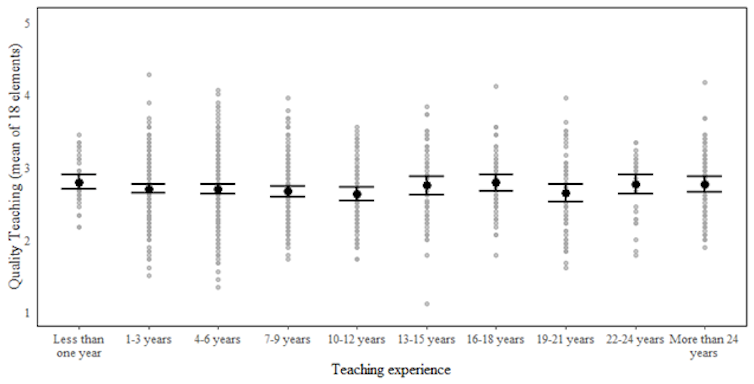
We found no statistically significant differences in average teaching quality across the years of experience categories.
Even when we broke down the experience categories in different ways to test for accuracy, we continued to find that years of experience did not equate to differences in the quality of teaching delivered.
On the graph below, each dot represents the average Quality Teaching score of an observed lesson. These have been grouped in a line based on how experienced a teacher is.
The average lesson quality in each experience category is represented by the large black dot and the horizontal lines represent the margin of error. The average Quality Teaching score across all the experience categories falls within the same margin of error range illustrating no statistically significant difference.
This graph shows a teacher’s Quality Teaching score (the mean of 18 elements), compared to their experience. Author provided
Why does experience appear to make no difference?
Teaching quality is consistently described as the most important in-school factor affecting student outcomes.
Our finding that newly graduated teachers deliver teaching of a similar quality to that of their more experienced peers is surprising and somewhat counterintuitive. There are at least two possible explanations for this result.
Graduate teachers may be starting their jobs more ‘classroom ready’ than policymakers assume. Christina @ wocintechchat.com/Unsplash
First, the result suggests graduate teachers are entering the profession “classroom ready” because initial teacher education programs are performing far better than is typically assumed in policy and the media.
That is not to say improvements in teaching degrees aren’t possible or warranted, or that graduate teachers don’t face difficulties. We know attrition among teachers in their first five years is high and is a major contributor to teacher shortages.
Second, on-the-job experience is insufficient on its own to raise teaching quality. While experienced teachers make many valuable contributions through leadership and mentoring, it could be that much of the professional development they do over the course of their careers makes little difference to the quality of their teaching practice.
Teachers need professional development that builds knowledge, motivates them, develops their teaching techniques and helps them make ongoing changes in their classroom practice. It should be backed by rigorous evidence of a positive impact on teaching quality and student outcomes.
Teachers and teaching
Part of the problem in debates about schools and education is the relentless use of “teacher quality” as a proxy for understanding “teaching quality”. This focuses on the person rather than the practice.
This discourse sees teachers blamed for student performance on NAPLAN and PISA tests, rather than taking into account the systems and conditions in which they work.
While teaching quality might be the greatest in school factor affecting student outcomes, it’s hardly the greatest factor overall. As Education Minister Jason Clare said last month: I don’t want us to be a country where your chances in life depend on who your parents are or where you live or the colour of your skin.
We know disadvantage plays a significant role in educational outcomes. University education departments are an easy target for both governments and media.
Blaming them means governments do not have to try and rectify the larger societal and systemic problems at play.
Jenny Gore, Laureate Professor of Education, Director Teachers and Teaching Research Centre, University of Newcastle.
BASIC Education Minister Angie Motshekga said on Sunday that government has taken action to accelerate the provision of school infrastructure across all nine provinces.
She said out of 3 398 schools, 2 478 have already been equipped with better infrastructure to create safe havens for school children.
Motshekga was briefing the media on the progress made on infrastructure roll out in the basic education sector on Sunday.
“To be precise, therefore, the department identified 3398 schools that were lacking in infrastructure in one form or another- that is either not age appropriate or simply inadequate. We have delivered 2478 projects to schools across the country,” Motshekga said, adding that Covid-19 pandemic lockdowns impacted on implementation.
Through private sector funders, 184 were allocated, and so far, 117 infrastructure projects were completed.
“317 electrification projects, 1 259 water projects and 1 053 planned sanitation projects were completed,” she sad.
She said government is still investigating the circumstances surrounding the death of four-year-old Langalam Viki whose body was found in a pit latrine at Mcwangele Primary School in Vaalbank in the Eastern Cape.
Motshekga revealed that the school where Langalam passed away has been provided with new South African National Standards approved infrastructure.
“Langalam was found in the tank of a senior toilet, not the age appropriate toilet where he would have normally gone. He was also found fully dressed,” she said.
She urged police to investigate the case with greater care given that “Langalam was to young to lift the manhole that covers the tank”.
Last week, SECTION 27 and the Centre for Child Law launched the Michael Komape Sanitation Progress Monitor online tool which will track progress by the Limpopo Department of Education (LDoE) in eliminating unsafe and inappropriate sanitation in the province’s public schools.
The online tool will be used hold the department and provincial government accountable.
“Education is a fundamental human right of every woman, man and child” – UNESCO
In keeping with the theme of ensuring access to education, funeral insurance firm AVBOB and Oxford University Press will give away 260 trolley libraries equipped with books donated by Oxford University Press (OUP) Southern Africa, representing 11 official South African languages, numeracy books and other learning resources, to deserving primary schools and education NPOs.
The campaign is part of instilling a culture of reading and contributing to improving the numeracy skills of primary school children across the country.
Kebo Mosweusweu, AVBOB General Manager of Shared Value and Sustainability, says experts through various studies have found that teaching in a mother tongue helps reduce dropout rates and makes education more accessible and engaging for learners.
“Equally important is the need to develop numeracy skills at the formative ages of children. Through this year’s campaign, we aim to reinforce further our commitment to instilling a love of reading in primary school learners nationally,” says Mosweusweu.
The Progress in International Reading Literacy Study (PIRLS) latest findings show that 78% of Grade 4 learners in South Africa could not read meaningfully in any language because they need to be taught basic literacy in the language they speak at home. This means that only 22% of the country’s 10-year-olds understand what they have read.
Hanri Pieterse, Managing Director of Oxford University Press Southern Africa, says a good reader needs a developed written vocabulary to read with meaning. “This is why a child must learn how to read in their mother tongue. When they do; they develop this written vocabulary more easily as the words they read match the words they hear and speak”.
Oxford University Press Southern Africa is South Africa’s leading literacy publisher and has donated 130 000 books in all 11 official languages for this campaign.
In 2022, 180 trolley libraries were given to the winning recipients; this year (2023), that number has increased by 80 to 260 trolley libraries. The trolley libraries are sturdy structures fitted with wheels used to store the books manufactured by AVBOB Industries in Bloemfontein.
Last year, each trolley library was equipped with 430 books, whereas in 2023, each trolley will be delivered with 500 books. Each AVBOB Road to Literacy trolley library has a value of R50 000.
The total investment value for the 2023 competition is R13 million, an increase from R10 million in 2022. You can give a child the opportunity to read in their mother tongue by nominating a school/NGO in your community to receive one of 260 trolley libraries each to the value of R50 000.
How to nominate a school?
Calls for nominations for this year’s campaign will open on 01 March 2023 at 09h00. The public is encouraged to take part in this initiative by submitting electronic nominations as to why their choice of school or educational NPO deserves to win a trolley library equipped with books.
To nominate a school or an educational NPO, the nominator must include the desired language for the library so that the winners can receive books in their preferred language. Nominators can nominate deserving primary schools or educational NPOs who serve learners in Grades R – 7.
Please visit https://clickme1.zero-data.co.za/RTL_PR to select your chosen beneficiary.
OVER 5 400 graduates will be capped when the University of Cape Town (UCT) hosts 15 graduation ceremonies from Monday, 27 March to Friday, 31 March 2023, at the Sarah Baartman Hall.
The university will also award high academic honours in honorary degrees to two distinguished individuals: Dr Debra Roberts and Her Excellency ǂXuu Katrina Esau.
UCT Interim Vice-Chancellor Emeritus Professor Daya Reddy said: “We have once again come to that jubilant time of the year on our university calendar when we celebrate those who have over the years burned the midnight oil and successfully qualified for their various undergraduate and postgraduate degrees. We are, therefore, with great delight, looking forward to hosting the graduation ceremonies.”
The total number of graduands includes 57 PhDs, whose work has in many ways lived up to the university’s vision of unleashing human potential to create a fair and just society.
“I congratulate most warmly all our graduands who will be honoured and whose achievements will be recognised during these auspicious occasions. In the same breadth, let me record my appreciation for the role that our academic staff have played in guiding our graduands, as well as the support ably provided by our administrative staff. Parents, guardians, and other family members have also, in one way or another, made significant sacrifices and contributions to ensure the success of their loved ones.”