Home Blog Page 213

Classroom Corner: Our study found new teachers perform just as well in the classroom as their more experienced colleagues

JENNY GORE

THE past four decades have seen an endless stream of reviews into teacher education. Australia has clocked up more than 100 since 1979. This comes amid constant concerns teachers are not adequately prepared for the classroom.

Our latest research, published in the Australian Education Researcher, provides a powerful counternarrative to concerns about teacher education and early-career teachers.

We analysed data from two major studies over the past decade and found it did not matter if teachers had less than one year of teaching experience or had spent 25 years in the classroom – they delivered the same quality of teaching.

These results indicate teaching degrees are preparing new teachers to deliver quality teaching and have a positive impact in their classrooms right away.

Recent reviews into teacher education

The most recent review into teacher education was finalised in February 2022. Led by former federal education department secretary Lisa Paul, the review found an “ambitious reform agenda” was needed to attract “high quality” students and make sure teacher education was “evidence-based and practical”.

Sydney University vice-chancellor Mark Scott (who also chairs The Conversation’s board) is now leading another expert panel, partly in response to Paul’s review and partly due to concerns about teacher shortages. It is looking at how to “strengthen” teacher education. It is also looking at developing a “quality measure” for teaching degrees and whether funding for universities should be tied to quality.

In among this, we have already seen an emphasis on attracting the “best and brightest” into teaching degrees and increasing requirements to graduate. To enter a classroom, teachers now need to have passed extra literacy and numeracy tests on top of their degrees.

The underlying assumption in all this government messaging and accompanying media commentary is that failings in education are those of teachers and teacher educators (the academics who teach teachers).

Our research

Our research used direct observation of 990 entire lessons to investigate the relationship between years of teaching experience and the quality of teaching.

We analysed the teaching of 512 Year 3 and 4 teachers from 260 New South Wales public schools in separate studies conducted over 2014-15 and 2019-21.

The schools involved in the study were representative of schools across Australia, and the lessons observed included a range of subjects, with the majority in English and mathematics. Most of the teachers observed had between one and 15 years of experience, although almost a quarter of the observations were of lessons taught by teachers with 16 years’ experience or more.

How we assess quality teaching

We used the Quality Teaching Model as the basis for the observations. The model was developed by education academic James Ladwig and me for the NSW Department of Education in 2003. It has been the department’s framework for high-quality teaching since.

It is based on research into the types of teaching practice that make a difference to student learning and centres on three dimensions:

  1. “intellectual quality” – developing deep understanding of important knowledge
  2. “a quality learning environment” – ensuring positive classrooms that boost student learning, and
  3. “significance” – connecting learning to students’ lives and the wider world.

Under these three dimensions are 18 elements of teaching practice that enable detailed analysis of lesson quality. Researchers coded the lessons they observed, with more than one researcher coding many of the lessons to ensure a high level of reliability.

Our findings

We found no statistically significant differences in average teaching quality across the years of experience categories.

Even when we broke down the experience categories in different ways to test for accuracy, we continued to find that years of experience did not equate to differences in the quality of teaching delivered.

On the graph below, each dot represents the average Quality Teaching score of an observed lesson. These have been grouped in a line based on how experienced a teacher is.

The average lesson quality in each experience category is represented by the large black dot and the horizontal lines represent the margin of error. The average Quality Teaching score across all the experience categories falls within the same margin of error range illustrating no statistically significant difference.
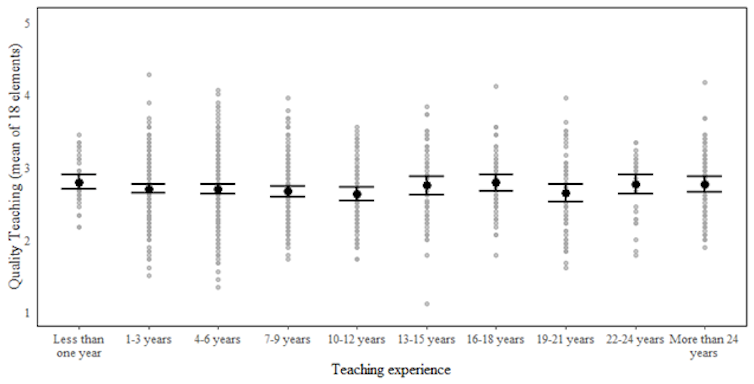
Graph showing Quality Teaching (mean of 18 elements) on Y axis and categories of teaching experience from less than 1 year to more than 24 years along the X axis.
This graph shows a teacher’s Quality Teaching score (the mean of 18 elements), compared to their experience. Author provided

Why does experience appear to make no difference?

Teaching quality is consistently described as the most important in-school factor affecting student outcomes.

Our finding that newly graduated teachers deliver teaching of a similar quality to that of their more experienced peers is surprising and somewhat counterintuitive. There are at least two possible explanations for this result.
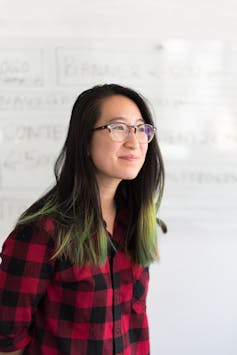
A young woman stands in front of a whiteboard.
Graduate teachers may be starting their jobs more ‘classroom ready’ than policymakers assume. Christina @ wocintechchat.com/Unsplash

First, the result suggests graduate teachers are entering the profession “classroom ready” because initial teacher education programs are performing far better than is typically assumed in policy and the media.

That is not to say improvements in teaching degrees aren’t possible or warranted, or that graduate teachers don’t face difficulties. We know attrition among teachers in their first five years is high and is a major contributor to teacher shortages.

Second, on-the-job experience is insufficient on its own to raise teaching quality. While experienced teachers make many valuable contributions through leadership and mentoring, it could be that much of the professional development they do over the course of their careers makes little difference to the quality of their teaching practice.

Teachers need professional development that builds knowledge, motivates them, develops their teaching techniques and helps them make ongoing changes in their classroom practice. It should be backed by rigorous evidence of a positive impact on teaching quality and student outcomes.

Teachers and teaching

Part of the problem in debates about schools and education is the relentless use of “teacher quality” as a proxy for understanding “teaching quality”. This focuses on the person rather than the practice.

This discourse sees teachers blamed for student performance on NAPLAN and PISA tests, rather than taking into account the systems and conditions in which they work.

While teaching quality might be the greatest in school factor affecting student outcomes, it’s hardly the greatest factor overall. As Education Minister Jason Clare said last month: I don’t want us to be a country where your chances in life depend on who your parents are or where you live or the colour of your skin.

We know disadvantage plays a significant role in educational outcomes. University education departments are an easy target for both governments and media.

Blaming them means governments do not have to try and rectify the larger societal and systemic problems at play.

Jenny Gore, Laureate Professor of Education, Director Teachers and Teaching Research Centre, University of Newcastle.

THE CONVERSATIOIN
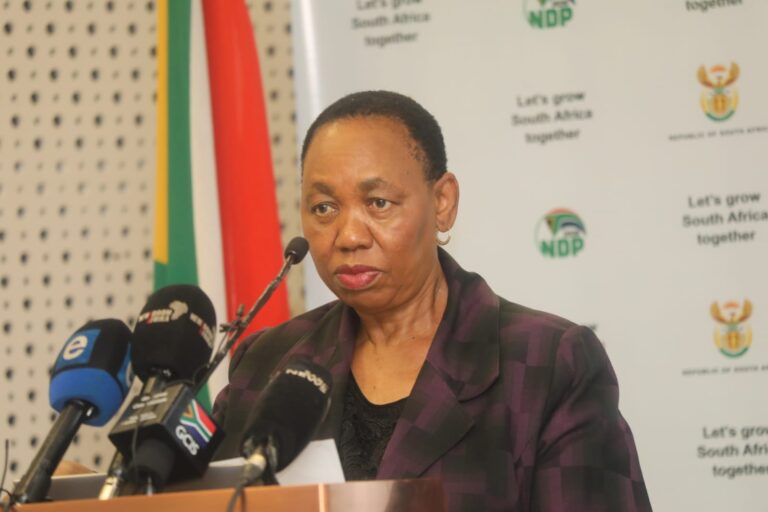
Over 2 400 schools equipped with necessary infrastructure, says Motshekga 

0

PHUTI MOSOMANE

BASIC Education Minister Angie Motshekga said on Sunday that government has taken action to accelerate the provision of school infrastructure across all nine provinces.

She said out of 3 398 schools, 2 478 have already been equipped with better infrastructure to create safe havens for school children.

Motshekga was briefing the media on the progress made on infrastructure roll out in the basic education sector on Sunday.

“To be precise, therefore, the department identified 3398 schools that were lacking in infrastructure in one form or another- that is either not age appropriate or simply inadequate. We have delivered 2478 projects to schools across the country,” Motshekga said, adding that Covid-19 pandemic lockdowns impacted on implementation. 

Through private sector funders, 184 were allocated, and so far, 117 infrastructure projects were completed. 

“317 electrification projects, 1 259 water projects and 1 053 planned sanitation projects were completed,” she sad. 

She said government is still investigating the circumstances surrounding the death of four-year-old Langalam Viki whose body was found in a pit latrine at Mcwangele Primary School in Vaalbank in the Eastern Cape.

Motshekga revealed that the school where Langalam passed away has been provided with new South African National Standards approved infrastructure. 

“Langalam was found in the tank of a senior toilet, not the age appropriate toilet where he would have normally gone. He was also found fully dressed,” she said. 

She urged police to investigate the case with greater care given that “Langalam was to young to lift the manhole that covers the tank”. 

Last week, SECTION 27 and the Centre for Child Law launched the Michael Komape Sanitation Progress Monitor online tool which will track progress by the Limpopo Department of Education (LDoE) in eliminating unsafe and inappropriate sanitation in the province’s public schools.

The online tool will be used hold the department and provincial government accountable.

INSIDE EDUCATION 


Read in your mother tongue – an initiative by AVBOB Road to Literacy campaign with OxfordUniversity Press.

0

EDWIN NAIDU

“Education is a fundamental human right of every woman, man and child” – UNESCO

In keeping with the theme of ensuring access to education, funeral insurance firm AVBOB and Oxford University Press will give away 260 trolley libraries equipped with books donated by Oxford University Press (OUP) Southern Africa, representing 11 official South African languages, numeracy books and other learning resources, to deserving primary schools and education NPOs.

The campaign is part of instilling a culture of reading and contributing to improving the numeracy skills of primary school children across the country.

Kebo Mosweusweu, AVBOB General Manager of Shared Value and Sustainability, says experts through various studies have found that teaching in a mother tongue helps reduce dropout rates and makes education more accessible and engaging for learners.

“Equally important is the need to develop numeracy skills at the formative ages of children. Through this year’s campaign, we aim to reinforce further our commitment to instilling a love of reading in primary school learners nationally,” says Mosweusweu.

The Progress in International Reading Literacy Study (PIRLS) latest findings show that 78% of Grade 4 learners in South Africa could not read meaningfully in any language because they need to be taught basic literacy in the language they speak at home. This means that only 22% of the country’s 10-year-olds understand what they have read.

Hanri Pieterse, Managing Director of Oxford University Press Southern Africa, says a good reader needs a developed written vocabulary to read with meaning. “This is why a child must learn how to read in their mother tongue. When they do; they develop this written vocabulary more easily as the words they read match the words they hear and speak”.

Oxford University Press Southern Africa is South Africa’s leading literacy publisher and has donated 130 000 books in all 11 official languages for this campaign.

In 2022, 180 trolley libraries were given to the winning recipients; this year (2023), that number has increased by 80 to 260 trolley libraries. The trolley libraries are sturdy structures fitted with wheels used to store the books manufactured by AVBOB Industries in Bloemfontein.

Last year, each trolley library was equipped with 430 books, whereas in 2023, each trolley will be delivered with 500 books. Each AVBOB Road to Literacy trolley library has a value of R50 000.

The total investment value for the 2023 competition is R13 million, an increase from R10 million in 2022. You can give a child the opportunity to read in their mother tongue by nominating a school/NGO in your community to receive one of 260 trolley libraries each to the value of R50 000.

How to nominate a school?

Calls for nominations for this year’s campaign will open on 01 March 2023 at 09h00. The public is encouraged to take part in this initiative by submitting electronic nominations as to why their choice of school or educational NPO deserves to win a trolley library equipped with books.

To nominate a school or an educational NPO, the nominator must include the desired language for the library so that the winners can receive books in their preferred language. Nominators can nominate deserving primary schools or educational NPOs who serve learners in Grades R – 7.

Please visit https://clickme1.zero-data.co.za/RTL_PR to select your chosen beneficiary.

INSIDE EDUCATION

More than 5 400 graduates to be capped at UCT

0

STAFF REPORTER

OVER 5 400 graduates will be capped when the University of Cape Town (UCT) hosts 15 graduation ceremonies from Monday, 27 March to Friday, 31 March 2023, at the Sarah Baartman Hall. 
 
The university will also award high academic honours in honorary degrees to two distinguished individuals: Dr Debra Roberts and Her Excellency ǂXuu Katrina Esau.
 
UCT Interim Vice-Chancellor Emeritus Professor Daya Reddy said: “We have once again come to that jubilant time of the year on our university calendar when we celebrate those who have over the years burned the midnight oil and successfully qualified for their various undergraduate and postgraduate degrees. We are, therefore, with great delight, looking forward to hosting the graduation ceremonies.”
 
The total number of graduands includes 57 PhDs, whose work has in many ways lived up to the university’s vision of unleashing human potential to create a fair and just society.
 
“I congratulate most warmly all our graduands who will be honoured and whose achievements will be recognised during these auspicious occasions. In the same breadth, let me record my appreciation for the role that our academic staff have played in guiding our graduands, as well as the support ably provided by our administrative staff. Parents, guardians, and other family members have also, in one way or another, made significant sacrifices and contributions to ensure the success of their loved ones.”

INSIDE EDUCATION

UKZN announces 10-year strategic plan for 2023-2032

STAFF REPORTER

THE University of KwaZulu-Natal has unveiled its plan for sustainable growth and excellence over the
next decade. The University’s 10-year Strategic Plan (2023-2032) was recently announced by Vice-Chancellor and Principal Professor Nana Poku, who described it as the “most ambitious plan by the University to date”.

“Over the next ten years, the University will build a resilient physical and human infrastructure to
foster innovation and entrepreneurship while continuing to engage in cutting-edge research,” he
said.

The Strategic Plan, which serves as a guide for University operations over the next decade, highlights five strategic goals to propel the University forward, i.e., Excellent Teaching and Learning, Excellent Student Experience; Excellent and High Impact Research Innovation and Entrepreneurship; High Impact Societal and Stakeholder Community Engagement; and Targeted Internationalisation.

“By creating partnerships and relationships with public and private sector partners as a vehicle for achieving its aspirations, the University will pursue its core purpose – to inspire greatness in every aspect of its mandate,” said Poku.

The University will strive to establish key high-impact interdisciplinary research institutes and promote institutional collaboration with industry and all stakeholders to provide a strong foundation that ensures relevant programmes are continually offered.

Chairperson of Council, Dr Leticia Moja, believes the plan will play a vital role in repositioning the University for continued global competitiveness and sustainability.

“As Council, we are excited to be part of this ambitious and forward-looking blueprint of the University for the next ten years. We applaud the hard work and diligence of the task team members who developed this Strategic Plan
and the stakeholders who provided input in the strategic planning process,” she said.

INSIDE EDUCATION

Teacher unions key to education stability, says KZN Education MEC Mbali Frazer 

0

PHUTI MOSOMANE

KWAZULU-NATAL Education MEC, Mbali Frazer, says that building a stronger working relationship with teacher unions is crucial to ensuring stability in education.

Frazer was addressing the South African Democratic Teachers’ Union (SADTU) KZN 6th annual excellence awards in Durban on Friday. 

“Today’s celebration of excellence in the education sector has further cemented my belief that the Department of Education’s strong partnerships with teachers’ unions and parents are essential for the stability of the education system in KwaZulu-Natal,” said Frazer.

As the biggest union in the sector, Frazer said SADTU plays a critical role in transforming the education sector. 

“We value our relationship with SADTU and appreciate our meaningful engagements and collaborations as a critical partner in the delivery of quality education in our great province of KwaZulu-Natal,” she said. 

Frazer said the province will continue supporting efforts by the union to advance professional development of educators and improve efficiency in the education sector.

“Your dedication, hard work, and tireless efforts in shaping the lives of our learners have not gone unnoticed, and we applaud you for your unwavering commitment to education. Wherever you go in the world, a functional education system begins with a dedicated qualified teacher and an efficient curriculum,” she said.

She said educators are the unsung heroes of our society, shaping the minds and futures of our learners. 

“Their commitment never wavers even in the most challenging times as we saw with last year’s floods and the Covid-19 pandemic which presented unprecedented challenges to our education system.”

“During the height of Covid SADTU members were among those at the forefront of adapting to the new reality of remote and hybrid learning,” she said.

She said teachers showed remarkable resilience, innovation, and creativity in ensuring that no learner is left behind: “For that, we all applaud you.”

KwaZulu-Natal’s matric class of 2022 achieved 83% pass rate and showed remarkable improvement in the quality of results.  

The significant contribution of SADTU, she said, as the largest union in the education sector, particularly in KZN province, made all of this possible

“I pledge to continue to support and work with SADTU to create an enabling environment that allows all our educators to excel,” she said.

INSIDE EDUCATION 

Unions considering 7.5% government wage offer

0

PHUTI MOSOMANE

THE South African Democratic Teachers’ Union, together with the unions affiliated to the Federation of Unions of South Africa (FEDUSA) including NAPTOSA, PSA, HOSPERSA and SAOU, are considering government’s offer of 7.5% wage offer. 

The unions represent 53,9% majority in the Public Service Co-ordinating Bargaining Council (PSCBC).

The unions said that the employer presented the final offer as follows:

1. An average of 7,5% for year 1 (Translation of the current non-pensionable cash gratuity into a pensionable salary). The 7,5% is implemented in a sliding scale where the lower salary levels would receive a larger percentage to close the wage gap. For an example at salary level the percentage would be 14,8% pensionable increase or what is known as baseline. The increase would apply to salary levels 1 – 12 including those remunerated in terms of an Occupation Specific Dispensation.

2. The difference between the demands on COLA and the final offer is 0,5%. As part of good faith negotiations labour had to revise its demand from 10% to 8% (7,5% employer and 8% labour) hence unions are subjecting the offer to members to decide.

3.The current cash gratuity translated into a pensionable increase was also cushioned by adding its tax as part of
pensionable increase.

4. If the cash gratuity of R1000 plus tax portion was removed as “claimed by those who seek disunity and dominance, the level 1 basic salary would be increase by 7,5% per annum to R22397,62. This would translate into R1562,62 per annum.” However, through tough negotiations, the employer acceded to 14,8% increase for salary level 1 which translated into R1539 per month.


5. In year two, which is the financial year 2024/2025, the employer has proposed to pay workers a pensionable increase set at CPI (Projected CPI for the relevant period will be deemed to be 4.5% and, in the event, the Projected CPI for the relevant period is above 6.5%, the Projected CPI will then be deemed to be 6.5%.

6. On housing allowance: the employer referred organised labour to a prior agreement that a CPI benchmarked increase would be effected yearly, hereafter referred to as the status quo.

But NEHAWU, POPCRU, DENOSA and SAPU did not to participate in the negotiations for the year 2023/2024.

Among others, NEHAWU and other public sector unions have committed to abandon the strike, return to council, and accepted the no work no pay rule.

“It is deeply concerning that unions in the public sector seem to be at odds with each other,” the majority unions at council said.

The unions urged members to engage in the mandate seeking process in their numbers so that negotiators “can secure what we have gained so far and more.”

The pay progression of 1,5% shall be paid with effect from the 1st of July 2023 in accordance with sectoral collective
agreements. 

This will further improve the notch by 1,5% for all those who shall have qualified. 

Unions said the reinstatement of the pay progression was an achievement. 

INSIDE EDUCATION 

SADTU Free State welcomes new MEC for Education

PHUTI MOSOMANE

THE South African Democratic Teachers’ Union (SADTU) Free State Provincial Secretary Mokholoane Moloi said the union welcomes the appointment of MEC for Education Makalo Mohale.

“We believe that the Premier has made a good choice in appointing MEC Makalo Mohale as he has been the MEC for the Department of Economic, Small Business Development, Tourism and Environmental Affairs (DESTEA) and understands the operation of government,” Moloi said.

He brings with him the knowledge and experience he acquired in DESTEA that the union believes could benefit the education sector, which is not new to him as he was once appointed as MEC for Education on an acting capacity in the absence of the late MEC Tate Makgoe.

Moloi said Mohale is a seasoned leader of the ANC who understands education policies of the movement that government must implement.

“We have full confidence in his capabilities and competence that he demonstrated in DESTEA to improve education.”

“As SADTU we are looking forward to a cordial, yet robust working relationship with the MEC that will enhance labour peace in the interest of education in the province,” Moloi concluded.

INSIDE EDUCATION

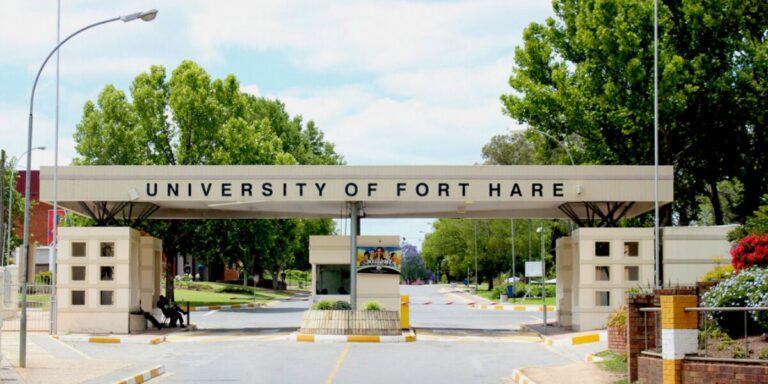
Ex-Fort Hare employee arrested in a sting operation

EDWIN NAIDU

A University of Fort Hare employee was allegedly arrested in a sting operation in Alice at the weekend. Police allegedly found him in possession of unlicensed firearms and live ammunition.

The employee, whose name is known to Inside Education, is in custody and due to appear in court.

Currently employed in a senior security management role at Calata House, the ANC provincial head office in Qonce, Eastern Cape, the man in custody joined UFH as a handyman in June 1989.

In October 2005, he was appointed as a security operations official at the university.

He left the university in March 2018. The man also worked as a bodyguard and chauffeur of a current UFH member of the Council.

In January, Professor Sakhela Buhlungu, the vice-chancellor, survived an apparent assassination.

Buhlungu was not in the car at the time of the attack on 6 January when his protection officer, Mboneli Vesele, who had worked with him since 2018, was shot and killed.

In May 2022, Petrus Roets, the university’s fleet and transport manager, was also shot dead in a suspected hit related to an investigation into corruption.

Buhlungu asked the President for action on corruption at Fort Hare. The Special Investigating Unit is still conducting investigations.

Fort Hare is one of the country’s oldest universities. Its alumni include the likes of liberation heroes Oliver Tambo, Nelson Mandela, Govan Mbeki, Robert Sobukwe, and Inkatha Freedom Party leader Mangosuthu Buthelezi in South Africa, Zimbabwean leaders Robert Mugabe and Herbert Chitepo, and Kenya’s Elius Mathu and Charles Njonjo.

INSIDE EDUCATION

Tribute to the late Free State Education MEC, Dr Tate Makgoe

0

EDWIN NAIDU|

CONDOLENCES for the late Free State Education MEC, Dr Tate Makgoe, who was laid to rest last weekend, continued across the education sector. These include condolences from the Minister of Basic Education, Mrs Angie Motshekga, Basic Education Deputy Minister, Dr Reginah Mhaule, various MECs, Umalusi, the South African Council for Educators (SACE) and teacher unions. 

The sector was shocked and saddened after the untimely death of Dr Makgoe on Sunday, 5 March 2023 when the MEC and his protector, Warrant Officer Vuyo Mdi, were killed in a car accident caused by stray cows whilst driving to Winburg.

Dr Makgoe, who has been the MEC for Education since 2009, has been lauded for the success of the province in education, which is attributed to his leadership and dedication to the sector, leading the province to retain the number one position for the National Senior Certificate (NSC) examination for four years in a row.

His passing is a huge loss to the sector as a whole; it is a tragedy for his family, the province and the country.

A memorial service for the MEC took place at the Education District Offices in the Free State Province on 8 March 2023, at various venues throughout the province, and for the Free State Provincial Government on 9 March 2023, at the University of the Free State, South Campus.

Dr Makgoe’s funeral service took place on 12 March 2023 at the University of the Free State, South Campus. Warrant Officer Mdi was laid to rest on Saturday, 11 March 2023.

Basic Education Minister Angie Motshekga described MEC Makgoe as a trailblazer of note.

“I have no words to express my deepest shock at the news of the untimely passing of comrade Tate. When I was appointed Minister of Basic Education, he was also appointed MEC of education in the Free State and has been in the position ever since. The success of the province in education can be attributed mainly to his leadership, dedication, understanding of the sector and the innovation which has yielded great results. I am saddened by his passing.”

He obtained a Bachelor of Commerce honours degree from the University of the Free State, a Master’s degree in business leadership from the University of South Africa. Then he registered for a PhD in Leadership in Education with the University of the Free State.

Between 1998 and 2001, Makgoe served as provincial treasurer and member of the executive committee of the ANC in the Free State. He later took on the role of chair of chairs in the Free State legislature, between 2001 and 2004.

In subsequent years, he filled the role of the MEC for public safety, security and liaison and the MEC for finance before taking over the education portfolio in 2009.

Makgoe made headlines this year after Free State clinched the number-one spot in the matric results for the fourth year in a row. The province obtained an 88.5% pass rate, an increase of 2.8% from 2021.

During a portfolio committee meeting on basic education recently, committee members also paid tribute to the late MEC. Chairperson Bongiwe Pricilla Mbinqo-Gigaba called for a minute’s silence and shared fond memories of the late MEC, commending him on his contribution expressing her condolences to Mr Makgoe’s family, the Free State Government, its learners and educators.

Motshekga said she was honoured that a moment was given to recognise Mr Makgoe, who was a key proponent in dealing with concerns around maths. He introduced innovative interventions such as maths labs, walls painted with mathematical shapes and mathematical games in primary schools in the Free State.

He introduced ways to inspire children to interact with maths.

The Minister said the death of the MEC was “a big loss”.

Democratic Alliance MP Baxolile Nodada expressed his condolences for the loss of Mr Tate Makgoe and his protector.

He said the loss was a massive blow to education as he would have made great contributions.

INSIDE EDUCATION