Home Blog Page 216

NSFAS vows to resolve students accommodation crisis

PHUTI MOSOMANE

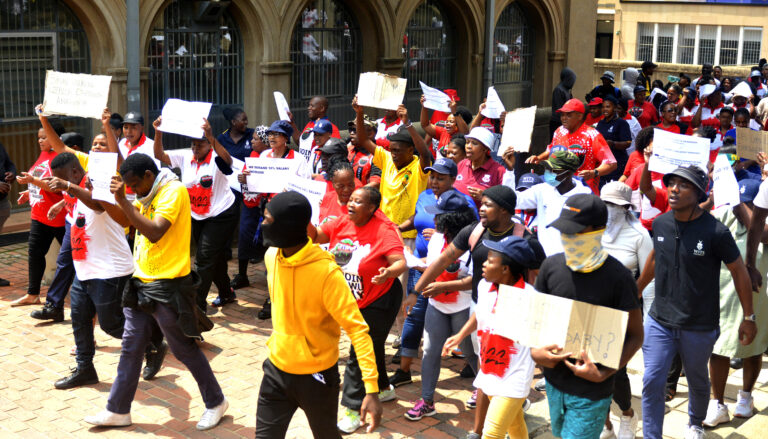
AFTER a series of countrywide protests by students at higher education institutions regarding the newly introduced accommodation cap and fee payment blocks, the National Student Financial Aid Scheme (NSFAS) says it will intervene to resolve the impasse.

“NSFAS held robust consultations with the South African Union of Students (SAUS) to mitigate these challenges ahead of the commencement of the academic classes,” NSFAS spokesperson Slumezi Skosana said on Thursday.

Skosana said NSFAS will take extraordinary measures to ensure that all funded students are not left stranded “due to skyrocketing accommodation costs.”

There have been protests in most universities against a new accommodation cap of R45 000 per annum.

During a meeting held in Gauteng on Monday, NSFAS management and SAUS agreed that the student union would assist the scheme in collating details of all students who do not have accommodation and are allegedly sleeping in public places.

“The scheme is also engaging universities in a bid to receive credible information to fast-track the process. In the meantime, NSFAS is in the process of identifying alternative accommodation to be provided within the stipulated rate of R45 000 per annum,” Skosana said.

The priority will be the universities affected by the accommodation cap, and these include the University of Pretoria, University of the Witwatersrand (WITS), Stellenbosch University, University of KwaZulu-Natal (UKZ), Rhodes University and Sol Plaatjie University.

NSFAS said SAUS has made an undertaking to contact all SRCs in affected universities to supply the information.

The Portfolio Committee on Higher Education, Science and Innovation held an urgent meeting this week on Monday with the South African Union of Students (SAUS) and the South African Technical Vocational Education and Training Students Association (SATVETSA) where the student governance bodies expressed areas of concern across the post-school education and training sector (PSET), highlighting specific universities and colleges.

Chairperson Nompendulo Mkhatshwa, who is a former Fees Must Fall activist, said the committee supports SAUS and SATVETSA on their stance in support of the R45 000 cap on student accommodation allowances for NSFAS students.

Mkhatshwa said the exorbitant prices of student accommodation cannot be normalised as they are “tantamount to price fixing.”

The committee recommended that the Department of Higher Education and Training and NSFAS reach out with speed to the Competition Commission to address issues of alleged collusion between private accommodation providers and officials of the institutions.

“The committee reiterated that a cap on student accommodation not only looks at NSFAS-funded students, but takes into account self-funded students who need to be protected from price fixing by private accommodation providers,” said Mkhatshwa. 

INSIDE EDUCATION 

UCT students disrupt classes over fee blocks

PHUTI MOSOMANE

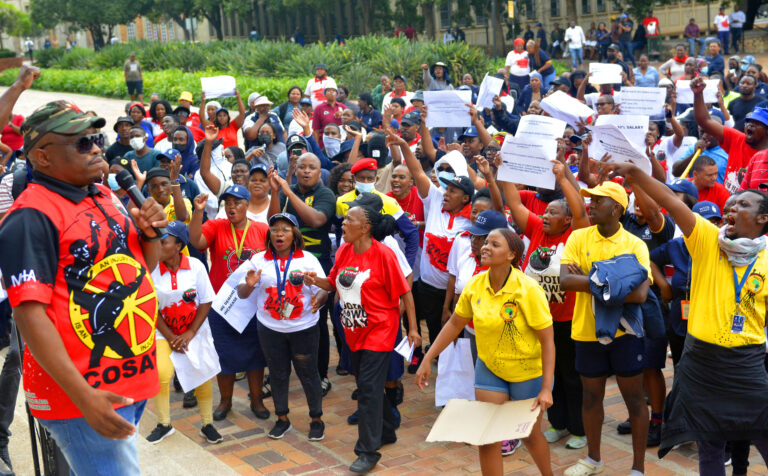
THE University of Cape Town (UCT) has confirmed that a group of students have disrupted lectures on upper campus on Wednesday over fee payment blocks and student accommodation.

“These acts of disruptions are unlawful in terms of the interim interdict granted by the Western Cape High Court on Friday, 17 February 2023. As a result, the relevant members of the executive have alerted the SAPS, who will intervene and respond to these disruptions,” the university said in a statement.

The Cape Town High Court granted an interdict on the 17th of February 2023, barring further violent protests, protecting infrastructure and students who wish to learn without disruption and move about freely on campus without intimidation.

The University said it is upholding the right to legitimate protest, but will act against any unlawful activities.

“The executive further remains committed to a process of engagement over any issues, noting that an array of measures has been put in place already to enable over 4 000 students with fee blocks to register for the 2023 academic year.”

“Only a few classes have been disrupted. The rest of the classes have continued. Where practically possible, classes scheduled for the remainder of the day are to continue while the executive activates measures to respond to the unlawful disruptive acts,” it said.

On Tuesday, UCT Student Representative Council (SRC) held a mass meeting in which it told students that the university council and its executives are prepared to let the future of 7 435 fee blocks come to an end.

“The SRC refuses to allow so many of our fellow students to fall deeper into the cycle of poverty. We will peacefully demonstrate and stand together as students against oppression. We have vowed to leave no student behind,” it said.

UCT SRC said it had a five-hour meeting with the University Council on Monday “in which the proposal to lift fee blocks was not accepted”.

It accused the university of having no care for poor and black students who are unable to afford the exorbitant costs (tuition and accommodation fees).

The DA in the Western Cape strongly also condemned the “illegal protests” currently underway at the University of Cape Town.

“We firmly support the Acting Vice Chancellor’s request that SAPS immediately respond to the matter and bring the protest under control. Today we have seen aggravated disruption and assaults on students. We hope to see the SAPS regain control and protect this institution and its students so learning may continue undisturbed.”

“Although we acknowledge their right to protest, they must do so peacefully and follow necessary protest action procedures,” DA Councillor in the City of Cape Town, Yusuf Mohamed, said.

Chairperson of the Portfolio committee on higher education Nompendulo Mkhatshwa said the committee remained concerned by the broader policy.

“Structural issues such as funding for the missing middle and thus implores once again on the DHET to finalise its work on the Ministerial Task Team on Student Funding and submits its report to the committee.”

INSIDE EDUCATION

Wits Protest: Low student morale as SRC President Aphiwe Mnyamana remains suspended

PHUTI MOSOMANE

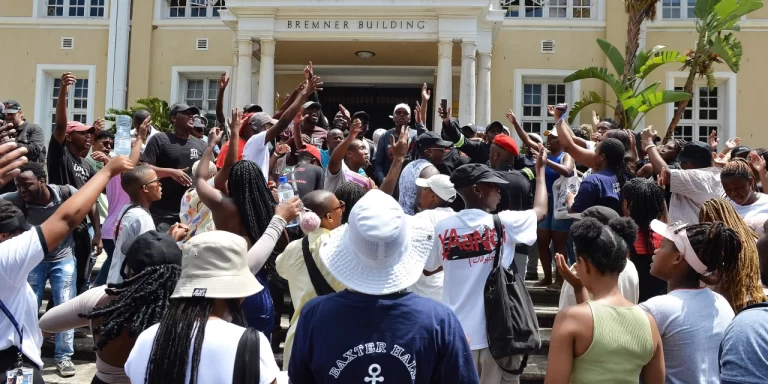
FOLLOWING the suspension of Wits University student representative (SRC) President, Aphiwe Mnyamana, a group of students continue to hold protest on university campus. 

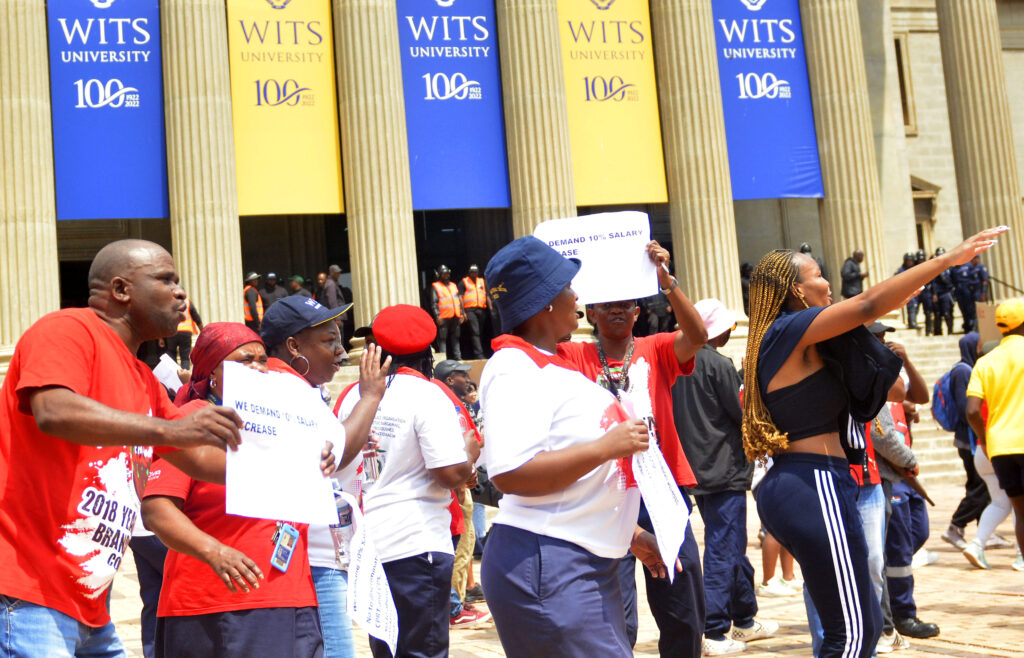
On Tuesday, protesting university students moved from campus to campus in small groups, singing and holding placards about their challenges including financial exclusion.

Visibly tired, a handful of students gathered in the morning outside Wits Great Hall, but the numbers increased by 12 midday on Tuesday.

Members of the Nehawu’s Bheki Mkhize branch joined the protesting students who vowed to continue the fight until their demands are met. 

The South African Union of Students (SAUS) raised concern over the suspension of Mnyamana.

“A team will be sent to Wits University for talks with the management while the protest continues,” SAUS President Yandisa Ndzoyiya said.

On Sunday, the university slammed protesting students for camping outside the Vice-Chancellor Zeblon Vilakazi’s home in Johannesburg.

“Homeless students in need of accommodation have decided to peacefully sleep outside the Vice Chancellor’s house in a bid to demonstrate the state of hopelessness and how dire the situation is,” Wits SRC tweeted pictures of desperate students at midnight on Sunday.

This prompted Gauteng Premier Panyaza Lesufi and National Student Financial Aid Scheme (NSFAS) Chairperson Enerst Khoza to meet SRC leaders in Monday.

Later on the same day, the university confirmed the suspension of Mnyamana.

“We refer to Mr Aphiwe Mnyamana’s tweet posted at 20:31 tonight and confirm that Mr Mnyamana was suspended on 6 March 2023. He failed to appear at a suspension hearing scheduled today despite having been provided with ample opportunity to make representations at such hearing,” Wits management said in a statement.

It said the allegations against Mnyamana are of a serious nature and relate to conduct that infringed on the rights of others, resulted in damage to property, and the intimidation of members of the University community, amongst other things.

“He will not be allowed to access any of Wits’ precincts, participate in university activities and engage in conduct which constitutes “student privileges”, and will not be allowed to stay in Wits’ residences until the legal process is finalised,” it added.

But Mnyamana remains adamant that as soon as he secures the services of a legal representative, he will announce his next decision in light of the suspension.

He said wanted to be represented by Advocate Dali Mpofu who, by Tuesday morning was still in Parliament representing suspended Public Protector Advocate Busisiwe Mkhwebane.

Wits Student Forum (WSF) condemned the suspension of Mnyamana.

“Wits Student Forum strongly condemn the suspension and single outing of the SRC President, and it warrants intimidation and constitute scare tactics by the University Senior Management towards student leaders,” said Student Forum Chairperson Lungile Magagula.

A group of students from Wits University. PHOTO: Eddie Mtsweni


INSIDE EDUCATION 

Higher Education Deputy Minister Buti Manamela says universities would collapse if debts were written off

EDWIN NAIDU

AMID escalating country-wide tension over student fees at tertiary institutions across South Africa, Deputy Minister of Higher Education, Science, and Innovation Buti Manamela has warned that universities would collapse if debts estimated at R16.5 billion are wiped out.

Speaking to Inside Education, as protests began earlier in the week, Manamela said the total amount owed by students was made up of new debt, as the government injected about R2 billion in 2018 to settle the historical debt.
Manamela said some paperwork between universities and the National Student Financial Aid Scheme must be finalised to understand the extent of student debt.

However, he added that any suggestion that debts be written off would mean that “most universities will go down the drain”.

“I think what we need to be working on firstly is that graduates should be employed. And once they
have a decent income, they can repay their debt.”

“But secondly, we’re looking at ways within which the missing middle, which is those who come from households whose income is more than R350,000 per annum but up to R600,000 per annum of those that people would regard as the missing middle, can get funding at reasonable repayment terms,” he said.

Referring to the Minister of Higher Education, Science and Innovation, Dr Blade Nzimande’s academic outlook last week, Manamela said the intention is to ensure that in the 2024 academic year, there is policy certainty regarding policy and systems in place.

“It would be quite challenging to write off the debt. It has huge implications for universities. And they would return to the national fiscus and say, look, you’re asking us to write off the debt. You’ll have to give us the money; I don’t think we have that. We are battling to raise funds to fund postgraduate students, which is, for me, the next bigger challenge for now,” Manamela said.

According to Nzimande, for the current financial year, NSFAS has approved the provisional funding of a record milestone of 1,083,055 students at a projected budget of R47.6 billion.

All NSFAS students are registering without making any upfront payments. Unlike last year, NSFAS has this year made upfront payments to universities and colleges to ensure that they register all NSFAS students and for student allowances to be paid.

The Minister has planned to meet with university registrars to attend to all matters relating to concerns raised by students and parents on the delays in providing information to facilitate registration by NSFAS.

NSFAS has introduced a NSFAS Bank account to ensure beneficiaries are paid directly and on time by eliminating third-party dependencies. NSFAS has also enabled a direct payment platform and student accommodation platform to address previously experienced challenges that significantly impacted student well-being.

But Manamela said the Ministry had pushed for tertiary institutions to refrain from withholding student results, making getting a job for graduates impossible.

“Some universities have responded positively, and I suppose, as long as we, because I think that’s how things work in this, is that you want to put something as you know, as policy or as regulation for them to so as is now, there is no
policy.”

INSIDE EDUCATION

Controversial, colourful UCT Vice-Chancellor leaves a divided varsity dubbed “the best in Africa”

EDWIN NAIDU

LOVE or loathe her, in her five tumultuous years, Professor Mamokgethi Phakeng has taken the University of Cape Town on an exhilarating, sometimes exasperating, even exciting, roller-coaster ride since her appointment on 1 July 2018.

She leaves behind a university deemed the best in Africa – the best-performing, according to five global rankings: Times Higher Education (THE) World University Rankings 2023, Quacquarelli Symonds (QS) World University Rankings 2023, U.S. News & World Report Best Global Universities Rankings 2022–2023, Center for World University Rankings 2022–2023, and Shanghai Ranking’s Academic Ranking of World Universities 2022.

Before she took office, they featured in one, however, the tenure of the first black female South African to achieve a PhD in mathematics education began at UCT on a sad note.

Just three weeks into the job, UCT was plunged into crisis when Professor Bongani Mayosi took his life.

He had attempted to leave twice under former vice-chancellor Dr Max Price but was given reassurances about his future, including the university’s offer of a Pro-Vice-Chancellor role which never materialised.

The 157-page report by Professor Thandabantu Nhlapo, Dr Somadoda Fikeni, Professor Pumla Gobodo-Madikizela and Ms Nomfundo Walaza dismissed the notion that students had pushed the professor over the edge. UCT executive was also criticised for not adequately responding to the warning signals from Mayosi, which showed someone struggling emotionally and needing serious intervention.

The panel was told of several incidents, one in October or November 2016, where Mayosi was to address members of the Western Cape Government at a hotel in the city. He did not show up and was found sitting in his car at a car park nearby, staring into space. While attending a conference in Egypt in 2016, a colleague reported that Mayosi had problems speaking.

In London, following the visit to Egypt, Mayosi did not arrive at a session in which he was scheduled to participate.

A family friend found him in his hotel room, apparently after he had been walking around the city.

Although Phakeng was not yet in charge during Mayosi’s most challenging period during the 2015 student protests, she faced criticism for failing to follow the panel’s recommendations in its report in 2020.

During the second year of her tenure, UCT was shocked at the brutal murder of Uyinene Mrwetyana, one of around 47 student killings at tertiary institutions in 2019. It brought safety at universities into the spotlight.

In 2020, the Covid-19 pandemic and the subsequent lockdown failed to keep UCT out of the news.

Former Ombud Zetu Makamandela-Mguqulwa accused Phakeng of bullying in a report, alleging that the outgoing council chair Sipho Pityana had not acted on the complaints.

Phakeng labelled the report inconsistent with the terms of reference. But Pityana left this hot potato for the new council, which also ignored it.

More drama followed in 2021, when fires on Table Mountain spread, ravaging the Jagger library and
other buildings. UCT could not escape the news as the clean-up operation took shape.

In 2022 came the bombshell allegations that council chairperson Babalwa Ngonyama allegedly lied to Senate.

“Through all these, UCT took leadership of all the five major university world rankings. It is important to note that when I took office in 2018, UCT led in only one world ranking and the Business school had fallen off all the rankings. People also forget that we had lost students from our feeder schools when I took office. Today we have them back, and we are telling a different story about UCT’s performance under my leadership. I am a decisive leader who holds people accountable, which has produced results,” she told Inside Education.

When news of the end of her reign emerged, it was the former Stellenbosch University Vice-Chancellor Professor Chris Brink, a member of UCT’s remuneration subcommittee, who initially made an offer on 9 February to drop the governance charges and disband the panel led by retired Supreme Court of Appeal president, Judge Lex Mpati, in return for her departure.

This was stated in a letter by attorney Halton Cheadle. Retired judge Dennis Davis also expressed a view on the alleged evidence against Phakeng.

Phakeng signed the letter accepting the offer to leave, citing that her position had become untenable. But the council said the panel would continue its governance probe following condemnation by the Black Academic Caucus of the proposal to withdraw it if Phakeng went.

In recent months, Ngonyama, along with Phakeng, were persona non grata and instructed to stay away from council meetings. At the same time, the governance charges against them for their role in the departure of 61-year-old Argentinian Associate Professor Lis Lange DVC: Teaching and Learning at the end of April were being formulated.

Lange’s grievance was not being given a chance to finish her work.

It led to Senate breaching its own governance rules in admitting her complaint without the protocols they usually employ. Her letter was read out to Senate by Professor Sue Harrison, Deputy Vice-Chancellor for Research and
Internationalisation, while Phakeng was abroad.

She disputed Ngonyama’s version of events leading to her departure before the Senate, wanting to end speculation and misrepresentation by the council chair. She signed the NDA on 17 March 2022.

Digesting the news that Phakeng had gone, a Council Member said: “Anti-transformation is the real enemy here. Just wish some people did not sell us out so badly, not referring to the Chair, but those with struggle credentials.”

A staff member said UCT could start from a clean slate and build on Phakeng’s good works.

Controversies and colour, she provided aplenty. Despite the heat, in September 2022, Phakeng won the inaugural Africa Education Medal, honouring changemakers who transform education.

Television personality Oprah Winfrey sent congratulations in a video.

Phakeng’s exit won’t end the probe into the governance allegations. But it will deprive South Africa
of one of higher education’s most vocal, sometimes outrageous, and outspoken voices.

Yet she kept silent when celebrated spinal surgeon Professor Robert Dunn was investigated for a
crude email in which he used the term “clinic bitch” against a young black medic.

He apologised, labelling it a joke. It was not funny. Phakeng addressed it internally, however. But things remain the
same.

The same month, the Twitterati vice-chancellor was endorsed when UCT was voted the
coolest university in a youth survey. No other vice-chancellor in the country posts videos exercising or dares to do the Jerusalema Dance challenge with a beaming smile. [https://www.youtube.com/watch?v=bdgn64U9LmY].

While the dust settles and UCT focuses on searching for a successor, Phakeng has returned to Johannesburg.

She plans next to conquer Mount Kilimanjaro.

INSIDE EDUCATION

Technology – where Smart Cities, disruptive engineering and machine learning meet

INSIDE EDUCATION REPORTER

IN a year that brought Artificial Intelligence (AI) solutions to the fore in a much stronger way than before, it is essential to demonstrate our authentic wisdom and empathy as engineers in all we do, says Prof Wynand JvdM Steyn, Dean of the Faculty of Engineering, Built Environment and Information Technology at the University of Pretoria.

While AI engines and apps provide us with additional tools to collect, analyse, and synthesise information and data on a scale that was previously only imagined, our authentic human talents and abilities to ensure a sustainable future are vital.

Do you want to make a difference in society as an engineer? Gone are the days when engineers were known only for their technical prowess. Today’s engineer – and the engineer of the future – is intent on changing the world for the better, designing innovative, yet functional systems, structures and materials that ultimately benefit the individuals who will be using them.

Sustainable development and resilience are the driving forces behind today’s engineering innovations. And the University of Pretoria’s Faculty of Engineering, Built Environment and Information Technology (EBIT) is the place to prepare yourself for such a future.

Recognised as a top faculty nationally and internationally, it is one of the few faculties in Africa to feature among the top 550 in the world in five subject areas in the 2022 QS World University Rankings by subject in engineering and technology. It has also been ranked in the top 1% in the world in terms of research output by the ISI Essential Science Indicators.

The faculty is home to a generation of leaders and innovators dedicated to improving lives – in their communities and cities, the country and the world. Its exceptional students and staff are process thinkers and problem solvers. Their research leads to real-world change through holistic, transdisciplinary solutions.

The strategic vision of the faculty is to develop critical mass and synergies at the intersection of its research focus areas. Its slogan, “Innovating our tomorrow”, keeps it on the path of pursuing innovation. It is committed to remaining relevant and addressing the challenges of the Future of Work.

With research initiatives aimed at making an impact locally, regionally and around the world, the faculty’s researchers consider key priority areas that have the potential to address global challenges. These focus areas have been identified for their potential to enable transdisciplinary research: water and environmental engineering, minerals and materials beneficiation, the Fourth Industrial Revolution, smart cities and transportation, energy, big data science, information and communication technology, and technology and innovation management.

One of the faculty’s flagship transdisciplinary initiatives is the Hatfield Digital Twin City. This collaborative, data-driven platform has real-world applications with multiple stakeholders. It is focused on developing smart cities, and transcends the boundaries between architecture, civil engineering, project management and information systems, particularly regarding the role of big data.

This platform facilitates a multitude of research and experimentation opportunities. It focuses on the 10 km2 area that forms the Hatfield Metropolitan Development Node in Tshwane, Gauteng. This includes the University of Pretoria’s Hatfield Campus, university- owned residential assets and the University’s Innovation Africa @UP platform,
encompassing the Engineering 4.0 facility and the Future Africa research institute.

The Hatfield Digital Twin City provides opportunities for transdisciplinary work, and acts as a testbed for developing smart applications that support improved service delivery, the more efficient use of resources and urban resilience. For example, the facilities management and civil infrastructure environment focus on developing continuous responsive networks, where real-time data informs maintenance and management decisions on both the local
and national scales.

The success and new possibilities that arise from such collaboration could lead to a longer-term vision to establish a centre of excellence for African digital and smart cities, hosted and anchored at the University of Pretoria.

Another research initiative that is changing lives is the development of insecticide-infused products to prevent malaria. This innovation has taken the laboratory to the marketplace.

Emanating from research conducted in the University’s Institute of Applied Materials, a long-lasting, slow-release insecticide active is woven into material fibres. This has proven to be an effective means of protection from the mosquitoes that cause malaria.

This life-threatening disease is caused by the bite of a female Anopheles mosquito infected with the Plasmodium falciparum parasite, which is endemic to Africa. Although mostly confined to tropical areas, it results in approximately 250 million clinical malaria cases and nearly half a million deaths annually.

The EBIT inventors’ patented slow-release technology reduces the evaporation of expensive insect repellents, making them last longer. Initially applied to mosquito nets, it has been expanded to a hiking sock, where it is woven into the material fibres. This product is already available in stores.

Additional future applications of the slow-release technology are being investigated. This includes slow-release pheromone traps for sustainable agricultural pest control and the transdermal dosing of pharmaceutical actives. These initiatives have passed the proof-of-concept stage and are currently under further development.

The sustainable use of energy impacts every aspect of our daily lives. Research into energy security is driven by the targets of the United Nations’ Sustainable Development Goal (SDG) 7: Affordable and Clean Energy. In addition to efficient energy use, it focuses on alternative energy sources in the global quest to achieve a zero-carbon economy by 2050.

This is in accordance with the objectives of the United Nations’ Intergovernmental Panel on Climate Industry support of the faculty’s research in energy security is evident in the Exxaro Chair in Energy Efficiency, focusing on improving energy use in the mining, manufacturing, commercial and residential sectors.

On the other hand, research in the Centre for New Energy Systems forms the interface with energy systems, econometrics, control theory and financial mathematics to provide a platform for developing transdisciplinary solutions.

INSIDE EDUCATION

Competition Commission’s school uniform procurement guidelines change lives

INSIDE EDUCATION REPORTER

TWO years ago, Tshwane-based entrepreneur, Pamela Luthuli sold school uniforms from the boot of her car for two days a week. On a good day, she would sell up to five items daily. Some days she would return home without a single sale.
 
Today, Luthuli runs a thriving business producing and supplying school uniforms, tunics, golf shirts, blazers, tracksuits, and related clothing items to 10 schools in and around Tshwane.
 
Luthuli owns one of many Small and Medium Enterprises (SMEs) that benefitted from the Competition Commission’s (Commission) school uniform procurement guidelines.

She used the National Guidelines on School Uniform issued by the Department of Basic Education (DBE) in 2006 and the Circular on the Procurement of School Uniforms and other Learning-Related Material jointly issued by the DBE and the Commission in 2020 (Circular No. 11 of 2020) as a steppingstone to participate meaningfully in the value chain of the school uniform production industry.
 
“The school uniform industry was in my family’s DNA. I know the business in and out but could never supply schools directly with my products. I would hit a brick wall and be told that they [schools] already have their preferred supplier,” said Luthuli.

But her fortune gradually changed when she learned of the guidelines and read about the Commission’s awareness
campaigns encouraging more schools to adhere to the guidelines and to practice pro-competitive procurement that supports SMEs and enables parents and guardians to exercise choice when buying school uniforms.
 
“The guidelines opened doors for me and many others. In approaching schools, I would also refer them to the guidelines and inform them about the importance of opening opportunities for entrepreneurs,” said Luthuli, who now also employs five workers at Panda Uniforms and Projects to help keep up the demand for her products.
 
Luthuli’s success, according to the Commission’s Head of Advocacy, Khanyisa Qobo, underpins the objective of the guidelines. Pointing to a survey conducted in October 2022 to evaluate compliance with the guidelines, Qobo said many respondents (schools, parents, and suppliers) were now aware of the guidelines – a completely different result from 2016 when there wasn’t much awareness about its existence. 
 
“The survey found that contracts between schools and suppliers have been limited. It also found that schools have now largely reconfigured their uniforms to allow for a greater mix of generic and unique items,” said Qobo, adding that there were improved levels of compliance with the guidelines.
 
The 2022 survey found that schools follow some procurement processes where exclusivity clauses are removed, and more competitive bidding practices are adopted. A large number of schools have taken steps to adopt the national guidelines as part of the school’s governance. 
 
Importantly, said Qobo, is that the guidelines and the work of the Commission have compelled all stakeholders along the school uniform value chain to promote greater levels of competition in the market.

INSIDE EDUCATION

New global ranking of all 26 universities in South Africa

Webometrics’ latest global ranking of universities in 2023 has ranked all of South Africa’s universities based on the quality, quantity, and access to their web content, using open data.

The “Webometrics Ranking of World Universities” is an initiative of the Cybermetrics Lab, a research group belonging to the Consejo Superior de Investigaciones Científicas (CSIC), the largest public research body in Spain.

The research group’s ranking has a special focus on open access to data from global universities and lists institutions based on the quantity and quality of their web content.

The group stresses that the ranking has nothing to do with university websites – ie., the popularity, design or accessibility – but rather link analysis, which includes bibliographic citations used by other university rankings and also third-party involvement with university activities.

“Research output is also a key topic for webometrics, including not only formal – e-journals, repositories – publications but also informal scholarly communication.

“Web publication is cheaper, maintaining the high standards of quality of peer review processes. It could also reach much larger potential audiences, offering access to scientific knowledge to researchers and institutions located in developing countries and also to third parties (economic, industrial, political or cultural stakeholders) in their local community,” the group said.

Using webometrics, the group focused the 2022 ranking on three main indicators:

  • Visibility: The number of external networks (subnets) linking to the institution’s web pages ( weighted 50%)
  • Transparency or Openness: The number of citations from the Top 310 authors, excluding the top 30 outliers (10%)
  • Excellence: The number of papers amongst the top 10% most cited in each one of all 27 disciplines of the full database over the last five years (40%)

Because the ranking pulls its bibliographic data from many of the same sources, the list of top institutions closely follows that of other rankings. However, the Cybermetrics Lab says its ranking differentiates itself by excluding “subjective” indicators like feedback from surveys and unreliable reporting from the universities themselves.

The caveats to its data include bad naming practices by universities and sharing top-level domains – or changing these domains frequently – which can penalise their performance in the ranking.

Because of the web-based nature of the data collected, the Webometrics ranking also covers a staggering number of higher learning institutions – over 31,000 – including many of the smaller colleges and institutes often left out of other global rankings.

However, because all these institutions are ranked together, no distinction is explicitly made, so colleges, universities and theological seminaries are all listed together.

For South Africa, 123 higher learning institutes were ranked, falling between 246th and 29,531st in the world. South Africa has 26 public universities, including 12 traditional universities, six comprehensive universities, and eight universities of technology. All universities feature in the rankings.

The University of Cape Town (UCT) was the top-ranked university in the country, following the same trend seen in other university rankings.

UCT is followed by the University of the Witwatersrand, Stellenbosch University and the University of Pretoria. These were the only universities ranked within the top 500 globally.

Within the top 1000, the University of KwaZulu Nata, the University of Johannesburg, Unisa and the University of the Western Cape follow.

The full ranking of South African universities is below:

Local #UniversityGlobal #
1University of Cape Town246
2University of the Witwatersrand398
3Stellenbosch University438
4University of Pretoria450
5University of KwaZulu Natal598
6University of Johannesburg653
7University of South Africa795
8University of the Western Cape927
9University of the Free State1106
10Rhodes University1138
11Cape Peninsula University of Technology1593
12North-West University1668
13Tshwane University of Technology1717
14Durban University of Technology1856
15University of Fort Hare2339
16University of Limpopo2710
17Nelson Mandela University2715
18University of Venda2941
19Vaal University of Technology3198
20Sefako Makgatho Health Sciences University3270
21University of Zululand3280
22Central University of Technology3570
23Walter Sisulu University3761
24University of Mpumalanga7935
25Mangosuthu University of Technology8262
26Sol Plaatje University9459

Global Universities

The ranking of global universities aligns closely with other global rankings, with Harvard University in the United States taking top honours.

This is followed by Standford University, the Massachusetts Institute of Technology, and the University of California Berkeley.

The top 10 is dominated by US institutes, with the only non-US institution in the top 10 being the University of Oxford, ranking 5th, while the University of Cambridge falls just outside the top 10 at 12th.

Global#UniversityCountry
1Harvard UniversityUS
2Stanford UniversityUS
3Massachusetts Institute of TechnologyUS
4University of California BerkeleyUS
5University of OxfordUK
6University of MichiganUS
7University of WashingtonUS
8Cornell UniversityUS
9Columbia University New YorkUS
10Johns Hopkins UniversityUS

BUSINESS TECH

Iran’s top leader says suspected poisonings of schoolgirls ‘unforgivable’

0

Iran’s supreme leader said Monday that if a series of suspected poisonings at girls’ schools are proven to be deliberate the culprits should be sentenced to death for committing an “unforgivable crime.”

It was the first time Supreme Leader Ayatollah Ali Khamenei, who has the final say on all matters of state, has spoken publicly about the suspected poisonings, which began late last year and have sickened hundreds of children.

Iranian officials only acknowledged them in recent weeks and have provided no details on who may be behind the attacks or what chemicals — if any — have been used. Unlike neighboring Afghanistan, Iran has no history of religious extremists targeting women’s education.

“If the poisoning of students is proven, those behind this crime should be sentenced to capital punishment and there will be no amnesty for them,” Khamenei said, according to the state-run IRNA news agency.

Authorities have acknowledged suspected attacks at more than 50 schools across 21 of Iran’s 30 provinces since November.

Iran’s Interior Minister Ahmad Vahidi said over the weekend that “suspicious samples” had been gathered by investigators, without elaborating. He called on the public to remain calm and accused unnamed enemies of inciting fear to undermine the Islamic Republic.

Vahidi said at least 52 schools had been affected by suspected poisonings, while Iranian media reports have put the number of schools at over 60. At least one boy’s school reportedly has been affected.

Videos of upset parents and schoolgirls in emergency rooms with IVs in their arms have flooded social media.

Iran has imposed stringent restrictions on independent media since the outbreak of nationwide protests in September, making it difficult to determine the nature and scope of the suspected poisonings.

On Monday, Iranian media reported that authorities arrested a Qom-based journalist, Ali Pourtabatabaei, who had been regularly reporting on the suspected poisonings. The hard-line Kayhan newspaper in an editorial had called for the arrests of newspaper publishers who printed articles on the crisis critical of Iran’s theocracy.

The protests were sparked by the death of a young woman who had been detained by morality police for allegedly violating the country’s strict dress code. Religious hard-liners in Iran have been known to attack women they perceive as dressing immodestly in public. But even at the height of Iran’s 1979 Islamic Revolution, women and girls continued attending schools and universities.

The children affected in the poisonings have reportedly complained of headaches, heart palpitations, feeling lethargic or otherwise unable to move. Some described smelling tangerines, chlorine or cleaning agents.

Reports suggest at least 400 schoolchildren have fallen ill since November. Vahidi, the interior minister, said in his statement that two girls remain in hospital because of underlying chronic conditions. There have been no reported fatalities.

As more attacks were reported Sunday, videos were posted on social media showing children complaining about pain in the legs, abdomen and dizziness. State media have mainly referred to these as “hysteric reactions.”

The World Health Organization documented a similar phenomenon in Afghanistan from 2009 to 2012, when hundreds of girls across the country complained of strange smells and poisoning. No evidence was found to support the suspicions, and the WHO said it appeared to be “mass psychogenic illnesses.”

AP

Corporal punishment rife in SA schools despite the ban

INSIDE EDUCATION REPORTER

DESPITE the ban on corporal punishment more than 20 years ago, South African schools still use it as a form of discipline. In 1997, the Abolishing of Corporal Punishment Act, No. 33, was enacted.

But despite the ban, corporal punishment is still used as a form of discipline more than 20 years later, according to a recently released report by Statistics South Africa called Children Series Volume I Children exposed to maltreatment, 2021. 

Of those that reported experiencing violence at school, the most common form of violence experienced was corporal punishment by teachers.

In 2019, just over 1 million out of 13 million school-going children aged 5 – 17 years reported that they had experienced some form of violence. Of those who experienced violence at school, close to 84% experienced corporal punishment by teachers, followed by verbal abuse by teachers (13,7%) and physical violence by teachers (10,6%).

Between 2009 and 2019, the percentage of children who experienced verbal abuse by other learners increased by six percentage points from 18,1% in 2009 to 24,1% in 2019.

Apart from home, school is the most important place in most children’s lives.

Their experience of school will play a vital part in their lives and will determine their academic, social and, probably, their occupational future. However, many children’s school experiences consist of bullying and abuse from other children.

Violent disciplinary methods were used more on females than males.

In 2009, close to 90% of females were subjected to corporal punishment by teachers. By 2019, this figure reduced to 85,5%.

Similarly, the percentage of males who experienced corporal punishment reduced to 82,3% in 2019 from 87,3% in 2009.

In 2009, both genders’ experience of physical abuse by teachers were close to 5%. 

This percentage declined to 3,2% for males in 2019 but remained unchanged for females. On the other hand, more males were victims of verbal abuse by teachers in 2019 (5,6%) compared to females (4,4%).  Females also experienced more verbal abuse by peers in 2019 compared to males (14,3% and 13% respectively).

However, the reverse was observed with regards to physical abuse by another learner where more males (11,9%) experienced more abuse.

While schools are expected to provide a safe and nurturing environment for children to fully benefit from educational opportunities, teachers and peers are the source of a fearful learning environment in South Africa.

The percentage of children aged 5-17 who reported experiencing some form of violence at school reduced by almost half from 18,5% in 2009 to close to 8,2% in 2019. In 2009 children in rural areas experience violence at school compared to those who lived in urban areas.

Moreover, children in urban areas were three times more likely to experience verbal abuse by
other learners compared to their rural counterparts in 2009; and this increased to six times more
likely in 2019.

Children in rural areas were more likely to be subjected to corporal punishment and other abuses compared to those in urban areas. However, verbal and physical abuses inflicted by other learners were more prominent in urban areas.

Violence against children requires a major shift in what societies regard as acceptable practices. Corporal punishment and verbal abuse by teachers are socially accepted and not considered maltreatment of children.

In addition, media reporting typically focus on extreme cases that involve deaths or sexual abuse of children. Nevertheless, it is important to note that the use of violence to punish children may be used with no intention to hurt the child, but this may have negative short-term and long-term consequences. 

These include physical injuries as well as emotional scars.

INSIDE EDUCATION