Home Blog Page 220

Nashville shooter who killed 6 drew maps, surveilled school

0

A former student shot through the doors of a Christian elementary school Monday and killed three children and three adults after elaborately planning the massacre by drawing out a detailed map and conducting surveillance of the building, police said.

The massacre at The Covenant School in Nashville was the latest in a series of mass shootings in a country that has grown increasingly unnerved by bloodshed in schools.

The victims included three 9-year-old children, the school’s top administrator, a substitute teacher and a custodian. Amid the chaos a familiar ritual played out: Panicked parents rushed to the school to see if their children were safe and tearfully hugged their kids, and a stunned community planned vigils for the victims.

“I was literally moved to tears to see this and the kids as they were being ushered out of the building,” Metropolitan Nashville Police Chief John Drake said during one of several news conferences.

Police gave unclear information on the gender of the shooter, who police say was fatally shot by two responding officers at the school. For hours, police identified the shooter as a 28-year-old woman and eventually identified the person as Audrey Hale. Then at a late afternoon press conference, the police chief said that Hale was transgender. After the news conference, police spokesperson Don Aaron declined to elaborate on how Hale currently identified.

Drake did not give a specific motive when asked by reporters but gave chilling examples of the shooter’s prior planning for the targeted attack.

“We have a manifesto, we have some writings that we’re going over that pertain to this date, the actual incident,” he said. “We have a map drawn out of how this was all going to take place.”

He said in an interview with NBC News that investigators believe Hale had “some resentment for having to go to that school.”

The shooter gained entry by firing into glass doors on the building, shattering them, police later said in a tweet.

The shooter was armed with two “assault-style” weapons as well as a handgun, authorities said. At least two of them were believed to have been obtained legally in the Nashville area, according to the chief.

Police said a search of the shooter’s home turned up a a sawed-off shotgun, a second shotgun and other unspecified evidence.

The victims were identified as Evelyn Dieckhaus, Hallie Scruggs, and William Kinney, all 9 years old, and adults Cynthia Peak, 61; Katherine Koonce, 60; and Mike Hill, 61.

The website of The Covenant School, a Presbyterian school founded in 2001, lists a Katherine Koonce as the head of the school. Her LinkedIn profile says she has led the school since July 2016. Peak was a substitute teacher and Hill was a custodian, according to investigators.

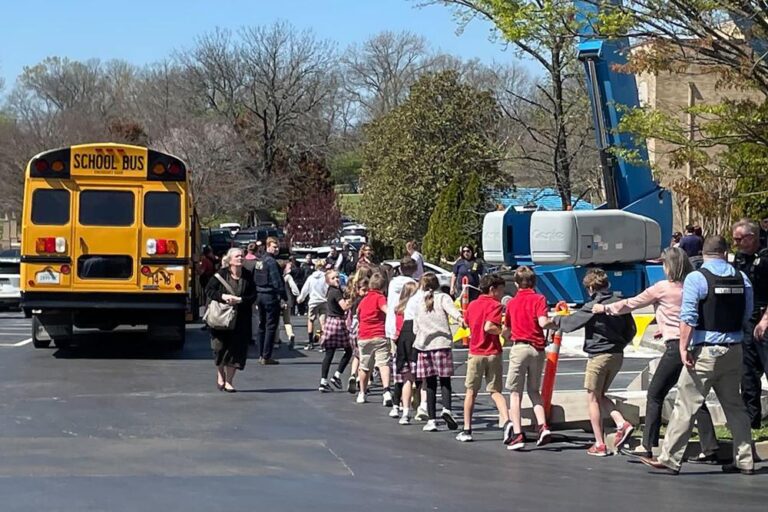
Students held hands as they walked to school buses, which drove them to a nearby church to be reunited with their parents.

Rachel Dibble, who was at the church as families found their children, described the scene as everyone being in “complete shock.”

“People were involuntarily trembling,” said Dibble, whose children attend a different private school in Nashville. “The children … started their morning in their cute little uniforms, they probably had some Froot Loops and now their whole lives changed today.”

Communities around the U.S. has suffered through one mass killing after another in recent years, with school shootings taking an especially painful toll.

Recent tragedies nationwide include the massacre at an elementary school in Uvalde, Texas, last year; a first grader who shot his teacher in Virginia; and a shooting last week in Denver that wounded two administrators.

President Joe Biden, speaking at the White House on Monday, called the shooting a “family’s worst nightmare” and implored Congress again to pass a ban on certain semi-automatic weapons.

“It’s ripping at the soul of this nation, ripping at the very soul of this nation,” Biden said.

Biden later ordered the U.S. flag to be flown at half-staff on all federal buildings through March 31. He also spoke to Tennessee Gov. Bill Lee and Nashville Mayor John Cooper about the shooting, officials said.

Founded as a ministry of Covenant Presbyterian Church — which is affiliated with the conservative evangelical Presbyterian Church in America — The Covenant School is located in the affluent Green Hills neighborhood just south of downtown Nashville that is home to the famed Bluebird Café – a spot typically beloved by musicians and songwriters.

The school has about 200 students from preschool through sixth grade, as well as roughly 50 staff members.

“Our community is heartbroken,” a statement from the school said. “We are grieving tremendous loss and are in shock coming out of the terror that shattered our school and church. We are focused on loving our students, our families, our faculty and staff and beginning the process of healing.”

Before Monday’s violence in Nashville, there had been seven mass killings at K-12 schools since 2006 in which four or more people were killed within a 24-hour period, according to a database maintained by The Associated Press and USA Today in partnership with Northeastern University. In all of them, the shooters were males.

The database does not include school shootings in which fewer than four people were killed, which have become far more common in recent years. Just last week alone, for example, school shootings happened in Denver and the Dallas-area within two days of each other.

Monday’s tragedy unfolded over roughly 14 minutes. Police received the initial call about an active shooter at 10:13 a.m.

Officers began clearing the first story of the school when they heard gunshots coming from the second level, Aaron said during a news briefing. Police later said in a tweet that the shooter fired at arriving officers from a second-story window and had come armed with significant ammunition.

Two officers from a five-member team opened fire in response, fatally shooting the suspect at 10:27 a.m., Aaron said. One officer had a hand wound from cut glass.

Late Monday night, police released approximately two minutes of edited surveillance video showing the shooter’s car driving up to the school from multiple angles, including one in which children can be seen playing on swings in the background. Next an interior view shows glass doors to the school being shot out and the shooter ducking through one of the shattered doors.

More footage from inside shows the shooter walking through a school corridor holding a gun with a long barrel and walking into a room labeled “church office,” then coming back out. In the final part of the footage, the shooter can be seen walking down another long corridor with the gun drawn. The shooter is not seen interacting with anyone else on the video, which has no sound.

Aaron said there were no police officers present or assigned to the school at the time of the shooting because it is a church-run school.

Jozen Reodica heard the police sirens and fire trucks blaring from outside her office building nearby. As her building was placed under lockdown, she took out her phone and recorded the chaos.

“I thought I would just see this on TV,” she said. “And right now, it’s real.”

Nashville has seen its share of mass violence in recent years, including a Christmas Day 2020 attack where a recreational vehicle was intentionally detonated in the heart of Music City’s historic downtown, killing the bomber, injuring three others and forcing more than 60 businesses to close.

A reeling city mourned during multiple vigils Monday evening. At Belmont United Methodist Church, teary sniffling filled the background as vigil attendees sang, knelt in prayer and lit candles. They lamented the national cycle of violent and deadly shootings, at one point reciting together, “we confess we have not done enough to protect” the children injured or killed in shootings.

“We need to step back. We need to breathe. We need to grieve,” said Paul Purdue, the church’s senior pastor. “We need to remember. We need to make space for others who are grieving. We need to hear the cries of our neighbours.”

AP

Free School Lunch for All – What the Pandemic Taught Us

0

WILLIAM HATCH

GOOD news! Colorado recently passed a law that made school meals free for every student, regardless of financial eligibility. Starting late in 2023, the Healthy School Meals for All program will officially launch in most Colorado school districts. This state-funded program aims to ensure that every kid attending school will have the nutrients they need to continue learning and thriving in their classes.

Let’s explore Colorado’s lead and others as they follow to bring free school lunches to all students. 

The Reason for the Introduction of Free School Lunches

The progenitor to this program was brought on by the recent pandemic—students relied on meals provided by the school, but as schools shut down, their access to these meals was cut off. Then, as schools slowly reopened, Colorado school districts offered free lunches via waivers to relieve some of the financial pressure that many felt during the pandemic.

State officials saw a 10% – 40% rise in students across several districts partaking in school lunches during this period, then decided that it should be more permanent. Voters agreed—55.1% of Colorado citizens voted “yes” on Proposition FF: to create and fund the Healthy School Meals for All program. But where does the funding come from? The measure promises to generate more than $100 million annually by reducing tax breaks to households earning more than $300 thousand per year.

However, there is bound to be some confusion among parents, as some of their kids may have to fill out an application to opt-in for the free meals, while their siblings that attend other schools may not. This is because many Colorado schools are already participating in the Community Eligibility Provision, which has provided students with free meals since 2020.

All this said, not every school district in Colorado has guaranteed that they will participate in the Healthy School Meals for All program. If you live in Colorado and have a child attending public school, be sure to check with your school district and stay informed.

Leveling the Playing Field

Introducing a free meal program is helping to alleviate peer pressure and stigma against the less fortunate kids who rely on free lunches or cannot afford to buy a meal every day. Since every student, regardless of status, is eligible for a free meal, it levels the playing field in that aspect—no one worries about any child going hungry, at least while at school.

Hunger Free Colorado

GlendaRika Garcia works for Hunger Free Colorado, a nonprofit organization that seeks to end hunger and provide nutrition to children all over her state. As a mom of four teenage boys, she’s seen first-hand the positive impact the Healthy School Meals for All program has had on children.

“I think that the kids being able to eat for free at school is really important, for all families, all kids,” she said. “Kids can’t learn if they don’t have good nutrition.”

How Other States are Following Suit

Colorado isn’t the only state that chose to continue providing free lunches for students. Some states like Nevada, Vermont, and Massachusetts have also decided to extend their free lunch programs to the end of 2023, though some still need to pass bills to make it permanent. 

California and Maine were the first to pass measures similar to Colorado’s last year. In Arizona, meanwhile, officials have invested almost $7 million to extend their free school meal program, and it’s happening much faster—it’s set to launch its benefits for students this month!

Three Cheers for School Staff

The pandemic has been tough on all of us—but especially for those who are either in school, have kids, or have jobs at a school. Teachers, students, and their parents had to transition to virtual and online learning overnight, and they deserve major kudos for blazing through that adjustment so quickly. Suddenly, everyone was homeschooled, putting a lot of pressure on teachers and parents.

Another one of the pandemic’s lasting effects was on our supply chain, directly impacting the food supplied to schoolchildren and the staff that prepared it. We’re still processing the past few years, and while things are getting better, the pandemic has left a lasting mark on our history. The pandemic has taught us what incredible things teachers are willing to do to continue their work to educate young minds. They are passionate about teaching and learning, and their example should be held in the highest honor.

Educationworld.com

Principals honoured as top achievers from Gauteng schools

Many of Wits University’s top learners come from important feeder schools, which produce quality students that easily adjust to the academic demands at Wits.

In celebration of the class of 2023, the Wits’ Schools Liaison Office (SLO) hosted over 49 feeder school principals and teachers from Gauteng at the annual Principals’ Function. The SLO visit a vast number of schools each year and advise learners about admission requirements, career opportunities, degree courses offered at Wits, fees and funding, student life on campus and the University’s core function.

Educators from Gauteng’s feeder schools were congratulated on the excellent work they do in nurturing learners through their 12 years of schooling, preparing learners for post-secondary education and supporting learners in securing a spot at a leading global institution like Wits.

“We at Wits pride ourselves as a place of intellectual debate, free expression, diversity of views and ideology. In partnership with your schools, we look forward to the next 100 years of mutual collaboration and contributing to leading this country and continent. Our goal at Wits is to weave in academic excellence in naturing the young minds, contributing to dialogue and discourse and becoming a beacon of what this country strives to be,” said Wits Vice-Chancellor and Principal, Professor Zeblon Vilakazi, who welcomed representatives at the event.

Wits received a record number of first-year applications for the 2023 academic year. Majority of those applications were from feeder schools. The relationship with schools is an important one in ensuring the success of learners, the University said.

Three schools were singled out and received certificates for being the top feeder schools in their respective sectors.

Greenside High School, Al Aqsa School and St Matthews Private Secondary School all walked away as Wits University’s 2022 top-feeder schools.

“Our learners, parents and community appreciate the relationship we have with Wits, the support we receive from the University is fantastic,” said Al Aqsa School’s principal Hamida Moosa. She further acknowledged the relationship with Wits, adding that the two have a long history and a shared vision.

Principal Craig Strauss received the award on behalf of Greenside High School and praised the work done by the SLO.

“The school visits and time spent with our learners help to broader our learners’ minds, exposing them to different opportunities and broaden their horizons on what is available at University.”

The principals were also captivated by guest speaker Professor Benjamin Rosman, School of Computer Science and Applied Mathematics who delivered an insightful talk titled Generating the Future: The Power of ChatGPT. Rosman took a deep dive into the advantages and disadvantages that the artificial intelligence model presents.

Artificial Intelligence (AI) tools have been developing for many years, but the release of ChatGPT, a powerful natural language chatbot, in November 2022 has created a global stir.

INSIDE EDUCATION

Four out of 191 educators struck off the roll over sexual misconduct – Motshekga

PHUTI MOSOMANE

MINISTER of Basic Education Angie Motshekga has confirmed that four educators out of 191 reported cases of sexual misconduct were successfully struck off the roll. 

Motshekga revealed this in an answer to a written parliamentary question by the Democratic Alliance (DA).

The number of cases of sexual misconduct reported to the SA Council of Educators (SACE) last year, has risen quite dramatically from 92 in 2019/20 to 169 in 2020/21 and 191 in 2021/22. 

This could potentially mean that for the 199 school days last year, a single case of sexual misconduct a day took place at a particular school.

The 2022 crime statistics indicates a total of 294 rapes reported to have occurred on the premises of educational institutions – schools, universities, college, and day care facilities.

SACE said it instituted 23 disciplinary proceedings in 2022 alone, this is 12% of the reported cases of sexual misconduct.

About 19 educators were found guilty of sexual misconduct, only four were struck off the roll indefinitely.

SACE indicated that some cases were closed due to lack of evidence to substantiate the allegations, deliberate unavailability of complainants to assist with the investigation/disciplinary proceedings, and witnesses refusing to cooperate with the Council.

“The complainants’ reluctance to cooperate with SACE in investigating and disciplining their alleged abusers indicates a perceived bias against the victims of abuse. SACE must take responsibility for this perception and ensure that disciplinary hearings are environments where alleged victims and witnesses feel safe, are protected from further trauma, and where evidence and testimony from both parties are examined in an objective and sensitive manner,” DA MP Desiree van der Walt said. 

Van der Walt said SACE must take appropriate steps to better categorise cases to ensure effective oversight of processes and procedures.

Without a thorough analysis of data, no institution can critically access its effectiveness.

“The Council must ensure that victims of sexual abuse are protected when reporting these crimes and that guilty abusers suffer the consequences for their heinous actions,” Desiree said.

INSIDE EDUCATION 

EDITORIAL: Basic Education must fulfil its promise to eradicate pit latrines in our schools

EDWIN NAIDU

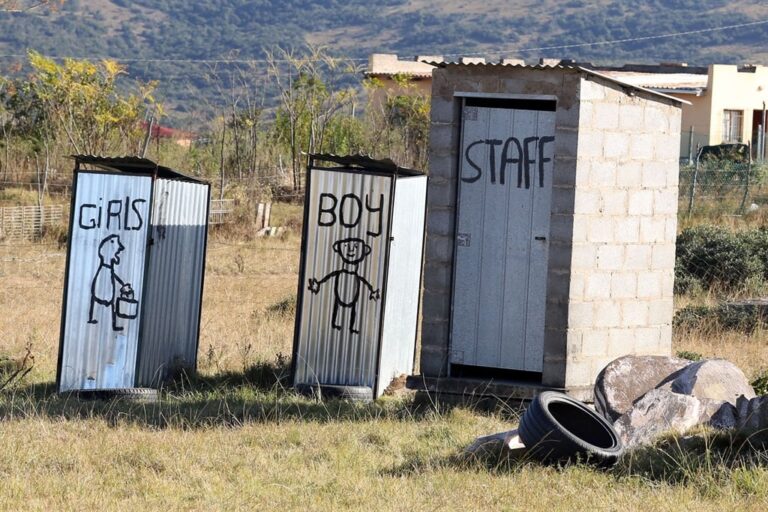
FOUR-YEAR-OLD Langalam Viki drowned in a pit latrine toilet in Vaalbank in Eastern Cape early in March. The tragedy highlighted the failure of the Department of Basic Education to get rid of pit latrine toilets, despite adopting the minimum uniform norms and standards for public school infrastructure, which banned them at schools in 2013.

The norms and standards created a legal responsibility for the department and provincial departments to eradicate pit latrines at schools. However, 3,398 schools countrywide still have pit latrine toilets. Over the past decade, there have been many horror stories like that of Viki.

This is one tragedy, too many.

On Sunday, the Minister of Basic Education, Angie Motshekga, pledged to tackle the problem within two years. While the Minister’s commitment is welcomed, one wonders how the department, which has failed to tackle this problem over the past decade, will address it in two years.

Basic Education has made a dent in the outstanding number, fixing a paltry 117 toilets.

Credit for raising awareness of this problem must go to civil society organisations, like Equal Education and Amnesty International, both of which have consistently raised the issue, highlighting the tardiness of the department in swiftly eradicating pit latrine toilets.

In a year, South Africans will go to the polls. Politicians are mindful of the mood of the people.

One can easily label the Democratic Alliance leader John Steenhuisen as opportunistic in visiting the dead child’s parents. But Nelson Mandela did not own the trademark on compassion.

Sadly, the leaders left behind have not adopted his caring nature.

Yet, one cannot disagree with his saying that schools should be safe spaces for our children, not gravesites. Steenhuisen argues that Human Rights Day could not be commemorated until every child had access to safe and dignified sanitation at school. The parents of little Viki would agree.

“The drowning of our children in pit toilets goes far beyond a human rights violation; it is a horror that no South African should ever be forced to contemplate,” Steenhuisen lamented.

While Motshegka told the media that it would eradicate pit latrines by 2025, the DA went further, proposing a two-point plan to eliminate pit toilets at schools across the country.

In two years, Motshekga, one of the longest-serving education ministers in Africa, is unlikely to remain in her job. Who will be held accountable should the Department of Basic Education not deliver on its promise? It is not an option one would like to contemplate.

Therefore, one hopes that the DBE will pull out all the stops to eradicate at least half the pit latrines by the time democracy celebrates its 30th year in 2024. While the grieving parents of Langalam Viki mourn their little girl whose promising life was snuffed out, Motshekga must act with urgency.

Failure is not an option.

INSIDE EDUCATION

Nzimande connects learners in Sekhukhune to the internet

0

EDWIN NAIDU

MINISTER of Higher Education, Science and Innovation, Dr Blade Nzimande, opened a computer lab at
Moloke Primary School in Sekhukhune last Friday, connecting learners and young people studying
to the Internet.

The computer lab consists of two connected 12-meter upcycled storage containers, with computers powered by solar energy, to bridge the digital divide for learners in disadvantaged communities.

Limpopo MEC of Education, Mavhungu-Lerule Ramakhanya, and the Fetakgomo Tubatse Mayor, Eddie Edwin Maila, joined Nzimande in handing over the computer lab to the community of Sekhukhune.

This off-grid media lab project is initiated and funded through the department of science and Innovation’s Renewable and Sustainable Energy Research Hub and Spokes Programme.

Apart from assisting in teaching and learning, the National Youth Development Agency also used the lab to train 30 young people in business development. This demonstrates that government departments and entities can work closely to deliver services to the nation.

The media lab project is the culmination of a long-standing investment by the Department of Science and Innovation in the development and application of scientific knowledge domains.

“These media labs are also meant to advance publicly funded Intellectual property to enable technology localisation, job creation and service delivery to our people,” he said.

Through this project, Stellenbosch University will train interns from the Technical and Vocational Education and Training (TVET) colleges.

The University has already recruited and trained one TVET College Graduate on solar PV and monitoring of the media labs.

This project will enable interns to secure Diplomas as part of their internship training for 18 months before they can get their qualification from the TVET college.

“What is also important is that our interns will get their qualification equipped with the scarce skills in the renewable energy sector where most people in rural areas do not normally participate,” the Minister said.

With the media laboratory at Moloke school, Sekhukhune TVET College is also involved.

This partnership will unlock the training of TVET college graduates in the scarce skills area of renewable
energy.

The media lab is off-grid, which was done to relieve the school from the pressure of buying
electricity to power the computers.

INSIDE EDUCATION

Motshekga congratulates district directors, provinces on matric 2022 results

0

BASIC Education Minister Angie Motshekga has congratulated provinces on their improved academic performance during 2022 in the National Senior Certificate (NSC) examination during her first meeting with district directors and senior DBE and Provincial Education Department (PED) officials earlier this month.

The Minister expressed gratitude to all district directors for their resilience during this challenging period as the first line of defence.

“Along with our circuit managers, you remain the heartbeat of the sector. We must now shift our focus towards quality. To this end, I am pleased to announce that the National Assessments and Public Examinations analysis is moving away from league tables towards the inclusive basket. As we celebrate the anniversary of the function migration, there is a lot to do with ECD, our new baby in the house. We have embarked on many projects to ensure better and more effective resourcing of early childhood education,” she said.

These include the ECD Census, which is helping the Department establish more robust planning systems, and the Thrive by Five Index, which is assisting the Department in strategically targeting its support.

“We are also driving the process of redrafting the Children’s Second Amendment Bill to make registration and access to funding more easily accessible to all ECD programmes. Guided by our anticipated Integrated ECD Service Delivery Model and Framework, based on the Five Pillars of Early Learning to bring all stakeholders on board, we need to prioritise access and quality,” the Minister said.

“We must continue with the Learning Recovery Plan and pay attention to Home Languages, emphasising languages in the Foundation Phase. The National School Nutrition Programme, which has successfully offered meals and created jobs for the local communities, should be expanded to fight malnutrition and stunting.”

“I am confident that this will be another great year for education, and I wish you all the best in
today’s deliberations and the year ahead,” the Minister concluded.

INSIDE EDUCATION

Science & Technology: Public-private collab to create coding skills pipeline

STAFF WRITER

SOFTWARE developer training academy WeThinkCode and Ekurhuleni West TVET College (EWC) will pilot a coding skills programme for youth with no prior experience.

This, after the organisations entered into a public-private partnership aimed at creating a pipeline of in-demand technical skills.

In a statement, WeThinkCode says the initial phase of the training programme will see two cohorts of 50 students learning the academy’s curriculum at the EWC campus.

The academy further sees the collaboration with EWC as an opportunity to close the gap between unemployed youth and market demand for skilled software developers.

“This pilot programme represents a pivotal opportunity to produce digital skills at scale,” says Ruvimbo Gwatirisa, WeThinkCode campus director: Cape Town, and lead of the TVET expansion.

“TVETs have a national footprint, and together with our coding curriculum, we can deliver thousands of digital skills into our economy and help to lower our youth unemployment rate more rapidly than WeThinkCode could on its own.”

Manie Stoltz, business unit: partnerships manager at EWC, adds: “Through this partnership, WeThinkCode and EWC are not only empowering young minds to become skilled coders, but also enabling them to unlock their full potential and create a brighter future for themselves and their communities. Investment in educationis a vital step towards building a better world.”

Launched in 2015, WeThinkCode seeks to eliminate the digital skills shortage by developing 100 000 coders in Africa over the next 10 years.

To date, over 700 young people have graduated and maintain a 91% post-graduation employment rate, says the organisation.

Says WeThinkCode CEO Nyari Samushonga: “In our seven years of operating, we have demonstrated that some of the best coding skills come from areas not normally associated with tech talent.

“We are incredibly excited about partnering with EWC to bring this opportunity to more young people and further secure local tech skills pipelines.”

Samushonga states partnerships are the answer to creating the pool and pipeline of digital talent.

Resultantly, the pilot programme has also brought on board other collaborative partners, namely the Gauteng City Region Academy (GCRA), Standard Bank Tutuwa Community Foundation and Michael & Susan Dell Foundation.

Percy Moleke, CEO of GCRA, notes: “The GCRA is proud to partnerwith WeThinkCode and EWC for the delivery of this exciting pilot programme.

“It will see close collaboration between GCRA, a post-education and training institution and a civil society organisation in the form of an NPO. The programme aims to take best in breed course content and curriculum delivery to youth in the province.

“The purpose of the pilot is to test the programme’s scalability. If it’s successful, the partnerswill have a model which could significantly improve the reach of this wonderful ICT programme.

“We look forward to future phases of this programme and replicating the model in other sectors.”

Ona Meyer, programme manager for jobs and livelihoods at the Michael & Susan Dell Foundation, adds: “The partnership between WeThinkCode and EWC is a case study of a new partnership model that will allow youth enrolled in TVETs to access a high-quality, industry-relevant curriculum and pathway support into jobs in the ICT sector in South Africa.

“Partnerships like these have the potential to stretch across multiple TVET campuses and incorporate a variety of high-quality private training providers to improve employment outcomes for many young South Africans.”

Gwatirisa concludes that beyond the envisaged skills pipeline outcome, the pilot programme provides an opportunity to collect and analyse data that can be used to innovate around policies aimed at creating a robust IT education framework.

ITWEB

Varsity Cup: The rivalry that powers Free State rugby returns

0

THE Varsity Cup returns on Monday, 27 March 2023, when archrivals in Free State rugby, the University of the Free State (UFS) and Central University of Technology (CUT) face off in the battle for points at Shimla Park, on the Bloemfontein Campus at 19:00.  

The derby fields some of the most illustrious stars, slugging it out for silverware and bragging rights in a rivalry that seems to intensify with each new encounter. Adding further spice to the derby is their last encounter in 2022 when the FNB UFS Shimlas won, but the FNB CUT Ixias who currently sit in fourth position on the log had previously won the last three encounters.

Shimlas occupy fifth position and will be looking to leapfrog their rivals with a win on the day. 

Undefeated on their home ground the Shimlas will seek to maintain their impressive home form and take advantage of playing to the home crowd. “The boys have been working hard since September last year.

They will give it their all to make the play offs and go a few steps further than last year. The team spirit and brotherhood is really strong among the players. They love it when Shimla Park is packed and they will entertain their supporters,” said Andre Tredoux, head coach of FNB UFS Shimlas.

Tredoux has eyes only for the prize, “We need to win this game to get into the top 4 positions, before our last round robin game. All six teams can still reach the play offs, so we are focused on what we need to do and not so much on the other teams, if our processes are good, we have a good chance.” He says synergy was a focal point during last season and nothing has changed.

“I expect the boys to play with the same spirit, effort and intensity as last season.” 

“We were a new coaching staff last season, so the players had to go through a process of adjustment. This season we are trying to adapt our game, play smarter rugby, and to keep things fresh. We had thirteen players finish off at the end of last season of which nine got contracts to play professional rugby (eight of those players graduated). The rest graduated or had injuries,” he said.

SUPPLIED: UFS

Classroom Corner: Our study found new teachers perform just as well in the classroom as their more experienced colleagues

JENNY GORE

THE past four decades have seen an endless stream of reviews into teacher education. Australia has clocked up more than 100 since 1979. This comes amid constant concerns teachers are not adequately prepared for the classroom.

Our latest research, published in the Australian Education Researcher, provides a powerful counternarrative to concerns about teacher education and early-career teachers.

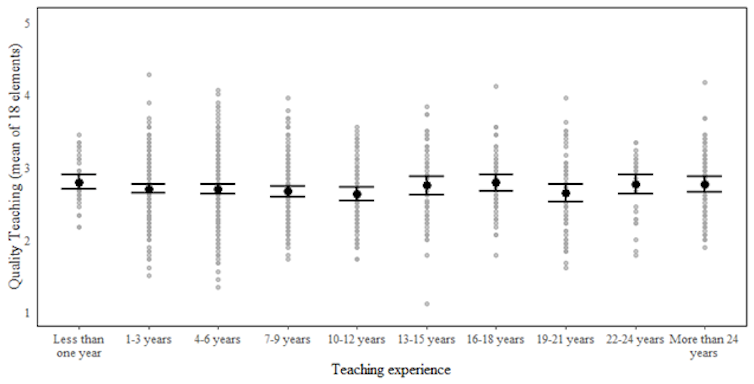
We analysed data from two major studies over the past decade and found it did not matter if teachers had less than one year of teaching experience or had spent 25 years in the classroom – they delivered the same quality of teaching.

These results indicate teaching degrees are preparing new teachers to deliver quality teaching and have a positive impact in their classrooms right away.

Recent reviews into teacher education

The most recent review into teacher education was finalised in February 2022. Led by former federal education department secretary Lisa Paul, the review found an “ambitious reform agenda” was needed to attract “high quality” students and make sure teacher education was “evidence-based and practical”.

Sydney University vice-chancellor Mark Scott (who also chairs The Conversation’s board) is now leading another expert panel, partly in response to Paul’s review and partly due to concerns about teacher shortages. It is looking at how to “strengthen” teacher education. It is also looking at developing a “quality measure” for teaching degrees and whether funding for universities should be tied to quality.

In among this, we have already seen an emphasis on attracting the “best and brightest” into teaching degrees and increasing requirements to graduate. To enter a classroom, teachers now need to have passed extra literacy and numeracy tests on top of their degrees.

The underlying assumption in all this government messaging and accompanying media commentary is that failings in education are those of teachers and teacher educators (the academics who teach teachers).

Our research

Our research used direct observation of 990 entire lessons to investigate the relationship between years of teaching experience and the quality of teaching.

We analysed the teaching of 512 Year 3 and 4 teachers from 260 New South Wales public schools in separate studies conducted over 2014-15 and 2019-21.

The schools involved in the study were representative of schools across Australia, and the lessons observed included a range of subjects, with the majority in English and mathematics. Most of the teachers observed had between one and 15 years of experience, although almost a quarter of the observations were of lessons taught by teachers with 16 years’ experience or more.

How we assess quality teaching

We used the Quality Teaching Model as the basis for the observations. The model was developed by education academic James Ladwig and me for the NSW Department of Education in 2003. It has been the department’s framework for high-quality teaching since.

It is based on research into the types of teaching practice that make a difference to student learning and centres on three dimensions:

  1. “intellectual quality” – developing deep understanding of important knowledge
  2. “a quality learning environment” – ensuring positive classrooms that boost student learning, and
  3. “significance” – connecting learning to students’ lives and the wider world.

Under these three dimensions are 18 elements of teaching practice that enable detailed analysis of lesson quality. Researchers coded the lessons they observed, with more than one researcher coding many of the lessons to ensure a high level of reliability.

Our findings

We found no statistically significant differences in average teaching quality across the years of experience categories.

Even when we broke down the experience categories in different ways to test for accuracy, we continued to find that years of experience did not equate to differences in the quality of teaching delivered.

On the graph below, each dot represents the average Quality Teaching score of an observed lesson. These have been grouped in a line based on how experienced a teacher is.

The average lesson quality in each experience category is represented by the large black dot and the horizontal lines represent the margin of error. The average Quality Teaching score across all the experience categories falls within the same margin of error range illustrating no statistically significant difference.

Graph showing Quality Teaching (mean of 18 elements) on Y axis and categories of teaching experience from less than 1 year to more than 24 years along the X axis.
This graph shows a teacher’s Quality Teaching score (the mean of 18 elements), compared to their experience. Author provided

Why does experience appear to make no difference?

Teaching quality is consistently described as the most important in-school factor affecting student outcomes.

Our finding that newly graduated teachers deliver teaching of a similar quality to that of their more experienced peers is surprising and somewhat counterintuitive. There are at least two possible explanations for this result.

A young woman stands in front of a whiteboard.
Graduate teachers may be starting their jobs more ‘classroom ready’ than policymakers assume. Christina @ wocintechchat.com/Unsplash

First, the result suggests graduate teachers are entering the profession “classroom ready” because initial teacher education programs are performing far better than is typically assumed in policy and the media.

That is not to say improvements in teaching degrees aren’t possible or warranted, or that graduate teachers don’t face difficulties. We know attrition among teachers in their first five years is high and is a major contributor to teacher shortages.

Second, on-the-job experience is insufficient on its own to raise teaching quality. While experienced teachers make many valuable contributions through leadership and mentoring, it could be that much of the professional development they do over the course of their careers makes little difference to the quality of their teaching practice.

Teachers need professional development that builds knowledge, motivates them, develops their teaching techniques and helps them make ongoing changes in their classroom practice. It should be backed by rigorous evidence of a positive impact on teaching quality and student outcomes.

Teachers and teaching

Part of the problem in debates about schools and education is the relentless use of “teacher quality” as a proxy for understanding “teaching quality”. This focuses on the person rather than the practice.

This discourse sees teachers blamed for student performance on NAPLAN and PISA tests, rather than taking into account the systems and conditions in which they work.

While teaching quality might be the greatest in school factor affecting student outcomes, it’s hardly the greatest factor overall. As Education Minister Jason Clare said last month: I don’t want us to be a country where your chances in life depend on who your parents are or where you live or the colour of your skin.

We know disadvantage plays a significant role in educational outcomes. University education departments are an easy target for both governments and media.

Blaming them means governments do not have to try and rectify the larger societal and systemic problems at play.

Jenny Gore, Laureate Professor of Education, Director Teachers and Teaching Research Centre, University of Newcastle.

THE CONVERSATIOIN