Home Blog Page 225

BUDGET 2023| Basic education feels the squeeze

0

EDWIN NAIDU

GIVEN the country’s energy crisis, which affects all citizens, it’s not surprising that education does not feature highly on the Government’s current compelling priorities, says Equal Education, Head of Research, Elizabeth Biney.

In fact, Biney said it was clear where the priorities lay as education featured just three times in Wednesday’s Budget Speech by Finance Minister Enoch Godongwana.

“In all fairness, we are all struggling with Eskom and it’s a huge problem but there’s also a secondary crisis that is overlooked. It is the crisis in our public education sector, which is struggling to get onto an upward trajectory,” she said.

Biney said the crisis is at the foundation, but throughout the system with terrible infrastructure and backlogs that will take years to get rid of. All this, she said was affecting teaching and learning.

“Funding is a huge aspect as well because even though government will have you believe that we are getting a bigger chunk of the budget on education, it has been decreasing over the years,” she said.

Speaking to Inside Education, Biney said the annual increases in education spend were not in keeping with inflation.

Over the medium term, the Department of Basic Education will continue to focus on improving school infrastructure, providing high quality support materials for learners and teachers, and providing nutritious meals for learners through the national school nutrition programme.

The department’s total expenditure is set to increase at an average annual rate of 7.2 per cent, from R23.4 billion in 2020/21 to R28.8 billion in 2023/24.

According to the Budget allocation for Basic Education, over the medium term, the department will focus on: improving school infrastructure; providing support to improve matric completion rates; providing high‐quality support materials for learners and teachers; facilitating the increase in supply of quality teachers while preparing serving teachers to teach new subjects that will prepare learners for a changing world; improving services provided through the early childhood development (ECD) function taken over from the social development sector; and providing nutritious meals for learners through the national school nutrition programme.

According to the Budget, the department’s allocations increase at an average annual rate of 5.6 per cent, from R29.7 billion in 2022/23 to R34.9 billion in 2025/26.

Transfers and subsidies account for 84.9 per cent (R85.1 billion) of the department’s allocation over the MTEF period, increasing at an average annual rate of 6.4 per cent, from R24.8 billion in 2022/23 to R29.9 billion in 2025/26.

“So when we adjust that budget allocations with inflation, what we are seeing is that the overall or the total allocation to basic education is not actually as high or as big as Treasury will have to believe in fact, it is decreasing,” said Biney.

Godongwana said R22 billion would be allocated to basic education to cover the shortfall in compensation budgets and to improve services. The Budget also provides additional funding for safety and security, education and health. In health, the funds are to hire new staff, address shortfalls in compensation budgets, and retain additional health workers appointed during the pandemic, as well as to clear the backlog in health services.

A huge chunk of the budget will go towards improving school infrastructure and physical infrastructure with emphasis on ensuring that the environment of every school is safe and appropriate for teaching and learning.

To achieve this, R48.7 billion is allocated to the education infrastructure grant and the school infrastructure backlogs grant over the MTEF period, accounting for 95.9 per cent of spending in the Planning, Information and Assessment programme.

The school infrastructure backlogs grant was given allocated R2.1 billion in 2023/24 to address infrastructure backlogs at schools that do not meet the basic norms and standards. In 2023/24, funds from the grant will be used to build a targeted 9 new schools to replace those that are built with inappropriate material such as mud, provide sanitation to 350 schools, and supply water to 1 school.

Over the period ahead, the department plans to use funds from the grant to repair school infrastructure damaged by flooding in KwaZulu‐Natal and Eastern Cape, and to reduce overcrowding in classes and schools. A grant of R42.2 billion over the MTEF period, which includes an additional R283.2 million in 2023/24 to repair schools damaged by the floods was allocated for this purpose.

To reduce the learner dropout rate, the Second Chance Matric programme provides support to matrics who do not meet the pass requirements of the national senior certificate examinations or senior certificate (amended).

Over the MTEF period, the programme aims to increase the number of learners obtaining subject passes from 50 000 to 100 000, partly driven by its expansion to include learners with barriers to learning, starting with visually and hearing‐impaired learners in 2023.

The programme is allocated R182.1 million over the medium term in the Curriculum Policy, Support and Monitoring programme.

Money will be made available to:

 Increase the number of learners who complete grade 12 by providing the Second Chance Matric programme for learners who failed to meet the national senior certificate and the senior certificate (amended) requirements annually.
  Improve the learning and teaching of critical foundational skills by developing, printing and
distributing 2 volumes of workbooks for grade R, grades 1 to 6 literacy/languages, grades 1 to 3 life
skills (quintile 1 to quintile 3), grades 1 to 9 numeracy/mathematics, and grades 1 to 6 English first
additional language to all learners in public schools annually.
  Improve learners’ reading proficiency in the foundation phase in all underperforming rural and township schools by using the early grade reading assessment toolkit to assess learners’ reading levels by 2023/24. This includes phonic knowledge, word recognition, and fluency and comprehension skills in the early grades.

In addition, there is a programme to fast‐track the rollout and implementation of ICT in schools by providing teacher training, ICT devices, digital content, software, connectivity, IT support to schools, and online learner and teacher support materials annually.

For the tertiary sector, over the medium term, the Department of Higher Education and Training will focus on supporting the post‐school education and training system by expanding access to higher education and facilitating the transition to work and enhancing performance by upgrading infrastructure and increasing capacity. Total expenditure over the MTEF period is expected to reach R432.4 billion.

INSIDE EDUCATION
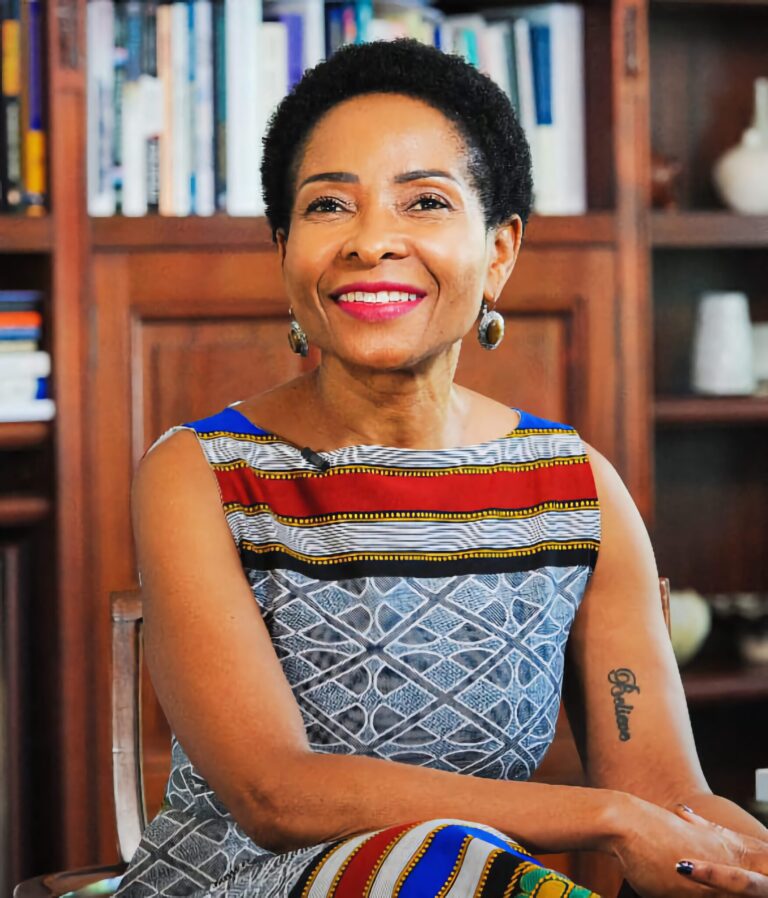
Exclusive: UCT’s Mamokgethi Phakeng vows to clear her name amid ‘false and defamatory’ accusations

EDWIN NAIDU

AS STORM clouds gather, embattled University of Cape Town vice-chancellor Professor Mamokgethi Phakeng has come out fighting amid claims that she has been suspended.

It has emerged that the University Council had offered her early retirement, with a caveat that it would drop the panel investigating governance claims against her and Chairperson Babalwa Ngonyama.

The vice-chancellor declined the offer, saying she wanted to clarify her name.

Asked about the status of reports that she has been suspended, Phakeng insisted she was an employee of UCT.

“I do not know. Since I am an employee of UCT, I trust that HR will notify me if I am to be suspended, clearly indicate what the charge is and hopefully allow me to indicate why I believe I should not be suspended,” she said.

What do you say to detractors about a crisis when UCT is among the best in five rankings according to global rankings?

“Since I took office as vice-chancellor of UCT, there has been a crisis. In 2018, just 27 days after my being in office, we lost one of our top professors and dean, Prof Bongani Mayosi. In 2019, we had the brutal murder of Uyinene Mrwetyana. In 2020, we had Covid-19, the lockdown and the Ombud report inconsistent with the terms of reference. And in 2021, we had a fire ravaging the Jagger library and other buildings. All these happenings captured the
imagination of the world. In 2022, we had Senate’s allegations that the council chair lied. Through all these, UCT took leadership of all the five major university world rankings. It is important to note that when I took office in 2018, UCT led in only one world ranking and the Business school had fallen off all the rankings. People also forget that when I took office, we had also lost students from our feeder schools. Today we have them back, and we are telling a different story about UCT’s performance under my leadership. I am a decisive leader who holds people accountable, and that has produced results.”

Why is it important for this panel to complete its given task?

“My name has been tarnished. An allegation against the council chair that started with a letter smuggled into the senate has suddenly changed to be about me. I have never received any letter or notification from HR about misconduct. I read about the council’s decisions in the media, so the panel must happen, and my name is cleared. People want to know the truth, and I cannot tell my side of the story because it would be unprofessional. So, I keep
quiet even when I see untruths being perpetuated by senior professors of the university who do not even serve on the council. So, I want the panel to go ahead, and I want it to be public.”

What message do you have for the UCT community being exposed to misinformation and confusion?

“Do not believe everything you read in the newspapers.”

Controversy aside, are you proud of what UCT has achieved under your stewardship?

“I am very proud! Extremely proud,” she said.

On Sunday, Ngonyama, the Chair of the UCT Council, told the university community in a letter that the council met on Thursday, 9 February 2023, to discuss issues around the Vice-Chancellor and the instability of the executive team and took specific resolutions.

“We have scheduled a meeting early next week to thoroughly and thoughtfully consider options and potential resolutions, after which we will report back to you with the way forward. We do not want to pre-empt any outcome.”

Masixole Mlandu, a student leader from the #RhodesMustFall and #FeesMust Fall movement, told Inside Education that the calls for the vice-chancellor to resign have long come from academics and staff “who feel the university belongs to them”.

“The charge labelled against the VC is racist at best and shows the arrogance of those who wish to do away with the small gains the university has made since 2015. I believe that the VC should fight this. Students, staff and academics interested in fair governance and transforming the university must unite and elevate the debate to an issue beyond a false university governance crisis.”

The Black Academic Caucus said in a statement that it was alarmed that the Council had offered the vice-chancellor early retirement.

“The university experienced great turmoil and suffered reputational damage over the last year due to the issues that were supposed to be investigated by the recently appointed independent panel led by [retired] Judge [Lex] Mpati. We are confident that this panel will be allowed to continue with its work and to dig deep into the leadership failures at
the institution,” said the Black Academic Caucus in a statement.

“We, therefore, call on Council to stick to its original resolution and allow the panel to conclude its important work that should benefit the university. Finally, we urge Council to provide the necessary resources and support to the panel so it can do its work as speedily as possible.”

INSIDE EDUCATION

VUT Vice-Chancellor, Professor Dan Kgwadi, “dismissed” over illness claims

EDWIN NAIDU

JUST over a year after Professor Dan Kgwadi was appointed vice-chancellor of the Vaal University of Technology (VUT), he told Inside Education this week that he has been dismissed following a 14-day sick leave.

“The Chairperson called me on Friday and informed me that I would be on special leave, pending delivery of the dismissal details in a letter,” he said.

On Friday, Council Chairperson Professor Mandla Radebe announced that Prof Kgwadi had been placed on special leave.

However, Professor Kgwadi, who has experienced problems with a knee/leg for over a year and consulted medics to no avail, posted details on Facebook about his dismissal.

“I have just been dismissed from work due to a 14-day sick leave (5 days hospitalisation). Apparently, that contributes to my lack of performance and probation issues. Going for a labour court race,” he wrote.

In a previous post, the former North-West University vice-chancellor said: “I almost believed that I am bewitched and about to consult traditionally. Your prayers worked.”

Registrar, Dr Dan Mokoena, will serve as acting vice-chancellor and principal.

Professor Kgwadi was appointed vice-chancellor on 4 February 2022, ending two years of instability during which VUT was under administration.

A new council was appointed in August 2022.

“Council would like to reiterate its commitment to the principles of good governance to ensure that VUT remains at the forefront of producing highly dedicated and qualified cohorts of graduate students,” he said.

A former schoolteacher born in Kraaipan in the North West, Prof Kgwadi became the first Black vice-chancellor of the North-West University in 2014 when incumbent Theuns Eloff resigned after first-year students gave him a Hitler salute.
In April 2018, Prof Kgwadi had a heart attack but stayed on until he announced on 7th November 2021 that he was leaving.

“All the success I achieved at North-West University and elsewhere was accomplished as a collective effort,” he said during his inauguration at VUT, adding that his wish was to ensure that the institution works to escape the “shade of corruption” associated with VUT. “Corruption is behind us. No more administration” was the key message during his installation as vice-chancellor.

Prof Radebe thanked students, staff and management for their dedication to this vision.

Prof Kgwadi, meanwhile, said he would challenge his dismissal.

INSIDE EDUCATION

Sci-Bono’s intervention in Gauteng’s under-performing schools yields results

0

EDWIN NAIDU

A GROUND-BREAKING Secondary School Improvement Programme (SSIP) to help matric learners improve their performance is starting to reap dividends in Gauteng, according to Vincent Zulu, the Senior Manager for Learner Support at the Sci- Bono Discovery Centre in Newtown, Johannesburg.
“What began as a project reaching 275 under-performing schools in 2010 is now benefitting over 440 schools throughout Gauteng, impacting about 101 715 learners,” said Zulu, emphasising that providing expert tuition from the best teachers was starting to pay off.

He said that since 2012, the Gauteng Province had ranked in the top two provinces annually when matric results are announced, with a rise in performance, particularly among learners in townships whose parents could not afford to send their children for extra lessons.

Sci-Bono manages various supplementary tuition programmes for the Gauteng Department of Education (GDE), including SSIP through a Saturday Programme. A meal is provided for attendees, holiday classes during residential and walk-in camps and broadcasting.

In the past five years, the SSIP programme has seen a tremendous increase in the number of Grade 12 learners participating.

The numbers have grown substantially from 67 063 learners in 2018 to 101 715 in 2022 at 309 sites throughout Gauteng.

Under former Gauteng MEC for Education Barbara Creecy, now the Minister of Environment, Forestry and Fisheries, the Gauteng Department of Education reviewed the 2010 matric results and launched the SSIP to change the narrative.

The department looked at why learners failed in Grade 12 and held additional classes on Saturdays for Grade 12 learners struggling in gateway subjects.

Another essential element of SSIP was a support programme for Grade 10 and 11 learners, who also participated in a programme during the June holidays.

The programme focused on Mathematics and Physical Science.

Principals were encouraged to ensure their learners participated in these lessons, with the former MEC demanding 100% attendance.

The SSIP requires that principals rigorously manage their school’s participation in the programme.

Each principal is responsible for ensuring that every learner and each selected teacher participate, and that appropriate action is taken where attendance is less than 100 percent.

And the results, according to Zulu, were evident.

Although an assessment study was still underway to quantify the progress made through SSIP, improved performance was already noticeable.

Since 2012 Gauteng Province has obtained a pass rate of no less than 80 percent, while the number of bachelor’s passes has been at 40 percent for the past three (3) years.

In January 2022, former MEC for Education Panyaza Lesufi said SSIP targeted over 65 734 grade 12 learners in 436 priority schools from January that year. The SSIP offers extra classes on weekday mornings and afternoons, on Saturdays and through study camps in some years.

Over the past years, classes were also extended to Sundays to make up for lost time due to the Covid-19 lockdown.

“More than 78,7% of SSIP learners passed [in 2021] compared to 78,5% of learners in 2019,” said Lesufi, adding that 79 SSIP schools achieved above 90% pass rate.

Four SSIP schools gained 100%.

“The SSIP programme once again proved its value,” Lesufi said.

He noted that the sustained improvement in results over the last four years showed that the SSIP system improved teaching and learning in the prioritised schools.

According to Zulu, the SSIP programme is based on a centralised and standardised approach to managing and delivering additional tuition. It seeks to establish existing best practices in and out of the province and to ensure that these are replicated consistently across all the schools in the programme.

The SSIP programme uses a transversal management approach that relies on all the stakeholders for input and depends on all stakeholders to achieve success.

This programme runs parallel to the regular school programme.

According to the agreed-upon GDE Work Schedule, what is taught during the week is consolidated during what is considered ‘the sixth school day’.

The programme focuses on tackling examination questions and achieving maximum results in critical areas of the curriculum.

There is also a strong focus on homework to support the curriculum being dealt with weekly in the classroom.

INSIDE EDUCATION

SOPA 2023: Lesufi puts a premium on education, says it’s key to economic development

EDWIN NAIDU

EDUCATION remains a high priority for Gauteng Premier Panyaza Lesufi and is key for economic development and improving citizens’ socio-economic conditions.

In his State of the Province Address (SOPA), Lesufi, who formerly held the province’s education portfolio with the
distinction between 31 May 2019 – 6 October 2022, congratulated the 2022 Matric Class for the sterling work they did in achieving a pass rate of 84.4%.

This was a remarkable achievement: out of every ten (10) learners that wrote matric in Gauteng, eight (8) passed. Of the eight (8), six (6) passed with a Bachelor’s pass.

“We are contributing 43 298 distinctions to the national education system; 20 769 come from township schools. This is a monumental achievement,” Lesufi said.

In the 2023 academic year, 4000 young people received bursaries worth R360 million outside the National Student Financial Aid Scheme (NSFAS). Furthermore, he said the province was committed to investing in youth.

Every learner that finished in the top three in every township high school will receive a 3-year bursary at a university of their choice.

On top of that, these learners will also receive a laptop to make their studies easier.

An outstanding achievement to note is the progress made by Gauteng in closing the gap between former model C and township schools’ pass rate from 12% to 9%.

As guests at the State of the Province, Lesufi invited students that received total marks and 100% passes in Maths, Business Economics and Economics; out of those learners, 24 came from township schools.

But there is no room for complacency. He said the province plans to benchmark Gauteng against international countries by participating in international examinations such as Progress in International Reading Literacy Study (PIRLS) and Trends in Mathematics and Science Studies (TIMSS).

Acknowledging that the education system is overcrowded, exacerbated by high in-migration levels, Lesufi warned that the system would collapse unless something different is done.

Addressing this issue and learning from the experience of unplaced learners in Grades 1 and 8, Gauteng has budgeted R6 billion from the provincial coffers to build new schools in high-pressured communities.

He announced that the province had received a significant boost of R1.5 billion from the National Treasury to finally demolish mobile and asbestos schools.

Thus, 18 new schools will be rebuilt in Gauteng.

The province will also access for the first-time resources from private sector financial institutions to fund infrastructure projects upfront, after which they will be built, maintained and transferred handed over to the province.

Proposals from private companies to build these schools will be sought.

Lesufi said the province would continue to roll out Schools of Specialisation to give learners a competitive edge and to prepare them for the post-matric world.

To date, the province has 21 Schools of Specialization, and by the end of this administration, he said they would number 35. The Premier praised Mr [Amos] Mashiane, principal of Soshanguve Engineering School of Specialisation, for focusing on automobiles.

“He and his students were honoured with Visionary Clean Tech Student Award in Abu Dhabi. Mr Mashiane, representing his school, will attend the Students for Advancement Global Entrepreneurship World Cup 2023 in California, USA.”

Mindful of the foundation among younger learners, Lesufi said the province was committed to rolling out Early Childhood Development Centres of the future across the five corridors.

“We are pleased that the number of children registered in our ECD sites has increased. As part of the process to bolster our education system, we are now ready to build an ECD of the future, starting with Tshwane (in Soshanguve),” Lesufi added.

The ECD of the future will have classrooms with indoor splash pools, ICT centres, a water recycling area and mini sports areas. Coding and Robotics will gradually be introduced into the curriculum to meet the challenges of the Fourth Industrial Revolution (4IR).

Education, starting at the bottom, and spreading through the system, is aimed at ensuring Gauteng learners continue reaching the top.

INSIDE EDUCATION

NWU academic looks at impact of heavy rains and declaration of a State of Disaster in SA

0

EDWIN NAIDU

NORTH WEST University (NWU) academic in the African Centre for Disaster Studies, Professor Livhuwani Nemakonde, says the heavy rainfall experienced in South Africa in recent weeks is due to a combination of factors.

“Climatologists have indicated that this is because of the La Niña phenomenon. La Niña (Spanish for little girl) is the opposite of an El Niño (little boy), which usually predicts low rainfall for South Africa. In simple terms, this means that most parts of the country will receive above average summer rainfall, and it is for this reason that seven of the nine provinces received huge amounts of rainfall that led to flooding,” said Prof Nemakonde.

He said the impact of the floods is relatively high, particularly in parts of Mpumalanga, KwaZulu-Natal, the Eastern Cape and Limpopo.

“The amount of rainfall plays a major role, but other human-related factors such as residing in low laying areas, flood plains, riverbanks and poor infrastructure contribute to the impact of floods,” added Prof Nemakonde.

He said weather forecasts warn that the trend might continue into the last week of February and that South Africa will likely receive more rain into autumn.

With seven of the nine provinces affected by the floods that resulted in the loss of lives and destruction of infrastructure, the government declared a national disaster on 13 February 2023.

According to Prof Nemakonde, government officials argued that the disaster declaration would help expedite resource availability to those most affected.

INSIDE EDUCATION

Entries for 2023 SADC Secondary School Essay competition now open

0

STAFF REPORTER

ENTRIES are being sought for the Southern African Development Community (SADC) Secondary School
Essay Competition to recognise the best work in the region.

The 2023 SADC Secondary School Essay competition topic is: How can SADC promote Industrialisation for inclusive, resilient and sustainable economic growth?

The topic is derived from the theme of the 42nd Ordinary SADC Summit of Heads of State, and Government held virtually by the Democratic Republic of Congo, Kinshasa, on 17th August 2022, which is: Promoting industrialisation through agro-processing, mineral beneficiation, and regional value chains for inclusive and resilient economic growth.  
 
The wording of the think piece and content should aim at addressing the topic and, at the same time, promoting the SADC’s Objectives and Common Agenda.

All entries should be typed and submitted electronically in Microsoft Word document format.

All essays entering the competition should be in one of the SADC working languages, i.e. English, Portuguese and French.

The essay should be between 900 and 1000 words.

The deadline for submission of entries to the Department of Basic Education is 28 April 2023.

Winners and Prizes

The SADC Secretariat has allocated USD1000 as prize money for the national competition winners in each Member State. The prize money will be divided as follows:
 USD 500 for the first prize
 USD 300 for the second prize
 USD 200 for the third prize

Each candidate will receive the equivalent prize money in South African Rands. The three national winning essays will be forwarded to the SADC Secretariat for consideration in the regional
competition.
 
Eligibility Criteria:


 Applicants must reside in South Africa,
 Applicants must be currently attending secondary school,
 Essays must not be more than 1000 words but not less than 900 (Arial 1.5 line spacing for
typed essays),
 Submissions must be the unaided work of applicants,
 Submissions should be in English,
 The name of entrants should be the same as those that appear on the Identification
Document (ID) or Passport, and
 Applicants must be willing and fit to travel.

To submit an entry:
The learner should forward their essays to sadcessay@dbe.gov.za.

For enquiries regarding the competition, one of the following officials may be contacted:​
 Mr Lucky Maluleke: maluleke.l@dbe.gov.za | 012 357 3494
 Ms Zanele Rakumaku: rakumaku.z@dbe.gov.za | 012 357 3485
 Ms Matome Sekgota: sekgota.m@dbe.gov.za | 012 357 3373

The closing date for entries is 28 April 2023.

INSIDE EDUCATION

Teen Suicide Prevention Week: A safe space for scholars

0

EDWIN NAIDU

EVERY year, almost one in ten teenage deaths in South Africa result from suicide. Up to 20% of high school learners have tried to take their own lives for various reasons, the most popular being depression, anxiety and suicide.

According to the World Health Organization (WHO), nearly 700 000 people die by suicide yearly. That’s an average of one person every 40 seconds. Suicide is the 4th leading cause of death among 15- to 19-year-olds globally.

Teen Suicide Prevention Week is being observed from the 14 th  to the 21 st  of February, focusing on raising awareness and preventing teen suicides.

Nkazimulo Zitha, Head of School Achievement at SPARK School, says it is important for schools to create a safe space for scholars who may want to discuss personal issues ranging from bullying, trauma, anxiety, or any problems affecting their mental health.

It is essential to understand the factors contributing to suicidal teenagers in schools, for teachers/principals to identify suicidal behaviour in scholars, especially teens in schools and explore ways parents can have a productive conversation about suicide with their children.

Schools and communities team up and can work together to combat teen suicide. SPARK Schools are active in educating learners to help prevent suicide.

INSIDE EDUCATION

Young South Africans frame their future – SACAP survey

0

EDWIN NAIDU

YOUNG South Africans aspire to do work that is both meaningful and fulfilling, according to the Frame Your Future survey recently conducted by SACAP (The South African College of Applied Psychology). 

The online survey canvassed 850 internet-connected respondents aged between 17 and 20 years who are recent school leavers or currently in Grades 11 and 12 to gauge their hopes and fears about the future. 

It found that 65% of the learners on the last leg of school aim to enter tertiary studies once they have matriculated, with only 7% looking to enter the workforce immediately and just 5% considering a gap year.

Among the students surveyed, 57% said that researching their study options online was the dominant source of information they used to decide their study path.
 
“What was striking in the Frame Your Future results was this generation’s desire to ensure they care about the work they’re involved in and, most importantly, that their work makes a difference to the world,” says Dr Lauren Martin, the Deputy Dean of Learning & Teaching at SACAP.

“Over half of the respondents said that they want to do work that they care about and that makes a difference. 40% have ambitions to do ‘something extraordinary with my work,’ and 38% think they will love their work,” she adds.

Martin says these sentiments were ranked far more highly than money as the be-all and end-all of
the work. 

These results highlight how important it is for school leavers to integrate their passions and interests with their skills and capabilities when choosing tertiary study paths.
 
Given the current state of the world and overall anxiety about the fast-changing future of work, she adds that these young South Africans indicated a generally positive outlook at this life stage, with 43% saying they wake up feeling hopeful and an additional 14% who are excited to face the day. 

While almost half the respondents are temporarily open to future international work opportunities, only 19% say they would seriously consider emigrating from South Africa.
 
Dr Martin says a significant proportion of young people think they can contribute to their country, with 58% concerned about climate change impacts and 55% believing in the responsibility to vote.

SACAP offers a range of registered and accredited courses ranging from higher certificates, a diploma and undergraduate degrees to postgraduate qualifications and specialised programmes at its Cape Town, Johannesburg, Durban, Pretoria, and online campuses.

Applied Psychology forms the core of each course, and topics include Psychology, Communication, Business Management, Human Resource Management, Social Work and Coaching.

“We are encouraged that many young South Africans value personal growth and face their concerns about the country and the world they live in with the question: how can I make a difference?  They need to develop resilience in facing fears and challenges as they step onto study paths that will lead them into the world of work. At the same time, they are well-supported in gaining the knowledge and skills that will enable them to be positive forces in their future workplaces,” says Martin.

To learn more, visit sacap.edu.za.

INSIDE EDUCATION

Safety at schools a priority, says Cabinet

0

EDWIN NAIDU

SCHOOL safety in South Africa remains a top priority for the government and reports of violence between learners and educators are a severe cause for concern, noted Cabinet in a statement last Thursday.

While the Department of Basic Education has implemented mechanisms to combat this scourge, parents and guardians have been urged to collaborate with school authorities and learners to ensure that schools remain safe places for learners to develop and become responsible citizens.

“The safety of our educators at schools is also paramount,” the statement said.

The cabinet reassures South Africans that the South African Police Service (SAPS) is being strengthened to prevent crime. If you have information that can help expose people involved in illegal activities, call Crime Stop at 0800 10111.

INSIDE EDUCATION