Home Blog Page 226

How ChatGPT and Google Bard can help schools and businesses

NEW AI chatbots – ChatGPT and Google Bard – have the ability to help those in the customer service and education industries, experts say – but won’t be removing the human element from jobs any time soon.

After launching in November last year, OpenAI’s ChatGPT is no longer the only chatbot on the market after Google Bard was announced last week.

Despite making an error during its official demo – causing Google’s parent company Alphabet Inc’s stock price to drop by more than $100 billion – Bard is expected to challenge ChatGPT in what has become a hotly contested and often controversial space.

Google is launching Bard to stop Microsoft’s Bing – which uses ChatGPT – from taking some of its marketshare. According to the most recent data from Statista, Google’s search engine market share is 84.08% compared to Bing’s 8.95%.

Despite the recent popularity of chatbots, there are some concerns regarding the technology, as it may give incorrect information – as shown in Bard’s demo – or that it might lead to plagiarism in written works.

However, those in the education and customer service fields have expressed excitement over the new technology as it can significantly improve the time taken to do administrative tasks.

Education 

Adam Fairall at Reddam House Atlantic Seaboard said that teachers should embrace chatbots as the education sector can not simply block students from accessing the new technology.

Fairall said that, when used correctly, chatbots can reduce lesson preparation time by 80% as lesson plans can be created digitally within minutes, giving teachers more time to assist students with learning barriers and deliver improved lessons.

Chatbots will also allow for higher-order thinking among students, allowing them the opportunity to think creatively when delivering work and solving problems in the classroom. However, he warned that educators should be on alert for students who have not learnt the baseline knowledge.

Using chatbots can thus reduce preparation and learning times for both teachers and students, but traditional take-home assessments like essays are not viable with chatbots – as students can easily cheat, with teachers needing to think flexibly when assessing students.

Fairall states that machine learning will require students to become more practical, as they are not assessed on the concept but rather on how they can use the concept practically to solve a problem.

Marketing and Customer Service 

Algorithm Agency said that chatbots will help digital agencies with improved content generation. Using automated technology can help digital agencies produce high-quality content far quicker than it would be to manually produce the content.

However, the Algorithm Agency said that human writers will not be replaced, as chatbots produce copy in a logical and well-structured way which saves time, but it is very easy to see that the copy is AI-generated – with search engines possibly down-weighting AI content in the future.

Moreover, all online content will sound similar if it is AI-generated. The Algorithm Agency questions if anyone would want to read online content if it lacked a brand’s voice, tone or creativity.

The Algorithm Agency said that the sweet spot is where tech and automation meet with human creative thinking.

As chatbots bring improved efficiency into the content creation process, strategists have more time to focus on other key elements of the business.

Another key use for chatbots would be imposing the customer experience due to their ability to respond to customer questions.

Digital agencies will thus be able to provide more personalised and relevant experiences for customers, which increases customer engagement and loyalty, the agency said.

For example, last week, the Dubai Electricity and Water Authority (DEWA) announced that it would use ChatGPT in customer and employee services.

DEWA said that this introduction of ChatGPT will endure productivity and meet current and future needs.

Business Tech
UP Senate Conference: ‘Tinkering at the edges of change’ will not deliver curriculum transformation

0

IN a provocative start to the University of Pretoria’s (UP) 2023 Senate Conference, speakers challenged the academic community to engage in uncomfortable conversations and to steer away from “tinkering at the edges of change”.

Setting the tone for forthright discussions on curriculum transformation – the theme of this year’s Senate Conference at the Future Africa campus – Professor Siona O’Connell of the School of Arts pointed to UP’s own problematic history and urged Senate members to “do our past justice”.

While race-based forced removals were under way across Pretoria in the 1950s and 1960s, including in Garsfontein, Marabastad, Eersterust and Wonderboom, the University had remained aloof.

“From the Humanities Building and all across the beautiful campuses, staff and students would have overlooked Pretoria’s shame,” Prof O’Connell said in a keynote address on Thursday, 16 February, the first day of the two-day Senate Conference, titled: “Turning the Tide: Reimagining Curriculum Transformation at UP”.

Gaps in UP’s own history

So removed had the University been from the apartheid-induced turmoil around it, she said, such as the mass arrests and detentions, consumer boycotts, factory strikes, work and school stay-aways that lasted into the 1980s, that critical moments in its own history went unrecorded.

One such moment was Chief Albert Luthuli’s visit to the University in the early 1960s, when the then-president-general of the African National Congress fell to the ground after being assaulted by a young student.

However, there is nothing in the UP Archives to show that that the visit had even happened. From what is available in the archives today, “Albert Luthuli never had the opportunity to visit the University,” said Prof O’Connell.

Even in 2015 and 2016, amid the #RhodesMustFall and #FeesMustFall protests, UP “squandered” the opportunity to make amends, not only to the Luthuli family but also for events of long ago, colonialism and slavery, that had made such moments possible.

“In the wake of student protests, the opportunity to transform was left spinning and trapped, unable to breathe in a vortex of metal turnstiles,” she said, referring to the security measures put in place in reaction to the protests.

Now, in 2023, UP has an “incredible opportunity” for redress. “We will imagine and re-imagine curricula of the sort that responds to South Africa and to students who are the first from their community to make it here, who may come from homes that are headed by young people, who may be afraid that they do not belong.”

Becoming known for boldness and compassion

“By setting out to understand all its students, and thinking and acting boldly, the University can stake its place as a benchmark space of higher learning in, and of, Africa,” said Prof O’Connell. “We can be known as the African university capable of having the most difficult of conversations, of not tinkering with the edges of change, and of looking at the past with compassion.”

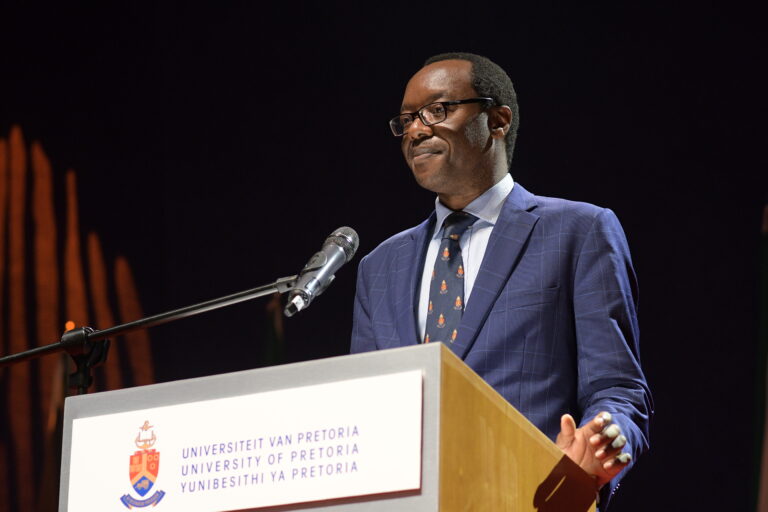
Professor Tawana Kupe, UP Principal and Vice-Chancellor, who gave the opening address at the conference, agreed that “you can’t tinker at the top or on the sides with education”. He said change has to be articulated right through the organisation.

During question time, he and other Senate members emphasised the necessity for UP and its staff to embrace curriculum transformation wholeheartedly and not to avoid difficult questions – including the issue of whether the UP has too many students who should rather be attending technical vocational education and training (TVET) colleges.

“We are ducking these questions,” Prof Kupe said.

No transformation without language change

The point was strongly made that the use of African languages and curriculum transformation go hand in hand.

“As a university, we need to take the role of African languages seriously. The monolingual model is excluding people who have the potential to succeed,” said Professor Chika Sehoole, Dean of the Faculty of Education, during a panel discussion on African languages in higher education.

He gave the example of a taxi driver he had encountered who speaks 10 African languages. “He asked, ‘Teach me English, it will open doors for me’,” said Prof Sehoole. He noted the irony that, by normative standards, someone who could speak one language, English, was considered intelligent, while a person who can speak 10 languages but not English was considered the opposite.

“That is an indictment on how we judge the inability to speak English, as well as how we speak English,” said Professor Loretta Feris, Vice-Principal: Academic, who was facilitating the discussion.

The notion that only certain accents are acceptable must be dispelled, said Professor Mbulungeni Madiba of Stellenbosch University, adding that it is important to help people understand that there is no preferred accent.

The 2023 Senate Conference continues on Friday, 17 February, with a combination of plenary sessions featuring speakers from academia, industry and indigenous knowledge practice, as well as breakaway sessions.

Curriculum transformation in practice

Four case studies on curriculum transformation in practice were presented during the first day of the 2023 Senate Conference:

Other conference highlights

For his welcoming speech, Prof Kupe had two sets of prepared remarks – one of which was written by the artificial intelligence (AI) chatbot ChatGPT. He shared this after reading the first set of prepared remarks, from ChatGPT, adding that he would not be reading the second set as it was largely similar to the ChatGPT version.

However, what ChatGPT had been unable to do was provide a long historical reflection on human civilisation and knowledge. It was important to the curriculum transformation debate to go further back in history than imperialism and colonialism, which were relatively recent developments.

When going back to the Gold Collections, such as the Mapungubwe Gold Collection known for its gold artefacts, it becomes clear that science was at the heart of the Mapungubwe kingdom’s way of life.

“Colonialism and apartheid do not define all of human history,” Prof Kupe said. “We need to go back to where knowledge is created, to where we came from.”

SUPPLIED: UP

UJ senior men’s football team emerges victorious in 2nd round of FNB 2022 Varsity Diski

0

THE 2023 FNB Varsity Cup rugby tournament gets underway on Monday, 20 February 2023 and the University of Johannesburg (UJ) senior rugby team is ready for the challenge. For the second season, FNB UJ goes into the tournament led by two co-captains, Kelvin Kanenungo and Buhlebenkosi Qaba, who will share the responsibility of guiding the team in their quest for lifting the trophy.

Under the leadership of Head Coach, Jonathan Mukwena, FNB UJ will be approaching the 2023 campaign differently with a squad made up of new and returning players. In 2022, the Orange Army gave a good account of themselves on the pitch, narrowly losing few games with marginal points. In their 2022 games, FNB UJ played with more vigor in the first halves of the matches and took the foot off the pedal in the second halves. They finished in 6th place on the log.

However, this year, FNB UJ has prepared well for the season. Their early return to the training grounds in January will be tested during their opening match against North West University (NWU Pukke) on Monday, 20 January 2023 at the Fanie Du Toit Sports Ground at NWU at 19:00.

Previously, FNB UJ finished in critical positions on the log in the 2020 and 2021 FNB Varsity Cup tournaments, risking relegation. The arrival of Coach Mokwena proved to have made a difference, moving FNB UJ out of the relegation zone in 2022. Out of the nine (9) matches played in the 2022 season, FNB UJ won four, lost four and drew one.

Ahead of their opening encounter, Coach Mukwena says, “I believe the many weeks we have spent in preparation for this tournament have been on point. We had a few disappointments with a few players not being able to come through but that is part of coaching, and it allows the next players to prove themselves. Generally, we are happy with where we are and hopefully, with time, we will see a few new stars emerge out of UJ rugby.”

After the UJ-NWU match, UJ will face Wits University in a highly anticipated Johannesburg derby on Monday, 27 February 2023 at the Wits Stadium. The Orange Army will play their first home game on Monday, 06 March 2023 against FNB UCT Ikeys at the UJ Stadium in Westdene.

A number of new faces feature in both the FNB UJ squad line-up and management. Co-captains says, “Well, the goal is pretty straight forward, it’s winning the competition. If we do not win it, we will finish in the top 4 positions. As a group, this year we are adding more intensity and aggression to our game.”

Co-captain Qaba added, “We have to make the right decisions at the right times and that comes from confidence and the training sessions we had. This will put us where we want to be in terms of winning games in the tournament.”

Unlike the previous campaign, this year FNB UJ will have a tougher programme as they will have less home games. Their pre-season preparations will come handy for their away games, having played friendly matches against the Griffons and UP-Tuks a few weeks ago.

SUPPLIED: UJ

UJ unveils electric buses- a first for a South African university

0

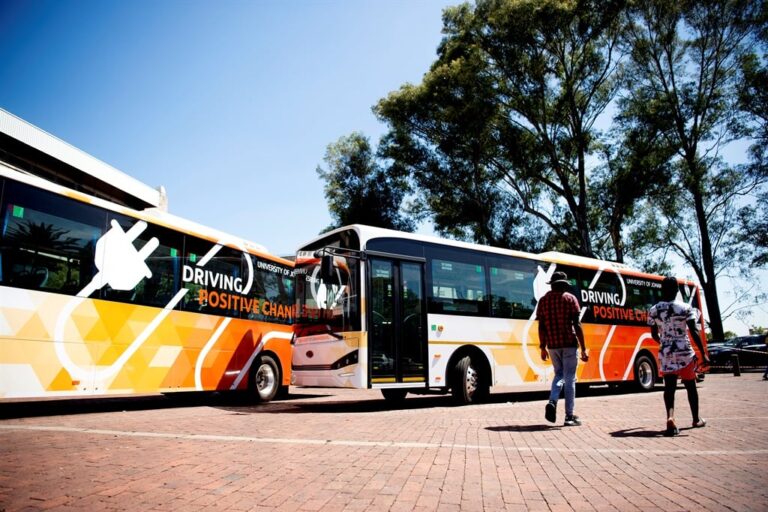
THE University of Johannesburg (UJ) has unveiled its new electric vehicle (EV) buses, in what is a first for a South African university. The EV buses, which will be added to the existing fleet, have already begun ferrying students between various campuses. 

The buses are the latest innovation in UJ’s ongoing efforts at going green, as part of the University’s plans to reduce carbon emissions, in line with the United Nations Sustainable Development Goals (SDGs).

UN Sustainable Development Goal 11 defines green cities as those that are dedicated to achieving environmental, social, and economic sustainability, with a focus on minimising inputs of energy, water, and food, and drastically reducing waste, heat output, and pollution. UJ has, in recent years, made strategic moves to improve its sustainability footprint. 

On Tuesday, 7 February 2023, there was excitement all around as one of the two brightly painted EV buses, branded in UJ’s signature orange and white, pulled out of Auckland Park Kingsway (APK) Campus into Joburg’s morning traffic. Aboard the bus were members of the University’s Executive Leadership Group (ELG), who were travelling to a meeting at one of the University’s off-campus venues in the city. And true to its nature, and unlike its diesel counterparts, the electric bus did not belch any toxic fumes. Not only do the EV buses produce much lower carbon emissions, but they also perform well, offering a smooth ride even on steep routes. 

Decreasing UJ’s carbon footprint

Special Projects advisor Professor Andre Nel explained the process that led to this project coming to fruition. “It started more than 18 months ago, as part of our drive to reduce our carbon footprint at UJ. We’ve always had a strong focus on sustainability issues. After implementing large numbers of solar panels, one of the next questions was how can we further make UJ sustainable? After some research, the obvious answer was how we were going to cut our carbon emissions in one area, and that area was transport. Transport makes up about four-and-a-half percent of UJ’s footprint and reducing that in any way is something we desired”. 

So what will happen when load shedding strikes and the buses can’t be charged? And what about their environmental friendliness, given that they are charged using coal-generated electricity? Dr Mpoti Ralephata, UJ’s Chief Operations Officer, was quick to allay such concerns. He said 15% of our energy at UJ comes from solar, which is enough to power the buses. “We will have to have loadshedding for more than five hours a night to affect overnight charging,” he said. 

4IR in action

Among those aboard the buses was Dr Nolitha Vukuza: Senior Executive Director: University Relations, Student Affairs and UJ Sport. “My experience is quite unprecedented because I’ve never been on an electric bus before. This is a day of celebration… We keep on talking about the fourth industrial revolution, and today it’s all about 4IR in action. I am also happy that the new VC (Vice-Chancellor and Principal Designate, Professor Letlhokwa Mpedi) has been talking about 4IR for societal impact. What a way to make it impactful,” she said, shortly before the bus drove off. 

The buses may at first glance – and from a distance – give the impression that they are part of the generation of the existing fleet. It’s only once you hop on that you realise that you have indeed entered into the fourth industrial revolution.

Most impressive is the amount of noise you will experience while the bus is running. Unlike the normal diesel-powered engines, the EV buses are almost silent – with the loudest sound being the humming of the air conditioning system.

Each bus has a capacity of 76 passengers, with 57 seated and 19 standing. 

For added safety, the buses are fitted with closed circuit television (CCTV) cameras and stop buttons.

The stop buttons make communication with operators easier, as passengers can draw the driver’s attention without being intrusive when approaching their destination. Adding to the high-tech design of the buses is that they are equipped with USB charging ports so that passengers can keep their gadgets running while onboard, for convenience. 

To get a bus fully charged, it would need to be left on the plug point for at least five-and-a-half hours. But that’s time worth investing in because it powers the bus enough to enable it to cover up to a 350 km range. The distance is significantly less than the 200 km of the entire bus route that the buses will cover. There are currently two charge points for the buses, one on campus and one at the bus depo.

An added beauty of these buses is that they are a gift that keeps on giving. Over the average 15-year lifespan which is expected that a bus will cover, these buses will save on fuel costs.

Another advantage is that they require less maintenance than their diesel counterparts. Due to the high-tech nature of the EV buses, and specifically because of the new technology that they come with, it is envisaged that drivers will be retrained in how to handle this fleet. 

Prof Mpedi was brimming with excitement at seeing the University’s vision come to life: “These buses are an example of 4IR in action. They are part of a legacy that we want to leave for future generations. As a testament to our position as a leader, we are the first university to make use of EV buses for commercial purposes.”

Prof Mpedi added that the buses are aligned with the institution’s sixth strategic objective, which is ‘fitness for global excellence and stature’.

“These buses are a tangible contribution towards achieving that goal. They are also a physical manifestation of our commitment towards the goal of being a sustainable institution that strives to implement improvements and actions across all spheres of its campus activities. We firmly believe that sustainable development is a long-term commitment. We aim to contribute to sustainability by reducing our environmental footprint while enhancing our contributions to the social and economic development of South Africa.” 

Engineering News

Robbing From the Poor to Educate the Rich

0

THE assault on public education currently unfolding in state legislatures across the United States stands to annually transfer tens of billions of dollars from public treasuries to the bank accounts of upper-income families.

Those dollars, which otherwise would have gone to public schools, will instead reimburse parents currently paying private school tuition. It’s a reverse Robin Hood scheme that Americans would hate if they fully understood what was going on.

That’s not the sales pitch, of course. As Betsy DeVos and her allies like to put it, their cause is “education freedom.” They want American families to have “options” beyond their local public schools. And their plan for creating those options is to push various forms of school vouchers.

The money that otherwise would have gone to local schools, instead, would be given to families. Families could then take those dollars—sometimes loaded on an actual debit card—and spend them at whatever kind of school, or on whatever kind of educational product, they want.

There are many reasons to dislike this plan. Public schools are open to all, meaning that they can’t turn students away on the basis of characteristics like ability or identity. And public schools serve the public good. That’s why we fund them with our tax dollars—because we expect them to serve all of us. Private schools, by contrast, can turn students away for nearly any reason, including that they have disabilities that make them more expensive to educate.

As more states adopt programs that use taxpayer dollars to fund private schools, taxpayers are increasingly footing the bill for discrimination. In Florida, for instance, a religious school that notified families this fall that LGBTQ students were no longer welcome and would be asked to leave immediately still receives more than $1.6 million a year in public funds through the state’s private school voucher program.

But school voucher plans are a raw deal not just for public schools and the students who attend them but also for taxpayers. Programs like the one jammed through by the Republican legislature in Iowa this week stand to immediately transfer massive amounts of cash directly from state treasuries to the families that least need it. While proponents, like Iowa Governor Kim Reynolds, sold the plan as a way to give choices to poor and middle-class families, the program will chiefly subsidize the parents who already send their kids to private schools.

The cost of that subsidy is significant—an estimated $340 million each year once the plan is fully phased in—and will be borne by the 500,000 students who attend the state’s underfunded public schools.

And it’s not just in Iowa that Republicans are pulling off this reverse Robin Hood maneuver. In Arizona, where lawmakers recently made all students eligible for school vouchers, 75 percent of the students who applied for the new subsidy never attended public school. The same dynamic is playing out in New Hampshire, where GOP legislators enacted an “education freedom” program over stiff public opposition. At Laconia Christian Academy, for instance, all but two families in the school took advantage of the program, pulling roughly half a million dollars out of the public treasury.

While earlier voucher programs, like the one adopted in Milwaukee more than 30 years ago, were limited to families enrolled in public schools, and came with strict income qualifications, the plans being adopted now dispense with any such limits, or adopt them only as temporary gestures designed as political cover.

The real goal is always a universal voucher open to all. And the math here isn’t pretty. Approximately 10 percent of students are presently enrolled in private schools—that’s just under 5 million students who would qualify for vouchers worth roughly $10,000 each, depending on the per-pupil expenditures in their states. When public schools are already systematically underfunded in most parts of the country, draining off an additional $50 billion each year will hurt quite a bit.

Who will benefit? Boosters claim it will be students presently denied “options.” Yet most families won’t leave their public schools. According to polling, most are satisfied with their children’s schools, even if they’d like to see more resources directed to them. And many families—like those in rural areas, or low-income families with limited access to transportation—are unlikely to ever have many viable “options.” Forty-two of Iowa’s 99 counties don’t have a single private school. Neither do the majority of zip codes in Utah, where yet another budget-busting voucher program is under consideration. For rural communities, draining resources from the public system is just another disinvestment in their children.

Mainly, the beneficiaries of these schemes will be the families presently paying private school tuition. An extra $10,000 or so each year, for each child presently enrolled in private school, will pay for things that will remain out of reach for most American families—a luxury vacation, a down payment on a new car, an addition to the retirement account. For those families wealthy enough to stockpile voucher money while continuing to pay private school tuition, the additional funds may even pay for college, as one Iowa Republican acknowledged last year.

Those left behind will simply have fewer resources. And that’s part of the design. Cutting the nation’s public school budgets off at the knees will dramatically reduce the tax burden on the wealthy. Equally important, it will shift schooling out of the realm of democratic politics and into the free market. And perhaps best of all in the eyes of voucher supporters, it will deal a fatal blow to teachers unions.

In an age of staggering income inequality, America’s public education system remains one of the last and best mechanisms for advancing equal opportunity. And that is precisely why it is a target. For all their high-minded rhetoric about “education freedom,” advocates of voucher schemes have repeatedly tipped their hands, revealing what they really value. They’ve got their own version of Robin Hood, and he already has his hands in the public purse.

THE NATION

SADTU ‘extremely’ concerned by increasing incidents of violence at SA schools

PHUTI MOSOMANE

THE South African Democratic Teachers’ Union says it is extremely concerned by increasing number of violent incidents at South African schools. 

This comes after a series of incidents of violence were reported at various schools in the form of bullying, suicide, stabbing and shooting since the beginning of the 2023 academic year.

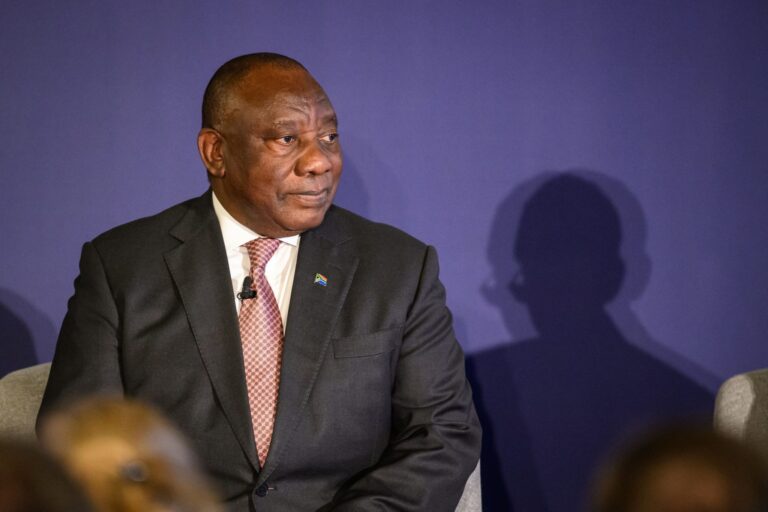
The teachers’ union called on President Cyril Ramaphosa and relevant ministries to establish a police unit dedicated to school violence in South Africa, including offering psycho-social services at schools.

“Violence in schools is increasing unabated and our schools, instead of being safe havens they are meant to be, are endangering the lives of teachers and learners,” said SADTU General-Secretary, Mugwena Maluleke.

Maluleke said the tragedy of South African schools is that they do not have enough infrastructure to ensure learners, teachers and communities do not bring weapons to schools. 

“We call for properly trained security personnel to oversee security in schools. We therefore reiterate our call to all stakeholders in education, more especially, communities and parents to be involved in schools in their neighbourhoods,” he added. 

“SADTU is calling for the creation of safe spaces for learners to confide in them about the issues they face. We again reiterate our call for dedicated psychosocial services in schools.

SADTU said during 2023 academic year alone, there were more incidents of violence at the following provinces since the reopening of schools in January:  

· At Geluksdal Secondary School in Brakpan, Gauteng: A Grade 10 learner was stabbed to death allegedly by fellow learners.

·  At Kagiso Secondary School, Gauteng: A man allegedly entered the school and took hostage some staff members. He allegedly stabbed and wounded one of the teachers and was subsequently shot dead by another teacher.

·  At Tlotlisong Secondary School in Ficksburg, Free State: A Grade 9 pupil allegedly poisoned himself and died following alleged humiliation by teachers in front of other learners. Following the suicide, angry learners attacked teachers, damaged the school, police and teachers’ vehicles accusing them for being the cause of the learner’s death.

·  At Sonyongwane High School, Southern KwaZulu Natal: A 17-year old Grade 11 learner committed suicide allegedly because of bullying by her schoolmates who constantly told her she was ugly and teased her about the shape of her head.

·  At Ntsu Secondary School in Bethlehem, Free State: The school principal allegedly used corporal punishment on a learner who had allegedly skipped detention.

Said Maluleke: “These incidents clearly indicate that schools are no longer safe havens they are supposed to be, but they endanger the lives of learners as well as teachers.” 

Maluleke said the union will now engage the Presidency and other government ministries and agencies to join hands with SADTU as it rolls out “I am A School Fan” campaign.

“Through this campaign, we acknowledge that schools are a microcosm of the society and therefore the violence cannot be divorced from what is happening in the community. We aim to mobilise for more parental and societal involvement including the private sector to play an active role in ensuring that our schools are safer,” he said.

Maluleke also said SADTU condemns the use of corporal punishment by teachers as it was a violation of children’s rights and dignity, and “perpetuates violence and may lead to the learner being aggressive and anti-social.”

“In a number of schools across the country we still observe the sexual assault and harassment of learners by those who are supposed to protect being teachers. This group of unprofessional sex pests continue to damage the profession. It is only counterrevolutionaries who can engage in this kind of violence against our children in our schools,” said Maluleke.

INSIDE EDUCATION

Science and Technology: Portfolio Committee visits projects in KwaZulu-Natal

0

EDWIN NAIDU

LAST month, the Portfolio Committee on Higher Education, Science and Innovation visited several KwaZulu-Natal Department of Science and Innovation (DSI) project sites.

The committee, led by Chairperson Nompumelelo Mkhatshwa and accompanied by senior managers of the DSI and Department of Higher Education and Training, visited several research facilities at the University of KwaZulu-Natal (UKZN) and the Council for Scientific and Industrial Research’s Biorefinery Industry Development Facility to learn more about how DSI-funded initiatives work.  

On 24 and 25 January 2023, Parliament’s Portfolio Committee on Higher Education, Science and Innovation conducted oversight visits to several sites in KwaZulu-Natal, where the DSI funds programmes.

Following the walkabout at the Biorefinery Industry Development Facility, which is working on using the methods developed to ascertain the causes or sources of problems in manufacturing, Ms Mkhatshwa said that there are not enough women in science and that institutions like these need more women to take engineering and science courses so that South Africa can grow its scientific expertise.

Professors at UKZN made presentations on the KwaZulu-Natal Research Innovation and Sequencing Platform (KRISP), the Aerospace Systems Research Group (ASReG), and the Indigenous Knowledge Bioprospecting and Product Development Platform, and committee members engaged with management on the presentations.

Mkhatshwa said she was pleased to be at UKZN to see how the DSI was using government funding and to make sure it could account for expenditure.  She added that the Department’s work needed to impact the citizens of this country directly, or it would be meaningless.

“I imagine a day when a young black person from rural KwaZulu-Natal can be, for example, an astronaut who goes to the moon. As the committee, we look forward to the day when young people from all backgrounds can take the lead in science, technology, engineering and mathematics, allowing South Africa to become a global leader in this field,” said Ms Mkhatshwa.

UKZN Vice-Chancellor Prof. Nana Poku echoed this sentiment, saying that the future of science can only be addressed fully if universities go to schools to motivate, enthuse, and give learners a sense of purpose to engage with science.
 
Highlighting genomic surveillance at KRISP

According to Prof. Tulio de Oliveira, the director of KRISP, the platform aims to put science on the global stage through critical interventions like genomic surveillance, which can significantly assist South Africa in investigating gender-based violence cases by providing DNA.

Prof De Oliveira said that African science should take centre stage globally, and Africa’s scientists can assist the rest of the world to prepare for the next pandemic.

“African and other low and middle-income countries need the opportunity to lead global consortiums, host large grants and events, and guide the global scientific agenda.”
 
Advancing space-related research through ASReG 

The ASReG, located within UKZN’s School of Engineering, runs flagship programmes such as the Phoenix Hybrid Sounding Rocket Programme, a rocket training programme started in the context of the government’s prioritisation of skills and resource development in space-related research.

“We need to give hope to the young people of this country, and this rocket technology can help us do that,” said Prof. Michael Brooks, co-founder of the ASReG.

As ASReG is the only dedicated sounding rocket propulsion research group in South Africa, it generates substantial human capital in mechanical and aerospace engineering research.  

In 2021, it launched the Phoenix-1B Mk II-R rocket, which set a new African altitude record of 17.9 km.  

Prof. Brooks also spoke about the ASReg’s talent pipeline programme, which acts as a bridge from the undergraduate to the postgraduate level by exposing students’ talents to aerospace engineering and providing them with financial assistance.  Last year, the programme reached approximately 1 600 schools in rural KZN and surrounding communities.

Building indigenous knowledge systems

Representatives from the Indigenous Knowledge Systems (IKS) Task Team, comprised of leaders from traditional health organisations and traditional healers, shared their experiences working with traditional medicines and how they collaborate with the university using their knowledge and skills.

Traditional healer Thulani Shangase, a steering committee member, said that traditional healers should be included in nation-building activities and that the committee would advocate for the recognition and integration of indigenous knowledge into the country’s landscape.

Mayashree Chinsamy, the Research Manager for the DSI-NRF Centre of Excellence in IKS at UKZN, said that the centre uses a ground-up approach in science, research, and community engagement to influence the centre’s areas of focus.

For example, she said, most people associate IKS with traditional medicine as it is usually the first thing that comes to mind. “We are talking about community-based knowledge systems, or culturally and ecologically specific knowledge,” she said.

“If you go into a certain space and look at the cultural communities there, yo u will notice that they have devised a certain knowledge system from different disciplines coming together to live and survive. People have been putting knowledge on the ground for a long time, whether to ensure food and nutrition security or public health and well-being. They are the scientists on the ground,” added Chinsamy.

Prof. Nceba Gqaleni, a Fractional Research Professor at UKZN, said that boosting traditional medicine can solve societal problems that Western medicine cannot cure.

INSIDE EDUCATION

Ramaphosa prioritises ECD, praises Class of 2022 and provides R800m boost for skills development

0

EDWIN NAIDU

PRESIDENT Cyril Ramaphosa praised the Class of 2022 in his State of the Nation Address (SONA) last Thursday.

“Last year, our matriculants defied the effects of the pandemic to achieve a pass rate of 80%, and we congratulate them for that great achievement,” said Ramaphosa.

“What we have achieved as a nation over the past year, despite our challenges, remind us that the
promise of South Africa is alive.”

Appealing to companies, departments and SOEs to remove the requirement for work experience for young people seeking entry-level positions, the President said skills development was integral to job creation.

Therefore, government would allocate R800m to the National Skills Fund to develop skills in the digital and technology sector through an innovative model that links payment for training to employment outcomes.

“Last year, we said we would place over 10 000 Technical and Vocational Education and Training (TVET) college graduates in employment. We have surpassed that figure and have now set a target for 2023 of 20 000 TVET to be placed in employment,” he added.

The number of students entering artisan training in TVET colleges will go up from 17 000 to 30 000 in the 2023 academic year.

One of the critical ingredients for economic growth and competitiveness is attracting skills that the economy needs.   
  
Last year, Ramaphosa spoke about the value of the Presidential Employment Stimulus in providing work and livelihood opportunities. The initiative has now created over one million opportunities, reaching every province and district in our country.   
 
Furthermore, a new cohort of 150 000 school assistants began work last week at more than 22 000 schools, offering dignity, hope and vital work experience to unemployed young people.   
 
The Social Employment Fund is recruiting 50 000 participants in its next phase to undertake work for the common good.

The revitalised National Youth Service will create a further 36 000 opportunities through non-profit and community-based organisations. 

The Department of Home Affairs has appointed the first cohort of 10 000 unemployed young people to digitise more than 340 million paper-based civic records.  
 
There are now more than three million users registered on SAYouth.mobi, a zero-rated online platform for young South Africans to access opportunities for learning and earning.  
 
This has been done in close collaboration with the National Youth Development Agency (NYDA), which continues to provide valuable assistance to young entrepreneurs and work seekers.  
 
“These are examples of the difference government can make in people’s lives through innovation, creativity and commitment. Access to quality education for all is the most powerful instrument to end poverty,” he said.
 
Ramaphosa added that laying a better foundation through Early Childhood Development for young children was critical so they could write and read to learn and develop.

Significantly, the number of children receiving the Early Childhood Development (ECD) subsidy doubled between 2019 and 2022, reaching one-and-a-half million children.

The Department of Basic Education is streamlining the requirements for ECD centres to access support and enable thousands more to receive subsidies from the government.

While at the other end of the primary education journey, Ramaphosa applauded last year’s matric pass rate of 80%, with all provinces showing improved results – up from 76% the year before.

The share of bachelor passes in no-fee schools improved from 55% in 2019 to 64% in 2022.

“These results reveal that a silent revolution is taking place in our schools. Schools must be safe and
allow for effective learning and teaching,” he added.

INSIDE EDUCATION

Former President of Mauritius, Ameenah Gurib-Fakim, explains why science matters to women and girls

0

EDWIN NAIDU

RENOWNED scientist Ameenah Gurib-Fakim, the former first woman President of Mauritius and current first ambassador for the SIDS at the World Diplomatic Academy, delivered a powerful message supporting the International Day of Women and Girls in Science at the weekend.

“I’ll mention that 52% of any country’s population are women, and if we exclude this powerhouse, which this population represents, I think we’re all heading towards failure.”

Gurib-Fakim sent a short message to the girls studying at Mont Lubin in Rodrigues, Mauritius, on Saturday, telling them that science was close to her heart.

Her message was supporting the United Nations International Day of Women and Girls in Science to promote full and equal access and participation for women and girls in Science, Technology, Engineering and Mathematics (STEM) fields.

Annually, 11 February celebrates the essential role that women and girls play in science and technology.

And why science matters?

“I’ll give you a statistic, which I’ve read which is quite mind-boggling, 85% of the jobs that will be in
exercise in 2030. These jobs have not yet been invented. And many of these jobs will be within the
science and technology realm. So, bringing women on board, looking at their intuition, and looking at
their talent will give a new perspective.”

“Now science, as you know, is at the basis of everything science at the business of life. And if you look at sectors where science can impact, let’s start with agriculture…I can safely say that women feed Africa.”

“Women are very involved in the agricultural sector but remain underdeveloped because most women who practice in this sector are not empowered. Now, imagine the impact of empowerment of these women in this sector if they have the tools of science and the mechanism of technology in this area with her culture. She will earn more, she’ll feed her family better, and she’ll be better educated. She can become that famous entrepreneur that we are all thinking about.”

Why do we need to have women empowered?

“Because the decisions made when women are at the table, these decisions make the family work better. They make the community perform better. They make society operate at a different level and the country fares. So that’s why I say to these women if you find that there is not a chair for you at that decision-making table, bring your chair.”

“The other thing I must say to girls is that you must live your dream. It would be best if you made whatever you do become your passion. Because when you’re passionate about something, you can rest assured that you do it well. You will enjoy it. Confucius said, “if you make your work become your passion, you will not have to work a single day in your life”.

“The other issue I would like to touch on very quickly is gender equality. Gender Equality matters a lot in the world of work. We need to ensure that women are equally paid for what they do. Unfortunately, in many countries worldwide, this is still not a reality. Women are still underpaid. So let us all think on this 11th February how we can make society work better with the proper empowerment of our girls about women so that they become the drivers of change. And we knew that if we put our heads together, we could make It.”

INSIDE EDUCATION

Motshekga calls for comment on proposed 2026 calendar for public schools

0

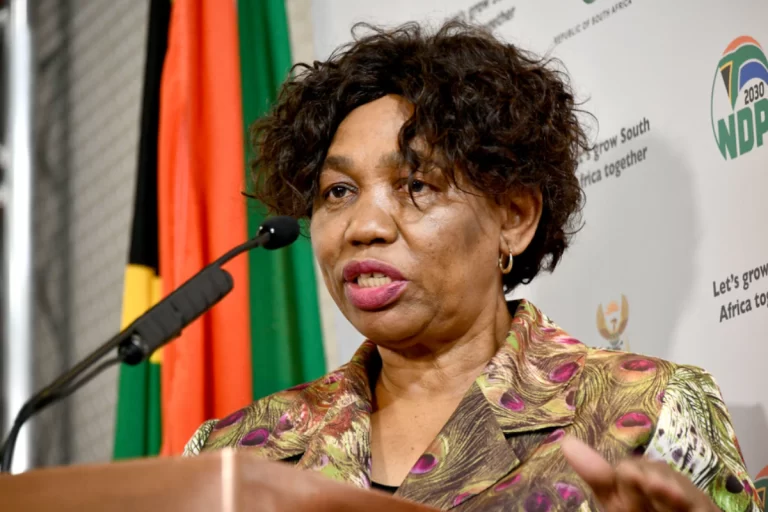
MINISTER of Basic Education, Angie Motshekga, has invited the public to comment on the proposed
2026 calendar for public schools.

All interested persons and organisations are invited to comment on the Proposed 2026 School Calendar in writing and direct the comments to the Director-General for the Department of Basic Education, for the attention of Mr S Mlambo, e-mail: Mlambo.S@dbe.gov.za; cc Manaka.L@dbe.gov.za.

The Proposed 2026 School Calendar and the National Policy for Determining School Calendars for Public Schools in South Africa (The Policy) is obtainable on the following Departmental website: http://www.education.gov.za.

INSIDE EDUCATION