Home Blog Page 297

Ohio Valley University Women’s Soccer Wins RSC Championship

0

THE River States Conference Women’s Soccer Championship took place Saturday under conditions that were not very soccer-like. The high temperature was around 42 degrees, but it didn’t feel like that with the swirling wind surrounding the OVU Soccer Field.

The grim conditions also added to the overall fee of the game – two very evenly matched teams that were getting ready to battle it out for a championship and a berth into the National NAIA tournament.

The game was a yellow card festival throughout and that aggressive play meant scoring would be minimal. In fact, one OVU goal was all it took on this afternoon to lift the Scots to their very first RSC Championship in their very first year in the league.

In the first half, the action was instantaneous and both teams battled back and forth, but no real scoring threats took place. The first shot on goal did not register until the 21st minute when Rio Grande goalkeeper Morgan Nutter made easy work of a Raewyn Murphy kick. It was not until the 36th minute that any team could break the ice on this chilly day.

Ana Rodrigues set up for a corner kick, but instead of sending a cross into the box, she sent a quick entry pass to Anouck Heyer. Heyer immediately sent it back and Rodrigues then sent a shot into upper left hand corner of the goal. Nutter got a fingertip on the ball but was not able to redirect it and OVU took the lead. That is how the half ended with the Scots owning a 1-0 lead.

The second half found two teams pulling out all of the stops to try and win a championship. A total of 13 fouls and 6 yellow cards in the half but not a single shot on goal was registered. The OVU defense was stellar as they surrounded RSC Player of the year Chase Davis and other RedStorm attackers anytime the approached the goal box. In the end, Rio just ran out of time and the Fighting Scots were crowned the champions.

After the game, the All-Conference team was announced. OVU’s Ylenia Cirrincione, Raewyn Murphy, Sindi Kanto, Yuliana Hererra and Oihane Abascal were all named to the RSC Second team. Ximena Jauregui and Manuela Filipe were named to the RSC First team. Filipe was then awarded the RSC Newcomer of the Year and Jauregui was awarded the RSC Defensive Player of the year.

OVU coach Eric Belcher was announced as Coach of the Year in the River States Conference after the game and had this to say about his team.

“What a season it’s been. Regular season champs. Conference tournament champs. So proud of these ladies! On to the National Tournament. There’s more work to do.”

The Scots have earned a right to play in the NAIA National Championship tourney. Their opponent and destination will be determined via a selection show on Monday.

  • * News & Sentinel

Department of Basic Education Took Government’s Vooma Vaccination Weekend to Sedibeng, Gauteng

THE Department of Basic Education heeded the call this weekend by President Cyril Ramaphosa to support the Vooma Vaccination Weekend – aimed at encouraging more South African to take the lifesaving COVID-19 vaccine.

The department hosted a vaccination activation from Saturday until Sunday from 8h00 to 15h00 at the Open Site next to Holy Pentecost Apostolic Church in Boitumelo, Sebokeng in Gauteng.

As part of government’s efforts to ramp up vaccinations for the country ahead of the festive season, Ramaphosa has written to a wide range of leaders in government, labour, faith-based organisations, the National House of Traditional and Khoi-San Leaders, business and civil society partners inviting them to support the Vooma Vaccination Weekend and participate in local events and community outreaches across the country.

“The department will have an exhibition on site to showcase and share information about the various programmes of the DBE including Funza Lushaka and Second Chance Matric Support Programme,” the Department of Basic Education said in a statement.

Earlier this week, Health Minister Dr Joe Phaahla said in a statement that the first Vooma Vaccination Weekend led to an unprecedented level of engagement and active mobilisation across many districts in South Africa.

He said that it achieved 75% of its target of 500,000 vaccinations over the three-day period, and government hopes to achieve 100% of that target this weekend. –SAnews.gov.za

University of Pretoria hosts book launch for award-winning South African writer Professor Zakes Mda

“We were taught that our history begins with colonisation, whereas our ancestors have contributed greatly to humanity,” said South African novelist, poet and playwright Professor Zakes Mda at a virtual book launch dialogue hosted by the University of Pretoria (UP).

Professor Mda recently published two books, Arola: A Journey into 10 Ancient African Civilisations and Wayfarers’ Hymns.

Arola is difficult to categorise because it is so complicated,” Professor Mda said.

 “The main aim of the book is to teach others about African history. The research process was not difficult or intense because the materials I am writing about are all accessible; some of them are even accessible online.

“We are taught to believe that African history begins only with the coming of the white man, and we call it ‘African history’, when in fact it is the history of the white man in Africa rather than African history,” he added.

“So I was keen to delve back centuries ago to look at the empires that existed then. History of these empires exist in museums all over the world, but scholarship has ignored material that was right in front of their eyes.”

Professor Tawana Kupe, Vice-Chancellor and Principal of UP, added to the conversation by placing emphasis on the University’s intention to educate individuals about their history. “We were not just people who were discovered – we existed before,” he said. “Our intention at UP is to teach people origins and histories of knowledge because, as Prof Mda said, when you are taught something only begins here, you are only being taught one history’s form of knowledge. You are also taught that you are not creators of knowledge. Another thing we would like to do at UP is situate Africans as knowledge creators.”

Moving from Arola to Wayfarers’ Hymns, Dr Nokuthula Mazibuko Msimang of UP’s Faculty of Humanities, who moderated the dialogue, described the novel as a “dramatic book about musical gangsters”.

“This book is centred on famo music, a popular genre of music in Lesotho,” Professor Mda said.

“The predominate instrument used in Lesotho is the accordion. Basothos [a collective term for native Sotho people] have turned the accordion and the concertina into Basotho traditional instruments, and have been creating famo music. This is a kind of music that is full of poetry, which is known as hymns, but these are circular hymns not religious hymns.”

Professor Mda went on to explain why he finds famo music and the culture surrounding it so interesting, and how this contributed to the conceptualisation of Wayfarers’ Hymns.

“I grew up in Lesotho, so I grew up listening to famo music. But I recently learned new things about this music. I learned that musicians also led gangs, so these musicians have evolved into gang leaders. Every weekend in Mafeteng, a city in Lesotho, there are funerals of musicians who have died in wars where they were fighting for territory and followers, but also fighting for [control of] illegal mining sites. The illegal mining that happens in Gauteng and Welkom is actually led by the musicians and leaders of these gangs. So I was fascinated to hear about this because I’ve never read about it, not even in newspapers.”

  • Zakes Mda was born in Herschel in the Eastern Cape in 1948 and studied in South Africa, Lesotho and the United States. He wrote his first short story at the age of 15 and has since won major South African and British literary awards for his novels and plays. His writing has been translated into 20 languages. Mda is a professor of Creative Writing at Ohio University.
  • * UP

Netflix’s Sex Education is doing sex education better than most schools

NETFLIX’s comedy Sex Education, now in its third season, is set among a group of students and teachers at a British high school. In depicting sex education, it teaches viewers about sex and sexuality – often doing a better job than school-based sex ed classes.

In the first episode of season three, Dr Jean Milburn (Gillian Anderson) is interviewed on the radio about her new book, Uneducated Nation: A Sex Education Manifesto for Our Youth.

When the host asks her to tell him about the book, she replies she was “shocked at the ineptitude” of school sex ed classes. So she created this easy-to-read manual to help empower our teenagers, and their parents, as they become sexually active young adults. He responds, “Sounds a bit racy”. Jean retorts,

Well, if, by racy, you mean highly researched and completely essential to the health and well-being of our children, then, yes, I suppose it is.

Jean’s response could easily be applied to the television series itself – racy but essential. It could also be seen as a comment about how school-based sexual education programs could improve their communication of relevant information to curious teenagers.

We are part of an international research team working with scholars from Greece, Ireland and Norway to interview adolescents and their parents about their perceptions of harm in accessing sexual content.

As researchers with expertise in the fields of sexology, communication and media studies, we value the knowledge young people share about their own needs and desires.

Our research with teens – and into stories that represent their experiences – illustrates they are sexual beings who want and deserve sex-positive information. Too often, this positive side of sex is left out of the classroom.

Sexually provocative, but educational

Sex Education is one example of how stories in popular culture can portray teen sexuality positively.

For instance, the opening scene of this first episode of season three is upbeat, playful and sexy.

It cuts between at least 13 different moments of sexual pleasure: heterosexual sex, gay sex between young men, gay role-playing sex between young women, masturbating while watching porn, online sex, virtual reality sex – and the pleasure of reading a book while eating cheese puffs.

This sequence is sexually provocative, but it also educational. It shows a range of desires across ages (yes, teachers and parents have sex, too), races, sexualities and body sizes.

There are none of the messages about abstinence and fear often associated with representations of teen sex, and no coy curtain-wafting standing in for sex.

The premise of the show is the teenagers at Moordale High do not receive adequate sex education classes, so Jean’s son Otis (Asa Butterfield) and his classmate Maeve (Emma Mackey) set up a sex therapy service for their peers.

These young people seek information about how to overcome sexual difficulties and become better lovers. They find (usually) correct – and always frank – information from Otis and Maeve, who offer resources and advice.

Teenagers and porn

As we argue in a recent essay, this TV show complicates the idea that pornography is only harmful to teens.

Watching porn can be “a bit of fun”, to quote one character, but also a source of misinformation about sex. Sex Education debunks this misinformation, such as when one character mistakenly believes a large penis is required for sexual satisfaction, and another thinks her labia should be tucked in.

Teenagers as consumers and producers of pornographic and erotic narratives can use these stories, and the stories in Sex Education, to develop an understanding of sex and sexuality and supplement the information provided in school curriculum.

This seeming contradiction about pornography aligns with a report written by the Australian Institute of Family Studies about the effects of porn on young people.

This report highlights the lack of information about how young people access sexual content (unintentionally or intentionally); about the content of pornography they view; and about teenagers’ ability to distinguish between the fantasy pornography represents and the reality of their sexual experiences.

The report also found very few accounts from teens themselves about their experiences accessing sexual content online and any perceived harm from it. It points to a need for further research, which includes the voices of adolescents.

Teaching pleasure

Dr Jacqui Hendriks, who coordinates Curtin University’s sexology courses, believes sex ed should include discussions of pleasure rather than focusing primarily on reproduction.

At present, the quality of sex education varies widely across the nation, but in Western Australia, a group of researchers have identified the “need for a greater focus on positive sexuality and relevant contemporary issues” in the classroom.Sex Education challenges a commonly-held perception teenagers should be protected from the harms of sex and sexual material. The stories told by teens and about teens can be crucial tools to open conversations between children and adults about sex.

The conversation started by shows like Sex Education highlights the need for more comprehensive sexual education not only in schools but in communities and in the family home itself.

  • * The Conversation

SADTU Concerned About The Adverse Impact Of Eskom’s Load Shedding On Matric Exams

SADTU has called on Eskom, the Department of Basic Education (DBE) and all other relevant authorities to urgently find a reasonable mechanism to reduce the adverse impact of load-shedding on the current National Senior Certificate examinations.

In a statement issued on Thursday, Sadtu spokesperson Nomusa Cembi said the Department of Basic Education should urgently consult with Eskom and, based on such consultations, respond accordingly to minimise the disruptions which cause collective trauma to both learners and teachers.

Cembi added that the current load-shedding by Eskom is having an adverse impact on leaners and students at this critical time of the academic year.

“The current situation, regardless of the reasons or circumstances under which it happens, adversely affect the right of learners to education and has a direct adverse impact on their emotional and psychological being,” said Cembi.

“In many other instances learners will be exposed to safety and security risks particularly in those instances where alternative arrangements are made to enable them to study and prepare away from their homes.”

Sadtu has also called on the Department of Basic Education to put in place measures to ensure that learners and students who arrive late for their examinations and who require electricity supply to conduct examination are not prejudiced.

“We also call on the Department of Basic Education to afford all learners who have missed their examination as a result of load shedding to be afforded an opportunity to write those examinations during this examination session,” said Cembi.

“We further call on the government to investigate the allegations that the technician ignored the red light warning of low oil that led to the tripping three days before the elections. It is our considered view that this was a sabotage to support the call for the firing of the ESKOM board and those who are dealing with the rot that was characterising ESKOM.”

On Thursday, Eskom announced that Stage 2 would be implemented from midday and that power cuts would end on Friday at 5am.

Earlier this week, Eskom implemented Stage 4 and later Stage 3 load shedding to allow the utility to fully replenish its emergency generation reserves.

“While Eskom regrets the escalation in load shedding, it is necessary to ration the remaining emergency generation reserves, which have been utilised extensively this morning as we are not getting the reduction in demand as expected from the implementation of Stage 2 load shedding,“ it said at the time.

“It was anticipated that an additional seven units would have returned to service by Monday, and this has not materialised. Further, a generating unit at Arnot power station tripped, contributing to the shortages.”

  • * Inside Education

Umalusi Says Eskom’s ‘Erratic’ Load Shedding Impacts On The 2021 Matric Results

UMALUSI believes rolling blackouts across South Africa due to load shedding may have a negative impact on the 2021 matric results.

Grade 12 pupils are in the process of writing National Senior Certificate exams and currently have to contend with stage 2 load shedding throughout this week, until 5am on Saturday.

This after Eskom implemented Stage 4 load shedding expected to last until Friday morning while Stage 2 blackouts will be implemented until five o’clock on Saturday morning.

Speaking to NewzroomAfrika, Umalusi CEO Mafu Rakometsi said load shedding would affect the quality of the exams as well as the results.

“Load shedding will negatively impact on the results. If students are not able to study adequately, then that is a problem,” said Rakometsi.

“I want to say that people are not equally sighted in terms of how they can see and immediately you have to write in a dark room. That situation is going to affect the students differently. [They] might struggle to go through the question papers and struggle to write because they are writing in a room that [isn’t] well lit.”

Gauteng Education MEC Panyaza Lesufi said 15% of matric exam centres in the province have been affected by blackouts.

Lesufi said while the department was prepared for the blackouts, if it continued, matric results could be badly affected.

“I can say 15% of our examination centres have been affected because it comes and goes at different times, we’ve got papers in the morning, we also have papers in the afternoon,” said Lesufi.

“So it has affected us but as I said we’ve incorporated it, but the sooner we get past this stage of load shedding the better because it will generally affect the outcome of the results.”

Public Servants Association (PSA) in KwaZulu-Natal has called on government to deal with the load shedding crisis.

The Department of Basic Education said on Monday it had contingency plans in place to ensure the latest bout of rolling blackouts won’t impact the matric exams.  

The department’s spokesperson Hope Mokgatlhe told Jacaranda FM news that there’s a plan B should load shedding disrupt exams.

“What we have said as the department and we always say so that the nation and the parents can be at ease, is that if it happens that learners cannot write because of a power outage, we have backup papers. We are talking about grade 12 here, in fact, all grades that are writing exams now- we have backup papers all the time,” said Mokgatle.

“So we want the nation and parents to know that as the department, our plan B is that if it happens that learners cannot write because of something we cannot control like a power outage, they will write at another time. We will have a backup paper so they will not be disadvantaged because as the department and as the government we work together knowing that there are things that we cannot really foresee.”

  • * Inside Education

Push For Fewer COVID-19 Lockdown Restrictions At South Africa’s Schools

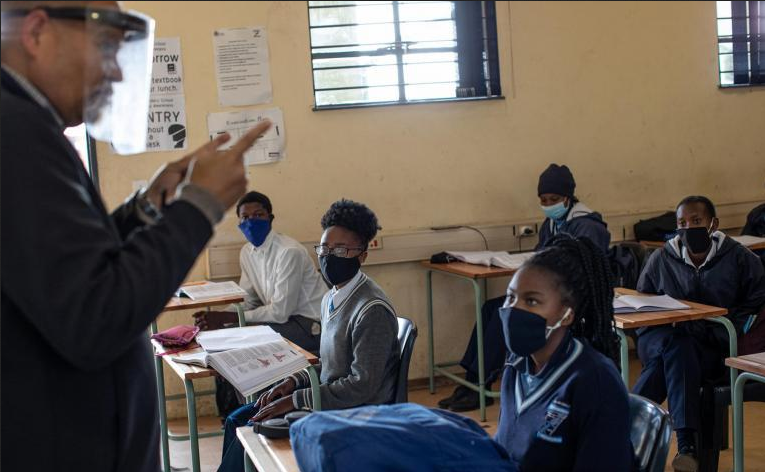
THE South African Human Rights Commission (SAHRC) says that a significant number of primary schools around the country remain on rotational timetables, with many schools also applying to keep a rotational timetable in place in 2022.

The reason for the rotation is a directive from Minister of Cooperative Government and Traditional Affairs (Cogta) minister Nkosazana Dlamini-Zuma providing that social distancing measures in primary schools should be maintained at one meter, the commission said.

The SAHRC said it has also been made aware that most schools in the Western Cape (86%) have applied for rotational timetables for the 2022 academic year.

“The commission holds that rotational learning has a long-lasting negative impact on learning outcomes for children and, as the Ministerial Advisory Committee on Covid-19 (MAC) advice states, that the harms of learners attending school on a rotational basis – specifically the severe cognitive, nutritional, and psychosocial costs – exceed the benefits of reduced Covid-19 infections from smaller class sizes.

“The Cogta directive compromises the ability of primary schools – where the very foundation of learning takes place – to return to normal teaching and learning, notwithstanding reduced transmission and virus acquisition rates among teachers and learners in these schools as the majority of educators have been vaccinated and due to the low acquisition risk profile of primary school learners.”

The SAHRC said that it agrees with the MAC that all primary schools should open at full capacity.

The commission said it has now written to the basic education minister, the health minister, and the Cogta minister to call for an urgent meeting to discuss the termination of rotation in primary schools.

“This would essentially mean that the Cogta minister needs to amend her directive by deleting the 1-meter social distancing requirement in respect of primary schools.

“We will also discuss the return to normal schools for high schools, in view of the fact that the Department of Health has commenced with the Covid-19 vaccine rollout for 12-year-olds,” the commission said.

  • * Business Tech

Condolences Pour In Following Free State Teacher’s Murder By Unknown Suspects

A 53-year-old principal from Mooifontein Primary School in Zastron, in the Free State, has succumbed to gunshot wounds.

Andile Ketso was shot by unknown suspects in Zastron.

Free State Department of Education said Ketso started the teaching profession in 1992 and was a Physical Science teacher at Lere-La-Thuto Secondary School before he was promoted as a principal.

The Free State Education Department has shared its condolences with the family members, learners and colleagues of a school principal who was gunned down at Zastron in the Free State.

Spokesperson, Howard Ndaba says the Department has lost a dedicated teacher who always strived for quality results.

Ndaba also condemned violence at schools, and called on all management teams, school governing bodies, and learners to strengthen school safety and build relationships with police.

“We want to take this opportunity to convey our sincere condolences to the family of Andile Ketso who’s a principal at Mooifontein Farm school in Zastron. Mr Ketso was gunned down and the suspects and motive for his killing are still unknown. He was a very dedicated educator who’s teaching physical science, he joined the department in 1992,” says Ndaba.

He further added that Ketso was a very dedicated principal and educator who joined the Education Department in 1992 as a junior teacher.

Last month, Dr Granville Whittle, deputy director-general at the basic education department, told parliament the national school safety framework remained their primary strategic response to school violence.

“It is based on a social ecological systems model, which locates the school within its broader community. It relies on collaboration and partnership. South Africa joined the Safe to Learn global campaign to end violence in schools, in partnership with Unesco and Unicef,” he said.

The education department said its partnership with the departments of justice and social development ensured improved vetting of teachers and other staff, and the establishment of a national school safety steering committee with related government departments and social partners to better coordinate safety interventions.

Whittle further said that in collaboration the department has also embarked on interventions aimed at addressing hotspots for most at risk schools.

Some of the measures include improving the built environment, such as considering learner safety when planning school infrastructure, as well as closure of taverns and liquor outlets in close proximity to schools, in partnership with the Department of Trade and Industry, SAPS and South African Local Government Association (SALGA).

The measures also include search and seizures in partnership with SA Police Service (SAPS) and the provision of security guards to schools at risk.

The SAPS said school based crime prevention would be intensified and that the collaborative agreement with DBE would be revised in order to make it more effective. 

Eighth UFS Chancellor Professor Bonang Mohale Inaugurated

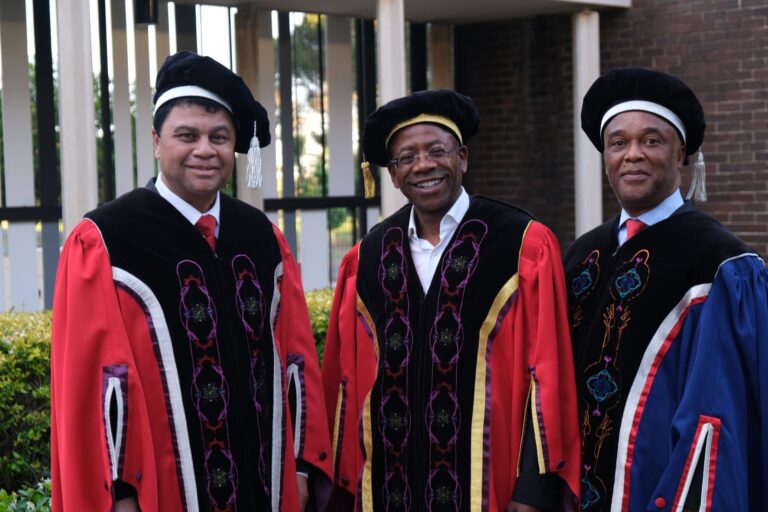
PROFESSOR Bonang Francis Mohale was officially inaugurated as the eighth Chancellor of the University of the Free State (UFS) on Friday.

He took up his five-year term in June 2020 and has served in the role for the past 17 months. Prof Mohale takes over from Dr Khotso Mokhele, who served as Chancellor of the UFS from June 2010 until June 2020.

Prof Mohale is the President of Business Unity South Africa (Busa), Professor of Practice in the Johannesburg Business School’s College of Business and Economics, Chairman of both the Bidvest Group Limited and SBV Services.

According to the UFS he is a highly respected South African businessman, known as much for his patriotism as his active role in seeking to advance the country’s interests. He is the author of the best-selling book, Lift As You Rise, launched in November 2018. The book is a compilation of some of the spoken and written words in which Prof Mohale reveals the issues that he is passionate about – among them leadership, transformation, people development, constructive collaboration, and integrity.

Prof Mohale emphasised that the challenges facing higher education were linked to the broader challenges facing South Africa, namely, poor economic growth, high youth unemployment, and the paralysing effect of the “nine wasted years” of state capture.

“The student protests and service delivery protests are a symptom of many societal ills and failures. While government may have had the resources – financially and technically – to map a way forward for the higher education sector, its ability to implement is severely constrained by insufficient capacity,” said Prof Mohale.

“The fundamentals of future higher education institutions should be values such as respect, empathy, equality, and solidarity that support and prepare learners for life, to be better citizens, to be more aware of their societal and civic responsibilities and role in the environment and not only for livelihood.”

David Noko, Chairperson of the UFS Council, said that the council appointed the right person for the job, the right person for this university, in this country, at this particular time. “The values that Prof Mohale embodies, which he is known to advocate from various platforms – in written media and virtual spaces – and which he actively lives out, are the values that the UFS cherish and embrace. Values such as respect, empathy, equality, solidarity, diversity, and caring.”

In congratulating Prof Mohale, Prof Francis Petersen, Rector and Vice-Chancellor of the UFS, acknowledged the contributions he made.

  • Compiled by Sazly Hartzenberg

UNR To Offer Nevada’s 1st Online Marijuana Education Program

0

THE extended studies program at the University of Nevada, Reno is launching the first online courses in the state to obtain non-credit certificates in cannabis education ranging from business to horticulture and medicine to help meet demand for jobs in an area that sponsors say is “growing like gangbusters.”

Each certificate program includes three eight-week online courses offered through Green Flower, a cannabis career training company. The four programs cover the business of the marijuana industry; agriculture and horticulture; law and policy; and health care and medicine.

“It’s a new era,” said Jodi Herzik, interim vice provost for Extended Studies.

“The industry is changing,” she told the Reno Gazette Journal.

“You can’t just have former potheads running the counter, you have to have educated professionals.”

Legal cannabis sales exceeded $1 billion in the fiscal year that ended Sept. 30 in Nevada, where about 10,000 people work in the industry, the Nevada Dispensary Association reported.

“We’ve been very careful to stress that this is strictly education about the industry because there’s a need,” Herzik said.

“With the impact of COVID-19 being displaced, and people looking for new career paths, we thought this might be the right time to try this program,” she said. “Jobs in that area are growing like gangbusters. They’re high-paying jobs too.”

Legal cannabis supports 321,000 full-time jobs nationally, growing faster than any other industry in the country, according to the Leafly 2021 Jobs Report.

“Such growth has created a large and growing job market, and a tremendous opportunity for people in Nevada to find rewarding careers,” said Daniel Kalef, Green Flower’s vice president of Higher Education.

Marijuana is still illegal at a federal level, and that includes direct research, consumption and any other direct use. A majority of states, however, have legalized marijuana in some capacity.

Nevada was the third state to approve cannabis for medical use with the adoption of the Nevada Medical Marijuana Act in 1998. Nevadans voted to legalize cannabis for adult recreational use in 2016.

Herzik said the university hasn’t promoted the program heavily so as to have a soft launch this month, allowing the school to ensure it’s a good fit and doesn’t need any tweaking.

About 30 to 40 prospective students have expressed interest so far, many from the Las Vegas area and a few from other parts of the country, she said.

The first session of online courses begins Nov. 15.

The cost is $2,950 per certificate, but the university is offering a special one-time $500 discount for students who enroll in the November launch. Payment plans are available.

Students will develop a portfolio of case studies and projects that can be used to demonstrate sector-specific cannabis knowledge, Herzik said. Upon successful completion of the program, students will earn a certificate of completion from UNR.

Courses begin in six start dates a year and are scheduled to accommodate working professionals, she said.

Enrollment is open at https://cannabiseducation.unr.edu.

  • * AP