Home Blog Page 318

Teenage Pregnancy During COVID-19 In South Africa: A Double Pandemic

DR KIM JONAS|

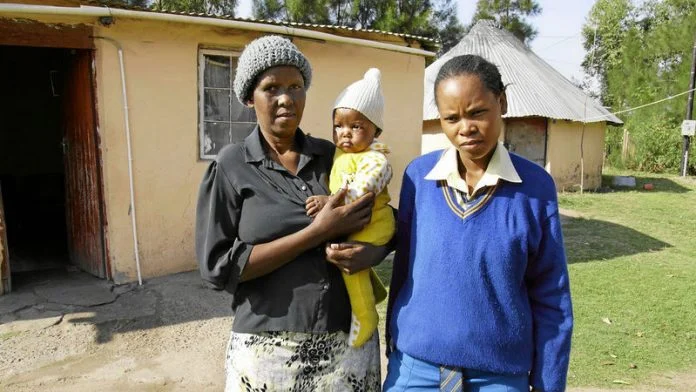
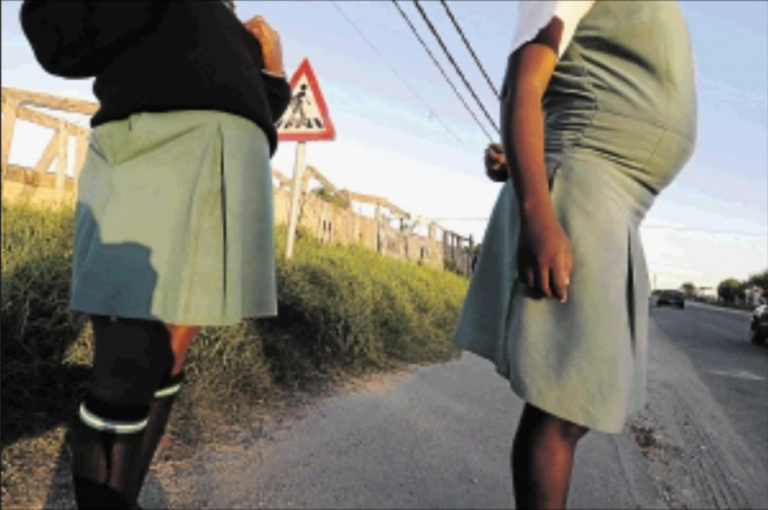
PREGNANCIES among adolescent girls remain a global problem. An estimated 21 million girls aged 15–19 years in developing countries become pregnant and about 12 million of them give birth every year.

Pregnancies not only have adverse health risks for adolescent mothers and their babies – these problems can persist into the next generation.

For example, girls who become pregnant often drop out of school, limiting their future economic opportunities and perpetuating a cycle of poverty.

South Africa recorded increased rates of teenage pregnancies in some parts of the country between 2018 and 2019 and more recently during the COVID-19 pandemic. This was partly due to the difficulty of accessing contraceptives, which was greater during the COVID-19 lockdown.

An increase in the adolescent pregnancy rate strongly suggests challenges with accessing sexual and reproductive healthcare services for this vulnerable age group and is a cause for concern.

Drivers of teenage pregnancy

Even before the pandemic, in South Africa, 16% of young women aged 15-19 had begun childbearing. The figure ranges between 11% in urban areas and 19% in rural areas.

One factor that has contributed to this is violence against women and girls.

In South Africa one in three women experience gender based-violence and one in five children under the age of 18 experience sexual abuse.

Deficiencies in the health system also contribute to teenage pregnancies. It’s not always easy for adolescents to get contraceptives if services aren’t youth-friendly.

Education about contraception for adolescents is inadequate too.

In South Africa, 31% of girls aged 15 to 19 aren’t getting the contraceptives they need – a bigger proportion of this age group than other age groups.

Our research has focused on health systems factors that are associated with access and use of contraception among adolescent girls and young women.

If these factors aren’t attended to, the needs and rights of adolescents could remain neglected even after the pandemic ends.

The rate of unwanted early pregnancies could remain high, affecting the health and life choices of young women and their children.

The research

We conducted two separate studies as part of an evaluation of a South African combination HIV prevention programme for adolescent girls and young women. Our research took place from 2017 to 2018 and from 2020 until 2021.

The first survey, conducted in 2017 and 2018, included 4,425 adolescent girls and young women aged 15 to 24 years living in six districts across five provinces in South Africa. The second survey, in 2020-2021, included 515 adolescent girls and young women.

These two studies revealed a worryingly high rate of pregnancy in this age group. We also found that most (70%) of the pregnancies were not planned.

The survey found that 68.4% had ever had sex and 9% reported having had sex before the age of 15. Among the group who had ever had sex, 36.2% said their first pregnancy had occurred before they were 18.

Our findings show that adolescent girls and young women have a high unmet need for contraception and that health system barriers to contraception services persist. Only 48% of the respondents said they’d ever used a modern contraceptive.

Use of condoms the last time the respondents had sex was reported by 51%. This means half of the adolescent girls and young women were at risk of being infected with HIV or any sexually transmitted infection, or passing an infection on.

Interviews revealed that many young women, especially in the age group 15–19  years, found it difficult to get contraceptives.

We found that they didn’t have information about contraceptives.

Many didn’t know how the different methods work and affect the body. Some believed that contraceptives were not good for the body, based on myths and misinformation. Some believed contraceptives didn’t work at all.

Misinformation and barriers

Some of the respondents said contraception would ruin their wombs and, in the future, they would not be able to have children. Many lacked support to use contraceptives from parents or other caregivers.

They said that health workers asked them embarrassing questions and mistreated them:

The nurses will start asking all sorts of questions; why are you here? Young as you are! Do you have a boyfriend? And because of these questions and that you feel embarrassed you end up leaving without accessing the services …

They won’t speak to you privately in a room, instead they will loudly say why are you here for contraceptives in front of people and you can imagine how many people are at the clinic.

In the second survey, among those who reported they had sex in the year before the survey, only 28% reported using contraceptives consistently.

The reasons included disliking the side effects; running out of contraceptives; inconvenient health service opening hours; stock-outs at the health service; and the COVID-19 pandemic.

During the past year 22% of the respondents said they had been unable to get the contraceptives they needed. And 21% reported challenges getting condoms because of COVID-19 and the lockdown.

Going forward

School-based interventions could be part of the effort to prevent sexual violence and raise awareness about adolescents’ sexual and reproductive health and rights.

Health system interventions and education campaigns to address the socio-cultural beliefs and misinformation that undermine use of contraceptives are needed too.

Free contraceptives should be available not only in health facilities but in safe spaces such as school, community settings and retail pharmacies. Health workers should discuss the concerns and needs of adolescent girls and young women with them and help them find the contraceptive method that suits them.

Finally, evidence shows that provision of incentives to promote adherence to medication is a promising strategy. For example, people could get money for transport or mobile data to get health information. This might promote access and consistent use of contraceptives among adolescent girls and young women.

(Dr Kim Jonas is Specialist Scientist, Health Systems, South African Medical Research Council)

  • The Conversation

World Literacy Day: Literacy, Numeracy Heartbeat of Education, Says Motshekga

0

IMPROVING the foundational skills of literacy and numeracy, especially ‘reading for meaning,’ is now an apex priority for the Department of Basic Education.

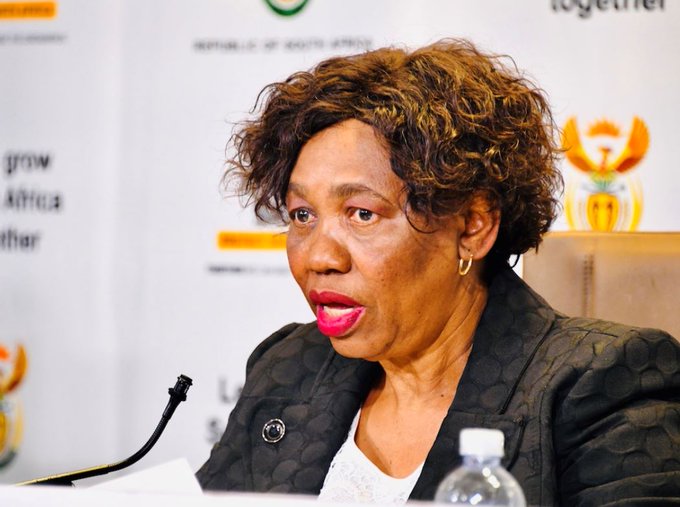
Addressing the UNESCO World Literacy Day, Basic Education Minister Angie Motshekga said the department remains convinced that literacy and numeracy are the heartbeats of basic education.

“His Excellency Mr President Cyril Ramaphosa has given us as the basic education sector a mandate to ensure that every learner can read with comprehension across all the subjects by their tenth birthday. Thus, we have since coined eleven priorities to take the basic education sector to the next level,” Motshekga said.

The Minister added that in 2019, the department launched the National Reading Coalition (NRC) to support reading improvement across the country.

The NRC’s main tasks are establishing reading clubs, training teachers, and material development in reading, numeracy and literacy.

They are also aimed at mobilising resources and expertise to enhance quality teaching and learning in the reading, numeracy, and literacy space.

The Minister announced that South Africa has designed its first-of-its-kind online programme dubbed ‘The Comprehension Across the Curriculum’ that offers an opportunity for teachers to be upskilled in reading comprehension.

“The programme will be launched later this month and will train teachers to teach reading comprehension skills across the curriculum,” Motshekga said.

The department has also launched an Integrated National Reading Sector Plan which aligns with its policy lodestar, the National Development Plan (NDP) that seeks to achieve critical developmental milestones by 2030.

“The NDP envisions that by 2030, schools will provide all learners with quality education, especially in Literacy, Mathematics and Science.

“The National Reading Sector Plan is an overarching evidence-based strategy that will alter the country’s entire reading and literacy landscape,” the Minister said.

The Minister added that the main thrust of this plan is to ensure reading for meaning across the curriculum, in all grades, and in all schools throughout the country. Furthermore, to ensure that all learners are taught to read well and read for meaning.

According to the Minister, the plan would have been successfully implemented throughout the system by 2024, meaning that all teachers would have been trained on the latest reading pedagogies.

Rural Education Assistants’ Programme (REAP)

To address disparities in Basic Education, the department has developed the novel Rural Education Assistants’ Programme (REAP).

The REAP programme uses Education Assistants in the Foundation and Intermediate Phases (Grades 1-4) to improve the quality of education, particularly literacy and reading skills, in rural schools.

Motshekga added that literacy is a human right and the basis for lifelong learning and it empowers individuals, families and communities and improves
their quality of life.

“Because of its “multiplier effect”, literacy helps eradicate poverty, reduce child mortality, and curb population growth,” said Motshekga.

“It also contributes to achieving gender equality and ensure sustainable development, peace and democracy. In today’s rapidly changing and knowledge-based societies, the acquisition of basic literacy skills and the advancement and application of such skills throughout life is critical.”   

Halala! DStv Schools Netball Challenge Is Finally Here

0

FINALLY, the DStv Schools Netball Challenge provincial finals are upon us. Starting on 10 September, Mpumalanga, Gauteng, Eastern Cape, and Western Cape schools will battle it out for the two top spots in each province to represent the respective provinces at the highest schools netball competition in the country.

So far the Northern Cape, Limpopo, KwaZulu-Natal and the Free State already have their representatives for the national competition which will take place between 23-26 September.

Hoërskool Diamantveld and Wildeklawer represent the diamond province, Hoërskool Pietersburg, Hoërskool Ben Vorster, Hlabi Secondary School and ME Makgato Secondary School will represent Limpopo while KwaZulu Natal will have Edendale Technical High School and Ashton International College in its corner. Wilgerivier High School and Teto Secondary School from the Free State complete the determined teams for the final round.

Hoërskool Middelburg hosts the Mpumalanga provincial competition where six high schools from around the province will do battle for the honours while Hoërskool Dinamika and Edenvale High School will open the competition in the Gauteng leg at Hoërskool Dr E.G. Jansen Boksburg.

The ongoing coronavirus pandemic had stalled most of the action of the Netball Challenge owing to the lockdown restrictions.

The tournament was launched in May with local inter-school leagues which progressed to regionals and now provincials before the big one, the national competition which will be broadcast on SuperSport.

The competition will unearth future Spar Proteas and the 2023 Netball World Cup in Cape Town is a huge inspiration for the thousands of players who took to the court throughout this competition.

South African Schools Netball president, Di Woolley hopes that the ongoing pandemic will no longer be a hindrance in completing the competition.

“I am hoping this horrible thing called Covid stays out of our lives so we can continue with our programme as scheduled and planned because these children are looking forward to playing ad doing what they do best. I am just hoping and praying people stay safe, look after themselves so we can play and enjoy ourselves to the best of our abilities,” says Woolley.

“The children are not as fit as they should be or can be. So we are allowing a couple of players per team to come to the national championships so they can substitute and so on because these children are not very fit. And to get back into things will take so much effort and time. But I think our netball kids are up and running and want to do things the way it should be done,” adds Woolley.

Netball fans can catch the exciting action via streaming on the SuperSport Schools App from 9am.

  • * Supersport.com

Gauteng Department of Education Grade 1 and 8 Online Admissions Open On Monday

0

THE 2022 phase 2 online admissions for Grade 1 and 8 learners will commence on Monday, 13 September 2021 and end on Friday, 8 October 2021.

The Gauteng Department of Education (GDE) says phase 2 will be for parents and guardians with children going to Grade 1 or Grade 8 in the 2022 academic year, but are currently not in a public school in Gauteng.
 
“We are also glad to announce that parents and guardians, who were not able to apply on time during phase 1 for learners in Grade 7 at public schools in Gauteng, will be able to apply under phase 2,” the department said.
 
Parents and guardians applying in phase 2 are urged to prepare the necessary documentation and ensure that it is all certified and correct. The following documents are needed when applying:


1. Parent and child ID or passport
2. Refugee Permit
3. Asylum Seeker Permit
4. Permanent Residence Permit
5. Study Permit
6. Your South African Birth Certificate
7. Proof of Home Address
8. Proof of Work Address
9. Latest School Report
10. Clinic Card/Immunization Card (Grade 1 only)
 
Parents and guardians are urged to upload these documents onto the system or submit them at the school they applied to within seven days of applying.
 
The department said they recorded a total of 351 169 applications when phase 1 applications officially closed on 3 September 2021.

Gauteng Education MEC, Panyaza Lesufi, expressed his gratitude towards parents and guardians who managed to successfully apply, and the patience they displayed throughout the process. He also thanked the GDE team who helped to make phase 1 applications a success.
  
“We have outdone ourselves this year, not just as the department but as stakeholders, parents and guardians in having made the new two-phased approach a success so far. We wish every parent and guardian applying under phase 2 the very best and we assure them that our team will be there to assist them every step of the way,” Lesufi said. 

The GDE team will be available for assistance during phase 2 applications on all the department’s social media platforms, the decentralised walk-in centres and call centre on 0800 000 789.

South African universities have taken to online teaching

0

SIOUX MCKENNA|

THE uptake of educational technology in South Africa’s higher education sector has been highly uneven and very slow. Before the pandemic, most courses offered in South African universities had some form of Learning Management System presence. Students could access course guides and readings, upload their assignments, and possibly communicate with their lecturer and peers via forums. But beyond that, many academics seemed to resist making use of the technology, even though it could allow for greater engagement and interactive learning.

And then 2020 happened and suddenly everyone found themselves thrown into the online world. The country’s higher education sector can be proud of the rapid pivot that was made as universities rushed to ensure that academics had the skills to teach online and that students had the hardware, software and data needed to learn from home. Collaborations between universities were central to the successes. Educational technologists across the sector worked tirelessly to support staff and students.

The online pivot has opened the eyes of many naysayers to the benefits of blended learning, whereby students can work at their own pace. There is much that the sector can reflect upon as universities start to return to face-to-face teaching.

But emergency remote learning shouldn’t be confused with carefully crafted online curricula. Many academics and students were struggling with the technical skills of it all and had little time to consider knowledge creation. It was often a case of getting through the syllabus rather than ensuring true epistemic access – helping students to understand how each field generates knowledge.

Education inequalities are worse online

While the pandemic experience has undoubtedly hastened the uptake of educational technology in higher education, it does not point to an entirely online future. There are at least three reasons for this.

Successes were partial. While those of us working in higher education can be proud of how we’ve maintained our educational responsibilities in the pandemic, this was not without costs. Academics have spoken of burn-out and depression, and many students have had to endure extreme mental health issues.

Most universities have done their utmost to ensure that students stay in the system and succeed in their studies. At times this has meant cutting sections of the syllabus, offering additional assessment opportunities, and adapting the examination schedule. There is no doubt that students lost out educationally in the pandemic. Certainly, it has meant fewer opportunities for vital extra-curricular learning and peer engagement.

The digital divide is real. The extreme inequalities in South Africa and globally have been laid bare. Universities and the department of higher education and training found themselves in a financial and logistical nightmare of ensuring that all students had access to hardware and data. Negotiating with service providers for reduced data costs was time consuming. Students who rely on the residence system found themselves shouldering family responsibilities, and often working in homes that were not conducive to studying. And rural students without access to signal were truly left behind.

Most accounts of the digital divide focus on physical access. What has been overlooked are the challenges of providing epistemic access online.

Epistemic access is hard in person. Online it’s even tougher.
The higher education sector is not particularly good at ensuring that students do more than get through the content. But the real role of higher education is to bring students into a transformative relationship with knowledge. This entails far more than the transmission of facts.

Academics should be role-modelling the norms and values of the field and how it is that we come to read and write in such different ways in mathematics, marketing or medicine. Teaching like this helps students understand how knowledge is made and how they can contribute to it themselves.

Teaching towards epistemic access with epistemic justice is even more complex. This means trying to understand what students bring with them and what they value and hope for. It means thinking about the ways a discipline may be excluding students.

Teaching with all this in mind is a minefield. It involves deep reflection on the often taken-for-granted norms and values of the field and how to make these explicit to students. It involves being vulnerable and open to learning from students. It involves providing opportunities for students to “try on” the practices of the field in a carefully scaffolded manner, with regular feedback.

Doing this in person is immensely tough. Doing this online is at another level.

Making sense of philosophy, physics or physiology may be possible in a carefully crafted online curriculum, but taking on the disposition of a philosopher, physicist or physiologist through online engagements is of another order. Education is about so much more than taking on facts. It is about becoming a specialist kind of knower who can contribute to their field in ways that serve the public good, and who is willing to take on the responsibilities of their educational privileges alongside the personal benefits it brings.

Wikipedia offers immediate access to knowledge on almost every issue taught in universities. YouTube videos of science experiments and medical procedures abound. It’s not access to knowledge that is the problem, it is access to education.

Education should change who we are and how we understand our role in the world.

Technology offers all manner of opportunities to enhance the educational experience, and we should reflect on our successes and sustain these. But taking universities entirely online is only ever going to be a stop-gap response to the pandemic. The sooner students are safely back in class the better. 

Sioux McKenna, Director of Centre for Postgraduate Studies, Rhodes University

  • The Conversation

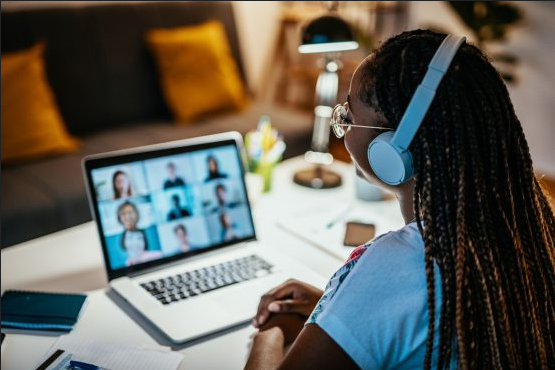
4IR: Digital Learning Assists Learners During COVID-19 Pandemic

0

PATRICK WADULA|

SCHOOLING has evolved across the world with the advent of the Covid19 pandemic which has changed the way teachers engage learners with their teaching methods.

When the President of South Africa Cyril Ramaphosa announced the state of disaster and effectively put the country under lockdown in March 2020, not only were businesses and other forms of economic and social activity halted but the education system came to a grinding stop.

Over the last 18 months, these schools have either been temporarily closed during periods of intensified lockdowns or, at best, operating on a limited rotational schedule where children have only attended schools for a few days a week.

However, this could not continue forever, as the world begun looking for alternatives of getting their economies back on track while under the lockdown and observing the Covid 19 regulations.

The global education system could not be left behind during this period as, the pandemic also helped the education sector indirectly to increase its pace in introducing the fourth industrial revolution or 4IR. Innovation and 4IR technologies in South Africa’s education sector.

Pupils and students needed to adjust and adapt to change by learning remotely using online education platforms created for schools. 

The teachers and lecturers equally had to upskill to digital teaching methods to remain relevant in the education sector.

In response to the emerging global phenomenon of the Fourth Industrial Revolution (4IR), which prepares the world for the new body of knowledge, The Department of Basic Education (DBE) has approved the introduction of the Curriculum and Assessment Policy Statements (CAPS) for Coding and Robotics for Grades R-9.

The new curriculum necessitates the training of subject specialists, co-ordinators, subject advisors, and teachers. In view of the Covid-19 pandemic and compliance with its regulations, the DBE the training is conducted virtually (online).

Unfortunately, digital learning has not grown substantially in South Africa due to several challenges that include limited access to the Internet, especially in rural communities, high data prices, lack of adequate bandwidth and storage (in terms of cloud computing).

Limited access to laptops, computers or tablets, and inadequate infrastructure required for using these devices (e.g., electricity loadshedding) and training in the use of computers have also been an impediment for learners to improve their learning skills through digital platforms.

To ensure digital learning becomes a way of life for learners, the MTN SA Foundation spends approximately R10 million annually on establishing and running states of the art multimedia centres at more than 400 urban schools and another 50 targeted at learners with special needs. Some of these multimedia centres can also be found at colleges, universities and TVET Colleges. 

To increase the use of digital platforms for learning purposes, MTN SA Foundation partnered with Siyavula, to introduce the Siyavula’s annual #1MillionMaths challenge five years ago

Explaining the challenge, MTN SA Foundation Manager for Special Programmes Judith Maluleka says the competition, challenges all high school learners to complete at least one million maths and science questions on the Siyavula online platform in one month.

In the recently released Trends in International Mathematics and Science 2019 Study (TIMMS), South Africa ranks consistently low in mathematics and science. A total of 20,829 pupils across 519 schools were assessed, with tests conducted according to curriculum-based content and cognitive thinking.

Maluleka says the #1MillionMaths challenge helps learners not only to understand maths and science, but also improve their digital learning skills.

“Until now, the #1MillionMaths challenge had focused only on learners competing individually. This year teachers are invited to enter the competition; learners can also compete as an entire grade or school.

Digital revolution.

Schools will compete against one another, for the chance to be crowned South Africa’s Maths or Science School Champion for 2021.

Maluleke says the idea is to bring the power of technology and a connected life to those most in need. This is being done by bringing Maths and Physical Science learning and support to schools across the country in both urban and rural areas to create the opportunity for students to be future-fit.  

For the first time since the Covid-19 pandemic started, all public primary schools in South Africa fully reopened on 2 August 2021.

The move to reopen normal physical schooling doesn’t necessarily mean abandoning e-learning. There should be a way of integrating both methods of learning in the new schooling system.

Face to face interaction between learners is also important for shared learning experience between learners and a need to interact with their own age-mates in the same grade and school, as opposed to constantly be at home with the family.

  • * Inside Education

Thousands of Zimbabwean Teachers Strike Over COVID-19 Concerns

0

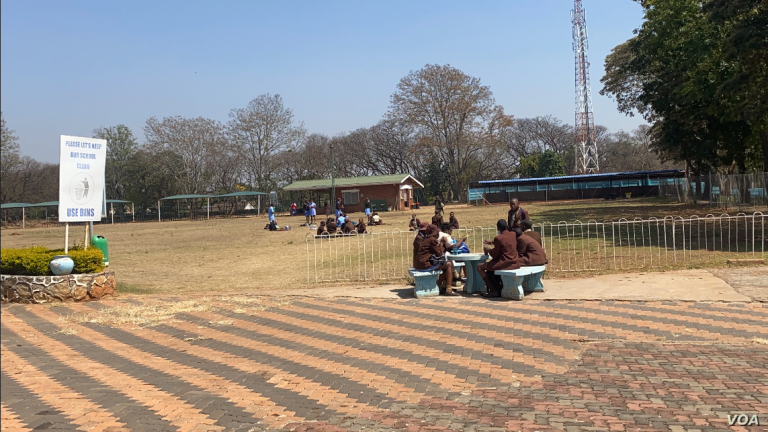
ZIMBABWE resumed in-classroom teaching this week, but thousands of teachers are protesting salaries that are below the poverty level and a lack of personal protective equipment against COVID-19. 

Zimbabwe’s Amalgamated Rural Teachers Union says it will only call off the strike when the government addresses the concerns.

“And there is negligence on the part of the authorit(ies) to make sure that there is enough safety to guarantee our teachers and learners from the pandemic,” said Robson Chere, secretary general of the teachers union.

“They should have been providing adequate water supply, enough PPEs. Arcturus Primary School, which is down here, hasn’t even water. It’s messy. It’s a disaster. We are sitting on a time bomb for both learners and teachers.” 

Authorities did not allow VOA into Arcturus Primary School, which is about 40 kilometers east of Harare. 

Some students around Harare have been going to school since Monday to try to learn among themselves, as there are no teachers. 

The teachers union warns that classrooms may turn into COVID-19 superspreaders. But Taungana Ndoro, director of communications and advocacy at Zimbabwe’s Education Ministry, says the government has been working to ensure classrooms are safe. 

“We have been putting in new infrastructure to ensure that we decongest the existing infrastructure to ensure that there is social and physical distancing for the prevention and management of COVID-19,” Ndoro said.

“We have also made sure that our schools have adequate supplies of sanitizers and water. So, it is looking good. We have got single-seated desks now, instead of two- or three-seated desks. This is to encourage social distancing. We do not have bunk beds anymore in our boarding schools. We have got single beds and spacing of at least one-and-half to two meters. So, it is encouraging.” 

UNICEF Zimbabwe has been helping students and the government during the COVID-19 lockdown.

“The two-key approaches were, one: How we can support the loss of learning as a result of school closure. The second one was: How to keep the school safe and ready for children to return to school,” said Niki Abrishamian, UNICEF Zimbabwe’s education manager. “We managed to produce more than 1,600 radio lessons as part of alternative learning approaches. We had to look at how to take learning to the children, especially when they were at home and did not have access to schooling.” 

Zimbabwe’s teachers hope such organizations can assist the government and supply the resources they require — adequate PPEs against COVID-19 and salaries that allow them to live above the poverty line. 

Zimbabwe currently has 124,773 confirmed coronavirus infections and 4,419 deaths, according to Johns Hopkins University, which is tracking the global outbreak. 

  • * VOANEWS

1 300 New Cases of HIV in Adolescent Girls Every Week, As SA Teen Pregnancies Soar

0

THE Department of Basic Education says scores of young girls between the ages of 10 and 19 years old are infected with HIV every week.

This was revealed during the department’s state of Teenage pregnancy and Comprehensive Sexuality report presented to the Portfolio Committee on Basic Education on Tuesday.

The report has revealed that teenage pregnancy increased by 30% higher than the annual average between April 2020 and March 2021 due to the Covid-19 pandemic. 

Deputy director-general Dr Granville Whittle said poverty, rape, gaps in the Comprehensive Sexuality Education, and school dropouts are among the culprits. 

“Girls are four times more likely to be impacted or affected by HIV compared to boys. 46% of sexual abuse complaints in South Africa are children, 15.1% of all the girls experience rape, sexual harassment, verbal abuse or bullying in schools.”

In the first quarter of 2021, just over 35 000 pregnancies were recorded among young girls aged between 15 and 19 years old. 

1053 pregnancies were recorded among children aged between 10 and 14 years old.

These numbers were increased by the countrywide lockdown due to the Covid-19 pandemic in 2020. 

Whittle told Parliament that the numbers are alarming and need immediate action and solutions. 

He said most of these pregnancies and HIV rates are due to statutory rape.

“We want to work with schools and school principals to ensure that the cases are reported, investigated and the perpetrators are brought to book. Often these girls are raped by older men and that’s why they fall pregnant,” said Whittle.

The department says keeping girls in school has proven to be one of the tools to prevent teen pregnancy and educate adolescent girls on sex, sexuality, and HIV. 

Alongside the Department of Health and Social Development, DBE has submitted an integrated school health policy to the cabinet for approval. 

This policy will according to DBE assist in the prevention and management of learner pregnancy in schools.

  • * Agencies

KwaZulu-Natal, Mpumalanga and Northern Cape Ramp Up Their COVID-19 Vaccination Drives At Schools As Cases Increase

0

MPUMALANGA, KwaZulu-Natal and the Northern Cape have embarked on COVID-19 vaccination campaigns in schools in an attempt to mitigate the spread of the coronavirus. 

Various schools in these provinces have been directed to cooperate with the Department of Health regarding student vaccinations and provide space and necessary facilities available for the purpose.

Department of Basic Education said last week that vaccination programme has brought life back to normal in many schools around the country.

All parents’ organisations, teacher unions and school governing bodies have been taken into confidence so that the risk of educational disruption could be minimized.

All learners 18 years and above will be vaccinated in their respective schools to ensure that teaching and learning are not disrupted.

While announcing the outcomes of the ANC NEC lekgotla on Monday, President Cyril Ramaphosa said everyone must be more proactive to assist government in consistently highlighting the safety of the vaccine and its efficacy in protecting people against serious illness and death.

“About 25 million doses of the J&J vaccine was completed at the Aspen plant in the E Cape, and more than half of these have been released in the market. Production is now mainly for use in SA and the rest of Africa,” said Ramaphosa.

“BIOVAC received a commitment from Pfizer/Biontech to produce their vaccine in SA, scaling up over a period to 100m doses and the SA firm is now getting ready to retool for this opportunity.”

The Northern Cape Department of Education has raised concern about the amount of learning losses as new COVID-19 cases continue to increase in the province’s schools.

At least 1 272 cases of the virus have been reported since 23 August to date with several schools closed and learning delayed.

In a statement, the department said the rising infections are compromising the learners’ ability to perform at a high level.

“This continues to take a devastating toll on the academic performance of learners and their preparedness for the examinations. It’s clear that the academic recovery will take much longer than expected, whilst the current reality is placing a massive strain on the entire education sector.

“The department is doing all that we can to support educators and learners across all grades during these difficult times,” the statement said.

The department said 410 new cases have been reported.

“The new COVID-19 infections include 28 educators, 367 learners and 15 support staff at various schools. We currently have seven schools which are closed in the province to allow for contact tracing and the disinfection of school premises,” the statement said.

KwaZulu-Natal has been ranked as the province with the third highest number of confirmed cases of Covid-19.

Schools in Kwa-Zulu Natal have seen an increase in the number of Covid-19 infections among teachers, support staff and students. The province has recorded more than 1100 reported cases in 350 schools in the past 3 weeks.

KZN Premier Sihle Zikalala announced that the department of health in the province will look to ramp up its vaccination program.

So far the province has inoculated more than 2 million people.

He said that the province is aiming to vaccinate around 60 000 people per day as this will help the province reach its goal of vaccinating 7.2 million people by March 2022.

Meanwhile, learners in Mpumalanga who could not register using the above information will be allowed to register and be vaccinated on-site.

Learners are expected to produce their identity documents or birth certificate at vaccination sites.

The following category of personnel is excluded from the mass vaccination process, however:
• Any person who tested positive with Covid-19; they can only be vaccinated 30 days after quarantine or isolation.
• Any person that vaccinated against flu in the preceding 14 days.
• Any person that was vaccinated using another vaccine (Pfizer or J&J under Sisonke) should not be revaccinated.

A vaccination date for special schools will be communicated to school principals once all logistics have been finalised.

The Mpumalanga MEC for education, Bonakele Majuba, visited Lethabong Secondary School, KwaMhlanga, Thembisile Hani Local Municipality, on Monday to monitor the programme.

  • * Inside Education

Updated plan for schools in South Africa to catch up lost teaching time – including changes to subjects

0

THE Department of Basic Education has developed a three-year recovery plan to help make up for teaching time lost during the Covid-19 pandemic, says minister Angie Motshekga.

Responding in a written parliamentary Q&A this week, Motshekga said that the Recovery Annual Teaching Plan accounts for each subject in each grade and will help guide teachers to focus on key concepts, content, and skills to be taught per subject over the next three year period.

“The curriculum statement for each grade and subject was evaluated by a panel of curriculum content experts, and the content was reduced to ensure that only the core concepts, knowledge and skills are taught for each subject and grade.

“It is anticipated that over the next three years, learners would have covered the core content in the subject, and the curriculum statement, post the three year period, would be reviewed to take learners forward in their learning process,” she said.

Motshekga said that the three-year recovery period is tentative at this stage and could be extended if necessary based on the findings from the continuous research, monitoring and support provided by the department to schools.

Teachers will have to use their own judgement

While the department has developed guidelines for fundamental content that teachers must prioritise, Motshekga said that the variation in teaching time across the schools means that there is now a higher dependence on teachers using their own professional judgment.

“Teachers are provided with a planner and tracker, which lists the reduced content to be covered in the week, and teachers must record coverage to ensure that every teacher has a record of curriculum coverage, per grade, which will be transferred to the next teacher,” she said.

“This will ensure continuity from one grade to the next,” she said.

Motshekga said that plans to reduce the impact of future disruptions must be agile and should consider schools on an individual basis.

“In accommodating the various school contexts, much is left to the teacher’s professional judgment and expertise.

“Hence, teacher development, training and support is now more crucial capacitating the teacher to manage his/her classroom context.”

A new strategy and different weightings

Motshekga said that the plan also incorporates ‘assessment for learning’  as a teaching strategy.

“This implies that the teacher not only assesses at the end of the learning process to make a judgment on the learning gains but assess the learner on a continuous basis during the learning process to support the learning process.”

Assessment weightings in Grades 4-11 have also been adjusted to ensure optimal time for teaching and learning, she said.

“The key tenet of the strategy is to reduce the curriculum to focus on key concepts, skills and knowledge that are essential for deeper learning and the development of cognitive skills that will promote creative thinking, problem-solving and effective communication.”