Home Blog Page 324

Lesufi says school infrastructure provision remains the biggest challenge in his department

NALEDI SHOTA|

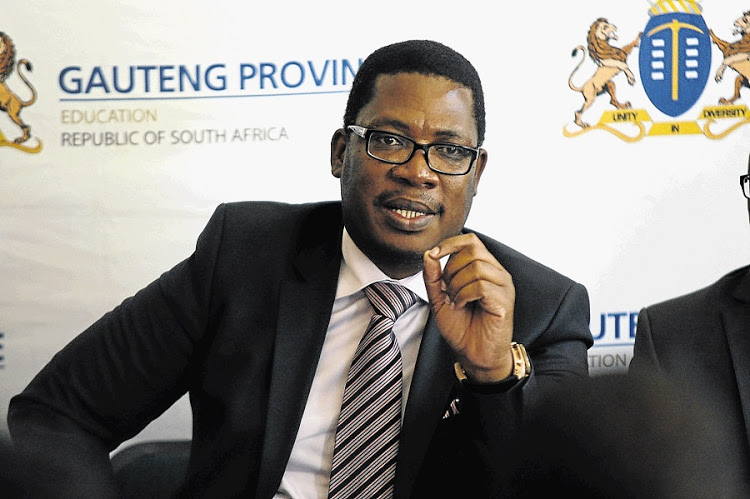
The Gauteng MEC for education, Panyaza Lesufi, has said that his department has increased compensation to school fee exemptions that are granted to parents. 

Lesufi said this while delivering his budget speech on Thursday. He said the department acknowledged that during the times of Covid-19 some parents in middle and low-income bands might find it difficult to keep up with the costs related to their children’s education. 

“We will use this budget to also compensate for the shock to education financing that comes from families’ own spending on education and fees. This will not only impact fee-charging schools but we, also, know from past crises that income shocks are likely to lead to many children dropping out of school or not returning when schools reopen.

“We welcome the emergency funding provided by the national government to schools to assist them with paying their SGB-appointed staff in the 2020/21 financial year. But this was a short-term stop-gap measure. Our schools are finding it harder and harder to make ends meet. We have increased our provision for compensating schools for fee exemptions granted,” said Lesufi. 

READ: SIU freezes accounts of decontamination companies contracted by GDE

He said his department has seen a budget cut of R135 million from R53,5 billion in 2020/21 to R53,4 billion in 2021/22. 

The department continues to spend the largest chunk of its budget on salaries which account for 75% (R39 billion) of the total budget. 

  • The rest of the spend is as follows:
    • An amount of R6,1-billion is for transfers and subsidies to schools 
    • Public ordinary schools will receive R38.8-billion 
    • Public special schools will get R4.5-billion 
    • Infrastructure development has been allocated R1.61-billion 
    • Examination and education-related services will get R 1.7-billion
    • Independent schools will receive R980-million
    • Early childhood development has been allocated R1.2-billion 

In his speech, Lesufi said the department’s “single biggest pressure” is the lack and the state of school infrastructure. 

“Over the last seven or more years we have maximised the utilisation of schools to the optimum and beyond reasonable accommodation in mainly township schools. Township schools have had to accommodate learners above their capacity, including the use of specialist rooms, due to their proximity to informal and new settlements.

“Suburban schools have also reached their capacity as a result of the growth of black middle class in existing and new middle-income housing areas. The number of schools built per year is not meeting demand and annually there is a growing backlog of new infrastructure,” he said. 

READ: Lesufi must fix burnt down classrooms at Joburg school

 He said the department is working with the Gauteng Infrastructure Financing Agency to find alternate funding to deliver additional schools to meet demand.  

Lesufi also mentioned that this year alone the province has had to close 20 schools due to Covid-19 cases, and also that 1077 teachers had tested positive for the virus as well as 1977 learners. 

He said the virus has impacted on teaching and learning and that there has been a rise to learning losses. 

“Outside the classroom, learning losses may translate into even greater long-term challenges… In the absence of any intervention, the learning losses arising from the COVID-19 pandemic are likely to have a long-term compounding negative effect on many children’s future well-being. These learning losses could translate into less access to higher education, lower labour market participation, and lower future earnings,”he said. 

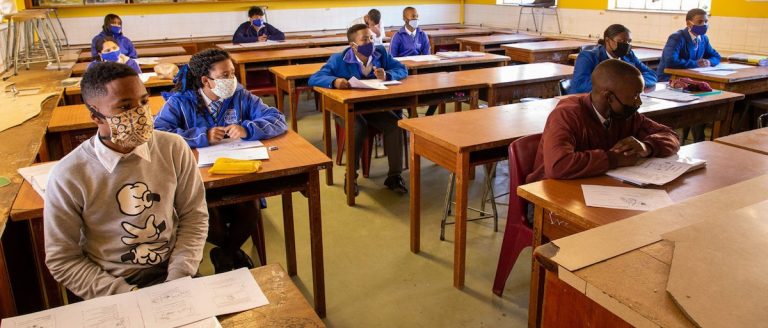
The MEC said the department has also had to refocus its budget and adjust it to respond to the pandemic by, amongst others, supplying running water and sanitation facilities to schools, provide more furniture in order to adhere to social distancing in class and also provide personal protective equipment to schools. 

The basic education sector to start its vaccination programme on Wednesday

NALEDI SHOTA| 

Basic education minister, Angie Motshekga, says she has not ruled out that schools might close as Covid-19 infection rises. However, she said, for now the basic education sector has taken a decision that schools will not close. 

Motshekga was speaking at a press briefing on Saturday afternoon, where she also announced that from Wednesday the sector will start its vaccination programme. 

Inside Education reported last week that the Economic Freedom Fighters (EFF) had called for the immediate closure of schools as more and more learners test positive for Covid-19. 

READ: Malema gives Motshekga seven days to shut down schools as Covid-19 cases rise in children

EFF president, Julius Malema, said at the time that they were giving Motshekga seven days to shut down schools or they would do so themselves.

On Saturday Motshekga said following a special meeting of the Council of Educators (CEM), teacher unions, school governing bodies and other stakeholders there was a consensus that schools must remain open.

The CEM is a forum where MECs of education, heads of departments, minister and director-general sit.

“At all times, we follow the advice of public health experts, who are supporting us in the management of the impact of Covid-19. We believe that schools must remain open and in saying so we are not insensitive to the concerns raised about the rising infections. 

“The position is that we continue to handle Covid cases according to the differentiated strategy, on a province by province, school-by-school basis. While there are disruptions in the sector, the majority of our schools remain fairly stable,” said Motshekga. 

Motshekga said any disruption that may arise from those who want to close schools is a matter for the police “it is not my matter”. 

“I take my cue, with due respect, based on facts and nothing else. So if parents said children must go to school, I am happy; if teachers said they will be at school, I am happy; if principals say we feel that we can continue, I am happy. That is where I get my mandate, that is where I get my guidance from,” she said. 

Motshekga said in a meeting on Saturday morning all provinces agreed that any infection is one too many but that the current situation the sector finds itself in does not warrant that schools should be closed. 

“This week in the information that we collected 100 schools were reported to have been disrupted with the majority of them being in Gauteng, and we are saying we have 25 517 schools [but] 100 schools were affected so 25 400 something schools were still open.

“And we just felt on the basis of facts there would not be any grounds for a full-scale school closure and that we should continue having a differentiated approach.

“But we are also not ruling out that if anytime during the week advised by your ministerial advisory committee from health, advised by the National Command Council, advised by Cabinet we will resist closing schools,” said Motshekga. 

READ: Unions wait in bated breath for details on the vaccination of educators

Vaccination programme

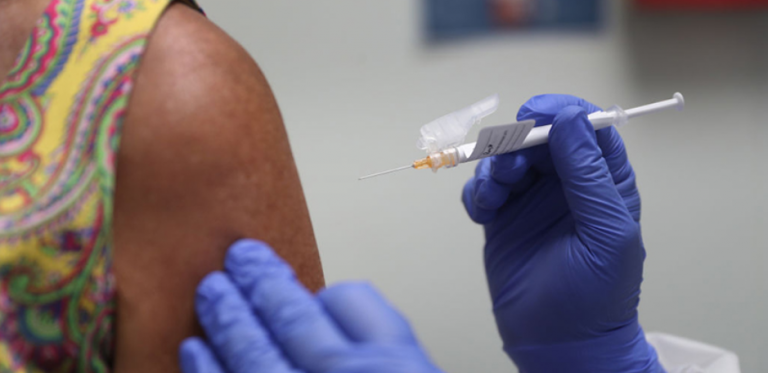
Motshekga announced that 582 000 people in the basic education sector will be vaccinated from Wednesday until 8 July. This number includes all teachers in public and private schools, all administrative and support staff in public schools. 

The number also includes staff of teacher unions, officials in district, provincial and the national department of education. 

Motshekga mentioned that people who had contracted Covid-19 in the past 30 days or those who received a flu shot in the past 14 days will not be eligible to vaccinate. However, she said that arrangements would be made that they vaccinate with the next group of people that will be vaccinated in the country. 

The minister said it was not mandatory for those who did not want to be vaccinated to do so. 

However, she said those teachers who are working from home because they have comorbidities if they chose not to vaccinate they will still  be expected back at school. 

“In the sector we have thousands of teachers that are home because of comorbidities and after this round there won’t be any opportunity for us to give exemptions. We will expect everybody to come back whether you have comorbidities or what, we will expect you to come back to work because you would have been given the opportunity to be protected in one way or the other,” said Motshekga. 

Acting director general in the department, Granville Whittle, said 300 000 doses of the Johnson & Johnson vaccination arrived on Thursday and that an additional 280 000 doses will be made available for the sector.

READ: GDE concerned about the rising number of Covid-19 cases at schools in the province

Wits University will compete in the international RoboCup tournament

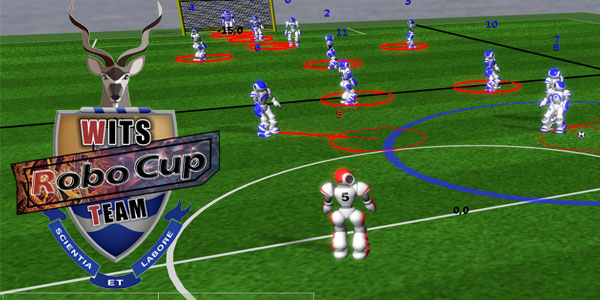
Wits University students will participate in this year’s 3D RoboCup simulation league tournament – a world cup for soccer robots tournament taking place virtually from 22 – 28 June 2021.

The Wits FC team consists of computer science students from the School of Computer Science and Applied Mathematics (CSAM) in the Faculty of Science and is headed by PhD candidate Branden Ingram and MSc student Andries Bingani.

The team is being supported by Associate Professor Benjamin Rosman and Dr Pravesh Ranchod from the Robotics, Autonomous Intelligence and Learning (RAIL) research group in CSAM.

Up to 24 teams will participate in this league that focuses on AI and team strategy.

Teams are also required to submit a conference-style paper which is reviewed by the RoboCup committee.

RoboCup, the world cup for soccer robots, is a major annual event on the artificial intelligence (AI) and robotics calendar with a goal to advance the state of the art of intelligent robots.

Teams from across the globe compete in different soccer leagues to show their mastery in AI and machine learning. The soccer robots can either be working physical robots or simulation robots.

Rosman said in order for development and innovation to be promoted there is an added requirement that each teams’ contribution contains some element of a novel approach on the problem of RoboCup.

“The code itself should also demonstrate the use and benefit of this new approach,” said Rosman.

Adding that the soccer robots tournament teams are all required to develop and submit a team of independent intelligent moving agents (players) that play soccer on a virtual field inside a computer.

Rosman said RoboCup presents a great opportunity for students to work together as a team and then compete against other students from around the world. Representation from Africa has always been minimal, at best.

“For our team to be able to compete in the tournament is important both for Wits’ representation internationally, and for providing our students with more exposure to international AI and robotics,” said Rosman

Ingram said the Wits FC robotics team have been in development for roughly two years.

Ingram said it was slow going in the beginning as they first had to understand what is available to them to develop their entry.

“Then installing the necessary software packages was difficult at the start but has been worthwhile, they say, because the experienced gained has resulted in them being able to create a far simpler method of doing things.

“These processes were then captured in tutorials that can benefit future Wits teams,” said Ingram.

Bingani said the 3D league increases the realism of the simulated environment by adding an extra dimension and more complex physics.

“We didn’t create the simulation but had to develop the AI and strategy for a group of agents which play within the simulated environment. In other words, we tell the players what to do given a certain situation, but we did not build the stadium they play in,” said Bingani.

According to Rosman these kinds of activities help promote science and technology by providing our students with a fun application of the theory in which they are so deeply immersed in their studies.

“It is an accessible means of outreach to the general public as many of the challenges we tackle in research can be explained in relatable terms,” said Rosman.

Adding that in taking part in RoboCup, they are also hoping to use their experience to help other local universities start their own teams, and then to stablish local leagues and tournaments to further advance science and technology in the region.

Ntuli brothers set to represent South Africa at the Tokyo Olympics

University of Pretoria’s Nqobile Ntuli and Siphesihle Ntuli are set to compete at the Olympic Games in Tokyo.

Siphesihle is the men’s hockey team’s assistant coach while Nqobile will be on the field.

Siphesihle – who is seven years older than Nqobile – played for South Africa’s U16 & U18 schools team and the U21 national team. 

Siphesihle was part of the South African men’s senior squad but unfortunately suffered a lower back injury which forced him to retire as a player when he was only 23. 

The two brothers both played football at school, but we ended up preferring to play hockey.

READ: Student athletes vaccinated ahead of the Tokyo Olympics

They said their main goal is to compete every time they play.

“It sets us up for individual flair, and who knows what that may lead to. The nice thing about being South Africans is that we know how to ‘fight’,” they said.

Nqobile said for him, playing hockey for South Africa is like being an “ambassador of hope” for those younger than him.

“I want aspiring young black hockey players to take note that anything is possible if you are prepared to put your mind to it.

“In the past, many thought it was an unrealistic goal to play for South Africa. So every time I take to the Astroturf, it feels like I am representing their hopes,” he said.

Nqobile plays as a forward for the South African national team.

He said he and his brother have also represented South Africa at the previous World Cup Tournament, as a player and as a coach.

“Both of us going to the Olympics is going to make my mom and the family proud again,” said Nqobile.

Denied a shot at competing at the Rio Olympics, Siphesihle said they are very excited to be part of the team going to Tokyo.

He said playing in Tokyo will not only be about winning medals but making a more lasting impression for the sport in this country.

READ: ‘Siyaya eJapan, Tokyo here we come,’ say UJ sportsmen, women in SA squad

Killing of Buyani Primary School principal was a hit – Lesufi

NYAKALLO TEFU|

Gauteng Education MEC, Panyaza Lesufi, has said all information about the shooting of a school principal at Buyani Primary in Finetown, Johannesburg, will be forwarded to police for investigation.

The principal was shot dead on the school premises on Friday morning. 

Lesufi visited the school today to get information on what transpired during the shooting.

“I had an opportunity to go through the footage because the school has cameras and it is extremely disturbing to witness such barbaric behavior happening in our school environment,” said Lesufi.

Lesufi said there is a sector we all know that is familiar with killings and it is clear that within the education space there are those that bring that sector behavior into schools.

“From the video footage one can tell that this was a hit that someone was assigned to do, we strongly condemn this,” added Lesufi.

READ: Lesufi Shocked At Fatal Shooting Of Grade 6 Learner In Katlehong

The 53-year-old principal, Lazarous Baloyi, was gunned down by an unknown assailant.

Baloyi was the chairperson of a branch at the South African Democratic Teachers Union (Sadtu) in the area.

“We want to send our condolences to the family, teachers and teacher union Sadtu and to the community at large,” said Lesufi.

Police have launched a manhunt hunt for the person(s) involved in the brutal killing of the school principal.

Lesufi said in March he received communication from some of the Pinetown residents raising concerns about the school and the principal’s qualifications.

“The district was forwarded the email to intervene and they did intervene and met with the people who raised concerns, so in the last three months we thought everything was sorted out, until today,” said Lesufi.

Lesufi said they will hand over the information to the police to establish what exactly happened.

“We are in discussion with the district to provide counselling and psychosocial support to the educators, learners and the family,” said Lesufi.

READ: Gunmen Posing As Parents Shoot Teacher At Durban School As Harrowing Start To New School Year Continues

Educators to be vaccinated in the next 10 days

NYAKALLO TEFU| 

The Department of Health announced on Thursday that over 400 000 educators will be vaccinated by the end of June 2021.

The department said 300 000 Johnson and Johnson (J&J) vaccines will arrive in the country on Friday.

On Thursday, the health portfolio committee held a briefing where the department’s technical advisor Dr Aquina Thulare said they want to get the vaccines tested and ready for use by next week.

Thulare said the J&J vaccines are set to arrive in the country by this week, following which, the department will meet with provincial health departments to finalise plans. He said distribution to provinces across the country is expected to start on Tuesday.

“The target group includes teachers, administrative and support staff at all schools, irrespective of age,” said Thulare.

Inside Education reported that there were delays in the vaccination of teachers after the US Food and Drug Administration ordered those 60 million doses be discarded with fears of contamination at the manufacturing plant.

READ: Unions wait in bated breath for details on the vaccination of educators

As a result, two million doses of the vaccine stored in the Eastern Cape were destroyed.

Thulare said the Department of Health aims to vaccinate educators across the public and private sectors, school governing body members and administrative staff over a period of10 working days from Tuesday 22 June.

Thulare said the timelines are especially critical because the vaccines must all be used before the expiry date of 11 July.

“After the vaccination of educators, when the next vaccine batch arrives at the end of June – police, soldiers and prison warders will be next in line,” he said.

The department said it expects batches of 700,000 and 500,000 to land in the country. However, it said the dates are not yet set.

The vaccination come when the country is currently in the third wave of the coronavirus where numbers continue to rise.

In the past 24 hours 11 767 new cases were reported with 100 deaths across the country.

READ: Basic education minister says not to worry about the return of school children to full-time classes

The hardest hit province is Gauteng with the highest number of cases reported on a daily which has resulted in the Gauteng Health Department temporarily suspending visiting hours at all health facilities in the province.

Spokesperson for the MEC of health in Gauteng Kwara Kekana said hospitals are under pressure with the number of Covid-19 cases in the province.

Teacher unions across the country have demanded that educators be vaccinated before primary school learners return to schools on a full-time basis from 26 July 2021.

“We want to consult with the department that teachers should be next in the line following those aged 60 and above to get vaccinated for Covid-19,” said National Professional Teachers Organization of South Africa’s Basil Manuel.

Manuel had stated that the union was concerned about the mental health of educators as 100% capacity causes panic in people during the time of the pandemic.

‘We need to up the game on Maths and Science’ – Eastern Cape MEC

NYAKALLO TEFU| 

The Eastern Cape Department of Education says it needs to improve its teaching and standards on Mathematics and Science for grade 12’s in the province.

The MEC for Education, Fundile Gade, held a media briefing on Thursday where he focused on the strides the department has made to ensure good governance and school functionality.

The mid-year briefing comes at a time where it was decided that matriculants will not be writing June examinations but instead will have assessments.

Gade said the province aims to get a 40% improvement on Mathematics and Science subjects in all its districts then it can achieve what it wants.

Adding that the Eastern Cape is one of the provinces with the biggest number of students registered for Mathematics and Science.

READ: North West learner flies school flag high in a Maths competition

“Out of 15 000 enrolled grade 12’s in OR Tambo Costal 8 000 are doing maths and physics. Which means if focus is on Maths and Science in all districts, we will get what we want, we need to up the game on those subjects,” said Gade.

The MEC announced that the province will be having additional learning opportunities and curriculum support material for learners across the province.

“We will be conducting learning through radio, visual platforms (television) across the province to deal with the divide,” said Gade.

“We are a rural province but equally we are investing more in ITC to close that gap,” he said.

Learners and educators have had to adjust to learning and teaching since the Covid-19 pandemic outbreak.

The MEC said the plan is to ensure that learners continue to engage in the curriculum on a continuous basis to limit the learning losses which arises due to school closures.

Gade said his department suggest that there be a centralized learning, where if a maths lesson is taking place at 10am, all learners are tuned in at the same time to keep everyone one the same track. 

“Hence I am saying, the sequencing of timetabling of all subjects can give us the milage that we want, but it can only happen if we up the game on anywhere and anytime e-learning solutions to ensure we connect all high schools through broadcasting lessons,” said the MEC.

Bushbuckridge residents speak of pain of disabled learners that are locked in their homes and not attending school

NALEDI SHOTA|

Parliament’s portfolio committee on social development has called for better care and treatment of children living with disabilities. 

This is after the committee learned while in Bushbuckridge, Mpumalanga that some children with disabilities do not go to school and are instead locked in back rooms by their parents. 

These revelations were made to the committee while it was in the area for public hearings into the Children’s Amendment Bill. 

“The Bill is intended to resolve numerous challenges relating to the welfare of children and those include parental responsibilities of unmarried fathers, child marriages, services to children born to foreign parents, and unaccompanied migrant children,” according to the committee. 

One of the participants in the hearings, Mofenyi Tshilwane told the committee that parents of children with disabilities need support. 

“It is not because the parents like the conditions the children live in but they don’t have support, they need to be empowered,” he said. 

READ: Sexual assaults and violence at South Africa’s schools

Acting chairperson of the committee Nkhensani Bilankulu also said that the committee had learned that learners are victims of rape and the perpetrators are teachers who never face consequences because they are defended by teacher unions. 

“Teacher unions can never be justified in defending alleged rapists in schools, if there are cases of such need to be reported to the police. We also learn that some educators are protected by management due to the importance of learning areas they teach. The committee appealed to community members that they need to be vigilant when it comes to issues and safety of children at schools,” said Bilankulu.

Last month, the South African Human Rights Commission held public hearings in Limpopo looking at corporal punishment, sexual relations between teachers and learners and bullying. 

Those hearings also heard that teachers who have sexual relations with learners are protected by unions or principals fail to report the misconduct to the department of education. 

Bilankulu said schools need to be a safe space for learners and: “… In cases where rapes have occurred, the educators’ code of conduct needs to prevail with proper follow up of such incidents by all stakeholders, the South African Police Service, school management, School Governing Bodies and teacher unions”.

Early this year Minister of Basic Education, Angie Motshekga, gazetted regulations that state that if a teacher has been found guilty and dismissed for having sexual relations with a learner that teacher will be banned for life from the teaching profession. 

Bilankulu promised the residents of Bushbuckridge that the issues they had raised during the  hearings will be escalated to the relevant  government departments. 

North West learner flies school flag high in a Maths competition

NYAKALLO TEFU| 

A grade 12 learner from Coligny Secondary School in the North West won the final round of a Virtual Mathematics Competition (VMC2021).

18-year-old Boitumelo Mohulatsi like other learners submitted his videos to the ‘Mthethwamatics Facebook’ page solving various mathematical problems.

VMC founder Dr Simo Mthethwa said the main aim of the competition is to educate the society about some principles, fundamental concepts and theorems in mathematics.

Mthethwa said knowledge of mathematics is not a pre-requisite to participate because the aim is to educate

“The learning component of this competition is done through allowing participants to consult with whomever that may be able to assist them, be it a teacher, tutor or parent.

“Once the participant is confident to have grasped the concept then the video (2 mins) detailing the solution should be conducted and submitted to them.

 “There is no limit to the tools and creativity that may be used to present the solution or explanation,” said Mthethwa.

READ: STEM: Extra Maths On A Mobile Device: A South African Study Shows It’s Not That Simple

Since the start of the coronavirus pandemic, most competitions and activities at schools across the country are being done virtually, where possible.

The VMC is normally done through seminars and various educational programmes.

The competition was divided into Grade R to Grade 12 according to South African phases. Each phase had a  problem/challenge to solve and explain.

Mohulatsi said the competition has taught him that he can do better.

“With each challenge we solve, not just my own, I learned a lot from others. It actually taught me that it’s not about what you know but from sharing and understanding concepts that makes you better”, said Mohulatsi.

READ: Maths and Science Tutor Gives Hope To Students In Soshanguve

MEC for Education in the North West Mmaphefo Matsemela has congratulated Mohulatsi, saying she has been cheering him on.

“I am happy for Boitumelo’s win. His dedication and passion for Mathematics proved his determination. This certainly paves a way for him towards his tertiary studies and I hope that his passion for mathematics is an inspiration to his peers as well,” said Matsemela.

The competition also aims to promote mathematics to a wider audience, over and above schools.

“We intend to do this through asking participants/contestant to explain necessary concepts in mathematics,” said Mthethwa.

Excited about his win, Mohulatsi said his motivation comes from online advanced mathematics he does when he is not at school.

“I would advise my peers to take maths as a challenge. Forget about your background or school you come from, focus on the solving a challenge. That’s the fun thing about mathematics,” said Mohulatsi.

Matsemela said this is an achievement for Mohulatsi, his school and his peers, and wished Mohulatsi many happy returns.

READ: Soweto Grade 12 Pupil Receives A Bronze Medal At 61st International Maths Ambassador

Much more needed than Ramaphosa’s reform gimmicks

DUMA GQUBULE|

In the face of soaring unemployment, which has created an unviable society, and brutal energy blackouts in the middle of winter, President Cyril Ramaphosa has announced two structural reform gimmicks that will do little to resolve the country’s immediate economic and power crises.

According to Stats SA’s latest survey, the expanded unemployment rate for black Africans was 47.9% during the first quarter of 2021. For black African females it was 51.5%. In the Eastern Cape and Limpopo, the unemployment rates for people of all races were 49.6% and 49.5% respectively. The expanded youth unemployment rate was a staggering 74.7%.

Since December 2008, the economy has created only 226,000 jobs and the labour force has increased by 5.7-million people. The number of unemployed people has soared by 5.5- million to 11.4-million people.

Ramaphosa’s gimmicks for the crisis have delivered nothing.

READ: Ramaphosa has no plausible strategy for reducing youth unemployment

The jobs summit agreement of October 2018 was supposed to create 275,000 jobs a year. The Youth Employment Scheme was supposed to create 1-million jobs. It has created 55,000 so-called work opportunities.

We do not know how many of these people are still working.

The decision to increase the licensing threshold for embedded generation projects to 100MW was billed as a game-changer that would kick-start the government’s economic recovery plan and help with the energy crisis. The decision will create investment of R75bn and new power capacity of 5,000MW between 2022 and 2024. That is equivalent to only 0.5% of GDP a
year. This is no game-changer.

Austerity measures of R264.9bn over the next three years — 0.5% of GDP in 2020/2021, 1.5% of GDP in 2022/2023 and 2.5% of GDP 2023/2024 — and leakages through imports will cancel out the impact of the small increase in investment. Let us be clear: the government does not have an infrastructure-led recovery plan. It has committed only 0.1% of GDP a year for the next three years to a R100bn infrastructure fund that the president announced in 2018.

READ: Youth unemployment: Is the solution a change in mindset?

Since the new capacity will be available only in 2024 or 2025, the president’s announcement will not tackle the immediate crisis of energy blackouts. Eskom’s year-to-date energy availability factor has collapsed to 60.78%. Regularly, about a third of the utility’s capacity is down.

The announcement will also accelerate the utility’s death spiral.

What the government has given to the private sector, it will take from Eskom, which will lose its key customers. The decline in sales revenues, which have collapsed by 12.5% since 2014, will accelerate. There will be higher price increases to cover for the reduced utilisation of generation capacity. The government will have to increase its bailouts to Eskom. The liberalisation of the sector will increase energy inequality in a country where the rich have already left public services such as health, education and security.

A few large companies will be able to exit the grid, but 224,000 formal small and medium enterprises will not have this option. There will be two energy systems — one for rich households and a few large companies who will have 24/7 power, and another one for millions of South Africans who will continue to rely on a mismanaged Eskom and experience blackouts.

READ: South Africa’s youth unemployment – a ticking time bomb