Home Blog Page 398

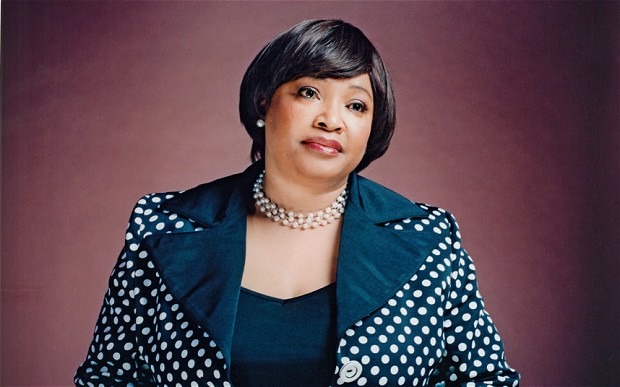
Zindzi Mandela, Daughter Of Anti-Apartheid Stalwarts Nelson And Winnie, Dies at 59

ZINDZI Mandela, the daughter of South African anti-Apartheid leaders Nelson and Winnie Mandela, has died at the age of 59.

Zindzi died after a short illness at a Johannesburg hospital on Sunday evening.

The cause of her death is still unclear at the moment but the Mandela family is expected to issue a statement at midday on Monday.

She had been South Africa’s ambassador to Denmark since 2015.

The Mandelas’ daughter came to international prominence in 1985, when the white minority government offered to release Nelson Mandela from prison if he denounced violence perpetrated by his movement, the Africa National Congress, against apartheid, the brutal system of racial discrimination enforced in South Africa at that time.

Zindzi read his letter rejecting the offer at a packed public meeting that was broadcast around the world.

Zindzi Mandela was born on December 23, 1960 in Soweto, and her famous father was sent to prison when she was just 18 months old – where he remained until 1990.

Zindzi studied law at the University of Cape Town before following in her family’s political footsteps, temporarily serving as the nation’s First Lady following her father’s election and her parents’ divorce.

She held the post until Nelson Mandela married Graça Machel in 1998.

Zindzi was married twice and leaves behind four children: Zoleka, Zondwa, Bambatha and Zwelabo.

(Compiled by Inside Politics staff)

More Than 60% Of South African Children Are Poor Reveals Stats SA Report

MORE than six out of ten children (62,1%) are identified as multidimensionally poor, according to a report on Child Poverty in South Africa released by Statistics South Africa this week.

The report gives an in-depth analysis of the Living Conditions Survey that was conducted in 2015. Child poverty in South Africa is multisectoral, with the majority of children (0-17 years) suffering from multiple deprivations simultaneously.

Black African children (68,3%) show the highest percentage of multidimensional poverty as compared to their peers from other population groups. Multi-dimensional poverty is highly prevalent amongst double orphans (77,3%) and paternal orphans (75,0%) as opposed to non-orphans and maternal orphans.

The report shows that more than twice as many children living in rural areas (88,4%) face multidimensional poverty compared to children in urban areas (41,3%).

The highest multidimensional poverty rates are found amongst children residing in Limpopo (82,8%) and Eastern Cape (78,7%). Gauteng and Western Cape, on the other hand, are best off with respectively 33,6% and 37,1% of children being multidimensionally poor.

Those living in non-metropolitan municipalities (73,7%) indicate much higher multi-dimensional poverty rates than children in metropolitan municipalities (39,6%).

Households with a larger number of members present a higher proportion of multidimensionally poor children than smaller sized households. Furthermore, households with many children demonstrate superior levels of multi-dimensional poverty in comparison to households with no or few children. Other household characteristics related to increased multidimensional poverty rates are households with no employed adults, female-headed households and household heads who attained no or low levels of education.

According to the child poverty report, children under five are most deprived in the dimensions of Housing (61,3%), Child development (57,9%)  and Health (54,4%). Among children aged 5-17 years old, the highest deprivation rates are observed for the dimensions Education, Housing and Health. For example, more than seven out of ten (74,4%) adolescents (13-17 years old) experience deprivation in Education.

Approximately half of the children (51,0%) in South Africa are considered to be monetary poor, that is they live in a household where its consumption was below the lower bound poverty line of R647 per person per month.

Furthermore, the findings show that approximately four out of ten children (42,0%) experience both money-metric poverty and multidimensional deprivation.

However, there is no complete overlap between money metric and multidimensional poverty for children in South Africa.

Only 9,0% of children are found to be only money-metric poor, but not multidimensional poor, whereas 20,2% are multidimensional poor only. Another 28,8% are neither monetary nor multidimensionally poor.

(Source: South Coast Herald)

City of Joburg Tables R68bn Budget After A Week Of Drama

THEBE MABANGA  

AMID technological chaos, banter and procedural missteps, the City of Johannesburg (COJ) succeeded in passing its budget and Integrated Development Plan by 228 votes to the Economic Freedom Fighters (EFF) 29 objection votes.

The session, which was the 17th extraordinary session of the council held virtually, started on a poignant note with a moment of silence for fallen icon Mary Twala, whose funeral was underway as council convened.

It then degenerated into a farce when council attendance had to be verified by video individually to satisfy rules of quorum and a section of council, Region A, struggled to follow proceedings due to technical challenges.

The 2020/ 2021 budget stands at R68.1 billion.

Of this R60.6 billion is the Operational expenditure and R7.5 billion for capital expenditure with a total R22 billion for capital expenditure outlay over the next three years, the city has a tough balancing act in the face of the COVID-19 challenge.

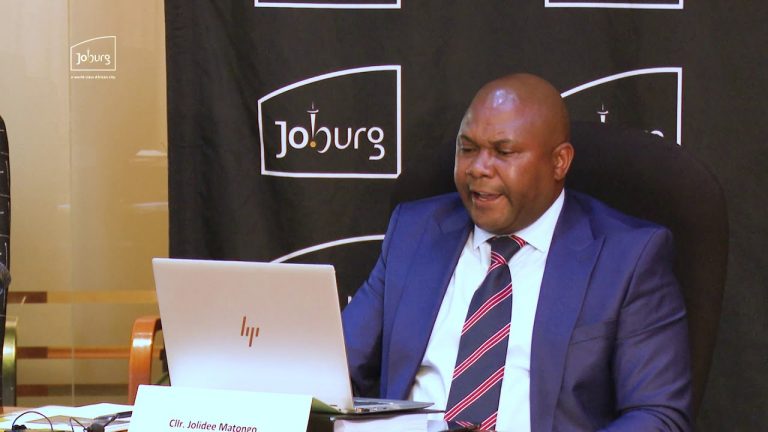
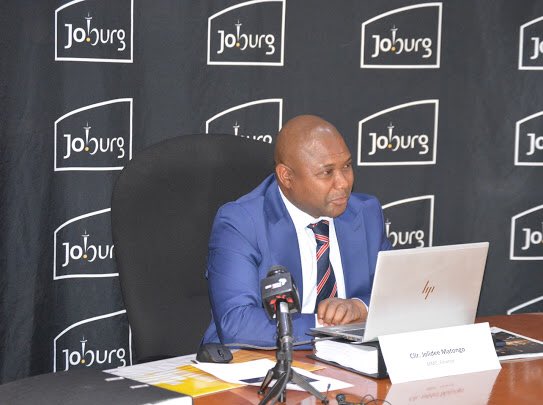
The finance MMC Jolidee Matongo described the budget as coming at a time when the city, and indeed the country, “stand in the stream of time that is unusual” due to the COVID-19 pandemic.

He noted that the city’s budget has prioritised cushioning the worst effects of COVID-19, the creation of localised jobs through investment in township economies and spending on social infrastructure, including housing and healthcare

Democratic Alliance’s councillor Chris Santana said the budget “was representative of all the 135 wards of Joburg” and called on Council and its employees to forgo their salary increases for this year.

The budget proposes a 6.25% salary increase, but Matongo said the ANC is willing to consider a freeze on increases and challenged the other parties to do the same.

The DA claimed credit for a number of key concessions in the budget, with one councillor noting that in his 16 years in council, they had never been consulted this extensively on the budget.

The DA notes that in exchange for its support the ANC agreed to a reduction in property rates increases from 4.9% to 4% a significant reduction in electricity charges from 8.1% to 6.23%, water tariffs lowered from 8.6% to 6.6, sanitation lowered from 8.6% to 6.6%.  

Refuse collection left unchanged at 5.2% as well as  reduction in commercial property rates.

Matongo announced that the city is to reinstate a free 6kl of water a month to every household and will put back R 400 million back into resident’s pockets through rebates.

The EFF sought to derail the process with its trademark militancy by first questioning the speaker’s powers and legitimacy of convening the sitting, strident opposition of all elements of the budget, questioning public participation of its formulation and opposition at voting stage.

EFF Councillor Motshabi Ledwaba said that the projected revenue increase of 7.5 % from last year’s budget is “absurd” given that the city estimates that it has lost R3 billion in revenue since April due to COVID-19.

She reiterated the call to sacrifice salary increases for councillors and employees.

She also called for a freeze in all Section 56 manager posts and redirect the spending to Covid frontline workers.

Ledwaba noted that funding capex on loans is not sustainable, but this likely exaggerated given that the city funds less than 30% of its capex budget on loans and has already said it will reprioritise spending from non-essential infrastructure to  frontline workers on COVID-19.  

EFF councillor Anthony Sipho Sithole came in hilarious student activist mode, using Karl Marx as his template to critique the budget.

He called the City’s rates policy “Inhumane and draconian” for contemplating an increase in the midst of a pandemic.

He rubbished the budget’s theme of “government of local unity” as fake and unsustainable.”

“Let me paralyse the medulla oblongata of the fake government” he said at one point, and when later commenting on the IDP noted: “No jobs will be created by this fake skelmpies government of local unity.”

Sithole argued that the city has excluded the majority of Joburg residents by publishing the draft budget in English and not supplying drafts in public buildings. 

“EFF will take legal action against the city,” he threatened, arguing that flyers, presumably in all officials, could be dropped in different parts of the City.

Matongo rejected this claim, arguing that in his filings he included analysis of 8000 comments from residents and other stakeholders from the city.

His ultimate response to the EFF was that the party must win election and thus the mandate to govern in order “to implement its wonderful ideas” which included the formation of a state bank as articulated by Ledwaba.

In its funding plans, the city has requested council to approve borrowing of up to R3 billion from the DBSA.

This was supported by all parties except the EFF and Matongo pointed out that the R 3 billion is merely an upper limit and may not necessarily be used up.

The limit now looks set to be exhausted due to COVID-19.

The City’s spending allocation are a mixture of hope and ambition: hope that revenue does not fall significantly due to COVID-19 and ambition to do things that were planned before COVID-19.

The upgrade of informal settlements for instance at a cost of R1.2 billion would be welcome if it were to materialise and not be bogged down by tender irregularities.

The construction or completion of six clinics and a hospice is now more critical in the Wake of COVID-19 and cannot suffer further delays or funding cuts should revenue fall short.

The distributions of 500 000 food parcels and vouchers are a sign of compassion in difficult times, but only of they reach intended recipients. 

The “seed funding of R50 million for youth development directed programmes in partnership with the provincial and national government, and the private sector to augment the City’s resources,” is a noble but vague goal.

Matongo closed off his presentation on a Biblical note,  reminding all that the Budget will serve those constituencies whose representatives did not support it, such as the EFF because, he declared: “God’s rain falls on sinners and the righteous”.

It felt like the Heavens can just come down.

KEY ALLOCATIONS BY THE CITY|

  • Over R 1 billion for job creation and SMMEs engagement through the roll-out of high-impact projects that include sewer upgrades, storm water upgrades, tarring of roads and housing developments in Orange Farm, Lakeside, Drieziek, Kapok, Ivory Park, Ebony Park, Mayibuye, Riverlea and Kliptown.
  • 1 350 to be employed across the City’s 135 wards – an initiative that will see each ward have a minimum of 10 people working daily to augment the services provided by the City’s entities;
  • 3 500 more housing units to be built in Region A, B, D and G in addition to the ongoing mega projects in Lufhereng, Fleurhof, South Hills and Lehae.
  • A total of R1.2 billion has been allocated for the formalisation of informal settlements over the medium term.
  • The upgrading of the Central Fire Station in the Inner City and the Protea Glen Fire Station in the new financial year.
  • An allocation of R200 million has also been made for the procurement of fire engines.
  • To advance the Joburg 10 Plus programme wherein a minimum of 10 law enforcement officers will be available per ward at any given time.
  • A seed funding of R50 million for youth development directed programmes in partnership with the provincial and national government, and the private sector to augment the City’s resource.
  • Up to 500 000 food parcels and vouchers to be distributed to vulnerable households amidst indications that more than a million households in Johannesburg are food insecure.
  • The construction and completion of clinics in Florida, Naledi, Bophelong, Turffontein, Zandspruit, the Orchards Clinic and the Alexandra Hospice. 
  • Allocation to further ensure the availability of extended service hours in 14 additional clinics and the establishment of six Substance Abuse Centres and 10 mobile clinics across the City.
  • Provision for the construction and operationalization of multi-purpose centres in Ivory Park, Lehae, Matholesville, Kaalfontein and Drieziek.
  • About R800 million over the medium term has also been allocated for the procurement of new buses for the Rea Vaya Bus Rapid Transit system to ease the current demand pressure on the existing fleet, and continue to offer a cheap and reliable public transport system to the people of Johannesburg.
  • Over the medium term, over R156 million has been set aside for hostel upgrades and R105 million for the upgrade of flats and old age homes.
  • In addition to the R45 million that was allocated in June this year for the roll-out of the Free Joburg Wi-Fi, an additional R40 million has been availed to expand access to free Wi-Fi across the City, including in hostels, flats, student villages and old age homes.
  • An allocation of R780 million over the medium term has been set aside for the tarring of gravel roads across Johannesburg.
  • Up to R820 million has been allocated over the medium term for storm water upgrades across the City including in Protea Glen.
  • A total of R440 million has been set aside over the medium term for the construction and upgrading of bridges.
  • An operating budget of R12.8 billion in 2020/21 – with a three-year capital budget of R3.1 billion for the continuous supply of water and sanitation to the people of Johannesburg – both in formal and informal settlements where rudimentary services in a form of chemical toilets and water tanks will be added and serviced regularly.
  • City Power has been allocated a three-year capital budget of R2.6 billion, which will fund the provision of public lighting at R205 million, the electrification of informal settlements at R498 million and the electrification of Mega Projects at R100 million.
  • The maintenance and refurbishment of existing electricity infrastructure, supporting infrastructure such as ICT and integrated security and fire protection systems at R22.7 million.
  • An operating budget of R3 billion for Pikitup will go towards the ward-by-ward approach to waste management. Co-operatives will be appointed across all regions and they in turn will appoint, on a short-term basis, at least 15 people per ward to keep the City clean.
  • The improvement of refuse collection in informal settlements through the provision of more waste bags and more strategically placed skip bins. These interventions will be rolled out alongside the City’s ongoing Kleena Joburg Campaign.

(Compiled by Inside Education staff)

Motshekga Condemns Rape Of 12-Year-Old KwaZulu Natal Learner

NYAKALLO TEFU

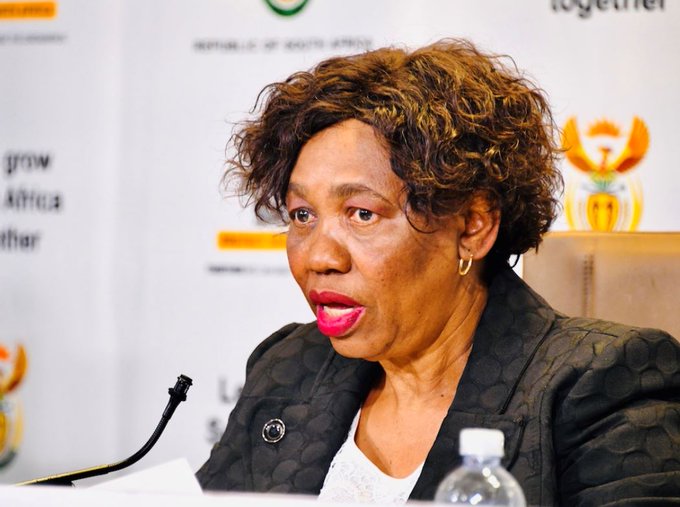
BASIC Education Minister Angie Motshekga has condemned the rape of a 12-year-old learn
er in KwaZulu Natal.

The learner was told to go back home after she forgot her mask and was allegedly raped on her way home in Bulwer, a small town in the KwaZulu-Natal‘s Midlands region,. 

“This rape of a learner once again shines the light on the scourge of Gender-Based Violence ripping our communities apart,” said Motshekga. 

Motshekga has condemned the rape of the 12-year-old in the strongest terms, saying a 17-year-old suspect has been arrested in connection with the rape of the learner. 

“We commend the swift action by the Donnybrook SAPS in apprehending the 17-year-old suspect and the seriousness with which they are handling the case,” said Motshekga.

Motshekga said the department will ensure that the learner receives the necessary psycho-social support from the District Auxiliary Support Services.

“We will also ensure that the 12-year-old’s identity is protected as she comes to terms with this painful and regrettable ordeal,” said Motshekga.   

(Compiled by Inside Education staff)
Health Minister Zweli Mkhize Says Eastern Cape COVID-19 Scooters Are Not Suitable Ambulances

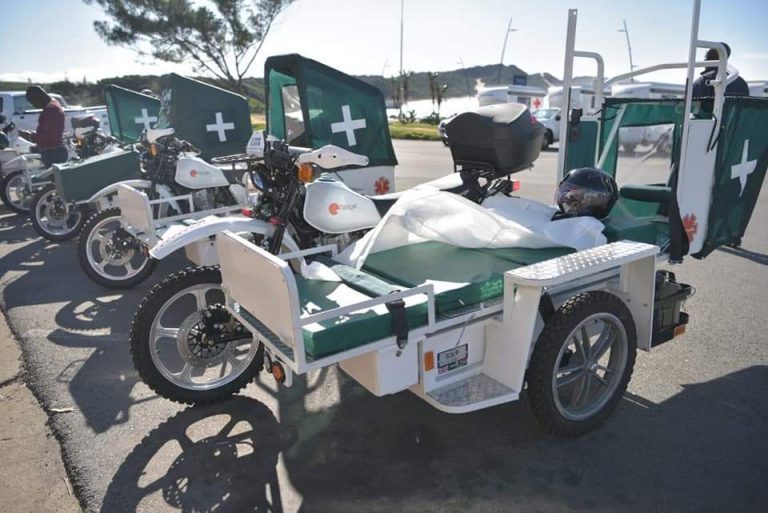
EASTERN Cape scooter ambulances don’t meet the basic criteria for patient transport as an ambulance.

This was the response of Health Minister Zweli Mkhize following a DA parliamentary question on whether the Scooter Project that was launched by the Eastern Cape Department of Health met the basic criteria of patient transport.

The minister launched the project last month, saying the scooters would be used to transport patients or deliver medication in rural communities.

He now says the scooters don’t meet Emergency Medical Service requirements.

“No, the Scooter Project that was launched by the Eastern Cape Department of Health (ECDOH) does not meet the basic criteria for patient transport as an ambulance. The purpose of this project by ECDOH is mainly for widening access to primary health care and delivering of chronic medicine for the most remote areas of the Eastern Cape Province,” said Mkhize.

Mkhize also says his department wasn’t consulted on specifications before the scooters were procured.

“The National Department of Health was not consulted on specifications before procurement of the scooters. However, the Province has been advised that none of these scooters will be used as ambulances because they do not meet the specific requirements as provided for in the EMS Regulations, such as, minimum patient compartment space and equipment requirements,” said Mkhize.

The Eastern Cape Health Department, which spent R10-million on the scooters, has now been told to stop using them as ambulances.

(Compiled by Inside Education staff)

DA, EFF Calls For No Increases In Property Rates, Salaries For City Of Joburg

0

THEBE MABANGA

THE Democratic Alliance (DA) and the Economic Freedom Fighters (EFF) on Thursday called on the City of Johannesburg to scrap proposed increase in property rate and forgo any salary increases for employees and councillors as the city grapples with the COVID-19 pandemic.

This was revealed at the virtual council meeting held to consider the 2020/2021 budget for the City of Johannesburg.

The budget, property rates policy and Integrated Development plan were passed with 228 votes to the EFF’s 29 votes.

In response, the city lowered proposed tariff increases and threw the gauntlet to all other parties in council to agree to a freeze in salary increases.

Property rates increases were decreased from an initially proposed 4.9% to 4% while water tariff increases were lowered from 8.6% to 4.6% while electricity increases were also dropped. 

The city’s budget for the coming year will be R68.1 billion, which represents a 7% increase in revenue.

The EFF said the city’s budget was “absurd” under the current economic circumstance.

The R60.1 billion will go towards operational expenditure. 

The city said it will create jobs through cleaning programmes among a range of programmes that will see 15 people per ward to complement clean-up work and refuse removal from Pikitup.

The city also said it will spend R80 million on new Rea Vaya buses to ease congestion among a total of 15 expenditure items. 

The City of Joburg also announced that it will reinstate the free 6 kl of water to every household and will put R 400 million into the pockets of households through rebates and property tax credits. 

(Compiled by Inside Education staff)
EUSA Commends Educators In Phoenix, KZN, For Closing Down Schools Due To COVID-10 Concerns

NYAKALLO TEFU

THE Educators’ Union of South Africa has expressed support for the decision taken by the school governing bodies (SGBs) and principals of KwaZulu Natal’s Phoenix area not to allow Grade 6 and Grade 11 learners to return because the majority of schools were not COVID-19 compliant.

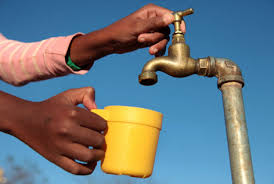
Learners at several schools in the Phoenix area were sent home on Monday because masks, sanitizers and water had not been delivered to their schools.

In a statement on Tuesday, EUSA commended the actions of the schools and principals in the Phoenix area, saying their action showed professionalism in their leadership and governance.

“It is vividly clear that both the Minister of Basic Education, Angelina Motshekga, and the MEC in the KZN Department of Education, Kwazi Mshengu, have no plans to act in the best interests of the teachers and learners, during this trying times of a deadly COVID-19 pandemic,” said EUSA President, Sicelo Bhengu.

The decision made by schools in Phoenix comes as the number of confirmed coronavirus cases continued to rise rapidly in South Africa.   

EUSA said it conducted a survey on Monday the 6th of July 2020 and can confirm that 65% of the schools in the province are without personal protective equipment and those that do are insufficient for all learners.  

“We remain steadfast in our initial position that schools shouldn’t have been reopened in the first place as this premature reopening of schools will definitely end in tears. We know that this improper  reopening of schools was not motivated by good intentions, instead it was propelled by the intentions of looting the public purse through unregulated tenders,” said Bhengu. 

(Compiled by Inside Education staff)
Plans To Reopen Some Schools In Limpopo Thrown Into Disarray Amid Water And Sanitation Chaos

MASHUDU SADIKE

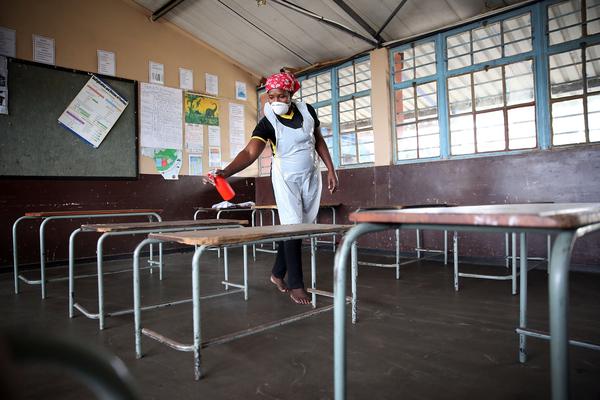
WHILE some schools in Limpopo resumed to a smooth on Monday, most were left without toilets and running water.

About 500 000 learners were expected to resume their studies today after Basic Education Minister Angie Motshega announced last month.

At Mokgwibidu Primary school in Moletjie, gates remained closed because service providers had not delivered mobile toilets and water tanks had arrived but had no water.

Saviour Association of School Governing (SASGB) bodies chairperson, Caiphas Mashutla, who had been at the school, maintained that the resumption of schools was premature.

“There so many challenges including teachers who are over 60 and have chronic illnesses who are still expected to teach. It also does not make sense that children must attend schools once a week. When the child comes back they have forgotten what they learnt the previous week. It defeats the purpose. This is just a way of government to solicit tenders,” Mashutla said.

He said that today proved that schools should just be closed and government concede that the year was lost and start preparing for 2021.

A principal at Mphetsebe High school in Badimong, outside Mentz, John Rapudi also said after a meeting with parents last week the resumption of schools was well underway but was concerned with overcrowding when the other grades came back.

“PPEs have been delivered but we are going to have a problem when Grade 10s return as we will not be able to manage ‘social distancing’.

Congress of South African Students (COSAS) chairperson in the province, Ntwanano Ngobeni, said that the student movement had monitored five schools in Mopani and had found them to be in compliance but warned that those schools that only comply only for now because there would be monitoring by various institutions, would be monitored.

“These schools must not only do things properly because the schools are opening today. They must implement it everyday,” Ngobeni said.

Ngobeni said that after consulting their constituency they felt happy that everything was smooth sailing.

Limpopo Department of education spokesperson, Tidimalo Chuene said they were still waiting for reports from District Directors but they had not had any complaints by Monday.

(Compiled by Inside Education staff)
Teacher Unions Upset Over Motshekga’s Decision To Return 2.5 million Pupils Back To School

NYAKALLO TEFU

TEACHER unions, political parties and parents associations are at loggerheads with the Basic Education Minister Angie Motshekga for sending more grades to school.

The various organizations said on Monday that they were concerned with the return of these grades as some of the schools were still struggling with Grades 7 and 12.

This was in response to Sunday’s announcement by Motshekga and her department that more than 2.5 million learners from Grade R, Grade 6 and Garde 11 would return to schools on Monday.

In a statement issued, the SA Democratic Teachers Union (Sadtu) said this was a regrettable decision.

“We are extremely disappointed, because we would have loved to see the schools building resilience in teachers, learners and education support personnel before receiving more grades,” said Sadtu.

“That it is taxing the teachers to deal with the curriculum recovery whilst at the same time having to deal with the probability of becoming infected.”

Yet on Monday, the ANC Women’s League also slammed Motshekga’s decision to return more grades to school.

The women’s league said it was concerned over the phasing in of more grades and allowing schooling when the country was still struggling to contain the spread of the COVID-19 pandemic.

“We cannot turn a blind eye to the number of infections and deaths in our country. We are all aware of the infrastructure challenges in many schools across the country and conditions in such schools have been hazardous and posing health risks to learners long before corona emerged in our country. Therefore, as a country we cannot gamble with the lives of children, more especially the poor learners who are subjected to study in potentially unhygienic conditions,” the league said in a statement.

Meanwhile, the Progressive Organisations (teacher unions, worker unions and civil organizations ) in the Western Cape met at the weekend to assess the health and safety situation of learners, parents, teachers and support staff in the province.

The progressive organizations agreed that the Western Cape Province has become the epicentre of the deadly coronavirus in South Africa and things have now reached a crisis point.

“What we have also experienced is that this province is not ready to deal with this pandemic and our poor state of the public health care system in the Western Cape and in particular in the working class areas is a living example,” said the organization, whose membership includes COSATU, ANC Youth League, SADTU, COSAS, SA Communist Party and the Parents Against Opening of Schools.

“To date the Western Cape has recorded 66 195 cases, representing more than 50 percent of the total infections in South Africa. Most tragically, is the rate at which the virus is spreading in the working-class areas such as Ravensmead, Du Noon, Khayelitsha, Bishop Lavis, Nyanga and Mitchells Plain. South Africa is the most unequal society in the world.”

The formation said Grade 7 and Grade 12 learners can continue to go to be at school while Grade R to Grade to 11 students should remain at home until the virus curve flattens.

“This is the view of COSATU WC, SADTU (WC), NUPSAW ES WC, ANC YL, SACP WC, ANC WL, SANCO, SASCO and YCL. Parents against the opening of schools for learners, BLAC, SOS, Athlone Teachers’ Group and COSAS WC demand that all students stay away from school including Grade 7 and Grade 12 students until the virus curve flattens,” the formation said.

“We do not support the phasing in of other Grades into the system until the virus curve flattens. The Formation will monitor the ill-conceived plan to bring back grade 6, 11 and Grade R on Monday 6 July 2020 and will report non-compliance to the Department and Employment and Labour and the Human Rights Commission. The decision of the National Department of Basic Education ( NDBE ) to allow the phasing in of the other grades now will further compromise social distancing, constant sanitizing, and staffing challenges as there would be a need to reduce the class size and accommodation would not allow for this.”

Meanwhile, all private nursery schools, offering early childhood development may open their doors immediately if they have adequate safety measures in place.

This follows a judgment by Gauteng High Court Judge Hans Fabricius who overturned government’s regulations that these institutions remained closed under lockdown Level 3.

Trade union Solidarity, Bronkieland Nursery School in Bronkhorstspruit and an organisation called the Schools Support Centre turned to court on an urgent basis as there was uncertainty about when private pre-school centres could open.

(Compiled by Inside Education staff)
3 Of 11 Teachers Who Succumbed To COVID-19

NYAKALLO TEFU

GREGORY Klink was more than just a teacher to his learners and fellow educators. He was also a father figure who was loved, adored and cherished by all.  

Klink, a Grade 7 teacher at the Montevideo Primary School in Cape Town, died on Friday June 26 from COVID-19 related complications after testing positive three days earlier.

Shortly after his death, Montevideo Primary School shared a tribute to Klink on Facebook with several of his colleagues writing touching comments about him.

“Always smiling and laughing,” wrote one teacher.

“A great loss for Montevideo and a father figure to many,” wrote another.

Some teachers said Klink was ‘one of those people who everyone liked’.

He was “a much-loved and gifted member of staff”, another teacher said.

According to the school’s acting principal Craig Daniels, Klink went for his COVID-19 test on a Tuesday, received a positive result on Thursday, and on a Friday morning, sadly, passed away at his home surrounded by his wife, children and grandchildren.

“In the space of three days, Coronavirus became a reality at Montevideo Primary… Mr Klink went for his Covid-19 test on Tuesday, received a positive result on Thursday, and on Friday morning, sadly, passed away at home,” said Daniels.  

“Our educators are heart-broken, as I am sure many of our children are – past and present. Mr Klink was the grandfather that your child needed, he was the father that was missing from home, he was the mentor to our educators and he was the source of our spiritual guidance and motivation.”

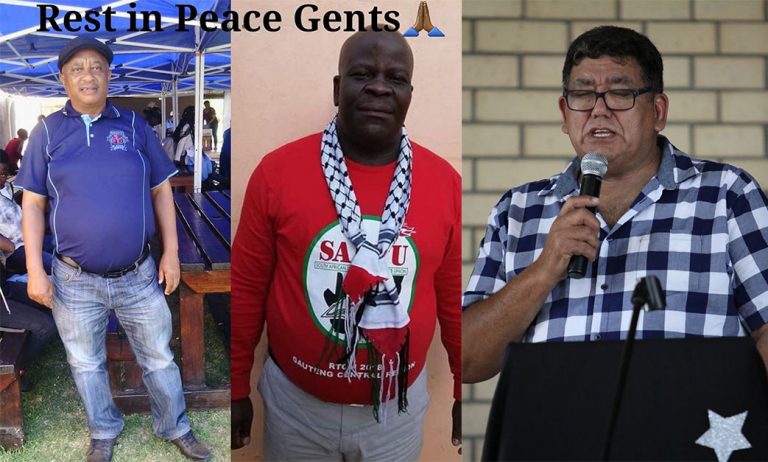
The other two teachers featured were educators at Boikanyo Primary School in the Gauteng Province.

They also succumbed to the deadly virus.

According to Basic Education Minister Angie Motshekga, since the return of the Grade 7 and 12 learners on 08th June 2020, 2 740 teachers, of the total number of about 440 000 teachers, were infected by the virus.

In the same period, 1 260 learners were infected by the virus.

“We unfortunately lost the lives of eleven 11 teachers and 4 non-teaching staff in the Eastern Cape to the virus; as well as 3 learners, who are reported to have succumbed to COVID-19. The reports show that some of these teachers and learners could not have the opportunity of reporting back to school on school reopening,” said Motshekga in her tribute to the fallen teachers and learners.

“We convey our deepest condolences to the affected families. May their dear souls rest in eternal peace. Due to the infection rate, it is clear that we need to continue to work together to contain the transmission of the virus. As the basic education sector, we have to play our part together, with all our strategic stakeholders and partners.”

Teachers were not coping with the psychological stresses of working during the pandemic while their colleagues were dying, said founder of the Western Cape Teachers’ Forum Lee Hoffmann, who is a teacher and works for a teachers’ union.

“Our people are really not coping, because, on a weekly basis, we’re sharing news of one of our education sector workers that has passed on,” Hoffmann said.

“The sector is reeling at the loss of these educators.”

Hoffman created the Teachers’ Forum Facebook group in 2015 as a place for education workers to network. During the pandemic, it has become a place to share information, fears and to support one another, with a particular focus on the mental wellness of teachers.

“Psychosocial support is really important. You’ve got PPE in place and social distancing, but we’ve not addressed the issue of wellness enough, for both teachers and learners,” he said.

(Compiled by Inside Education staff)