Home Blog Page 409

Section 27 Threatens Limpopo Department of Education With Court Action Over Lack Of Sanitation At Kharivha Primary School

SECTION 27 is preparing to take Limpopo Department of Education to court over poor sanitation at the Kharivha Primary School in Venda.

Section 27 is representing the School Governing Body (SGB) of Kharivha Primary School in Ndovhada village in Limpopo, a school which is nowhere near ready to be reopened safely during the COVID-19 pandemic.

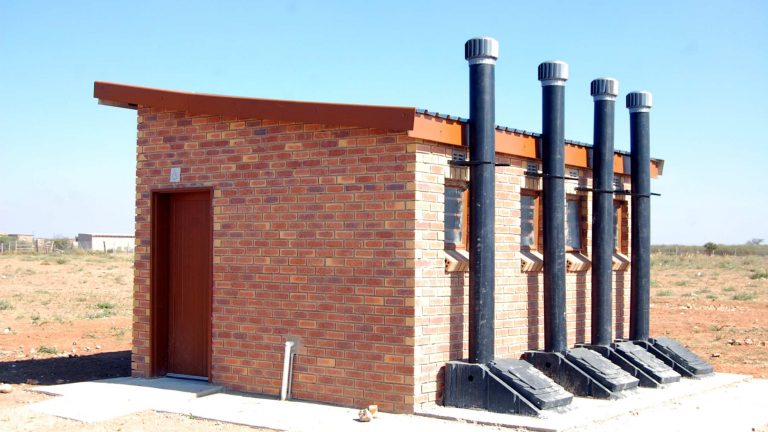
At the school, learners and staff were forced to use unlawful pit toilets which have subsequently been demolished.

The school lacks running water on the school property, and SGB members told SECTION27 that only six disposable masks were delivered for the school’s staff and that the school only received seven 1 litre bottles of sanitizers for approximately 95 learners.

Section 27 spokesperson Julia Chaskalson confirmed in a statement that the civil society organization has written to the Department of Basic Education well as the Limpopo Department of Education (LDOE) about its concerns about the school’s readiness twice, and received no response.

The organization is demanding that a water tank, portable toilets and other necessaries be delivered to the school before it opened on June 8, failing which Section 27 will go to court to ensure that the government complied with its undertakings to ensure the safety of the schooling community during the COVID-19 pandemic.

 “We have been campaigning for lawful sanitation in schools for five years and counting, since the tragic and undignified death by drowning in a collapsed pit toilet of 5 year old Michael Komape. We had hoped that the DBE would fulfil its promises to deliver safe and decent sanitation given the urgency during the COVID-19 Pandemic. We hope it still does to avoid future litigation,” said Chaskalson.

Chaskalson said the school has no portable toilets, water tanks or masks for learners.

“The DBE [Department of Basic Education] has set out the safety preconditions for the reopening of schools during the COVID-19 disaster in its Standard Operating Procedures for the Prevention, Containment and Management of COVID-19 in Schools and School Communities (SOPs),” said Chaskalson.

“Key pillars of the safety procedures therein are adequate sanitation infrastructure (including safe toilets, clean and reliable water supply and sanitiser facilities), personal protective equipment (PPE), social distancing measures, adequate orientation and screening for COVID-19. The SOPs note that these key pillars must be adhered to.”

(Compiled by Inside Education staff)

North West School Closes After Principal Tests Positive For COVID-19

A SCHOOL in the North West Province has been forced to close its doors amid reopening preparations after a 56-year old principal tested positive for COVID-19.

This comes less than a week before schools officially reopen after the Department of Basic Education delayed the reopening by a week due to lack of readiness at some schools in the country.

The department’s spokesperson Elias Malindi said a 56-year-old school principal from the province visited a doctor who then revealed that he had signs of the novel coronavirus.

“The results confirmed the positive status on Tuesday and immediately the principal was subjected to a 14 days self-quarantine,” said Malindi.

North West education MEC Mmaphefo Matsemela said the school will not be opened until all necessary investigations have been concluded.

 “As the department we are shocked to learn about the news. We are working with the department of health who have advised us to close the school with immediate effect,” said Matsemela.

Most teacher unions remain opposed to reopening of schools.

South Africa’s major teacher unions say the Department of Basic Education’s decision to reopen schools was deeply flawed and dangerous.

(Compiled by Inside Education staff)

SAHRC Demands To Know Why Schools Are Not Ready

LUCAS LEDWABA

THE SA Human Rights Commission (SAHRC) wants the Department of Basic Education to provide information on all schools that are not ready to open and provide effective learning and also give reasons why that is the case.

The commission said on Tuesday it will also request for information on alternative measures instituted to ensure that learners whose schools cannot open under the COVID-19 regulations are not left behind as far as effective learning is concerned.

“The Commission will monitor schools throughout the country to ensure that effective learning takes place and that no learners are unduly disadvantaged by the inability of schools to open and provide learning,” the  SAHRC said in response to Minister of Basic Education Angie Motshekga’s decision to postpone resumption of schooling to June 8.

Motshekga said on Monday that the Council of Education Ministers (CEM) received three critical reports  from the National Education Collaboration Trust (NECT), Rand Water and the Heads of Education Departments Committee (HEDCOM) on the state of readiness for the phased-in reopening of schools. She said based on the reports it became clear that the sector was at different levels of readiness.

“In the main, it was for this reason that the CEM determined that the sector requires more time to mop-out its state of readiness for school reopening, in order to comply with the health and safety standards on COVID-19,” Motshekga said. Grade 7 and 12 learners are expected to return to class on June 8 and teachers who have received PPEs were expected to start work on June 1.

The SAHRC said it “will not hesitate to take necessary measures within its mandate and powers, including litigation, if necessary, to ensure that learners are not unduly deprived of their right to a basic education.”

Motshekga said teachers, whose schools have already received the personal protective equipment, will be expected report for work on 01 June 2020, and prioritize the preparation of their schools to deal with the “new normal” brought about by the Corona Virus.

She also said provinces should finalise all their outstanding deliveries of PPEs to schools, and the outstanding provision of water and sanitation to the schools and that ongoing cleaning of schools should be finalised within the week of 01 June 2020.

“All teachers and support staff should be inducted and orientated for the new environment brought about by the COVID-19. In return, the teachers should induct, orientate and counsel the learners, who have already arrived at the schools, to deal with the new COVID-19 environments.”

(Compiled by Inside Education staff)

SA Human Rights Commission Mulls Court Action Against Western Cape Education Over Reopening Of Schools

NYAKALLO TEFU

THE SOUTH African Human Rights Commission is taking legal action against the Western Cape Department of Education over its decision to go against Basic Education Minister Angie Motshekga’s directives to reopen all schools on June 8.

SAHRC’s Andre Gaum said that the reopening of schools in the Western Cape will exclude learners in disadvantaged communities.

 Gaum said some schools in these areas are still not ready or compliant to deal with the spread of the novel coronavirus.

“According to our monitoring and our assessment and also surveys that have been done, they are about 80 percent ready. So there are also a substantial number of schools in the Western Cape that are, indeed, not ready,” he said.  

The commission has written to the department asking it to urgently ensure that it upholds the Constitution by leaving no learner behind.

The commission has also asked Western Cape MEC for Education Debbie Schafer to stick to the rules or face court action following her decision to reopen schools on Monday.

“The basis of all of this is Section 9(1) of the constitution which highlights the right to basic education and not be unfairly discriminated against,” said Gaum.

The commission also called on Motshekga to amend the directions published in the government gazette on May 29.

“At present it says schools that comply with COVID-19 rules may open and those that aren’t may not open. It should be amended to make alternative plans for learners who come from schools that cannot open,” said Gaum.

The commission is currently monitoring other provinces, said Gaum, who added that they want to make sure deliveries are taking place.

“If deliveries are not happening, we will contact the different provinces so learners can access their right to education,” he said.  

Schafer has argued that gazetted regulations, coupled with the Western Cape’s state of readiness, meant that schools in the province would open on Monday June 1.

Schafer said she will not stop children from learning unless a court of law tells her to stop.

“I am really battling to understand what the issue is. The Human Rights Commission is supposed to protect the human rights of all citizens and one of those fundamental ones is the right to basic education, and we are providing the right to education,” said Schafer.

“We are working with the national minister to do that and we are complying with the gazette but suddenly they feel that if all schools across the entire country can’t open at the same time, then they mustn’t open at all.”

(Compiled by Inside Education staff

Large Quantities of PPE Stolen From School Districts in KwaZulu Natal

KWAZULU Natal MEC for Education Kwazi Mshengu confirmed on Tuesday that large quantities of personal protective equipment has disappeared in the uMlazi, Pinetown and Zululand districts.

The equipment apparently disappeared en route to circuit offices and schools.

“The disappearance of these PPE makes the preparations for the reopening in schools an elusive goal. Their replacement of these PPE will cost the department millions of rand, the money of which the department does not have,” said Kwazi.

He has since directed the head of department Dr Vusumuzi Nzama to launch an investigation on the disappearance of PPE in these districts.

(Compiled by Inside Education staff)

WHO Pushes To Keep Ties With ‘Generous’ U.S. Despite Trump’s Exit Move

0

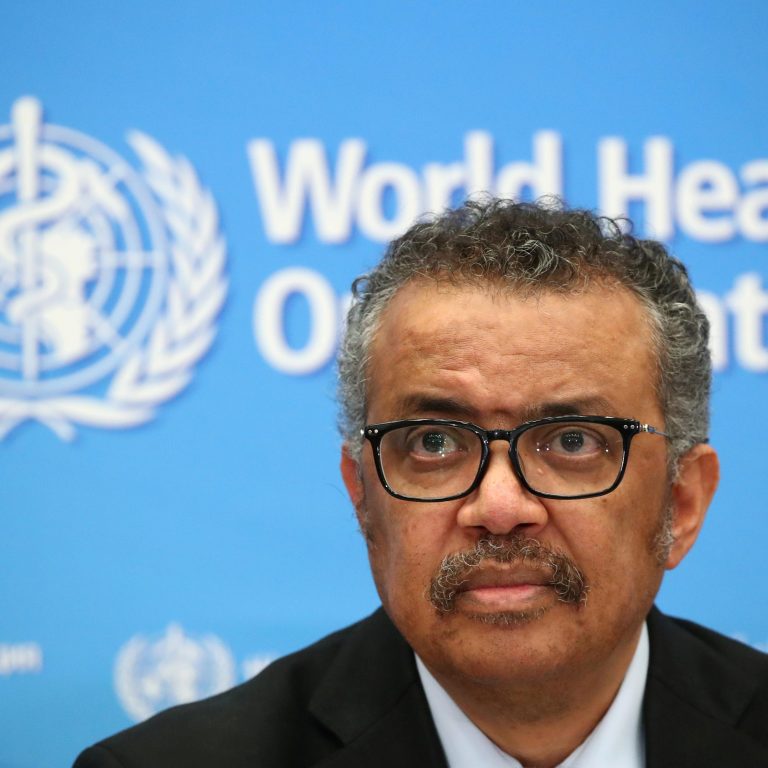
LONDON (Reuters) – The head of the World Health Organization (WHO) on Monday praised the United States’ “immense” and “generous” contribution to global health in a push to salvage relations after President Donald Trump said he was severing ties with the U.N. agency.

Accusing it of pandering to China and overlooking an initially secretive response to the COVID-19 outbreak, Trump said on Friday he was ending Washington’s relationship with the WHO.

But WHO chief Tedros Adhanom Ghebreyesus told an online media briefing he hoped his organisation could continue its longstanding collaboration with the U

“The United States’ contribution and generosity towards global health over many decades has been immense, and it has made a great difference in public health all around the world,” he said.

China has reacted furiously to Trump’s move, calling it selfish and petulant politics by a U.S. administration “addicted” to quitting international bodies and treaties.

Tedros, who is Ethiopian, said he only knew about the U.S. decision from the media, with no formal communication yet from Trump’s government. He declined to answer further questions about the U.S. stance

Asked about potential health risks from protests that have flared up in the United States over racism, another WHO official, epidemiologist Maria Van Kerkhove, said close contact could heighten the risk of spreading the COVID-19 disease.

Unrest erupted in the United States after last week’s death of a black man, George Floyd, in police custody, bringing thousands onto the streets and adding to a sense of crisis as the nation already faces the world’s worst coronavirus outbreak.

At the briefing, chief scientist Soumya Swaminathan said the WHO should have enough information in 24 hours to decide whether to continue suspending trials of hyrdroxychloroquine.

Trump has been one of those promoting the anti-malaria drug to help combat the COVID-19 disease, despite medical warnings about associated risks.

With many nations easing lockdowns as the rate of new coronavirus cases drops, emergencies expert Mike Ryan said it was “laudable” to see economies being put back on track, but a cautious “stepwise” approach was still needed.

Central and South America were current COVID-19 hotspots which had not yet reached their peak, he warned.

(Source: REUTERS)

Angie Motshekga: I Am Sorry

CHARLES MOLELE and NYAKALLO TEFU

THERE are growing calls for Basic Education Minister Angie Motshekga to step down over her mishandling of reopening of schools amid COVID-19 pandemic and getting away with it. Grade 7 and Grade 12 learners were supposed to have returned to school on Monday June 1 but the department postponed the date, sparking outrage among parents, teacher unions and school governing bodies.

Irate South Africans took to social media on Sunday and called for the minister to step down because she lacked professionalism, while others criticized her decision for reopening schools amid the coronavirus pandemic.

Despite serious health and safety concerns raised by teacher unions and vocal NGOs, Motshekga has stubbornly insisted that the phased reopening of schools should go ahead, ignoring scientific data and evidence on the increasing number of confirmed coronavirus cases, including projections of a peak in active cases between early July (pessimistic) and early Aug (optimistic).

Government figures showed that as of Monday this week, the cumulative number of confirmed COVID-19 cases in South Africa stood at 34 357 while the number of deaths 705.

In the Western Cape, there were 22 new deaths, bringing the total to 525 in the province.

One South Africa Movement (OSAM) founder and leader Mmusi Maimane told Inside Education on Monday that Motshekga should resign or be removed from office.

“We’ve had lockdown for three months yet the Education Minister only started consultations on Saturday about the reopening of schools. If she can’t even show up at her own media briefing to the address the nation about her plans, that’s unacceptable. We live in a consequence-free society,” said Maimane.

“We are calling for reopening of schools at the same, equitably. We can’t have some good schools opening while leaving those from poor communities closed. All schools must open at the same time.”

Last Thursday, Economic Freedom Front (EFF) leader Julius Malema urged Motshekga to reconsider its decision to reopen schools for Grade 7 and 12 pupils.

Malema said many schools were not yet ready to reopen and sending children back to the classroom would expose them to the virus.

“Do not send your children to schools. The schools don’t have toilets, drink from one tap, travel in crowded transport. We are led by fools who don’t think,” said Malema.


In an interview with Inside Education on Monday, EFF’s spokesperson Vuyani Pambo lambasted Motshekga’s decision to reopen schools in the middle of the worst health crisis in South Africa, and a potentially daunting challenge to the world since the 1918 Spanish flu and the 1932 Great Depression. The Spanish Flu decimated more than 300 thousand South Africans over a two-year period.

“I think the many South Africans who are calling for Angie Motshekga to step down are well within their rights. They are asking her to do so because you can’t have a government Minister who is unable to see that the decision to reopen schools is an ill-informed decision. The schools in South Africa have not been ready, not in just the past three weeks but for decades,” Pambo said.

“Schools have been running without proper flushing toilets, children have been falling into pit toilets, we have cases of children who have lost their lives. It is important that the government rethinks this decision. In fact, it must not even try to reopen schools on June 8 because what the department is doing is preparing our children for a mass slaughter. Why does Angie feel the need to open schools in such a rush. Who is holding a gun to her head? No one is holding a gun to her head!”

The DA’s Shadow Minister of Basic Education Nomsa Tarabella-Marchesi said Motshekga must step down because she was ‘incompetent” and had failed to prepare schools on time for the reopening of schools.

“I am not surprised that people want her to step down because South Africans believe that she has dropped the ball. You can’t drop people at the 11th hour when you have announced that they will return to school, some parents traveled long distances to get their children to school.  The Minister misled the country and she failed to prepare on time,” said Tarabella-Marchesi.

Teacher unions, parents and civil society groups also called Motshekga to step down for mishandling the reopening of schools under COVID-19 pandemic lockdown.   

In a joint statement, teacher unions said Motshekga asked for time to consult her colleagues in the Cabinet on the issue of June 1 reopening given the information from the independent Consortium and the Unions and committed to respond on the 31 st May 2020, which she did not honour.

“This is a betrayal of trust and does not bode well for the credibility of the education system. We want to put on record that the date of the 8th June was never mentioned in the meeting because the focus was readying the system and ensuring that all the provinces comply with the twelve non-negotiables,” the unions said in a statement.

“The astounding confusion caused by the statement must be condemned because the Department of Basic Education is obsessed with dates and ignoring the evidence of provincial readiness. The lack of appreciation for evidence can only be characterized as irresponsible and negligent.”

The teacher unions called on teachers and learners not to go back to school until the non-negotiables were delivered at all schools across the country.

“We therefore advise all schools, even those that might be ready to re-open, having received all the necessary materials for teachers and learners, not to re-open for learners until the non-negotiables have been delivered to all schools and to inform their learners accordingly. To further contribute to disparities between schools would be irresponsible,” the unions said.

“We call on the Minister to meet the Teacher Unions and Governing Body Associations on Thursday, 11th for genuine assessment and engagement about the readiness of the system. Parents, learners, teachers and education workers can be assured that we all wish schooling to resume as soon as possible, but not at the expense of their health and safety.”

In a joint statement, SECTION27, Equal Education Law Centre and Equal Education said the NGOS were immensely distressed that Department of Basic Education has failed to fulfill its promises to enable schools to re-open safely.

“With last minute announcements about schools reopening for learners on 8 June 2020 instead of 1 June 2020 coming from the DBE late last night (31 May 2020), there is renewed uncertainty about the way forward for schooling. What’s more, some provinces – notably the Western Cape – seem to be giving directives that contradict this announcement, and maintain that schools will open on Monday,” the NGOs said in a statement.

“If plans were implemented as they were intended to be, all schools should have been properly sanitized, and PPE and the promised infrastructure ought to have been delivered in time for the re-opening date determined by Motshekga. The failure of the DBE and most provincial education departments to comply with their undertakings and meet their own deadlines in terms of preparing schools for re-opening, unfortunately mirrors their ongoing failures to provide textbooks, essential school infrastructure like toilets, and scholar transport.”

They added: “We urge the DBE to engage in meaningful consultation with learners, school staff and caregivers, and to move expeditiously in ensuring that all deliveries occur at all schools. It is critical that the uncertainty surrounding the re-opening of schools is resolved in the interest of the right to basic education for all learners in South Africa.”

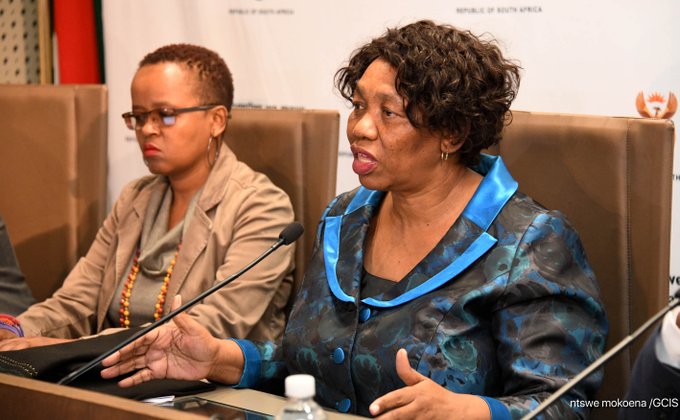
Earlier on Monday during a media briefing out of Rustenburg, North West, Motshekga ‘wholeheartedly’ and profusely apologized for delaying her address to the public as well as her late postponement of the return to schools of learners from 1 June until 8 June.

“At the outset, I must acknowledge the furore the postponement of yesterday’s media conference caused, and for that I sincerely apologize. Due to last minute changes to plans to start the teaching and learning for Grade 7s and 12s in public school, I was forced into a number of consultations with a number of key stakeholders with a direct interest in basic education, resulting in challenges to continue with the press briefing we had planned,” said Motshekga.

“I had to urgently engage with, for instance, the association of school principals, the leadership of special schools, private and independent schools to manage the difficulties that these changes presented. I also had to communicate with the South African Human Rights Commission, which had also raised concerns about the resumption of classes today. I wish to apologize wholeheartedly for the inconvenience caused.”

Motshekga said that following the presentation of three reports which showed that schools were not ready to reopen, she spent Sunday consulting with key stakeholders.

Among others, water and sanitation was also one of the outstanding issues, with 2634 schools with no water and still awaiting to be supplied with water tanks by Rand Water.

Teboho Joala, General Manager of Communication and Stakeholder Management at the Rand Water, which is assisting the department in providing water to schools that do not have it, admitted that his company has not yet supplied water to the majority of schools across the country. 

“In total, we have 3126 schools affected by the water problems in the country and there are two types – ones with water tanks that are too far from the water supply and schools with no water tanks”, said Rand Water.

“Water tanks are being transported across the country to reach schools that need them.”

(Compiled by Inside Education staff)

Western Cape Opens Its Doors To Learners Despite Nationwide Reopening Postponement

NYAKALLO TEFU

THE WESTERN Cape Province said schools would reopen on Monday as it had already spent millions on PPE for teachers, pupils and general government staff.

The notice, issued by the Western Cape MEC for Education in the Western Cape, Debbie Schafer, has added further complexities to an already convoluted back to school plan.

Despite Basic Education Minister Angie Motshekga’s late-night turn around, which effectively postponed the reopening of classrooms to Grade 7 and Grade 12 learners to Monday June 8, Schafer argued that gazetted regulations, coupled with the Western Cape’s state of readiness, meant that schools in the province would open on Monday June 1.

“We have been engaged in discussions at a national level over the weekend and we can no longer allow our schools to hover in a state of uncertainty,” said Schafer.

Schafer said the provincial education department has already spent R280 million on personal protective equipment (PPE) and cleaning material in preparation for the reopening of schools across the Western Cape.

She said this includes 2.4 million masks – 2 masks for each learner and WCED-employed staff member.

“We have also provided over 7 000 non-contact digital thermometers for the screening process that every learner and staff member must follow each day, and millions of litres of hand sanitiser, liquid soap, disinfectant and bleach,” she said.

“Learner transport has been arranged for tomorrow morning for those learners on the Learner Transport Scheme. Schools have also made preparations for the provision of school meals. Learners have already begun to arrive at school hostels today, and parents have made preparations to take their children to school tomorrow morning. School staff and WCED officials have been working around the clock to ensure that all plans are in place to receive those learners on time. Given these preparations, and the enormous effort put in by teachers and non-teaching staff alike, it would be unfair to delay all schools from re-opening.”

Schafer said there are also outstanding issues that need to be finalized over the coming week – including confirming a position on home schooling options – but these will not prevent the majority of Grade 7s and 12s from returning.

“Whilst we are aware of the many anxieties surrounding Covid-19, keeping schools closed indefinitely is not going to resolve them.  The South African Paediatric Association has come out in favour of the phased re-opening.  We are taking every precaution, but the longer schools remain closed, the poor will suffer the most.  The disingenuous arguments by some that all schools should open simultaneously do not hold water.  They argue that the poor will be left behind.  Well the reality is that the poor ARE being left behind now, as wealthier schools or parents have the means to continue online,” she said.

Meanwhile, the South African Human Rights Commission said on Monday it will challenge the Western Cape Education Department’s decision to open schools after Motshekga’s announcement that schools would re-open for Grades 7 and 12 next Monday, the 8th of June.

(Compiled by Inside Education staff)

Schools In Limpopo Not Ready To Reopen Amid Water Shortages, Lack of PPE and Vandalized Classrooms

LUCAS LEDWABA

THERE will be no schooling in Limpopo after a frantic week of deliberations, consultations, denials and accusations between the authorities, teacher unions and learner representatives. On Sunday night the provincial Coronavirus Command Council announced that schools are not ready to reopen “after considerable assessment.”


The command council said consultations with all stakeholders will continue through the week. It also said delivery of all PPEs and training of officials will also continue “as they have been.”


“The PCC believes Limpopo schools will be ready by the 8 June 2020. Learners are therefore advised not to go to school until instructed otherwise. Educators and other administrators are however expected at schools and various administrative stations as usual,” the council which is led by Premier Chupu Mathabatha said in a statement late on Sunday.


The SA Democratic Teachers Union (SADTU) had already announced on Saturday that feedback from its members on the ground had indicated the schools were not ready for reopening on Monday.


The union said it had expressed its misgivings about the intention of the Limpopo department of education to recall teachers back to work early last week.


“The union then advised the educators not to return to work as the department had not yet put in place the health safety precautionary measures before workers could return to work,” Sadtu’s secretariat said.

The union said it also indicated that it would take the week that began on Monday 25th May 2020 to Thursday 28th May 2020 to assess the situation on the ground and would then indicate its position on whether the department was ready to re-open schools or not.


“Accordingly, the union tasked all of its structures to give daily reports on their observation about whether the department was complying with the delivery of all the required resources needed like PPE’s as well as attending to other strategic risks identified to be addressed first before the schools can re-open.


“The reports submitted, viewed singularly and accumulatively, have painted a very bleak picture about the state of the province’s readiness to reo-open the schools on 01st June 2020.”


The union said the reports indicated amongst others that not all PPEs have been delivered to schools and these include the cloth masks for both educators and learners.


It also said the department has not yet appointed screeners at the schools and trained them about executing their work and that in some cases the department has attempted to coerce principals of schools to do this task.


“The process of cleaning and disinfecting the schools was still underway due to financial constraints as a result of the norms and standards monies not yet paid. There are no proper guidelines on managing educators presenting with comorbidities as the policy to implement this was still being finalised at the national Education Labour Relations Council (ELRC).”


Sadtu said the water tanks to be delivered to schools, with no running water, had not yet arrived at those schools and that schools that had challenges of toilets have not yet been provided with mobile toilets as a mitigating factor.


The union said it had since advised teachers not to report to school on Monday [1 June 2020] “pending the finalisation of all of the above-mentioned issues”.


National department of basic education spokesman Elijah Mhlanga said the Council of Education Minister met yesterday on Saturday to assess the state of readiness for the reopening of schools.


He said the body received a report from the consortium of service providers coordinated by the National Education Collaboration Trust on the External Evaluation and Monitoring of the state of readiness.

He said Rand Water, as an Implementing Agent delivering water to 3 500 schools, also presented its report.

Mhlanga said the Heads of Education Departments Committee (HEDCOM), also presented its technical report.


“All three reports converged on the fact that a substantial number of schools would not be ready for the reopening Monday [June 1], albeit tremendous progress had been made by most provinces, which overall reflected 80% state of readiness. CEM was concerned that, in some provinces personal protective equipment for learners in particular, had not been received; and some schools had not been made ready for the arrival of teachers and learners,” he said.

He said “the CEM took informed decisions to have schools to continue to reopen on 01 June 2020, but with School Management Teams, Teachers and Non-Teaching Staff only arriving to prepare for the arrival of learners. Provincial and district officials should ensure that health, safety, and social distancing requirements, are strictly adhered to when teachers arrive.”


Mhlanga said this whole coming week must be used for the proper orientation and training of teachers, the mopping and ramping of all supply chain matters, and final touches to the readiness of each facility for the arrival of learners.

“The date on which all learners have to report back to school, is the 08 June 2020.”

SA’s School Feeding Programme To Resume From June 1: Equal Education

NYAKALLO TEFU

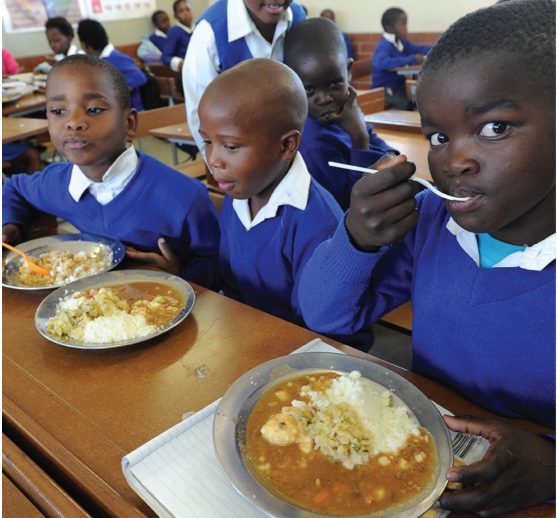
SCHOOL PUPILS relying on the National School Nutrition Programme will start to receive their daily rations as from June 1 onwards. The civil society organizations, Section 27, Equal Education and Equal Education Law Centre, issued a joint statement this week saying after engagements with education stakeholders, Department of Basic Education has confirmed that the school nutrition programme would be implemented as Grade 7 and Grade 12 learners return to school next week.

South Africa has more than 9.6 million school learners who rely on the school feeding schemes, but since the lockdown was announced by President Cyril Ramaphosa in March, most have been going to bed on empty stomachs.

According to the latest figures, the cost of a nutrition programme per annum costs the government an estimated R1.4 billion. It involves more than 5 250 schools and over 9 million learners.

The National School Nutrition Programme is a national policy which seeks to promote healthy eating habits and healthy lifestyles among learners. Several research and studies conducted by the Department of Basic Education and other organisations has highlighted the benefits of providing meals to children at school.

Some of the benefits include reduced levels of absenteeism and increased learner participation in school work.

In a joint statement by the organizations, provincial education departments would be responsible for developing the appropriate mechanisms for collection or delivery of meals and food parcels to learners.

The NGOs have called on the department to make all provincial plans publicly available on the DBE’s website, and for national and provincial legislatures to maintain effective oversight. 

Schools across the country are currently preparing for the return of learners on June 8 in a phased approach, where only Grade 7 and Grade 12 learners will go back during alert Level 3.

EE Law Centre Media and Communications Coordinator, Tad Khosa said they are waiting for communication from the department as to how this will be rolled out.

The Western Cape Education Department has agreed to continue with its feeding programme as it did throughout the different lockdown levels.

Earlier this month, Inside Education reported that over 1 million meals have been served to vulnerable and poor children by the Western Cape Education Department as part of its emergency school feeding programme.

The programme came into effect after government shut down all national feeding schemes following the nationwide lockdown.

“While EE, EELC and SECTION27 welcome the DBE’s commitment, monitoring of provincial plans will be crucial to ensuring that the DBE’s commitment and constitutional obligations are fulfilled”, said the organizations.

The NSNP is run by the Department of Basic Education (DBE), working in partnership with other government departments, namely the Departments of Health (DoH) and Agriculture, Forestry and Fisheries (DAFF). Private companies also assist with the breakfast programme, namely Tiger Brands Foundation (TBF), Pioneer Foods and Economic Development Solutions (EDS).

(Compiled by Inside Education staff)