Home Blog Page 417

Angry Teachers’ Unions Accuse Motshekga Of Misleading Public About Back-to-School Talks

1

Charles Molele

Irate education teacher’s unions on Tuesday accused Basic Education Minister Angie Motshekga of misleading the public about consultations on the return to work by school management teams (SMTs) and the subsequent reopening of schools. .

This comes only a day after Motshekga held virtual meetings with governing body associations as well as teacher unions on Monday.

In a fiery joint statement issued on Tuesday night, the country’s five teachers’ unions said Motshekga had promised in previous meetings to deliver all non-negotiables to ensure safety at schools on Level 4 of the Covid-19 lockdown, but this has not happened.

The non-negotiables include, among others, the fumigation and disinfection of schools, proper school infrastructure in the form of proper toilet facilities, observance of social distancing inside the classrooms, reduction of class sizes, provision of sanitizers, screening of learners, teachers and social distancing in the transportation of learners to and from schools.

 “The rush to announce dates before assessing the practical situation is damaging to the reputation of the education system. It’s eroding public confidence, and this has to stop,” said the teachers’ unions in a joint statement signed by National Teachers Union (NATU), South African Democratic Teachers Union (SADTU), National Professional Teachers of South Africa (NAPTOSA), Professional Educators Union (PEU) and Suid-Afrikaanse Onderwysers Unie (SAOU).

“The only date agreed upon was the 18th for the SMTs to fully report for duty and any other tentative date would be considered, based on the readiness check list.”

SMTs were meant to return to schools from Monday, 11 May to prepare for pupils’ phasing in.

However, the unions said only two provinces, Gauteng and the Western Cape, were ready to receive the SMTs by May 13 and not earlier as announced by Motshekga.

Members of SMTs are tasked with determining if teachers and support personnel can return to work under safe conditions.

“The unions … emphatically told the minister that even the two provinces claiming to be ready were not ready, if they are going to use the SMTs members as screeners. The meeting agreed to use the whole of this week to allow the provinces to comply with the non-negotiables. To avoid confusion, we agreed that the schools must be having the essentials such as the PPEs, sanitisers and education support personnel to help the SMTs to prepare to receive the teachers,” they said.

The unions said Motshekga’s rush to announce dates before assessing the practical situation was damaging to the reputation of the education system.

“It’s eroding public confidence, and this has to stop. The meeting agreed to have a weekly meeting to receive reports and monitor progress,” they said.

“Education Trade Unions had a ‘consultation’ meeting with Minister of Basic Education on the 11th May as agreed in the last meeting of the 26 April 2020. The meeting received a one week’s progress report which was noted. We have noted the report and agreed to allow the Minister 24 hours to provide a summary of issues the unions have raised. We wish to correct the impression created by the statement attributed to the DBE’s spokesperson that the unions were consulted and agreed on the plan.”

Motshekga is expected to address the nation on Thursday to provide details of the final dates and detailed plans for the phased approach to the possible reopening of schools.

Cabinet is also scheduled to sit on Wednesday where it is expected that the Recovery Plan of the education sector will also be discussed.

The unions said Motshekga’s announcement to address the nation on Thursday was premature and ill-advised because consultations about the state of readiness were ongoing and still far from being concluded.

“We wish to state that for the Minister to address the nation before addressing all the areas that are still not compliant, will further erode the confidence in the public education system,” said the unions.

They also stressed the need for a single national calendar for public and private schools, and vehemently rejected the idea of a phased approach to provinces and schools reopening.

“We placed on record our concern at the increasing infection rate in the country and the impact this could have on the schools returning,” said the unions.

“The manner in which the department is conducting itself on the consultations is causing trust deficit with the unions and this must be addressed. The DBE must desist from misleading the public about unions having agreed on everything. We all want to see a smooth reopening of the schools.”
World Nursing Day: Ramaphosa Applauds Nurses For Their Role in Fight Against Coronavirus

0

Charles Molele

President Cyril Ramaphosa has paid tribute to South African nurses for their services in the fight against the novel coronavirus disease in a message marking International Nurses Day.

A total of 511 health workers have tested positive for the novel coronavirus in South Africa while 26 doctors have been hospitalized and two health workers, a doctor and a nurse, have died.

“Currently, nurses are placing themselves between our communities and the unseen enemy we face in COVID-19. We are humbled by their bravery, their hard work and their commitment to putting the interests of all South Africans before their own and those of their own families,” said Ramaphosa.

“Let us pause today to celebrate this invaluable and treasured cadre of our society and let us give them our full support and gratitude into the future.”

Other politicians paying tribute on International Nurses Day included the Deputy President David Mabuza.

In his capacity as Chairperson of the South African National AIDS Council (SANAC), Mabuza lauded the meaningful role played by nurses in the fight against COVID-19, HIV/AIDS and Tuberculosis in the face of current unprecedented workload of tracing, testing and treating patients with COVID-19, while also keeping with other essential health services. 

“We take this opportunity to convey our special and sincere gratitude to all our Nurses throughout the country, for their dedication in providing healthcare support to our people.  Through their dedication and commitment, Nurses play an important role in saving lives of our citizens by providing quality treatment and care,” said Mabuza.

“Whilst our country and indeed the whole world is confronted by the COVID-19 virus, which affects all elements of the social and economic fabric, it is our nurses as frontline workers, who care and instil hope in the minds of the patients.” 

Addressing health workers at Durban’s King Edward V Hospital on Tuesday, Health Minister Dr Zweli Mkhize said nurses are the face of healthcare in South Africa and played an important role in protecting and caring for communities.

“Let us remember those nurses who put their lives on the line every day to fight COVID-19 and the nurses who put our safety before their family’s. Happy International Nurses Day. We appreciate you,” said Mkhize

The International Nurses Day is observed each year around the world to mark and recognise the significant contribution that nurses make to society.

It is held on 12 May, Florence Nightingale’s birthday.

This year marks the bicentenary of the pioneering nurse’s birth.


SADTU Threatens To Pull 250 000 Teachers From Unsafe Schools

0

Nyakallo Tefu

The teachers’ union SADTU has instructed its members not to return to work after a high-level meeting between it and the Department of Basic Education collapsed on Saturday.

The 250 000-strong teachers’ union General Secretary Muguena Maluleke said the Basic Education has failed to meet its non-negotiables, which include the provision of Personal Protective Equipment (PPE) for office-based personnel, school-based educators and education support personnel.

Maluleke said SADTU has since advised its members to remain at home until further notice. School Management Teams (SMTs) were scheduled to return to work on Monday, while teachers were expected back on May 18.

“We have taken a decision based on the responsibility we have to ensure that the occupation, education and health safety of workers is important,” said Maluleke in an interview with Inside Education on Monday  

“Therefore, we have asked them not to return to work today as the school management team because as far as we understand, the Minister was going to come back to us today and report back in terms of the readiness of the provinces to provide what the Department of Employment and Labour had prescribed as essential requirements, such as the screenings, the masks, the sanitizing and the cleaning of the offices as well as schools. That has not been done.”

Maluleke said the teachers’ union had a moral obligation to advise its members not to return to school until their safety was guaranteed.

“The provinces are not ready and therefore it was going to be an irresponsible act from our side if we let them go back and expose themselves to a possible transmission of the virus, because they would not be protected if they returned today as the delivering of protective equipment among others has not taken place,” said Maluleke.

Government’s guidelines call for schools to reopen in a second phase of recovery, after symptoms and cases of COVID-19 in a province or region have been on the decline for at least two 14-day periods.

Maluleke said as soon as the deliveries of PPEs are done, “we can call the school principals to confirm that the deliveries are done and then the SMTs can go back but not today.”

Many teachers in South Africa are scared of going back to school too early, and teachers unions are also cautioning against it.

They also fear for the safety and well-being of students who rely on schools for food, health care, social services and emotional stability

Health experts have warned that even if COVID-19 cases abated, a second wave of infection could arrive with the flu season about to start in a few weeks.

Maluleke said Saturday’s meeting with Basic Education Minister Angie Motshekga reached a deadlock because the department failed to persuade the union that it would deliver on non-negotiables.

“We called a meeting because we were seeing a lot of contradictions from provinces and we were beginning to have fears that at the end of the day, if we don’t intervene and meet with the Minister, we  will end up having a chaotic reopening of schools”, said Maluleke.

“We  told the Minister that we have taken the decision to ask our members not to return to work until the department gives a clear indication that all is well for SMTs to return,” said Maluleke. 

Department’s spokesperson Elijah Mhlanga said the minister met with various stakeholders on Monday to consider various reports on the state of readiness for schools to re-open.

“The Minister of Basic Education Mrs Angie Motshekga has today held a series of scheduled meetings with stakeholders in the basic education sector. The purpose of the meetings were to consider the state of readiness for the reopening of schools,” said Mhlanga.

“The first meeting was that of the Council of Education Ministers (Ministers and MECs). This was followed by another meeting with the leadership of teacher unions. The last session was held with the School Governing Body Associations and the South African Principals Association.

These consultative sessions happened ahead of the Minister’s return to the National Coronavirus Command Council set to take place on Tuesday, May 12. Cabinet is also scheduled to sit on Wednesday where it is expected that the Recovery Plan of the Education Sector will also be discussed.”

Mhlanga said the Minister will brief the media on Thursday on the preparations towards the reopening of schools.

SADTU’s secretariat officer, Xolani Fakude, told eNCA on Monday that Basic Education has not shown any evidence as yet suggesting that it is ready to receive the administration staff at schools.

“It is our very strong view as SADTU that the department has not shown any evidence as yet to suggest that it is ready to receive the first cohort of education workers into the school environment”, said Fakude.

“The disinfecting process of schools and offices has not even reached 25%. It is unlawful to expect workers to report for duty when their safety is not guaranteed.” 

Meanwhile, Provincial Departments of Education in KwaZulu Natal and Western Cape have also urged their SMT workers not to return to schools this week. 

KZN Education MEC Kwazi Mshengu said the province has opted for teachers not to return to schools yet.

“We have done this in order to allow for the space for the deep cleaning and sanitisation of our schools, which is part of the non-negotiables agreed by all stakeholders in the sector,” said Mshengu.

“This does not mean that the province of KwaZulu-Natal will not be ready for the return of learners on 1st of June. We prioritise at all times the safety of the learners as well as the educators.” 

(Compiled Inside Education staff)

#2020BudgetVote: Limpopo Education MEC Sets Aside R3.4 billion For School Infrastructure

0

Nyakallo Tefu

Limpopo MEC for Education Polly Boshielo says the 2020/2021 education budget will prioritize infrastructure and sanitation at schools, Early Childhood Development (ECD), School Safety and Skills for the Changing World.

Boshielo tabled the education department’s budget vote at the legislative chambers in Lebowakgomo, Limpopo, on Thursday last week.

She said the department has been allocated R33.794 billion for the 2020/2021 financial year.

She said the budget was made up of R27 billion for Compensation of Employees, R3, 0 billion for goods and services, R2.5 billion for transfers and Subsidies and R1.2 billion for Education Infrastructure Grant (EIG).

Boshielo said the department has set aside R3.4 billion for key school infrastructure projects in the province, including the building of toilets, building of new schools, sanitation facilities, maintenance and general repairs.

“The Infrastructure budget will be utilized towards the building of new and replacement infrastructure, upgrading of existing infrastructure; refurbishment, rehabilitation and renovations of existing infrastructure (including storm damaged schools), as well as maintenance and repairs of existing infrastructure,” said Boshielo.

“We need to indicate that this budget speech is delivered at the time that the world is fighting the Covid-19 pandemic. This situation will create a new normalcy which might necessitate a review of the APP and the reprioritisation of our budget.”

She said by the end of the academic year 2020, 500 schools would be part of the entrepreneurship and employability education programme.

Smart Classrooms will be established in 106 schools and 110 schools will pilot coding and robotics.

Boshielo said in terms of training and development, 50 488 educators will be trained on the implementation of the Quality Management System this financial year.

“492 principals of underperforming schools will be trained on Curriculum Management and Support. 400 teachers and 100 subject advisors will be trained on subject content and methodology in Mathematics, Physical Sciences and Commercial subjects. The department will continue to use the 1% levy to fund bursaries and training programmes for officials,” she said.

(Compiled by Inside Education staff)

ANC Throws Its Weight Behind Education Minister Motshekga’s Phased Approach For Re-Opening of Schools

0

Charles Molele

The ANC’s highest decision-making body between national conferences says it is closely monitoring preparations by the Department of Basic Education ahead of the proposed re-opening of schools, possibly in June.

The national executive committee (NEC) of the governing ANC took a resolution during a virtual meeting on Thursday, when it discussed among other things the local economy, impact of coronavirus on the poor and education matters under the topic, ‘Back to school in the time of COVID-19’.

The NEC said the issue of re-opening of schools amid coronavirus was unchartered terrain and presented a huge challenge to the South African government and others around the world.

It encouraged all sectors to work together, including Provincial Education Departments, District Offices, teachers union and associations, as well as school governing bodies and education NGOs and health professionals, to make preparations for the phased opening of schools.

“Unfortunately, we are all in a situation where decisions about health and education outcomes have to be made in the absence of a sufficient knowledge base,” said the NEC.

“This matter is unchartered terrain for all countries – Education and Health authorities must work together to find the correct balance and the different approaches adopted by different countries.”

The NEC said getting South African children back to school, and back to learning safely would require a high level of leadership and communication from the Department of Basic Education, strong interdepartmental cooperation, a concerted and a united societal effort.

“It will have to be done in a phased manner, aimed at protecting the health and education of our children and teachers, ensuring that it does not further marginalise learners from poor communities and households,” it said.

The NEC admitted that the challenge was exacerbated by the country’s huge schooling sector, which has over 13 million learners in 23,076 public and 1,922 independent schools; and over 400,000 teachers in public schools and 37,856 in independent schools.

All in all, public school sector accounts for over 95% of learners, 92% of schools and 91% of teachers.

The NEC said it supported the phased approach by Basic Education Minister Angie Motshekga for the re-opening of schools, starting with Grades 7 and 12, hopefully by June, and phasing in other grades.

The NEC said it noted the critical and fine balance between protecting learners and their families against the COVID-19 pandemic, and the need to advance the rights of all children to education.

It also agreed with the UNICEF, UNESCO and the World Food Programme in their Framework for Reopening Schools, which says that:

“Global school closures in response to the COVID-19 pandemic present an unprecedented risk to children’s education, protection and wellbeing…Disruptions to instructional time in the classroom can have a severe impact on a child’s ability to learn. The longer marginalized children are out of school, the less likely they are to return. Children from the poorest households are already almost five times more likely to be out of primary school than those from the richest. Further, prolonged closures disrupt essential school-based services such as immunization, school feeding, and mental health and psychosocial support…”

The NEC also came out in support of the guidelines on school sanitising, social distance and screening, the provision of basic sanitation and hygiene packages to all schools, safety in scholar transport and provision of emergency water supplies to schools with inadequate water.

Commenting on school vandalism of nearly 1 000 schools during the nationwide lockdown, the NEC said it was appalled by the vandalization of over 900 schools during the few weeks of the lockdown.

“Schools belong to communities and the nation, and it is therefore our responsibility to report these criminals to the police, so that they can be arrested and prosecuted,” the NEC said in a statement.

(Compiled by Inside Education staff)

UCT’s Graduate School of Business Joins Global Alliance in Management Education

0

The University of Cape Town’s (UCT) Graduate School of Business (GSB) has become the first business school in sub-Saharan Africa to join CEMS – Global Alliance in Management Education.

The UCT GSB joins the CEMS global network of 32 existing academic members (leading business schools), 70 corporate partners (multinational companies) and seven social partners (NGOs) dedicated to educating and preparing future generations of international business leaders through the top ranked CEMS Master in International Management (MIM).

Registration for this one-year master’s programme opened on 1 May 2020 for its first intake in South Africa in September 2021. The programme prepares young leaders to contribute to a more open, sustainable and inclusive world.

The partnership is set to tap students studying in Cape Town into the heart of an emerging global conversation as the world resets itself after the COVID-19 pandemic. The partnership with CEMS will expose Cape Town to the shared expertise of the CEMS global network of leading business schools on every continent, as well as international corporate partners who can offer students broad exposure to global business challenges.

It is also believed that the GSB’s expertise of teaching students how to produce excellence in a tough operating environment, as well as its entrepreneurial spirit, will benefit the CEMS global network at an uncertain time.

Preparing students for thinking on a global scale

“COVID-19 has revealed the fragility of our globalised society. Now, more than ever, we need to prepare future leaders for thinking systemically on a global scale. Joining CEMS will help our students to do exactly that,” said Beverly Shrand, MIM programme director at the GSB.

“Business schools, along with our students, are having to grapple with the reality that the world – and the way people live, work and learn – has changed forever. We need to be prepared for bigger, more frequent global disruptions in the future because they are going to keep on happening.”

More importantly, she noted, is how the students as future leaders will respond to solving complex problems in the varying contexts. “I believe that we have a unique role to play in shaping the conversation going forward.”

A multicultural, boundless classroom

The CEMS MIM is a one-year, pre-experience programme delivered by CEMS academic and corporate partners, and offers students the opportunity to be educated in a truly multicultural and boundless classroom. Students with a sound academic track record who wish to embark on a career in management that spans the globe will find this to be the ideal postgraduate programme.

Students enrolled in the programme study for one semester at their home university, with mandatory study abroad in a different CEMS member school. In addition to completing a degree at their home university, students complete a consulting project and a compulsory international internship. Upon graduation, students’ careers take a truly international path in a great variety of sectors, and in many cases within multinational companies.

  • 98% are employed or continuing their studies
  • 95% are living outside of their home country
  • 74% work for multinational companies.

Roland Siegers, executive director of CEMS, said that modern business education is a developing field – the continuous interaction among CEMS stakeholders keeps innovation at the forefront, making CEMS the ideal choice for future international business leaders.

“The MIM emphasises personal and social responsibility in business decision-making, leadership and citizenship, informed by ethical reasoning, personal integrity, and respect for social diversity,” he said. “The programme helps students understand and navigate the international business environment, while equipping them with the knowledge, skills and network to manage people across borders and within multinational teams, tackling real business issues across a range of fields.”

Producing excellence in a tough operating environment

As the first business school in sub-Saharan Africa to join this network, Shrand believes the GSB has a particularly relevant contribution to make – especially at this time. “The UCT GSB’s recognised expertise in teaching students how to produce excellence in tough operating environments, characterised by high inequality and uncertainty, has made its programmes internationally sought-after qualifications,” she said.

“In South Africa, we have had to deal with VUCA

[volatility, uncertainty, complexity and ambiguity]

factors on a magnitude and scale far beyond what business schools in developed contexts have had to grapple with before now.

“For example, in Cape Town we are operating in a city that nearly became the first in the world to run out of water. This unlocked a flowering of innovation and resilience strategies from government, businesses and citizens alike. VUCA factors are part of our lived reality, and that gives us an edge in infusing our teaching with experiential and practical learning to equip graduates to find solutions for business and societal challenges.”

(Source: UCT News)

Global Education: Germany Goes Back To School

0

Children were taught how to practise social distancing on their return to school in Germany today, as the country prepares to lift a raft of lockdown restrictions. 

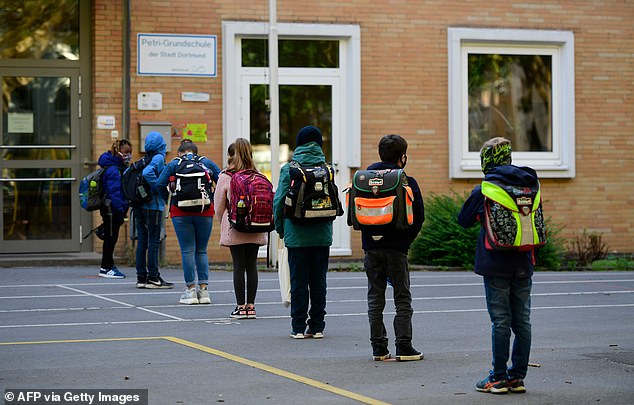
Social distancing was the first lesson on the timetable in Dortmund this morning where pupils lined up at 5ft intervals in the playground.    

Angela Merkel this week gave the green light for all German schools to re-open with appropriate hygiene measures, with exact timings to be decided by regional leaders.

Meanwhile Germany’s top diseases institute said the closely-watched R rate had fallen from 0.71 to 0.65, meaning the epidemic is losing pace. 

Germany has identified a rate below 1.0 as the key indicator of whether life can return to normal, although Merkel says lockdown measures could be re-imposed at a local level if necessary.

Germany’s top diseases institute said the closely-watched R rate had fallen from 0.71 to 0.65, meaning the epidemic is losing pace.

Pupils were wearing masks at the Petri primary school in Dortmund as they learned about social distancing in the playground. 

Watched by a teacher who was also wearing a mask, they stood on markers which had been laid out at a 5ft distance in the school yard. 

The children continued to observe the safety distance as they lined up to enter the school buildings for their first lessons this morning. 

The pupils were back at school after the state of North Rhine-Westphalia allowed the oldest primary school children to return today, with the rest due to follow on Monday.

Unlike in some countries where the youngest children have been returning first, many German states have given priority to older pupils who are facing exams. 

However, every state has done it differently and some pupils were back at school as early as April 23. 

Merkel said yesterday that lockdowns would be re-imposed at a local level under an ’emergency mechanism’ if there is a surge in new cases. 

The chancellor agreed with state leaders that the threshold would be set at 50 new cases per 100,000 people over seven days. 

If the contagion is worse than that, local authorities will be required to impose stay-at-home measures to contain the outbreak, Merkel said.   

‘We can afford to take a little courage, but we need to stay cautious,’ she added.

The number of new cases in Germany was above 1,000 today for the first time since last Friday, with 1,284 more infections bringing the total from 164,807 to 166,091.  

Merkel has also given permission for shops to re-open and the Bundesliga to resume before the end of May. 

The football season could restart as soon as May 15 in the first such resumption in Europe, although all matches will be played behind closed doors.  

The exact date of the Bundesliga’s restart will be determined by the league, as players will have to undergo a week-long quarantine before matches resume.  

‘I believe we can say that we have the very first phase of the pandemic behind us,’ Merkel said, adding that Germany had ‘achieved the goal’ of slowing the contagion.  

A document agreed by Merkel and state leaders said bolder moves were justified because an initial re-opening on April 20 had not led to a surge in new cases.  

‘Even after initial steps to open up were introduced from April 20, the number of new infections remained low’ with ‘no new wave of infection,’ the document said.  

Only the cultural sector will have to wait, as large events are still cancelled until the end of August. 

Borders also remain closed, although there are some calls for the emergency checks to be lifted, according to German media. 

Social distancing rules will also remain in place until at least June 5, Merkel said.

Germans will also still be required to wear face masks when shopping or using public transport. 

However, they will now be allowed to meet people from one other household at a time.     

Germany’s death toll today rose by 123, taking the total from 6,996 to 7,119, a smaller rise than yesterday’s 165 deaths. 

The death toll is far lower than in the UK (30,076), Italy (29,684), Spain (25,857) or France (25,809), even though Germany’s population is larger than all of them.  

The R rate has now fallen to 0.65, meaning that 100 infected patients pass the virus on to only another 65 people on average. 

However, Germany today saw more than 1,000 new cases for the last time since last Friday. Another 1,284 brought the total from 164,807 to 166,091.  

Merkel has repeatedly urged caution, warning that it would be a ‘crying shame’ to throw away early successes in containing the deadly disease.  

Experts have also urged restraint, with the head of the Robert Koch Institute (RKI) for disease control warning of possible second or third waves of the virus. 

But Germany’s largest state of Bavaria pre-empted yesterday’s discussions by announcing that restaurants would open from May 18 and hotels from May 30.   

State premier Markus Soeder said ‘the time has come for a cautious reopening’, pointing to the ‘success’ in containing the spread of the virus.

Lower Saxony, Mecklenburg-Western Pomerania, Saarland and Saxony-Anhalt have also announced their own plans, covering everything from restaurants to care homes. 

Award-Winning Teacher Of the Week is Charmain Kruger from Laerskool Magalieskruin in Pretoria, Gauteng

0

CLASSROOM CORNER

Teacher of the Week

Teacher: Charmaine Kruger

School: Laerskool Magalieskruin in Pretoria, Gauteng Province

The Laerskool Magalieskruin school teacher Charmain Kruger’s teaching career dates back from an early age when she used to teach her teddy bears and dolls.

While busy with her studies, her focus of impacting in the young lives changed.

“I knew that if I love what I do, I don’t have to work a day in my life,” she says.

She enjoys the versatility of her job because there are so many platforms to impact on young lives.

She indicated that the major challenges in teaching today is to ensure that not one child is left out whilst teaching.

Again, teachers fill many social roles because of the absence of parents in most of the families.

As teachers we have to play roles towards our learners which includes being parents, nurses, judges, and psychologist and sometimes as marriage councillors.

The fact that she is making a difference in the young lives keeps her going despite all the other challenges she faces across her teaching career. 

“I know that I have much to give and many lives to impact,” said Kruger. 

She is more than prepared to do her best with the time which is still left in her career.

She believes that there is no bigger re-ward than positive feedback from learners and parents.

Becoming a provincial winner has proven that giving your all to the learners will always reward you positively.

“I do have a special talent which will make my province proud.”

The sup-port from her school, district and province made it possible. 

“Through hard work and persistence, it paid off.”

As a national participant, she has a responsibility to give back by mentoring, reaching out to colleagues and ensure that best practices are shared.

“There is no sense in getting rewarded and keeping the knowledge to yourself.” 

As a way of advocating the NTAs she will start advising other teachers to believe in what they know, be humble, to gather evidence and take hands with the district co-ordinators and participate in the NTAs.

She concluded with the words of former president Nelson Mandela: “Education is the most powerful weapon which you can use to change the world.”

(Compiled by Inside Education staff)

The 2020 Edition of the Varsity Cup Provides Window To The Future

0

Dylan Jack

In the first of a series from SA Rugby magazine, DYLAN JACK looks at the Varsity Cup season that was and the best back and forward from each team.

The 2020 edition of the Varsity Cup looked set to be one of the most closely contended in recent memory.

After six rounds of the tournament, Maties had continued their unbeaten run from the last two seasons, but the defending champions did look vulnerable a times as they had narrow wins against UP-Tuks and the University of Cape Town.

Despite a compelling start to the ever-popular varsity competition, the season was postponed indefinitely due to the impact of the coronavirus.

SA Rugby is in ongoing deliberations on the reworked domestic rugby calendar and as a result, the Varsity Cup Board reconvened towards the end April 2020 to reassess the situation and take a final decision on the 2020 competition,’ the board said in a statement in mid-March.

In the latest update, Varsity Sports organisers took the decision to suspend all tournaments – including rugby – for the remainder of the year after stakeholders agreed that it is unlikely that normal sports will resume in 2020.

Should the Varsity Cup and Shield not resume this year, the tournaments will be declared incomplete with no overall winner.

As NMU Madibaz had already achieved an unassailable log-points tally on the combined Varsity Shield log of 2019 and 2020, they will be promoted to the Varsity Cup. There will be no team relegated from the Varsity Cup competition and no promotion/relegation match between the Varsity Cup and Varsity Shield competitions. Therefore, there will be 10 teams in the Varsity Cup for 2021.

Despite the disappointment of a season cut short, there are plenty of players to watch with a view to the future.

MATIES

BACK: Anton du Toit

Much has already been said about the third Du Toit brother. Helping Maties seal back-to-back Varsity Cup titles in his debut season showed that he has the talent to make it at the top level. Unlike his older brothers, Pieter-Steph and Johan, Du Toit plays at fullback, but he has a similar build with a cannon of a boot and a mean sidestep. Du Toit did struggle against UCT, showing that he still has a bit to learn and still has to get that consistency in his game. That should come with experience. What is undeniable is his talent.

FORWARD: Ben-Jason Dixon

Maties captain Ben-Jason Dixon should arguably have been a more consistent member of the Stormers’ Super Rugby squad this year. The lock has been near-unplayable at the lineouts this year and memorably caused franchise teammate David Meihuizen a headache in this area when Maties and UCT clashed in Stellenbosch. The former Junior Springbok took over as Maties captain this year and has led his team through some tight spots. If he can continue his form, a permanent place in the Stormers’ squad won’t be too far away.

UP-TUKS

BACK: Theo Boshoff

The Bulls’ academy of flyhalves may have its next big star in Boshoff. The 21-year-old helped the Bulls win the U21 Championship and before that was instrumental to UP-Tuks winning the Varsity Cup Young Guns tournament in 2017. Boshoff has carried that through into his first Varsity Cup season, scoring 23 points on debut – including a match-winning penalty after the hooter – against NWU in the opening match of the season.

FORWARD: Hanru Sirgel

Possibly UP-Tuks’ unsung hero this season, Sirgel gets through a lot of dirty work at the breakdown and in defence. As one of the survivors from 2019, he has used his experience well this year in an effective loose trio. Sirgel’s performances have started to be recognised by the Bulls as he was part of the U21 side that won the U21 Championship and was subsequently named U21 Forward of the Year.

WITS

BACK: Aidynn Cupido

Having made the move north after starring for the University of the Western Cape in 2018 and 2019, Cupido was desperate to fulfil his ambitions of playing provincial rugby. Given how instrumental Cupido was to UWC’s promotion to the Varsity Cup from the Shield, the signing was an absolute steal for Wits. It is no surprise the Cupido slotted straight in and helped Wits to an unbeaten start to the season, with four wins and a draw. With competition tight at flyhalf, Cupido was used at inside centre, a position in which he is more than comfortable, and he was the creative hub for the team. He will be hoping that he has done enough to convince the Lions to give him an opportunity.

FORWARD: Emmanuel Tshituka

The younger brother of Lions forward Vincent, Emmanuel made his Varsity Cup debut for Wits this year. In a powerful loose trio with Constant Beckerling and former SA Schools captain Travis Gordon, Tshituka has caught the eye with his work rate, especially on defence. A particular highlight was his Man of the Match performance in the crucial win against UP-Tuks, a game in which he put in a number of bone-shaking tackles.

UCT

BACK: James Tedder

When Tedder plays well, the rest of Ikey Tigers team tends to follow suit. Once contracted to the Sharks as an U19, Tedder decided to leave Durban and pursue a degree while still keeping alive his dreams of becoming a professional rugby player. The Bcom student possesses an accurate boot and has held his nerve to pull UCT through a number of tight games. He also also more than comfortable taking the ball to the line and can slot in at fullback if needed.

FORWARD: David Meihuizen

Meihuizen showed his ability to step up at a senior level when he was brought in from the cold to make a surprise Super Rugby debut off the bench against the Sunwolves in 2019, when the Stormers were suffering an injury crisis at lock. The 22-year-old has been singled out by Stormers coach John Dobson as a ‘phenomenal talent’ and has been the subject of interest from Scotland Rugby, who wanted to make him their next project player. Meihuizen has all the ability to make a success at a higher level.

NWU

BACK: Chunier van Rooyen

The potential of this utility back has already been highlighted in a previous edition of this magazine and he remains one of NWU’s most promising players. Van Rooyen can double between flyhalf and fullback, has an awesome kicking game and an uncanny ability to score tries. Having made his provincial debut for the Leopards in the Currie Cup First Division, Van Rooyen will be hoping to be able to build on that for a move to a bigger union.

FORWARD: Malembe Mpofu

Even though he has the nickname ‘Itoje’ (after England star Maro Itoje), Mpofu has taken some time to come of age. The lock attended Crawford International Ruimsig, a private school in Roodepoort hardly known for producing Springboks, and only took his rugby further when he was given a bursary to study at UJ in 2014. It took him a while to make his Varsity Cup debut too, as he had to wait until 2017. After completing his law degree, he decided to pursue a postgraduate in Business Management at NWU, and has now increasingly makes an impact on the competition.

(Source: SA Rugby Magazine)

Glencore Supports Education During The Lockdown

0

Chrisuné Vermeulen

As scholars edge towards their mid-year exams, many have been missing classes due to the school lockdown that was instated since March 16.

Glencore understands the importance of education in building a better future for the youth in their mine communities.

As a result, Glencore supports the Ligbron e-Learning System team to make Science, Technology, Engineering and Mathematics (STEM) education accessible to Grade 11 and 12 learners during the nationwide lockdown.

The Ligbron e-Learning System team worked hand in hand with the Department of Education to compile a comprehensive plan for learners during the COVID-19 lockdown period.

This programme makes it possible for learners with internet access to stream Maths and Science lessons during the lockdown and with 19 free Glencore WiFi hotspots of 1GB per user, more learners can stream the lessons.

Furthermore, the Department of Education has been provided with the recorded lessons which will be made available on SABC and DSTV channel 319 for learners without access to the internet.

Ligbron has also launched an app, with quality educational material for Grade 11 and 12 Maths and Science. The Ligbron e-Learning app covers all topics in the curriculum. Data costs will only apply when downloading the app, thereafter the app can be used for a year offline.

 “We partnered with Ligbron for e-learning because we understand the importance of education for learners from our mine communities. This partnership will ensure that the education of scholars continues during this very challenging time in our country,” said Noel Pillay, general manager for community and regulatory affairs at Glencore.

The e-Learning programme has been made available to schools in Mpumalanga where Glencore, Izimbiwa and Umsimbithi support 23 schools in the eMalahleni, Emakhazeni and Steve Tshwete municipalities.

The programme is set to reach over 13 000 students in various households while maintaining their responsibility to socially distance themselves from each other during this critical period.

Ligbron is streaming lessons on “ZOOM” and also on the “Ligbron Online School” YouTube Channel since April 14 and will continue for the duration of the nationwide lockdown.

(Chrisuné Vermeulen works for Witbank News)