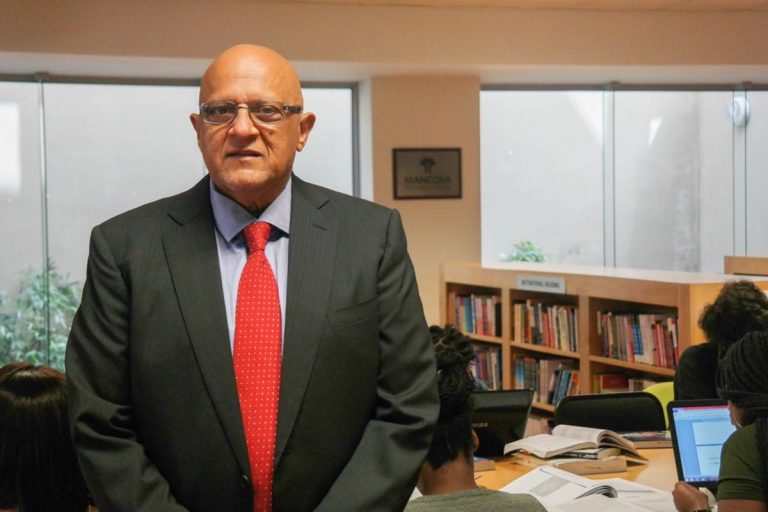
In an interview with How We Made It In
Africa, founder of MANCOSA and
Regent Business School, Professor
Yusuf Karodia, shares his thoughts about the future of the
education sector on the continent.
1. How will the fourth industrial revolution
change traditional approaches to education?
The fourth
industrial revolution is built around the way digital communications,
artificial intelligence, big data and the internet of things (IoT) come
together to transform our world. It is rapidly transforming how industries
manufacture, how financial firms operate, how we drive our cars, how we shop,
how we make everyday decisions and how we consume media – it is ubiquitous, and
it touches upon absolutely everything we do and how we do it. It is by default
disruptive and as such impacts what we do at work and how we do it. Graduates,
therefore, have to be prepared for this new world of work.
For
educational institutions to continue to produce successful graduates for the
future of work, they must align their teaching and processes with technological
advancements. The revolution will impact the soft skills that students will
need in the future. This means empowering students with the expertise and
skills that are needed in a digitally transformed workplace.
In order to
sustainably address the challenges posed by the fourth
industrial revolution, policymakers and education
advocates in Africa need to embrace new, digitally immersive methods in higher
education. Teaching pedagogies, curricula and activities must orient the
student towards digital literacy, critical thinking, communications,
entrepreneurship, and emotional intelligence – in addition to the ability to
succeed in a highly mobile global workforce. Also, lifelong learning will
become increasingly relevant in the future world of work because technological
change will only accelerate, exponentially.
2. How is Honoris United Universities
adapting to the fourth industrial revolution?
There is a
growing number of higher education institutions in Africa sensitive to the need
for rapid educational reform. Honoris United
Universities is a leading example of a pan-African network that is
wholly focused on creating programmes and initiatives specifically designed to
prepare graduates for the 21st century workplace, which it does through a
comprehensive strategy for employability and a teaching pedagogy based on
collaborative intelligence.
Within the
Honoris network, the Regent Business School’s specialist employability unit,
called the iLeadLAB, aims to create a new breed of entrepreneurs with the
skills, knowledge, and personal attributes to succeed in our challenging and
high-tech world. Through mentorship and hands-on practice, especially using the
latest technologies such as 3D printing, entrepreneurs will bridge the gap
between theory and its implementation in the real world. They will learn how to
set up and run their own businesses, understand how to apply digital solutions
to specific business sectors, recognise opportunities and – ultimately – build
powerful careers that are personally fulfilling and can positively impact
tomorrow’s African economies and communities.
These are
critical learnings because the modern global economy and jobs market demands
that the individual is self-confident, mentally agile and able to
problem-solve. In preparing students to adapt, to learn quickly and to be able
to speak the language of innovation, we can develop graduates capable of
flourishing even in a world of constant flux.
We have also
introduced a co-op education scheme, for example at Université Mundiapolis in Morocco,
whereby our students alternate between going to school and doing internships.
This scheme allows students to spend time with employers so when they graduate,
they have a competitive edge of professional experience in their chosen field,
direct insights on how digital solutions are disrupting business and a mindset
that prepares them for the challenges and opportunities that are abundant in
the 21st century world of work.
3. What are currently the biggest challenges
facing Africa’s education sector?
Access and
quality are equally as critical in Africa. Research conducted by UNESCO shows
that sub-Saharan Africa has the highest rates of education exclusion. Over
one-fifth of children between the ages of about 6 and 11 are out of school,
followed by one-third of youth between the ages of about 12 and 14. Almost 60%
of youth between the ages of about 15 and 17 are not in school according to UIS
data. This situation is likely to worsen if urgent action is not taken as the
region faces a rising demand for education due to its fast-growing school-age
population.
There is
some good news though. A report by the African Development Bank, African
Economic Outlook 2020, showed that the continent is among the highest
spenders on education in the developing world, at an average of 5% of national
GDP. At the same time, the private sector has played an increasingly critical
role in promoting access to affordable, quality education. If this trend
continues, we will certainly address some of the perennial issues plaguing
Africa’s education system.
What is most
important is that there is a concerted effort by all stakeholders in developing
the next generation of Africa’s leaders and entrepreneurs through a
well-conceptualised and well-coordinated education system.
4. Honoris has a vision of Education for
Impact. Briefly explain what this means.
At Honoris
United Universities, we educate for impact, which means we are committed to
developing a culturally and professionally adaptable mindset within our
pedagogical approach. Through an exciting range of programmes, including
international exchanges and collaborative projects, Honoris faculty and
students benefit from the sharing of academic practices, real-world expertise,
and multi-cultural immersion.
In practical
terms, our collaborative intelligence approach means bringing together experts,
academics, and students to find solutions to specific challenges. An example
would include a collaboration between the two Honoris network institutions of
EMSI in Morocco and Université Centrale, in Tunisia to create a real bridge
between the two countries, facilitating mobility between Morocco and Tunisia.
A recent
example is the success of a world-class team of scientists, doctors, and
engineers from across the Honoris that has developed a prototype for a new
non-invasive ventilator respirator to help in the fight against the global
COVID-19 pandemic. The innovation can be quickly manufactured in different
African countries and around the world using a 3D printer and materials that
are cheap and readily available in most parts of the developing world.
Through
initiatives such as iLeadLAB, we are able to equip students with the ability to
utilise new technological tools to develop new industries and create
innovations that have the potential to create new products and new jobs – and
that make a meaningful impact upon the world.
Honoris has
also recently announced a specialised AI Applications Lab in Tunisia, which
provides students with an insight to the very cutting edge of how artificial
intelligence is being applied to the world of work, thereby
equipping them with the requisite skills to face a high-tech future.
Honoris
continues to build and invest in providing workspace, access to resources, and
centres for the professional development of its students.
5. Share your thoughts on the importance of
life-long learning?
The reality
is that not all our learning comes from the classroom. We acquire new knowledge
and learn new skills every day either through socialisation, trial and error,
or self-initiated study. The ubiquitous nature of digital technology
necessitates intellectual adaptability and lifelong learning. Graduates from
the Honoris network are fully aware of and prepared for a life of flux in the
workplace.
Organisations
are also seeing lifelong learning as a core component in employee development
as a result of the fast pace of today’s knowledge economy. Employees and
employers should be working in synchronicity to ensure that skills are
constantly appraised, and businesses are able to adapt and remain competitive.
6. What are some of the approaches to take to
heighten 21st-century learning skills through distance education?
Honoris is a
leader in distance learning in Southern Africa. Good examples would include
MANCOSA and the Regent Business School, which have empowered thousands of
mature learners through access to affordable quality higher education via their
distance learning programmes. These institutions have also enabled the network
to act quickly in response to the emergency of the coronavirus pandemic. As distance
learning leaders, our institutes and academics were able to pivot quickly and
ensure continuity of studies for our students by moving weekend face-to-face
instruction to online mode, and the academic services teams (our ‘Ask a Tutor’
facility) resourcing was extended to cover an increase in queries and extended
hours of support.
Honoris’
commitment to distance learning is also evidenced in MANCOSA’s response to the
COVID-19 pandemic. Through a partnership with the Gcinamasiko Arts and Heritage
Trust, MANCOSA worked with the legendary African storyteller Gcina Mhlophe to
record 10 five-minute online stories to keep children educationally entertained
for 10 days during the COVID-19 lockdown.
7. You were recently honoured for your
contribution to the advancement of education in Africa. What does this mean to
you?
I am
sincerely grateful for my nomination and for winning the African Leadership
Person of the Year Award for Education and Development earlier this year. I
have been a dedicated teacher and a university lecturer for a significant part
of my life, and the future of our continent – its economies and people – is
something that I care for passionately.
I have spent
over two decades pursuing new avenues to make quality education accessible to
more people in Africa. During my career as an educator, I have had the
opportunity to attend both national and international conferences and have also
been privileged to have my research published in various international and
local journals.
Through my
foundation, I have also established the Million Books campaign, aimed at
provisioning a million books within mobile libraries across Southern Africa, at
under-resourced, deserving primary schools. For now, I am going to dedicate my
efforts to improve education and improve the quality of life for all.