Home Blog Page 423

Wits to Resume Classes on April 20 After Switching to Remote Online Teaching and Learning

Nyakallo Tefu  

The University of the Witwatersrand announced on Tuesday that lectures will resume as from 20 April, after it launched an emergency remote online teaching and learning programme as one of the measures to help minimize the time lost in the 2020 academic year.

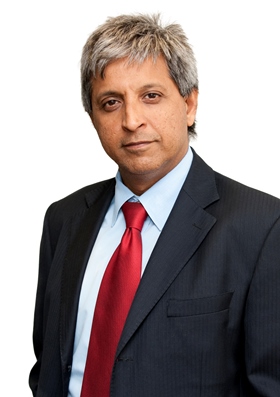
 Professor Adam Habib, Wits Vice Chancellor and Principal confirmed the decision to resume lectures, saying the global coronavirus pandemic has presented major disruptions for higher education and the only way to navigate the challenges brought on by the rapid spread of COVID-19 was through remote online teaching and learning.

 “We are acutely aware of the anxiety and uncertainty that online teaching and learning presents for both our colleagues and students. The world as we know it is in flux, and it will take our collective courage, dexterity and commitment to fend off the effects of this pandemic and to adapt to new ways of teaching and learning,” says Professor Adam Habib, Wits Vice-Chancellor and Principal.

Online learning has been a debatable issue in the country, with many worried about everyone having access to the internet and the high cost of data in South Africa.

However, the Wits education department says it has done its own research regarding the challenges of online teaching solutions and has come up with the following solutions:

Access to devices, data and learning resources

Multiple surveys across the institution have revealed that between 10% and 15% of Wits students do not have access to appropriate computing devices, adequate access to data or conducive learning environments.

To this end, the University is putting in place the following measures to ensure that the majority of students are able to learn remotely:

* Wits has established a Mobile Computing Bank which will enable qualifying students who do not have access to appropriate mobile learning devices to loan basic devices from the Bank. These basic computing devices will be suitable for educational purposes and will be pre-loaded with the required learning resources before being delivered via the South African Post Office to students who absolutely need them. The cost of the device will be added to students’ fee accounts and will be reversed if the device is returned in good order at the end of the 2020 academic year. The students most in need will be prioritised when devices are allocated;

* The University has finalised an agreement with four telecommunications service providers: Telkom, MTN, Vodacom and Cell C to zero-rate Wits’ library and learning management sites from 15 April 2020. The full list of zero-rated sites is available via this link: https://www.wits.ac.za/mywits/zero-rated-data-to-students-and-applicants/

“We understand that our emergency remote teaching and learning plan has to take into consideration the different learning environments of our students and their access to learning resources, appropriate devices and data,” said Professor Ruksana Osman, Deputy Vice-Chancellor: Academic.

“The University is aware that the playing field is uneven and that whilst many in society and our community enjoy greater levels of privilege, the consequences of the pandemic have illuminated and amplified the existing inequalities in our society with the poor, marginal, precarious and under-resourced disproportionally experiencing its fallout”, said Osman.

Motshekga To Meet Top Education Officials To Discuss Schools Recovery Plans

Charles Molele and Nyakallo Tefu

Basic Education Minister Angie Motshekga this week meets top education officials, including provincial MECs and heads of education departments to discuss proposed amendments to the 2020 School Curriculum, which could result in the cancellation of the June and September school holidays.

The high profile meeting is expected to take place between Wednesday and Thursday and will also discuss proposals by teacher union Sadtu to conduct compulsory mass screening of all learners and teachers before the re-opening of schools.

The earlier than expected school closures in March has adversely affected all learning programmes in public, independent and private schools as well as the early child development centres across the country.

Government is now looking at May 5 as a possible date for the reopening of schools after President Cyril Ramaphosa’s decision to extend the lockdown to end of April.

Inside Education reported two weeks ago that the department was looking at the possibilities of postponing this year’s matric supplementary examinations in June to December due to coronavirus pandemic disruption of the 2020 academic year.

There have also been behind-the-scenes discussions within the Basic Education Department to amend the curriculum as part of government’s plans to recover time lost during the lockdown period.  

These will, among others, include cancellation of the June and Septermber holidays.

Learners could also find themselves having to attend schooling right through seven days a week in order to get back on track and make up for the lost time.

Motshekga has said in recent days that the department was also preparing recovery materials which would intensify teaching at the end of the lockdown. 

Professor Mary Metcalfe said basic education would need to contract the cirruculum as part of its recovery plans for at least 18 months.

“I am confident of the careful thinking that is being invested in the unfolding scenarios by the DBE. Contracting the curriculum in a recovery plan of at least 18 months without compromising the development of core knowledge and skills in each subject is an inevitability and a priority – and teachers will need support in implementing this appropriately relative to the needs of learners,” said Metcalfe.

“The big unknown is the various scenarios for schools opening, how a phased introduction will work in practice, and over what time frame.  The greatest priority for learners during the lock down is for them to be supported to have structured and purposeful days that include learning – but few families have the resources to ‘replace’ the learning of school, and teachers will need to pull together where the learners are in planning forward; typically learners ‘forget’ some learning after an extended school break.”

Ruksana Osman, Professor and Deputy Vice-Chancellor at Wits University, said amendments to the cirruculum was another viable way to recover lost time during the lockdown.

“Curriculum amendments can certainly be made in thoughtful ways; secondly calendars can be adjusted and finally online can be a viable option,” said Osman.

“For a while now the DBE has been speaking about rollout of tablets in schools. Some of this could work for some of the students. This will not be a perfect solution that will work for all, and searching for one solution in an Imperfect context will not work.  We need multiple approaches. Most important thoughtful interventions with due consideration for learning at this point is what will work. Focusing on online initiatives for all in an equitable way can help us out of the question about cancelling the year or having 7-day week school week. This virus has taught us that being resilient, caring and agile is what works,” said Osman.

After her meeting with provincial MECs and HODs, Motshekga will table the recovery plan to cabinet for further deliberation before the plan gets implemented.

During a meeting of directors general at the weekend, it was proposed that schools should reopen on May 5 following the president’s decision to extend the lockdown period to end of April.

 “There’s a view that schools must be reopened on May 5, but there’s high possibility that not all schools would be reopened depending on whether or not the areas in which they are located are regarded as high risk areas,” said a senior government official who asked to remain annonymous.

He added: “There was consensus during the meeting that the lockdown liftment should be done gradually. Areas that are high risk should remain closed. We cant lift the lockdown throughout the entire country as this could undo the progress that we have made in flattening the curve. There are areas that are high risk and if we lift the lockdown in those areas, it would be recipe for disaster,” said the senior government official, who attended the National Command team secretariat meeting at the weekend.

A senior Gauteng education official told Inside Education the province supperted calls to conduct screening of all learners and teachers before schools reopen. 

“One of the things that we need to look at is mass screening of the learners because we dont know who is positive or negative. We can’t have an influx of kids coming back to schools without knowing their status. We also need to discuss how to go about the process of fumigating the schools before learning resumes. We must also agree on the protocols around social distancing and whether or not learners put on musks on a daily basis and what the financial implications of that will be. The fact of the matter is that the schooling environment is going to be very different. Even within the department, we are going to have to decide whether its a wise move to have everyone back at work at the end of the lockdown or say only senior management should be back at the office while the rest of the officials are working from home,” said the provincial education official.

Western Cape MEC Debbie Schafer Under Fire For Re-Opening School Feeding Scheme During Lockdown

Charles Molele

A war of words has erupted between Western Cape MEC for Education Debbie Schafer and national government over the implementation of the emergency school feeding scheme in the province amid COVID-19 lockdown.

The tensions between the DA-led provincial government in the Western Cape and the national government came after the province announced the R18 million emergency school feeding programme to help vulnerable learners who depended on the National S.

All in all there are 9.6 million learners who rely on the government’s school feeding scheme in the country.

Schafer told Inside Education through her spokesperson Kerry Mauchline on Monday that the feeding scheme, which caters for over 100 000 learners in the province, will go ahead despite the disapproval from Basic Education Minister Angie Motshekga, Portfolio Committee on Basic Education, labour federation COSATU and its biggest affiliate, teacher union SADTU.  

“The emergency feeding of children will go ahead. Under the lockdown, we are allowed to leave home to collect food, and buildings used to distribute food are allowed to be open. Social distancing protocols are being observed,” she told Inside Education.

“It is unfortunate that SADTU and COSATU have chosen not to support a humanitarian programme to feed children who might otherwise not have a meal that day.”

This week, Chairperson of the Portfolio Committee on Basic Education Bongiwe Mbinqo-Gigaba took a swipe at the provincial government for implementing the feeding scheme despite President Cyril Ramaphosa’s call to observe social distancing protocols.

“We do not want to expose our communities to the possibilities of contracting the virus. We cannot be telling people to stay safe and stay at home and at the same time we are encouraging them to collect food at school,” said Mbinqo-Gigaba.

Motshekga is on recording saying her department will not support any feeding scheme programmes during the lockdown period.

“We are not going to do anything different outside of what we normally do; we are not going to have special programmes; we are not going to run feeding schemes. We have accessed our capacity and we will not be able to do it,” Motsekga was quoted in media reports.

But the Western Cape provincial government insisted this week that the emergency feeding school programme will go ahead as planned.

The education MEC’s office told Inside Education that the department had informed the police about its plans to feed school children.

“SAPS has also been made aware of the plans, and has agreed to patrol the areas around the schools when meals are being served,” said Mauchline.

“We have issued detailed protocols to schools for the implementation of this essential work to ensure that social distancing is maintained and that our learners and staff are kept safe. Learners must bring their own food containers from home, which are not touched by the staff or volunteers. We also ensure that learners remain at least 1.5m apart from one another. We also provide soap and water for learners to wash their hands, or hand sanitizer. Learners will not eat at school – they will go directly to school, collect their meals, and go directly home.”

On Monday, Equal Education, the Equal Education Law Centre, SECTION27, the Centre for Child Law, and the Children’s Institute wrote a letter to Motshekga urging her to restore the National School Nutrition Programme (NSNP) immediately.

“We encourage the Department of Education to urgently reconsider its approach to the provisioning of school nutrition programmes during school closures. To allow for the safe and accessible distribution of food, schools should be able to serve as collection points for food packages or pick-up-and-go meals specifically tailored for beneficiaries of the NSNP,” NGOs told Motshekga in the letter.   

“Minister Motsekga, these are exceptional times that call for compassionate, clear and decisive leadership. The continuation of school nutrition provisioning for learners is critical and urgent and we urge you to ensure that children’s needs are prioritized and protected in government’s plans.”

Cosatu said at the weekend that while Ramaphosa and government were trying to prevent COVID-19 from spreading, Schafer was doing the opposite.

“We condemn her conduct in the strongest possible terms and herewith support the Sadtu for her immediate removal as MEC of Education in this province,” said Cosatu in a statement.

The trade union federation said it cannot allow children to risk being infected with Covid-19, saying Schäfer should be charged and investigated for her actions.

“We call on the premier of the Western Cape to remove the MEC with immediate effect and to replace her with a capable person. We also call on the national health minister to intervene in this matter,” it said.

Cosatu has also called for Schafer to be charged for contravening the lockdown regulations and for an investigation by the Human Rights Commission.

Rural Learners Offline as COVID-19 Lockdown Stretches

Xalati Nkhwashu

Grade 11 learner Vutlharhi Nkhwashu is worried she might not be able to catch up on her studies following the COVID-19 lockdown.

The Cata Secondary School learner lives in Mafarana, a rural village near Tzaneen in Limpop province.

She is among hundreds of thousands of learners trapped in rural areas with erratic cellphone network and limited resources to connect to the outside world.

Minister of basic education Angie Motshekga announced last month that the Council of Education Ministers had agreed to focus on catch up programmes through the Promotion of Learning and Teaching in homes.

Motshekga said together with provinces the department had prepared online and broadcast support resources comprising subject content and a focus on Grade 12 learners and the promotion of reading for all the grades. She said some of the programmes would be available from April 1.  

However most learners in rural areas such as Nkhwashu are finding it difficult to access online programmes due to connectivity issues, lack of funds to purchase data and a general lack of resources such as laptops, tablets and smartphones.

“Well, since I am used to having a teacher teaching and helping me with questions that I battled to understand, this lockdown has really changed everything. No traditional classes, extra or weekend classes anymore,” said the 15-year-old.

“I find it hard to study forward because of that one section that I don’t understand.  And these TV programmes are mainly focused on the Grade 12,” she explained.

She said the programmes she can access have a short time slot for grade 11s. Her grade subjects include Mathematics, Physical sciences, Geography and Life science.

“I do own a smartphone but buying data is really hard. It’s useless owning a smart phone with zero data because you can’t participate on online or WhatsApp classes that everyone is talking about,” she said.

Her mother is a volunteer at a local school and only gets paid when the learners contribute R50 each. And since schools are closed that means she will not receive her salary for April.

“And my father is in the security department, but he has to cover his rent, grocery and transport. So the money that he sends this side only contributes to our groceries and electricity bill,” said Nkhwashu.

“But the fact of having a mother who works a job of no work no pay sometimes I can’t buy data and if the lockdown is extended again it will mean that our DSTV account will be suspended and this will mean I can’t watch the programmes offered by the mindset channel,” she said.

Motshekga said the department was working closely with key partners to coordinate and make available content tailored to support learners’ educational and health needs during the lockdown. She said they would make available among others broadcast lessons working with the SABC TV and Radio, DSTV channel 180, e-tv, community radio stations and that electronic readers would be available via all platforms in partnership with Vodacom, MTN, Telkom and Cell-C.

Orphaned grade 12 learner Vutivi Mhlarhi plans to save enough money for data to be able to download more online learning materials during the lockdown because he can’t afford daily online classes without data.

“With these expensive data and without attending everyday classes and regular access to our teacher, its not easy,” said Mhlarhi also from Cata Secondary school in Mafarana.

Mhlarhi (19) said having teachers assisted them stay  up to date but now , without teachers, they are on their own and must make sure they update themselves until there’s possibility to lift our national lockdown.

“I’m an orphan, both my parents passed away. My grandmother is looking after me but she can’t afford to spend her money for groceries on data,” he said.

“I can’t afford a proper functioning smartphone. I don’t have data and no laptop. It’s tough for me,” he said.

“The lockdown has caused destruction in my life. I don’t know if I will pass my exams because everything has come to a standstill,” he said.

Mhlarhi’s matric subjects are Economics, Geography, Life Sciences, Maths Literacy, English, and Life Orientation and Xitsonga.

UCT Student Recovers From COVID-19

Nyakallo Tefu

The first student who tested positive for COVID-19 at the University of Cape Town has fully recovered and has left isolation.

The university says COVID-19 cases from UCT now stands at seven – four staff members and three students.

Health Minister Zweli Mkhize announced recently that over 400 people have recovered from COVID-19.

Before President Cyril Ramaphosa announced the closure of schools, there were fears of the virus spreading like wildfire among students at all levels.

The University of Witwatersrand has also had a COVID-19 case in which one of its medical students contracted the virus and went into self-isolation.

The Wits medical student has also been cleared off the virus.

South African schools and universities remain closed as the country is under lockdown with strict restrictions implemented by the government as it battles with the spread of COVID-19.

The Departments of Basic Education has since opted to go digital with teaching and learning until the end of the lockdown period.

Mayor Bill De Blasio Adamant New York City Schools Should Be Shut Down Until September

New York State governor Andrew Cuomo and New York City mayor Bill de Blasio have locked horns once again, this time over whether school buildings in the nation’s largest district would close for the rest of the year, with classes continuing online.

De Blasio said in a news briefing that public school sites in the city’s 1.1 million-student school district would shutter for the rest of the academic year to curb the spread of the coronavirus.

Soon afterward, Cuomo said at his own briefing that the decision was his to make.

“It is my legal authority in this situation, yes,” Cuomo said.

De Blasio, like Cuomo a Democrat, had said that it was not an easy decision to close school buildings in favor of online learning, but that “it is the right decision and it’s also a decision made a little clearer by the fact that the distance learning is working more and more every day.”

The goal, he said, is to reopen school sites by September, adding that high school graduates may have to go without a commencement ceremony.

But Cuomo said school closings would have to be coordinated with districts surrounding the city.

“So I understand the mayor’s position, which is he wants to close them until June, and we may do that, but we’re going to do it in a coordinated sense with the other localities,” Cuomo said. “It makes no sense for one locality to take an action that’s not coordinated with the others.”

When a reporter suggested that the mixed messages would confuse parents, Cuomo said, “We just clarified it. It’s not going to be decided in the next few days because we don’t know.”

Adding to the confusion, an email from the city to parents was issued while Cuomo spoke, advising of the extended school closing.

“NYC school students will continue with Remote Learning for the rest of the 2019-2020 school year,” it said.

The dispute was the latest bout in a long-running grudge match between the two elected officials, who have failed to maintain a united front in the face of a pandemic.

When de Blasio said last month that city residents should prepare for a “shelter-in-place” order, Cuomo countered that the city didn’t have the power to make such a declaration.

Days later, Cuomo announced a “New York state on pause” order directing nonessential businesses to close and telling people to stay 6 feet away from others when in public. The order sounded much like shelter-in-place, a term de Blasio has continued to use.

De Blasio spokeswoman Freddi Goldstein alluded to the earlier dispute on Twitter, saying Cuomo’s reaction to de Blasio’s school announcement was “reminiscent of how he reacted when the Mayor called for a shelter in place. We were right then and we’re right now.”

Cuomo addressed the school issue as he released numbers showing that 783 deaths from COVID-19 were recorded statewide on Friday, the fifth day in a row that the toll topped 700.

The new figures raised the number of coronavirus-related deaths in the state to 8,627.

“These are just incredible numbers depicting incredible loss and pain,” Cuomo said.

The governor, whose national profile has risen as his virus briefings have become must-see TV, said again Saturday that he is not interested in running for president.

When a reporter said some Democrats would prefer Cuomo to former Vice President Joe Biden as their party’s presidential nominee, Cuomo said, “That is on one hand flattering. On the other hand, it is irrelevant.”

“I have no political agenda. Period,” he said. “I’m not running for president. I’m not running for vice president. I’m not running anywhere. I’m not going to Washington. I’m staying right here.”

De Blasio ran for the 2020 Democratic nomination but dropped out early in the race.

Cuomo’s remarks Saturday were embraced by authorities on Long Island, which has seen its own surge in coronavirus cases. “Everybody wants to get back to normal as soon as possible, but we have to take a data-driven, regional approach,” Laura Curran, the Nassau County executive, said in a statement.

“If this pandemic has taught us one thing,” added Suffolk County Executive Steve Bellone, “it is that we are one New York and all in this together.”

School buildings in New York City, the U.S. epicenter of the pandemic, have been closed since March 16. All school buildings in the state have been closed since March 18 following a Cuomo executive order.

The school closings were initially announced for a few weeks back before the virus’s full impact was known. New York’s school year lasts through late June.

A massive effort to move instruction online has met mixed success in the city, where many low-income students lack Wi-Fi and devices for connecting to their virtual classrooms.

De Blasio said tens of thousands of tablets and laptops have been loaned to students who needed them and the remaining students who lack devices for online learning will get them by the end of April.

De Blasio had resisted closing schools as the city recorded its first deaths from the coronavirus, saying he feared that health care workers would have to stay home to care for children and that hundreds of thousands of poor students would go hungry without free school meals.

Since then, the city has set up food distribution sites and centers where essential front-line workers can drop their children off.

Authorities in some other locales, including the states of Virginia and Pennsylvania, previously announced that schools would close for the rest of the year.

Source: Associated Press

Ramaphosa Condemns Burning of Schools, ‘Horrifying’ Surge in Domestic Violence and Lawlessness During Lockdown

Cyril Ramaphosa

Since we declared the nation-wide lockdown, we have found that the majority of South Africans have responded with patience and understanding despite the considerable hardship.
 
There is a common appreciation that the measures that have been enforced since Friday 27 March are in the best interests of all.
 
While the majority of South Africans continue to respect the rules of the lockdown and the rights of others, there are some among us seeking to exploit this crisis for their own sinister ends.
 
It is a great indictment of our society that dozens of schools have been burgled, trashed or burnt to the ground.

When the lockdown is lifted and learning resumes, thousands of our children will have no school to return to, depriving them of the right to education.

Eskom has also reported an increase in cable theft and vandalism of its infrastructure since the lockdown began, resulting in power supply interruptions and damage that will cost a considerable amount to repair.
 
That public property is being vandalised while the entire country is experiencing hardship because of the lockdown, is a demonstration of utter disrespect and disregard for the majority of South Africans who are law-abiding.
 
It is despicable that criminals are using this period of the lockdown as a cover to break the law at a time when our law-enforcement authorities are occupied with supporting the national effort to contain the pandemic.
 
Unfortunately, criminals are also preying on the weak and vulnerable.
 
Our hearts go out to the family of Mama Ngenzeni Zuma who was raped and killed in KwaZulu-Natal last month by men who allegedly pretended to be soldiers to gain entry into her home.
 
We feel the pain of the family of 14-year-old Simphiwe Sibeko who went missing from her Soweto home, and whose body was found dumped in bushes last week.
 
As a nation, we are saddened at the death of Constable Percy Ramalepe who was shot and killed while attending to a domestic violence call in Johannesburg last week.
 
It is disturbing that during a time of such immense difficulty for our country, women and girls are being terrorised inside their own homes, forcing them to make desperate calls for help.

The number of calls to the GBV National Command Centre has increased since the lockdown began on 27 March.
 
Since the outbreak of the coronavirus pandemic, violence against women has become a global problem.
 
Last week the United Nations Secretary-General António Guterres said in a video message that since restrictions were imposed by countries around the world to contain the coronavirus, women and girls were increasingly facing violence “where they should be safest: in their own homes”.
 
While reaffirming that lockdowns and quarantines were essential, Secretary-General Guterres said they were trapping women with abusive partners, resulting in “a horrifying global surge in domestic violence”.
 
“In some countries, the number of women calling support services has doubled,” the UN Secretary-General said.
 
As South Africa we have heeded the call for governments to prioritise gender-based violence in their national responses to the COVID-19 pandemic.
 
We continue to implement the Emergency Response Plan to end gender-based violence that was announced last year.
 
Support services to vulnerable women and children remain operational throughout the lockdown, including psycho-social services like counselling for women and children, sheltering and places of safety, and medico-legal services in cases of sexual violence.
 
The Gender-Based Violence National Command Centre remains operational.

I have directed the Minister of Police to ensure that Family Violence, Child Protection and Sexual Offences Units are reinforced at police stations during the lockdown and beyond.
 
We recognise since people may not leave their homes, women and children in abusive situations are vulnerable.

Survivors of violence may not have access to phones or airtime, or public transport to take them to a police station, shelter or a doctor.
 
To this effect the Interim Steering Committee on Gender-Based Violence and Femicide, in consultation with civil society organisations is developing guidelines and protocols for GBV management in the context of COVID-19.
 
Our law-enforcement officials are to be commended for swiftly arresting suspects in the recent murders of the two women. They should also be commended for arresting and charging 148 suspects for crimes of gender-based violence since the start of the lockdown.
 
We are aware that the restrictions that have been placed on people’s movement and the confinement to their homes is a frustration for many.
 
But there is no excuse, nor will there ever be any excuse, for violence – against women, children, the elderly, members of the LGBTQI+ community, foreign nationals, not against anyone.
 
Vandalism of public property and key economic infrastructure will not be tolerated. We call upon communities to play their part in reporting such acts, because they seldom take place in the absence of witnesses.
 
When communities allow themselves to be passive bystanders when they witness crime, they become party to the sabotage that ultimately disadvantages ourselves, our children and our communities.
 
I have a message for those callous criminals who think they can take advantage. The criminal justice system is not on leave. Our law enforcement authorities will deal with those who transgress the law. You will be arrested, you will be tried and you will be put behind bars.
 
As the UN Secretary-General said in his message, women’s rights and freedoms are essential to strong, resilient societies. Violence against women erodes the moral fibre of our society. It sinks its insidious roots in families and communities, causing the cycle to be repeated across generations.
 
Our resolve and commitment to rid our country of this scourge remains firm. We will continue to bring all the state’s resources to bear to support vulnerable women and children, and ensure that perpetrators face the full might of the law.
 
I call on the men of South Africa and all citizens to play their part to combat gender-based violence and to provide survivors with the necessary support and assistance. This time of difficulty does not diminish the responsibility of every citizen to respect the rights and dignity of others.
 
Some have called for a gender-based violence ‘ceasefire’ during the time of pandemic. This is not enough. We want to see it end, once and for all.


UN to Scale COVID-19 Data-lite Mobile Learning Programme Across Africa

Luis Monzon

Adapt and Thrive, a data-lite, mobile education program that launched this week in South Africa will be scaled across the continent by the United Nations.

Developed in a collaboration between Funzi and Harambee Youth Employment Accelerator, the four-part programme takes just a couple of hours to complete and uses only about 8MB of data. The course shares clear and up-to-date information about COVID-19, as well as actions South Africans can take to stay safe and informed.

It addresses the physical, mental, social, and financial impact that coronavirus has on people’s lives, their families, communities, and South African society. The programme was created in conjunction with medical specialists, digital product designers and other local learning experts and is designed specifically for users in emerging markets, covering the themes:

  • What is COVID-19?
  • COVID-19: what can you do?
  • How to stay healthy and resilient
  • How to maintain your social and financial well-being

“In times of crisis, mobile learning has proven to be incredibly impactful,” says Aape Pohjavirta, Founder of Funzi. “We were able to launch the course in only 10 days, giving millions access to timely and critical information. The Funzi approach is unique because of our combination of technology and way of teaching.”

The partnership between Harambee & Funzi is one of many within what has become known as the ‘3Million 3Weeks’ initiative that intends to achieve the ambitious goal of providing credible, consistent, compelling and clear COVID-related information to over 3 million young people that ensures they are kept informed, engaged and connected during these difficult times.

Other partners in theinitiative include the Solidarity Fund, the National Youth Development Agency, Tshepo 1 Million and over 160 other youth-based organisations and employers.

(Edited by Luis Monzon)

COVID-19: What Consequences For Higher Education?

Goolam Mohamedbhai

COVID-19 will leave no sector in any country in the world unaffected, and its consequences will be felt for years to come.

At a time when huge efforts were being deployed to transform and improve higher education in Africa, there is a danger that COVID-19 will destabilise the sector, with serious consequences.

In this article some of these consequences are highlighted to enable leaders of higher education institutions, policy-makers and other stakeholders to reflect on them and to be better prepared to address them.

Inequities

African countries had no choice but to close their higher education institutions as part of their lockdown measures to contain the spread of the virus. And higher education institutions had no option but to have recourse to the use of information and communications technology (ICT) to deliver their programmes online at a distance to their enrolled students.

But the process has laid bare the digital divide within the African continent: between those countries that have better ICT infrastructure than others; between higher education institutions within the same country, with some being far better equipped and experienced than others; and between students within the same institution – the rich who live in urban areas and the poor in rural areas who can barely afford to access the internet, when and if it is available.

It is true that the crisis has provided an opportunity to all higher education institutions to quickly improve and maximise their ICT operations. However, the majority of them do not have the capacity to fully deliver whole programmes online.

It is the few open universities in Africa that have that capacity, but their targets are mostly mature students, those in employment and those wishing to upgrade their qualifications, not fresh school-leavers.

While a significant number of African higher education institutions have been implementing blended learning (a mixture of face-to-face and online learning) in order to increase access and improve learning, hardly any had intentions for their face-to-face delivery to be completely replaced.

How then can African countries and higher education institutions deal with the inequities arising from the wide use of online learning, even for a relatively short period?

Quality

It is a fallacy to believe that online learning can be effective by merely posting a lecturer’s notes online or having a video recording of the lecture. Yet, this is what is generally happening at present.

Experience has shown that quality online learning requires that the teaching material is prepared by a professional instructional designer, that the lecturer is pedagogically trained for delivering the programme and the students are equally exposed to the pedagogy of online learning.

The unprepared online delivery will have an impact on the quality of the programmes. This is unfortunate at a time when significant achievements have been made in improving the quality of teaching and learning in African higher education institutions.

The worst affected programmes will be science and technology as students will be unable to access laboratories for their practicals. Yet, science and technology programmes are the ones that are most important for Africa’s development.

How can higher education institutions find alternative approaches to using laboratories and, subsequently, how can they mitigate the consequences of poor-quality programmes as a result of unplanned online delivery?

Pipeline effect

Secondary schools which feed students to higher education institutions have also been closed. Already, it had been observed in many African countries that with the high increase in enrolment in secondary schools, resulting from measures taken to improve access, the quality of students entering higher education institutions had deteriorated.

The situation will be aggravated with the closure of schools, and higher education institutions will have to devise measures to cater for a poorer quality of student intake, perhaps by running remedial courses in the first year.

Also, end-of-secondary school examinations are being postponed or cancelled. What approaches should higher education institutions adopt in selecting their next cohort of students if examination results are not available? Here, a national approach covering the whole education sector needs to be adopted.

Research

In order to improve the research output from Africa – which is known to be the lowest of any region – a plethora of initiatives and projects have been initiated over the past couple of decades, whether at national, regional or continental level.

The emphasis has been on increasing postgraduate training, especially at doctoral level, and facilitating research projects in higher education institutions with an emphasis on areas which are of priority to the development of Africa. And all indicators show that the initiatives are now bearing fruit.

However, the bulk of the research initiatives are funded by European countries and by agencies and foundations in the United States, and lately by China. In Africa, there are very few national agencies funding research and hardly any regional or continental ones. Also, almost all the research is undertaken in collaboration with higher education institutions in these foreign countries.

As COVID-19 is impacting the whole world, and Europe, the US and China appear to be the hardest hit, can Africa continue to rely on research funding from these sources? Several of these countries will probably end up in recession and their higher education institutions will understandably give priority to redressing their own situation rather than supporting international research collaboration.

How then will research projects already initiated in Africa and funded externally be maintained? To what alternative sources of funding can African higher education institutions turn to undertake their research?

Graduate unemployment

Almost every African country has lately been experiencing the challenge of graduate unemployment, and in some countries the unemployment figures are alarming. From feedback obtained from employers, a major cause of the unemployment is the lack of ‘soft skills’ in graduates – poor communication skills, lack of personal initiative, inability to work in a team, etc.

The wide use of online learning because of COVID-19 will undoubtedly exacerbate the situation as students will be working on their own. Here is an opportunity to actively involve employers to assist in providing the skills they need.

Unfortunately, for economic reasons, many potential private employers of graduates may be forced to lay off their staff, thus increasing unemployment. This will make it even harder for graduates to find employment. The social and political consequences of large-scale unemployment, especially among the educated youth, can be serious.

Private higher education institutions

A characteristic of the higher education sector in African countries is the presence of private institutions. The number of institutions is already significantly greater than public ones, and private student enrolment has steadily increased over the years, with some countries now having almost equal student enrolment in public and private institutions.

These private institutions usually operate along a business model and are heavily dependent on students’ fees to cover staff salaries and operational costs. While public institutions may eventually receive assistance from the state to overcome the consequences of COVID-19, the private ones may be forced to stop their operations for lack of funds. Closure of these institutions would have a dramatic impact on the higher education sector and countries’ economic development.

What are the possible solutions? How can the state assist the private institutions at such a time of crisis?

Action

Understandably, at present African countries, as elsewhere in the world, are prioritising the health sector to minimise contagion and limit deaths. They are also trying to assist the socially-disadvantaged of their population.

Economic recovery and support to other sectors of the economy will have to come later. But it is vital for each sector to start reflecting on the impact of COVID-19 and assessing its possible consequences, otherwise recovery of the sector may be too slow, too late.

This applies to the higher education sector as well. The approach must be holistic and involve all stakeholders, including the private sector. Each country should set up a task force on higher education under the leadership of the relevant ministry to survey the situation, suggest immediate and short-term measures and be ready to effect redress when the crisis is over.

Professor Goolam Mohamedbhai is the former secretary general of the Association of African Universities, former president of the International Association of Universities and former vice-chancellor of the University of Mauritius. He is a former member of the governing council of the United Nations University and is a board member of University World News – Africa.

Top Cricket Batsmen Shine At Schools Festival

Theo Garrun

Four schools remained unbeaten at the Independent Schools Cricket Festival at St Alban’s College, writes THEO GARRUN.

Helpmekaar Kollege emerged the standoutteam of the Independent Schools Cricket Festival with three wins and a match washed out by a Highveld thunderstorm.

Three others – Hilton College, St John’s College of Johannesburg and St Andrew’s College of Grahamstown – also avoided an ‘L’ on the scoresheet.

The festival is in its 32nd year and in all but three of those it has been organised and hosted by St Alban’s College. The exceptions were occasions when three of the regular participants made the festival part of their centenary celebrations.

No one is certain why St Alban’s holds such a privileged position for the first-team event, since independent schools festivals in all the other age groups rotate around the country. It seems the festival started as a small event hosted by the Pretoria school and as it grew over the years there has been an agreement that St Alban’s should continue hosting it.

This year, there were 20 schools in action in the four-day tournament, making it the second-biggest festival after the Michaelmas Week which has 24. Games were played at St Alban’s, the University of Pretoria’s LC De Villiers complex and at Cornwall Hill College. The three Johannesburg schools – St John’s, St Stithians and St David’s – hosted two games each.

All three formats of the game were included: time cricket on day one, 50 overs on days two and three and T20 on the final day.

Helpmekaar beat St John’s of Harare, a CSA TAP XI from the Titans region and Cornwall Hill, and had their game against St Andrew’s School abandoned. St Andrew’s of Grahamstown beat St Alban’s and St Benedict’s and drew their game against St John’s (Johannesburg), with the one no-result. St John’s beat Bishops, drew with St Andrew’s and tied with Hilton in their T20 game on Sunday.

Hilton substituted one of their 50-over games with another time cricket encounter and drew against their neighbours, Michaelhouse. They beat St Stithians in the first innings on day one.

Most of the standout performances across the four days came from batsmen. The exception was a remarkable bowling display on day four from Gregory Ford of St John’s (Johannesburg), who took 7-22 off his four overs to help bowl Hilton out for 99 in their T20 encounter. St John’s equalled that total off the last ball of the game and it was decided not to have a super over.

The outstanding batsman of the festival was Dion Myers of St George’s College, Harare. He captained Zimbabwe at the ICC U19 World Cup earlier in the year and showed all that class and experience in notching up two centuries – 128 against St David’s and 155 against St Alban’s. His 155, on the excellent surface at the TC Mitchell Oval at St Alban’s, came off 137 balls and included 24 fours.

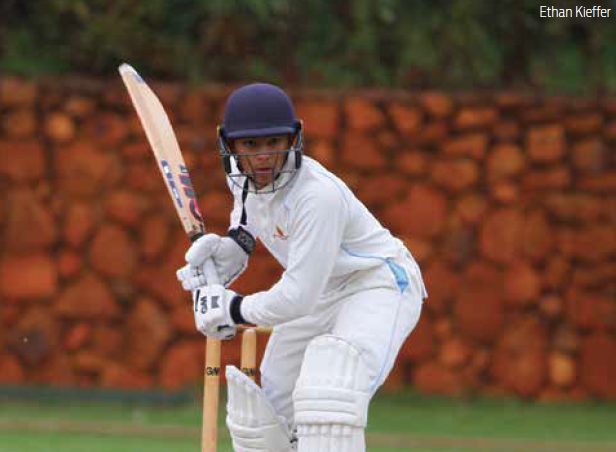
Two other centuries were scored: Ethan Kieffer made 152 for Bishops against St Alban’s on day one and followed that up with 58 not out against Michaelhouse on the second day. Liam McCarthy struck 105 for St Stithians against St Andrew’s of Bloemfontein on the Saturday. It was on one of the smallish outer fields at St Alban’s but according to Saints’ coach, Philip Koen, it was one of the best knocks he has seen from McCarthy in what has been a stellar career at the school.

Apart from the four hundreds made, there were a number of big half-centuries. Nicholas Barlow of St Andrew’s College was out on 99 against St John’s on the opening day; Slade van Staden made 77 for Hilton against St Andrew’s College; Travis Norris of Bishops made 73 against St John’s (Johannesburg); Jonathan Miltz of St John’s (Johannesburg) was 59 not out against Bishops; Christiaan Daniels made 61 for the CSA TAP team against St John’s (Harare) and the visitors’ Dane Schadendorf got 63 in the same game; and Arnaud du Plessis of St Alban’s made 77 against St Georges.

St Alban’s director of sport Krinesan Moodley was impressed with the cricket played over the four days. ‘These players are all from private schools and they are used to playing on pristine fields in perfect conditions. It was admirable to see how well they adapted to the varying conditions of the fields and we saw some good performances,’ he said.

‘That we got as much cricket in as we did over four days of almost non-stop rainy weather speaks volumes of the dedication of everyone who contributed to the event. We look forward to next year.’ 

This article appears in the April-June issue of SA Cricket magazine