Home Blog Page 424

UCT Student Recovers From COVID-19

Nyakallo Tefu

The first student who tested positive for COVID-19 at the University of Cape Town has fully recovered and has left isolation.

The university says COVID-19 cases from UCT now stands at seven – four staff members and three students.

Health Minister Zweli Mkhize announced recently that over 400 people have recovered from COVID-19.

Before President Cyril Ramaphosa announced the closure of schools, there were fears of the virus spreading like wildfire among students at all levels.

The University of Witwatersrand has also had a COVID-19 case in which one of its medical students contracted the virus and went into self-isolation.

The Wits medical student has also been cleared off the virus.

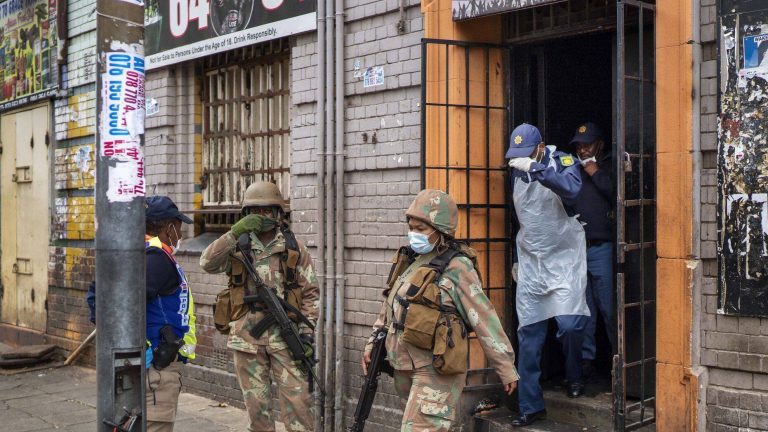
South African schools and universities remain closed as the country is under lockdown with strict restrictions implemented by the government as it battles with the spread of COVID-19.

The Departments of Basic Education has since opted to go digital with teaching and learning until the end of the lockdown period.

Mayor Bill De Blasio Adamant New York City Schools Should Be Shut Down Until September

New York State governor Andrew Cuomo and New York City mayor Bill de Blasio have locked horns once again, this time over whether school buildings in the nation’s largest district would close for the rest of the year, with classes continuing online.

De Blasio said in a news briefing that public school sites in the city’s 1.1 million-student school district would shutter for the rest of the academic year to curb the spread of the coronavirus.

Soon afterward, Cuomo said at his own briefing that the decision was his to make.

“It is my legal authority in this situation, yes,” Cuomo said.

De Blasio, like Cuomo a Democrat, had said that it was not an easy decision to close school buildings in favor of online learning, but that “it is the right decision and it’s also a decision made a little clearer by the fact that the distance learning is working more and more every day.”

The goal, he said, is to reopen school sites by September, adding that high school graduates may have to go without a commencement ceremony.

But Cuomo said school closings would have to be coordinated with districts surrounding the city.

“So I understand the mayor’s position, which is he wants to close them until June, and we may do that, but we’re going to do it in a coordinated sense with the other localities,” Cuomo said. “It makes no sense for one locality to take an action that’s not coordinated with the others.”

When a reporter suggested that the mixed messages would confuse parents, Cuomo said, “We just clarified it. It’s not going to be decided in the next few days because we don’t know.”

Adding to the confusion, an email from the city to parents was issued while Cuomo spoke, advising of the extended school closing.

“NYC school students will continue with Remote Learning for the rest of the 2019-2020 school year,” it said.

The dispute was the latest bout in a long-running grudge match between the two elected officials, who have failed to maintain a united front in the face of a pandemic.

When de Blasio said last month that city residents should prepare for a “shelter-in-place” order, Cuomo countered that the city didn’t have the power to make such a declaration.

Days later, Cuomo announced a “New York state on pause” order directing nonessential businesses to close and telling people to stay 6 feet away from others when in public. The order sounded much like shelter-in-place, a term de Blasio has continued to use.

De Blasio spokeswoman Freddi Goldstein alluded to the earlier dispute on Twitter, saying Cuomo’s reaction to de Blasio’s school announcement was “reminiscent of how he reacted when the Mayor called for a shelter in place. We were right then and we’re right now.”

Cuomo addressed the school issue as he released numbers showing that 783 deaths from COVID-19 were recorded statewide on Friday, the fifth day in a row that the toll topped 700.

The new figures raised the number of coronavirus-related deaths in the state to 8,627.

“These are just incredible numbers depicting incredible loss and pain,” Cuomo said.

The governor, whose national profile has risen as his virus briefings have become must-see TV, said again Saturday that he is not interested in running for president.

When a reporter said some Democrats would prefer Cuomo to former Vice President Joe Biden as their party’s presidential nominee, Cuomo said, “That is on one hand flattering. On the other hand, it is irrelevant.”

“I have no political agenda. Period,” he said. “I’m not running for president. I’m not running for vice president. I’m not running anywhere. I’m not going to Washington. I’m staying right here.”

De Blasio ran for the 2020 Democratic nomination but dropped out early in the race.

Cuomo’s remarks Saturday were embraced by authorities on Long Island, which has seen its own surge in coronavirus cases. “Everybody wants to get back to normal as soon as possible, but we have to take a data-driven, regional approach,” Laura Curran, the Nassau County executive, said in a statement.

“If this pandemic has taught us one thing,” added Suffolk County Executive Steve Bellone, “it is that we are one New York and all in this together.”

School buildings in New York City, the U.S. epicenter of the pandemic, have been closed since March 16. All school buildings in the state have been closed since March 18 following a Cuomo executive order.

The school closings were initially announced for a few weeks back before the virus’s full impact was known. New York’s school year lasts through late June.

A massive effort to move instruction online has met mixed success in the city, where many low-income students lack Wi-Fi and devices for connecting to their virtual classrooms.

De Blasio said tens of thousands of tablets and laptops have been loaned to students who needed them and the remaining students who lack devices for online learning will get them by the end of April.

De Blasio had resisted closing schools as the city recorded its first deaths from the coronavirus, saying he feared that health care workers would have to stay home to care for children and that hundreds of thousands of poor students would go hungry without free school meals.

Since then, the city has set up food distribution sites and centers where essential front-line workers can drop their children off.

Authorities in some other locales, including the states of Virginia and Pennsylvania, previously announced that schools would close for the rest of the year.

Source: Associated Press

Ramaphosa Condemns Burning of Schools, ‘Horrifying’ Surge in Domestic Violence and Lawlessness During Lockdown

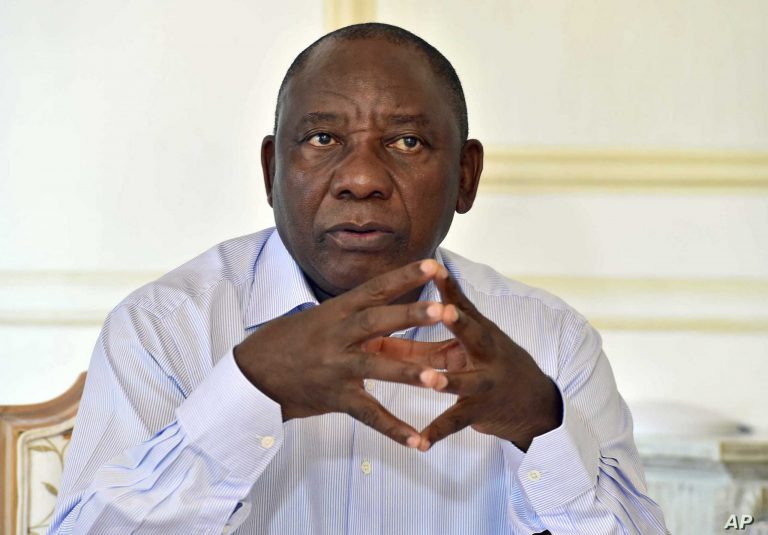
Cyril Ramaphosa

Since we declared the nation-wide lockdown, we have found that the majority of South Africans have responded with patience and understanding despite the considerable hardship.
 
There is a common appreciation that the measures that have been enforced since Friday 27 March are in the best interests of all.
 
While the majority of South Africans continue to respect the rules of the lockdown and the rights of others, there are some among us seeking to exploit this crisis for their own sinister ends.
 
It is a great indictment of our society that dozens of schools have been burgled, trashed or burnt to the ground.

When the lockdown is lifted and learning resumes, thousands of our children will have no school to return to, depriving them of the right to education.

Eskom has also reported an increase in cable theft and vandalism of its infrastructure since the lockdown began, resulting in power supply interruptions and damage that will cost a considerable amount to repair.
 
That public property is being vandalised while the entire country is experiencing hardship because of the lockdown, is a demonstration of utter disrespect and disregard for the majority of South Africans who are law-abiding.
 
It is despicable that criminals are using this period of the lockdown as a cover to break the law at a time when our law-enforcement authorities are occupied with supporting the national effort to contain the pandemic.
 
Unfortunately, criminals are also preying on the weak and vulnerable.
 
Our hearts go out to the family of Mama Ngenzeni Zuma who was raped and killed in KwaZulu-Natal last month by men who allegedly pretended to be soldiers to gain entry into her home.
 
We feel the pain of the family of 14-year-old Simphiwe Sibeko who went missing from her Soweto home, and whose body was found dumped in bushes last week.
 
As a nation, we are saddened at the death of Constable Percy Ramalepe who was shot and killed while attending to a domestic violence call in Johannesburg last week.
 
It is disturbing that during a time of such immense difficulty for our country, women and girls are being terrorised inside their own homes, forcing them to make desperate calls for help.

The number of calls to the GBV National Command Centre has increased since the lockdown began on 27 March.
 
Since the outbreak of the coronavirus pandemic, violence against women has become a global problem.
 
Last week the United Nations Secretary-General António Guterres said in a video message that since restrictions were imposed by countries around the world to contain the coronavirus, women and girls were increasingly facing violence “where they should be safest: in their own homes”.
 
While reaffirming that lockdowns and quarantines were essential, Secretary-General Guterres said they were trapping women with abusive partners, resulting in “a horrifying global surge in domestic violence”.
 
“In some countries, the number of women calling support services has doubled,” the UN Secretary-General said.
 
As South Africa we have heeded the call for governments to prioritise gender-based violence in their national responses to the COVID-19 pandemic.
 
We continue to implement the Emergency Response Plan to end gender-based violence that was announced last year.
 
Support services to vulnerable women and children remain operational throughout the lockdown, including psycho-social services like counselling for women and children, sheltering and places of safety, and medico-legal services in cases of sexual violence.
 
The Gender-Based Violence National Command Centre remains operational.

I have directed the Minister of Police to ensure that Family Violence, Child Protection and Sexual Offences Units are reinforced at police stations during the lockdown and beyond.
 
We recognise since people may not leave their homes, women and children in abusive situations are vulnerable.

Survivors of violence may not have access to phones or airtime, or public transport to take them to a police station, shelter or a doctor.
 
To this effect the Interim Steering Committee on Gender-Based Violence and Femicide, in consultation with civil society organisations is developing guidelines and protocols for GBV management in the context of COVID-19.
 
Our law-enforcement officials are to be commended for swiftly arresting suspects in the recent murders of the two women. They should also be commended for arresting and charging 148 suspects for crimes of gender-based violence since the start of the lockdown.
 
We are aware that the restrictions that have been placed on people’s movement and the confinement to their homes is a frustration for many.
 
But there is no excuse, nor will there ever be any excuse, for violence – against women, children, the elderly, members of the LGBTQI+ community, foreign nationals, not against anyone.
 
Vandalism of public property and key economic infrastructure will not be tolerated. We call upon communities to play their part in reporting such acts, because they seldom take place in the absence of witnesses.
 
When communities allow themselves to be passive bystanders when they witness crime, they become party to the sabotage that ultimately disadvantages ourselves, our children and our communities.
 
I have a message for those callous criminals who think they can take advantage. The criminal justice system is not on leave. Our law enforcement authorities will deal with those who transgress the law. You will be arrested, you will be tried and you will be put behind bars.
 
As the UN Secretary-General said in his message, women’s rights and freedoms are essential to strong, resilient societies. Violence against women erodes the moral fibre of our society. It sinks its insidious roots in families and communities, causing the cycle to be repeated across generations.
 
Our resolve and commitment to rid our country of this scourge remains firm. We will continue to bring all the state’s resources to bear to support vulnerable women and children, and ensure that perpetrators face the full might of the law.
 
I call on the men of South Africa and all citizens to play their part to combat gender-based violence and to provide survivors with the necessary support and assistance. This time of difficulty does not diminish the responsibility of every citizen to respect the rights and dignity of others.
 
Some have called for a gender-based violence ‘ceasefire’ during the time of pandemic. This is not enough. We want to see it end, once and for all.


UN to Scale COVID-19 Data-lite Mobile Learning Programme Across Africa

Luis Monzon

Adapt and Thrive, a data-lite, mobile education program that launched this week in South Africa will be scaled across the continent by the United Nations.

Developed in a collaboration between Funzi and Harambee Youth Employment Accelerator, the four-part programme takes just a couple of hours to complete and uses only about 8MB of data. The course shares clear and up-to-date information about COVID-19, as well as actions South Africans can take to stay safe and informed.

It addresses the physical, mental, social, and financial impact that coronavirus has on people’s lives, their families, communities, and South African society. The programme was created in conjunction with medical specialists, digital product designers and other local learning experts and is designed specifically for users in emerging markets, covering the themes:

  • What is COVID-19?
  • COVID-19: what can you do?
  • How to stay healthy and resilient
  • How to maintain your social and financial well-being

“In times of crisis, mobile learning has proven to be incredibly impactful,” says Aape Pohjavirta, Founder of Funzi. “We were able to launch the course in only 10 days, giving millions access to timely and critical information. The Funzi approach is unique because of our combination of technology and way of teaching.”

The partnership between Harambee & Funzi is one of many within what has become known as the ‘3Million 3Weeks’ initiative that intends to achieve the ambitious goal of providing credible, consistent, compelling and clear COVID-related information to over 3 million young people that ensures they are kept informed, engaged and connected during these difficult times.

Other partners in theinitiative include the Solidarity Fund, the National Youth Development Agency, Tshepo 1 Million and over 160 other youth-based organisations and employers.

(Edited by Luis Monzon)

COVID-19: What Consequences For Higher Education?

Goolam Mohamedbhai

COVID-19 will leave no sector in any country in the world unaffected, and its consequences will be felt for years to come.

At a time when huge efforts were being deployed to transform and improve higher education in Africa, there is a danger that COVID-19 will destabilise the sector, with serious consequences.

In this article some of these consequences are highlighted to enable leaders of higher education institutions, policy-makers and other stakeholders to reflect on them and to be better prepared to address them.

Inequities

African countries had no choice but to close their higher education institutions as part of their lockdown measures to contain the spread of the virus. And higher education institutions had no option but to have recourse to the use of information and communications technology (ICT) to deliver their programmes online at a distance to their enrolled students.

But the process has laid bare the digital divide within the African continent: between those countries that have better ICT infrastructure than others; between higher education institutions within the same country, with some being far better equipped and experienced than others; and between students within the same institution – the rich who live in urban areas and the poor in rural areas who can barely afford to access the internet, when and if it is available.

It is true that the crisis has provided an opportunity to all higher education institutions to quickly improve and maximise their ICT operations. However, the majority of them do not have the capacity to fully deliver whole programmes online.

It is the few open universities in Africa that have that capacity, but their targets are mostly mature students, those in employment and those wishing to upgrade their qualifications, not fresh school-leavers.

While a significant number of African higher education institutions have been implementing blended learning (a mixture of face-to-face and online learning) in order to increase access and improve learning, hardly any had intentions for their face-to-face delivery to be completely replaced.

How then can African countries and higher education institutions deal with the inequities arising from the wide use of online learning, even for a relatively short period?

Quality

It is a fallacy to believe that online learning can be effective by merely posting a lecturer’s notes online or having a video recording of the lecture. Yet, this is what is generally happening at present.

Experience has shown that quality online learning requires that the teaching material is prepared by a professional instructional designer, that the lecturer is pedagogically trained for delivering the programme and the students are equally exposed to the pedagogy of online learning.

The unprepared online delivery will have an impact on the quality of the programmes. This is unfortunate at a time when significant achievements have been made in improving the quality of teaching and learning in African higher education institutions.

The worst affected programmes will be science and technology as students will be unable to access laboratories for their practicals. Yet, science and technology programmes are the ones that are most important for Africa’s development.

How can higher education institutions find alternative approaches to using laboratories and, subsequently, how can they mitigate the consequences of poor-quality programmes as a result of unplanned online delivery?

Pipeline effect

Secondary schools which feed students to higher education institutions have also been closed. Already, it had been observed in many African countries that with the high increase in enrolment in secondary schools, resulting from measures taken to improve access, the quality of students entering higher education institutions had deteriorated.

The situation will be aggravated with the closure of schools, and higher education institutions will have to devise measures to cater for a poorer quality of student intake, perhaps by running remedial courses in the first year.

Also, end-of-secondary school examinations are being postponed or cancelled. What approaches should higher education institutions adopt in selecting their next cohort of students if examination results are not available? Here, a national approach covering the whole education sector needs to be adopted.

Research

In order to improve the research output from Africa – which is known to be the lowest of any region – a plethora of initiatives and projects have been initiated over the past couple of decades, whether at national, regional or continental level.

The emphasis has been on increasing postgraduate training, especially at doctoral level, and facilitating research projects in higher education institutions with an emphasis on areas which are of priority to the development of Africa. And all indicators show that the initiatives are now bearing fruit.

However, the bulk of the research initiatives are funded by European countries and by agencies and foundations in the United States, and lately by China. In Africa, there are very few national agencies funding research and hardly any regional or continental ones. Also, almost all the research is undertaken in collaboration with higher education institutions in these foreign countries.

As COVID-19 is impacting the whole world, and Europe, the US and China appear to be the hardest hit, can Africa continue to rely on research funding from these sources? Several of these countries will probably end up in recession and their higher education institutions will understandably give priority to redressing their own situation rather than supporting international research collaboration.

How then will research projects already initiated in Africa and funded externally be maintained? To what alternative sources of funding can African higher education institutions turn to undertake their research?

Graduate unemployment

Almost every African country has lately been experiencing the challenge of graduate unemployment, and in some countries the unemployment figures are alarming. From feedback obtained from employers, a major cause of the unemployment is the lack of ‘soft skills’ in graduates – poor communication skills, lack of personal initiative, inability to work in a team, etc.

The wide use of online learning because of COVID-19 will undoubtedly exacerbate the situation as students will be working on their own. Here is an opportunity to actively involve employers to assist in providing the skills they need.

Unfortunately, for economic reasons, many potential private employers of graduates may be forced to lay off their staff, thus increasing unemployment. This will make it even harder for graduates to find employment. The social and political consequences of large-scale unemployment, especially among the educated youth, can be serious.

Private higher education institutions

A characteristic of the higher education sector in African countries is the presence of private institutions. The number of institutions is already significantly greater than public ones, and private student enrolment has steadily increased over the years, with some countries now having almost equal student enrolment in public and private institutions.

These private institutions usually operate along a business model and are heavily dependent on students’ fees to cover staff salaries and operational costs. While public institutions may eventually receive assistance from the state to overcome the consequences of COVID-19, the private ones may be forced to stop their operations for lack of funds. Closure of these institutions would have a dramatic impact on the higher education sector and countries’ economic development.

What are the possible solutions? How can the state assist the private institutions at such a time of crisis?

Action

Understandably, at present African countries, as elsewhere in the world, are prioritising the health sector to minimise contagion and limit deaths. They are also trying to assist the socially-disadvantaged of their population.

Economic recovery and support to other sectors of the economy will have to come later. But it is vital for each sector to start reflecting on the impact of COVID-19 and assessing its possible consequences, otherwise recovery of the sector may be too slow, too late.

This applies to the higher education sector as well. The approach must be holistic and involve all stakeholders, including the private sector. Each country should set up a task force on higher education under the leadership of the relevant ministry to survey the situation, suggest immediate and short-term measures and be ready to effect redress when the crisis is over.

Professor Goolam Mohamedbhai is the former secretary general of the Association of African Universities, former president of the International Association of Universities and former vice-chancellor of the University of Mauritius. He is a former member of the governing council of the United Nations University and is a board member of University World News – Africa.

Top Cricket Batsmen Shine At Schools Festival

Theo Garrun

Four schools remained unbeaten at the Independent Schools Cricket Festival at St Alban’s College, writes THEO GARRUN.

Helpmekaar Kollege emerged the standoutteam of the Independent Schools Cricket Festival with three wins and a match washed out by a Highveld thunderstorm.

Three others – Hilton College, St John’s College of Johannesburg and St Andrew’s College of Grahamstown – also avoided an ‘L’ on the scoresheet.

The festival is in its 32nd year and in all but three of those it has been organised and hosted by St Alban’s College. The exceptions were occasions when three of the regular participants made the festival part of their centenary celebrations.

No one is certain why St Alban’s holds such a privileged position for the first-team event, since independent schools festivals in all the other age groups rotate around the country. It seems the festival started as a small event hosted by the Pretoria school and as it grew over the years there has been an agreement that St Alban’s should continue hosting it.

This year, there were 20 schools in action in the four-day tournament, making it the second-biggest festival after the Michaelmas Week which has 24. Games were played at St Alban’s, the University of Pretoria’s LC De Villiers complex and at Cornwall Hill College. The three Johannesburg schools – St John’s, St Stithians and St David’s – hosted two games each.

All three formats of the game were included: time cricket on day one, 50 overs on days two and three and T20 on the final day.

Helpmekaar beat St John’s of Harare, a CSA TAP XI from the Titans region and Cornwall Hill, and had their game against St Andrew’s School abandoned. St Andrew’s of Grahamstown beat St Alban’s and St Benedict’s and drew their game against St John’s (Johannesburg), with the one no-result. St John’s beat Bishops, drew with St Andrew’s and tied with Hilton in their T20 game on Sunday.

Hilton substituted one of their 50-over games with another time cricket encounter and drew against their neighbours, Michaelhouse. They beat St Stithians in the first innings on day one.

Most of the standout performances across the four days came from batsmen. The exception was a remarkable bowling display on day four from Gregory Ford of St John’s (Johannesburg), who took 7-22 off his four overs to help bowl Hilton out for 99 in their T20 encounter. St John’s equalled that total off the last ball of the game and it was decided not to have a super over.

The outstanding batsman of the festival was Dion Myers of St George’s College, Harare. He captained Zimbabwe at the ICC U19 World Cup earlier in the year and showed all that class and experience in notching up two centuries – 128 against St David’s and 155 against St Alban’s. His 155, on the excellent surface at the TC Mitchell Oval at St Alban’s, came off 137 balls and included 24 fours.

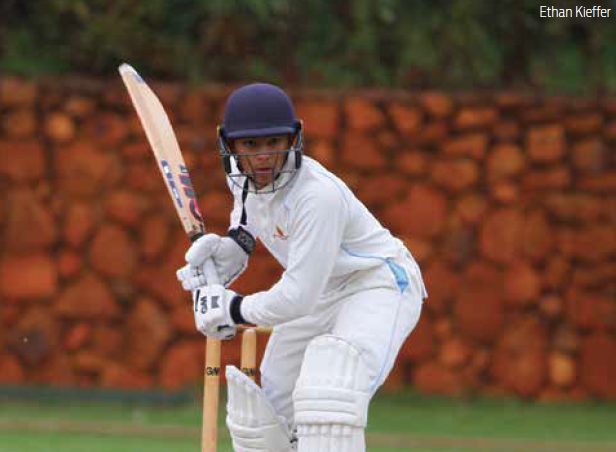
Two other centuries were scored: Ethan Kieffer made 152 for Bishops against St Alban’s on day one and followed that up with 58 not out against Michaelhouse on the second day. Liam McCarthy struck 105 for St Stithians against St Andrew’s of Bloemfontein on the Saturday. It was on one of the smallish outer fields at St Alban’s but according to Saints’ coach, Philip Koen, it was one of the best knocks he has seen from McCarthy in what has been a stellar career at the school.

Apart from the four hundreds made, there were a number of big half-centuries. Nicholas Barlow of St Andrew’s College was out on 99 against St John’s on the opening day; Slade van Staden made 77 for Hilton against St Andrew’s College; Travis Norris of Bishops made 73 against St John’s (Johannesburg); Jonathan Miltz of St John’s (Johannesburg) was 59 not out against Bishops; Christiaan Daniels made 61 for the CSA TAP team against St John’s (Harare) and the visitors’ Dane Schadendorf got 63 in the same game; and Arnaud du Plessis of St Alban’s made 77 against St Georges.

St Alban’s director of sport Krinesan Moodley was impressed with the cricket played over the four days. ‘These players are all from private schools and they are used to playing on pristine fields in perfect conditions. It was admirable to see how well they adapted to the varying conditions of the fields and we saw some good performances,’ he said.

‘That we got as much cricket in as we did over four days of almost non-stop rainy weather speaks volumes of the dedication of everyone who contributed to the event. We look forward to next year.’ 

This article appears in the April-June issue of SA Cricket magazine

COVID-19: UP Research Group Sets Up Databank To Empower Experts and Citizens With Accurate Info

Masego Panyane

A research group based at the University of Pretoria (UP) is playing its part in disseminating factual information about the novel coronavirus that the world is currently in the grip of by setting up a databank that offers users real-time updates about COVID-19.

The Data Science for Social Impact group aims to use data science as a way to find solutions to social problems and to get end-users and decision-makers to better understand how to use and understand data science and its limitations.

For the current health crisis, it has set up a repository and dashboard that pulls information from the National Institute of Communicable Diseases (NICD) and the Department of Health (DoH).

https://www.up.ac.za/media/shared/1/2020/coronadash_700.zp188242.jpg

The manner in which the information is presented will hopefully empower South Africans with accurate data and statistics, says Dr Vukosi Marivate.

The data is presented in an easy-to-interact format on a dedicated site. ABSA Chair of Data Science at UP Dr Vukosi Marivate leads the group and says the databank was set up to pool resources in a time of crisis.

“Very early on we saw that the coming epidemic was going to stretch the country’s data capabilities,” says Dr Marivate who is a senior lecturer in UP’s Department of Computer Science.

“Once the minister of health and the NICD started publishing their data only in statements, we thought about how other researchers may need to get hold of this information in a more accessible way. As such, group members and collaborators have worked to build tools to automate the data gathering and cleaning as much as possible. Validation is also done through discussions about errors and rectifying them as soon as possible.”

The group also set up the repository and database in order to provide an interactive dashboard that the public could use to better understand the impact of the pandemic on the country.

The research group consists of more than 15 members, including masters and doctoral students, other research organisations as well as affiliate members who regularly collaborate with UP.

https://www.up.ac.za/media/shared/1/2020/coronadash700.zp188243.jpg

The databank was set up to pool resources in a time of crisis.

“One member of the research group, Herkulaas Combrink, has a health background and advised us on some of the needs of health professionals,” adds Dr Marivate.

“As it stands, the project has become very volunteer-driven, with many volunteers from South Africa and beyond lending their skills. We now have maps and an API [application programming interface] courtesy of these volunteers.”

The group is, however, cautious about making predictions about the progression of COVID-19. “We believe that predicting the spread of the virus is best left to epidemiologists at the moment,” says Dr Marivate.

“We look to the leadership of NICD and the South African Centre for Epidemiological Modelling and Analysis for their experience in disease modelling. We need to be responsible. Many predictions are being made, but we need our energies to get us through this. We do not want to add to any unnecessary panic or get sidetracked. We would like to have the best data to be available to experts.”

Another challenge of the COVID-19 pandemic is curbing the spread of fake news in relation to the disease. Dr Marivate says the transparency of the data research group and the manner in which the information is presented will hopefully empower South Africans with accurate data and statistics.

“A big part of our design and discussion with regards to the dashboard was on it being simple to navigate and being factual,” he says. “As such, we update only from NICD or DoH reports, so anyone can check our raw data to confirm how we come up with our visualisations and numbers. We are very transparent in our process.”

Source: University of Pretoria

Teacher Of The Week: Danielle van Eck from Protea Heights Academy, Western Cape

CLASSROOM CORNER

Teacher of the Week

Teacher: Danielle van Eck

School: Protea Heights Academy, Western Cape

Danielle Van Eck received an award for excellence in teaching Natural Sciences.

She is engaged in two innovative programmes – namely, Women in Science and Protea Heights Academy Science Week initiative, which focus on bringing learners from all socio-economic groups and expose them to science activities and guest speakers.

These activities include whizz-bang science shows, snake shows, bridge building, robotics and inspirational speakers.

Van Eck, the GET Natural Science teacher from Protea Heights Academy in Western Cape, says her passion for teaching was ignited by working as a demonstrator for several years during the time she studied at Stellenbosch University for the degree.

She would often do individual tutoring with students who didn’t understand the work.

She was motivated by seeing her students’ understanding of concepts after the tutoring.

She is passionate about teaching and providing the learners with deeper understanding of how the world around them works.

She adds that she loves being innovative and inspiring young minds to think beyond the problem.

She is a practical person and a critical thinker and encourages her learners to be the same.

The major challenge she faces is getting buy-in from the learners, sometimes colleagues and from other schools to partake in projects. She has also experienced challenges with funding and as a result has had to be very innovative when it comes to getting sponsorship for the programs she runs.

Van Eck wants to continue to provide quality education in natural sciences and give back as much to the surrounding communities as possible in the scientific field.

South Africa Needs To End The Lockdown: Here’s a Blueprint For Its Replacement

By Shabir Madhi, Alex van den Heever, David Francis, Imraan Valodia, Martin Veller, Michael Sachs, University of the Witwatersrand

The public debate on strategies to tackle COVID-19 often unhelpfully positions health and economic considerations in a diametric fashion – as trade-offs. In fact, economic policy has health consequences. And health policy has economic consequences. The two need to be seen as parts of a coherent whole.

In the case of South Africa, the country currently faces three interrelated problems. These are the public health threat from the COVID-19 pandemic, the economic and health effects of the lockdown, and a range of intractable economic problems not directly due to the current pandemic. These include high unemployment, low economic growth and falling per capita income.

Any potentially viable response to COVID-19 needs to address all three aspects in concert. This is particularly important as the country plans for the next stage of its response after the lockdown. Focusing only on the health challenges and not paying attention to the economic issues will result in significantly higher economic costs, and will also undermine the health imperatives.

Our view is that a protracted lockdown won’t necessarily have the effect of ridding the country of the virus, but it will result in unacceptably high health and economic consequences.

The cost

The initial lockdown was prudent and is likely to have lowered the risk of community spread of SARS-CoV-2.

But the true number of COVID-19 (the disease caused by SARS-CoV-2) cases is difficult to quantify. A limited number of tests have been done, and community-wide screening for suspected infectious cases has been delayed.

The available evidence on the COVID-19 pandemic suggests that any initial containment of the disease through a lockdown will be short-lived. Also, it’s likely to result in a rebound of cases in the absence of aggressive community-wide screening for SARS-CoV-2 infectious cases, isolation of the identified cases and quarantine of their close contacts for at least 14 days.

On top of this, South Africa may find itself permanently harmed by the simultaneous destruction of both the demand and supply sides of the economy under an extended generalised lockdown.

This will have other unintended long term health and economic consequences. For example, an extended lockdown could result in the undermining of other health services, such as the immunisation of children.

The economic effects of a lockdown, too, are severe.

Early forecasts suggest significant economic disruption from the current lockdown, which is costing the economy an estimated R13 billion per day. Preliminary projections by the South African Reserve Bank indicate that South Africa could lose 370,000 jobs in 2020. Projections by private banking analysts (based on the initial 21-day lockdown) suggest a GDP contraction of 7% during 2020, leading to a fiscal deficit of 12% of GDP (forecast at 6.8% in the 2020 budget) and a debt-to-GDP ratio in excess of 81% in 2021. This means that the country’s already limited public finances will be further constrained.

Towards a post-lockdown strategy

Globally, attention is turning from initial containment through generalised lockdowns to short- and medium-term risk-based public health and economic strategies. We present some considerations for a health and economic policy beyond the lockdown in South Africa.

In this we proceed from the following assumptions:

  • The SARS-CoV-2 will not be eliminated in South Africa until either a vaccine is introduced (yet to be developed), or sufficient natural immunity in the population is achieved. It is therefore necessary to put in place and maintain a sustainable mitigation strategy for COVID-19 for the remainder of 2020, or until a vaccine is available (an optimistic timeline for this is 18-24 months).
  • A generalised lockdown is not a viable long-term prevention strategy for COVID-19 due to its deleterious effects, including the resultant long-term impact on society, public health and the economy.
  • Removal of the lockdown without appropriate health and economic measures will result in an excess mortality from COVID-19, resulting in further economic hardship.

South Africa’s health and economic strategy beyond the current lockdown must be designed to ensure good health care and be economically sustainable. We argue that the country needs to transition to a risk-based strategy which offers effective health protection and allows for the resumption of some economic activity.

This approach has been advocated by researchers in both Germany and the Indian state of Kerala.

Accordingly, the following objectives should be central to any policy.

  • First, mitigate the rapid spread of the virus, while allowing for natural immunity in the population to increase gradually.
  • Second, strengthen health care systems to ensure optimal treatment for as many patients as possible, both those with COVID-19 and those with other serious illnesses.
  • Third, protect individuals at high risk for severe COVID-19 disease; and
  • Fourth, make economic activities possible with measures in place to manage the health risks associated with these activities.

Economic and health strategies

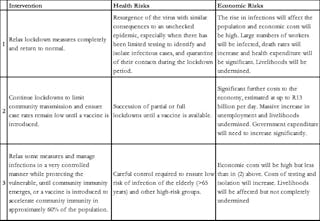
At the highest level, there are three broad intervention strategies available to South Africa (summarised in the table below), adapted from a recent article by leading Australian health academics James Trauer, Ben Marais and Emma McBryde. We believe that option three is the only practicable one for South Africa. And the details of its implementation matter.

Table 1: Typology of interventions and risks

Adapted from (Trauer et al., 2020)

A health strategy based on an extended generalised lockdown is economically unsustainable. It is also damaging to public health. Instead, we need a unified health and economic strategy that allows for some economic activity while inhibiting the uncontrolled spread of the virus. This requires a number of health and economic measures to be implemented in a coordinated manner.

First, to reduce the rate of infections, the country must have ready the capability of mass virus testing and efficient contact tracing before the end of April 2020. This must be accompanied by a comprehensive approach to social distancing. Relying solely on screening of symptomatic individuals will not effectively reduce the rate of infection because high viral loads of SARS-CoV-2 in the upper airway occur in pre-symptomatic and possibly asymptomatic people.

To be successful, the scale of testing needs to be at least equivalent to that in South Korea (17,322 tests per day in South Africa, eventually testing 1 in 150 people). At best, it must be equivalent to that carried out in Germany (36,399 tests per day in South Africa).

Test turnaround times must result in identification of infected individuals within 12 to a maximum of 24 hours. This must be followed by immediate isolation and contact tracing. Isolation of infected individuals and contact quarantine must last for at least 14 days, either at home, if suitable, or in designated isolation and quarantine facilities.

The annual cost of conducting 17,000 tests per day is approximately R5 billion. There would perhaps be an additional annual cost of R4 billion for contact tracing and quarantine. These costs compare favourably to the daily economic cost (R13 billion) of the generalised lockdown.

Secondly, economic activities must be allowed in a way that is consistent with the aim of preventing the uncontrolled spread of the virus. Within the constraints of the health strategy outlined above, a risk-based economic strategy is required that balances economic and health imperatives.

Decisions on differential opening of the economy should be made in line with the criteria proposed in a recent paper by German researchers. This includes, for example, opening sectors with low risk of infection (highly automated factories) and less vulnerable populations (child-care facilities) first. It could also include areas with lower infection rates and less potential for the spread of COVID-19. Of course, these decisions will have to be based on a careful assessment of factors such as household structure and composition in South Africa, and public transport.

To do this, the country will need excellent data on the extent and location of any community outbreaks of the virus. Such data will be generated by mass testing, and accurate information about the ability of certain sectors of the economy to reopen safely and in compliance with the health protocols.

The health and economic strategy will thus need to be implemented in a dynamic fashion, responding to the latest evidence.

Source: The Conversation

New York City Public Schools To Remain Closed For Rest Of The School Year: Mayor

New York City Mayor Bill de Blasio said on Saturday public schools will remain closed for the rest of the school year as the city battles the outbreak of the novel coronavirus.

“Having to tell you that we cannot bring our schools back for the remainder of this school year is painful, but I can also tell you it is the right thing to do,” he told a news conference.

De Blasio had ordered public schools shut beginning March 16 to curb the spread of the disease, with an initial goal of reopening by April 20.

But the mayor said it soon became clear that date goal was unrealistic as the city emerged as a major U.S. coronavirus hot spot.

The city closed its public schools on March 16 as the virus continued its rapid spread.

Families lacking computers or laptops are being loaned city-owned devices for use in online learning; 175,000 have already been distributed.

The citywide closing affects 1.1 million students in what is by far the country’s largest public school district.

Source: REUTERS/AFP