Charles
Molele
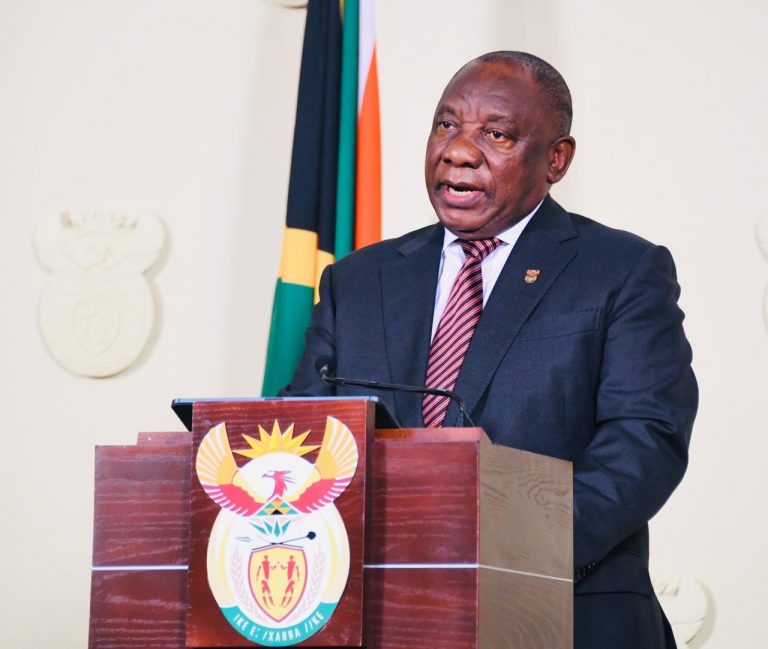
After a few days of speculation, President Cyril Ramaphosa has extended the national lockdown by another two weeks until the end of April in a bid to curb the spread of the novel coronavirus.
Ramaphosa said the decision to extend the lockdown was based on rigorous research and empirical evidence gathered on the ground by officials from the department of health and members of the National Coronavirus Command Council currently based at the Council for Scientific and Industrial Research in Pretoria.
Addressing the nation on
Thursday evening, Ramaphosa said if the government ended the lockdown “too soon
or too abruptly”, it risked a “massive and uncontrollable resurgence of the
disease”.
“This evening, I stand before you to ask you to
endure even longer,” said Ramaphosa.
“I have to ask you to make even greater sacrifices
so that our country may survive this crisis and so that tens of thousands of
lives may be saved. After careful consideration of the available evidence, the
National Coronavirus Command Council has decided to extend the nation-wide
lockdown by a further two weeks beyond the initial 21 days. This means that
most of the existing lockdown measures will remain in force until the end of
April.”
He said the decision to extend the national lockdown in South Africa was not taken lightly.
“We did not take this decision to extend the
lockdown lightly. As your President, I am mindful of the great and heavy burden
this will impose on you. I am keenly aware of the impact this will have on our
economy. But I know, as you do, that unless we take these difficult measures
now, unless we hold to this course for a little longer, the coronavirus
pandemic will engulf, and ultimately consume, our country.”
Ramaphosa said government has already put in place measures to provide support to “businesses in distress, to workers facing loss of income, to the self-employed and to informal businesses”.
He said the Unemployment Insurance Fund has set aside R40 billion to help employees who will be unable to work, as part of the effort to prevent jobs losses as a result of the lockdown.
To date, he added, the UIF has paid out at least R356 million to claimants.
Ramaphosa also announced that
the Industrial Development Corporation has set aside R3 billion for the
procurement of essential medical supplies.
“It has already approved R130 million in funding
and expects to approve a further R400 million in the coming week to companies
who applied for funding under this special facility. The Small Enterprise
Finance Agency has approved the postponement of loan repayments for a period of
6 months,” he announced.
“The small business debt relief and business growth
facilities are currently adjudicating applications for assistance. There is a
total of R500 million available in support. Government has reprioritised R1.2
billion to provide relief to smallholder farmers and to contribute to the
security of food supply.”
Turning to the Solidarity Fund, Ramaphosa said it has already raised R2.2 billion in donations from companies, high-net-worth and private individuals.
He said many companies and individuals have come forward to provide financial and other assistance to businesses in distress.
He also announced that the President, Deputy President, Ministers and Deputy Ministers will each take a one-third cut in their salaries for the next three months.
This portion of their salaries will be donated to
the Solidarity Fund.
“We are calling on other public office bearers and executives of large companies to make a similar gesture and to further increase the reach of this national effort,” he said.
This week, Old
Mutual announced that its executives will donate a portion of their salaries to
Solidarity Fund, according to the company’s interim chief executive officer Iain
Williamson.
“Salary reduction
would be equivalent to the inflationary increases we received at the end of
2019 and we’ve agreed with Old Mutual that they wouldn’t put that money into
corporate savings. It would be donated straight to the Solidarity Fund, on a
monthly basis,” said Williamson.
He said the
company will also be making R4 billion worth of cover available to over 400,000
healthcare workers.
The Johannesburg
Stock Exchange also announced that it will also donate money to the Solidarity
Fund.
Ramaphosa
said government will use the extended lockdown period to ramp up its public health
services to contain the spread of the virus.
He said that in the two weeks before the lockdown,
the average daily increase in cases was about 42%, but since then it has
dropped to around 4%.
“Our immediate priority is to
slow down the virus and not allow it to consume our country. We have used the
last week to improve our screening and testing methodology,” he said.
“Since the lockdown came into effect, the rate at which new cases
have been identified here in South Africa has slowed significantly. From 1,170
confirmed cases on the 27th of March, the number of confirmed cases today
stands at 1,934.”
“While it is too early to make a definitive analysis of the progression
of the disease in South Africa, there is sufficient evidence to show that the
lockdown is working.”