Home Blog Page 428

NYDA Boss On A Mission to Create 1 000 Businesses in 100 Days

0

Charles Molele

Sifiso Mtsweni, the tenacious and forward-thinking chairperson of the National Youth Development Agency [NYDA], showed entrepreneurial prowess from an early age.

He started out selling an assortment of sweets and vetkoeks at primary school, procured from his mother’s tuck shop in Motetema, outside Groblersdal, Limpopo Province.

By the age of 12, the former COSAS leader was selling ice-cold drinks and national Sunday newspapers on the dusty streets of his township to school teachers, government officials and other ‘black diamonds’ in his neighbourhood.

Little did he know that one day he would be at the forefront of entrepreneurship and small business ownership, working with young enterprise owners across the nine Provinces after joining the youth development agency.

Since then,  Mtsweni has assisted hundreds of young entrepreneurs to start up their own enterprises, attributing his business acumen to his ‘sharp’, ‘street wise’ character, and adding that being ‘a sweets seller’ at an early age worked in his favour. 

Mtsweni, in a wide-ranging interview with Inside Education, says there’s nothing that makes him more happier than to see thriving enterprises owned by young entrepreneurs creating much needed jobs and contributing towards economic growth in the country.

“We must continue to support entrepreneurship and small business ownership. Is one of the ways South African can turn its economic fortunes around, like the Asian Tigers countries, who went through rapid growth by supporting small businesses and encouraging entrepreneurship at all levels.”

With the ever increasing unemployment and tough economic conditions that South Africa is currently experiencing, the youth development agency, under Mtsweni’s leadership has set itself a target to assist 1 000 businesses in 100 days- from March to June-  to coincide with Youth Month activities.

The NYDA, in conjunction with the Department of Small Business Development, has embarked on a recruitment drive to fund 1000 young South Africans to start their own enterprises.

These 1000 eligible young entrepreneurs, says Mtsweni, will receive an NYDA Grant Funding.

The campaign also aims to support the young entrepreneurs through mentorship and financial resources to grow their start-ups and burgeoning companies.

During his State of the Nation Address in February, President Cyril Ramaphosa announced that government would be implementing the Presidential Youth Employment Intervention programme, which will focus on six key areas.

These include creating pathways for young people to be party to the country’s economic growth.

“Our campaign is aimed at empowering young people to run their small businesses. Most of SMMEs in this country fail in their first three years of existence, largely because they have to service the loan they receive from many development finance institutions such as Small Enterprise Development Agency, National Empowerment Fund and the IDC,” says Mtsweni.

“We came up with a model where you apply for funding and we offer you compulsory training on how to run a business through an Enterprise Development Programme. However, we do not put money into people’s pockets. If you need material, we buy it for you and supply you with stock.”  

South Africa has the highest rate of unemployment for young people in the world.

The recession announced by Stats SA has made matters worse, according to Mtsweni.

A new study by the Ichikowitz Family Foundation Charity has found that half of young people across Africa said that if they were offered 100 dollars, they would use it to start a business. 

Some 17% of those questioned said they wanted to do so in the retail sector, while 10% of respondents said they would look to either start a business in technology or agriculture. 

Social entrepreneurship, according to the study, was a popular theme among young people in Africa, with 63% of respondents saying that their idea for a business or social enterprise would benefit those living in their community. 

When he took over as the Chairperson of the NYDA, Mtsweni says he found an institution which was perceived to be corrupt, and unable to create jobs for young people.

Mtsweni said he worked really hard to overcome these challenges by, among others, assembling a highly qualified team including a deserving young CEO.

He cited a number of other challenges during his two-year term, including restoring public confidence and trust in the organisation, fighting with government to increase the NYDA budget to at least R1 billion per annum, and increasing the number of NYDA offices from 15 to 48 today across all nine provinces to ensure that more young entrepreneurs have access to the organisation.

At the same time, the NYDA also formed a partnership with the National Student Financial Aid Scheme for applicants to use their centres to apply for the NSFAS bursaries.

As his term is coming to an end in April, Mtsweni is proud to boast that under his leadership the agency has managed to maintain the clean audits that it received in five consecutive years.

The Sub-committee of the Portfolio Committee on Women, Youth and Persons with Disabilities, and the Select Committee on Health and Social Services is currently processing the appointment of new members of the NYDA Board. Mtsweni, who received praises from president Ramaphosa for turning the organisation around, has been asked to reapply to ensure continuity.

The president will announce the new Board in April.

Some of the things that Mtsweni counts as achievements include the concerted campaign that he put in ensuring work experience was no longer a requirement to obtain employment in South Africa for young people.

He said the agency wanted 40% of the workforce of private companies and government departments to employ youth graduates – even without work experience.

“We fought vehemently the notion that there are no jobs for young people. Saying there is no job is a myth. Jobs are there. The problem is experience. This has resulted in many graduates without jobs and placements because employers are demanding experience,” says Mtsweni.

“Why does anyone have to possess a five year experience to do a darn mere admin job, or become a driver? It is ridiculous. There is a South African Police Services warehouse that has over 50 000 stationery vehicles and there are no drivers to drive these vehicles. Why can’t we employ young people with driver’s licences to drive those cars and become police reservists – and help the country in combating crime?”

Mtsweni, who is 34 years old, has been approached by several ANC leaders to contest for the leadership of the ANC Youth League at an upcoming elective conference in May in Bloemfontein, Free State.

Mtsweni this week refused to comment about lobbying for positions but he expressed his views on how best the ANCYL could be revitalized to its former glory.

In the last ten years since the expulsion of Julius Malema and his cohorts, the Youth League tended to be entangled in internal issues of the ANC and factional battles.

“The youth league needs to change direction and reach out to more young people. EFF is currently occupying that space. Policies such as land expropriation without compensation, nationalization of the mines and other strategic minerals are Youth League policies,” says Mtsweni. 

“We need to build structures on the ground and mobilize our youths in rural areas, universities … TVET Colleges, townships … suburbs … and those who are active on social media platforms such as Twitter and Facebook to come home to the Youth League,” says Mtsweni.

He says the youth league also needs to mobilize young people in the creative arts space such as Cassper Nyovest, TV personality Bonang Matheba, rapper AKA, comedian Trevor Noah and Miss Universe Zozibini Tunzi.

He says during the preppy 1950s and 1960s, the ANC youth league mobilized young artists and celebrities such as songstress Miriam Makeba, music superstar Dorothy Masuku, trombonist Jonas Gwangwa and trumpeter Hugh Masekela, among others, who went on to mobilize the world against apartheid and the isolation of the racist minority regime.

One thing is for sure, Mtsweni still has a lot to contribute to youth development issues in SA and on the continent.

Panyaza Lesufi announces top performing primary schools in Gauteng ‘to kick-start a skills revolution’

0

Charles Molele

MEC for Education Panyaza Lesufi has announced for the first time the performance results of more than 900 primary schools in Gauteng, saying the move was intended to empower Grade 1- 9 learners to achieve functional literacy and acquire skills that match labour market demands.

Lesufi was addressing 6 000 teachers, HODs and principals at the inaugural primary school summit held at the Rhema Bible Church in Randburg, north of Johannesburg.

“We are going to measure performance of primary schools – from the performance of the principal, school teachers, HODs and the resources and infrastructure of the school.  We are transforming the whole education sector and preparing our children for a better future,” said Lesufi.  

“Gone are the days when primary schools were recommended in terms of the uniform the learners wore to school. We are now going to apply rankings to all schools just as we grade hotels in terms of stars, from 3 to 4 and 5 stars.”  

Lesufi said from 2020 academic year, Grade 1 to Grade 4 learners in the province would now learn about coding, sign language, entrepreneurship and many other skills to match the labour market and the demands of the Fourth Industrial Revolution.

“Our focus is to build the skills of the future. We need to embrace new changes that are coming in future as a result of technological advancements. If we don’t get our education system right we will never get the skills for our economy.”

The summit was also addressed by the department’s Deputy Director-General Albert Charney and head of department Edward Mosuwe.

Gauteng Premier David Makhura delivered a keynote address.

“This inaugural summit is quite historic. We are not only fixing education. We are fixing the foundational phases of our education system. A house built on shifting sands cannot withstand the storms,” said Makhura.

“Todate, the spotlight was on matric results only. We must now shine the spotlight on our primary schools. This summit is important for us because the Diagnostic Report says the problems we have in matric and post-matric stages arise from the early phases of our education system.”

Makhura said education was important for the future of Gauteng – the country’s economic hub, which comprises of approximately 14.7 million people.

 “As it were, 85% of Gauteng’s total budget is spent on Education, Health and Social Development. We must spend all our resources to educate our people.”   

Mosuwe, Gauteng education’s HOD, said in his presentation that one of the most worrying issues of primary school results was the increasing high failure rate and repetition.

At least 21 000 learners failed their Grade 1 schooling in 2019.  

“Most of the overage learners are due to having repeated at least one grade in their school career. Most of the learners who are at least two years older than their cohort would have repeated grades in more than one phase,” said Mosuwe.

“In the interpretation of the graph above, it is important to remember that a learner may not repeat more than once in a phase, accordingly the number of learners repeating in the “last grade” in a phase; i.e Grades 3, 6 and 9, appear fewer than in the following grades – Grade 1, 4 and 10. Grade 7 is an exception, as this is the last year of primary school and schools seem to promote learners so that they can move to secondary school.”

Dr Blade Nzimande urged to resolve financial, student accommodation problems at SA universities

0

Nyakallo Tefu 

The Democratic Alliance has called on Higher Education Minister Blade Nzimande to deal decisively with issues facing universities around South Africa following sporadic protest action in some campuses. 

The DA has also formally written to President Cyril Ramaphosa, urging him to compel Nzimande to take action and resolve the impasse at campuses.

The University of Witwatersrand is the latest tertiary institution which put a halt to academic activities this week, demanding the university to provide accommodation for over 200 students who have been left stranded, this after a video emerged of students sleeping at the institutions library. 

This happened while TVET students from Pietermaritzburg and Tshwane held demonstrations owing to the fact that the colleges are not paying out NFSAS funds. 

Just a few days ago, Nzimande, delivering his executive statement in Parliament, said it was all systems go for higher learning institutions in South Africa for the 2020 academic year.

DA’s interim leader John Steenhuisen said his party demanded the following:

  • That NSFAS expedite disbursements directly to students immediately as they missed their deadline which was 7 February;
  • TVETs are failing to disburse funds to students and therefore NSFAS should do this themselves;
  • The Minister should provide specific timelines of when poor students will have their historic debt cleared;
  • To urgently engage the Departments of Public Works and Human Settlements to allocate unused buildings for student accommodation;
  • Allowances for students at university and TVET Colleges needs to be standardized, because accommodation and food are just as expensive for both students who are in TVET Colleges or Universities;
  • The Minister has to engage Fort Hare management to prevent the eviction of students and find a way to allow for the academic program to continue.

“We urge the Minister to remember his primary responsibility, which is to ensure that every South African has fair access to higher education in a conducive and safe environment”, said Steenhuisen.

Health Minister Dr Zweli Mkhize To Visit KZN School After First Case of Coronavirus

0

Nyakallo Tefu 

Health Minister Dr Zweli Mkhize is on his way to visit Cowan House Preparatory School in Pietermaritzburg after it emerged yesterday that a 38-year-old man with the country’s first confirmed Coronavirus case was a parent of two children at the school.

Mkhize will be accompanied by KwaZulu-Natal MEC for Health Nomagugu Simelani-Zulu and officials from the National Institute for Communicable Diseases.

The KwaZulu-Natal man, who’s the first in South Africa to be confirmed with the coronavirus, says he developed symptoms after returning from a skiing trip in Italy.

According to South African health authorities, the man’s two children attend school at Cowan House.  

This is the first confirmed case of the coronavirus to hit South Africa yesterday since the outbreak of the deadly disease.

Health authorities have confirmed that a total of 97,852 infections have been confirmed world-wide and more than 3,300 people have been killed by the virus.

The NCID said after the meeting with the school’s board and management, the minister will address the media to give an update on the developments.

According to Mkhize, the KZN man flew into OR Tambo, and then flew from Johannesburg to Durban on the same day.

“The patient is a 38-year-old male who travelled to Italy with his wife. They were part of a group of 10 people and they arrived back in South Africa on March 1, 2020,” Mkhize said.

As of Thursday night officials were contacting those who were seated near him on both planes.

Tracer teams are currently in KwaZulu-Natal, tracking down others he may have had contact with. 

Mkhize said direct contacts such as family will be placed into quarantine, and a broader group of contacts will be checked for symptoms such as fever.

Meanwhile, President Cyril Ramaphosa has urged South Africans not to panic.

“The report I received from the Minister of Health has demonstrated to me that we can be more alert and we can go to higher levels of alert,” said Ramaphosa.

(Additional information from agencies)

Experts: R2.5 Billion Allocation Must Improve ECD Quality

0

Thalia Holmes

Gauteng MEC for Finance and e-Government Nomantu Nkomo-Ralehoko announced in her maiden budget speech on Thursday that a hefty R2.5-billion would be allocated to ensuring that all learners, regardless of their socio-economic status, go through Early Childhood Development.

To give one an idea of the magnitude of this, the department will spend less than one percent of this amount (R155 million) on improving literacy and numeracy across all grades.

But while the principle behind the decision to spend on ECD is sound, the tools that provincial leadership have chosen to implement it could be misguided.

The R2.5 billion, earmarked to be spent in the province over the medium term, will be used to “complete the Universalisation of Grade R and preparing and piloting the introduction of Grade RR in public schools,” said Nkomo-Ralehoko.

This follows a statement by Gauteng Premier David Makhura in his recent State of the Province address.

“Most of the problems of our basic education system derive from the weaknesses of the foundation phases and primary schools,” said Makhura.

“It is for this reason … that over the next decade more attention will also be given to the strengthening of the foundation phases.”

He went on to undertake that the provincial government will support 700,000 children aged 0-4 years in early childhood development centres across the province, by providing funding, curriculum development and training of teachers.

“We want all crèches operating in Gauteng to comply with the ECD norms and standards and follow the approved curriculum so that they can offer our children a proper foundation,” said Makhura.

“Universal access to Grade R for all children aged 4-6 remains our goal during this decade.” This goal “constitutes a major step in giving our children a strong foundation,” said the Premier.

However, Professor Ursula Hoadley at the University of Cape Town’s School of Education, suggests that the quality of Grade R education is of more concern than increasing the number of learners enrolled in it.

“In 2011, about 40% of five-year-olds had access to grade R in schools; 11% were enrolled in primary schools and approximately 32% were attending a less formal preschool, such as a crèche,” says Hoadley in a 2013 academic essay, citing figures from the Department of Education.

In fact, only about 17% of five-year-olds were not enrolled in any form of schooling or preschool.

Enrolment in grade R more than doubled in the poorer provinces of Limpopo, Northern Cape and North West between 2002 and 2011.

Using data from the General Household Survey, the Department of Basic Education reported that, in 2011, 88% of grade ones had received formal grade R the previous year, she noted.  

“Participation in early formal education is thus high, and expanding, especially in poorer provinces,” observes Hoadley.

“The question however is what children have access to in grades R – 3.”

More important than an extra year of schooling, Hoadley argues, is the quality of the education being offered to children.

“Infrastructure, resources, support, inspection and management all play a role in the quality of children’s learning. But research confirms that, amongst school factors, it is what happens in the classroom that makes the greatest difference to children’s learning outcomes,” she says.

The weaknesses in current classroom learning are vast-ranging. In summary, she says, “there is an emphasis on oral discourse, with limited opportunities for reading and writing. Classes are often large, with inappropriate teacher–learner ratios for early learning activities. Dominant forms of student participation involve chorusing rather than individual response in the classroom. Assessment and feedback to learners from teachers is weak, and there is very little direct or explicit instruction. The level of cognitive demand made on children in classrooms is low, and textbooks and other guiding materials are under-utilised.”

Five economists at the Department of Economics at the University of Stellenbosch, compiled recommendations on improving education quality in South Africa for the National Planning Commission in 2011.

In their report, among other things, they recommended focusing on improving the quality of Early Childhood Development facilities.

 “All South African children should have access to ECD facilities that are closely monitored and well supported ensuring a high quality so as to give children a better foundation for learning upon entering primary school,” said the researchers.

This research once again underpins the argument that quality is the real buzzword for improving ECD outcomes: ensuring that better education in Grade R is provided, rather than more learners enrolled in Grade R.

Research conducted by Stellenbosch University and published in the 2015 African Evaluation Journal found that the Grade R programme has expanded dramatically, to the point where participation is nearly universal.

However, the report found that, although a substantial literature points to large potential benefits from pre-school educational opportunities, the impact evaluation reported on in this article demonstrated that the Grade R programme, as implemented until 2011 in South Africa, “had a limited impact on later educational outcomes”.

Hoadley told Inside Education: “In other words, adding a year to primary school had no effect on later schooling outcomes. The reason: the quality of Grade R.”

In light of these findings, Hoadley said that there was little value in the government’s aim of piloting Grade RR.

“There is no point rolling out Grade RR unless there is some sense of how quality can be ensured,” she said.

Lectures Resume at Wits University After Violent Protests Over Student Accommodation

0

Nyakallo Tefu 

Academic activities at the University of the Witwatersrand in Johannesburg resumed on Thursday after a violent protest march on Wednesday.

Wits’ Student Representative Council embarked on a protest to demand student accommodation for over 200 students, accusing the university management of leaving desperate students to sort out this issue themselves. 

In a statement on Wits’ Twitter page, management said it was disappointed that the agreement between the university and students signed on February 10 was broken by the Wits SRC.

It further added that the university released R17 million to the Wits Hardship Fund (a fund created for students who are in urgent need of assistance), to help those in need of accommodation. 

Wits SRC President Thuto Gabaphethe said students have been sleeping at libraries because they have no accommodation.

Eastern Cape student, Nomonde Foli, shared her story at the march, saying she had been sleeping at the university’s 24-hour library since the beginning of the year. 

Foli said she had a historical debt of R89,000, which she owed to the institution and has had to make a commitment with the finance office to make a payment of R500 a month, in order to be allowed to register for the 2020 academic year. 

“The number of black students sleeping in laboratories is disgusting and our moral conscious does not allow us to turn a blind eye”, said Gabaphete.

Wits management said despite an agreement between the two parties being broken, the Dean of students, Jerome Seppie, is still willing to engage with leaders of student councils to find a resolution to the issue. 

However, Ander Crouch, management and vice principal at Wits addressed students, saying that the university is not in a position to assist every student registered with a bed.

Key Highlights of #GPBudget2020 in Less Than 10 Minutes

0

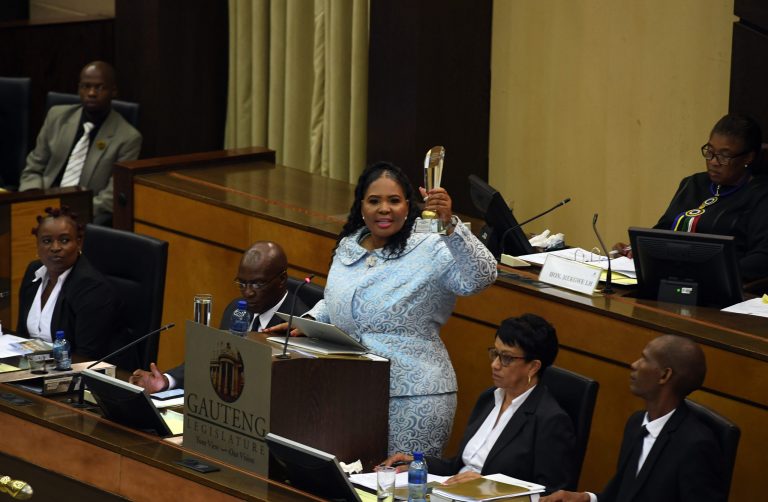
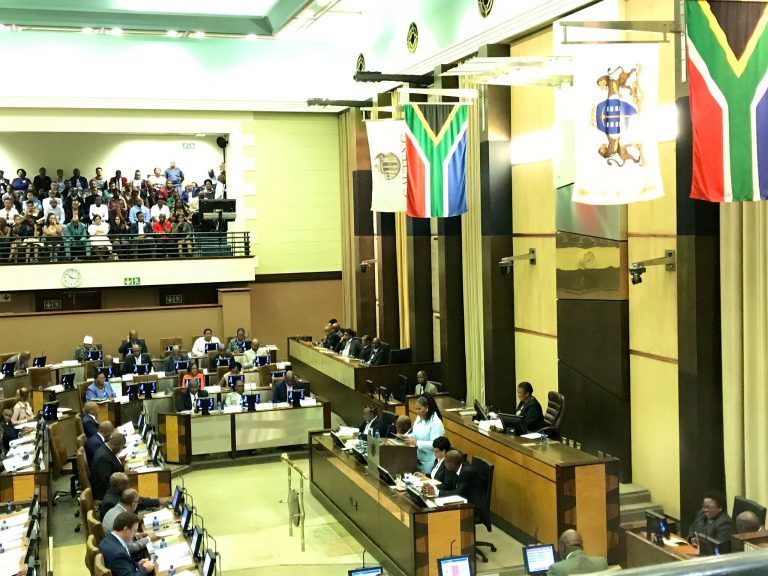
MEC for Finance and e-Government Nomantu Nkomo-Ralehoko tabled her budget on Thursday at the Gauteng Provincial Legislature.

Here some of the key highlights of #GPBudget2020:

  • Overall 2020/21 Budget R 142.4 billion, now up by R10 billion
  • R33.3 billion goes to Premier David Makhura’s Plan, Growing Gauteng Together;
  • R157 million allocated for support of the taxi industry and establishment of the Gauteng Transport Authority;
  • Tshwane Automotive Zone has received R 200 million;
  • R 625 million has been allocated for crime-fighting priorities,  including R280 million for recruiting 400 traffic officers;
  • R 189 million allocated over the next three years for Gender-Based Violence and the training of officers and establishment of victim empowerment centres; 
  • R 205 million has been allocated for 10 000 serviced stands
  • R 157 million for completion of all incomplete Human Settlement projects;
  • The GPG wage bill to be maintained at 60% of the total budget 
  • The Forensic Unit at Treasury will now move to the Premiers Office;
  • Commitment to pay suppliers on time;
  • Lifestyle audits for supply chain and human resource officials are being introduced to help fight corruption and fraud.

(Compiled by Thebe Mabanga)

Taung School Principal Arrested for Submitting Fraudulent Travel Claims

0

Nyakallo Tefu 

A school principal from Taung in the Northwest will appear in court on Thursday following her arrest on charges of fraud. 

The Hawks’ Serious Corruption Investigations Unit arrested the 35-year-old principal on Wednesday after she attempted to submit a travel claim of over R17 000. 

According to a statement from SA Police Services, preliminary investigations have revealed that she allegedly used a state vehicle in October 2017, and fraudulently claimed official kilometers as though she used her private vehicle whilst executing work related duties.

Forensic Report into Enock Mpianzi’s Death Finds the Lodge, Parktown Boys’ High Teachers Liable and Negligent

0

A forensic report into the drowning of Parktown Boys’ High pupil Enock Mpianzi has found Nyati Bush Lodge, school principal and teachers liable and negligent for his death.

Lawyer Peter Harris told the media in Johannesburg that the Grade 8 pupils on the fateful trip were not given life jackets.

He also said there was no accurate roll call for those who went to the school’s orientation camp in Brits, North West.  

When calls were made the following day to parents if their boys were at the camp, all parents confirmed.

It was only at 12:45 on the Thursday that it was found that Mpianzi was actually missing.

“If the correct roll call list was used they would have discovered 18 hours earlier that he was missing at 17:30 the previous day,” said Harris.

Harris, a lawyer at Harris Nupen Molebatsi Attorneys in Dunkeld West, Johannesburg, released the damning report on Wednesday night.

“We find negligence and extreme recklessness on the part of the school … the headmaster, educators and the bush lodge,” said Harris.

The 13-year-old Mpianzi went missing while attending the camp.

His body was found washed down the Crocodile River after he drowned while participating in a water-based activity.

Harris said the school and educators were also negligent in fulfilling their duties such as making sure every child was accounted for.

Harris said the district officials and the school principal, Malcolm Williams, who is currently on suspension, should be the subject of a disciplinary hearing.

Harris said the investigation has also recommended that Gauteng Department Education should in future regulate all outings to school camps.

“It should not be something left to the school alone. As it is the schools who choose the camps and this should not be the case in future,” he said.

Harris said Mpianzi was the fifth person to die in water-based activities at the same camp.

Gauteng MEC for Education Panyaza Lesufi also briefed the media after the release of the Forensic Report into the Death of Mpianzi.

Lesufi said criminal charges were being laid already for those responsible for the boy’s death.

“Heads will roll. They have to,” said Lesufi.

“However, we cannot pre-empt if police are going to charge people. All the other four deaths were reported to the police but nothing was done. We are going to ensure that Mpianzi’s death does not go the same route,” he said.

Lesufi said government has established a team of lawyers who negotiate settlements on behalf of government.

“Our approach is that there must be a reasonable settlement on this matter especially when a life has been lost,” he said.

(Compiled by Charles Molele)

Wits University Students Protest Over Lack Of Student Accommodation On Campus

0

Lectures and other academic programmes were disrupted on Tuesday at the University of the Witwatersrand after students took to the streets to protest against lack of accommodation on campus.

Wits Student Representative Council has now vowed to shut down the university until students are given accommodation.

Wits SRC President Thuto Gabaphethe, addressing hundreds of students on campus, said about 200 students were still in need of accommodation, resulting in some of them sleeping in laboratories, libraries and open spaces.

During the rally on campus, some students suggested that management should talk to government to request that buildings be donated to Wits University students.

However, the university said in a statement that it was disappointed with the actions of Wits SRC, who apparently broke the agreement signed on 10 February, saying it  R17 million to Wits Hardship Fund to support those facing hardship and those in need of accommodation. “To date, 800 students have been helped. Another 50 are being helped this morning as more beds from a private service provider have become available. Despite the  @Wits_SRC having broken this agreement, the Dean of Students  @JeromeSeppie is still willing to engage in order to resolve any further issues. It is now up to the  @Wits_SRC to show leadership in this regard,” the university said in a statement.

Wits Vice Chancellor Adam Habib told EWN that he has an agreement with the students and the SRC is not telling the whole truth.

“What she (SRC secretary-general Katie Morget) is not telling you is that the vast majority of students who have problems with accommodation are people who have lost their National Student Financial Aid Scheme (NSFAS) bursaries. They lost those bursaries because they failed more than two times,” said Habib.

(Compiled by Charles Molele)