Aishat Babatunde
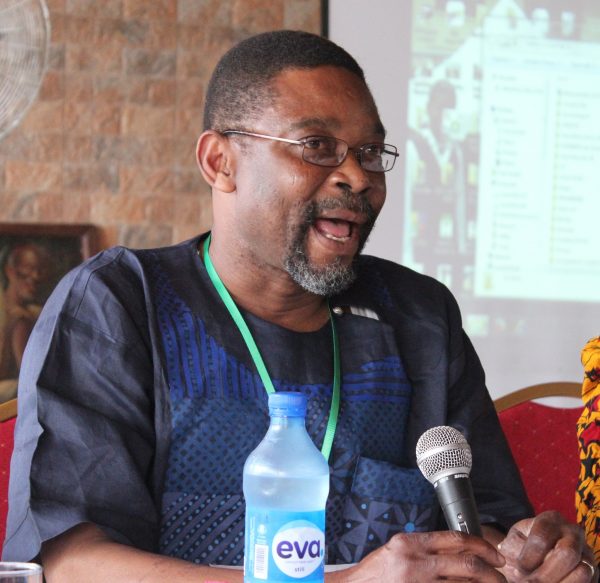
Renowned Nigerian academic and poet, Professor Harry Garuba, has died.
He was 61. Garuba passed away on Friday evening in South Africa, following a long illness.
A
statement on Saturday by the University of Cape Town where the poet had taught
for much of his career, announced his death.
The
university, on its Facebook page, described Mr Garuba as ‘a masterful writer
and poet’, ‘a luminary in the field of African literature and a champion of
postcolonial theory and postcolonial literature.’
“His
dedication to his field was critical in developing the UCT Centre for African
Studies as a hub for research on the African continent.
“As part of the
university’s Curriculum Change Working Group (CCWG), Professor Garuba was
committed to developing thinking about what a decolonised curriculum would look
like in Africa and the global south and what a multicultural curriculum would
look like in the West,” the statement read.
As a revered academic,
Mr Garuba was praised for his scholarly contribution to the canons of African
studies and literature with his warm personality and empathy for his students.
The Acting
Vice-Chancellor of UCT , Lis Lange, remembered Mr Garuba as ‘a genuine person
who dedicated his time to moving the university forward and supporting his
students.’
“His passing is a
great loss to the university and the transformation project, but we must
continue this important work in his absence and build on the foundation he has
left,” she said in the statement
The statement said
details of the funeral and memorial service would be shared as the university
expressed its condolences to the Garuba family.
‘Humble
beginning’
Born in Akure, Ondo
State in 1958, Mr Garuba was a literary prodigy.
He was still a teenager
when his one-act play Pantomime for Saint Apartheid’s Day was published in the
Festac Anthology of Nigerian New Writing, a publication compiled on the
occasion of the Second World Black and African Festival of Arts and Culture,
held in Lagos in 1977.
He was seventeen when
he began his undergraduate studies in English at the University of Ibadan where
he would later bag both his Master’s and Doctoral degrees.
While he was a student
at the university, he founded ‘The Poetry Club’ which met every Thursday. It
was at the club that poets like Afam Akeh, Remi Raji, Onookome Okome, Chiedu
Ezeanah, Bose Shabah, Sanya Osha, Niyi Okunoye first planted their seeds of
literary creativity.
He published his first
academic book, Mask and Meaning in Black Drama: Africa and the Diaspora, in
1988. He taught at the university for fifteen years before migrating to South
Africa to teach in the English Department at the University of Zululand.
In 1988, he edited the
collection Voices from the Fringe: An ANA Anthology of New Nigerian Poetry.
In 2001, he moved to
the University of Cape Town, where he taught in the African Studies and English
departments until 2019, and published widely in the fields of African and
postcolonial literature.
Meanwhile, in 2017, he
published a second collection of his own poetry, Animist Chants and Memorials.
In addition to being an
author and poet, Mr Garuba was a member of the editorial advisory board of the
Heinemann African Writers Series and one of the editors of the journal
Postcolonial Text.
He also served as
acting dean of the Faculty of Humanities from February to December 2017, and
held research fellowships at the University of Texas at Austin, Harvard
University and Emory University.
In late 2019, he wrote
a blurb about the emphemerality of life and the permanence of art in Wreaths
for a Wayfarer, an anthology of poems in honour of late Nigeria scholar, Pius
Adesanmi.
‘Literary
Luminary’
The immediate-past
National President, Association of Nigerian Authors (ANA), Denja Abdullah,
described the poet as a literary luminary to crops of young talented writers
Nigeria is currently proud of.
“He was a great
teacher and influence to many young writers of today.
“His contribution
to African scholarship is highly eminent and goes beyond mere mentions.
“He will be
greatly missed,” Mr Abdullah told PREMIUM TIMES.
Mr Garuba is survived by his immediate family in Cape Town, his wife, Zazi, son, Ruona (20), and daughter, Zukina (14).