MEC for Education Panyaza has welcomed a decision by Gauteng to release the performances of primary schools, as is tradition with the annual matric results.
For the first time since the dawn of a new
democracy, parents in Gauteng will get a picture of which primary schools are
the best in the province.
Lesufi
said he was excited about the move as it was imperative to monitor and enhance
the performance of learners in the foundation phases.
“We are looking forward to the assessment report to be released by the Premier on this issue,” said Lesufi.
Gauteng Premier David Makhura made this announcement
on Tuesday during his State of the Province Address at the Sefako Makgatho
Health Sciences University in Ga-Rankuwa, North of Pretoria. .
He said his government would be releasing an
assessment report of primary schools in due course.
“We
have completed the assessment of all the primary schools in the public
education system and are ready to publicly release the report in keeping with
the commitment we made,” said Makhura.
“Most
of the problems of our basic education system derive from the weaknesses of the
foundation phases and primary schools. Poor performance in the Science
Technology Engineering and Mathematics (STEM) subjects, as well as Accounting
and Economics should be addressed through interventions from ECD to Grade 7.”
“It
is for this reason that we made a pronounced that over the next decade more
attention will also be given to the strengthening of the foundation phases and
improving the overall performance of all primary schools in Gauteng.”
Makhura said the government is ready to
invest not only in high school education but in early childhood development as
well.
Gauteng received the second-highest matric
pass rate in the country, achieving an 87.2%.
Makhura said ECD centres have been neglected
for too long.
“The
provincial government will support 700,000 children aged 0-4 years in early
childhood development centres across the province. We will do this by providing
funding, curriculum development and training of teachers,” said Makhura.
“We want all crèches operating in Gauteng to
comply with the ECD norms and standards and follow the approved curriculum so
that they can offer our children a proper foundation, including numeracy,
digital literacy and inclusionary education.”
The world of work is changing constantly,
profoundly, and faster. This is clear from the outsourcing of work, waves of technological
advances, increasing automation in business, and big data analysis driving the
growth of industries.
The needs of industry are shifting constantly and
the education system should be responding to provide needs-based support.
Education theorists, researchers, practitioners,
and policy makers have to remember that the occupational situation differs from
country to country. They also need to remember that changing work contexts are
influencing employees and job-seekers in distinct ways. Work is becoming
increasingly more complex. This means that there’s a growing need for lifelong
learning, teamwork, and networking as well as an increased emphasis on digital
skills to promote career adaptability and employability.
They also have to bear in mind that the industrial
sector is shrinking. Accordingly, work-seekers in the Global South have
been turning to the service sector as well as to the informal economy with a
fair amount of success. This trend is likely to continue.
The issue is whether education systems are keeping
pace with the changes.
Gateway subjects
To understand whether young South Africans have the
skills required by the current world of work after 12 years in school I use the
lens of the so-called gateway subjects. These are maths and physical sciences
and, to an extent, accounting. These form the foundation for scientific, economic, and industrial
development and research.
Multiple educationists
and researchers have contended that learners who’ve passed maths and
physical sciences and have acquired the basic aspects of information
communication skills and robotics have a competitive advantage in the
occupational world over those that have not. South Africa simply cannot afford
the unacceptably low percentage of school learners who pass Grade 12 with
mathematics and physical sciences.
Why the emphasis on maths and physical sciences?
Having passed Grade 12 with maths and physical
sciences helps because these subjects contribute at least 22% to the economy. Likewise, having passed either information
communication technology or even computer-assisted technology helps to advance the economy by reducing production costs, boosting the
growth of new businesses, and improving communication.
It also helps to acquire “soft skills” such as career adaptability, emotional-social
intelligence, career resilience, creativity, innovation, and the ability to
collaborate and to network, among other things. These skills are increasingly
being seen as “hard skills” in the 21st century workplace because they’re
strongly aligned with market needs.
Unfortunately, they aren’t being taught and learned
adequately at school.
South Africa’s
overly academic school system
A number of problems afflict South Africa’s
education system.
Black learners continue to feel the effects of
apartheid’s education system which spent more on education for white learners. This means that
the vast majority of black learners in the neediest environments get inadequate
teaching and learning.
Unless the disparity between rich children and poor
children is addressed, the gap between the achievements of learners in
well-resourced schools and disadvantaged learners in resource-scarce schools
will persist.
The effects of this disparity are felt for the rest
of the pupils’ lives. One consequence is that they they struggle to succeed in
university studies.
An added difficulty is that the country’s overly
academic school system sends the message to learners and their parents that
learners should strive to study at a university and that it is ‘better’ to
study at a university than, for instance, at a TVET (Technical and Vocational
Education and Training) College.
I’m in favour
of introducing a system that facilitates differentiated training from an early
stage.
At the end of grade nine – at about 15 years old –
most learners are already able decide whether they want to pursue academic or
more vocational studies. This is the point where the system should start
channelling them in career-related directions that will give them their best
chance of eventually pursuing careers that “fit” their personalities –
including their interests and aptitudes and enable them to enact their central
life themes.
Another key factor that needs to be addressed is
the matter of inadequate career counselling for pupils – black learners
especially. During apartheid, the disadvantaged black majority of students were
denied access to career counselling in schools. Even today,
the vast majority of black learners still receive little career
counselling at school and cannot afford to pay a career counsellor.
Funding should be made available
by the government and employers to enable learners to consult career
counsellors. Group-based career counselling is a viable solution to the
challenge of providing career counselling in schools with large numbers of
pupils.
Solutions
I maintain that there are solutions for these
challenges. What’s needed is the will to use resources that are available and
to move forward expeditiously.
To help narrow the disparity gap I’ve argued in favour of making it compulsory for graduating
teachers and educational psychologists to do community service in rural areas
and townships. These professionals must be given incentives, their
safety must be ensured, and they must be paid a decent salary.
Another step that could be taken is to rehire the many teachers who have been retrenched or who have taken
severance package deals.
SOURCE: THE CONVERSATION
(Kobus Maree is Professor of Educational Psychology at the University of Pretoria)
Can you name the countries where humanitarian emergencies have forced
millions of children out of school? You’d probably come up with the
likes of Syria and Yemen, maybe South Sudan.
But would you think of Chad and Ethiopia? While other conflict-torn
countries grab the global headlines, the “hidden” crises can be just as
devastating. Here are some startling facts:
CHAD: 1.2 million children aged six to 11 are out of
school because of a long-running and complex crisis. Only one in 10
girls complete middle school.
ETHIOPIA: One million children are out of school because of conflicts and natural disasters that have damaged more than 700 schools.
These youngsters are among 75 million children and youth whose
education is disrupted by humanitarian emergencies around the globe.
“In Chad, Ethiopia and other crisis-affected countries, children’s
lives have been ripped apart by conflict, forced displacement, climate
change impacts and protracted crises,” said Yasmine Sherif, Director of
the Education Cannot Wait fund. “We must not leave these children
behind. They all have the right to develop and thrive.”
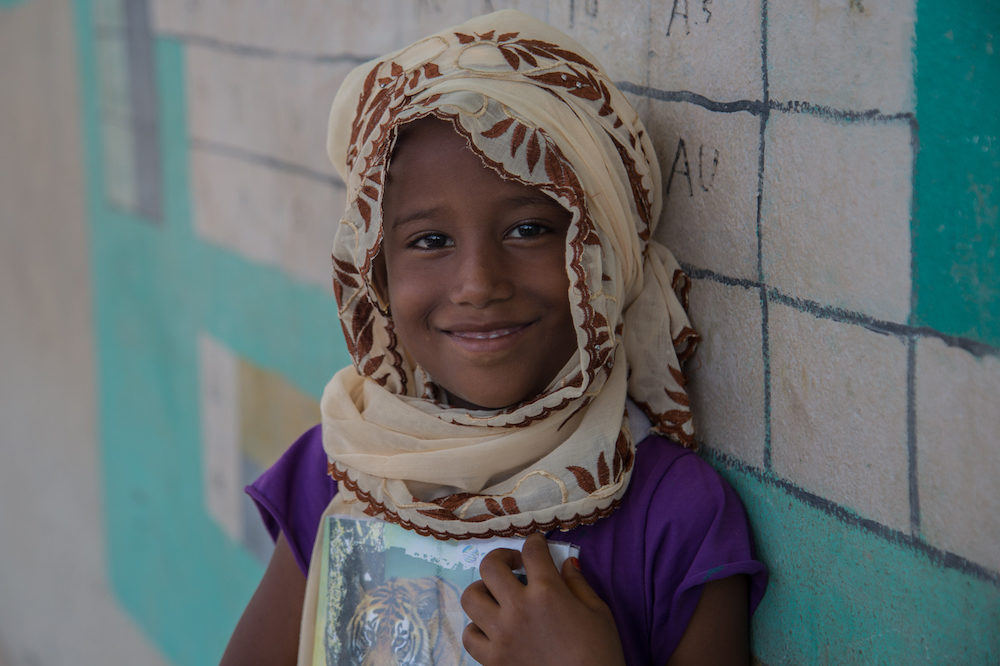
A girl at Simbile Primary School in Ethiopia’s Afar Region.
— Photo credit: UNICEF / Tadesse
When wars, displacement and natural disasters strike, education is
crucial to help children deal with trauma and return to a normal life.
But only five years ago, education in emergencies was overlooked and
underfunded – with less than 2% of humanitarian aid going to schooling.
Then Theirworld led the way in calling on world leaders to create an
urgent fund for education in emergencies. We launched a #SafeSchools
campaign and – after months of campaigning by us and other leading
charities – Education Cannot Wait (ECW) was launched in 2016.
“In the beginning, there were few partners advocating for a new fund
for education in emergencies – in fact many were skeptical,” said Justin
van Fleet, President of Theirworld.
“But at Theirworld, we built a grassroots movement led by our Global
Youth Ambassadors and joined by like-minded organisations which pushed
hard until we reached the World Humanitarian Summit where Education
Cannot Wait was inaugurated.”
Fast forward to 2020 … and ECW has reached more than 2.3 million
girls and boys in 30 countries and raised over $500 million. This month
it has invested $48 million by launching multi-year programmes in Chad
and Ethiopia with the governments and partners, which help almost one
million children into school.
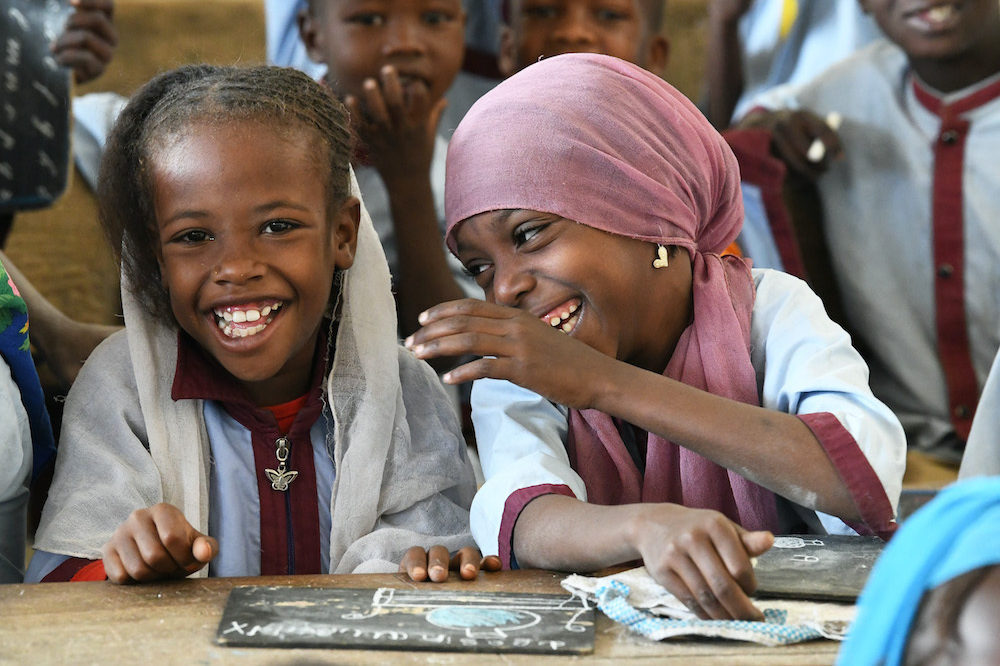
Girls having fun in a class at their school in Moussoro in the centre of Chad
— Photo credit: UNICEF / Frank Dejongh
ECW now has a proven model in 10 crisis-affected countries –
Afghanistan, Bangladesh, Central African Republic, Chad, Ethiopia,
Palestine, Somalia, South Sudan, Syria and Uganda.
“At Theirworld, we’re now focused on filling the gaps that still
remain, and that’s why we partnered with Education Cannot Wait and
Nationale Postcode Loterij to deliver education where international
partners have failed to step in, starting with the Greek Islands
emergency,” added van Fleet.
Theirworld’s project with Education Cannot Wait is allowing partner
organisations to send 5,500 vulnerable refugee children to school on the
Greek Aegean Islands.
In Chad, the problems are different but the effects are the same.
Ongoing violence, population displacement, the effects of climate change
and widespread poverty and hunger in the Lake Chad Basin has resulted
in 4.3 million people needing humanitarian assistance. One result is
that only 19% of girls and 40% of boys access lower secondary school
education.
ECW plans to allocate a total of $21 million over three years in seed
funding grants to catalyse the additional $30 million required to fully
fund the three-year programme and reach 230,000 girls and boys.
Children at an accelerated school readiness programme at Simbile Primary School, Afar region, in Ethiopia
— Photo credit: UNICEF / Tadesse
Chad’s Education Minister Aboubakar Assidick Tchoroma said: “With
generous funding from Education Cannot Wait, this new programme will
reach girls and boys that have been left behind as the result of ongoing
crises and emergency in the region. It’s an investment in our children
and in a more prosperous future for the country.”
The Chad initiative will reintegrate out-of-school girls and boys
into learning and training programmes, train teachers, provide
psychosocial and school feeding services, support early childhood
education and increase school enrolment and retention.
In Ethiopia, ECW plans to allocate a total of $27 million in seed
funding grants to catalyse the additional $138 million needed to fund
the three-year $165 million programme and reach 746,000 crisis-affected
children.
To help address the country’s high drop-out rates at Grade 1, the
programme will focus on early childhood education – providing improved
opportunities for 213,000 pre-primary and 532,000 primary school-aged
children.
“This multi-year investment from Education Cannot Wait will help
address one of the most important, yet often overlooked, needs for
vulnerable children and youth in times of crisis,” said Ethiopian
Education Minister Dr Tilaye Gete.
“By building a programmatic response that brings together multiple stakeholders including the local community, this is a sustainable investment in the future of our children and in the prosperity of our country.
The University of Cape Town has
been ranked 10th in the world and the best in Africa, according to the 2020
Times Higher Education (THE) Emerging Economies University Rankings, a
relative ranking of 533 universities in 47 countries with emerging economies.
While these
rankings use the same 13 performance indicators as for the THE World University
Rankings to assess institutions across their teaching, research, research
impact, industry income and international outlook, the indicators are
recalibrated to reflect the characteristics and priorities of universities in
emerging economies. More weighting is given to a university’s industry links
and international outlook, for example.
Compared to
last year, when UCT was placed 9th in the same rankings, the university’s
scores increased in the teaching, research and citation categories, pointing to
the growing impact and influence of UCT in these areas.
“While it
uses the same 13 performance indicators as the THE World University Rankings …
the indicators are recalibrated to reflect the characteristics and priorities
of universities in emerging economies.”
Scores for
the international outlook categories dropped only slightly, indicating UCT
remains a destination of choice for international students. Despite a small
drop in the industry income category score, this remains one of UCT’s strongest
categories, reflecting UCT’s research impact and contribution to industry.
China led
the rankings with seven universities in the top 10. Tsinghua University
maintained overall top position with Peking University again taking second
place. Russia, South Africa and Taiwan are the only other countries represented
in the top 10.
The rankings
include institutions classified by the London Stock Exchange’s FTSE Group as
“advanced emerging”, “secondary emerging” or “frontier”.
Last year, UCT
jumped up 20 places to 136th position in the 2020 THE World University
Rankings, which assessed almost 1 400 institutions worldwide. This put UCT
in the top spot in the country and the continent.
Higher Education, Science and Technology minister Blade Nzimande has welcomed the establishment of the new university of science and innovation in Ekurhuleni, east of Johannesburg.
This follows an announcement by President Cyril Ramaphosa during his state of the nation address last Thursday, where he also promised to resolve shortage of student accommodation at universities and other institutions of higher learning.
Although a formal name has not been agreed upon yet, an interim name of the OR Tambo University of Science and Innovation was being used.
The curriculum
design would focus on engineering, agriculture, logistics, aviation and
aerospace studies, as well as design
Ekurhuleni is the only metro in South Africa without a university.
“We
believe that this location, together with fresh new challenges arising from the
revolution in science and technology in the third decade of the 21st century,
offers an opportunity for a new initiative to provide cutting-edge science and
technology innovations across crucial areas such as Data Science,
Machine-Learning, Artificial Intelligence, Block Chain, Robotics,
Hydrogen-powered technologies including smart transportation and logistics
systems,” said Nzimande.
Nzimande
said he would outline all the details on the establishment of the University
during the upcoming Departmental Budget Vote 2020 later this year.
Nzimande also welcomed Ramaphosa’s announcement of
R64 billion to be set aside for student accommodation.
“We are
currently developing large projects comprising of 7 273 new beds at various
universities, where there is gross shortage of student accommodation,” said Nzimande.
Nzimande
said that from the 2019/20 Historically Disadvantaged Institutions Development
Grant, R147.674 million for the Mangosuthu University of Technology, University
of Venda and the Walter Sisulu University recommended allocations will be
allocated.
“For the
two new universities of Sol Plaatjie and Mpumalanga, 2 331 beds have been
funded from the New Universities Infrastructure Grant to the amount of R772.950
million,” said Nzimande.
“We have
made strides by commencing the building of nine (9) new TVET colleges campus
sites scheduled for completion in 2020. They include Sterkspruit, Aliwal North,
Graaff Reneit, Ngungqushe, Umzimkhulu, Greytown, Msinga, Nongoma and
Kwagqikazi. Construction will commence with a new campus site for Mitchells
Plain in 2020.”
The University of KwaZulu-Natal
says while violent protests took place on campus on Wednesday morning, lectures
continued without any interruptions at carious campuses.
More than 120 students took
part in a protest, damaging property and burning mattresses.
A 70-year-old professor was
also was attacked by angry students upon entering campus in the morning.
He was immediately taken to
hospital for treatment.
Students are protesting
against paying
15% of their historical debt
KZN police spokesperson Captain Nqobile Gwala confirmed the
protests on campus, including a dozen students who climbed and attacked a
police Casspir.
Gwala said a case of public violence had been opened for
investigation by Westville South African Police Service (SAPS).
“This morning at 05:00, a group of about 120 students gathered at
UKZN Westville campus where they blockaded the road, burned mattresses and
fridges,” said Gwala.
UKZN’s
spokesperson, Indu Moodley, said the University Academic Programme is
continuing as scheduled on all campuses.
“This morning one of the three entrances to the
Westville Campus was blocked but has since been cleared. South African Police
Services and University security are currently monitoring the situation,” he
said.
THE KwaZulu-Natal Parents Association is urging parents and caregivers to explain to their children the dangers of a new social media craze that has caught the attention of South African teenagers.
The
‘Skull-Breaker’ or ‘Tripping Jump’ challenge has gone viral after initially
emerging on video-sharing social networking app TikTok.
It
involves three participants – with one of them being kicked by the other two as
they jump up. The jumper plummets to the ground after being kicked.
The
association’s Vee Gani says the challenge could lead to severe injuries.
“The
thing is somebody can die. There is a possibility that people could have passed
away. It is very irresponsible. No child should attempt to do anything of that
sort.”
“As
you have seen in the videos, you can hit your head very hard on the concrete
floor, and it can cause irreparable damage, if not death – and you would be then
charged with murder because that’s exactly what it is.”
Gani says
he fears that the challenge has now crept into local schools.
“Having
come into our schools means that our children are going to try to perform those
acts and unsuspectingly on their colleagues who don’t know about
it.”
KZN
Education spokesperson, Muzi Mahlambi has issued a warning to pupils not to
follow the trend.
The department is also appealing to parents and caregivers to discourage their children from participating in the challenge.
Professor Adam Habib, Vice Chancellor of Wits University, has resigned. This follows his appointment as director School of Oriental and African Studies (SOAS) at the University of London, United Kingdom.
Habib, who has led Wits University since 2013, will
step down from his current role in December and join SOAS in January 2021.
He will succeed Baroness Amos, who is set to become master of the University College, Oxford, in August this year.
“I was approached to apply for the SOAS
position at the end of last year. I threw my hat into the ring and was
surprised when they offered me the post. After much deliberation with my family
and considerable engagement with the Wits Council and the Executive, I have
agreed to accept the offer. My decision was not made lightly – I am a proud
leader and champion of Wits University and South Africa, and will continue to
fly these flags high,” said Habib in a statement.
“I have committed to strengthening ties
between the South African and UK higher education sectors in my new role.”
Habib implemented the Wits 2022 Strategy.
Under his leadership, Wits has exceeded in all
indicators – Wits’ research output has increased by more than 60% (in
quality, international journals), throughput rates are up (more students are
passing) and a record number of students have graduated in recent years.
Wits University’s Tshimologong Digital Innovation
Precinct has also flourished under his leadership, Wits’ finances
are stable and it has strong, independent governance structures in place.
“Wits has recorded significant achievements in the
last seven years,” added Habib.
“In 2019 we graduated over 9 500 students, the most in the University’s history. In line with the Wits’ aim of becoming an increasingly postgraduate university, we enrolled 15 000 postgraduate students last year. Our research outputs have increased from 1 200 units in 2013 to just under 2 000 in 2020, without compromising on quality – about 90% of our papers are published in peer-reviewed international journals – these are phenomenal achievements for any university, and I will leave Wits in a strong position.”
Mr Isaac Shongwe, the Chairperson of Wits University’s Council said about Habib’ resignation and appointment at SOAS University of Londo: “Please join me in congratulating Professor Adam Habib on his appointment. He is a dynamic leader, who has without a doubt made a significant contribution to Wits and the higher education sector, both locally and abroad. His fearless, forthright commentary and his general robustness has left our University, and South Africa, a richer intellectual space, for which we are grateful.”
According to Times Higher Education, Habib will
face formidable challenges at SOAS, which describes itself as the world’s
leading institution for the study of Asia, Africa and the Middle East.
In May 2019, Times Higher Educationreported that the school’s director, Baroness Amos, had
told trustees that the Bloomsbury institution would “exhaust [its] cash
reserves” by 2021-22 unless it took action. It returned a £1.2 million
deficit in its 2017-18 accounts.
Last August, SOAS said acceptances
of new undergraduates had fallen by 8 per cent over the past two years,
but claimed that its “finances are healthy” with a projected surplus of
3 per cent in 2022-23.
A school voucher system is an efficient way for the government to make the most of the billions it spends on education, and to eradicate poor schools and teachers.
This is the view of Hermann Pretorius, campaign coordinator at the South Africa Institute of Race Relations.
According
to the IRR, school vouchers can be distributed to parents in the form of smart
cards and the money can only be spent on education.
The
system, which is tantamount to a universal bursary system, will empower parents
to buy schooling wherever they chose instead of the current system where the
state decides.
The idea
will introduce competition throughout the education system, as schools will
have to compete for voucher-bearing customers in the form of pupils.
Schools
unable to attract or retain pupils will have to close. This will ensure that
schools are run in the interests of pupils, rather than in the interests of
teachers.
Speaking to CNBC Africa, Pretorius said the quality of
education in many South African schools is lacking – and is hurting learners’
chances of receiving a good education.
He added
that the ANC government’s ideological approach of gaining more and more power
with regards to education is also hurting the system.
Parents
whose children are not doing well at school have a very difficult route to find
accountability, because of how the schooling system works, he added.
“The
problem is that schools are ensured of funding whether they perform well or
not. In most cases teachers are also ensured of jobs whether they perform or
not,” he said.
He said
parents must therefore be given more power to hold schools and teachers
accountable.
“The current amount of R250 billion that the state spends each year on paying teachers and running schools should be redirected to parents in the form of vouchers worth some R12,000 each.”
City of
Ekurhuleni will finally build its own University of Science and Innovation, President
Cyril Ramaphosa announced during his state of the nation address.
This will be
the third new university to be built after the Sol Plaatjie University of Kimberley,
Northern Cape and the University of Mpumalanga since the dawn of the new
democracy.
“We have decided to
establish a new University of Science and Innovation in Ekurhuleni,” said
Ramaphosa.
“This will enable young people in that metro to be trained in high-impact and cutting-edge technological innovation for current and future industries.”
The
ANC’s Ekurhuleni regional secretary TK Nciza said the party welcomed Ramaphosa’s
announcement on the establishment of the OR Tambo University of Science and Innovation.
“This is a historic breakthrough and
a milestone of the collective Leadership led by the ANC Regional Chairperson
and Executive Mayor Cde Mzwandile Masina. This achievement continues to
demonstrate a committed and stable government that is able to discharge its
constitutional mandate diligently,” said Nciza.
“The ANC wishes to underline the fact
that the OR Tambo University of Science and Technology will be designed to
directly respond to the economic structure of the City of Ekurhuleni. The
primary curriculum of the university will be intended to deepen research on a
number of spheres in the science field, and thus producing an output of
academics who will accelerate and expand the already existing Industrial
Economic structure of the City of Ekurhuleni.”
During his previous
state of the city address, Ekurhuleni mayor Mzwandile Masina said the new
university would cost between R5bn and R6bn, which was the national average
based on the universities currently being built in Mpumalanga and the Northern
Cape.
Masina said
they had considered the feasibility and budget of the project since Ekurhuleni
contributes 23.1% to the economy of Gauteng and 8.1% to the national economy.
“We
commissioned a feasibility study on the University of Ekurhuleni to focus in
the areas of applied engineering, logistics, science, aviation, tourism and
hospitality. That study gave us the understanding that indeed there is a need
and immense potential for a University within the city,” he said.
Ekurhuleni is
one of the only two metros in the country without a university.
Masina said
they have already engaged with various stakeholders, including the private
sector and government, to develop skills and training in the area.
Although a
formal name had not been agreed upon yet, an interim name of Ekurhuleni Applied
Sciences and Technology University was being used.
The curriculum
design would focus on engineering, agriculture, logistics, aviation and
aerospace studies, as well as design.