Home Blog Page 449

Eradicating Pit Latrines In Limpopo Schools Tops Education Department’s Priority List

Rolivhuwa Sadiki

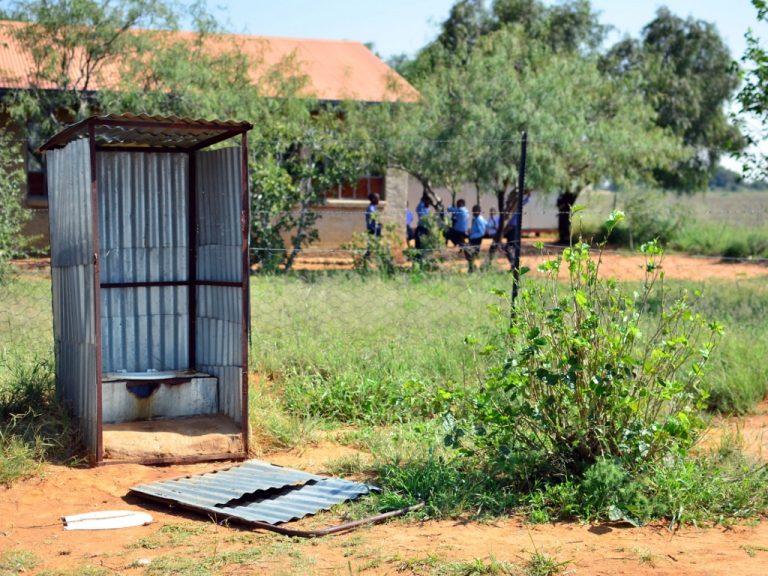
Limpopo’s Department of Education has prioritized the eradication of pit toilets during the coming financial year.

The department has allocated R32,291bn for phasing out pit latrines in 507 schools.

Education MEC Polly Boshielo said during her budget speech Tuesday, that the Department of Basic Education will oversee the process at 300 schools while 207 schools will be managed by the provincial education department. 

Limpopo has been marred by pit toilets controversy since the death of five year-old Michael Komape in January 2014. He was a pupil at Mahlodumela Primary in Chebeng village. He died after his school’s pit toilet collapsed and he fell in while relieving himself.  

The case is heading to the Supreme Court of Appeal (SCA) after Polokwane High Court Judge, Gerrit Muller dismissed compensation claims from the Komape family who were suing for damages from the government.

In the civil claim, the family sought R940 000 in general damages for emotional trauma including shock experienced as a result of the learner’s death and R2m for grief.

Instead, R6000.00 was awarded to each of Komape’s siblings for medical expenses. 

However, the court put the department on notice to install proper toilets in all rural schools.

The Komape family is appealing sections of the 2018 High Court judgment which dismissed some of their claims and the appeal will be heard by the SCA on September 2.     

Limpopo’s matric results were up a mere 3.8% from 2017s 65.6% to 69.4% in 2018. 

Education MEC Polly Boshielo

While it also managed to improve the 2017 bachelor passes by 2.1%, putting it as the fifth contributor of (bachelor) passes in the country, the department will continue to implement and intensify various interventions that will assist in improving learner performance in the 2019 Grade 12 National Senior Certificate. 

“We will continue to implement the second chance matric programme and intensify the support for learners who enroll for this programme,” said Boshielo.  

Major challenges in terms of delivering infrastructure projects because of staffing shortages continue to hinder progress.

Boshielo said vacant posts within the infrastructure unit will be prioritised this financial year.

“We hope this will enhance the effectiveness of the unit,” she said.

With the 4th Industrial Revolution beckoning, R75 million has been allocated to procure tablets, interactive boards and mobile science laboratories for schools, especially in the rural areas. 

These initiatives will assist in bringing learners on par with learners from other provinces in Information and Communications Technology (ICT) skills and the implementation of e-Learning. 

However, the department’s main challenge remains theft and vandalisation of school infrastructure including ICT equipment. 

“The department is appealing to communities to protect and jealously guard this infrastructure for the benefit of our children,” Boshielo said.  

Limpopo premier Stan Mathabatha said issues such as industrialization, and the delivery of basic services such as water, sanitation and roads are also focus areas for the province. 

Mathabatha was speaking at the province‘s provincial legislature in Lebowakgomo during the province’s budget speech. 

With the challenge of water shortages occurring in most parts of the country, the premier said he has moved the issue of water delivery to his office. 

“I will be working closely with water boards and municipalities which are water service authorities including the department of water affairs to ensure that they deal with whatever is preventing water to go to our communities,” he said. 

Following an unqualified audit opinion within the office of the premier from the Auditor General of South Africa (AGSA)’s consolidated general report on the local government audit outcomes; Mathabatha said a few management issues will require urgent attention and action. 

“An administration has been directed to ensure a sustained solution to all the issues which have been highlighted by the Auditor General,” said the premier.


New Colleges, 4IR High On Higher Education Department’s Agenda

The Department of Higher Education, Science and Technology plans to have a post school training institution in every district municipality over the next ten years.

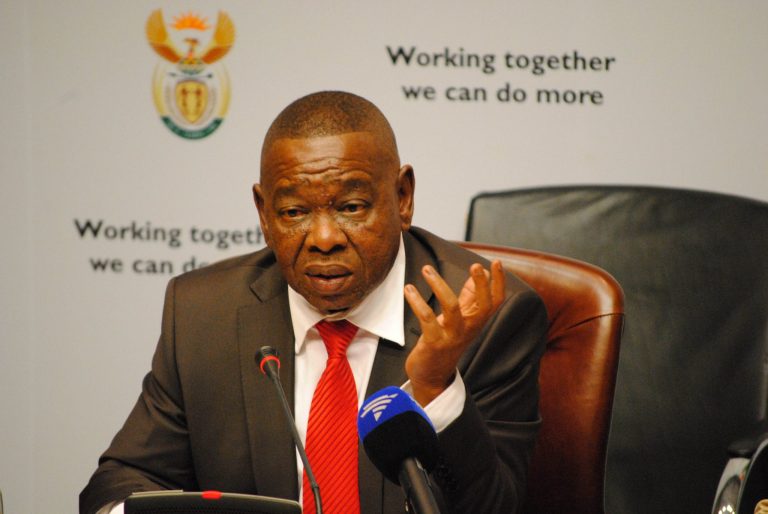
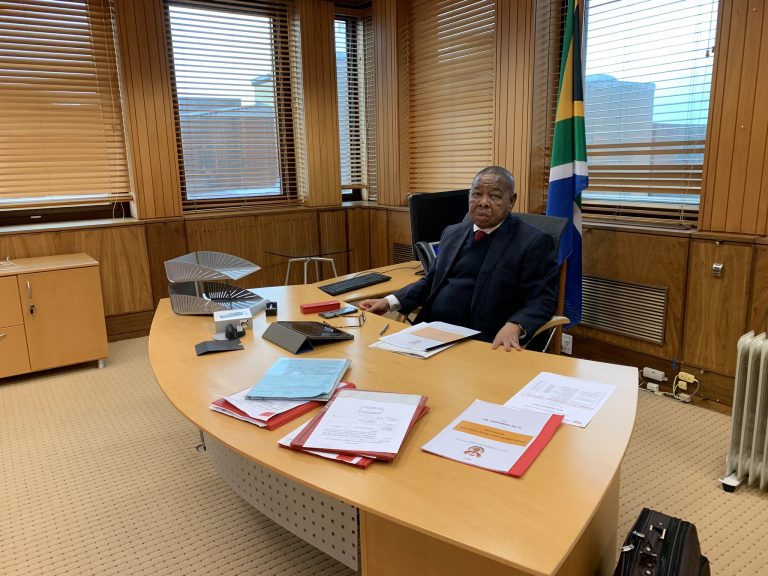
Delivering his policy vote address in the NCOP, minister Blade Nzimande said this will open and broaden access to children of the poor and working class to have a better chance than their parents to break the cycle of poverty and deprivation.

He added that nine new TVET college sector campus sites are under construction and scheduled for completion in 2020.

They include Sterkspruit, Aliwal North, Graaff Reneit, Ngungqushe, Umzimkhulu, Greytown, Msinga, Nongoma and Kwagqikazi.

Contracts will be awarded for a further four campus sites in Balfour, Giyani, Nkandla B and Vryheid for 2019/20.

Image result for TVET COLLEGES CONSTRUCTION

Construction will commence with a new campus site for Mitchells Plain in 2020.

Nzimande said his department has allocated R1 billion (2018/19 to 2021/2022) to roll out a College Infrastructure Efficiency Grant for maintenance at all 50 TVET Colleges.

He added that over R11 billion will be invested in infrastructure projects across South Africa’s 26 universities (2018/19 to 2020/21).

The minister also announced a Ministerial Task Team on the Fourth Industrial Revolution (4IR). The team will “provide critical policy advice and interventions required to align and effectively participate and innovate for this revolution,” he said.

The outputs from the Ministerial Task Team will work closely with the Presidential Commission on the 4IR and Inter Ministerial Committee (IMC) on the 4IR.

Nzimande said the Department of Higher Education, Science and Technology are developing a Skills Master Plan in response to the known skills demands associated with the 4IR.

This plan, he added, will be complemented by a national list of Occupations in High Demand and the Critical Skills List to inform career development services, resource allocation and enrolment planning.

Nzimande said his department also plans to “implement a new SETA landscape to further respond to the skill demands of our economy.”

“We will ensure that we strengthen, realign and repurpose SETAs so that they respond to the skills needs of our economy,” the minister said.

But, Nzimande emphasized, artisan skills development remains a top priority for his department whilst rapidly expand workplace-based learning through learnerships, work integrated learning and internships.

“We will further heighten our collaboration with relevant industries in provinces to ensure that our institutions respond to the skills requirements of provinces and municipalities,” he said.

Nzimande said there are plans to recruit a minimum of 100 new academics per year through the New Generation of Academics programme (nGAP).

Some 80% of these new recruits will be blacks and women South Africans under the age of 45.

There are also plans to increase the total headcount enrolment in higher education, in public and private institutions, to 1.62 million by 2030.

He also reaffirmed his department’s commitment to continue offering bursaries through NSFAS to support students from families earning a gross annual income of up to R350 000 per annum at universities and TVET colleges.

“The substantial investment in poor and working-class students over the 2019 MTEF, amounts to R82 billion for University students and R20.4 billion for TVET College students,” Nzimande said.

The minister said a huge chunk of the Department of Higher Education, Science and Technology’s budget, 82%, goes to University Education.

This is mainly as a result of the subsidy payment to universities through the National Student Financial Aid Scheme.

“As we work towards the revision of the TVET and CET College landscape, this current budgetary allocation of resources will change and align to the repositioning of these important sectors,” Nzimande said.

DBE & Japan Cement Maths Outcomes Initiative

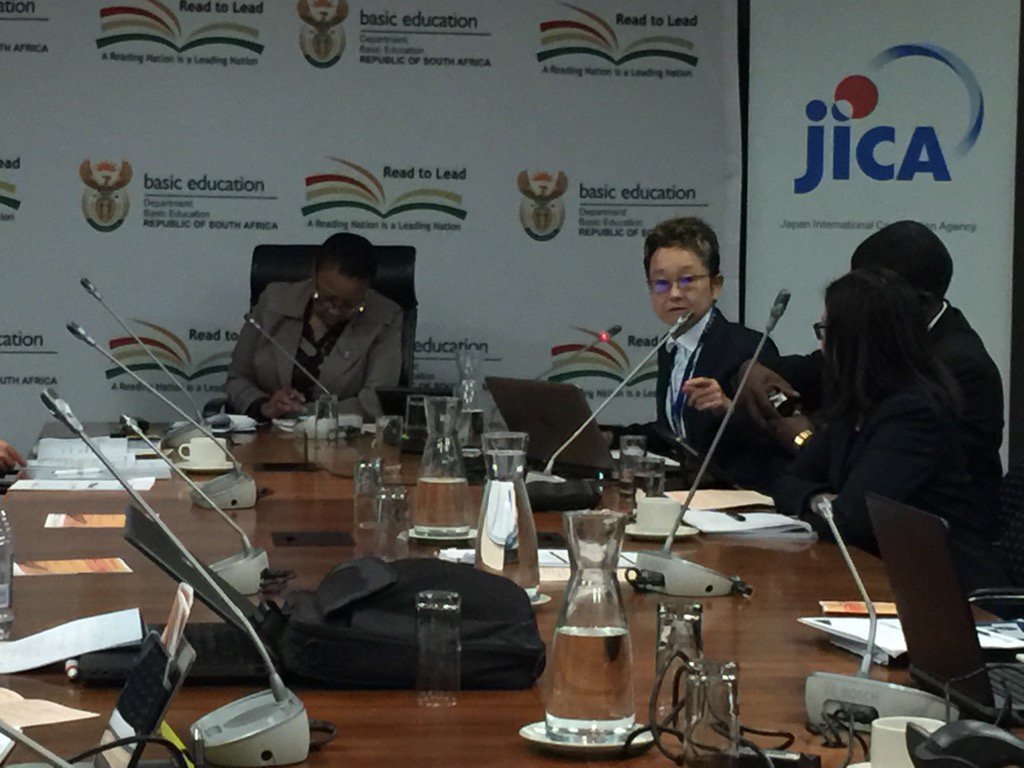
Basic Education Minister, Angie Motshekga and the Ambassador of Japan, Norio Maruyama has cemented a partnership aimed at improving Mathematics learning outcomes in South African schools.

The DBE cooperates with Japan through Maths specialists provided by the Japan International Cooperation Agency (JICA), and who are currently assisting provincial education departments in improving Mathematics learning outcomes.  

The DBE and JICA piloted the “In-School Monitoring Model” in 192 schools in the Eastern Cape and North West Provinces for monitoring the implementation of teaching word problems through lesson plan style activities using a guidebook.

The DBE-JICA Mathematics project will play a crucial role in improving quality passes in Mathematics, JICA said.

JICA also congratulated the DBE for having overseen a significant improvement in Mathematics during the 2018 National Senior Certificate (NSC) Examinations.

The two parties are now working towards the development of a teacher’s manual that will consist of lesson plans and critical pointers to address learning gaps in Mathematics.

JICA is further assisting the DBE with the establishment of the National Mathematics, Science and Technology Institute.

Maruyama reaffirmed Tokyo’s commitment to support the DBE in enhancing Mathematics outcomes, and announced that the contracts of the JICA Mathematics specialists provided to the DBE has been extended to 2020.

“Japan wants to continue providing the much needed support in the field of Mathematics, and is also willing to expand the support to include science and vocational education and training, to support South Africa in gearing itself up for the Fourth Industrial Revolution,” said Maruyama.

Only 1 Day Left For Online Applications – GED

The Gauteng Education Department (GED) has warned parents that there is only one day left for for Grade 1 and Grade 8 online applications for 2020 admissions.

The application period opened on 20 May and will close on Monday, 22 July at midnight.

The department said it had received nearly 300,000 applications.

“We call upon parents to submit those documents because we will not be in a position to issue any of the placements to any of our schools without the documents we are expecting from them,” GED spokesperson Steve Mabona cautioned.

However, to accommodate parents that could not submit documents within seven days following the application and those who made applications during the school holidays, the department said it had made provision for schools to accept documents until 14:00 on 31 July.

It said no further extension would be granted.

Mabona added that 62 028 of the 298 003 applicants had not yet submitted the required documents to schools.

Applications can be made by logging on to http://www.gdeadmissions.gov.za

“As a province, we are pleased that the parent population and stakeholders in Gauteng have embraced the use of the online application.

This groundbreaking online application has provided the department with credible and reliable information,” Gauteng Education MEC Panyaza Lesufi said.

Related image

“We will, therefore, continue to enhance this system and link it to other existing government systems, to further strengthen the credibility of the information attained.”

The placement period for admission in 2020 was expected to begin on 30 August and close on 31 October.

Inside Education Adopts Benoni Junior School In Memory Of Madiba On #International Mandela Day

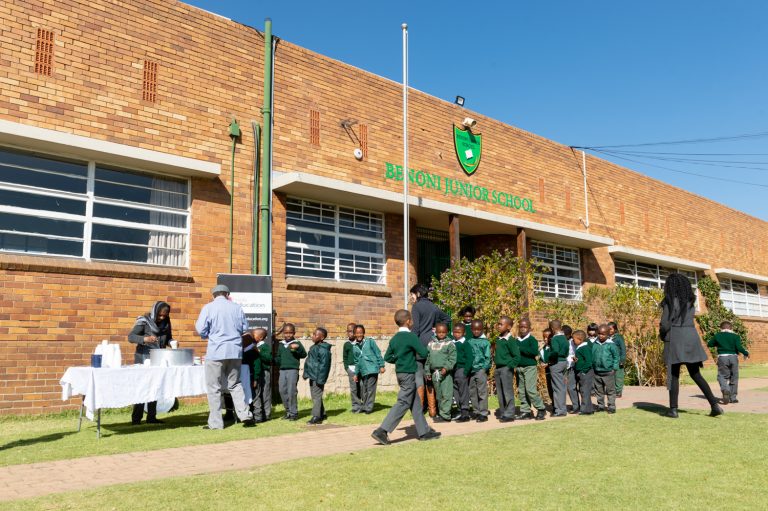
Inside Education has marked International Nelson Mandela Day, the annual international day in honour of South Africa’s first democratically elected president, by adopting Benoni Junior School (BJS) in Ekurhuleni.

The occasion was marked by serving 800 learners a hearty meal of soup and mini bread rolls, with K&K Media Chairperson Matuma Letsoalo, serving the first meal.

K&K Media owns the Inside Education and Inside Politics brands.

Inside Education Managing Director Matuma Letsoalo at BJS, Ekurhuleni

Inside Education also pledged sporting attire for the school’s netball and football teams which will be handed over in the next week.

BJS Principal, Pranisha Mansingh, said the school is thrilled and equally humbled by the gesture, adding that the intervention is “timely and needed.”

Adriana Botha, Matuma Letsoalo, Pranisha Mansigh and Charles Molele with learners of Benoni Junior School

“Our school was established the same year Tata Mandela was born, and it is indeed an honour for us to salute this global icon, marked by this important partnership with Inside Education.”

Letsoalo said the decision to adopt the school was motivated by the words of Mandela’s widow, Graca Machel who said that people should approach International Mandela Day not as an event, but a process, a “pledge for the whole year that goes beyond one’s daily activities.”

Charles Molele of Editor-in-Chief of Inside Education hands out bread to a learner of Benoni Junior School in Ekurhuleni

“This is exactly what we at Inside Education have done by adopting BJS,” Letsoalo said.

Letsoalo added, “We have entered into a partnership with this 100 year old school, and together we will decide what are the differences we can make so that it can become a way of being, and and have maximum impact on the lives of our future leaders.”

And, though these ‘future leaders’ may just be starting out, Nelson Mandela is very much ingrained in their young minds, as borne out by these impressive ‘Madiba Shirt’ designs.

Letsoalo said the decision to adopt BJS was further inspired by Madiba’s love for children.

“Children was very close to Madiba’s heart, and through this small, humble contribution, we are striving to emulate Tata by bringing smiles on the faces of South Africa’s future leaders.”

BJS learners from Room 7 offered a passionate rendition of the national anthem in honour of Madiba.

International Nelson Mandela Day is an annual day in honour of Nelson Mandela, celebrated each year on 18 July, Mandela’s birthday.

The day was officially declared by the United Nations in November 2009, with the first UN Mandela Day held on 18 July 2010

Basic Education Minister Unveils 11 Focus Areas In Budget Speech

Basic Education Minister Angie Motshekga says her department plans to enrol all South African children in a two-year compulsory Early Childhood Development (ECD) programme before starting Grade 1.

Presenting her departmental budget in Parliament Tuesday, Motshekga listed ten other focus areas for the DBE.

Among the department’s priorities — improving reading and maths for learners in early grades, the decolonisation of basic education, the implementation of a grade 9 exit certificate, and developing new ways of dealing with the delivery of school infrastructure.

DBE Minister Angie Motshekga’s Full Speech.

Motshekga said that ECD programme will improve the foundational skills of literacy and numeracy.

“To achieve that goal, we need to urgently proceed with the implementation of the two-years of ECD before Grade 1 and the systematic relocation of the responsibility for ECD from the Department of Social Development to the Department of Basic Education,” Motshekga said.

“The Department of Basic Education is working closely with the Department of Social Development and other partners to oversee the migration, and proceed with the process towards two years of compulsory ECD for all children before they enter Grade 1.”

Motshekga said that her department will develop a comprehensive plan for the different workstreams involved in the ECD function shift (Grade R, Grade RR, and Birth to 4), in collaboration with the relevant partners in government.

She added that a plan, including all the costs of the programme, will be finalised by March 2020.

Eradicating pit latrines in three years

Motshekga said her department had prioritised the Eastern Cape, KwaZulu Natal, and Limpopo to eradicate pit latrines over the next three years.

Earlier at a media briefing, DBE director-general Mathanzima Mweli, said the department has allocated R700 million for 2019/20; R800 million for 2020/21; and R1.3 billion for 2021/22 for completely clearing inappropriate sanitation in schools throughout the country.

The total 2019/2020 budget allocation for the DBE is R24.5 billion, an increase of 3.4% from the 2018/19 overall allocation.

Motshekga said the department will work at making sure that learners in early grades are able to learn to read, write and do mathematics.

“Although there are various factors affecting high school children that may trigger dropping out of school, the evidence shows that the root cause is inadequate learning foundations.”

Motshekga said this — among the other priorities — would be achieved by rolling out a primary school reading improvement programme that would help improve the quality of teaching home language literacy as well as English as a first additional language.

Motshekga said the department will launch reading clubs and hold reading competitions as a way to encourage learners to read.

And that by the end of the 2019-20 financial year the department would have adopted a national reading plan for primary schools.

Kiswahili As A Subject

Motshekga also announced that Kiswahili will officially be introduced as a subject in local schools.

She said a number schools, mainly around Gauteng, have been identified to pilot the language offering this year – with an aim of fully implementing it next year.

“I am delighted to announce that the Council of Education Ministers overwhelmingly agreed to incrementally introduce Kiswahili in our schools.

There is a high level of enthusiasm about this,” Motshekga said.

Getting Ready for the 4IR

As part of plans to future-proof the economy, president Cyril Ramaphosa has also pledged to introduce a number of technology-focused subjects to the curriculum.

In April, the Department of Basic Education (DBE) said it had trained 43,774 teachers in computer skills and would shortly begin training teachers for the new coding curricula.

Motshekga said that these teachers will be trained on coding from June to September 2019.

Coding as a subject will be piloted at 1,000 schools across five provinces starting in the 2020 school year.

Motshekga said the DBE will also introduce a robotics curriculum from Grades R to 9.

Department to build 40 schools this year

Motshekga added that her department will complete the construction of 40 schools and deliver sanitation to 775 schools and water to 225 schools by the end of 2019.

Some 606 schools will also be provided with sanitation through the Sanitation Appropriate For Education (SAFE) initiative, she said.

“School infrastructure provision remains a contentious matter that requires agility, innovation for effective delivery to accelerate the achievements that have already been registered.”

Motshekga said her department was discussing various financing options with the National Treasury and the Development Bank of SA, including partnerships with NGOs. 

Ditch The Double Standards

Concrete steps need to be taken to create awareness and monitor the implementation of a new international code aimed at stamping out “ethics dumping,” says Dr Lyn Horn, director of the Office of Research Integrity at UCT.

The Global Code of Conduct for Research in Resource-Poor Settings (GCC) was drawn up in response to a European Commission call for action opposing double standards in international research.

‘Ethics dumping’ is the term used to describe research activities in foreign countries that would be prohibited in the researcher’s home country; especially taking advantage of the lack of awareness, regulation or enforcement in some poorer countries to conduct unethical work that is illegal in developed countries.

The University of Cape Town (UCT) was the first university to adopt the new code in April this year.

Dr Horn said the impact of the code had been “limited” to date.

“Universities, including ourselves, who have now adopted the code do need to take concrete steps to create awareness and monitor its implementation,” explained Dr Horn.

Local communities can take measures to protect themselves against ethics dumping, like the San indigenous peoples of Southern Africa.

Because of their unique genetic properties, the San are in high demand as a research population.

Following a long history of exploitation, they developed the San Code of Research Ethics and now, researchers who wish to work with the San must adhere to this code.

Examples of unethical research practices being offshored include work that imposes high risks on research participants who are unlikely to benefit from the study’s results, as might be the case in some medical trials, failing to respect cultural requirements and refusing to compensate for harm incurred during a study.

Or it might occur because of the researcher’s ignorance of local spiritual beliefs, customs or requirements in the foreign country; like when local beliefs about the sanctity of human blood mean that genetic screening which uses blood, may be viewed as an affront to the sacred aspects of life.

“Whatever the cause, the result of ethics dumping is exploitation, and the risks for exploitation are not limited to individual participants,” says Dr Kate Chatfield, the Deputy Director for the Centre of Professional Ethics at the University of Central Lancashire (UCLan).

She said the GCC fills a niche which no other code has occupied before.

It consists of 23 clear articles that help funders, researchers, communities and individuals to recognise and address potential ethical pitfalls.

It emphasises that local communities must be involved in research in meaningful ways, right from the start, and that the end results must provide benefits locally.

Any research that uses biological materials and associated information such as genetic sequence data should clarify to participants the potential monetary and non-monetary benefits that might arise, and a culturally appropriate plan to share benefits should be agreed to by all relevant stakeholders.

An EU-funded project, TRUST, identified 88 specific risks for the exploitation of individuals, communities, institutions, animals and environments.

The GCC was recently adopted by the European Commission (EC) as a mandatory reference document for applicants to Europe’s biggest research fund: Horizon 2020 and the forthcoming Horizon Europe.

Professor Doris Schroeder, director of the Centre for Professional Ethics at UCLan said the EC’s adoption of the code as mandatory for all research funded under Horizon 2020 has given the movement against ethics dumping the “best possible start.”

Accelerate Transformation In Academia & Research Communities Demands Nzimande

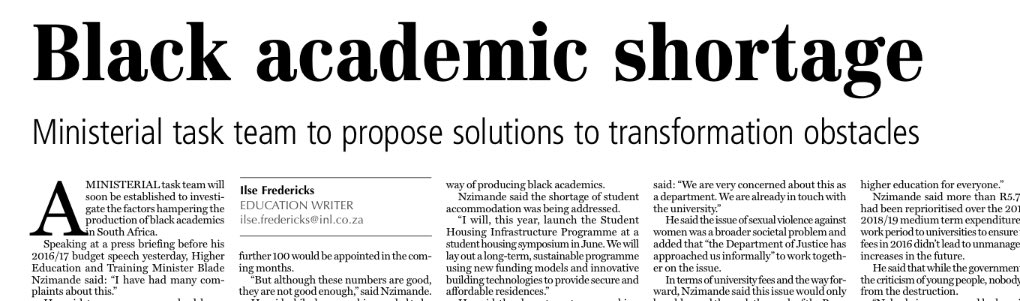
The findings of a study into what is retarding the production of South African black women academics is imminent, Higher Education, Science and Technology Minister Blade Nzimande has announced, and he intends to make the results public.

Speaking during his portfolio’s budget vote in Parliament, Nzimande said its important to “open the much needed dialogue and debate on how to accelerate transformation in our academia and research communities in our universities.”

He acknowledged that a lot has been done, but added that there is also a clear need and urgency to significantly accelerate transformation in the racial and gender profile of our academic and research communities.

“Both curricula and the nature of research questions must be framed such that they help overcome patriarchy and racism in broader society, including in the very halls of academia and research,” Nzimande added.

Earlier, at a pre-budget media briefing, he spoke of progress towards setting up a fund that will ease the risk of bringing new technological innovations onto the market.

The fund would receive R1-billion per year for five years, with the aim of making these new business ventures more attractive for investors, Nzimande said.

“The fund is designed to largely de-risk the early stages of technology commercialisation and/or business development. An injection of R1-billion per year for five years is expected to make a significant impact in making these businesses more attractive to investors for significant scale-up,” he said.

“In this context, it is crucial that we ensure that the nation’s future science, technology and innovation paradigm is intimately connected with the principles of promoting public good, equality and inclusion,” he said.

Nzimande said the past decade has seen a significant increase in applications for intellectual property rights licences and in the number of start-ups coming out of the country’s higher education institutions.

He said his department planned to use its budget increase for the current financial year — up to R8.15-billion from R7.79-billion — to support new research and the development of new industries that could serve to beneficiate raw materials exported by South Africa.

No Magic Wand To End School Violence – Basic Education Minister

Basic Education Minister Angie Motshekga says there’s no magic wand to end violence in schools.

Presenting her department’s her annual performance plan in Parliament, Motshekga said although all parties are aware of violence in schools it’s important “not to militarise schools.”

There is been an upsurge in school violence in recent weeks, with both learners and teachers falling victim.

Motshekga, while acknowledging that the violence in some schools was out of control, shifted responsibility of security in schools to provincial departments.

https://www.insideeducation.org/featured/school-safety-is-premiers-priority-makhura-at-sopa-2019/
Gauteng Premier David Makhura said school safety is a priority for his office during his SOPA speech.

“We don’t run schools, provinces run schools. So, if there are issues like security, those are done by provinces. And different schools in different provinces have got different needs and that’s why the strategy will be varied,” she said.

Committee Chairperson, Bongiwe Mbingo-Gigaba, said parliament will assist all role-players to ensure that schools are places of safety where education can take place without fear of death or injury.

“We agree that this requires a multi-sectoral approach and plan. Violence occurs in our communities and spills over into schools. This is a societal issues and must be addressed by us collectively to ensure a better and brighter future for all learners,” Mbingo-Gigaba said.

https://www.insideeducation.org/featured/talis-2018-key-findings-on-south-africa/

In terms of the budget, the committee heard that although it receives a budget of more than R24.5 billion, only around R6 billion remains with the National Department, with the bulk being transferred to the respective provincial departments of education.

Motshekga said her department would continue to work with police to make schools safer, adding that government will not turn places of learning into military zones.

https://twitter.com/thepres5/status/1148580706660036608

“We don’t want to militarise schools but we also want to protect teachers. So, what is the balance? Because we can’t allow guns [in schools], they are gun-free places.”

The committee commended the department for its National Reading Plan for primary schools to be implemented by the end of this year.

“This is definitely a step in the right direction in order to ensure that our learners read with understanding and comprehension. We will monitor this target and plan closely,” Mbingo-Gigaba said.

South African Teens Complete Cape-to-Cairo Mission In Self-Assembled Plane

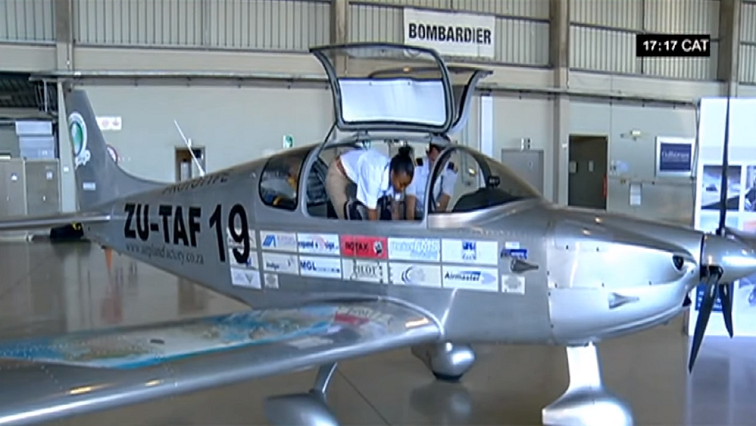
An aircraft built and piloted by South African teenagers has successfully touched down in Egypt three weeks after it set off from Cape Town.

The four-seater Sling 4 plane was assembled by a group of 20 students from vastly different backgrounds.

The teenagers in their four-seater aircraft left Cape Town last month and visited nine countries on their way to Cairo.

“I’m so honoured to have made a difference around the continent at the places we’ve stopped,” said Pilot Megan Werner, 17, founder of the U-Dream Global project.

“The purpose of the initiative is to show Africa that anything is possible if you set your mind to it,” she added.

Another Sling 4 plane, flown by professional pilots, accompanied the teen pilots on their journey.

The teenagers built the aircraft in three weeks from a kit manufactured in South Africa by the Airplane Factory.

Megan’s father, Des, who is a commercial pilot, said it would normally take 3,000 man hours to assemble a Sling 4.

The impressive feat had its challenges, Megan said.

In the Ethiopian capital, Addis Ababa, they could not get fuel.

“We were concerned about flying across Sudan because of the political unrest in that country.”

https://twitter.com/localblogng/status/1140284450154131457

The last leg, from Addis Ababa to Cairo via Aswan, tested the pilots’ mettle.

“Driaan van den Heever and I flew alone for 10 hours, without the support aircraft, so it was two teenagers, all by ourselves with no support,” Megan said.

The two pilots encountered a problem with one of their avionic systems about an hour into Egyptian airspace.

So they decided it would be better to land at the closest domestic airport in Cairo, instead of the international airport as planned.

“That created a little chaos but it was done in the interest of safety,” Des Werner said.

“In the end it was just a loose connection which they sorted out but the bureaucratic process took a while to sort out because they had to complete a report,” he added.

“When we landed in Egypt the authorities wanted to arrest us, take our passports and licences but luckily after about four hours, everything was sorted out and we got some more fuel and carried on to Aswan.

We then flew from Aswan to Cairo and it was a really awesome feeling to land here,” Megan said.