Home Blog Page 462

South Africa: Court to rule on Schweizer-Reneke teacher’s return

Zelda Venter 

The North West MEC for Education, Sello Lehari and his department, are no longer opposing the urgent application today by suspended Laerskool ­Schweizer-Reneke teacher Elana Barkhuizen to return to her post.

Lehari told labour union Solidarity late yesterday afternoon that he decided to withdraw his opposition to Barkhuizen’s urgent application before the Labour Court to have her suspension set aside.

Lehari indicated that he would abide by the decision of the court.

Lawyer Werner Human said the application was still on the roll and the case would go ahead as planned, as the court must rule on the legality of the suspension.

Both the school and its governing body earlier indicated that they, too, would abide by the court’s ruling.

Lehari and the department were due to deliver their opposing papers by 4pm on Monday, but missed the deadline. They informed Solidarity nearly 24 hours later by email that they would no longer oppose the application.

While Barkhuizen will not have opposition to her case, Human said it did not automatically mean that the judge would grant the order.

“The judge can still pose a few questions to us. The MEC in a statement sent to us acknowledged that he did not have the power to suspend Barkhuizen. He said: ‘I have no powers to suspend the applicant and at any time when reference was made to suspension, I was only confirming what was conveyed to me by the governing body.’”

Human said this was despite the fact that Lehari had clearly stated in front of scores of people that it was his decision.

Human said Barkhuizen still had to obtain an order that would entitleher to return to the school.

In her court papers, Barkhuizen said the children were at first seated in certain groups, according to needs such as communication barriers, as the school was predominantly Afrikaans and used an interpreter.

“I explained to the parents my approach to education and the outlay of my classroom. I explained my approach to seating arrangements, particularly with reference to individual learner’s needs and requirements.”

“It has everything to do with an effective teaching approach to the advantage of the learners themselves.”
Education department supports school, says sangoma pupil must cover beads

0

Sibongile Mashaba 

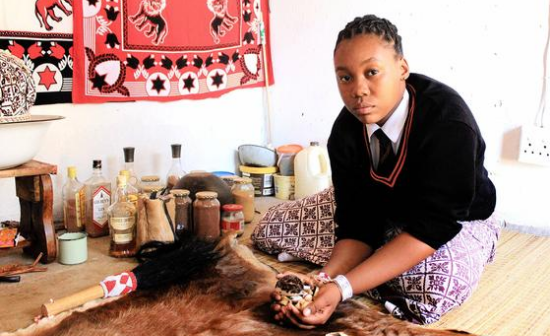
The Gauteng Department of Education is not investigating the violation of the Constitutional rights of the Sunward Park High School learner who is also a sangoma.

If anything, the department says that the measures put in place by the school are that the learner may wear her beads, but she must cover them up.

“According to the information at our disposal, a meeting was held at the school with the parents of the learner and measures were put in place in relation to the learner’s calling.

“The learner may wear her traditional beads, but she must keep them covered with a long-sleeved shirt.

“This is so that it does not attract attention from other learners or educators who may not subscribe to her calling,” said the department’s spokesperson, Steve Mabona.

On Tuesday, The Star reported that Bongiwe “Lwandle” Ngobese, 15, was allegedly called “a demon” by educators at the school for wearing her traditional beads and bracelets.

In the scorching heat, she is forced to wear a jersey to school to cover up the beads.

Mabona said: “The learner may not practice, promote or advertise her status as a traditional healer/sangoma at the school.”

Bongiwe underwent the initiation process in 2018 and missed out on schooling. She is in Grade 10 and wants to become a lawyer when she finishes school.

In an interview with The Star this week, Bongiwe said: “I love everything about my life and would not change a thing. I love being a sangoma and I enjoy it. My family supports me. My schoolmates know about it. I just have a problem with a few teachers who are discriminating against me wearing my traditional beads.”

Students get another chance for NSFAS financial aid

0

Nomahlubi Jordan 

Students whose financial aid applications were unsuccessful can appeal to the National Student Financial Aid Scheme (NSFAS).

“There are unfortunately some students who have been unsuccessful, based on information that we received from credit bureaus regarding their household income. Should a student want to dispute this outcome because of changes to the household income or Sassa status, they may lodge an appeal by providing the necessary documentation to NSFAS,” said spokesperson for the scheme Kagisho Mamabolo.

Students can lodge their appeals by completing a form that can be downloaded from the scheme’s website or by submitting their appeals directly to NSFAS offices, Mamabolo said.

He said appeals would be considered only if:

  • There is a “material” change in combined household income
  • A student lost a bursary/sponsor in the 2018 academic cycle
  • A student failed to meet academic criteria while he/she had a satisfactory academic track record
  • If more than one student from the same household is concurrently enrolled at a tertiary institution.

According to Mamabolo, NSFAS has assessed all 2019 applications of first-year students.

“Of the 417,000 applications received, more than 300,000 students have been declared approved, pending registration at public institutions for NSFAS funded qualifications.

“In December 2018, the NSFAS administrator, Dr Randall Carolissen, called for a review of the 109,000 applications that were initially unsuccessful for the 2019 academic year.  Following this process, more than 60,000 of these applicants have subsequently been declared financially eligible. As NSFAS processed applications in the pipeline, the number of unsuccessful applicants escalated to 65,000.”

Students are encouraged to log on the NSFAS self-service portal www.nsfas.org.za to check their application status. Successful applications will be indicated as: “Approved for funding subject to registration.”

Source: TMG Digital

Court lets Rhodes University lecturer off sexual harassment hook

0

Philani Nombembe 

A Rhodes University lecturer accused of sexual harassment has been given a reprieve, just 20 days before his contract with the university ended.

The institution hauled the lecturer, whose name is known to this publication, before a disciplinary hearing in July last year. The lecturer was found guilty of sexual harassment and he took the decision to the high court in Grahamstown to have it declared “unlawful and void”.

He challenged the guilty finding on technical grounds. The nine-page judgment does not give details of the alleged incident, nor does it reveal the person who made the allegations.

The lecturer complained to the court that the university had “failed to ensure a prompt resolution and conclusion of the disciplinary action” and that “the parties involved in [the] disciplinary hearing had resolved the matter between them in an informal manner that any action taken against him is tantamount to ‘double jeopardy’”.

But what got the lecturer hot under the collar was the fact that his disciplinary hearing was dealt with under a new harassment policy. The university’s harassment officer testified at the hearing that the old policy, although under review, was still being implemented.

“[Rhodes University] admits that the disciplinary hearing was conducted under the auspices of a new procedure. It is conceded in this regard that the new procedure was utilised on the bona fide but mistaken view that it had been approved by the Rhodes University’s governing structures and that it ought to have governed the [lecturer’s] disciplinary hearing,” the judgment reads.

Rhodes University argued that the case concerned a labour relations issue and that the high court was not the appropriate forum to hear the matter. The university denied that it had breached the lecturer’s contractual rights in a manner that could lead to the nullification of the disciplinary finding.

Judge Nomathamsanqa Beshe found that Rhodes University’s disciplinary code and the “old harassment policy” formed part of the lecturer’s employment contract and that the institution’s failure to “adhere to the two documents amounts to a breach of an enforceable contract. He has a right to be dealt with in terms of his employment contract.”

“I am not persuaded that the breach was not material,” said Beshe. “I am of the view that the [lecturer] has succeeded in making out a case for the relief he seeks. Accordingly the application succeeds. The disciplinary hearing against the [lecturer] is declared unlawful and void…”

Beshe made the ruling on December 11. The lecturer’s employment contract with Rhodes University ended on December 31.

#FeesMustFall activist Nompendulo Mkatshwa for parliament

0

Neo Goba

Former #FeesMustFall activist Nompendulo “Ulo” Mkatshwa will likely make it to parliament after elections as her name appears in the top 50 of the ANC’s national list.

Mkatshwa, 25, is among top ANC members who will be deployed to parliament, subject to her making it through the party’s vetting process. Mkatshwa, who became known during Wits’s #FeesMustFall protests in 2015, was regarded as the movement’s foremost leader, which included her SRC predecessors Shaeera Kalla and Mcebo Dlamini.

Earlier this year, acting ANC spokesperson Zizi Kodwa said candidates who made it to the 200 list will be submitted to the IEC by the end of January after the NEC gives the approval.

We understand that the party is yet to complete the vetting process of its members.

The vetting process, according to Kodwa, “includes criminal records, people who have a history of fostering divisions, people who have been to the DC of the ANC [and] people who can’t pass the test of the integrity of the ANC”.

Mkatshwa holds a BSc in geography from Wits and is furthering her studies.

Sowetan

Danone Cup promises to be spectacular

0

Staff Reporter

The under-12 Danone Nations Cup soccer season promises to be a spectacular one this year.

The call is out for primary schools around SA to register and enter their teams.

This year marks two major milestones in the history sponsors’ Danone, namely the company turns 100 and it is 20th edition of the tournament.

“It’s a privilege for Danone to be involved in this prestigious tournament,” said Chantel Ehlers, Internal Communications manager, Danone Southern Africa.

“Over the past 20 years, the tournament has inspired millions of youngsters around the world to believe in their dreams and develop healthy eating habits that will benefit them throughout their lives. As 2019 coincides with our centenary year, we have decided to host a spectacular double final in the place where it all began – Barcelona.”

Nomlinganiselo primary school from the Western Cape won the 2018 SA Danone Nations Cup and will compete against 18 other nations for the world title. The tournament is run under the auspices of the South African Schools Football Association (Sasfa).

Games will kick off at cluster level in March, with the national final in June or July. The world finals are in early October.

Schools can register by contacting Sasfa’s Themba Tshabalala @ thembatshabalala@saschoolsfa.co.za or on (011)403 2844, 084 290 0602 or 072 588 4957.

Professor Tawana Kupe at helm of an ever-expanding Tuks

0

Virgilatte Gwangwa 

THE University of Pretoria is the place to be, declares its new vice-chancellor, Professor Tawana Kupe.

Not only for him, but for its tens of thousands of students too.

It holds a number of special attributes, such as being the only university in South Africa to offer a sought-after degree in Veterinary Sciences, and its High Performance Centre is a sporting powerhouse.

But, most importantly for Kupe, who has taken over the position of VC and principal from Professor Cheryl de la Rey, is that it offers high-quality education across its faculties.

Speaking from the comfort of his new office in the administration building on Tuks’ main Hatfield campus, the 55-year-old Zimbabwean professor told the Pretoria News that he had been raised by teachers.

His mother was his Grade 1 and 2 teacher, while his father was the principal at the same school, later to become a school manager looking after 30 primary schools in his home country.

He said that from his time in high school, he knew he wanted to be a professor, just like his uncle. “My mother’s brother was a history professor and he would normally write me letters from New Zealand, Nigeria and the UK, where he worked.

“In the letters he would always tell me to value education, so when I was in high school, I would tell other guys that I was going to be a professor,” he recalled. After completing his Master’s degree in Zimbabwe, he was offered a tutoring post.

“When I finished (studying) I though I was going to be a teacher just like my parents, but when I went to bid farewell to my professors, they told me I could hang around and help with tutoring and marking, which I did.

“The first year into tutoring I had fun, and then people started giving me more and more work. By the end of the year one lecturer had resigned and I was told there would be a post advertised. I applied for the position and actually got the job from 1989.”

Six years later, Kupe completed a PhD in Media Studies at the University of Oslo, Norway, and returned to the University of Zimbabwe, where he worked in various departments before moving to South Africa to teach at Rhodes University.

Between 1991 and 2001 he was there, acting as the head of the Journalism and Media Studies department. Wits invited him to lecture on journalism and media studies, and he later helped to start their Media Studies department and became its first head, he said. Kupe said he was beyond excited to be joining the largest residential university.

“Tuks has 53000 students, followed by the University of KwaZulu-Natal, with 46000.

“This shows you that the university is responding to the national demand for higher education and the number is going to grow.

“If you come here in 2025, we will have 75000 students,” he said.

One of Kupe’s priorities is to step up the university’s transformation programmes to ensure that students pass and graduate in good time. The only way for this to happen is that they choose the right course – one that interests them rather than is driven by how much money they think they can earn.

Kupe said to ensure that they did not have a lot of drop-outs due to poor career choices, the university offered career counselling and guidance at their registration centre.

“Transformation is not just about demographics, more black students than white students, but it is about people passing and getting their degrees and finishing in time.”

He said 55% of Tuks students are black and more than half are female. “In the residences, 59% of students are black, but in people’s minds, Tuks is still a ‘white’ university.

“However, it is true that the transformation of academics has not been as fast as the transformation of students,” he said.

Under his leadership, Kupe said he wanted to ensure that students and staff felt safe, secure and free from any form of violation. “Part of our transformation programme is to mount advocacy programmes around gender-based violence, racism, homophobia and xenophobia among others.”

South Africa: Department launches investigation into matric Business Studies scores

0

Sne Masuku

THE Department of Basic Education is investigating how the scores of last year’s Business Studies matric pupils dropped dramatically in the final examinations.

While the department said it was not convinced that the complaints received were a national concern, as it believed the claims “come from certain groups and not everywhere else in the country,” the claims would be investigated.

The investigation comes after a Durban North principal conducted his own investigation and reported a “shocking drop” in Business Studies marks in the matric final exams.

Realising it would affect scores of matriculants’ entry into university, he called for the department to immediately review the results and for affected pupils to receive their correct results.

Nationally, the pass rate for the 192139 pupils who wrote Business Studies was 64.9%; in KwaZulu-Natal 59.5% of the 51588 matriculants who wrote the subject passed.

To qualify for a Bachelor’s pass, a requirement to enter university, pupils need to have passed all their subjects, but the affected pupils achieved 20% passes in the finals, although they had achieved 70% and above in their school-based assessments.

After a complaint by the principal of Oakridge College, Durban North, the DA also called for an urgent review of marking of last year’s Business Studies exam.

The SA Teachers’ Union brought the concerns of schools in KwaZulu-Natal, Mpumalanga and Gauteng to the attention of the department.

The union threatened legal action should the department fail to divulge information regarding the marking processes, the adjustment of marks and incorporation of the school-based assessment marks.

Last week AfriForum held a meeting in Centurion to seek answers as to why thousands of pupils had performed poorly in Business Studies.

A source told the Daily News yesterday that teachers who had not studied the subject, had not taught the subject at matric level, and had never marked the subject before had been appointed as markers.

The source claimed that some markers who had been doing the job for more than 10 years were not appointed.

The department said it would investigate claims by DA spokesperson on Education, Nomsa Marchesi, that markers did not have the requisite qualification or experience, and allegations concerning the conversion of marks during the data capture process.

Department spokesperson Elijah Mhlanga said they would also investigate why these claims come from “certain groups” and not everywhere else in the country, and give feedback at the right time.

“We have received a letter that reads almost the same as the one we got from the DA. What we find interesting is that the complaints come mainly from a certain group of people representing a certain section of society.

“In these letters, the authors say the concerns regarding the paper have come from ‘countrywide’ ,but in our engagement with districts and schools we have not come across this particular issue,” he said. “We take it seriously and at the right time we will make our public standpoint,” he said.

While the investigations would get under way, some of the affected candidates already accepted at universities told the Daily News yesterday they were left with no choice but to apply for re-marking, because they feared the investigation would take long.

The closing date for re-marking was Friday, January 18.

They would have to wait until April to see if there would be any change in their marks. By then, it would be well into the end of the first trimester of the year and they would have lost their places, sponsors and bursaries.

In 2017, Mvelo Lusiba from Velabahleke High School lost his university sponsorship after the department bungled his maths mark.

As per his original NSC results sheet, he had obtained eight distinctions and 67% for maths. Knowing he was a top pupil, his principal took him to the department offices in Durban, where it was found that he had in fact got 93% for maths.

Daily New

South African schools will start teaching Kiswahili to students from 2020

0

Abdi Latif Dahir

Africa’s most “internationally recognized language” will soon be taught in South African classrooms.

The push to embrace the Swahili language comes as African countries look into plans to reform and critically assess their education systems. There’s also the recognition that the continent needs a new strategy for mother-tongue based education from primary through to tertiary level education, and to cast aside dependence on foreign languages. This realization also arrives as African languages continue to die as governments adopt official languages while discouraging local ones, in hopes of forging a harmonized national identity.

In a continent with more than 2,000 distinct languages, the role and importance of indigenous African languages in post-colonial modern societies has also proved to be a contentious issue. Over the last few decades, the place of African languages has suffered negative consequences due to colonization, globalization, and the entrenchment of official languages like English and French. African languages have often been labeled as a hindrance to learning, and have suffered delegitimization at social, economic, and political spheres.

More often than not, foreign languages have also displaced African languages in educational, cultural and even leadership spheres. For instance, at his farewell speech as the chairman of the African Union in 2004, Mozambique’s then-president Joaquim Chissano surprised African leaders by delivering his remarks in Kiswahili. At the time, the AU was only using English, Portuguese, Arabic, and French as its official languages—and government officials, caught unawares, scrambled to find translators. The event later pushed the continental body to introduce Kiswahili as an official language.

Since then many governments and activists have moved to call for institutions, both local and foreign, to embrace the Swahili language. In 2015, Tanzania announced it would dump English and solely stick to Kiswahili as a language of instruction. Campaigns have also been launched to get social media giants like Twitter to recognize Swahili—albeit in vain so far. Motshekga’s announcement also comes just weeks after the leader of South Africa’s Economic Freedom Fighters party Julius Malema suggested Swahili be adopted as the language of the African continent.


Help, at last, for Kenya Tana River girl who walked long distances to raise school fees

Collins Omulo

A girl from Tana River, who worked as a house help and trekked for more than 15 kilometres in a bid to raise school fees to join secondary school, can now smile as she is set to finally join Bunyore Girls High School.

This comes after the high school’s alumni group came together to raise funds and resources to help her join the school.

Bunyore Girls Alumni chairperson, Vicky Owake, said that the group learnt of Juliana Koshi’s plight when her story appeared in the media prompting them to step in.

“One of us saw her photo in the newspaper and shared it in our WhatsApp group. We did our due diligence, looked for contacts to get to her and then contacted Tana River Woman Representative Rehema Hassan to help us get hold of her,” said Owake on Saturday.

She said so far the alumni group – through its welfare page which consists of 120 members – has raised Sh93,000 while the county government has chipped in Sh50,000. An additional Sh27,000 set to be paid directly to the school through the Constituency Development Fund (CDF).

“The school’s principal told us her slot is still available and so she will be travelling to the school for admission next week. She will need Sh54,000 for her first term fees and other necessities,” she said.

WELL-WISHERS’ HELP

Owake called on more well-wishers to come forward and make sure that the student goes to school even beyond secondary school while at the same time challenging the county government and Galole Constituency CDF office to support the girl throughout her secondary education.

“Most of us went to school through being helped by others. Why don’t we also do the same to others? I am appealing to all alumni, even those in the diaspora, to come out and ensure that the girl goes up to university. We also intend to open a fund that will also help other needy girls admitted to Bunyore Girls,” said Owake.

Juliana Koshi holds up her admission letter to Bunyore Girls High School on January 19, 2019. She will be joining the school for her high school education. PHOTO | FRANCIS NDERITU

She challenged other needy students not to keep quiet with their problems but come out for their plight to be highlighted so that they can get help.

The 15-year-old girl from Hola took it upon herself to see that her dream of one day becoming a cardiologist is realized.

Staring at a bleak future after scoring 358 marks in last year’s Kenya Certificate of Primary Education (KCPE) examination at Hola Primary School, she knew that just sitting at home and cursing why she was born into a poor family would not help her aspirations.

HOUSE HELP JOB

The last born in a family of three girls and one boy decided to get a job as a house help not far away from their home immediately after the KCPE exams knowing too well that her parents, who are all jobless, were not going to be able to raise school fees to take her to secondary school.

She worked for a month a family comprising a father, mother and their child but she felt that with her monthly pay of Sh4,000, it would take her at least a year to only raise enough money for cater for first term at Bunyore Girls High School.

“I realized that even with the support from my employer, my brother who tilled farms in a bid to help me raise the money needed, the burden was still too big. My dad is also old and sickly while my mother is a charcoal burner. We are barely managing,” said Koshi on Saturday during an interview at Nation Centre.

The young girl hastily left her house help job and embarked on traversing across villages to seek for whatever little help she could get.

In the process she ended up walking for more than 15 kilometres in a bid to raise the required school fees. It is through her desperate efforts that her plight was highlighted in the media.

Thankfully, she can now afford a smile after help finally came her way.

“I would like to eventually join the University of Nairobi to pursue a course in Medicine and later become a cardiologist,” she said.