Home Blog Page 466

State-of-the-art school in Tsakane informal settlement unveiled

Charles Molele

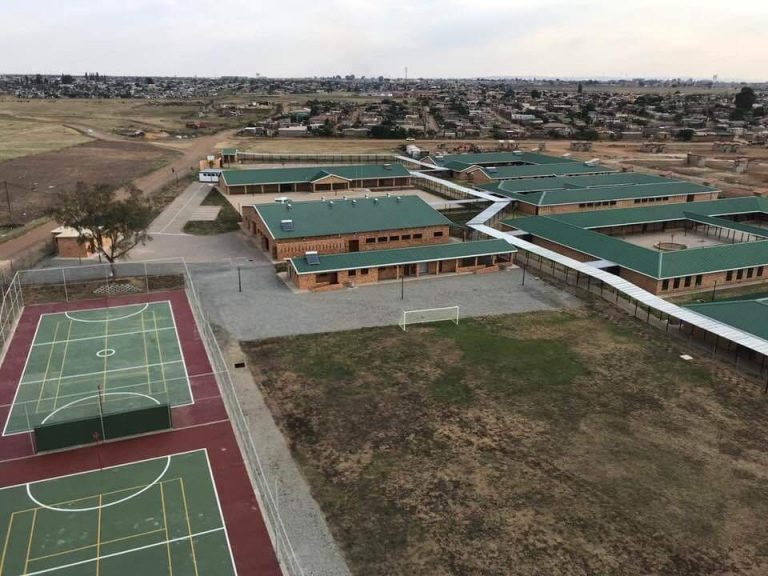
The life of five-year-old Busisiwe Madidiza has changed significantly since the opening of the new R105 million state-of-the-art Menzi Primary School in Tsakane, Ekurhuleni.  

According to her mother, Nokuthula (35), her daughter’s numerical and communication skills have improved dramatically since she enrolled at the brand new school last year.

The school, which is a modern information-technology-based facility, is built right in the middle of extreme poverty, with dirt roads and shacks built from corrugated iron sheet.

“My daughter now can read and write well just like those in [former] Model C schools in the suburbs, thanks to this new school in our township,” Nokuthula said on Wednesday during the official opening of the school by Gauteng Premier David Makhura, MEC of Education Panyaza Lesufi and MEC of Infrastructure and Development Jacob Mamabolo.
“I am not sure where she will land in future but the greatness that already lies within her is already showing in a profound way.”

Menzi Primary School caters for 1 088 learners from Grade R to Grade 7. It has 33 smart classrooms, two science laboratories, a library, IT control rooms, a nutrition centre, a dining hall, 5 courtyards, sports facilities and a 1 088 capacity school hall.

The building of the school is in line with Gauteng’s modernisation programme to create smart classrooms.

The construction of Menzi Primary School began in 2015 but faced many challenges along the way including strikes and work stoppages by local sub-contractors as they demanded more work and that more locals be employed on the site.  

Despite these numerous challenges, the project was successfully executed and a sectional handover was done during the first week of December 2017 – this is according to the Gauteng Department of Infrastructure and Development.

During the opening, Lesufi appealed to members of the local community in Tsakane to protect the multi-million rand state-of-the-art school from vandalism and theft from local criminals.

“All our schools in Duduza and Tsakane were burgled and broken into during the school holidays this past December. I am appealing to community leaders to protect the school from theft and criminals.


“The department of education invested more than R105 million into the construction of this beautiful school and all we want is to see our children go to school without any hindrance,” Lesufi said.

He added the newly built school was the first in Tsakane to have smart classrooms.

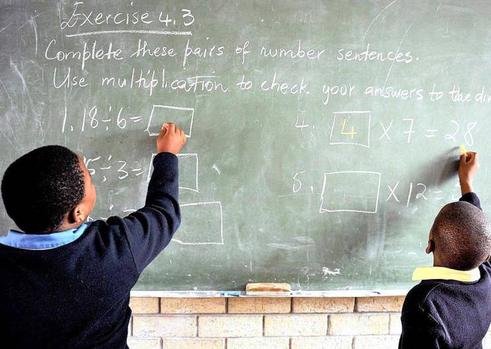
“This is the first primary school in this community where our children will never smell chalk; will not be asked to go and clean a duster and will not know what is a chalkboard,” said Lesufi.

Lesufi told parents and community leaders present that the local children from the nearby townships now have an opportunity to change their lives for the better with the opening of the school.

“The children of this community are the first generation that will not queue for a RDP house but will queue for a graduation ceremony,” said Lesufi.  

“We must unleash these children to be part of the Fourth Industrial Revolution (4IR). These children here today will not have somebody to drive to Eastgate Mall. A driverless car will drive them there. That is why in the history of KwaThema, Duduza and Tsakane, our children will never be exposed to a blackboard as we know it.

“We provide classroom devices in the form of interactive boards. We say, One Learner, One Tablet. This school is connected to data and the learners have access to information and general knowledge just like any learner in any school in the suburbs,” said Lesufi.

Makhura congratulated his Lesufi for making it possible for the province to claim the number one spot at 87.9%.

“Education is a number one priority in Gauteng and we are happy for being declared number one. We are number one not because of the schools in the suburbs but because schools in the townships have improved,” said Makhura.

“This school does not belong to the Premier or the MEC Lesufi. It belongs to the community for the benefit of the children so we need to make sure that our children are safe and study in a conducive environment.”

Community leader Buti Cindi (62), told Inside Education that the ward committee will work with the community to ensure that the school is protected and not burned during service delivery protests as is the norm in South Africa.

“We are going to convene a meeting to educate to our people that we must protect this school. If we have a service delivery protest, let us resort to other forms of protests rather than burn a school and destroy this much needed infrastructure,” said Cindi.

Acting Ekurhuleni Executive Mayor Lesiba Mpya promised to build better roads connecting to the school after several people complained about the condition of the roads in the area and riding in the gravel roads with stones, mud and sand.

The school was built on dolomite ground.

“We noted the conditions of the roads. They are definitely not in good shape. But we promise that we are going to include the construction of the roads in our budget for the 2019 financial year,” said Mpya.

EFF branches to be deployed to primary schools to assess admissions

Naledi Shange

Branches of the EFF will be deployed to primary schools on Wednesday January 9 to ensure that the admission of grade one learners commences without any glitches, the party said on Tuesday.

“All EFF branches will report to their nearest primary schools for the back to school campaign. We will be there to help teachers and parents, for a successful registration period and first day at school,” party spokesperson Mbuyiseni Ndlozi said in a statement.

The class of 2019 was expected to complete its matric in 2030.

Ndlozi called on the education department to ensure that the bulk of these children made it to their matric year.

“Care must be given to ensure quality education, not only 12 years later when the department cannot account for over 60% of them, as is the case each year during matric results,” he said.

“The South African education system must correct the sin of child neglect it has committed over the years. Just in the last five years, of the learners who started grade 1 more than 12 years ago, the department only managed to pass an average of 35%. Over 60% have either failed, or dropped out, and no doubt, [the] majority of these children are the black poor in townships and rural areas.

“No country must ever satisfy itself with such a track record, unable to ensure that {the] majority of its youth, particularly the poor and marginalised, attains a national senior certificate. It is the greatest shame on the ANC government that they could not improve this situation, thus keeping millions of black youth in a permanent state of under-education,” he added.

Sowetan

South Africa’s zero-percent pass schools face the music

Thami Magubane

The KwaZulu-Natal Education Department has summoned the schools that achieved a zero-percent pass rate in the matric exams last year to explain what went wrong.

Nine schools in KZN produced a zero-percent pass, according to the results released last week.

This was a marked increase from the three schools that had a zero-percent pass in 2017.

Education MEC Mthandeni Dlungwane had previously said the department was working to ensure no schools in the province had all their pupils fail matric.

“We will meet the school principals and district directors before the week is out for an explanation of why this went wrong despite all the support provided,” said Education Department spokesperson Muzi Mahlambi.

“Some of the schools are non- viable schools (where there are not enough pupils) that we wanted to close down. But we faced opposition from the community who are sentimental about those schools.

“The total number of pupils combined that failed is less than 100 as most of these schools have very few pupils, but that does not change the pass rate. If a school has one pupil and that one pupil fails, that is a 100% fail at that school,” he said.

He said the outcomes of the meetings with the principals and district officials would be presented to the communities where the schools were situated to convince them the schools were not academically viable.

However, unions and political parties laid the blame for the schools’ poor performances on the department, saying it had not provided them with support.

DA education spokesperson Dr Rishigen Viranna said the schools were situated among the poorest and most vulnerable communities and deserved strong support.

He said the plan to phase out non-viable schools had stalled.

“If you look at the classes where the pupils failed, they are not big classes, some of the classes only had eight pupils, one had 17, so it is not an issue of overcrowding,” he said.

SA Democratic Teachers Union (Sadtu) provincial secretary Noma- rashiya Caluza said among the challenges was that the number of teachers was determined by the number of pupils at a school, which should not be the case.

“The number of teachers at the school should be determined by the number of subjects being taught at the school.

“When the number of teachers is cut because the number of pupils has declined, teachers are forced to teach multiple subjects – some of the subjects they never trained for. We have always stated that the number of teachers should be equal to the number of subjects,” she said.

She said the lack of urgency when appointing teachers was also contributing to the problem. “If the department appoints a mathematics teacher only in September, what is that teacher going to achieve?”

She said targeted intervention could turn the situation around, saying that Sadtu had adopted a school that had a zero-percent pass in 2017 and in 2018, the school’s matric pass rate had improved to 55%.

The Mercury


University of Johannesburg cautions against third-party agencies

0

Lindi Masinga

The University of Johannesburg (UJ) on Tuesday, said that the 2019 student registrations were progressing smoothly and warned prospective students against third-party agencies.

“By lunchtime today, Tuesday, 08 January 2019 – just more than 36 hours after the online registration process went live on Monday, 07 January 2019 – over 3000 students had been registered, and the numbers are growing every hour,” UJ Registrar, Prof Kinta Burger, said.

“This trend is consistent with the numbers seen in previous years, which confirms that new and returning students are comfortable with the online registration process.”

UJ said registrations by new and returning students for the 2019 academic year were proceeding well on the first day of registration.

The university said the virtual registration system had again assisted them in ensuring that all four campuses were well prepared for the 50 000 students who would be studying at UJ in 2019.

UJ said by 9am on Tuesday their call centre had handled 20 000 calls, while the late enquiry system had dealt with more than 30 000 queries.

The university urged prospective students to take caution when approached by individuals offering assistance in the registration process and promising placement.

“UJ has noted with concern that there are individuals and agencies promising academic admission and funding to prospective students. The university is not in agreement or partnership with any third-party agencies or individuals to process applications. Prospective students are urged to use the late application enquiry system to avoid disappointments,” said Burger.

The university said admissions were competitive, and they could only admit a limited number of students.

“The planned intake of undergraduate first-year students for 2019 is 10 000. This number of spaces available is in accordance with the formal Enrolment Plan approved by the department of higher education and training.”

African News Agency (ANA)

Education MEC tells parents not to panic

Matlhatsi Dibakwane

Children not in school today will soon find a place in a classroom.

This was the assurance from Gauteng MEC for Education Panyaza Lesufi, who addressed the media yesterday.

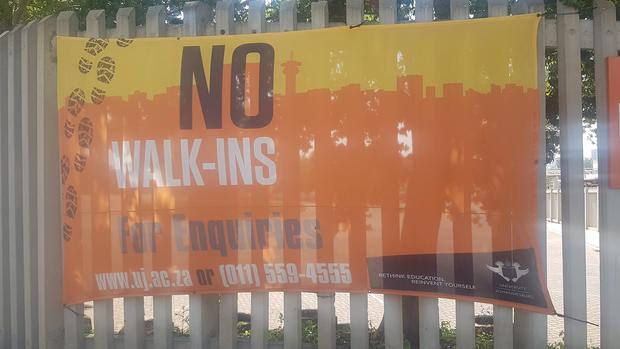
He said there had been a rush of late applications, but parents should not panic because children would be accommodated where there was space for them. The deadline for registrations was closed and walk-ins were referred to district offices, not schools.

Panicky parents sat in a queue at the department’s Tshwane West District office in Odi yesterday, saying with a day to go, they were losing hope their children could start school today.

They were openly critical of the online system of admissions for Grade 1 and 8 pupils.

Among them was Sandra Kwata, 26, who said the failure to place her child made it seem as if she was disorganised. Yet, she said, her online application was not approved and now, a day before school opened, she was spending her days waiting in queues and had not even bought uniforms for her daughter who was supposed to start Grade 1 at Bokamoso Primary School in Soshanguve Extension 4.

“On Monday, I was told to go back to Bokamoso, but the school told me to come back here. And yet again the same long queue waited for me.”

Another parent said she had to call her family to find out the location of Thuto Thebe Primary School in Ga-Rankuwa where her son was placed.

“After being told to go there, I was confused as to whether I should take a taxi to town to buy uniforms or hear from the school first. I am truly hurt because my child might miss his first day at school,” she said.

Lesufi said the department had concerns when the online registration closed last year and there were still parents who had not applied.

But he said he would not compromise education by allowing 80 children to be placed in one class.

Basic education department lashes out at WCED over #MatricResults claim

Staff Reporter

The Department of Basic Education (DBE) on Sunday questioned the Western Cape education department’s assertion that the province produced the highest 2018 matric pass rate.

“It is disappointing that the Western Cape education department (WCED) should have released a statement, on 4 January, claiming, on the basis of what is a patently flawed analysis that the province produced the country’s highest number of National Senior Certificates (NSCs) relative to the population,” the department said in a statement.

“This is incorrect, and masks serious challenges which the Western Cape faces when it comes to getting poorer and black (specifically black African and coloured) youths to successfully complete Grade 12,” it said.

The table released by the WCED, claiming the province occupied position one, divided NSCs in 2018 by Grade 10 enrolment two years back, so in 2016. The problem with this was that the Western Cape’s grade repetition in Grade 10 was exceptionally low, meaning that the resultant statistic would be superficially high.

“These statistical issues are something officials in [the] WCED are well aware of, as they are discussed at planning meetings where the national and nine provincial departments meet.

“The reality, according to credible statistics released by the DBE, for instance in the 2018 NSC report released recently, is that Western Cape sits at roughly the national average, or slightly above, when it comes to youths attaining the NSC,” the DBE said.

“It is clearly not in position one. The Western Cape has historically not been good at ensuring that black African and coloured learners attain the NSC.

“If one counts just these two population groups, then [the] Western Cape still lags behind Gauteng, KwaZulu-Natal, and Mpumalanga when it comes to attainment of the NSC qualification (this is according to household data, but analysis using just administrative data from the education sector confirm this).

“This situation has prevailed despite the fact that [the] Western Cape performs rather well in the international tests, and is favourably placed when it comes to teacher qualifications and school infrastructure. These contradictions should receive closer attention by [the] WCED. [The] WCED should not be publishing clearly misleading statistics that hide real challenges,” the DBE said.

African News Agency/ANA

How technology, businesses and communities help poor schools thrive

William Gumede

It would take a Herculean effort to rescue South Africa’s failing government schools in townships and rural areas, yet it is urgently necessary because a globally competitive quality education is the best possible black economic empowerment, radical economic transformation and country investment strategy.

Quality education gives one economic freedom. South Africa will have to muster the political will to bring public education to the same quality level as elite private education.

Recently, I returned to my old high school, Ravensmead Senior Secondary School, on the Cape Flats, to give an address to pupils, parents and staff before the matric exams.

The school is located in a triangle of townships among the most violent, most drug- and gang-infested areas on the Cape Flats, if not, in South Africa.

In the 1980s, it was the incubating area for local competing gangs – the Ugly Americans, Sexy Boys and Hard Livings. Many of these now gang leaders were competing peers.

Sadly, although apartheid has ended, lack of public service delivery, effective policing and high unemployment has made it appear that nothing has changed for the better in the townships surrounding the school.

Single mothers, absent fathers and an increasing number of child-headed families are the norm. Drug peddlers, shebeens in residential areas, continuing gangsterism and an unreliable police service are still the daily experience for many. In spite of this unpromising environment, Ravens­mead Senior Secondary School has consistantly produced good results.

What would be the basis of a formula for success to turn around ailing government schools?

The idea that it takes a community to educate a child should be reinvigorated. A new concept of school community should include not only the immediate village or township, but a much broader community that would include civil society, members of the immediate community with the time to spare, even if they do not have children at the particular school, and successful former pupils not living in the area any more.

But the new community should also include privileged schools in surrounding suburbs, privileged individuals with no immediate connection to the school, business and the government.

Government schools must have dedicated school principals and teachers. The principal at Ravensmead during my time was a trade union leader – in fact, he was president of one of the country’s prominent teacher trade unions. He put the interests of the pupil, education and the school first, rather than those of the trade union, which is often the case nowadays.

The teachers, in spite of apartheid restrictions on black education, did their best to teach a curriculum that was global in its outlook. They went out of their way to teach music, culture and sport. It only dawned on me long after I matriculated, when travelling, studying or living in a number of countries abroad, that the songs I learned at school were from across all these different cultures, including our own wonderfully diverse South African ones.

My maths, biology and physical science teachers went far beyond the call of duty to catch up with the missing curriculum before the 1988 matric exams. They generously gave sessions before and after school.

The school believed in developing all-round pupils – in spite of the apartheid attempt to educate blacks to become unskilled labour. After hours at school was a buzz of sport, cultural and music activities.

When I walked across the school sports field, before my talk, I could only wonder now how we managed to have a considerably small sports field, but one that squeezed in a ­soccer, rugby and cricket pitch into one.

Play-time for different sport codes often had to be staggered. Physical education was done on the netball court.

Yet, this same matchbox-like field produced Proteas all-rounder Vernon Philander and former Orlando Pirates midfielder Kamaal Sait.

Parental, community, civil society and former pupils’ involvement in black schools is crucial to improving the quality of schooling. However, the reality in many townships is that parents are practically unable to be involved, as those with jobs leave home at the crack of dawn and arrive back home long after sunset.

After the end of apartheid, those who could do so left the townships and rural areas, depriving these communities of alternative role models.

Community representatives who are available, civil society organisations, outside professionals or accomplished former pupils who may have left the areas they grew up in must volunteer to play the role of parents in school bodies, to mentor pupils and provide guidance, even from afar.

Unemployed parents could patrol outside the school and ensure that drug dealers, criminals and opportunists do not molest pupils.

Rich schools in the suburbs should partner with poorer township schools. Technology makes it possible for teachers in a privileged school to beam out the same lessons to a school in a poor community. Parents with children in privileged schools could get involved in mentoring in poorer schools.

Businesses should actively support poorer black schools. I remember in 1987 and 1988, Gencor sponsored a two-hour computer-based learning programme for maths and science for selected township schools in the Western Cape, Eastern Cape and KwaZulu-Natal.

Luckily, Ravensmead school participated in the programme when I was in matric in 1988. It definitely helped me get familiar, for the first time, with a computer keyboard, and to work through maths and sciences cases that I would never otherwise have been able to.

Public school inspectors, dropped at the end of apartheid, should be reintroduced. The independent oversight of teachers is crucial to raising the quality of government schooling.

Gumede is the executive chairman of the Democracy Works Foundation (www.democracyworksfoundation.org) and author of South Africa in BRICS (Tafelberg).

#MatricResults2018: For those who failed, this is not the end of the road

Omphitlhetse Mooki

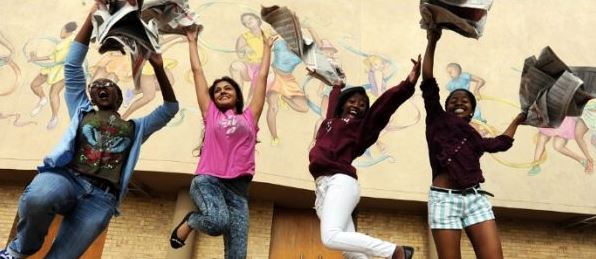
Bucket loads of tears were shed last week – tears of joy and tears of sadness.As some leapt for joy and basked in the glory of attaining great results in matric, there were those who had nothing to celebrate, their names not listed among those who have made it.

For them there were no calls from aunts and uncles sharing the joy with proud parents.

There were no sparkling accounts of their hard work on social media sites. Instead, they probably felt judged.

If no one pays attention or offers words of encouragement, these matriculants could sink into a deep, dark hole of depression, feeling like failures because, unlike their peers, they’ve got no fruits to reap for work done not only last year but over the course of their high school years.

Their peers are busy talking tertiary education or taking gap years to travel, but for these young people who’ve failed, the future looks bleak.

This is a critical time as some young people tend to become suicidal, mostly because they feel isolated. Psychologists have listed social isolation as one of the triggers, and this is particularly worrying as the SA Depression and Anxiety Group (Sadag) and the World Health Organisation (WHO) described as a crisis the state of youth and mental health in the country during last year’s mental health awareness month. The WHO said close to 800000 people die due to suicide every year, which is one person every 40 seconds.

According to Sadag, 17.6% of South African teens had considered attempting suicide, and over 20% of 18-year-olds had one or more suicide attempts.

Parents, caregivers and extended families should pay attention and offer support, encouraging these young people to understand that failure isn’t the end of the road. They can pick themselves up and write matric again.

When Professor Mamokgethi Phakeng urged graduates to post pictures of their graduations and share their stories last year, one young man shared a story of how he had failed matric, rewrote the next year and barely passed, then tried again four years later and passed well enough to get accepted to a top local university.

That young man who failed matric in 2003 now holds two degrees, and his hard work and determination later earned him a scholarship to study towards an MA at a UK university.

This story of perseverance shows just how far one can go if one keeps trying. So to those who didn’t make it, or didn’t pass well enough to pursue degrees that would ensure they get to pursue their chosen careers, there is still hope. Get up, dust yourself off and register for a rewrite. There are endless opportunities out there, and you can make it.

For those who did well, The Star congratulates you and wishes you well as you embark on a new journey. Tertiary education can be tough for some, especially those who will live away from home for the first time. Adjusting to a new environment can be challenging for some and bring about feelings of anxiety.

So, to take a note from clinician Megan Hosking, to avoid feelings of failure or depression, proper planning, preparation and prioritising will be very helpful.

As you prepare to leave home and start a new life, try to prepare yourself mentally and engage with senior students you know so you don’t feel overwhelmed by the new environment.

Omphitlhetse Mooki is Assistant Editor at The Star

Students flock to tertiary institutes for last-minute spots

0

Sisonke Mlamla

Thousands of students were already flocking to tertiary institutions on Sunday trying to secure a spot for the new academic year.

Cape Peninsula University of Technology spokesperson Lauren Kansley said students seeking last-minute admissions were always expected.

However, she said their priority remained with those who applied on time and had been officially accepted.

“Only once those students have accepted their places do we start considering walk-ins in courses with space.”

Kansley added that parents and students should liaise only with official university staff, not those purporting to be able to assist.

Kansley said scammers may target desperate individuals.

University of the Western Cape student representative secretary Bongani Mbelekana said they were already assisting new students.

“We understand the devastations and frustrations of being a new student. We are here to help those who will be coming to UWC.

“I was surprised to see students coming to our campus already. We’ve allocated rooms for them to sleep.”

Despite some universities already saying they are full and will not be considering walk-ins, Higher Education and Training Minister Naledi Pandor said she was hoping for a smooth opening of the 2019 academic year.

She said that where there were challenges, the department was ready to assist the management of the institutions to speedily resolve those issues.

Pandor said matriculants who had applied for admission to tertiary institution but had not yet received confirmation of a place in their programme of choice were encouraged to contact the Central Applications Clearing House (CACH) system.

CACH is a government online service ran by the department to assist those who want to access universities, colleges and skills development opportunities. Department spokesperson Lunga Ngqengelele said that where places existed and applicants met the requirements, the institutions would directly contact applicants to offer them available places.

Ngqengelele said CACH was particularly useful for people who had applied for admission to a tertiary institution in time in 2018, but had not been offered a place in their programme of choice.

“It is also useful for prospective students who had applied to institutions and had met the entry requirement based on their Grade 11 results, but find that their Grade 12 results do not meet the entry requirements.”

Ngqengelele said CACH also provided access to skills development opportunities, including artisan programmes and learnerships.

He said institutions with skills development or study opportunities would then select potential students from the CACH database and make direct contact with those selected.

He said the CACH 2019 service was opened on Friday until February 28; Mondays to Fridays from 8am-6pm, and Saturdays from 8am-4.30pm.

Individuals can either register or sign up online via the website www.cach.dhet.gov.zaor contact the call centre on 0860356635 or SMS with their name and ID number to 49200.

Cape Argus

Inside Rwanda’s new sports and talent detection programme in schools

Athan Tashobya


On Friday last week over 200 young basketballers concluded a holiday camp “in style”, Rwanda Basketball Federation noted.

The camp culminated with two entertaining days of 3-on-3 Basketball Tournament, where 49 teams from different suburbs of Kigali participated. The best in U12, U14 and U17 boys and girls categories went home with medals.

A day before, dozens of students who recently completed lower secondary aged 16 and below entered a residential training camp in Huye, Southern Province for a week-long talent detection programme.

This follows a similar arrangement that involved 696 primary six graduates that was also held in Huye.

Under this initiative, primary and secondary schools across the country send in their best in various sports disciplines and meet with peers for boot camp, where they practice together as a way of detecting the most talented for further growth.

From that point, Isaac Munyakazi, the State Minister for Primary and Secondary Education says, selected students and pupils are allocated to specific schools which have been identified as centres of excellence “for easy follow up,”

However, it remains unknown if these selected students will get full government scholarship at the schools they will be sent too.

“We have involved all sports federations to be part of this new talent detection programme in schools. Once these talented kids are sent to a particular school, federations will send professional coaches and avails kits for further training and growth,” Munyakazi told The New Times.

Kigali Sharks players. File.

Why sports in schools?

The Minister for Education, Eugene Mutimura, said that the ministry is “prioritizing” sports in schools because it not only develops skills and talents of learners but also contributes to the enhancement of quality of education, with a view that healthy kids perform better in school.

During East Africa’s annual primary and post-primary FEASSSA games that were staged in Musanze last August, Rwanda’s primary and secondary schools won 25 medals and four trophies.

Three regional countries took part, with Burundi and Tanzania opting out of last year’s regional games.

Overall, Uganda toppled Kenya to finish top on the medal table with 30 medals, Kenya were second with 28 medals while the hosts Rwanda finished third with 25 medals – 8 gold medals, 9 silver medals and 8 bronze medals.

Mutimura is buoyant that Rwandan students are headed to better results once schools start implementing the new sports programme.

“From our performance in FEASSSA, you saw how well our schools performed. Games and sports activities are a priority and we have to keep that momentum as we also address some of the existing challenges,” Mutimura said.

According to Munyakazi, the prevailing challenge towards sports and games in schools is that some schools administrators don’t “value” co-curricular activities, hence many talents go to waste.

“We have learned that some schools don’t value sports as much and so they don’t allocate time to co-curricular activities as it is stipulated by the school policy. Games and sports must be compulsory to all schools,” Munyakazi said.

To emphasis on the need for co-curricular activities, Munyakazi says, the ministry of education came up with sports in school policy, late last year, which underlines the pathway for sports programme in schools.

“That policy clearly stipulates the significance of games and sports in education but also the guidelines for schools to take in promoting talent,” Munyakazi noted.

One of the components of the new sports-in-Schools policy is the Talent detection programme being championed by the education ministry through Inter-Schools sports federation.

“We want to move beyond talent detection in schools to nurturing future stars through maintaining a close contact and collaboration with respective national and international sports federations,” Munyakazi added.

Samuel Mugisha during 2018 Tour du Rwanda. Sam Ngendahimana.

What stakeholders say

Vincent Mashami, the head coach of Rwanda national football team, is one of the people who have been involved in the new schools talent detection programme from its inception.

Just a fortnight ago he was involved in the talent holiday camp for primary children and next week he will be witnessing a similar camp for selected lower high school students.

Mashami told The New Times that the initiative will go a long way in providing the country with the best talent in all games and sports if stakeholders are intentional about detection and consequent development.

“We have started with kids in primary; they are excited and have immense talent. It is upon us and all stakeholders involved giving them the chance, guidance and exposure to thrive,” Mashami said.

It is from this camp that, the ministry of education, inter-schools sports initiative and various sports federations are working with sports experts and coaches to identify the most talented kids and offer them guidance depending on their physical skills and passion.

“What I like about this programme is that it will benefit all federations. It is important to detect talent at an early age but it is also important to follow them through the ranks and set up stiff competition for growth. If we do that, then the future of our sports industry is headed in the right direction,” Mashami said.

Mashami noted that stakeholders must provide infrastructure, kits and allow the kids to train and competed on a regular basis if this schools talent detection program is to pay dividends.

“Schools must priorities sports and games because we know how important it is. We have all gone through schools and not all of us ended up becoming lawyers or doctors or journalist…sports is a profession which can actually benefit the economy very strongly. It’s good to be educated but at the same time develop one’s talent.

Mashami believes that Rwanda has got a lot of talented young people in all sectors but it is up to the stakeholders to detect and provide ideal environment for such talent to grow.

Mashami added, “For our football or any other sport to prosper it must have a solid foundation and the children are our foundation. At such an age, children are humble and ambitious enough to, listen and learn unlike when they are older,”

Djuma Masudi, a former Rayon Sports midfielder and current Coach of AS Kigali said that, “One of the challenges our sports industry has faced is trying to transform players when they are already mature.

In sports development, talents are detected at a young age. This reduces the cost of investment but it also promotes excellence,” Masudi said.

Bugesera FC club’s Secretary General, Sam Karenzi is also upbeat that, “This initiative will avail sports clubs in the country with enough talent on the market, promote competition and consequently stimulate quality growth and excellence in the country.

“About 98 per cent of young kids are in schools and that’s where you can easily detect the best talents at an early age. The more good players out there, the better for sports clubs in general to scout players and it provides much needed competition in leagues and national team consequently bringing in good results,” Karenzi said.

AS Kigali defender Omar Ngandu, seen here in action against Sunrise in a past league match, was pivotal in his team’s victories against Bugesera and SC Kiyovu last week. Sam Ngendahimana.

However, he is concerned about the sustainability of the programmes.

“In the recent past we have seen relatively similarly good talent development initiatives that have died a natural death. Sustainability of this new program will be crucial in leading Rwanda to becoming a sports powerhouse in the region,”

The President of Rwanda Cricket Association, Eddie Balaba Mugarura, has commended the education ministry for championing sports development right from schools.

“From my experience in cricket, detection in secondary schools has been the life-blood of our growth as a sport in Rwanda. Both our men and women’s national teams are comprised of people who were spotted in interschool competitions,” Balaba said.

He added; “Elsewhere, the most successful cricketing nations such as Australia and South Africa have strong schools development programs that are split into age categories of U13s, U15s, U17s and U19s.”

The New Times

Ads Blocker Image Powered by Code Help Pro

Ads Blocker Detected!!!

We have detected that you are using extensions to block ads. Please support us by disabling these ads blocker.