Home Blog Page 467

Students warned to beware of bogus institutions

0

James Mahlokwane

Prospective students have been warned to look out for bogus institutions of higher learning amid a scramble to get spaces.

The warning was issued by the Department of Higher Education and the police, who say fraudulent advertisements would be on the rise, after the release of the matric results.

Every year, scores of students discover that they wasted their money by enrolling to acquire tertiary qualifications at institutions not registered with the Department of Higher Education and Training.

These bogus institutions take advantage of unsuspecting students seeking to better their lives through education.

Victims often discover the deception too late.

They then detect that the qualifications offered are not recognised by regulatory bodies such as the Sector Education and Training Authority (Seta) and the Quality Council For Trades and Occupations (QCTO).

Numerous colleges are said to have opened their doors in and around the country’s busiest CBDs. And many of them operated for years before being busted and shut down.

“In fact, the police have warned that these institutions use marketing strategies to lure prospective students into the scheme so they could be robbed of their money,” higher education officials have said.

The police have warned prospective students to be aware and cautious when looking into studying at private colleges because some were fly-by-night operations.

Police had worked closely with the Department of Higher Education and Training to shut these bogus institutions down once discovered.

The department’s Register of Private Higher Education Institution’s Dr Shaheeda Essack said these institutions often had convincing names and offered the “convenience” to complete degrees in as little as a few months.

People who have queries or doubts about the status of an institution are urged to contact Dr Shaheeda Essack on 0123125444.

Thousands of Grade 1 and 8 learners still waiting to be placed in schools

Mpiletso Motumi

There  are still over 17000 learners who still need to be placed in Grade 1 and Grade 8 classes.

Parents had until Monday to submit late online application documents for their children to be placed.

Online applications for Grade 1 and Grade 8 opened in April last year and closed in May. The placement period began in July and ended in October.

In a statement posted in November, 17445 outstanding learner documents had yet to be submitted. Areas that have already reached full capacity include Joburg Central, Joburg East and Tshwane South Districts.

Speaking on Power FM on Monday, Gauteng Education MEC Panyaza Lesufi  urged parents to make sure all the documents needed were ready in order for the department to place the learners.

He also warned parents that late registrations meant that children would be placed at schools that had openings, which could be schools not of their choice.

Last year, about 31000 learners in Gauteng had not been enrolled in schools by the time schools reopened.

At a school readiness media briefing, Lesufi said just over 2500 were placed days before schools reopened.

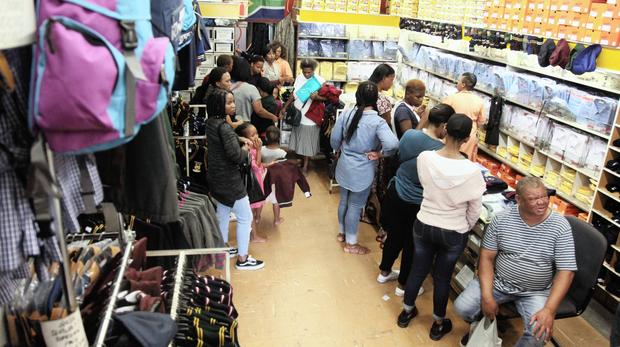
Five year-old Amukelani Ncube tries a school shirt as he prepares for his first day at Basa Primary School in Soweto, where he will be doing Grade R. Nhlanhla Phillips African News Agency (ANA)

Meanwhile, the DA urged Lesufi to “urgently conclude” the placement of learners.

“The DA has been inundated with calls from parents who are still uncertain as to where their children will be placed. The department has failed to place all learners who applied for placement prior to October last year.

“This delay is causing uncertainty among parents who want to buy school uniforms and stationary before they go back to work, as well as budget for scholar transport,” said DA spokesperson Khume Ramulifho.

Ramulifho said the online application system should have helped the department to place learners and allocate resources.

“However, this has not been the case. The DA is calling for the department to take all possible measures to avoid last year’s crisis where the Human Rights Commission was asked to intervene as learners weren’t placed by the end of February.

The department was on Tuesday expected to brief the media on the state of readiness for the reopening of schools and provide an update on admissions.

Schools in Gauteng reopened on Monday for teachers, while learners will report for schooling on Wednesday.

IOL

#MatricResults: Son of a street hawker becomes a top achiever

Staff Reporter

East London’s International Convention Centre was a scene of jubilation on Friday evening as the Eastern Cape education department honoured its 2018 matric top achievers.

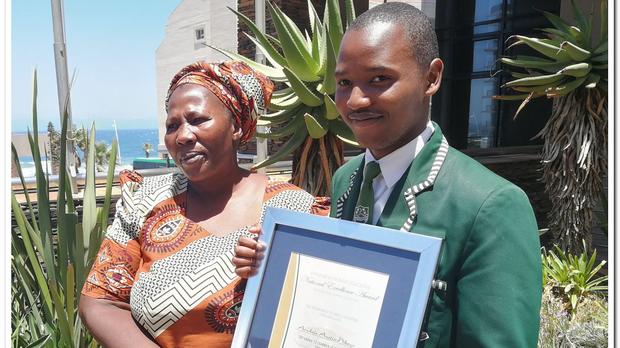
Among the proud parents at the ceremony was 57-year-old widow Margaret Nkayi from Polar Park in Elliot, whose son Avukile Nkayi is one of the top four Eastern Cape achievers for 2018. Avukile bagged seven distinctions, making him the number two star pupil from South Africa’s quintile three schools.

At the awards ceremony, Margaret could barely contain her joy.

“I am very grateful to all the schools and teachers who played a part in shaping my son’s future,” she said.

“The teachers at Ulundi Primary School organised him a bursary to do his high school at Nyanga [High School] and when he got there he came on top.”

Margaret has been making a living as a street hawker since 1991, after her then-husband died in 1990. The family currently share a two bedroom RDP house with other relatives. “Now it is just a matter of time before we are out of poverty. I have been frying leftovers and selling apples for us to put food on the table,” she said.

Avukile said his achievement followed after he dedicated time to help other pupils.
“The more I helped other pupils, the more I developed my own understanding.” He intends to study medicine at the University of Cape Town. “After completing [medical studies] I want to specialise in neurology and then go back to serve my community.”

His interest in neurology stems from when his elder brother became mentally ill, and he now wants to help people such as his brother.

Avukile Nkayi receives a trophy and other awards from Eastern Cape government officials. Picture: African News Agency (ANA)

Avukile attributed his mathematics results to the “maths camps” organised by Eastern Cape African National Congress chairman Oscar Mabuyane.

“I attended Oscar Mabuyane maths camps in December 2017. Before then my maths marks were below 80 percent, but since I grasped what we practiced during the the camp I achieved above 90 percent,” said Avukile.

His advice for pupils starting matric in 2019 is, “Do not let your background hold you back, be inspired to succeed and change your situation.”

African News Agency/ANA

WATCH: Khayelitsha private girls school centred around Pan Africanism

Staff Reporter

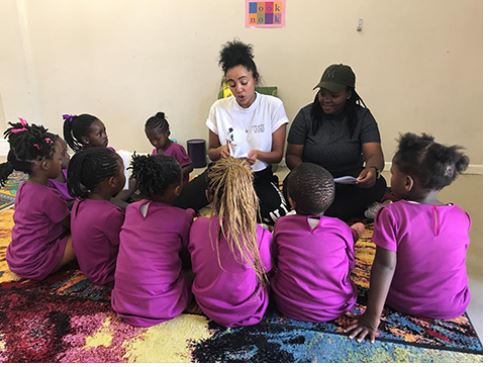
Forty one years since the 1976 Soweto uprising, young people are changing the narrative around education in the townships by designing a system of their choice. A private all-girls school, Molo Mhlaba, in the heart of Khayelitsha in Cape Town opened its doors in January 2018 and already boasts thirty four learners. The school is centred around the idea of Pan Africanism and is the brain child of 33-year-old Dr Rethabile Sonibare (SHO-NI-BA-RE) and others.

The kids also learn coding, robotics, mathematics, science and engineering.

Daily activities last for 9.5 hours and are made up of yoga, reading and two hot meals.

The challenge that the project addresses:

Khayelitsha is one of South Africa’s biggest and fastest growing townships. It is unfortunately infamous for it’s escalating crime rates, poverty and inequality. Part of the solution to many of Khayelitsha’s problems is providing the youth with opportunities to access quality education.
Molo Mhlaba is located in Khayelitsha specifically in Harare Square. This school is the very first Pan African Girls Private School to be established in Khayelitsha.
One of the biggest challenges in Khayelitsha is accessing schools with quality teaching and learning. Molo Mhlaba officially opened it’s doors in 2018 with the support of the Thope Foundation.
It is still teaching learners at foundation phase and hopes to grow throughout the years.
The project responds to the following challenges:

1) Molo Mhlaba aims to provide quality education to young girls in Khayelitsha.

2) It does this by prioritizing access and charging low tuition fees.
The focus is primarily on girls because they are faced by various obstacles in society.

3)The school is inspired by the Montessori approach where the learners are taught in a fun, playful and creative environment.

4)The school provides a bilingual language setting where learners are taught in Xhosa and English.

5) In a township notorious for escalating crimes rates, Molo Mhlaba provides a safe learning environment to young girls. Therefore the extended school day ensures that the learners are safe and take part in fun activities while their parents are still at work.

Describe the project’s impact:

1) Molo Mhlaba is not your conventional school. Therefore this school has had a massive impact in bringing the community together. It requires frequent parental engagement in that parents or guardians are required to spend a specific amount of hours per year actively and positively contributing skills and being present in their children’s schooling career.

2) The young learners at Molo Mhlaba are continuously being exposed to the various opportunities that exist in the world and are learning to view the world in a different lens.

3) Molo Mhlaba is a school established by black women and it is ran by black women and teaches amazing black girls at a foundation phase level.

4) Molo Mhlaba is cognisant of the social realities and it therefore provides the learners with two nutritious meals a day.

Original video by SABC Digital News.

Forget the matric ballyhoo and focus on the real issues that need fixing

Mary Metcalfe

Because the National Senior Certificate (NSC) results have great significance in the lives of individuals and families, SA celebrates the release of the results. We know that futures are determined by this rite of passage that makes an absolute difference to life chances, to opportunities for further study and any hope of employment.

But the annual ritual of the matric results announcement has assumed an exaggerated significance and is a distraction from our real education challenges

Whether the pass is 77%, 79% or 81%, the real figures to which we should be holding ourselves accountable for the improvements on which our future so crucially depends are 22%, 35%, 46%, 61%. We must expect regular high-profile reports to the nation on progress relative to these four figures.

There are four key distractions in the annual NSC ritual.

First, education improvement is a long, hard process and expectations of sudden shifts are unrealistic. Between 2010 and 2017, the range of the overall pass mark was between 68% and 78%, and the average was 73%. The 2018 pass mark topped this range at 78.2%.

Second, the national matric pass rate does not tell the story of all our children but of only the 60% (at most) who stay long enough to write the NSC – and with a pass rate of 80% the celebrations are for no more than 46% of our children. All children should leave school with a certificate indicating some form of achievement, but more than 50% leave with a sense of failure and an uncertain future.

The National Development Plan (NDP) commits SA to achieving a 90% retention rate by 2030. We have 12 more years to achieve what we have not achieved in 25 years.

Third, the focus on the “top” province is inappropriate. The starting points and contexts are not the same, nor are the sizes of the systems. The jostling for the “prize” is based on minuscule differences. What divides the top province from the province that comes second is often a fraction of a percent.

The Free State came first three times in the past five years and Gauteng and the Western Cape once each. The six provinces that are assured of performing in the 75%-88% band are Gauteng, the Western Cape and the Free State, with the North West, Mpumalanga and the Northern Cape not far behind. No surprises.

The provinces that are struggling are KwaZulu-Natal, the Eastern Cape and Limpopo. These three are critically important for the future of our country. They have a massive 62% of the country’s learners and both the lowest NSC pass rates and the highest dropout rates. This is where we bleed our youth.

By contrast, only 25% of our learners are in the Free State, the Western Cape, North West and Mpumalanga. The heavy lifting to improve education and the life chances of young people has to happen in KwaZulu-Natal, the Eastern Cape and in Limpopo. These provinces collectively inherited 10 Bantustans with their massive structural underdevelopment and education deficits.

They have the worst infrastructure, the fewest textbooks, and the lowest ratios of supervisory and support staff. These underlying inequalities (and greater poverty) drive the differential NSC performance. The empty “top” province competition is a distraction from the real work we have to do.

Last, the NSC pass rate is a limited indicator of education health. In 2012 the NDP committed the country to two fundamental goals by 2030: all children in grade 3 must be able to read and write and more learners must achieve above 50% in literacy and mathematics. Are we making progress? In the 2016 “Progress in International Reading Literacy Study” only 22% of our grade 4 children could read for meaning. In the 2015 “Trends in International Mathematics and Science Study”, 61% of grade 5 learners could not add and subtract whole numbers. In the 2014 Annual National Assessments conducted by the department of basic education, only 35% of learners in grade 6 achieved 50% in maths.

Let us not be distracted by NSC improvements of one or two percentage points when 46% of learners leave school with no school-leaving certificates, and our primary school performance is haunted by performance figures of 22%, 35%, 50%, and 61%. These are the priority benchmarks to monitor and improve for the urgent educational change our national development depends on.

Change is possible. We must focus on improving literacy and numeracy in the first four years of schooling. This must be programmatic, properly resourced, reach every teacher who needs it, and have clear indicators for success in implementation and in outcomes. These must be regularly monitored, reported timeously, and responded to. Children must have textbooks and books to read for pleasure. All children must learn in a language they understand. School management teams must be empowered to support teachers and learning. District staff must have time to focus on professional and supportive relationships with schools.

The national minister has the power to set norms and standards and hold provincial MECs accountable for the provision of infrastructure (and its maintenance) including libraries and laboratories; class size; the availability of teaching material and equipment; and also for learning performance. Monitoring of key indicators should enable nimble and prompt responses to failures of delivery.

The law requires MECs to annually report achievement relative to goals and to table clear plans and programmatic approaches to achieving these incrementally. Senior bureaucrats need to listen more to the professionals working with limited resources to change education in complex situations. They are our greatest resource.

A national consensus on this focused programme of action must be built which has the support of key stakeholders and unites across political divides. Nothing is more urgent.

Metcalfe is associate professor of education at the University of Johannesburg and former MEC for education in Gauteng.

This article was first published in The Sunday Times.

Matric pass rate announcement is misleading fanfare, says Equal Education

Sisonke Mlamla

The overall matric pass rate is a poor indicator of the health of the education system, and the national Department of Basic Education should not pat itself on the back.

So says lobby group Equal Education, which has used the release of the 2018 matric results to lambaste the Education Department’s poor overall performance, citing rampant illiteracy and lack of numeracy among South Africa schoolchildren.

Equal Education researcher Duduetsang Mmeti said matric examinations were one step in an uphill education path for South African pupils. Mmeti said a narrow preoccupation with the results concealed the multitude of challenges pupils faced over their schooling career.

It also limited the scope of important conversations that should be had about basic education, she said.

“Not only at this time of the year, but consistently,” Mmeti said.

She added that Equal Education reiterated that the annual matric pass rate announcement was “misleading fanfare” that on its own provided a poor indication of the overall health of the education system.

“This was particularly evident when the announcement of a 75.1% matric pass rate for 2017 was followed the release of the devastating outcome of an international reading study – that 78% of Grade 4 pupils in our country cannot read for meaning, in any language.”

She said passing matric was a tremendous achievement for each individual pupil, and “we commend the diligence and perseverance of the Class of 2018, their teachers, and their families”. However, the Foundation Phase reading crisis was a national emergency, despite some improvements in basic education.

“It is criminal that we have not been able to solve the early grade reading crisis,” she said. ”The years from Grade R to Grade 3 are life-changing for SA pupils. It is when the foundation must be laid for learning in all the later grades. There is no skill more crucial to acquire in the Foundation Phase than learning to read for meaning, and to count.”

Equal Education again called on the Basic Education Department to drastically expand the Early Grade Reading Study intervention in all provinces.

“Foundation Phase teachers must be capacitated, supported by government sectors, parents and the broader public, must be well remunerated, and teach in environments that are dignified, safe and well-resourced.”

Department of Basic Education spokesperson Elijah Mhlanga said they were “extremely” disappointed by Equal Education’s attempt to discredit the announcement of the 2018 Grade 12 National Senior Certificate (NSC) results.

“This takes away from the individual accomplishment of every pupil who has passed through at least 12 years of schooling and worked hard to attain this all-important qualification, that in many instances is the gateway to a brighter future,” he said.

The NSC results were one of a multitude of events, activities and programmes that spoke to improving all areas of the education system, Mhlanga said.

He said the department had never claimed the NSC pass rate as the only barometer with which to measure the system. “It has many; this is but one, and it is an important one.”

Mhlanga said there had been an improvement in the quality of education in South Africa.

“The Trends in International Mathematics and Science Study 2015 has confirmed that South Africa has shown the largest improvement since 2003 of any country in the world in these important assessments, with an increase of 87 points in maths and 90 points in science,” he said.

United Association of SA spokesperson Stanford Mazhindu warned that matriculants would struggle to find jobs, adding to the country’s crippling unemployment rate. He urged young people to never give up on educating themselves.

Cape Argus

Gauteng MEC Panyaza Lesufi praised for matric pass rate

Charles Molele

Gauteng Premier David Makhura has hailed the province’s rise to the top spot in the 2018 matric results as a reflection of massive work the provincial government has put over the past years towards building an equal and just education system.

Gauteng was announced as the top performing province for 2018 with an 87.9% pass rate by Basic education Minister Angie Motshekga during a briefing in Midrand, Johannesburg on Thursday.

Gauteng districts also lead the pack with 8 top performing districts.

An ecstatic Makhura took to social media networking site Twitter last night to congratulate Lesufi and his team for putting the Gauteng province high on the map after it overtook the Free State province, which dominated the top position for the past few years.

“These results are a true reflection of the massive work we have put in over the years towards building an equal and just education system for all. Gauteng remains committed to fulfilling the aims of the freedom charter as envisaged by our forebears.”

Under Lesufi’s leadership, the Gauteng province has seen a constant improvement in its matric performance, prompting calls by some in the country for him to be considered by President Cyril Ramaphosa for the position of Basic Education Minister after the 2019 general elections later this year. Motshekga has served on the portfolio for more than ten years and is rumoured to be on her way out after the elections.

In a statement released Thursday evening, the provincial ANC spokesperson Tasneem Motara praised Gauteng for claiming the number one position nationally following the release of the 2018 National Senior Certificate results.

“The sterling performance by the Class of 2018 and the entire education fraternity in the province under the stewardship of the MEC for Education Comrade Panyaza Lesufi is as tale of persistence, sacrifice and visionary leadership,” said Motara.

“We could not be more proud of this outcome which confirms that the goal that the ANCGP set itself five years ago to transform and modernise our education system through decisive interventions is bearing fruits.

“This has resulted in the province attaining a 2.8% improvement on its previous results to achieve 87.9% in 2018, propelling it to the number one spot with an unprecedented eight out of ten top performing districts being from Gauteng.”

2018 matric pass rate improves to 78.2%

Charles Molele

South Africa’s overall public schools matric pass rate for the Class of 2018 has improved by 3.1% from last year to 78.2%, Basic Education Minister Angie Motshekga announced on Thursday evening.

Excluding progressed learners, the pass rate was 79.4%, Motshekga added during a briefing in Midrand, Johannesburg.  

“If we exclude progressed learners, we’ll be at 79.4, [which is] 0.6% short of the 80% we’ve been clamouring for all the years. So without progressed learners we’d be at 79.4%, but we don’t regret it,” she said.   

For the first time in many years, Gauteng Province edged out the Free State to become the top performing province in the 2018 National Senior Certificate examination results.

The Free State and Gauteng provinces outperformed the rest of other provinces with their districts taking them top ten performing districts.

Gauteng has over eight best districts, four districts performed above 80% and six broke the ceiling with 90%.

“It is unprecedented that the ten top performing districts in the country, are from two provinces. It is for the first time that four of the top ten performing districts performed above 85%; and six of the top ten districts broke the 90% glass ceiling. Notably, out of the top ten performing districts in the country, eight are from Gauteng, and two are from the Free State. We must congratulate the Free State and Gauteng – this is remarkable!,” said Motshekga.

The top 10 performing districts in the country are as follows:

  • Fezile Dabi in the Free State, with 92.3%
  • Tshwane South in Gauteng, with 91.7%;
  • Johannesburg East in Gauteng, with 90.3%; 
  • Sedibeng East in Gauteng, with 90.2%;
  • Johannesburg West in Gauteng, with 90.1%; 
  • Thabo Mafutsanyana in the Free State, with 90%; 
  • Tshwane North in Gauteng, with 89.6%; 
  • Gauteng West in Gauteng, with 89.1%;
  • Ekurhuleni North in Gauteng, with 88.8%;
  • Johannesburg North in Gauteng, with 88.6% 

The Eastern Cape, which has performed dismally in the past few years, improved its performance by 5% and achieved a pass rate of 70.6% – the largest improvement in the country.  

“I must particularly single out the Eastern Cape. We must applaud the Eastern Cape for joining the 70% performance club, which includes the Northern Cape, KwaZulu Natal and Mpumalanga,” said Motshekga. 

“The Eastern Cape had the largest performance improvement, while Mpumalanga and Limpopo had the second and third largest performance improvements, respectively. The learner support programmes and interventions these three provinces have implemented, are beginning to bear good fruit. I must particularly single out the Eastern Cape.

Despite the challenges they are faced with, especially the contestations related to the rationalisation of small and unviable schools, under the leadership of MEC Mandla Makupula (may his dear soul rest in peace),” she said.

“The Eastern Cape has now taken off, and should continue on this trajectory.  It is about to reach its cruising height. I wish to encourage the executive and administrative leadership of the Eastern Cape, to keep the fires burning, in memory of the late MEC Makupula’s unobliterable and unforgettable legacy.”

Limpopo remained the worst performing province nationally.

“Only one province achieved below the 70% threshold, namely Limpopo, which achieved 69.4%, an improvement of 3.8% from 2017 – the third highest improvement,” she said.  

“With the exception of Limpopo, all the other provinces achieved above the 70% pass rate. All the provinces, including Limpopo, have shown improvements in their performances, except for the Northern Cape and the Western Cape. We wish to implore the communities of the Northern Cape to desist from using schools as bargaining chips in their service delivery protests,” said Motshekga.

In recent years, Limpopo made headlines notorious for with failing to deliver to different schools on time.

The province experienced the same problems every year and the department was unable to solve them, according to Democratic Alliance.   

Umalusi’s statistics for the 2018 national exams stated that there were 629,141 full-time matrics and 167,401 part-time matrics – making a total of 796,542 learners writing matric exams.

Of these, 33,413 were progressed learners who were pushed into matric from Grade 11. Motshekga said 60.2% of progressed learners passed their matric exams.

She added that 172,043 matric students achieved a bachelor’s pass, while 141,700 achieved a diploma pass. 86,800 achieved a higher certificate pass.


Minister Angie Motshekga announces the 2018 NSC #MatricResults

0

Staff Reporter

Basic Education Minister Angie Motshekga announced the results of the National Senior Certificate (NSC) examinations at a media briefing in Johannesburg.

The minister’s announcement comes after the release of the Independent Examinations Board results earlier today.

Motshekga said the matric class of 2018 achieved an overall pass rate of 78.2%.

She announced the figure during a live broadcast of the results.

The pass rate is an improvement on the year before; the class of 2017 achieved a 75.1% pass rate, itself an improvement from the 72.5% pass rate in 2016.

In total, just under 800 000 candidates wrote the 2018 exams. This figure is made up of over 625 000 full-time and over 176 000 part-time candidates. It was the fourth largest cohort of matrics to register for final exams.

Motshekga commented that this was the eighth straight year that the matric pass rate had passed the 70% mark.

Provincially, it was Gauteng that came out as top performer, with a 87.9%.

The Free State followed at 87.5%. Western Cape (81.5%) and North West (81.1%) were the only four provinces to get above 80%.

Mpumalanga achieved a pass rate of 79% followed by KwaZulu-Natal at 76.2%, the Northern Cape 73.3% and the Eastern Cape at 70.6%

At the bottom end, Limpopo was the only province to get below the 70% threshold, achieving 69.4% – but this was an improvement of 3.8% from the year before.

In comparison, The Independent Examinations Board’s 2018 pass rate was announced at 98.92%.
This was a slight increase on last year’s pass rate of 98.76%.
All successful IEB candidates achieved a pass that will allow them to enrol at tertiary institutions at one of the three levels:
* 90.65% of the cohort achieved entry to degree study (compared to 88.50% in 2017)
* 7.33% qualified for entry to diploma study (compared to 8.95% in 2017)
* 0.95% achieved entry for study at the Higher Certificate level (compared to 1.30% in 2017)

Ramaphosa to unveil government plans to replace textbooks with tablets

Charles Molele

The South African government has announced bold plans to phase out textbooks in all South Africans schools and replace them with digital content.

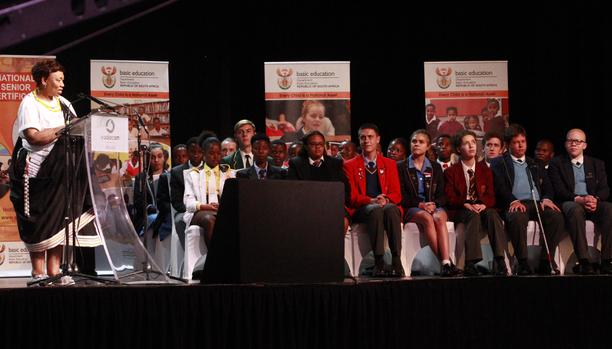
Speaking at the Ministerial Breakfast with Top Achievers  (#Matric2018 breakfast session) organized to honour the 2018 top matric achievers on Thursday, deputy minister of Basic Education Enver Surty said all school learners in South Africa, from Grade 1 right up to Grade 12 will in not-too distant future access their study materials entirely through the internet.

President Cyril Ramaphosa is expected to provide more details about government strategy to phase out textbooks in schools during his State of the Nation Address.

Surty said that the decision to embrace new technologies in education was aimed at the provision of quality education where bulky textbooks would be totally replaced by tablets and digital learning.

“We are going to develop digital content to enhance the quality of education in SA by embracing technology through a highly sophisticated, digital learning as part of the Fourth Industrial Revolution,” said Surty.

“All learner material and textbooks, from Grade 1 to Grade 12, will be digitized as part of our strategies in technology. President Cyril Ramaphosa and Vodacom chief executive officer Shameel Joosub will make an official announcement in due course.”

Surty said the department is grateful for the opportunity to contribute towards education during the centenary of struggle stalwarts former President Nelson Mandela and Albertina Sisulu and encouraged the top learners to emulate their exemplary leadership styles.

Technology in education is set to open a huge world of possibilities for South African learners, be it sharing of study material or revision material via computer or tablet devices, according to Takalani Netshitenzhe, Vodacom’s Chief Officer: Corporate Affairs for the Vodacom Group.

Netshitenzhe added that the introduction of One Learner One Tablet at South African schools will assist government to cut costs amounting to billions of rands in the production of textbooks. Digitization of textbook content will also help government to deal with shortages of textbooks in provinces such as Limpopo, KwaZulu-Natal and the Free State Province.

It will also help in tackling the increasing number of learners sharing textbooks in some of the South African schools.

“The idea is to completely move away from textbooks hence our slogan One Learner, One Tablet. Textbooks are expensive and digitization will assist government in reducing costs of producing textbooks and reams and reams of copies. In terms of our partnership, the content belongs to the Department of Basic Education. Our company will merely be hosting it,” said Netshitenzhe.

Basic education minister Angie Motshekga told the top achievers at the breakfast session that a lot was expected from them as they prepare to help to rebuild the country in line with the National Development Plan and the strategic vision of ANC-led government.

“We expect a lot from you [as top learners]. You are not here by prayer or miracles. You worked very hard. You are the best of the best and now form part of a critical mass of future leaders who are going to build this country; the Republic of South Africa,” said Motshekga.

“The Fourth Industrial Revolution must not find us unprepared. You are going to find technological solutions to our socio-economic problems and take us out of the challenges of underdevelopment and being known as the Third World country.”