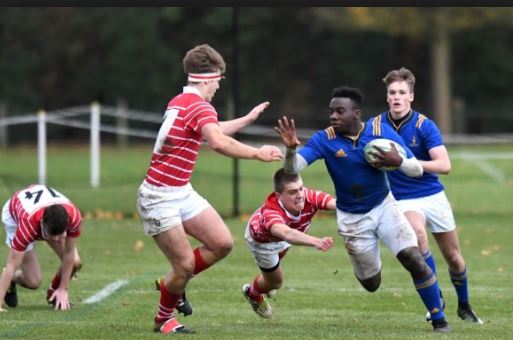
Nine Junior Springbok stars were among the half-century of emerging young players who were taught a thing or two by REF (the Rugby Education Foundation) in 2018 after winning education bursaries through the SA Rugby-run programme.
Junior Springbok prop Alulutho Tshakweni (Sports Management) and centre Rikus Pretorius (Sports Administration and Coaching) were among a handful of SA Under-20 players who were REF bursary recipients, with the group also including Xerox Golden Lions flanker Mandisi Mthiyane (Marketing Management).
They formed part of the SA Rugby Academy Programme which aims to balance formal education with high performance training and player welfare. The foundation, which was launched in October 2015 thanks to the vital support from corporates, have assisted over 100 players with bursaries to date.
The recipients are identified in consultation with scouts, school coaches, provincial rugby unions, as well as SA Rugby high performance staff. Given the success of the programme to date, the aim for 2019 is to assist 75 players with education bursaries.
“Education is the backbone of society, and when one combines this with sport, we are able to develop and uplift the youth of South Africa and make an impact,” said SA Rugby CEO Jurie Roux.
“That is essentially what the Rugby Education Foundation aims to achieve. This programme has and will continue to make a big difference in the lives of individuals and greater society in general in the years to come as we assist in developing more rounded individuals.”
A total of 75% of the programme’s recipients this year were players of colour, contributing significantly to SA Rugby’s transformation process. Their studies included various degrees, national diplomas, national certificates and short courses, while they were also exposed to life skills and mentorship programmes and regular tutor sessions.
“I would like to thank the corporates who have assisted us in making a difference in the last three years for their generous support and commitment to changing the lives of some of our talented young rugby players,” said Roux. “They are assisting our young players in building a bright future outside of the game in the years to come.
“The more players we can assist with bursaries the bigger the impact we can make, and we will continue to work hand-in-hand with corporate South Africa to achieve this.”
Deputy Minister of Basic Education Enver Surty officially opened three mathematics classrooms, a Science and a Computer Laboratory at the Manyano High School on Tuesday.
He said his visit to the school was an interesting one, because he got the opportunity to assess what is happening in schools in the Western Cape.
“We still have long way to go, but we need to work harder to give quality education in public schools,” he said.
He said it is their duty to ensure that learners are not disadvantaged because of where they come from.
Manyano principal Nokuzola Malgas said they were honoured and excited for receiving the new facilities.
“We are blessed by receiving the new facilities; they will assist us in getting good results, particularly in Maths,” she said.
She said their learners will benefit because they had to transport them to other places in order for them to access laboratories, but now they are in-house.
Malgas said the mathematics classes will help because before the classes were full but now there is more space.
She said they have young, passionate teachers who will find doing their work more easy now.
However she said there is the issue of crime where schools get broken into and computers get stolen but they have a plan in place to counter that.
Anaso Yantolo (17) a grade 11 leaner said the new classrooms will help them a lot because before they had to squeeze themselves in small desks which made it hard to concentrate in class. She said even the new blinds in the classrooms will help them control the amount of light that comes in.
The new facilities were sponsored by South Africa Medical and Education Foundation (SAME), which tries to promote maths and science at township schools.
SAME Chief Executive Trevor Pols said they have renovated nine schools so far at a cost of R14 million. He said there is a huge need for such facilities in other schools as well. “I hope learners appreciate what has been done for them and will use it wisely.”
Teach school learners and matriculants that failure does not necessarily mean the end of their future.
The Gauteng Department of Education and local psychologists are urging parents to monitor their children for any signs of depression or suicidal thoughts in the wake of receiving poor year end academic results.
The warning comes after reports of a Grade 11 learner from Strauss Secondary School, Ekangala having committed suicide after receiving his year-end academic report on December 6.
It is alleged that the learner’s mother found him hanging in the garage at his home.
Panyaza Lesufi, Gauteng MEC for Education said: “The department appeals to learners not to commit suicide, and emphasise that, failing a grade does not signify the end, we all fail at some point; however, we must be encouraged to start over and strive to reach our desired goals.”
He added: “Suicide is not an option since there is available intervention and support for learners. The department urges parents and the community to closely monitor the behaviour of learners and seek intervention timeously.”
Christopher Langefeld, clinical psychologist said suicides were particularly prevalent during December and January as those were the periods learners received their final year academic results.
Langefeld said parents could look out for signs of the child becomes socially withdrawn, expressing a low or down mood or when they become increasingly quiet.
Tebogo Monyamane, clinical psychologist, said it was important for parents to be supportive, and encourage their children to consider other options, however, if the child seemed to be struggling to also consider seeking professional help.
The department urged learners experiencing depression due to their poor academic performance to contact the following numbers for intervention and support: Childcare toll free line: 0800 055 555, or Childline Gauteng contact number: 011 645 2000 during working hours.
In celebration of the Global Hour of Code and Computer Science Education week which started yesterday the 3rd of December until the 9th December, iStore South Africa will be holding multiple one-hour coding sessions for Grade 3 to 9 learners.
The Global Hour of Code is a global movement with over 100 million learners in +180 countries are getting help and encouraged by many organisations and people to allow children to get access to or exposed to coding.
iStore SA will host their coding sessions on the 7th and 8th December multiple store locations such as iStore Cavendish, Mall of Africa, Gateway, iLanga, Sandton Drive, Tygervalley, V&A Waterfront, Woodlands, Walmer and Cresta.
Learners who are keen to participate are required to bring their own iPad in order to join the free coding sessions. They could also stand the chance to win one of five tickets for the iStore’s Think Ahead FutureSpace holiday camp.
South African billionaire businessman Johann Rupert’s rare public interview received mixed reaction on Tuesday night after he was accused of racism and arrogance.
Rupert was this year’s guest on Power FM’s annual Chairman’s Conversations – a show in which the station’s chairman Given Mkhari interviews prominent South Africans.
Among key questions during the interview, Rupert was asked to respond to allegations that he was an apartheid beneficiary who was now a central figure of “white monopoly capital” and the “Stellenbosch mafia” which controlled the economy.
Rupert, the chairman of Swiss-based luxury-goods company Richemont as well as of the SA-based Remgro group, denied that his father’s empire benefited from apartheid.
“Where does this story come from? We never did business with the (apartheid) government. If my father had emigrated, the shareholders would have done a lot better. We were boycotted oversees because of South Africa, so the choice is to leave or stay. We could have taken the money out of the country, bought boats, whatever, but we did a series of partnerships,” Rupert said.
Rupert said he did not understand why he was labelled a monopoly capitalist, as most monopolies belonged to the State.
“All the people here who belong to a government pension fund own twice as many shares in all those companies as we do and from the beginning my father had no money. He started with £10, then a hundred pounds in a garage and my mother was a company secretary. They grew up poor,” Rupert said.
Rupert said his mother had to walk to school and that she saved until she was in her 80s.
Rupert however, received massive backlash from the audience and from social media after he said he was born in a poor Afrikaner generation that built itself through education and saving instead of consuming.
“They didn’t go and buy BMWs and hang around at Taboo and The Sands all the time, okay?” Rupert said.
Power FM host Iman Rappetti told Rupert that the conversation was not sitting well with many South Africans as he came across as racist and patronising to black people.
“In fact sitting here and listening to the conversation myself I feel like, am I in the wrong place? Am I in the wrong room and I hear laughter… an affirmation for some of the things that you are saying. What would you say to South Africans for whom your message jars?”Rappetti asked.
Rupert defended himself, saying he had been accused of many things in his life but that his generation did not believe he was racist.
Asked what his views were on transformation he said: “I don’t think that hand-outs leave the recipient of the hand-out with any dignity. I believe on hand-ups and leg-ups… and helping people start their own businesses”.
Rupert said while land redistribution was necessary, the expropriation of land without compensation would not be good for the economy.
“Let us not fall into the trap of Zimbabwe and Venezuela. Everything looks good on paper but the game is played on the grass. You need to be tough to farm,” he said.
Few children in Bugesera District are happier than Solange Ishimwe, the 15-year-old who has just been promoted to primary six.
Ishimwe – a pupil at Kigusa Primary school, which is located in Nyagihunika cell, Musenyi Sector – treks about six kilometres every day to and from school.
The school borders Lake Cyohoha, and is the “furthest part” of the district from Nyamata town.
Solange Ishimwe. Photo/Athan Tashobya.
Her home is not connected to electricity. So, when regular school time, instead of participating in co-curricular activities, she would resort to revising her books before sunset.
She didn’t want to miss a minute of daylight because she was about to sit for exams.
Even as Ishimwe describes herself as “social but focused”, circumstances surrounding her school and community sometimes forced her to forego her social life in order to concentrate on her studies.
“We never had electricity around our school and we don’t have it at home either. It is hard to play with your friends when you know that you won’t be able to study when you get home because there’s no power,” Ishimwe said.
But when The New Times visited the school, it was about a month after solar panels had been installed and the school lit.
Rwanda Environment Management Authority (REMA) in partnership with the Ministry of Education installed a solar system at Kigusa Primary School, as one of the initiatives to enhance the greening programme in remote schools.
The solar system generates 800 Watts on a normal bright day.
It was around 3:30 pm when we met Ishimwe and delved into her past story. Unlike in the past, this time she was taking part in co-curricular activities, trotting around the school compound with her friends.
“We are very lucky to have our school connected with solar system,” Ishimwe says thoughtfully. Now that the school has electricity, we will be able to study computer lessons. There are chances that we, the primary six pupils, will be able to stay longer at school to revise and perform better in national exams (in 2019),” Ishimwe said.
With 3,200 pupils, Kigusa Primary School has just over 80 laptop computers, which it received through the Government’s One Laptop per Child scheme.
However, the students had never used the computers until when the solar panels were installed.
Eugenie Akingeneye, who doubles as a teacher and a parent to one of the pupils at Kigusa Primary School, told The New Times that they used to borrow computers from the neighbouring school in order to deliver practical ICT lessons to pupils.
Recently, they had opted to charge their own computers from the neighbouring trading centre.
“It was a big challenge to teach children computer lessons. But now that we have solar power it will not only benefit the school but also the neighbouring community. Students will stay until late at school to study. This is a big very addition to the education programme of this area,” Akingeneye said.
Alphonse Musabyima, a Science Teacher acknowledges that it was a challenge teaching students computer lessons before the installation of solar-powered electricity around the school.
“It was really difficult trying to demonstrate how a computer works when you don’t have it working. This made computer lessons rather imaginary. But things have changed from the time solar panels were installed. Kids are able to start computers and learn a few functions in detail,” Musabyimana said.
Under the greening school programme, Kigusa also got six huge water tanks of 10,000 litres each to harvest rain water.
The greening programme aims to o measure and reduce school’s “large ecological footprint”, while making the school environment healthier for students and staff, and getting the community thinking about solutions to the environmental problems, according the Environment Minister Vincent Biruta.
The pillars of a green school is to; strive to be toxic free, use natural resources efficiently, create a healthy and green space; and, teach the young generation of sustainable development and consciousness about environmental protection.
As for Kigusa primary school, water tanks are such a great boost to promoting hygiene.
“Whenever it was time to clean our classrooms, we would go fetch water in the swamp because we don’t have tap water. This is an excise that would take half a day to carry out,” Gloria Nyiransegimana, a 12 year old pupil.
This interrupted normal school programme, Nyiransengimana added.
“Now that we have water tanks it will make the excise much shorter and easy. And we won’t go for weeks before we mop our classrooms. I think this will also promote hygiene around our school.” Ishimwe said.
According to Musabyimana, the school usually cooks porridge for the pupils but getting water has always been a daunting task.
“Now it is easy to prepare food for our kids because we have water in the tanks within the school compound,” he said.
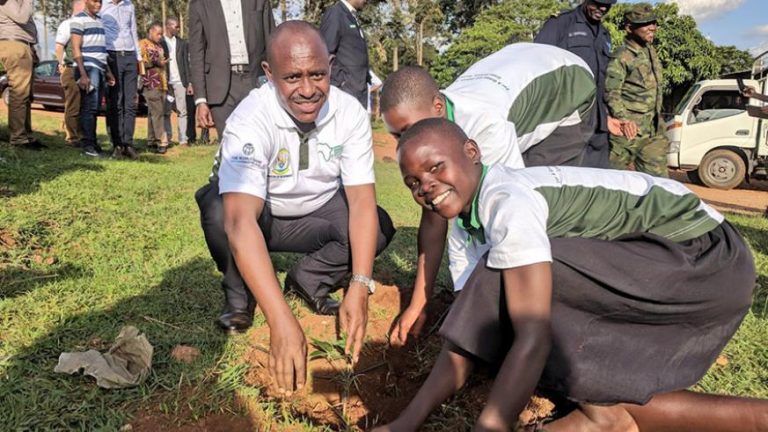
As part of recently concluded African Green Growth Summit, the Green Schools initiative was officially inaugurated. During the activity, top government officials plus over 1000 policy makers, experts, investors and financial specialists from across Africa – whore were in Rwanda for the inaugural African Green Growth week-long forum – joined pupils of the remote Kigusa Primary School in planting 500 trees in efforts to promote environmental protection culture in schools.
Among the trees planted include avocados, mangoes and orange trees among other eatable fruits.
According to Bugesera District Mayor, Richard Mutabazi, the district is one part of Rwanda that experienced severe droughts due to deforestation back in late 80s and early 90s. This also explains why planting a tree around this school is such a big deal.
“With solar system, water harvesting tanks and hundreds of trees planted around this school, climate change impacts has been dealt with sustainably. This will also more certainly improve education experience for these children,” Mutabazi said.
Ishimwe noted, “This place gets really hot during dry season. Trees will give us shade, and as we have learned trees also give off oxygen that helps us to breathe, and form rain.”
Speaking at the launch of Green schools campaign, Minister Biruta stated that initiative such as harvesting rain water and use of clean energy such as solar-powered electricity could well fit into building climate resilient communities and building a future worthy of the aspirations of the next generation.
“Installing water tanks and solar panels on our buildings are some of the things we can do to offset climate change impacts,” Biruta said.
Biruta’s comments were echoed by Education Minister, Eugene Mutimura. He said that his ministry is committed to ensure that schools foster climate-friendly initiatives.
“We want to reiterate our commitment as the Ministry of Education to continuously work with various stakeholders to ensure that our schools across the country become green,” Mutimura said.
As for teacher Musabyimana, it is important that they continue to plant more trees and take good care of the water tanks and solar system such that the students live health and probably perform much better going forward.
So far five remote primary schools in Bugesera have benefited from the greening programme.
The initiative is being rolled out in all schools across the country.
It is common cause that science news reporting in the South African media does not enjoy the same status as other beats such as politics, crime, sport and business.
It is hardly surprising that politicians like Julius Malema and Malusi Gigaba, and businessmen like Markus Jooste and Nicky Oppenheimer grace our front pages more often than any scientist or researcher in South Africa.
Knowledge journalism and quality content has been replaced with celebrity news, horoscopes, astrology columns and the sex lives of prominent people in our society. We know more about the Kardashians than we do about the first African female cardio-thoracic surgeon in South Africa.
A 2004 study by a student at Stellenbosch University found that only 2% of editorial content in the country’s top publications is dedicated to science news.
Considering the power of the media to influence public perceptions and to assist the government, business and consumers in making informed choices, specialist science journalists are vital to assist in and improve the public’s understanding of science.
According to the World Economic Forum Global Competitiveness Report in 2012, the quality of South Africa’s science and maths education has been rated second to last globally.
This has a great impact on science literacy in a country where about 20% of adults are illiterate, more than a quarter of the adult population unemployed and very few teenagers graduate from high school with university-level science or maths passes, according to the same report.
This paints a grim picture as most people in South Africa do not understand the impact of science on their daily lives, rendering them unable to achieve socio-economic development goals. Fake news and overwhelming amounts of information available on the internet make it difficult for South African audiences to distinguish fact from fiction and real science from pseudoscience and downright quackery. It would be interesting to see how many people still believe in former health minister Manto Tshabalala-Msimang’s claims that beetroot and garlic work better against HIV/Aids than anti-retroviral treatment.
To make matters worse, there are those who spend their time purposefully creating confusing content, rather than adding value to the news industry in the country. As we speak, Unisa is investigating an employee implicated in a network of 15 fake news websites.
Many have lamented the insufficiency of science journalists due to budget constraints, human resources challenges and the ‘juniorisation’ of newsrooms. Science is also not considered sexy enough to make it into the news and most people consider science too difficult for “normal people” to understand.
Thus, the importance of good science journalism cannot be overstated.
We have a myriad of great, one-of-a-kind reporting opportunities on issues such as climate change, energy issues, the discovery of Homo naledi and Little Foot in the Cradle of Humankind, and the Square Kilometre Array project in the Northern Cape.
Science can save lives, but the incorrect reporting of science can also lead to the loss of life. Thus it is of the utmost importance that journalists, and not only specialist science journalists, equip themselves with critical thinking skills to ensure audiences receive high quality, reliable news.
Aspiring science journalists should make use of the opportunities offered by the 2018 Science Forum South Africa to hone their skills and to network with those doing cutting-edge research in all fields in this country.
Science communicators and researchers should open the doors to their institutions and help journalists fall in love with telling success stories that often remain locked away in ivory towers or hidden away in complex, dense and difficult-to-understand academic studies.
Van Zuydam recently completed her MA Journalism thesis on the current state of science journalism in South Africa at Stellenbosch University
As renewed debate on sex education continues after controversy over teen pregnancies.
Peter Mogaka rests easy with the knowledge that all his schooling daughters are on birth control.
Mogaka, a sugarcane farmer in Kisii County, is happy that his daughters are almost done with their secondary education without any risk of falling pregnant.
He made the decision after a double tragedy. His eldest daughter, he says, became pregnant while in Standard Seven.
She died while delivering.
“She was still very young and her organs were not well developed so she could not push the baby. They both died,” he recalls.
After that, birth control became an option.
“As a parent, I know the pain of losing a child to reckless sexual behaviour. No one should ever instruct me on how to handle my family affairs. I am not regretting it,” he says.
Mogaka’s decision is sure to rile the Catholic Church and other religious leaders, as its bishops on Tuesday said it is “intrinsically wrong” to give children contraceptives.
RESPONSIBLE PARENTING
“We would like to emphasise the importance of responsible parenting instead of picking the short-term unethical solutions such as contraceptives,” said Bishop Philip Anyolo, the chairman of the Kenya Conference of Catholic Bishops.
So, should parents just admit that mere talk won’t help their children who become sexually active from an early age? A study released in April 2017 already concluded that teens want more than just talk.
Researchers from the Guttmacher and African Population and Health Research Centre interviewed 2,484 teenagers aged between 15 and 17 in Homa Bay, Mombasa and Nairobi counties.
The outcome was that most of the teens wanted to know more about contraceptives, an admission that they were already sexually active.
So, sex education or contraception? Our interviews with various individuals yielded varying results.
Esther Mbau from Amani Counselling Centre said girls should be given the right knowledge before they can choose whether to abstain or not.
LIFE SKILLS
“Before the contraceptives, I would advocate life skills training, and a lot of real talk with the girls,” said Mbau.
For Nelson Otwoma, the executive director of the National Empowerment Network of People Living with HIV and Aids in Kenya, it is important to give sex education to children before they become sexually active.
“We need to focus more on girls since they mature faster than boys and when they are at their prime stage, they tend to experiment a lot of things,” he said.
Arthur Muriuki, a consulting psychologist, believes that not all teens are engaging in sex and that could be the starting point in the conversation.
“The question here then might be: Why are these teenagers not having sex and not getting pregnant? What knowledge might they have that their counterparts lack?” he posed.
The starting point, he said, is to have age-appropriate sex education because children are imbued with sexual innuendos all around them: from commercials, videos, house- helps and older children.
PORNOGRAPHY SITES
“This child will want to try and do what they observe. If we ban the pornography sites, we heighten their curiosity. We create a black market ring,” Muriuki said.
His comment on banning pornography was in reaction to remarks made early last week by Professor George Magoha, Chairperson of the Kenya National Examinations Council. who said the blocking of pornographic sites will reduce the pregnancy crisis.
According to a December 2017 report by the United Nations Population Fund, some 78,397 adolescent girls in Kenya aged between 10 and 19 became pregnant between July 2016 and June 2017.
Another report released by the Education ministry in July this year identified Narok, Kilifi, Meru, Bungoma, Busia, Migori, Nairobi and Homa Bay as the counties most affected by the teenage pregnancy crisis.
The teen pregnancy crisis manifested itself during the national examinations that started from October. In Kilifi County, for instance, 13,624 teenage pregnancies had been reported between January and November.
The shocking number led the Gender ministry officials to choose Kilifi as the county of focus during this year’s 16 Days of Activism that are geared towards reducing violence against women.
PREGNANCIES
Faith Kasiva, the Secretary for gender affairs in the State Department of Gender Affairs, told the Nation that one of the contributing factors in the Kilifi problem is culture, in that girls are supposed to sleep in houses quite far from their parents.
“For me, what was very disturbing again is that some of the pregnancies were from adolescent boys. It’s really a concern,” added Kasiva.
The experts we interviewed gave a raft of suggestions towards addressing the problem. Mbau said a girl who has just hit puberty is usually in a confused state of mind.
I’ll share from my own personal experience. There is a lot of confusion, a lot of self-doubt at that stage. If this girl has not had someone to talk to her and prepare her in advance, she may actually feel dirty. And this erodes her self-worth,” she said.
“What she will do, if she does not find a good mentor to help her through this very crucial stage, she will look for that self-worth in all the wrong places,” added Mbau.
For Muriuki, the banning of pornographic websites will do little to help. He says parents should play the biggest role.
MICROSOFT has entered into an agreement with the Zimbabwe government which will pave the way for the creation technology sensitive classrooms in the country’s education sector.
The development comes after government’s introduction of a technology-based education curriculum in 2016 which has however, failed to fully take off due to financial challenges that have seen schools struggling to acquire computers and related necessities for student use.
Last Friday Primary and Secondary Education Minister, Professor Paul Mavima and Microsoft regional business leader Mark East agreed an MOU which may lead to the creation of modern classrooms that drive innovation, performance and growth could be a step in solving the nation’s technological problems.
Commenting on the development, East said that Microsoft has a long history of commitment towards digital transformation on the African continent and emphasised the need for governments to embrace science and technology in order to gain prominence in the global economy.
“Similarly, if we are to truly invest in the human capital of the future, we must prioritise the importance of Science, Technology, Engineering and Mathematics learning for all students. We are glad to be entering this into this vital partnership which will see the education system in Zimbabwe transform rapidly,” he said.
Under the deal, Microsoft would assist the Ministry of Primary and Secondary Education in identifying the ideal device for specific digital education strategies and building partnerships with international Original Equipment Manufacturers.
The technology firm will also provide consultancy services in building a local assembly strategy and create avenues of increasing internet connectivity in rural areas, and teacher development initiatives to equip future generations.
East was attending the Africa Innovation Summit 2018 held in Harare between the 28th to the 30th of November.
The UK department of health recommends that young people (aged five to 18) should get at least 60 minutes of physical activity a day. But not enough teenagers actually do.
In schools, children and teens are taught from a young age about the benefits of being active. They should know that it reduces the risk of obesity, coronary heart disease and diabetes, and increases well-being. Yet the lack of teenagers’ activity has become such an issue that it is now a serious public health concern.
Try as they might to implement physical activity schemes for British young people, it seems that the work of public health policy makers is not reaching everyone. Though leading experts are contributing to plans with interventions such as the Daily Mile, we have found a missing link – the teens themselves. Researchers and policy makers play a vital role in designing physical activity schemes, but they often do not speak directly to the groups they want to target.
For our latest project, ACTIVE (The active children through individual vouchers evaluation project), we wanted to give young people the chance to make their own recommendations to help others of the same age be more active now, and carry on being active in the future.
We worked with more than 70 teenagers from seven secondary schools in Swansea to come up with a list of easily implementable recommendations.
1) Lower cost without sacrificing quality
The teenagers we worked with said that lowering the cost of activities would help them become more active. They recommended that more free activities should be available – although teenagers were aware that when places lower their prices, the quality of the activity/venue also drops. One way to tackle this would be to offer activities that do not need coaches or referees but allow teenagers to play freely, making their own games and rules in a safe space.
Working out. Rob Marmion/Shutterstock
2) Make activities local
Removing the need to travel to venues would go some way towards making physical activity more available to teenagers. The teens we worked with said they were happy to organise their own activities if they had facilities close to where they live. They did not mention the need for coaching, just a need for a space to play. All they want nearby is the space to participate in unstructured, non-competitive forms of their favourite sports.
3) Improve the standards of existing facilities
The teenagers all said that their local facilities need to be improved. Spaces, such as local parks, have fallen into states of neglect and equipment is broken. The local council’s maintenance of facilities was frustrating for teenagers. They said that the council should do more to maintain and improve local facilities.
4) Make activities more specific to teenagers
The young people we spoke to also stated that there is very little that specifically invites teenagers to attend, or provides things tailored for them. They believed that council-run services particularly neglected their age group and suggested solutions such as removing age restrictions on some gym classes, such as zumba and spin.
5) Give teenagers a choice of activities
Like everyone else, teens don’t want to just be restricted to a small range of sports. The activities they suggested were less traditional – for example, dodgeball, trampolining or going to the gym. But this is not just an issue for local services, the teenagers also said that schools have a lack of choice, too.
The teenagers complained that they were stuck doing the same sports year after year. More girls spoke about the lack of choice than boys, suggesting they were more disengaged with school sport. In particular, girls suggested being able to select the activities they wanted to do at the beginning of the school year through a conversation with teachers or questionnaires.
6) Provide activities that teenage girls enjoy
The teenage girls we spoke to said that if they do not like what is on offer, they will not do it, and would actually prefer to be inactive instead. When talking about different activities, teenage girls said they are more likely to be active if they can do activities they enjoy.
The young women we spoke to said that they enjoyed the local water park, with slides and wave machines, and a trampoline park because “it’s fun”. It might not seem like traditional exercise, but the key here is getting teens to be active, regardless of whether we would traditionally view it as “exercise”.
It is obvious that what is currently on offer is just not helping teenagers become more – and stay – active. But simply by including the teens’ own recommendations in solutions for the future, we might be able to finally solve the national problem of young people being inactive.