Home Blog Page 476

South Africa: Village girl builds solar cooler box

Peter Ramothwala

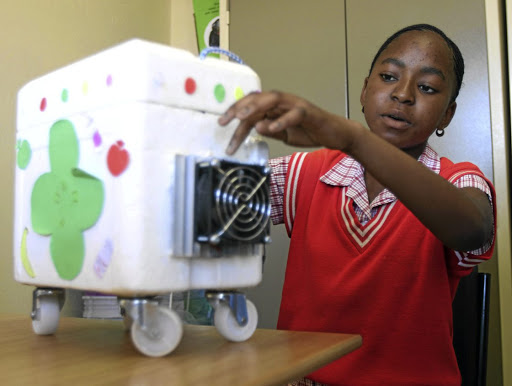
Curiosity for technology has earned a 13-year-old Limpopo grade 7 pupil a top spot in the country for creating her own solar cooler box.

The learner Tumelo Ramokone, who attends Mapudithomo Primary School in Nobody village, GaMothiba, was voted the best young female scientist during an Eskom Expo in Boksburg, Ekurhuleni, last month.

Eskom Expo for Young Scientists is a science fair where students get a chance to show case their groundbreaking projects based on their own scientific investigations. By participating at the expo learners increase their awareness of the wonders of science, add to their knowledge and broaden their scientific horizons, the power provider said.

Tumelo said she was voted the best after she showcased her solar-powered cooler box for food, drinks and medicine.

“It also charges cellphones. In 2016, we took a family trip to Mpumalanga; we needed cold water after our ice had melted in the ordinary cooler box.

“At the time we were very far from the shops to get ice. We had no choice but to drive to the shops. It was at the time I thought about creating the solar-powered cooler box because it would have saved us time,” she said.

However, Tumelo said had it not been for her twin sister Kgaugelo, she wouldn’t have won the prestigious award.

“After my teacher told us about the expo I wanted to create a solar-powered umbrella but she (twin sister) convinced me to follow my long thought project. Kgaugelo is into arts but she really helped and encouraged me in completing my project. She would be searching information on the internet while I tried to assemble the parts,” she said.

Tumelo prides herself on her achievement. The cooler box can keep drinks cool for a day when fully charged.

“I’m happy I can’t believe I went this far. It took me two weeks to complete this project but had it not been for one scarce part I would have finished in a week. I had to order parts called ‘peltier and heat sink’ from America on the internet and it came through Pretoria then Polokwane. And thanks to my parents for financing my project and teachers for motivating me,” she said.

Tumelo won herself a laptop, R500 and a gold medal.

She said she hoped to start a business dealing in the product before completing matric.

Despite her technological skills Tumelo wants to pursue her dream career and become an orthopaedic surgeon. But she will always love technology, she said.

Her mentor and teacher Matsatsi Dunkuru described Tumelo as a hard-working, disciplined pupil.

Maggie Ramokone, Tumelo’s mother, said she and her husband spent R2500 to help her with the project. “We are very proud of this young girl.”

Annually, at the expo selected students from 35 Expo Regions in SA compete against the best young scientists from the continent and the world.
 

Solar backpacks have become Côte d’Ivoire pupils’ ray of hope

AFP

The equatorial sun has been up for about an hour as a gaggle of children set off from the Ivorian village of Allepilla on their hour-long trek to school.

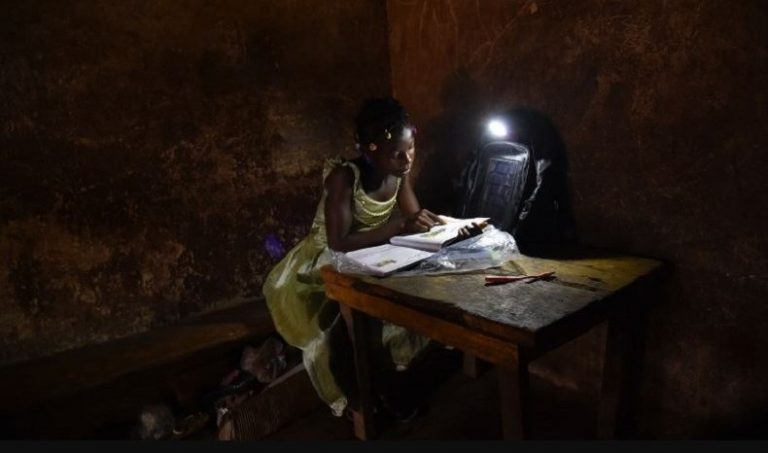
Back home in the evening, eight-year-old Marie-France Amoandji Ngbessoo does her homework by the light of her backpack’s LED,  captured by solar panels on her way to and from school.

The light can run for three hours.

With insects flitting overhead, Marie-France points to the pictures in her textbook, identifying them: “Orange, plane… ”

Allepilla, some 100 kilometres (60 miles) north of the West African country’s economic capital Abidjan, is a rural community centred on cocoa and coffee production.

A single pump supplies water to the village of around 400 inhabitants including 150 children, and, as is the case for thousands of villages and hamlets across the country — there is no electricity.

Instead, oil-burning storm lanterns and battery-powered torches are the only sources of light.

An Ivorian charity that promotes education for rural girls, Yiwo Zone, has raised funds to provide the backpacks — which cost 13,000 CFA francs (20 euros, $23) apiece — to schoolchildren across Africa.

Computer salesman Evariste Akoumian had the idea for the solar backpack in 2015 when his car broke down as night was falling near Soubre, in the southwest of the country.

“At the same time, children were returning home from school,” he recalls. “I said to myself, ‘We must give them light so they can study. It’s not normal for rural children to be unable to do so.”

The Ivorian government has set a target of ensuring electricity to 80 percent of the country.

“These rural children are poor. They use rice sacks or plastic bags to take their things to school,” Akoumian said. “The idea was to kill two birds with one stone: give them a backpack with a light to go with it.”

The entrepreneur stressed that the solar backpacks belong to the children: “So Dad or Mum can’t come and take the light from them… to use while they are cooking or doing housework.”

Sales are brisk and have reached 55,000. Akoumian’s company Solarpak already sells the backpacks in Gabon, Madagascar and Burkina Faso, as well as to charities in France and Germany.

Striving to keep up with demand, Akoumian is seeking aid or loans so that he can set up an assembly plant in Abidjan and boost production.

– ‘Better marks’ –

“It may seem cheap, but these are large sums that the villagers don’t have,” said Anna Corinne Menet Ezinlin, head of Ywo Zone.

“Here in this village some people can’t afford the school fees or even notebooks. Usually school is free, but there are always registration fees or (other) payments.”

Last year, Marie-France’s 13-year-old sister Lucienne could not attend school at all because their mother was off work with an illness.

“It’s hard for the children,” said village chief Jean-Baptiste Kotchi Okoma, whose seven-year-old daughter Nethania received a solar backpack. “There’s not enough money here.”

He added: “I hope their marks will be better. Children are disadvantaged here. With the backpack, I hope they will all progress.”

Lucienne, flipping through a book, said: “I am happy. Before it was more difficult. It’s easier now, with the backpack.”


South Africa: Solar farm will power Nelson Mandela University campus

Siyabonga Sesant

Construction of an R18-million solar farm at Nelson Mandela University (NMU) is underway.

When fully functional‚ the green power plant is projected to provide at least 10% of the university’s south campus’s electricity requirements‚ said André Hefer‚ NMU’s sustainability engineer.

Hefer said the only other solar installation equal in magnitude in the metropolitan municipality is the 1 megawatt (MW) installation at Volkswagen.

The project is expected to be completed by February.

Hefer said the photovoltaic (PV) panels will go up following the construction of the basis and supporting structures in about two weeks’ time after the fencing has been completed.

“Apart from the obvious huge financial benefits to the university‚ the solar farm will also serve as a ‘technology park’ to academic units for technology and other research‚ another big advantage‚” Hefer said.

World Bank re-engages Tanzania on scrapped education plan

Reuters

The World Bank will work with Tanzania to redesign a $300 million (R4,2 billion) education project, a senior official said on Sunday, days after the lender said it cancelled plans for the project due to the country’s controversial policies on pregnant school girls.

The World Bank told Reuters on Wednesday that it had not presented the education programme to its board for financing approval last month in part due to Tanzanian President John Magufuli’s stance on pregnant girls in schools. Tanzania has banned pregnant girls from attending state primary and secondary schools since 1961.

Magufuli affirmed his commitment to this policy last year, saying school girls who become pregnant must be expelled and not allowed to return. However, World Bank Vice President for Africa Hafez Ghanem told reporters on Sunday the lender had agreed with authorities to find ways for pregnant girls who are forced to leave school to still access education.

Ghanem said, following a meeting between the World Bank, Magufuli and other officials in Tanzania, the local government had committed to finding ways for the girls to return to school.

“That is what has changed,” he said, when asked why the World Bank had reversed its decision to withdraw the project from board consideration.

However, he said the project would still be subject to board approval before the funds could be disbursed. Leonard Akwilapo, Tanzania’s Permanent Secretary at the Ministry of Education, told Reuters on Sunday that he could not comment on the World Bank’s latest comments until he received an official statement.

However, he said Tanzania’s policy was to ensure all school dropouts, including pregnant school girls, continued their education through different options such as the adult education system. On Friday, the Tanzanian government said the World Bank had agreed to provide the $300 million( R4,2 billion) loan to implement the project.

The project includes the construction of class rooms, hostels, laboratories, staff houses and teaching facilities. Tanzanian female teenagers are on average three times more likely than their peers globally to get pregnant, according to government data, a statistic researchers attribute largely to low access to contraception.

In a September speech, Magufuli told Tanzanian women to not use birth control because the country needs more people and described women who limited the number of children they have as “lazy“.

The World Bank’s decision to re-engage the government on the education project comes amid increasing criticism from foreign donors over the Magufuli government’s restrictions on the media and political parties and threats against LGBTI people.

Denmark on Wednesday was the first foreign donor to freeze funding to Tanzania over concerns about policies that threaten gay people and women. The European Union also last week launched a comprehensive review of its policies toward the East African nation over concerns about rights abuses.

Magufuli — a populist leader nicknamed “the bulldozer” — has railed against foreign investors and promised to end corruption. Ghanem also said the government told him they are open to discussing how a new statistics law will be implemented.

The lender last month criticised the legislation, which will punish anyone who questions official statistics, saying the law will undermine the production of useful, high-quality data.

“We agreed that we will work together to avoid having in place a system that stops us and others from having access to credible, neutral and transparent data,” he said. “If we don’t get reliable and credible statistics, we will be unable to do our job … we made this clear to the government.”


South Africa: Principal bars teacher from hosting awards ceremony in traditional Swati attire

James Mahlokwane

The Department of Basic Education is investigating allegations that a white Laudium Primary School principal prevented a black teacher from hosting the school’s end-of-year awards ceremony because he was wearing “inappropriate” Swati traditional attire.

Disappointed and hurt, the Grade 2 teacher, Mlandvo Dlamini, caused a stir on social media on Thursday when he publicly called the principal a racist who disrespected the Swati tradition.

He said the principal had barred him because his dress was inappropriate, but he was planning to wear an academic gown over it.

The incident comes just days after Gautrain management apologised to Thando Mahlangu who was prevented by security from boarding a train at Park Station in traditional Ndebele attire deemed inappropriate.

Gautrain described this as an isolated incident, and said it fully supported and embraced diversity.

Dlamini made another video and tagged MEC of Education Panyaza Lesufi on Twitter to ask for advice, since he did not think his attire was inappropriate. He said he felt targeted because there was no communicated dress code for the event.

“Interestingly, quite a lot of parents came to the award ceremony adorned in their traditional regalia,” he said.

“I have experienced a lot of racially motivated challenges but this was my breaking point. At some point I was admitted to Vista Clinic for stress and depression due to racially motivated occurrences,” he told Pretoria News.

Education Department spokesperson Steve Mabona told Pretoria News that the department was shocked and disappointed to learn about the incident. Officials were sent to investigate the matter and he promised appropriate action would be taken.

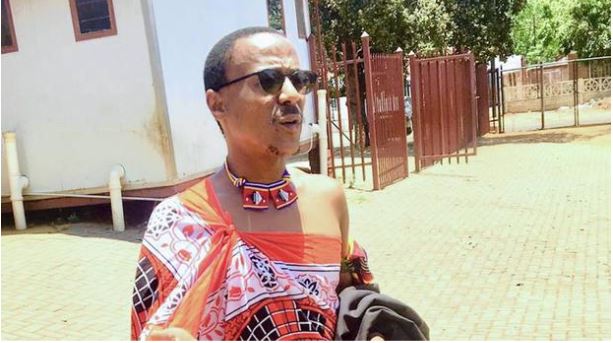
Laudium Primary School teacher Mlandvo Dlamini is crying racism after he was rejected as MC because his Swati traditional attire was deemed inappropriate by a school principal. Picture: Supplied

“Social cohesion dictates that we should be tolerant and embrace all cultures in our environment.

“Dlamini wrote a letter to the school governing body detailing how he was allegedly summoned to the grass area behind the staff room.

“In full view of both parents and learners, he was asked by the principal about his ‘dress code’,” Mabona said.

Surprise and interested as what could have brought about such “rage” regarding his traditional attire, he said he asked for an explanation.

He claims he was told that what he was wearing was unacceptable, and not allowed for the function.

“I then explained to him that I was dressed in my full Swati traditional attire, which was especially for such events.

“Unfortunately, he immediately interrupted in my explanation to repeat that I was dressed inappropriately and such a dress code was not acceptable.

“He proceeded to tell me I was supposed to be dressed in a ‘decent shirt and tie’ for this particular function.”

Dlamini wrote that he explained that “besides the fact that there was not a specific prior dress-code discussion for the event, nor a policy in place against wearing traditional or cultural wear at school functions”, he wanted clarity and a proper explanation for the reprimand.

Africa: Entrepreneur runs thriving e-learning platform despite failing high school

Siphelele Dludla

Even when he failed his school-leaving exam for the third consecutive time in his native Ghana during the early 2000s, Cecil Nutakor remained convinced this was through no fault of his, but rather a rigid education system not geared to deal with inquisitive and creative students.

“Everybody blamed me for not studying hard. But I felt that the system was too rigid and wasn’t designed to make learning interesting and fun,” Nutakor says. “The system was designed in a way that some of us who did not like cramming would keep failing.”

“Some of us like asking questions, being analytical, and trying things out,” he told the African News Agency on the sidelines of a recent investment forum in Johannesburg. “I had to do something to prove to my family that I was not that dumb but it was the system that had a problem.”

Thirteen years later, the 35-year-old entrepreneur runs a thriving e-learning platform, eCampus, which traces its humble beginnings to the era of floppy disks.

After raising more than $300 000 (R4.2m) in funding, eCampus is now a disruptor across the continent which has changed the way teaching and learning are conducted while giving learners an incentive to study.

The platform leverages on exponential technologies, Nutakor says, referring to any technology that grows 10 times every year in power, capacity, and deliverables such as artificial intelligence, machine learning, quantum computing and blockchain, among others.

He describes eCampus as an electronic classroom where over 400 experts upload tutorials and course material on subjects ranging from maths to music, science and sport – which then get digitized in voice, notes and video format, allowing for chat groupsand open discussions for students who get scored on what they have learnt.

Clients include governement and private schools, insurance companies, medical and engineering schools and firms as well as authors and the content is available in seven languages.

“With eCampus we are able to predict whether you are ready for an exam or not so you don’t go and embarrass yourself,” says Nutakor.

“So when you’re learning on our platform, you will be earning points which we will calibrate and predict the mark you will get. If you know that, for instance, 40,000 points will get you a B and before the exam you have 80,000 points, you will be (very) confident.”

“Anything that has a final exam – nurses training, medical school, law school, architects – we are able to predict your final mark.”

He said the platform was introducing micro-credentials, certificates that acknowledge achievement in each aspect of course material, giving students the opportunity to get employed based on what they have learnt.

It also offers learning as a currency “by making the act of learning give you instant gratification”.

“Beyond making you know if you are ready for an exam or not and generating you micro-credentials, you can also trade the points you earn by learning on our platform for real-world things like food, transportation, entertainment and healthcare,” says Nutakor.

Despite not having a school-leavers certificate, Nutakor was able to use his innovation to get admitted for a Bachelor of Science degree on a fully-paid scholarship to Regents University of Science and Technology in Ghana but dropped out after a year.

In 2014 he completed an MBA in Global Business and Sustainability at the Catholic University of Milan, Italy, where he learnt more tricks of the trade after scoring another scholarship worth €8 000 (R128 000).

Nutakor says a 2008 decision to walk away from a $2 million deal in which he would have sold an 80 percent stake in e-Campus to the Venture Capital Trust Fund, making it possible to go and study at Yale, was one of the hardest decisions he has ever had to make.

The offer however did make him realise he had not acquired the aqeduate education and experience to run a large corporation.

“They were right. They were asking things like, what’s your present and future value, discounted ratios, the balance sheet deficit, and I would call the consultants to explain,” Nutakor says.

“At the time I was angry but now that I know all these things I think they were right because they were going to give me $2 million and I would have to do quartely reports, depreciations armotizations. But I said I can’t give 80 percent of all my hard work to somebody else, go to the US and come back (to find) it has changed.”

“I remember that day I walked for kilometres in the hot sun wearing a suit and carrying my bag. I was just angry and walked for a long time before I realised I had walked too many kilometres.”

“Right there I decided to ask which schools in Ghana can give me a degree, so I went to the Ghana Institute of Public Management and Administration and got in on a new programme in Entrepreneurship and SME Management.”

“So it is still very important to get an education,” he concedes.

eCampus shares subscription revenue with “fellows” or teachers and content providers at a 50:50 ratio, with learners paying a “reasonable” subscription fee for classes, except for primary and high school material which is freely available.

Nutakor was invited to South Africa by the African Development Bank to participate at the inaugural African Investement Forum as one of eight young and successful entrepreneurs on the continent.

He decided to extend his stay by another week to try and close deals and participate in Global Entrepreneurship Week activities.

Africa: United Kingdom commits to empower hard-to-reach girls

The United Kingdom Department for International Development has partnered Plan International, the Campaign for Female Education (CAMFED International) and World Vision to improve education outcomes for marginalised girls through a campaign dubbed ‘Leave No Girl Behind.’

Through the Girls’ Education Challenge (GEC) launched in 2012 as a 12 year commitment to reach the most marginalized girls in the world, the United Kingdom has launched a project dubbed Leave No Girl Behind.

According to Annabel Gerry, Head of the Department for International Development Zimbabwe and South-Africa, the Leave No Girl Behind will enable the most marginalized girls to continue their schooling and transition on to secondary education and is targeting 21,780 hard-to-reach girls aged between 10 and 19 years old, up to 6% of whom are living with disabilities.

“The aim is for these girls to not only learn important literacy and numeracy skills but also gain vital life skills to help them grow into confident young women. DFID’s aim is to build on what we have learnt so far and further deepen global understanding of what works for girls’ education, particularly during adolescence and in the transition from education to work,” said Gerry.

Speaking during the same event, Tsungai Mahumucha, Head of Programmes for Plan International Zimbabwe reiterated his organisation’s commitment to empower the hardest to reach girls by providing then with pathways to enhance their life chances.

“Plan International aims to empower the hardest to reach girls by providing them with education so that they can lead, decide and thrive. LNGB provides the girls with a number of pathways to enhance their life chances, going beyond literacy and numeracy to support various transition options,” said Mahumucha.

She added that through the GEC,they are looking at transforming the lives of over one million of the world’s most marginalized girls through quality education and learning.

The, “Leave No Girl Behind” will be supported through Plan International up to 2024 and will offer learning activities and transition pathways for adolescent girls, who will participate in accelerated learning programmes, learn life skills as well as sexual and reproductive health and rights knowledge.

The girls will also gain valuable vocational skills training and take up employment or self-employment opportunities.

Africa: MBA not the only route to success

0

Bryan Hattingh

A master of business administration (MBA) degree has long been touted as a “crowbar” to pry open career opportunities that lead to corner offices or counter offers.

While not a specialist degree, there is no denying that it offers those who choose to pursue it a deeper understanding of the business world. If being scholastic is your fashion, then an MBA is a tailored fit.

However, studying for an MBA doesn’t come cheap. The fees at the top five South African universities offering the courses are north of R200 000.

Studying at some of the top B Schools in the US is prohibitive at over $100 000 just for the tuition fees. Throw in the living expenses and you are in debt faster than you can say Ivy League.

When such large sums of money are involved, the pursuit of higher education begins to be a gamble.
The notion that an MBA helps one understand anything and everything of business is false. It is equally false to assume that an MBA can potentially enrich you in its aftermath.

The theories and frameworks taught at business schools become quickly redundant in the ever dynamic economic milieu. At best, it must be viewed as an investment that can pay out at some stage. It is definitely not a Ponzi scheme.

A study of the 100 best-performing chief executives in the world done earlier in the decade by the Harvard Business Review highlighted that an MBA is not a prerequisite for business success.

Of the 100 chief executives on the list, only 29 had MBAs. Apple, for example, had hardly any MBAs in its top ranks and most of the world’s top hedge funds preferred people with insight and analytical skills to those with MBAs.

Unless you work for a company that provides generous learning opportunities, leaving it to get an MBA is a higher risk than ever.

If you are at the coalface, getting good business experience, a better strategy is to keep learning on the job. Some of the world’s most respected business leaders have grown by following that simple strategy.

Investment in an MBA is not only financial and, when you add the time spent away from home and family and other commitments and opportunities lost, you are undertaking an arduous journey.

Still, if you can match your intent for pursuing the programme and be willing to trade the above, it could well turn out to be a rewarding and adventurous journey.

There are some very good reasons to opt for an MBA, though if you intend to build a career in, say, event management, an MBA will do little to boost your career prospects outside of bragging rights.

That idea re-emphasises the importance of knowing exactly what you are hoping to gain from an MBA. When you outline your goals, compare them to the coursework and see if they align. If not, it might be time to look at shorter and more meaningful courses.

There is a tendency to discount the impact of shorter courses like those offered by independent organisations and even online. These can be of tremendous help to those who aren’t ready to commit to a full degree but want to improve their credentials.

That said, there are some good reasons to get an MBA. Ask yourself how much room for growth you have in your current career and whether your aspirations require you to flap your wings elsewhere.

If you’re not getting the right learning opportunities in your current workplace, but you’re also short on some of the skills to progress in another role or company, it might be time to think about getting an advanced degree. An MBA could be the best place to gain this knowledge.

While leaving employment to pursue an MBA might not be a financially prudent decision – already know that even though classes do happen after office hours, studies and exams will mean you sacrifice all free time.

Usually this is met with an overwhelming “yes” but when the adrenaline runs out, it can be stressful – having a goal in mind gives you something tangible to keep you motivated.

If your employer will reimburse your MBA tuition, it might seem like a proverbial no-brainer to take advantage of that benefit. But understand what will be required if you do – many companies in South Africa require you to commit to a certain period in which you cannot leave the employ of the company.

Largely this then goes against your plan of moving up the corporate ladder in another firm, an underlying reason for the sacrifices at the altar.

If you do have money saved and hope to advance your career with a new employer, make sure the B-school you choose has the right resources to support your job search.

Hattingh is founder of exponential leadership firm Cycan

South Africa: Call for NSFAS candidates to apply before November 30

Bongani Nkosi

The closing date for National Student Financial Aid Scheme (NSFAS) applications is drawing closer.

The funding scheme has also warned it would not accept any more applications from public college and university students after the closing date.

“We wish to emphasise that there will be no extended window period for the 2019 applications, therefore the NSFAS will not accept any late applications after the 30 November, 2018, deadline.

“NSFAS has communicated to all vice-chancellors and TVET principals that the closing date for applications is 30 November… and that no extension will be granted.

“Institutions were also informed that NSFAS-funded students with a confirmed bursary offer should not pay a registration fee when they present themselves for registration in January 2019.”

Applications opened on 1 September to anyone wishing to further their studies at any of the country’s 26 universities and 50 in 2019 on an approved course at any public university or technical and vocational education and training college.

Applications have been coming in thick and fast.

“On average, NSFAS has been receiving 3 500 applications a day,” said administrator Randall Carolissen.

“The numbers can be attributed to the easy-to-complete online application system that allows applicants to complete the application within five minutes.”

At a recent press briefing, Communications Minister Nomvula Mokonyane urged students who were yet to apply to do so urgently.

“Students are strongly encouraged to submit online applications or visit their nearest National Youth Development Agency centre before the closing date,” Mokonyane said.

South Africa: New feeder zones for public schools will ‘cross the colour line’

Canny Maphanga

Gauteng Education MEC Panyaza Lesufi is hoping that new feeder zones for public ordinary schools will be inclusive of all South African learners irrespective of race, background or creed.

“We are thrilled to announce this today. It is a groundbreaking way of opening all our schools to all our children and a radical shift in addressing the negative impact of apartheid spatial planning,” Lesufi said at a media briefing on Thursday.

This comes after the Constitutional Court – on May 20, 2016 – ruled that the MEC had to determine feeder zones for all public schools in the province, in the manner required by regulation 4(1) of the Admission of Learners to Public Schools, by November 20, 2018.

Approximately 2 067 feeder zone maps had been finalised and would be published in the government gazette for consultation. According to the department, 334 schools had contested their proposed feeder zones and their concerns had been addressed.

These feeder zones will enable learners from previously disadvantaged areas to access schools that were previously reserved for white learners.

“We are closing a chapter in our history that was left unattended for too long.

“There must be no one that is told you are born in the wrong area and, therefore, you cannot come to this school,” Lesufi said.

He said he believed this would address the issue of transformation with respect to public schools.

“The feeder zone will incorporate white areas with black/Indian areas. It will cross the colour line.”

Speak up within 30 days or keep quiet’

“They will never oppress our children or our children’s children. We are handing over now a non-racial society, where no one will be judged based on the colour of their skin,” Lesufi explained.

The publication of the new feeder zones dictates that schools will have to resubmit their policies to the head of the Gauteng education department within three months.

“Every school policy must now be resubmitted to department, whether it be uniform, hair, language etc, but in particular their admissions policy.

“They have 90 days to submit and the department has 90 days to respond,” Lesufi said.

The provincial education department also clarified that feeder zones would be up for review every year for all schools and that, only in the event of dramatic changes in demographics, should a school apply for a review of their feeder zone.

“I delegated this to the HOD, Edward Mosuwe, and I have removed myself just to have a separation of powers, because you know my views,” Lesufi added.

The department said it would be ready to implement the proposed feeder zones as law in 2020 and has urged school governing bodies to speak up within “30 days or keep quiet”

News24