Home Blog Page 480

South Africa: Future stars camp gets underway

Staff Reporter

The 2018 Copa Coca-Cola Future Stars camp officially got under way last Tuesday with players selected for this year’s tournament reporting for the six-day training camp at the high-performance centre in Pretoria.

Following a highly successful Copa Coca-Cola tournament which was defended by Gauteng’s Clapham High School last month, Coca-Cola has gone a step further in this year’s tournament by introducing the Copa Coca-Cola Future Stars camp.

Fifteen players were picked across the country by selectors Simba Marumo and Jabulani Mendu to experience a high-quality training and development programme by some of SA’s experienced football industry experts.

The opening day of the camp saw the players being addressed by Mamelodi Sundowns and Bafana Bafana midfielder Hlompho Kekana.

He gave an in-depth discussion on what it takes to be a professional footballer.

SuperSport United player Reneilwe Letsholonyane is also expected to conduct passing drills and share his experience and knowledge with the players later this week.

Outside of the field, the boys will be exposed to important life skills and educational sessions to ensure they are holistically developed footballers.

The squad will also be hoping to impress in friendly matches. They were to play AmaTuks and Randburg FC yesterday before putting their skills to the test against Kaizer Chiefs on Saturday.

Sowetan

Gauteng education department ‘working tirelessly’ to place 23 000 pupils by October 31 deadline

Staff Reporter

With the deadline for the placement of learners at Gauteng schools approaching, the Gauteng department of education says has assured parents that 23 644 learners that still have to be placed will receive places before October 31.

In a statement, Gauteng MEC for education Panyaza Lesufi said a number of measures had been put in place to ensure that this happens.

On Thursday, October 25, all principals were told to accept offers of placement from their schools, he said.

All schools were also told to accept placements of parents who received confirmations of placements from the department’s district offices, without delay.

The department has also decided to remove from the system about 21 094 learners that have not submitted the relevant documents, Lesufi said, and those learners will be considered for placement at a later stage.

In addition, 5 974 learners forfeited their spots because they didn’t accept or reject placements offers. Lesufi said those spaces were offered to other children.

“Our officials are working tirelessly to place learners in our schools, on average, approximately 1 500 learners per district are still to be placed. The two districts that have the highest numbers of unplaced learners are Tshwane South and Ekurhuleni North. This is a critical period which is closely monitored by relevant officials.

“We are committed to place all unplaced learners at our schools, officials are working around the clock to place learners. This is to appeal with parents to be patient and work with our officials for necessary placements to be processed. It must be noted that, most schools are full and unfortunately, not all learners will be placed at their preferred schools,” Lesufi said.

Department spokesperson Steve Mabona said that 34 109 learners had not submitted the necessary documents at the time. Lesufi said then that 440 schools had reached capacity.

News24 

26-year-old Nigerian highest paid robotics engineer in the world

0

Staff Reporter

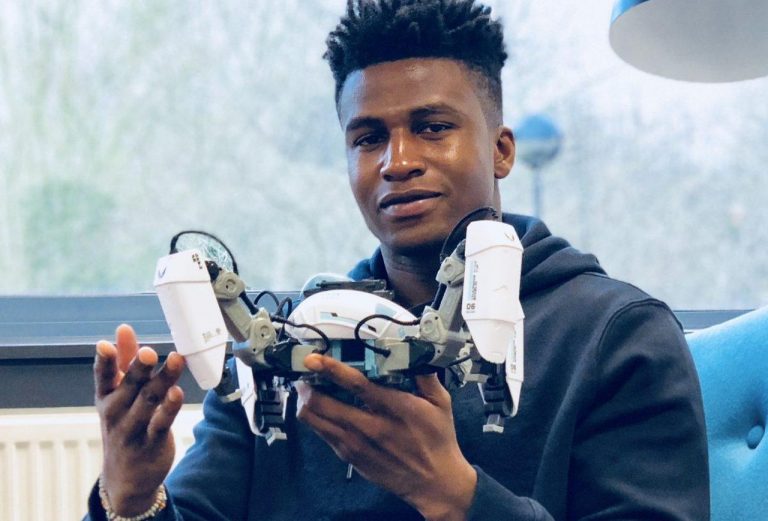
A 26-year-old Nigerian, credited for building the world’s first gaming robot, Silas Adekunle, has become the highest paid in the field of robotic engineering.

Adekunle achieved the feat after signing a new deal with the world’s reputable software manufacturers, Apple Inc.

The robotics engineer was also named as “Someone to Watch in 2018” by the Black Hedge Fund Group.

Adekunle is currently the founder and CEO of Reach Robotics, a company developing the world’s first gaming robots.

He also recently graduated with a first class degree and has four years’ background in robotics.

Born in Lagos, Adekunle studied in Nigeria before relocating to the United Kingdom as a teenager.

After completing his secondary school education, he proceeded to the University of the West of England where he graduated with a first class degree in Robotics.

In 2013, he founded Reach Robotics and developed a lot of experience on robotics within a space of four years.

Adekunle was also a team leader of Robotics In Schools programme, a programme which encourages and pays attention to students in Science, Technology, Engineering and Mathematics (STEM).

The programme encouraged him to develop robotics to make education more entertaining for STEM students.

In 2017 MekaMon, he released the world’s first gaming robot, with the special ability to customise the gaming bot to perform personalised functions.

The initial launch of Mekamon sold 500 bots, generating $7.5 million.

Following this feat, he received support from various organisations including London Venture Partners ($10 million) and Reach Robotics signed a deal with Apple securing exclusive sales in Apple stores.

“Impressed by the quality of his robots and their ability to show emotion with subtly-calibrated movements, Apple priced his four-legged “battle-bots” at $300 and has put them in nearly all of its stores in the United States and Britain.

Early customers skew towards male techies but a growing number of parents are buying the robots for their children to get them interested in STEM, Adekunle told Forbes in an interview this year.

The Guardian Nigeria

Africa: SA’s free coding college is looking for students

0

Timothy Rangongo

WeThinkCode, a tuition-free training institution with campuses in the Johannesburg and Cape Town, is recruiting new students for 2019.

WeThinkCode’s campus in the Joburg CBD.

Founded three years ago, WeThinkCode has large corporate sponsors like Standard Bank, Investec, FNB, Dimension Data, Telkom and Outsurance, which offer employment opportunities in their IT departments to some WeThinkCode graduates.

Final year WeThinkCode student, Naledi Matutoane (second from left) with fellow coding students at the E-kasi Tech and Gaming Festival in Soweto recruiting prospective students. (Photo: Business Insider SA)

This is what it takes to get into WeThinkCode’s free coding programme:

Age and availability

You have to be between the ages of 17 and 35, and be able to study full-time for two years. While the course is free, students from outside of South Africa are responsible for the cost of their study visas.


Prior education and experience

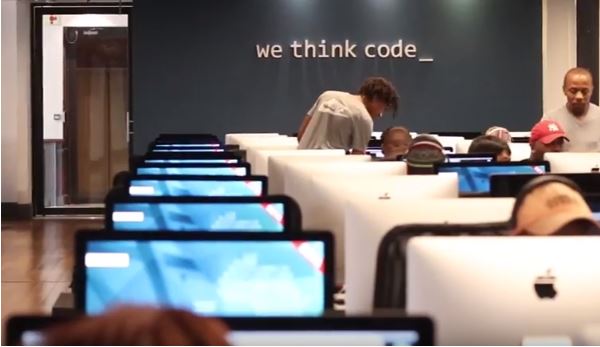
A WeThinkCode student in Johannesburg engaged in coding. (WeThinkCode)

No prior education or coding experience is required.


Online application and test

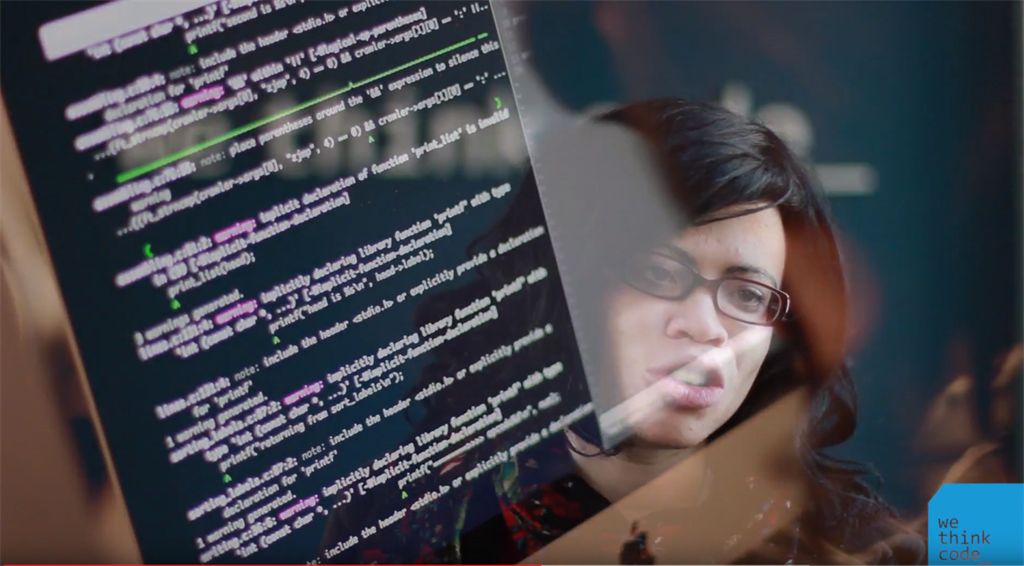
WeThinkCode student, Alyson Ngonyama’s reflection on a computer screen with code. (WeThinkCode)/(YouTube)

Applicants provide basic information as part of the online registration process and then have to play online application games at apply.wethinkcode.co.za

The games test applicants’ abilities to solve problems.

Those without computers can make use of WeThinkCode’s computers by going to one of the campuses in person during regular testing days.


Bootcamp

Those who’ve passed the online application will be invited to participate in a month-long bootcamp, which will then decide who is suitable for the full-time course.

WeThinkCode is revolutionising learning with no teachers or classes. Students are, instead, given coding and development problems to solve among their peers.

Naledi Matutoane, final-year student at WeThinkCode and representative of the institution at the recent E-kasi Tech and Gaming festival, told Business Insider that “although there aren’t teachers, campus managers monitor how we work.”

Matutoane, who’s always been interested in computer science but didn’t meet the stringent requirements for maths and science set by universities, started the programme straight after matric after passing WeThinkCode’s recruitment bootcamp.

There are students who’ve come as far as Zimbabwe and Ghana to enrol for the free two-year coding programme.

WeThinkCode wants to open five new campuses across Africa by 2024.

South Africa: Naledi Pandor opens R200m library in East London

Aretha Linden

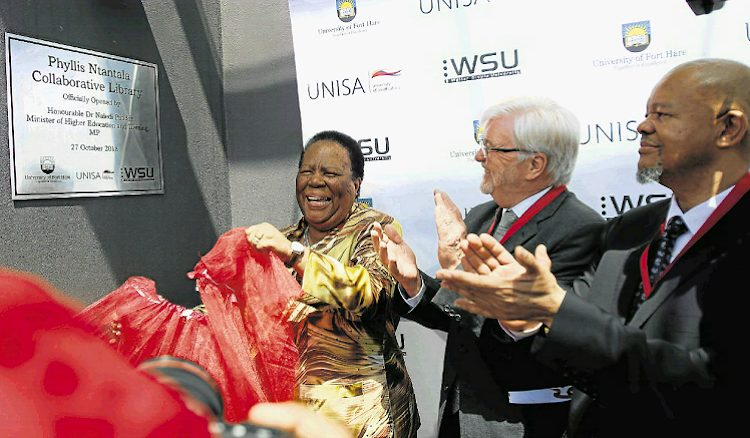
A R200m university library that will serve 18,000 students from three universities was officially opened in East London on Saturday by higher education and training minister Naledi Pandor.

Named after the late Eastern Cape-born renowned political activist and scholar Phyllis Ntantala, the library was a culmination of a six-year partnership between Walter Sisulu University (WSU), University Fort Hare (UFH) and the University of South Africa (Unisa).

The department forked out R120m, Unisa R50m, UFH R30m and WSU R20m.The building boasts six floors including the basement. Each university has its own floor and the building can accommodate 2,500 students.

Speaking at the opening ceremony, Pandor said the new facility would contribute significantly towards alleviating the acute shortage of study, research and learning spaces for the three universities within the East London area.

“This is the first successful joint-venture educational facility built to support teaching, learning and research for students and staff of three universities.“This demonstrates how the department can partner with universities in the provision of quality shared infrastructure facilities,” said Pandor.

Ntantala was married to AC Jordan, and speaking on behalf of both families, Reverend Khazeka Ntantala-Somhlahlo said they were humbled by the honour from the three universities.

“She [Phyllis Ntantala] comes from a humble beginning from a rural life. It was unthinkable that she would become a strong thinker and a symbol of men’s struggle. She is the icon of the family and naming the library after her is commemoration of what she stood for,” said Ntantala-Somhlahlo.

UFH vice-chancellor Professor Sakhela Buhlungu described the joint venture between the three universities as a unique experiment.

“When I joined the university last year the building was halfway up and I watched it emerge into this beautiful, elegant structure,” he said.

Buhlungu also said the library was a vote of confidence in BCM and a signal that the three universities were here to stay.

Unisa vice-chancellor Professor Mandla Makhanya said the opening of the library was a dream come true.

“It was a critical commitment to be part of this library. This is a noble cause for our country’s education,” said Makhanya.WSU vice-chancellor Professor Rob Midgley was also overjoyed.

He said the collaboration was a test case for many joint ventures to come between the universities.The president of the SA Union of Students, Misheck Mugabe, called on students to treasure the building.

DispatchLive 

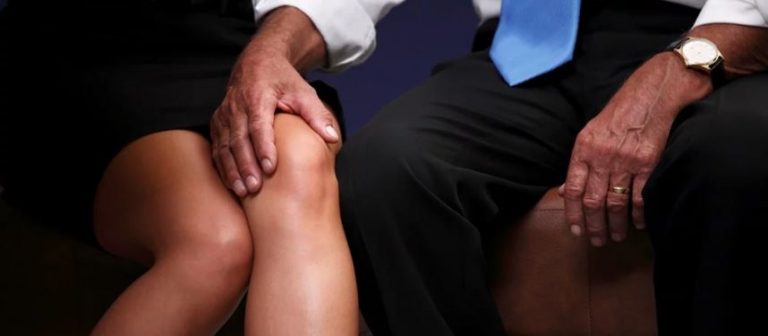
At least 124 school teachers dismissed over ‘sexual harassment’ in Mozambique – report

Staff Reporter

The Mozambican government has reportedly sacked at least 164 school teachers over the last 12 months for various reasons, the main one being suspected sexual harassment.

According to Club of Mozambique, of the total number dismissed, 124 were removed on sexual harassment grounds.

Minister of Education and Human Development Conceita Sortane was quoted as saying that her ministry remained “vigilant in identifying professionals who behave in a dubious manner”.

Pambazuka News reported in 2010 that teenage girls in Mozambique often fell pregnant before reaching 16, the legal age of marriage. This usually put an end to their education.

Quoting a 2008 report compiled by the Mozambique Ministry of Education and Culture, Pambazuka News said that many of these pregnancies were not consensual and girls were impregnated by teachers who asked for sexual favours in exchange for passing grades.

The report, entitled “Mechanism to stop and report cases of sexual abuse of girls”, found that 70% of female students said a teacher had asked them for sexual favours in order to pass.

Not only were female students becoming pregnant, but they were also becoming exposed to sexually transmitted diseases through their teachers, the report said.

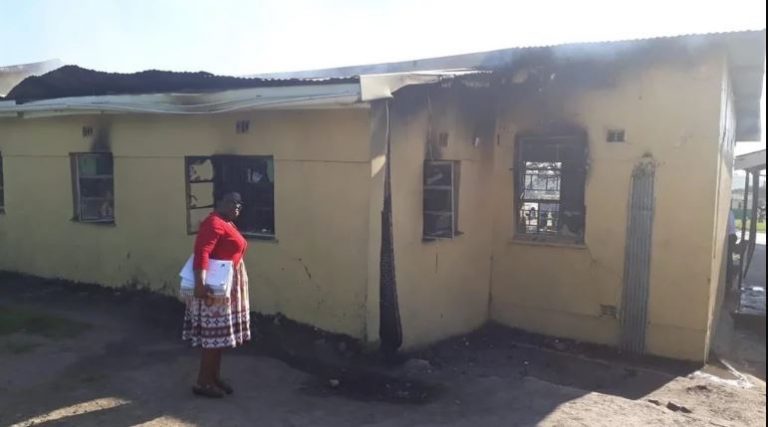
Aggrieved matric pupils who allegedly set school alight meet with officials

Jenna Etheridge

Aggrieved matric pupils from Ndaliso Secondary School in the Eastern Cape who allegedly went on a rampage and burnt down the school’s administration block were meeting with officials on Thursday to figure out a way forward.

In a protest that started on Tuesday, pupils demanded that they be allowed to write all seven subjects and that their Grade 11 report cards reflect they passed all their subjects in 2017, despite having failed.

Several school buildings were set alight and the deputy principal was assaulted by pupils.

“The burning of the administration block follows a protest by the school’s Grade 12 progressed learners who were demanding to write all the subjects despite the advice from the department to write some this year and the remainder of them next year, as they are part of the multiple examination opportunity candidates,” department spokesperson Mali Mtima previously explained.

The protest resulted in 350 pupils failing to write English first additional language paper one.

On Thursday, Mtima told News24 that the pupils and their parents were currently in a meeting at the school with officials from the department, police and unions.

The purpose was to come to a common understanding on the way forward, he said.

Police spokesperson Nozuko Handile said on Thursday that no arrests had been made in connection with the arson.

She added that members of the surrounding community guarded the school overnight to ensure that no further damage was caused.

News24

Wits to increase counselling services capacity after third student suicide this year

Nonkululeko Njilo

The University of Witwatersrand has responded to the outcry over recent student suicides‚ vowing to increase the institution’s counselling services capacity.

“All signs point to him taking his own life. Wits officials have been on the ground since last night and are in touch with his family and friends.

Our deepest condolences go out to all whose lives he touched and those who knew him well‚” senior communications manager Buhle Zuma said. Zuma said the university had measures in place to deal with mental health issues but that they had proven to be insufficient.

“We are trying‚ through increasing capacity at CCDU‚ through creating new hotlines‚ through staff identifying students at risk‚ through residence programmes and social media to address issues related to mental health‚ but we clearly need to do more‚” she said in a statement.

The university said it was convening a specialist group of psychologists and psychiatrists to advise on how it could better service the students in need and especially how it could reach those who require counselling‚ but do not reach out for it.

While the university has taken a step towards fighting the scourge‚ it has admitted that it could not do it alone. It has urged members of society to look out for one another and encourage those in despair.


African education experts converge in Nairobi

Ouma Wanzala

Education policy makers and opinion leaders are meeting Tuesday to discuss the initiatives African governments are making to entrench disability inclusive education in the continent in their respective countries.

The acting director for special education, Mr Fredrick Haga, said international agreements and conventions are calling for education services to be provided in an inclusive manner.

“Inclusive education happens when children with and without disabilities participate and learn together in the same classes,” he said.

Research shows that when a child with disabilities attends classes alongside peers who do not have disabilities, good things happen.

He said the conventions have questioned the efficacy of segregating education for learners with disabilities from conventional schooling.

“The objective of the workshop is to create opportunities for sharing knowledge and capacity building for effective disability-inclusive education planning and practices in Africa,” Mr Haga said.

He said it will also provide a chance for fostering South-South exchange and local solutions to disability inclusive education as well as strengthening regional and country-specific networks in Africa to promote disability-inclusive education

The acting director said the workshop has also attracted experts from the World Bank, USAID and UNICEF as well as from 10 countries in the Africa region namely: Ethiopia, Ghana, Rwanda, The Gambia, Lesotho, Malawi, Namibia, Senegal, Tanzania, and Zambia.

Nation

Is Senegal ready to listen to adolescent girls?

Elin Martinez

In October 2017, I traveled to a small village in southern Senegal. I was there to investigate persistent allegations of sexual abuse in secondary schools.

There I met 16-year-old Aïssatou, who told me that her teacher had approached her at the beginning of the school year. “He told me, ‘What’s your name? Where are you from? I like you a lot.’ I told him ‘I don’t like you. I don’t go out with teachers.’” This appeared to be a common practice, the girls I interviewed told me. And not everyone felt able to be as forthright as Aïssatou in fending off the teacher.

We heard similar stories in other regions of Senegal, as we looked into what is keeping many girls and young women from staying in — and succeeding in — secondary school. We found that sexual exploitation and harassment by teachers is a significant concern for many girls. Some teachers approach their students –during classes, or school evening activities — then demand a favor or their phone numbers. Often, the exploitation and harassment span months– or in the case of one girl I interviewed, years.

Wherever we went, girls told us that it’s hard to get adults to believe them if they report the harassment. Worse, some adults –including those in a position of authority in schools, or even in local and national government offices—told us that adolescent girls often make things up. That girls seek to get their teachers into trouble. Or that they accuse teachers of wrongdoing because they didn’t get a good enough grade.

“ If girls accuse a teacher [of harassment], and tell the principal, the teacher will deny it,” a 17-year-old girl named Penda told me. “Girls are afraid of denouncing – they [the administration and the teachers] can even destroy our career.”

But why do adults assume that adolescent girls make things up? Why don’t the people in authority listen to what they are saying?

This is a relevant question not just for Senegal. As the #MeToo or #BalanceTonPorc movements have shown us, girls and young women face this problem in many countries and settings. In Senegal’s own discreet #Nopiwouma movement – “I will not be silent” in Wolof—has Senegalese women and girls have described facing sexual harassment, exploitation and abuse in schools, universities, at home and in the workplace –but say that these cases remain invisible and unaddressed.

When girls know that someone with authority is harassing them through text messages, touching them in sexual ways in between classes, or whispering dirty words in their ears as they are asked to write something on the blackboard—they carefully assess whether they should speak out or carry on “as normal.”

 What these children are experiencing in school should not be seen as normal, though, and no girl should be made to feel that it is. Rather than encouraging silence, parents, teachers and government officials should encourage openness and create safe ways to report inappropriate and unprofessional –if not unlawful — behavior that should not be tolerated under any circumstances.

I was lucky to meet teachers who are doing just that. I remember Laila Mané a secondary school teacher and girls’ education ambassador in the town of Kolda. She has made it her mission to ensure that girls succeed in school, including by promoting a spirit of openness and safety in the school where she teaches.

Teachers and government officials should not be complicit in silencing children who try to report abuse. Girls and young women who have been harassed, exploited or abused by teachers should be able to report these abuses confidentially. Schools need to make sure that they have a system in place so that this can happen –whether trained designated teachers who can carry the complaint forward confidentially, or a confidential reporting line to child protection focal points set up by the government.

This, of course, requires a concerted effort to tackle the stereotypes that make girls feel that they are responsible for sexual exploitation and abuse committed against them. Training and workshops for teachers and students are key, but the government should embed gender issues in its long overdue curriculum on sexual and reproductive health education.

Senegal should listen to what adolescent girls have to say and address the abuse. For their part parents, teachers, religious and community leaders, and young people themselves should join forces to tell children that if someone is abusing them, it’s not normal.

The government has made it clear that it wants children to succeed in education. Now it needs to create systems to protect children at school so that they can succeed free of harassment and abuse.

Elin Martínez is a children’s rights researcher for Human Rights Watch.