Home Blog Page 489

Africa: Less than half of refugee children enrolled in school

0

Sonia Elks

More than half the world’s school-age refugees are excluded from education as host nations struggle under the weight of growing humanitarian crises, the United Nations said on Wednesday.

Four million refugee children around the world do not attend school, an increase of half a million from a year earlier, the U.N. Refugee Agency (UNHCR) said in a report.

“Education is a way to help young people heal, but it is also the way to revive entire countries,” said the U.N. High Commissioner for Refugees Filippo Grandi.

“Based on current patterns, unless urgent investment is undertaken, hundreds of thousands more children will join these disturbing statistics.”

The UNHCR said there were nearly 20 million refugees under its mandate, which excludes about 5 million Palestinian refugees, by the end of 2017 as the number of displaced people worldwide grew.

More than half were children and 7.4 million were of school age.

Only 61 percent of refugee children attend primary school, compared to more than 90 percent of all children, said the report.

The figure is even lower for older children, with less than one in four secondary-age refugees in school. Just one percent attend higher education, compared with more than a third of young people globally.

More than 500,000 refugee children were newly enrolled in school last year, but the rapidly growing refugee population means the proportion missing out on education has not shrunk.

Katherine Begley, a senior technical advisor for education at humanitarian agency Care USA, said schooling was a vital step in helping refugee families rebuild their lives.

“Education protects and education empowers,” she told the Thomson Reuters Foundation.

“It provides opportunities to cultivate friendships and supports work to establish a routine that children who are coming out of traumatic circumstances need as quickly as possible.”

What little education is available is often in poorly constructed temporary shelters or in the open air.

Social and cultural conventions mean girls are especially likely to miss out – a major concern, said Francisca Vigaud-Walsh, senior advocate for women and girls.

“We need to break this cycle by reducing the barriers to schooling,” she said.

“Less education increases vulnerabilities to forced marriage, exploitation, and even trafficking in refugee contexts.”

To address the problem, the UNHCR said refugees should be enrolled in mainstream schools rather than specially created ones, offered extra support, and barriers to enrolment such as requirements for identity documents should be removed.


Thomson Reuters Foundation

Stakeholders want teaching of leadership, entrepreneurship as subject in schools

Ujunwa Atueyi

With continuous decline in moral values and lack of good virtues among Nigerian youths, stakeholders have called on managers of the country’s educational system to facilitate the teaching of leadership and entrepreneurship as a subject in all schools.

They made the call at the launching of a book titled, Leadership and entrepreneurship series, co-authored by Chief Executive Officer, Crystal Marketing Centre Ltd, Dipo Ojedeji and creative director, Manners and Conduct, Aderonke Faseru.

The stakeholders regretted that social vices and societal ills are multiplying by the day, thus the need for government at all levels to begin to redirect the minds of the youths and expose them to good traits of leadership and entrepreneurial education.

Vice chancellor, Caleb University, Prof. Ayandiji Aina, who described the attitude of most Nigerian youths as unsatisfactory, pointed out that majority of them lack skills, mentorship and moral values, which he described as a threat to the country.

Citing so many nefarious acts the contemporary youths usually engage in at homes and in schools, he stated that from all indication parenting has gone wrong in the society.

He said, “We recently had conference on revitalising Nigerian education system, and I have come to realise that we cannot revitalise without doing something in the feeder system.

If the foundation is wrong, there is nothing we can do at higher education level.

Thus I recommend this book for all schools as it has lesson plans that will enable teachers inculcate leadership traits and stimulate entrepreneurial spirits of leaners at early age.”

Tobi Lawal, who chaired the event, said Nigerian youths are highly intelligent and hard working but lack mentorship and direction.

Teaching of leadership and entrepreneurship in practical terms is key.

They must be made to understand that attitude, integrity and passion are imperative to living a responsible life.

The book reviewer and education consultant, Busola Adegbaju, said the 17-chapter book, which is divided into two segments-leadership and entrepreneurship, regretted that Nigerians are known for high intellectual prowess, but applying it to realities of life is a challenge.

Describing lack of application of knowledge to real life as a huge gap, which must be bridged, she said issues of leadership and skills must be prioritised in Nigerian schools.

“I have read a lot of books, and I have not seen one with this volume of activity pages. This will encourage collaboration among pupils.

The author was able to develop a curriculum in the book and this is laudable, as it will stimulate hands-on activities and enable learners to be explorative.

This is the standard in developed climes but unfortunately it is lacking in our schools.”

The authors urged both the federal and state governments to ensure that leadership and entrepreneurship is separated from civic education and prioritised in teaching and learning.

Malawi: Chinese polytechnic to boost technical community colleges in Malawi

0

Nyasa Times Reporter

Shaanxi Polytechnic Institute of China could boost the teaching capacity of community technical colleges in Malawi.

This follows an expression of interest for cooperation between Shaanxi Province acting governor Hu Heping to Malawi leader Prof. Arthur Peter Mutharika.

Hu expressed the interest on Saturday when President Mutharika visited the polytechnic to appreciate the technical skills it offers to the youth in Shaanxi Province.

Speaking to governor Hu during the tour, President Mutharika said his government has embarked on an ambitious youth empowerment program via technical colleges to create a readily available trained labour force to support Malawi’s development.

“I am very impressed with the quality of work and teaching being done here at this polytechnic. This is exactly what I want for the youth of Malawi in the technical colleges”, Mutharika told Hu.

Hu told Mutharika that Shaanxi is ready for a deeper province-to-country collaboration with Malawi adding that technical skills transfer, is an area Shaanxi would comfortable support Malawi on.

The establishment of technical community colleges is one of President Mutharika’s administration flagship projects.

So far one cohort of 697 students have graduated from the colleges which offer courses such as ICT, bricklaying, tailoring, carpentry, metal and fabrication and many others.

The government of Malawi plans to have a technical college in every district making them 28 in total.

The Republic of China has already pledged to build 5 out of those 28 district community colleges.

Read original article here.

17 students march 300 km to ask Ramaphosa to pardon Fees Must Fall activists

Alex Mitchley

A small group of students from North West University have marched more than 300km to the Union Buildings in Tshwane to hand over a memorandum to President Cyril Ramaphosa, asking that he pardon all convicted Fees Must Fall students.

A weary Dikago Pule said he and 16 other students had started their journey last Wednesday, marching from Mahikeng in the North West to Tshwane, with the purpose of helping all students who were charged and convicted for their roles in the Fees Must Fall protests.

Pule said he was a former student representative council (SRC) president at the North West University.

“What we are saying here is [that] the president must pardon. Of course, we are begging him, because it is his constitutional discretion to pardon a person,” Pule said.

“So we are asking the president to pardon Fees Must Fall [activists], those who are charged and those who are convicted, and those who are sentenced.”

He also asked that Ramaphosa step in and have charges withdrawn against the students who had not yet faced trial, and that students who had been suspended or expelled be allowed to return to their universities to complete their studies.

On Wednesday morning, the 17 students joined a group of local Pretoria-based students in their final leg to the Union Buildings. Pule described the journey as very tough. He said they had relied on donations to keep them going.

Water, food and lodging had been a constant issue on their seven-day journey by foot.

Minister promises to assist students

In August, Justice Minister Michael Masutha said he would assist students who were being prosecuted for their roles in the protests, in order to pursue avenues other than outright criminal prosecution and guide them in applying for amnesty.

Masutha’s announcement followed a meeting with students, including Fees Must Fall activist Bonginkosi Khanyile, who had been camping outside the Union Buildings.

Khanyile, who was arrested in 2016, initially faced 13 charges, but was acquitted of nine others. He will have to return to court on October 16 for sentencing.

Masutha said the meeting with students was on the instructions of Ramaphosa.

“The criminal justice system provides avenues for various alternatives to outright criminal prosecution which include diversion, mediation and various forms of restorative justice mechanisms,” Masutha said.

“With respect to pardons, the department of justice and constitutional development supports the process by way of facilitating applications and draft memoranda on the basis of which the minister makes a recommendation to the president for decision.”

Khanyile said that the more than 560 students in the legal system, following the Fees Must Fall protests for free higher education, were not criminals.

“All what students have done was a reaction to what was happening on the ground,” he added.

Read original article here.

How Rwanda plans to leapfrog straight to the fourth industrial revolution

0
Julius Bizimungu


What is the fourth industrial revolution? This has always been the first question that comes to the minds of people not just in Rwanda but in other parts of the world as well, especially in the developed countries.

Think about the drones you have seen in Rwanda supplying blood to rural hospitals and healthcare centres, a company like babyl enabling people to consult doctors by just using a mobile phone and a firm like Blockbonds allowing smartphone users to transact and pay for goods and services using blockchain technology.

You can also think of technologies being used to predict weather conditions, the robotics being used in Chinese factories to do the work or even the flying or driverless cars you have perhaps seen on the internet.

A combination of these is what forms what many refer to as the ‘Fourth Industrial Revolution’ or industry 4.0. It is an era in which cutting-edge technologies are being invented, and they are changing the way people do work, how industries perform tasks and generally how economies are moving.

A country like Rwanda is already benefitting from the beginning of this revolution with people who hardly accessed doctors now able to access them by a click on a mobile phone and patients who risked dying because of lack of blood are now getting it with the help of unmanned aerial vehicles or drones.

But this is just the beginning. In developed countries, much more is happening. However, experts argue that Africa still lags behind.

There has been a conversation on how the continent can leapfrog into this revolution. Yet, this conversation has shifted from how to what will countries benefit and what it will take.

A case for Rwanda

Norbert Haguma, a Rwandan technologist, believes that the country has potential to benefit more from this revolution.

“The most important thing about this revolution is the efficiency that comes with adopting the new technologies. When you take an example of drones delivering blood; the time taken to get blood is much lower than what vehicles would take previously. This is efficiency,” he says, adding that a more efficient country has a more efficient economy.

He highlights that this revolution comes with increased capacity for innovation.

“When you talk about artificial intelligence, big data, and robotics, the more you master them the more abilities they give you. This enables people to innovate,” he adds.

Haguma was among the panellists that were hosted by DMM.Hehe yesterday to discuss what it will take for Rwanda to be at the forefront of the 4th industrial revolution.

Clarisse Iribagiza, the Chief Executive at DMM.Hehe, thinks being part of this revolution can enable companies like hers to utilise resources.

“In our case, for instance, we can be able to predict the demand for our products and therefore we can plan for the right production. And as a continent we can also be able to add value addition to our products,” she says.

There is another aspect that the entrepreneur says is important – the ability to move from scarcity to abundance.

“Going digital today has, for instance, enabled us to access abundance of educational resources and materials, which was previously almost inaccessible,” she says.

The fourth industrial revolution is associated with emerging technology breakthroughs like artificial intelligence (AI), big data, robotics, Internet of Things (IoT), and 3D printing, among others.

Klaus Martin Schwab, a German engineer and economist, best known as the founder of the World Economic Forum, has been on top when it comes to advancing this concept.

However, some believe that there is a need to define, own and contextualise this revolution for Africa. And for others like Haguma, addressing basic needs such as energy and infrastructure is critical.

“We still have people using their legs and hands as the main source of energy within the agriculture sector. It’s time to master the 3rd industrial revolution by making energy and communication more accessible,” he notes.

On the other side, experts argue that the 4th industrial revolution has potential to address these and other existing problems that Rwanda and Africa are facing.

What will it take?

Innocent Muhizi, the Chief Executive of Rwanda Information Society Agency (RISA), opines that it will start with education.

“We need to disrupt the educational sector, from elementary level, by not just focusing on sciences but problem solving in general, as well,” he says.

Betty Tushabe, from the United Nations Industrial Development Organisation (UNIDO), emphasises that capacity building for dreamers, prototypers and all innovators is significantly important.

“What we have found out from businesses we work with is that they know what technologies they want. People in the banana wine industry will tell you they need watering and crushing machines. But all they need is the capacity to innovate around these machines,” she says.

With capacity building, Rwanda in partnership with Inmarsat, has set up a centre for Internet of Things (IoT) to facilitate students to experience, develop IoT prototypes, and carry out academic research in the field of potential IoT solutions.

Sport programmes available for the community

0

Staff Reporter

The recent affiliation to the KZN Athletics Association and the Reservoir Hills Sports Club has led to the launch and success of Taekwondo training programme that take place on Saturdays.

The Reservoir Hills Sports Club continues to expand its sports programmes for the residents of Reservoir Hills and neighbouring communities.

“The Saturday training sessions take place at the Siripat Grounds promptly at 7am. There are 1km, 3km, 5km and 8km routes for the various types of runners. Very shortly another training day will be included in the programme,” said Reservoir Hills Sports Club public relations officer Tintin Pillay.

Pillay said community members are encouraged to join in these programmes as the club is affiliated to the various federations. He said squads needed to be selected to participate in the tournaments organised by the federations.

“Ladies volleyball takes place on Sunday afternoons at the Siripat Road Grounds in Reservoir Hills. The club is in the process of selecting a squad to participate in the boxing and table tennis tournaments,” continued Pillay.

The sports club called all volleyball enthusiasts to assemble last Sunday with the aim of starting a women’s volleyball league.

“We are planning to meet every Sundays at 4pm at Siripat Grounds. The session will start with basic warm up and some volleyball coaching. This would enable those that have not played but want to start playing with the tools to enjoy this exciting game,” continued Pillay.

Sport is an excellent way to keep the children away from the negative and unsavory activities.

Community members who want to assist the club in any way or take full benefit from the programmes on offer at no cost whatsoever can contact Tintin Pillay on 072-616-1116 or 078-043-2132.


Free WiFi for Polokwane

0

Staff Reporter

Limpopo Government has launched a free WiFi as part of the implementation of the broadband telecommunication network infrastructure.

Provincial Government spokesperson Phuti Seloba said the Free WiFi service will provide a unique opportunity for the people of Limpopo Province to become active participants in the knowledge economy.

He said the implementation of the ICT projects demonstrates the commitment made by the Premier during the 2018/19 State of the Province Address on 23rd February 2018.

“Government provides free WiFi  at the Library Gardens and Polokwane Municipality Offices. This free ‘WiFi services is plug and play. In other words there is no password needed to connect to the services within the two areas mentioned above. This service will provide users with 250MB of data daily,” said Seloba.

He said the free WiFi was located at the Library Garden close to the Limpopo Department of Home Affairs, the province’s Financial Hub and the Provincial Government Communication Information Services offices (GCIS).

The  WiFi will provide students, unemployed graduates, SMMEs, and all citizens with access to global data and information to advance their academic assignments and research, employment searches, and market researches for business development.

Seloba said this is the one milestone of taking Limpopo Province forward towards accessibility, affordability quality and availability of broadband network services.

Over 90% of the libraries in Limpopo Province are well equipped with ICT infrastructure to enhance reading and learning experience.

 Read original article here.

Google, Apple and 13 other companies that no longer require employees to have a university degree

0

Courtney Connley


The economy continues to be a friendly place for job seekers today, and not just for the ultra-educated — economists are predicting ever-improving prospects for workers without a degree as well.

Recently, job-search site Glassdoor compiled a list of 15 top employers that have said they no longer require applicants to have a college degree. Companies like Google, Apple, IBM and EY are all in this group. But currently, EY’s non-degree requirements are applicable to candidates in the UK.

In 2017, IBM’s vice president of talent Joanna Daley told CNBC Make It that about 15 percent of her company’s U.S. hires don’t have a four-year degree. She said that instead of looking exclusively at candidates who went to college, IBM now looks at candidates who have hands-on experience via a coding boot camp or an industry-related vocational class.

Check the list below to see what other top companies you can score a job at if you don’t have a college degree:

Google has expanded its Google for Jobs initiative, launched last summer, to feature a job search tool that uses AI technology. The company believes it will radically change the online job-seeking experience.

Bloomberg | Getty Images
Google has expanded its Google for Jobs initiative, launched last summer, to feature a job search tool that uses AI technology. The company believes it will radically change the online job-seeking experience.

1. Google

Glassdoor company rating on a five-point scale: 4.4

Current openings include: product manager, recruiter, software engineer, product marketing manager

Hiring locations include: Mountain View, CA; Austin, TX; San, Francisco, CA

Click to view openings

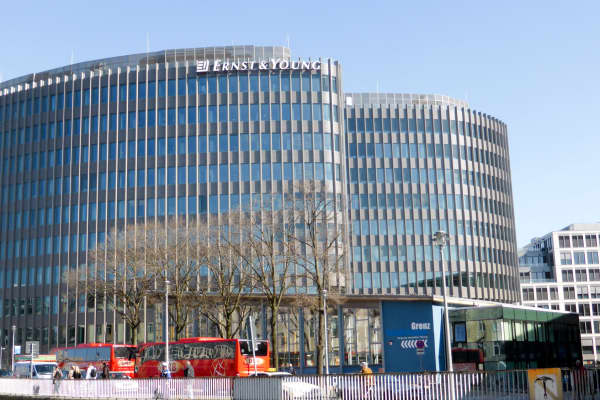
Ernst and Young building in Berlin, Germany.

Patti Domm | CNBC
Ernst and Young building in Berlin, Germany.

2. Ernst & Young (EY)

Glassdoor company rating on a five-point scale: 3.7

Current openings include: assurance services senior, risk advisor, experience management manager, tax services senior

Hiring locations include: Alpharetta, GA; San Francisco, CA; Boston, MA

Click to view openings

Penguin and Random House in Deal Talks

Joseph Devenne | Getty Images

3. Penguin Random House

Glassdoor company rating on a five-point scale: 3.8

Current openings include: marketing designer, publicity assistant, senior manager of finance, production assistant

Hiring locations include: New York, NY; London, England; Colorado Springs, CO

Click to view openings

jetcityimage | iStock Editorial | Getty Images

4. Costco Wholesale

Glassdoor company rating on a five-point scale: 3.9

Current openings include: cashier, stocker, pharmacy sales assistant, bakery wrapper

Hiring locations include: Baton Rouge, LA; Vallejo, CA; Kalamazoo, MI

Click to view openings

Vehicles drive through the parking lot outside a Whole Foods Market Inc. location in Willowbrook, Illinois.

Daniel Acker | Bloomberg | Getty Images
Vehicles drive through the parking lot outside a Whole Foods Market Inc. location in Willowbrook, Illinois.

5. Whole Foods

Glassdoor company rating on a five-point scale: 3.5

Current openings include: grocery team member, cashier, bakery team member, whole body team member

Hiring locations include: Napa, CA; Petaluma, CA; Tigard, OR

Click to view openings

The New York Hilton midtown hotel is show in this December 2013 photo.

Victor J. Blue | Bloomberg | Getty Images
The New York Hilton midtown hotel is show in this December 2013 photo.

6. Hilton

Glassdoor company rating on a five-point scale: 4

Current openings include: event manager, front office manager, housekeeper, hotel manager

Hiring locations include: San Rafael, CA; Napa, CA; Indianapolis, IN

Click to view openings

0554M919

John Greim | Getty Images

7. Publix

Glassdoor company rating on a five-point scale: 3.7

Current openings include: pharmacist, retail set-up coordinator, maintenance technician, job fair

Hiring locations include: Lakeland, FL; Atlanta, GA; Deerfield Beach, FL

Click to view openings

Apple CEO Tim Cook greets guests at the grand opening of Apple's Chicago flagship store on Michigan Avenue in Chicago, Illinois. 

Scott Olson | Getty Images
Apple CEO Tim Cook greets guests at the grand opening of Apple’s Chicago flagship store on Michigan Avenue in Chicago, Illinois.

8. Apple

Glassdoor company rating on a five-point scale: 4

Current openings include: design verification engineer, engineering project manager, iPhone buyer

Hiring locations include: Santa Clara, CA; Austin, TX; Las Vegas, NV

Click to view openings

1006_29_peru120115118.jpg

Jeff Greenberg | Getty Images

9. Starbucks

Glassdoor company rating on a five-point scale: 3.8

Current openings include: barista, shift supervisor, store manager

Hiring locations include: Dublin, GA; San Francisco, CA; Compton, CA

Click to view openings

Pedestrians walk past a Nordstrom Inc. store.

Ben Nelms | Bloomberg | Getty Images
Pedestrians walk past a Nordstrom Inc. store.

10. Nordstrom

Glassdoor company rating on a five-point scale: 3.6

Current openings include: retail sales, cleaning, stock and fulfillment, bartender

Hiring locations include: Phoenix, AZ; Las Vegas, NV; Scottdale, AZ

Click to view openings

A cashier scans a customers purchases at a Home Depot store in New York.

Mark Kauzlarich | Bloomberg | Getty Images
A cashier scans a customers purchases at a Home Depot store in New York.

11. Home Depot

Glassdoor company rating on a five-point scale: 3.5

Current openings include: department supervisor, customer service sales, store support

Hiring locations include: Colonial Heights, VA; South Plainfield, NJ; San Diego, CA

Click to view openings

Pedestrians walk in front of the IBM building in New York.

Scott Mlyn | CNBC
Pedestrians walk in front of the IBM building in New York.

12. IBM

Glassdoor company rating on a five-point scale: 3.4

Current openings include: financial blockchain engineer, lead recruiter, contract and negotiations professional

Hiring locations include: San Francisco, CA; Raleigh-Durham, NC; Austin, TX

Click to view openings

Pedestrians pass in front of a Bank of America Corp. branch in New York, U.S., on Wednesday, Oct. 12, 2016.

Mark Kauzlarich | Bloomberg | Getty Images
Pedestrians pass in front of a Bank of America Corp. branch in New York, U.S., on Wednesday, Oct. 12, 2016.

13. Bank of America

Glassdoor company rating on a five-point scale: 3.5

Current openings include: client service representative, client associate, analyst, executive assistant

Hiring locations include: Tulsa, OK; Wilmington, DE; New York, NY

Click to view openings

Diners eat at a Chipotle restaurant in Chicago, Illinois.

Getty Images
Diners eat at a Chipotle restaurant in Chicago, Illinois.

14. Chipotle

Glassdoor company rating on a five-point scale: 3.4

Current openings include: district manager, kitchen manager, service manager

Hiring locations include: Sandy, UT; Woburn, MA; Pleasant Hill, CA

Click to view openings

Lowes Retail Store Sign

Getty Images

15. Lowe’s

Glassdoor company rating on a five-point scale: 3.3

Current openings include: plumbing associate, commercial sales loader, lumber associate

Hiring locations include: Westborough, MA; Omaha, NE; Mooresville, NC

Read original article here.

Thousands pay tribute to slain Tshwane University of Technology student

Sesona Ngqakamba

Tshwane University of Technology (TUT) student, Andries Monareng’s  death has robbed the world of the vast talent and potential he offered, the university’s vice-chancellor, Professor Lourens van Staden, said on Thursday.

Van Staden was addressing thousands of students, staff members and management members at Monareng’s memorial service at the Soshanguve campus on Thursday.

“As I stand before you today, I am extremely sad about the life of your son, friend, a leader, a young man with a bright future and our student, who was tragically, untimely and abruptly brought to an end,” van Staden said.

Monareng was shot outside the Soshanguve campus when protests broke out following allegations of vote rigging during the Student Representative Council (SRC) elections.

In a statement, university spokesperson Willa de Ruyter said, apart from the university’s vice-chancellor, various representatives from student political structures were given the opportunity to speak at the memorial.

Van Staden said the university planned to do everything in its power to get to the bottom of what caused the tragedy that led to Monareng’s death.

“The high-level engagement meeting between TUT management, student leadership, the [SA Police Service] and Department of Higher Education and Training (DHET), as well as the executive of the TUT council the past week, demonstrates our commitment to find answers,” he added.

De Ruyter also said that the university had appointed SNG Grant Thornton to conduct a full-scale, independent forensic investigation into allegations of irregularities during the 2018 SRC elections and the subsequent protest action at the Soshanguve and Ga-Rankuwa campuses.

“This investigation will complement that of the Independent Police Investigative Directorate (IPID) into the death of Mr Monareng,” Ruyter said.

On Wednesday, hundreds of students marched through the Pretoria CBD to protest against the death of the student.

They handed over a memorandum to police, demanding that Police Minister Bheki Cele hold the Soshanguve police station accountable and that a special police task team be established to investigate the death.

The student is expected to be laid to rest in Bushbuckridge, Mpumalanga on Saturday. – News24

South Africa: Afrikaans community fights back over school admissions in Gauteng

Ernest Mabuza

The termination of the role of feeder schools‚ erosion of the school governing bodies’ role and the exclusion of SGBs from the determination process regarding schools’ capacity were among the objections raised by AfriForum on Thursday as it called for draft regulations on the admission of learners to schools in Gauteng to be scrapped.

The organisation made the call after submitting its own comments on the Draft Regulations on the Admission of Learners‚ which were published by Gauteng Education MEC Panyaza Lesufi in a special Provincial Gazette on July 30.

The draft regulations make provision for the MEC of education in the province to have the final say about a school’s language and admission policy.

The proposed regulations state that no pupil may be refused admission to a Gauteng public school on grounds that constituted unfair discrimination – including race‚ gender‚ disability‚ belief‚ culture‚ language‚ pregnancy or illness.

They also suggest that no pupil may be refused admission because they‚ or their parents‚ do not subscribe to the mission statement of the school and code of conduct.

The amendments also propose that when a pupil has applied for admission to a school‚ the school may not request information from the pupil’s current school for information about the financial status of their parents or information about the health of the learner.

Thursday was the closing day for the public to comment on the proposed amendments.

AfriForum said its submission comprised a legal opinion by an advocate and comments by members in Gauteng who were parents that requested their concerns to be submitted.

AfriForum raised a number of objections to the draft regulations.

In addition to the role of SGBs and the lack of consultation opportunities with stakeholders regarding the issue of feeder zones‚ AfriForum also said the draft regulations provided that the current model of cooperation among the department‚ schools and school governing bodies would be replaced by a system dominated by the department.

In light of these concerns‚ the group called for the draft regulations to be scrapped.

Carien Bloem‚ coordinator for education at AfriForum‚ said Lesufi held numerous public meetings where concerned Afrikaans parents had asked questions.

“However‚ these questions were not answered at any of the meetings. On the contrary‚ parents who specifically asked about mother-tongue education were reviled as being racist‚” said Bloem.

Read original article here.