Home Blog Page 507

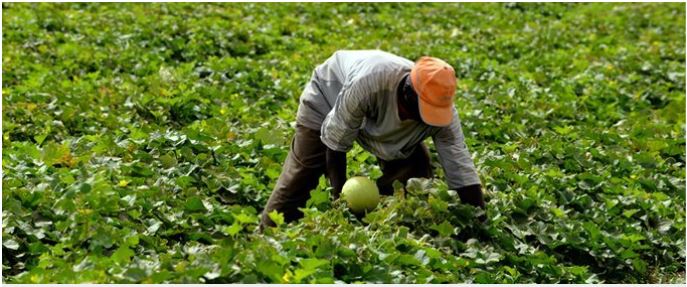
Agriculture will create jobs for youth in Africa

Thuletho Zwane

The African Development Bank (AfDB) has identified agriculture as key for the acceleration of economic growth and the reduction of unemployment in Africa.

Speaking to media from different countries on the continent, the Director for Communications and Media Relations at the bank, Dr. Victor Oladokun, said it was paradoxical that even though 65% of agricultural land was right here in Africa, 85% of food consumed in Africa was imported.

Olakodun said this was the reason the bank decided to invest in agriculture and agri-trepreneurs.

“There is no reason for Africa to be a net food importing region, spending $35 billion annually on food imports. This is especially so because the continent has 65% of the uncultivated arable land left in the world to feed 9 billion people by 2050. What we do with African agriculture today will determine the future of food in the world,” said Oladokun at the AfDB headquarters in Abidjan, Côte d’Ivoire.

Media across Africa was invited in an attempt to showcase the success of development projects implemented by the bank in different African countries.

Oladokun said media was considered a major development partner of the bank.

He said it was important to capture the true story of Africa. That among challenges, there were many projects on the continent contributing to the betterment of African lives, yet conversations on the global scale were still largely negative.

“I have the greatest respect for the youth of Africa. Despite challenges, they are doing amazing creative work. We need to encourage them to see agriculture as attractive. We must change the mentality of people so that they take their own destiny into their hands,” said Oladokun.

He said agricultural transformation will help to revitalise rural areas, turning them from zones of economic misery today, to zones of economic prosperity.

Oladokun said the bank recognised that this will require significant investments in raising agricultural productivity, development of rural infrastructure, provision of affordable finance, as well as incentives for the private sector to establish food processing and Agro-allied industries in rural areas.

Statistics show that Africa has more undeveloped arable land than any other region globally. The continent’s arable land is equivalent to 25% of the world’s fertile land, yet food insecurity and malnutrition are persistent.

In 2015, 24.6% of the population was at risk of food insecurity.

AfDB’s Development Effectiveness Review of 2016 shows that a significant number of Africa’s farmers also work fragile soils in rain-fed areas, using little or no fertiliser, pesticide, irrigation or machinery.

“African farmers lack infrastructure, financial systems, scientific innovation and access to markets. This is reflected in low levels of agricultural productivity that trap millions of farmers in poverty and act as a brake on growth,” said Oladokun.

The bank recognises that agriculture could be a major source of income in Africa. However, untapped agricultural potential has contributed to persistent poverty and deteriorating food security.

This is how the development of the Feed Africa Strategy came to be.

Feed Africa is a renewed and determined effort to transform African Agriculture into a globally competitive, inclusive and business-oriented sector that creates wealth, generates gainful employment and improves quality of life.

The African Development Bank, through its Feed Africa Strategy, will invest $24 billion over the next ten years in support of African agricultural transformation.

The bank’s goal is to help to end extreme poverty, eliminate malnutrition, end dependency on food imports and move Africa to the top of the value chains in areas of its comparative advantage.

Oladokun explained why this project was close to his heart.

“My grandfather was a cocoa farmer. But in all through his life, he never tasted a chocolate bar. Many years later, we are challenged with putting value on our food.”

“Every dollar used on imported products is a dollar taken away from Africa forever. We need local value addition.”

The other issue is that of youth unemployment.

Africa has the world’s youngest population, with more than 200 million people between 15 and 24. According to a Mckinsey Global Institute (2010) report, young people in Africa will double by 2045.

Between 2000 and 2008, Africa’s working age population (15-64 years) grew from 443 to 550 million; an increase of 25%. In annual terms this is a growth of 13 million, or 2.7% per year. If this trend continues, the continent labour force will be a billion strong by 2040, making it the largest in the world, surpassing both China and India.

This is why the bank makes the case for African youth to be involved in agriculture as a business.

Director for Human Capital, Youth and Skills Development Oley Dibba-Wadda said the Enable Youth Programme will provide access to capital and capacity to Agri-preneurs to create about 300,000 agribusinesses and 1.5 million jobs in 30 countries across Africa, with an estimated investment of $15 billion over the next five years.

“We recently approved a Rural Enterprises Project in Madagascar aimed at reducing food insecurity and fragility, and increasing youth employment in agriculture. The project will enhance agribusiness by supporting young rural enterprises and entrepreneurs in the agriculture and agroindustry sector, developing agricultural investment zones (including construction of irrigation networks, and building up processing and marketing infrastructure) and facilitating access to financial and non-financial services,” said Dibba-Wadda.

Dibba-Wadda added that AfDB aims to make Africa self-sufficient in food by transforming the agriculture sector from one of subsistence to one that is a creator of jobs, wealth and growth.

“The Bank is bringing agriculture into Africa’s transformational agenda; it is one of the top five priorities established by the Bank’s — “High 5s” — in order to deliver real changes in the lives and livelihoods of Africans,” she said.
#ZolileKhumalo: Students come out in numbers to protest outside court

Sarah Smit, Agencies

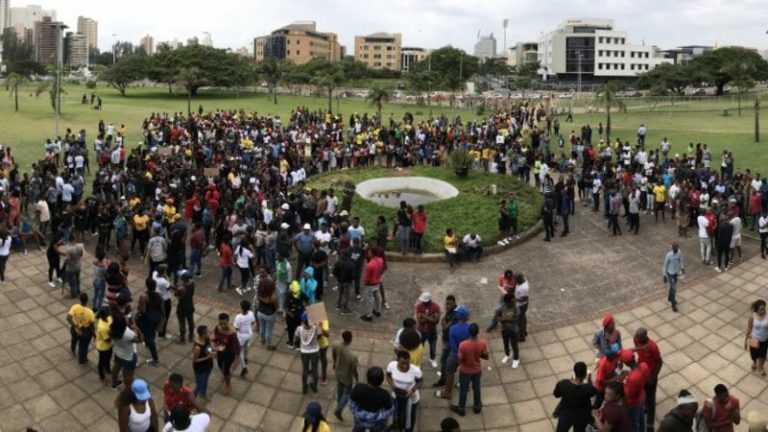
Hundreds of Mangosuthu University of Technology (MUT) students gathered outside the Durban Magistrate’s Court on Thursday for the appearance of the man who allegedly confessed to the murder of his girlfriend, Zolile Khumalo, on Facebook.

According to News24, the throng of students marched from Point Road to the court building, holding placards as they chanted slogans against women abuse.

On Wednesday, the student representative council of MUT expressed dismay following the death of the 21-year-old student, who was shot in Lonsdale Hotel residence on Tuesday evening.

Khumalo’s 23-year-old ex-boyfriend is accused of killing her and is under police investigation.

KwaZulu-Natal police spokesperson Lieutenant Colonel Thulani Zwane said police were called to the university residence in the early hours of Wednesday.“When police arrived, they found a 21-year-old with multiple gunshots,” Zwane told News24.

Zwane said the incident is suspected to have been part of a domestic dispute.

On Thursday, Afro Voice reported that one student said the suspect, a former MUT student, had asked one of his friends who lives at the residence to sign him in as a visitor after Khumalo had refused him entry. Khumalo’s roommate reportedly answered the door.

Khumalo’s murder garnered media attention when the suspect appeared to confess to killing her on his Facebook page on Wednesday morning.

Loosely translated from isiZulu to English, the accused wrote in a Facebook post that he “would bring her back so that we can right our wrongs by talking. But that’s no longer possible because she has left me without me having told her that I forgive her.

”When one of the man’s Facebook friends asked him what had happened, the accused replied: “Man, I killed my Zozo.” It is suspected that he wrote the post shortly after he allegedly committed the crime. The post sparked a huge social media response, with thousands commenting on it.

MUT communications director Mbali Mkhize said in a statement that the circumstances around Khumalo’s death were not yet clear. Mkhize and other representatives from the institution were in court on Thursday in solidarity with the family.

Two South Africans go head-to-head on slavery

Roger Southall

A recent exchange on Twitter between South African TV personality Sizwe Dhlomo and Western Cape Premier Helen Zille, is worthy of close examination because it raises important questions about how history is viewed, how debates unfold on social media and how South Africans deal with racism and diversity.

Initially, Dhlomo basically baited Zille by redirecting a tweet by the King Centre – an advocacy group set up in memory of Martin Luther King – which issued a blunt proclamation that:

There was nothing righteous, just or positive about the Transatlantic slave trade or slavery in America. Nothing.

Zille replied:

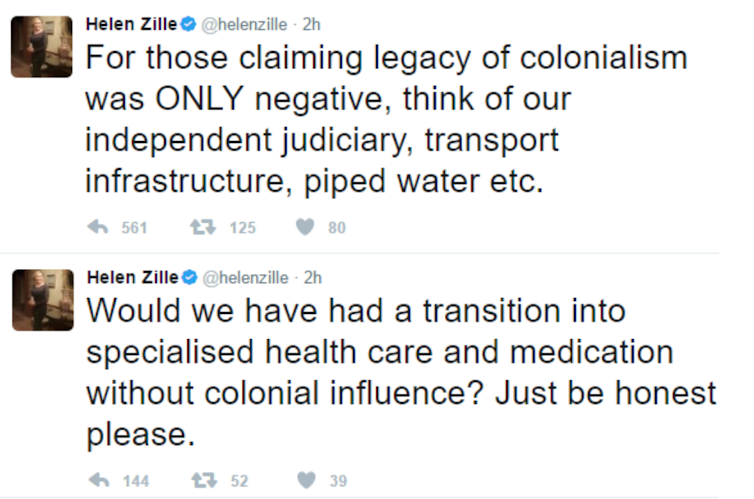
I agree, there was absolutely nothing positive about slavery or the slave trade. If you read the transformed (South African) history textbook… you will see the acknowledgement that despite its many evils, colonialism helped end slavery in parts of Africa.

Dhlomo then responded:

You, like it or not, are a beneficiary of colonialism, albeit indirectly. Your biases, whether you’re aware of them or not, make it unlikely for you to be able to accurately weigh up the negatives of colonialism versus the positives you speak of.

After asserting that the motive of colonialism was never to ultimately benefit the colonised (an assertion with which Zille agreed), he rounded off by posing the question whether or not there might have been alternative historical alternatives to colonialism:

Without colonialism, were the colonised nations doing well? Would they have continued to do so and develop at their own pace?

before providing his own answer:

I see no reason why the answer would be no.

Four points can usefully be made about all this. The first is about the limitations, and dangers, of engaging in serious debates on Twitter; the second is that reducing history to simple matters of right or wrong is fraught with risk; thirdly, the need to recognise that history can be contradictory; and finally that history, is and always has been, contested.

The inappropriateness of Twitter

Twitter is inappropriate for complex historical debates. There is just too much to be said in defence of any position – whether conservative, liberal or radical – for it to be reduced to exchanges of 280 characters or less. The process of assessing the motivations, dynamics and impacts of colonialism by scholars is both constant and continuous, and reducing historians’ debates to trite summaries is dangerous.

This is not to say that the history should be the property of only the historians, and that ordinary people should keep out. History is, after all, actually as much about the present as the past. But we should beware of the misuse of history for political point-scoring.

Yet if Dhlomo may be considered as guilty of this, Zille has only herself to blame for setting herself up as a target by her initial ill-advised tweeton colonialism sent more than a year ago while she was in Singapore.

Just as Twitter can’t encompass the complexity of historical debate, reducing history to matters of simply right or wrong, or good or bad, is similarly fraught with risks. This was gloriously and famously illustrated by 1066 and All That, by WC Sellar and RJ Yeatman, published as long ago as 1930, which reduced English history to a hilarious parody of good and bad kings and queens.

The fundamental point is: history is almost always contradictory, moving in different directions at the same time.

It would seem that this is the major point that Zille wants to make in her various tweets and more extended comments about colonialism. She will claim that she is not defending colonialism, and the racism inherent in it, but pointing out that, like God, it moves in a mysterious way.

In her defence, we might reference debates about the origins of the “developmental state” in Southern Africa. Broadly, a number of radical scholars (by that I mean not conservative ones) have explored how settler colonialism fostered capitalism development. Examples include Bill Freund’s “SA Developmental State of the 1940s”.

In South Africa, for example, the launch of parastatals – such as the power utility Eskom in the 1920s – fostered rapid growth and the creation of an Afrikaner bourgeoisie. In Marxian terminology, state policies helped develop the forces of production – but only for the benefit of white people in general, and Afrikaners in particular.

Would South Africa have industrialised as fast, or in a more beneficial way, without such a white-driven developmental state – as Dhlomo implies? Frankly, we don’t know. Nonetheless, we must allow that counter-factual history, the exploring of possible alternative historical paths that might have been followed if A and B had not happened, is a legitimate line of enquiry. Yet it can never be a substitute for exploring what did happen.

History is always contested

While Zille should not be pilloried for indicating that history is contradictory, she needs to be far less slapdash in lauding what she perceives as the benefits of colonialism. Her exchange with Dhlomo on slavery offers a prime example.

Let’s not be so politically correct that we have to deny the fundamental truth of Zille’s proposition that the colonial intervention involved the attempted abolition as well as the promotion of slavery. However, the problem is not what she says but what she does not say. We need to ask, for instance, why and how the British chose to bring slavery to an end.

The “why” must necessarily refer to the heroic labours of the anti-slavery movement of the day. But it also needs to be pointed out that abolition featured slave-owners being compensated by the state, whereas the slaves themselves received nothing.

In addition, much of the compensation was redirected into investment in the then rapidly expanding railway system in Britain, thereby providing a direct boost to the development of capitalism and colonialism.

We might also want to remember that when the American Civil War broke out, Britain initially supported the South, as it wanted to avoid the disruption of slave-produced cotton to its textile mills in northern England.

In short, it’s all so much more complicated than any attempt to produce a historical balance sheet in which the good of colonialism may outweigh, or at least compensate for, some of its negative impacts. Historians of whatever stripe, and certainly not politicians, cannot be allowed to omit inconvenient facts.

Yet while Dhlomo may be granted as much space as he likes to explore and condemn the brutalities of slavery and colonialism, he cannot be allowed to argue, as he did, that Zille’s historical judgement is inherently flawed by the inherent biases which flow from her being “a beneficiary of colonialism, albeit indirectly”.

This is dangerous nonsense. For a start, it assumes there is such a thing as “correct” history. There is not. History is always contested.

More saliently, Dhlomo’s assertion is absurdly deterministic, implying that social background (in today’s South Africa, read “race”) dictates the capacity to “understand” history. This is rubbish. True, it is very likely that the social experiences of being black will provide some major comprehension of colonialism. But it does not follow that being white necessarily blocks such understanding.

If it did, then Marx’s thoughts on colonialism should themselves be deleted from the black reading list.

Roger Southall is Professor of Sociology, University of the Witwatersrand

Tanzania: Govt to Organize Nation-Wide Debate On Education, Minister Reveals

Deogratius Kamagi

The Tanzania government is planning to organize a nation-wide debate with stakeholders in education to discuss possible ways to improve the sector.

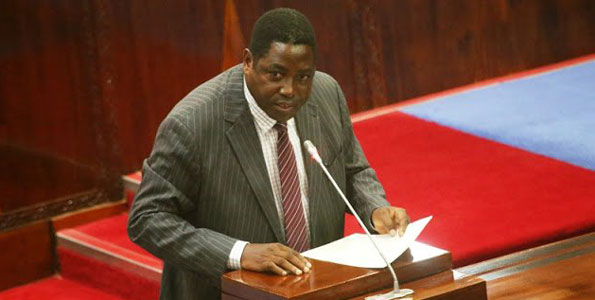
This was said in Parliament on Wednesday, April 25, by the deputy minister of State in the President’s Office who is responsible for Regional Administration and Local Government (PO-RALG), Joseph Kakunda.

Mr Kakunda was responding to a supplementary question that was raised by the Vunjo constituency member of Parliament on the NCCR- Mageuzi ticket, Mr James Mbatia, who sought to know the government’s plan to engage stakeholders in efforts to earnestly improve education in Tanzania.

“Mr Mbatia has raised a valid observation, and we are working on it. His views on this are in line with those of former President Benjamin Mkapa,” the deputy State minister said.

Read original story here

South Sudan’s former child soldiers find it hard to get back to school

Merethe Skårås

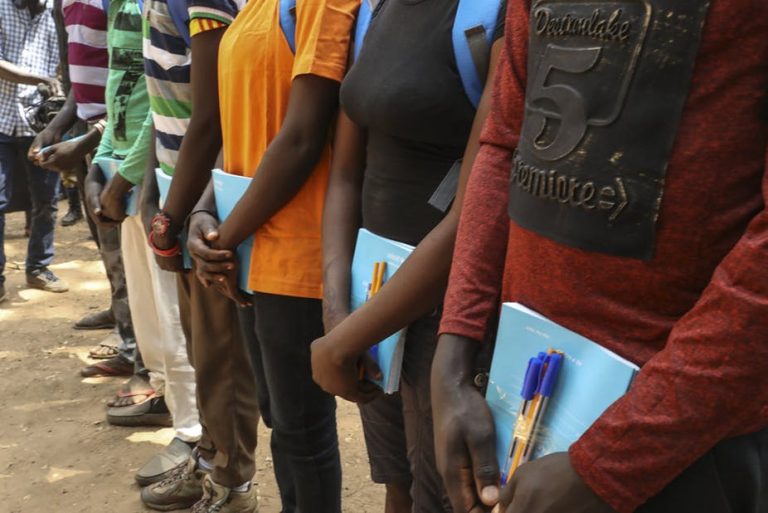
More than 200 child soldiers have been freed from armed groups in South Sudan. The 112 boys and 95 girls, all under the age of 18, took part in a “laying down of arms ceremony” after which efforts will be made to reunite them with their families and their reintegration process will begin.

The children were part of a new civil war that broke out in the Republic of South Sudan, two years after it was granted independence from Sudan. The ongoing conflict has ripped the country apart, making the living conditions for most South Sudanese worse than ever before.

Characterised as a struggle over power and resources, the conflict is driven by corruption and ethnic rivalries. The main actors are the former rebel group and political party Sudan People’s Liberation Army/Movement led by President Salva Kiir Mayardit, and the Sudan People’s Liberation Movement-in-Opposition led by former Vice President Riek Machar.

About 19 000 child soldiers are thought to be part of the conflict and so the release of any is great news. But it’s not guaranteed that they will reintegrate successfully. The reintegration process, often done by UNICEF and local communities, is crucial in determining whether these youth remain as civilians or return to the barracks as soldiers.

Based on interviews and observations with 20 former child soldiers in South Sudan, my research shows that though children do get forcibly recruited, many “choose” to join the armed groups. They are driven by poor socio-economonic conditions – like a lack of food, housing and security – and because they can’t afford school or physically get to one. And so they find the military, and the protection of a gun, to be the better option.

It is therefore imperative that education, whether formal schooling or an alternative system, be part of the reintegration process. Because without it the children find themselves in a vicious cycle and though thousands have left armed groups, they find themselves back with them for the same reasons as before.

But education isn’t accessible to most children in South Sudan. In 2016only 50% of children aged 6-13 were enrolled in primary education and just 3.5% aged 14-17 were enrolled in secondary education. There are challenges in finding a school, and being able to afford to go to one. This is even harder for demobilised child soldiers who are often traumatised and stigmatised.

Education challenges

One of the biggest problems in South Sudan is a lack of school facilities. A recent report states that there have been 293 military attacks on schools, affecting over 90,000 children. Due to this security concern, education isn’t readily available in many home communities and so shortly after the former child soldiers are reunited with their families, they leave. They usually go to bigger towns in search of schools, staying with distant relatives or family friends.

Even if the children manage to get into a school, the classrooms are overpopulated (in some secondary schools there can be over 100 students in a class), there are few decent textbooks and the teachers aren’t properly trained. The education the children get is very poor in quality.

The children will also have to pay for it. Even though most of the schools are meant to be government funded, my research shows that teachers are often not paid and so the students pay fees to give the teachers a little income. But with few resources and no support system, the children struggle to do this and run the risk of not attending or not having teachers.

Way forward

The global agenda for education is focused on teaching and learning for all, with an emphasis on quality and sustainability. But in the case of South Sudan the first main problem is access. If this was resolved it could keep former child soldiers occupied and prevented them from being re-recruited. It would also ensure that they were socialised in a non-violent environment and were working together with others towards a common future.

Experience shows that to reach child soldiers with educational interventions, they must be specifically targeted. The government also needs to ensure teachers are paid and trained in psychosocial support. The education should be geared towards accommodating and supporting the childrens’ traumatic past, increasing their chances of successful reintegration.

Unfortunately, this might all be too much to ask in the midst of a civil war where I often hear people say:

We are all traumatised

Merethe Skårås is PhD candidate and lecturer, Oslo Metropolitan University

Quality education starts with schools that work

What would it take to re-imagine South Africa’s education system? It starts with the basics: we must find a way to give each child access to quality education, from early childhood right through to matric.

Since 1994, South Africa has made great progress in dealing with the legacy of a deeply unequal past.

By 2010, South Africa had achieved universal access and gender parity in schooling, and about 99% of learners now complete grade 9 in our schools, according to the Education for All (EFA) 2010 Country Progress Report.

Whilst we have some excellent results, some of the statistics associated with our schools make sad reading.

Last year, for example, we heard from the 2016 Progress in International Reading Literacy results that 78% of our learners coming out of grade 4 fail tests of reading for comprehension.
Put differently: 8 out of 10 South African grade 4 learners cannot read for meaning.

Education can serve as a powerful tool to deal with the legacy of underdevelopment and tackle the challenges of inequality, unemployment, and poverty. These are all massive socio-economic issues that start being addressed when education outcomes improve, especially in a country like South Africa.

So how do we do this? Like many companies, Anglo American has historically made substantial investments in education.

Over the last five years alone, we have invested over R780 million on educational resources and skills development.

However, we have realised that more needs to be done to help learners achieve their academic potential.

This week, we launched the Anglo American South Africa Education Programme, in partnership with the Department of Basic Education.

The programme will focus on 100 early childhood development (ECD) sites local to Anglo American’s operations, as well as a “whole school” systemic approach for 100 primary and secondary schools in these areas.

Many of these schools are “no-fee” schools.

In other words, they simply don’t have the resources that many other schools do.

This programme aims to improve educational outcomes, particularly in reading, writing, and numeracy and, importantly, also seeks to address the underlying reasons for poor educational outcomes in these schools.

These include poorly functioning institutions, wasted teaching and learning time, school leadership who require support, teachers needing assistance with content knowledge and skills, as well as a lack of access to resources and teacher support material such as textbooks and workbooks.

One of the ways we see the programme working is by helping the schools to run more effectively so that the school has a solid “drumbeat” or routine.

From the time the school bell rings the children should be sitting at their desks and have started schooling for the day.

Once we have that rhythm, we can get the children through their entire syllabus by the end of the year. So just helping the school to run “like clockwork” or to a drumbeat is very important.

To do this the programme will support school management teams, governing bodies, principals, staff as well as parents.

There will also be a strong focus on helping teachers develop their content knowledge and teaching skills – how to teach reading for understanding, how to teach bigger classes, even how to teach children to draw, colour-in and learn numbers.

The programme aims to have:

• 90% of learners aged five meeting the minimum requirements for school readiness

• 90% of grade 3 learners passing with at least 50% in Numeracy and Literacy

• 75% of grade 6 learners passing with at least 50% in Mathematics and English First Additional Language

• 65% of grade 12 learners passing with at least 50% in Mathematics

• 90% matriculation pass rate in participating schools, with a 50% university entrance pass rate.

We are facing changing and fast-paced times as the world enters the 4th Industrial Revolution.

Our education system can no longer afford to lag. Now more than ever, we need to capacitate our learners with the skills to navigate the complex, yet exciting future that lies ahead. This can only be done if we first focus on getting the fundamentals right.

This programme, launched in the centennial year of Nelson Mandela, is our contribution to the important work that lies ahead of us as a nation.

We must do better than simply acknowledge the fundamental right of every child to a quality education. It is our collective responsibility to deliver it. Our future depends on it.

Mbazima is deputy chairperson of Anglo American South Africa

Validating ‘the truth’ about SA’s education system

Gopolang Makou & Kate Wilkinson

A South African Twitter account promises to “tell you the truth, no matter how hard it is to accept”. But are the education claims @Sowellnomicsrecently tweeted to its over 10 000 followers the truth?

“South Africa has the 3rd worst education system in the world, 50% of students drop out of the system, while only 30% get the marks requires [sic] to get into Uni,” the account claimed.

The tweet was retweeted 763 times and liked by 1 479 people by the time we published this report. Africa Checked dug into the data behind the tweet’s three claims.

Claim: “South Africa has the 3rd worst education system in the world”.

Verdict: Incorrect

To support the claim that “South Africa has the 3rd worst education system in the world”, @Sowellnomics tweeted a MyBroadband articlefrom 2016.

The article reported on the World Economic Forum’s (WEF) Global Information Technologyreport. The WEF placed South Africa 137th out of 139 countries for the overall quality of its education system. (Note: This isn’t the total number of countries in the world. The United Nations currently recognised 193 member states.)

More recent data from the WEF’s 2017/18 Global Competitiveness Index report ranked South Africa 114th out of 137 countries for the quality of its education system.

WEF rankings ‘subjective, unscientific’

But the way the WEF assesses education quality has been severely criticised by education experts. Nic Spaull, a research fellow with Research on Socio-Economic Policy (RESEP) at Stellenbosch University, has described the rankings as “subjective, unscientific, unreliable and [lacking] any form of technical credibility or cross-national comparability”. That is because the rankings are based on the opinions of unidentified “business leaders” – 170 for South Africa, in the case of the Global Competitiveness Index report.

No pupils were tested and educational performance was not compared to determine a country’s education quality. Martin Gustafsson, a researcher in the school of economics at Stellenbosch University, has previously stressed that while the rankings could offer insight into business confidence, it doesn’t speak to the quality of education in the country.

“You can’t apply opinions to things like education,” Gustafsson told Africa Check. “It is like asking business experts what they think the HIV rate is.”

More useful measures available

A more insightful measure of a country’s education system would be standardised tests, like those compiled by the Southern and Eastern Africa Consortium for Monitoring Educational Quality(SACMEQ).

In 2007, 61 396 Grade 6 pupils from 2 779 schools were tested. (Note: The most recent SACMEQ assessment is from 2013, but there are concerns about the comparability and validity of the results.)

South Africa’s average student maths score placed it eighth out of 15 countries, ahead of Mozambique, Uganda, Lesotho, Namibia, Malawi and Zambia. Its average student reading score placed it 10th out of the 15 countries, ahead of Uganda, Mozambique, Lesotho, Zambia and Malawi.

South Africa’s education system does face serious challenges. But the claim that it has the “3rd worst education system in the world” is not based on rigorous data.

Claim: “50% of students drop out of the system”

Verdict: Misleading

“The dropout statistic obviously depends on how one defines ‘dropping out’,” Gustafsson told Africa Check. Data shows that between 2014 and 2016 an estimated 50% of 22 to 25-year-olds had not passed matric.

“But many of these youths at least attempt the [senior certificate] examinations and fail – I wouldn’t consider these youths ‘dropouts’,” says Gustafsson. “A useful statistic [to consider] is the number of South Africans, by age, who did not successfully complete Grade 11.”

A recent internal analysis from the department of basic education found that 67.6% of people born between 1990-1992 managed to pass Grade 11, meaning 32.4% of them “dropped out” of the secondary education system.

“Hardly any of these [pupils] would successfully complete the desired or ideal alternative, a qualification in a public TVET college,” said Gustafsson. “Some might complete other qualifications beyond school… but those numbers are not large.”

Last year of compulsory schooling Grade 9

Gustafsson told Africa Check that it is also important to look at the Grade 9 completion rate, as it is the last year of compulsory schooling in South Africa. The most recent publicly available data shows that in 2016, 88.6% of young people between the ages of 19 and 21 had passed Grade 9.

This means that 11.4% of young people in this age bracket had dropped out of the education system before successfully completing the minimum amount of education prescribed by law.

Claim: “[O]nly 30% [of students] get the marks requires [sic] to get into [university]”.

Verdict: Mostly correct.

The latest National Senior Certificate results show how many students qualified for university entrance. To apply for university, a pupil needs to achieve at least 30% in their language of learning along with at least 50% in four other subjects.

Of the 534 484 students who sat for the National Senior Certificate exam in 2017, a total of 153 610 received a bachelor pass. This means 28.7% of the candidates who wrote the exam received the necessary marks to apply for a place at one of South Africa’s universities. This compares to 26.6% of the 610 178 students who wrote the national senior certificate in 2016 and 25.8% of the 644 536 who wrote in 2015.

Year Number of candidates % receiving a bachelor pass
2017 534 484 28.7%
2016 610 178 26.6%
2015 644 536 25.8%

Source: Department of basic education

– This fact-check was researched by Kate Wilkinson and Gopolang Makou for Africa Check, the continent’s leading fact-checking organisation.

Read it on their website here.

Kenya public universities crack whip on striking secturers

Ouma Wanzala

Public universities have started cracking the whip on striking lecturers and other staff as the industrial action enters its third month on Tuesday.

The University of Nairobi (UoN) has suspended 35 lecturers after they declined to return to work following Labour Court’s ruling that declared the strike illegal and unprotected last month.

Technical University of Kenya (TUK) on Friday started a head count of lecturers who are teaching, and has threatened to sack those who will not report to work.

At UoN, acting Deputy Vice Chancellor Finance and Administration Isaac Mbeche said the suspension is a warning to those who are still on strike.

“We are now dealing with individuals since they have different contracts with the university. If you do not come to work without permission, there are consequences,” Prof Mbeche warned.

Salaries

He said the institution wrote to staff asking them to resume work, and that those who abided have not been punished.

“Some wrote back agreeing to resume work while others insisted they were still on strike,” Prof Mbeche said, adding that learning had resumed at the institution.

Last month, the university denied more than 1,200 staff their salaries for boycotting work.

At TUK, all staff are now required to sign commitment forms as the institution moves to ensure that operations are normalised.

“The directors of schools and heads of administrative units are hereby requested to ensure compliance with this directive by submitting completed commitment forms to the management,” a circular by Deputy Vice-Chancellor in charge of Administration and Planning, Joseph Kiplangat, reads.

Staff at the university who are still on strike are set to start receiving their suspension letters today.

Academic Calendar 

At Moi University, Vice-Chancellor Isaac Kosgey has warned that the striking staff will not get their salaries.

“Other disciplinary measures will be taken as the university council advises.

“Staff who are ready to resume work can do so by registering with the respective heads of departments on a daily basis with immediate effect,” Prof Kosgey said.

At Kenyatta University, lecturers are now required to sign forms indicating their willingness to teach, and which must be submitted to deputy VC in charge of administration and planning.

Jaramogi Oginga Odinga University has since adjusted its academic calendar for all students due to the strike.

Students

Students in most universities have gone home as they wait for a solution to the crisis that has affected learning for the last one year.

The strike, which started on March 1, has paralysed learning in all 31 public universities. Lecturers are demanding Sh38 billion for the 2017-2021 CBA.

Education Cabinet Secretary Amina Mohamed last week set up a team to table a counter-offer.

“The impact of these perennial strikes has, to say the least, been disastrous.

“The image of our university education worldwide is taking a severe beating.

“Our students are taking more than double the period required to complete academic programmes and employers are losing faith in the capacity of our graduates,” Ms Mohamed said.

SRC

Ms Mohamed said with the enactment of the Constitution and the subsequent creation of the Salaries and Remuneration Commission, all salaries in the public sector must now be based on advice from the commission.

However, Universities Academic Staff Union Secretary General Constantine Wasonga said lecturers will only call off their strike after receiving an offer.

“We are used to threats, and we will now be forced back to work,” Dr Wasonga said.


‘Stimela’ – a tale about apartheid’s migrant labour system

Andries Bezuidenhout

What is the ultimate song to celebrate Workers’ Day? Many will suggest “The Internationale” which had its roots as a poem written in the aftermath of the Paris Commune in 1871 by Eugène Pottier, a transport worker. Set to music a few years later, it became the anthem for the wider progressive movement. It served as the Soviet Union’s anthem after the Bolshevik Revolution in 1917, making it more closely associated with the communist movement.

But I would argue that trumpeter Hugh Masekela’s iconic and internationally popular song “Stimela” – the coal train – is perhaps a more appropriate anthem for Workers’ Day in southern and Central Africa. The song speaks about local history and the migrant labour system on the mines.

“Stimela” reminds everyone that South Africa’s wealth and infrastructure was built on the back of labour from all over Africa. They were the force that modernised the country. But the song is also internationalist in focus.

Hugh Masekela’s iconic ‘Stimela’.

Later recordings of the song typically begin with bass rhythms and percussion mimicking the sound of a train on its tracks. Then the instruments retreat to the background and Masekela announces:

There is a train that comes from Namibia and Malawi

there is a train that comes from Zambia and Zimbabwe,

There is a train that comes from Angola and Mozambique,

From Lesotho, from Botswana, from Swaziland,

From all the hinterland of Southern and Central Africa.

This train carries young and old, African men

Who are conscripted to come and work on contract

In the golden mineral mines of Johannesburg

And its surrounding metropolis, sixteen hours or more a day

For almost no pay.

Early morning commute

Until recently I was responsible for teaching an introductory course in sociology to first year university students. The auditorium in which I delivered the lectures had a beautiful sound system.

I’d plug in my computer and play music before lectures started. The music served two purposes. I liked to imagine that it allowed students to find some calm after their early morning commute from the city’s periphery on dilapidated trains.

It was also a way to introduce debates about key topics covered in the first year course.

I always started the first lecture of the year with Masekela’s “Stimela” because it was the perfect opening to a conversation about the forces that modernised South Africa.

South Africa’s was not a slow, organic growth of industrialisation that characterised the European transition from feudalism to industrial capitalism, the great transformation that gave rise to my discipline of sociology, with Karl Marx as one of its key contributors.

The emergence of modern South Africa was brutal in a different way. It came about as a result of the discovery of diamonds and gold, and the need for cheap labour to extract metals from the seams that ran through the Witwatersrand’s rock formations.

This was a story of labour shortages and the intervention of colonial administrations and armies across southern and Central Africa. They dispossessed pastoralists of their land and imposed hut and poll taxes on traditional leaders so that Johannesburg could be supplied with the much needed “Black Gold”, as journalist-activist Ruth First described the system.

The song describes what’s on the minds of mining recruits on a steam train as it makes its way to Johannesburg:

They think about their lands, their herds that were taken away from them.

For Masekela, writing “Stimela” must have been, in part, a reflection on his own life. Born in the coal mining area called Witbank, he was raised by his grandmother who made her livelihood from a shebeen (an illegal bar) for mineworkers.

The legacy lives on

Up until the 1970s, when Masekela composed “Stimela” while he was in exile, South African mineworkers typically spent only a few years on the the mines, saving up money or buying cattle to return to their lands.


Read more: Remembering Hugh Masekela: the horn player with a shrewd ear for music of the day


But the 1970s was time of great change in South Africa’s mining industry.

In 1974 72 Malawian mineworkers were killed in an aeroplane crash. A year later, Mozambique became independent. Both Mozambique and Malawi were major suppliers of migrant workers to South African mines and these events put the steady flow of labour at risk.

In the case of Mozambique, the apartheid state was able to strike a deal with the new Mozambican government for the continued supply of labour. But Malawi withdrew permission for the recruitment of workers from their country.

The result was a shift to recruiting more South African workers and the emergence of career mine workers with much longer contracts. This change in the mining labour market eventually led to the founding of the National Union of Mineworkers (NUM) in 1982.

The successful organisation of workers who were at the heart of South Africa’s economy was one of the most important pillars of resistance against apartheid.

Sadly, the mining industry’s contested legacy and its migrant labour system remain challenges in the post-apartheid period. This is evident in a number of ways. The massacre of mineworkers at Marikana in 2012 was a stark reminder of the acute vulnerability and exploitation of workers.

On top of this is the inability of the mining companies and the state to provide many mine workers – now often employed through subcontractors – with decent housing and services. And finally, the issue of land dispossession still haunts the country, and remains unresolved.

Steam trains no longer crisscross southern Africa. Yet “Stimela” remains as much a song about present and future aspirations, as it does of the past.

Andries Bezuidenhout is Professor of Development Studies at University of Fort Hare

Curro considers a “school fee loan” scheme

Phillip de Wet , Business Insider SA

Curro is considering a “school fee loan” scheme, private school group Curro said on Monday, for “selected learners” in grades 9 and higher in its schools.

The loans would take into consideration credit score and academic performance, Curro said – and available capacity in the class.

“A key goal for 2018 onwards will be the retention of learners,” Curro told investors in its annual report.

“A detailed evaluation of all learners who leave is now being performed.”

But Curro already knows two things: pupils who leave its schools do so “mainly for financial reasons (voluntarily or involuntarily) and it is hard to fill up classrooms when older pupils leave.

An excerpt from Curro’s annual report

Its major entry points are grade 1 and grade 8, Curro said. “When learners leave as a result of financial reasons from Grade 9 onwards it is unlikely that the learner will be replaced with a new learner.”

Keeping classrooms full, at 25 pupils per teacher at its flagship schools, is key to Curro’s business.

The new loan scheme “and other attempts to increase occupancy” may push up its bad debts, Curro warned investors – and those are already at record levels. In 2017 the company wrote off a net R31.2 million, or 1.5% of its turnover. That is an increase of 72% from the 2016 year, when net write-offs were stead at 1% of its turnover.

At the beginning of 2018 Curro recorded 52,233 pupils across its 145 schools, and it will soon employ around 3,000 teachers.

An excerpt from Curro’s annual report

In 2017, its average school fee per pupil was R41,600 – but for some families the increases into 2018 were steep, at a weighted average of 9% but with some fees going up by 12.2%.

Curros fees vary from school to school, and grade to grade within the same school, based on factors that include demand for places.