Home Blog Page 507

Parents stop teaching at primary school after allegations of corporal punishment

Zimbili Vilakazi  


Teaching was disrupted on Monday at Zamokuhle Primary School in D Section, KwaMashu, Durban, after angry parents locked the school gate. The parents demanded the principal call officials of the education department to address their concerns.

Parents accuse seven teachers of using corporal punishment. They also say the school principal and a head of department had a fight in front of the children. Parents are also angry that a teacher proposed that Grade 7 learners pay R1 per learner per day for a stokvel to hold a farewell party at the end of the year, and R1 per learner for rental of a space for extramural music practise.

One of the protesting parents, Samkelo Shelembe, said, “We heard that there are teachers who are using coat hangers in this school to beat our children.” He said they heard a student had been sent to a clinic for stitches to the head.

Chairperson of the school governing body Thoko Hlatshwayo said teachers and an official from the KwaMashu circuit office had met. It was decided that the teacher accused of beating learners with a coat hanger be suspended pending an investigation.

Spokesperson for the KZN education department Kwazi Mthethwa said the provincial level of the department was not aware of the situation at Zamokuhle Primary, but would contact the district to start investigating the allegations.

“It is not a good thing that the education of learners be disrupted in any way. The teachers should conduct themselves well, so that the learners’ right to education should not be violated,” said Mthethwa.

Teaching recommenced on Tuesday.

Read original article here.

UCT to become ‘unapologetically African’ under new vice-chancellor

Tshego Lepule

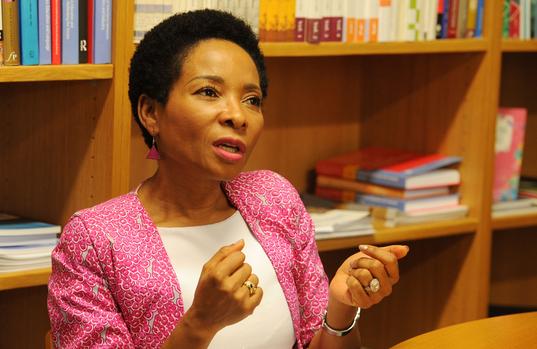
The incoming vice-chancellor of the University of Cape Town (UCT), Mamokgethi Phakeng, is on a mission to ensure that the institution realises the vision of becoming unapologetically African.

The 51-year-old was appointed by the university’s council in March after months of speculation on who would replace outgoing vice-chancellor Max Price.

The maths professor, who was born in Pretoria, went to study at the University of the North West at just 16 and obtained her PhD in 2002.

She will take the reins at UCT from July 1, and plans to ensure that the institution remains one of the best in Africa and adopts an identity that does not seek to make it something that it is not.

“If you look at the UCT’s strategic documents since the outgoing vice-chancellor came, it talks about UCT being Afropolitan and there are a lot of debates around using Afropolism rather than African,” she said.

“Being African is an identity that we should be proud of. We should not use Afropolism.

“That suggests we are a mixture of African and something else, or we are Africans somewhere in the world but not on the continent.

“That concept makes me a little uncomfortable, it denies who we are, tries to polish us, attempts to assimilate into something that is not necessarily who we are, to explain ourselves to others that we are not the poor and backward Africa they think we are.

“I’m saying we are African and we do work that can make an impact globally and is relevant to the continent, (and) that the world should sit up and take us seriously as Africans.

“I want to write something moving the institution from Afropolitan to being unapologetically African,” Phakeng said.

She revealed in preparation for her new role that she met former vice-chancellors to learn from their experiences and to see how she could incorporate this into her position.

“There have been a lot of people who have come before me – Mamphela Ramphele, Professor Njabulo Ndebele, Professor Stuart Saunders, Max Price -and I’ve made an effort to meet with each of them individually because in my view there is something to be learnt from all of them,” she added.

Phakeng explained that the government’s adoption of a free higher education policy had the institution working on plans to accommodate postgraduate students whose ability to afford to continue their education should not be a hindrance.

“The big challenge for free education is not so much for universities but from the government’s side to see if they can sustain it.

“It can’t just be done for five years and (then) we are told that there is no more money.

“For us internally it’s that the government is supporting us to do it for undergraduates but we don’t have it for postgraduate, so the very student who gets supported as an undergraduate, what happens to them when they want to do a postgraduate?

“Are we saying they are no longer poor, and what does that do for our transformation agenda because the majority of these students are black students?

“That is the challenge we are grappling with now, and we have started working on a model for Honours students but because it comes from institutional funding it is not available for everyone, and as we get on to our budget season in September we will (look at) how we tackle this.”

Having been faced with protests around transformation and the #RhodesMustFall campaign, Phakeng said the institution had to ensure that it tackled transformation in three phases.

“Looking at the university today, there are more black students than 15 years ago and my critique is that it’s just one level of transformation.

“I always talk about three levels of transformation – access, participation and success.

“Equity of participation talks to when students are here at campus. Do they feel a part of this university and if they still feel alienated? What is the point of bringing more people here and they feel like it is not their place,” she said.

“One has to start questioning what are the things we need to transform about the institutional culture that can make sure that the people don’t feel like intruders.

“And do we have transformation at the level of success? Are we looking at who is making it, who is dropping out? And if it is black students, it should worry us and we need to ask ourselves why.

“If we are experiencing more black students who pass at a lower level or it takes them six years to complete a three-year course, it should be a challenge for us to question.

“You can say that you have succeeded at transformation at the level of access, but you have brought people here and they might be frustrated and failing here and go back worse than when they came.”

With more attacks on students on campuses being recorded across the country, Phakeng said ensuring the safety of students would need engagements with students and building trust in securing measures put in place.

“For us, that is our biggest challenge because we are an open campus, and it is not so easy to close it up and it is not something I can say I have a magic solution for.

“There is an antipathy towards security, but then we need security and it comes from our history because they don’t want to be securitised, so we are going to have to hold conversations with students around how we ensure that the campus is safe for their own protection.

“The students have to understand that we live in a society that is complex where these things happen not just at UCT but everywhere else,” she said.

Read original article here.


Kenya: lecturers resume work amid crackdown by universities

Ouma Wanzala

A number of lecturers have started to resume work although at a slow pace as universities crack down on those who are defiant.

At Kenyatta University, students reported back on Monday, and they have started to learn. Learning has also resumed at Technical University of Kenya (TUK) and University of Nairobi (UoN).

This came after lecturers in these and other institutions were forced to individually sign commitment letters as the 31 public universities move to end the two-month strike.

At UoN, more than 35 lecturers have received suspension letters after declining to resume work. Those who are not working have also been denied their salaries.

Cautioned Lecturers

Students leaders have also been roped in by vice-chancellors, and they have cautioned lecturers who will disrupt learning of dire consequences.

Security has been beefed up in universities to ensure that those who want to teach are free to do so. At TUK, student leader Mark Oroko said learning resumed on May 2.

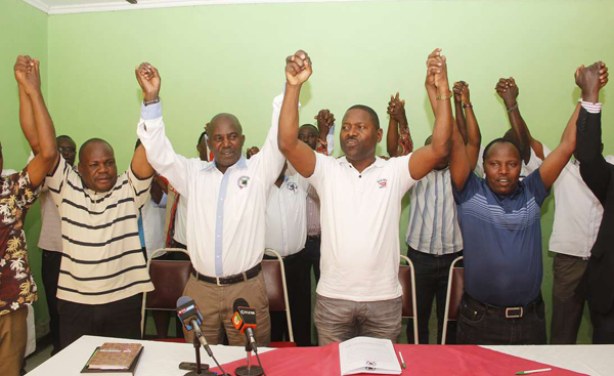
But yesterday, Universities Academic Staff Union (Uasu) and Kenya University Staff Union (Kusu) condemned the tactics that have been employed by universities to ensure learning resumes.

The two unions protested the harassment of its members by police and universities’ management, saying it was against the law. They maintained that no learning was going on in those institutions. Uasu Secretary-General Constantine Wasonga also cautioned those signing commitment letters.

Striking Employees

“There are police officers in the grounds of Masinde Muliro University, Masai Mara University, Pwani University and Kenyatta University, who have been brought in by universities to try and force striking employees back to work, brutalise those who refuse, and disperse peaceable assemblies,” he said.

Kusu Secretary-General Charles Mukhwaya said: “Vice-chancellors should stop using students to undermine their lecturers.”

He said the action by the police and management is a blatant violation of article 37 and 41 of the constitution of Kenya which guarantee the right to peaceful assembly and right to strike.

He cited the harassment of staff at Kenyatta University by police saying they used live bullets to disperse the lecturers.

“Uasu demands that Kenyatta University management desist from the barbaric and inimical behaviour hence forth,” said Dr Wasonga.

Incite students

He went on: “We have been aware of an evil plot hatched by university management to incite a section of students against lecturers. No evil attempt to separate students and their lecturers will succeed.”

Kenya University Staff Union (Kusu) Secretary General Charles Mukhwaya reminded students that lecturers are the one who will teach them, prepare them for exams, mark the exams and prepare them for graduation.

“Vice-chancellors should stop using students to undermine their lecturers,” said Dr Mukhwaya.

The strike that started on March 1 entered its 69th day with lecturers insisting that they will only go back to work once they have negotiated, signed and the CBA implemented.

Security provision

However, Vice-chancellors Committee chairman Francis Aduol denied the allegations saying police are only in universities to provide security.

“We usually have police officers in campuses and no such officers have harassed lecturers at all,” said Prof Aduol.

He also denied allegations that Universities management are using students to threaten and intimidate lecturers.

“We cannot incite students to harm their lecturers and they need to explain to us how this is being executed,” said Prof Aduol.

Maasai Mara University Vice-chancellor Mary Walingo also denied the allegations noting that the institution has since closed after examinations and students will be reporting back in September.

Harassment of staff

“We concluded our examinations and students are now home. We have no officers on the ground to harass staff,” said Prof Walingo.

Dr Wasonga said despite efforts by lecturers to engage the Ministry of education, they are still being harassed by university management.

“There is no fault line between students and lecturers, as some university management would want us to believe, but there is an orchestrated campaign by managers to stir up hostility and conflict in our universities,” said Dr Wasonga.

He asked parents to take their children home saying there safety in universities is not guaranteed noting that the strike will take long time unless the government tables a counter-offer.

Zimbabwe: teachers reject government pay-hike offer

Anna Chibamu

It was business as usual at most urban and rural government schools on the second day of the new school term this week.

This is according to teachers’ representatives.

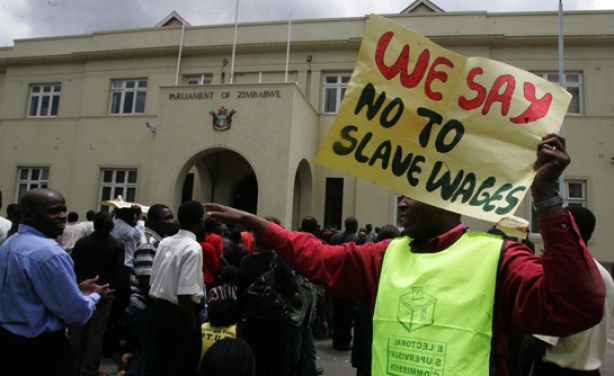
Unions had called a strike, demanding a 100 percent salary hike and vowed that schools would not open for the second term this Tuesday if government did not award the wage increment.

Government held two meetings with the Federation of Zimbabwe Educators Unions (Fozeu) and the National Joint Negotiating Council (NJNC) on Monday to avert a nationwide strike by the teachers.

The administration offered the tutors, and the rest of the civil service, a 10 percent salary increment effective July 1.

This was rejected by unions.

A second meeting between the unions and the employer is scheduled for May 14 but some unions said their members would continue with the strike regardless.

Zimbabwe Teachers’ Association (Zimta) chief executive officer Sifiso Ndlovu said teachers largely returned back to work.

“Our teachers have taken heed of our call to return to work,” he said.

“We may have a few that are not yet at work because of the time lag between the announcement and the action which was limited.

“So, we may have some delay, but we are certain that we will have the schools fully functional and having normal sessions.”

Ndlovu stated that the government has indicated that it may not negotiate with Fozeu, the umbrella grouping of education unions.

Instead, the unions will meet with government under NJNC.

“Fozeu is not yet registered and it has to be formalized for government to recognise it,” said Ndlovu.

However, Amalgamated Rural Teachers’ Union of Zimbabwe (Artuz) leader Obert Masaraure said the members were on strike.

The union vowed to continue with the job action, telling its members to stage sit-ins when schools opened last Tuesday.

“The response from teachers from the rural areas is overwhelming,” he said.

“We are pleased that the comrades are actually asking for more. They want to go on a full-blown strike.”

Negotiations with government took place on May, 14.


Ethiopia: ministry to employ 80 percent of university graduates

Betelhem Bedlu

Ethiopia’s Ministry of Education stated that it has been working to attain the vision of securing employment for 80 percent of university graduates by 2020.

The Ministry’s Higher Education Inspection Director, Samuel Dessalegn, told said  the strategic plan was set to help the graduate obtain relevant jobs within 12 months of graduation.

 “We give due emphasis to not only provide new graduates access to jobs, but also to ensure that it would be relevant to their field of study within 12 months after graduation,” said Dessalegn.

Inadequate English proficiency and limited exposure about future carriers have been identified by the Ministry as the major challenges facing new graduates. To this end, a strategy was put in place that takes these major hindrances into consideration.

Dessalegn said carrier service centers that offer training for graduate students on different jobs, work discipline, market, salary rate and other related issues were established in all universities.

Currently the centers are providing service in 23 universities.

 Dessalgen added that preparation has also been finalised to install carrier path prototype in 79 programs while the trainings are incorporated into the system.

It is a viable move in acquainting them with the desired knowledge, and exposure about future carriers, he added.

The Director also pointed out that the manual for English Language Improvement Program is prepared for students to improve their English language proficiency and enhance their competitiveness to secure jobs.

Students continuous assessment, opening language improvement centers, improving university-industry linkages, Career Services and Sensitizing Career Path are also part of the strategic plan that aim at building graduate’s capacity for future jobs, Dessalgen said.


Learners deserve free access to internet, a basic human right

Joseph Chirume

There provision of free access to the internet in the Eastern Cape has been cut by province’s department of sport, recreation, arts and culture as well as the National Library of South Africa.

The department claims the tender for internet provision is still in progress and will only be completed end June.

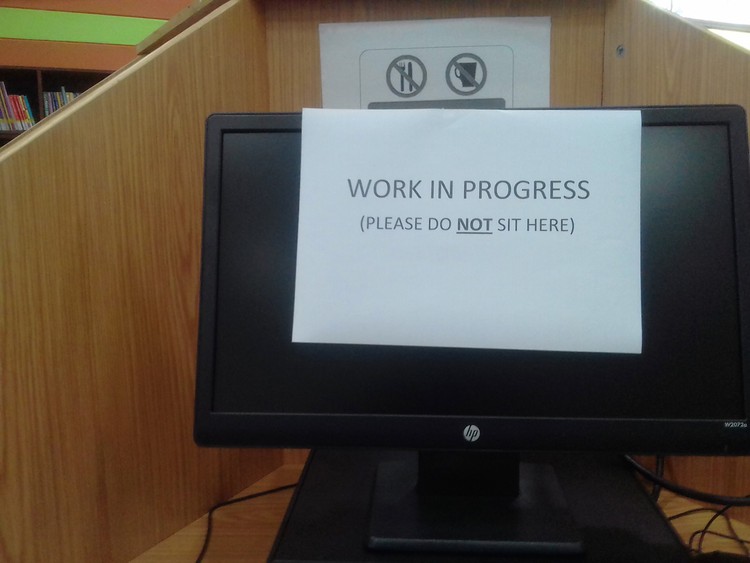
In the mean time, learners and students who depend on free internet provided by public libraries find themselves without access to information.

Onica Makwakwa of the Alliance for Affordable Internet World Wide Web Foundation once said access to the internet was a basic human right.

Makwakwa was part of a panel discussion on closing the digital divide at the World Economic Forum in Durban last year.

 “When I am online, I no longer live in a shack,” Makwakwa said who called for internet access to become more accessible and affordable for people across the African continent.

“Access to internet is a basic human right, the same as access to water and electricity. We need real policies around competition to drive prices down,” she said, adding that some young people in Africa would spend up to 80% of their income on staying connected.

People who depend on free internet access in public libraries in the Eastern Cape say they have been struggling since last year August when the service stopped.

The National Library of South Africa and the Eastern Cape department of sport, recreation, arts and culture used to pay for the service.

One of the department’s strategic objectives is the provision of a free, equitable and accessible library and information service,

Many library users, especially high school learners, say they cannot afford the high costs of data and the fees charged by internet cafes.

Abongiwe Sayman, a matric learner in Motherwell, said: “I used to be the best in my grade when the free internet service was available at the library. I am now struggling with my work. I am afraid I will fail my final examination.”

Noluthando Thondlana, who frequents the Uitenhage library, said in the past she used the library computers and the free internet access.

“Internet cafes charge anything between R15 to R20 an hour,” she said. As she does not have a laptop she is also charged for the time she spends typing up her assignment on the cafe’s computer even if she isn’t using the internet. Thondlana is trying to complete a diploma in Transport Management by correspondence.

Sabawu Mlanjeni from Motherwell is studying for a degree in Public Management through a Cape Town university. He said the librarians had been helpful and showed him how to do new things on the internet. “I wish the municipality would bring back the service again.”

The municipality does offer free internet through Always On, but only 100BM per day and only on a personal laptop or mobile phone.

“Many people don’t have computers, and most of the work needs a computer not a cellphone. And the data bundles get quickly used up,” said Mlanjeni.

Spokesperson for the Eastern Cape Department of Sport, Recreation, Arts and Culture Andile Nduna said: “The department is in the process of finalising the contract for a new tender to supply free internet to all the province’s [200] libraries. This should be done by the beginning of June this year.”

Read the original article here.


R 50 billion not enough to improve KZN schools

Nompendulo Ngubane

Protests by learners and parents at Umthombo Senior Secondary School in Mpophomeni, Pietermaritzburg, have entered a third week. Teaching stopped on 24 April.

Last Tuesday, learners locked up officials from the Department of Education in an office at the school. Public Order Police had to use teargas to disperse angry protesters and free the officials.

Learners, supported by their parents, want the school’s quintile ranking to be lowered from four to two.

South African schools are ranked in five categories (quintiles) according to the socio-economic status of the community. Parents say that although Umthombo is near a suburban area, most learners are from poor families.

“We are from Korea, Nguqa, Hhaza, Ebumnandini and Mafakatini. We live in RDP houses not in flashy homes,” said a grade 12 learner.

“We can’t even afford R200 school fees. There is a class that has 96 learners. If we are lucky to have textbooks, it’s only two per class. We sit in threes on desks. How can a school faced with so many challenges be ranked quintile four,” said the leaner.

Mzwakhe Zondi, a parent, said the department had promised to change the quintile to a lower level back in January 2016.

“The school is a mess. The teachers have no chairs. They have no staff-room. … Learners move desks from one class to another. Other learners are left standing. Yet the school is ranked on quintile four,” said Zondi.

Teaching has stopped at Umthombo High School for three weeks. Photo: Nompendulo Ngubane


School governing board member Mbali Ngubane said the board had been liaising with the department since 2016.

“All they are telling us is that there is no money. We requested that at least they change the quintile,” she said.

Provincial spokesperson for the Kwa-Zulu Natal department of education Sicelo Khuzwayo said: “We are appealing to the parents and learners to calm down. This is not a permanent situation.”

The allocated budget for 2017/2018 financial year the KwaZulu-Natal department of education was close to R 50 billion of which close to R 40 billion was allocated to public ordinary school education.

Khuzwayo said, “The department is currently faced with a challenge of funds. We made them aware of that. We will commit ourselves to solving the matter. Currently there is no money.”

Ngubane said that matrics struggled to further their education after qualifying.

“They cannot get grant funding [bursaries] because of the [school’s] quintile. Learners are very angry. They are fighting for their rights and we can’t stop them. The department must intervene,” said Ngubane.


Learners use field as toilet

Yamkela Ntshongwana

Young children are forced to use a field as a toilet at Ntshingeni Senior Primary in the Eastern Cape school, while teachers turn to neighbouring houses.

“We feel abandoned by the government. Most of us went to school here using these [same] old toilets, and even our grandchildren are forced to use them,” said Phumla Sitetho, a parent from Ntshingeni village near Cofimvaba.

Malixole Dliso, a teacher at the school, said the toilets were built in the 1980s. The zinc toilets are some distance from the classrooms and in a poor condition. The seats are broken and there is only rough stone and concrete to sit on.

“Since a five-year-old pupil fell into a school pit toilet in Mbizana in the Eastern Cape, we feel our children are not safe in these toilets,” said Sitetho.

The school has 254 pupils from Grades R to 7.

One teacher, Khanyiso Twala, said in his three years at the school, he has never used its toilets “because of the condition they are in”.

Spokesperson for the Eastern Cape Department of Education Malibongwe Mtima said at the beginning of the year, each school is given a maintenance budget.

If it is insufficient, the principal may apply for “top-up” funding. He said the department had not received an application from the school.

But school principal Trom Antoni said he had written a letter to the department in 2015 asking for new toilets. He was told to send photographs of the toilets, which he said he did. He said he never heard back.

Antoni added that the maintenance budget was not enough. They needed to start afresh with new toilets.

“We plead to the department to hear our cry … for the sake of the young [pupils] that are at risk,” said Antoni.

Mtima said the department will send a team to the school to survey the toilets.

Read original article here

Rural community development central to Africa’s industrialisation

Thuletho Zwane

Victor Oladokun’s grandfather was a cocoa farmer. His grandfather lived in a small village in Nigeria.

“But all through his life, my grandfather never tasted chocolate,” said African Development Bank (AfDB) Director of Communications Dr Victor Oladokun.

Many years later, the continent is still faced with the same challenges. Africa remains an exporter of raw materials and an importer of finished goods. He added that if his grandfather were to come back to life and go to this village, he would see that nothing had changed.

“If we are going to change Africa, we must first change the rural areas. We need to ensure rural areas become sustainable,” said Oladokun.

Government institutions, the private sector and civil society all agree that Africa needs to industrialise in order to change the fortunes of many lives on the continent. However, the point of contention is how industrialisation should take place.

Economic analysts argue that Africa relies too heavily on agriculture and the export of raw commodities. They say the continent should focus more on manufacturing, beneficiation, and infrastructure development while others make the argument that this would cause too much debt; and that debt-dependent industrialisation is another form of neo-colonialism.

Professor of Economics at the University of Ouagadougou in Burkina Faso Justine Coulidiati- Kielem was one of the proponents of development away from big agricultural projects, financialisation of African economies or infrastructure development. She said structural programmes through grassroot community projects were what was needed for Africa’s development.

“Look what Thomas Sankara did for Burkina Faso. He rejected debt offered by foreign institutions in the form of aid. What Burkina Faso managed to achieve in that short space of time shows that for African states to truly develop, this kind of plan should be followed,” said Coulidiati- Kielem.

Thomas Sankara, the former president of Burkina Faso, introduced the concept of endogenous or self-centred development in his country between 1984 – 1987. Self-centred development  refers to the process of economic, social, cultural, scientific and political transformation, based on the mobilisation of internal social forces and resources and using the accumulated knowledge and experiences of the people of a country.

The model allowed citizens to be active agents in the transformation of their society instead of remaining spectators outside of a political system inspired by foreign models.

Endogenous development looks at “own strength”. Sankara mobilised the masses to take responsibility for their own needs, with the construction of infrastructure, (dams, reservoirs, wells, roads and schools) through the use of the principle ‘relying on one’s own strength.’

He was assassinated in 1987.

Coulidiati- Kielem was part of the audience in a panel discussion that took place at the African Development Bank (AfDB) in Abidjan, Côte d’Ivoire in May under the theme Engaging Civil Society in Accelerating Africa’s Industrialisation.

Coulidiati- Kielem’s argument was a counter to views made by AfDB’s Jennifer Blanke who is the vice-president responsible for  agriculture, human and social development.

Blanke said agriculture and agro-processing will be the main drivers of industrialisation on the continent.  She said agriculture projects needed to be bankable and incentivised to attract private investors and create employment opportunities.

“Right now Africa exports raw materials and imports finished products. This means we are exporting jobs. We export cotton and buy back clothing. We should be thinking about how we can capture whole value chains so that Africans can have these jobs and so that we can have a generation of agro-preneurs,” said Blanke.

Blanke used cocoa farming as an example. She said Ghana and Cote d’Ivoire together produced 60% of cocoa globally. The two countries, together with Cameroon, produce 70% of cocoa globally.

“We should be talking about these three countries creating an oligopoly power where they do not only set the price of cocoa but also add value to cocoa and sell finished goods. We have to start talking about moving up the value chain,” said Blanke.

Development economics cannot be separated from geo-politics

Honorary President of the Network of Farmer Organisations and Producers of West Africa (Roppa) said African countries already attempted to industrialise when they gained independence. However, this failed as a result of interventions by the World Bank and the International Monetary Fund (IMF) who put pressure on African states to “privatise, liberalise the economy and open up our borders”.

“The first act of structural adjustment was to reverse this [industrialisation] and bring us to our knees. It was a revolution that could not be accepted. This bank [AfDB] is an example. This was an African bank, now we have non-Africans as shareholders,” said Mamadou.

Mamadou added that multinational companies come together and remove what Africa creates. He said it was not normal that west Africa produced cotton yet it  buys material from China.

“At start of independence, we made everything here. We are in global partnerships and our partners do not want us to succeed. We should be producing, processing and selling finished products,” he said.

He said African economies have to move focus from commodities and beneficiation because those resources are close to depletion but should rather focus on growing SMEs and developing them.

“We must focus on local development and create  territorial markets. They are putting robots in the factories, we need to put young people in the factories,” said Mamadou.

Coulidiati- Kielem was in agreement.

She said like Europe after World War II, Africa needs a programme like the Marshall Plan that allowed Europe to develop itself.

She said structuring programmes such as the development of small and medium enterprises and industries (SMMEs/SMMIs) were essential and would enable communities in African countries to develop organically, in the way they should.

The Marshall Plan was the post-World War II reconstruction of Western Europe where U.S President Harry Truman assigned $13 billion (approximately $130 billion in 2017/2018)  to Europe in the years 1948-51.

Economic historians James Bradford De Long and Barry Eichengreen explain how the Marshall Plan helped restart Europe’s economy after World War II. They say the plan “significantly sped Western European growth by altering the environment in which economic policy was made”.

A project carrying these ethos is already being implemented in Côte d’Ivoire after successful implementation in the Turi Goda village of Ethiopia and  the Kinseki II, Mbungu, Menga and Kinsendi villages of the Democratic Republic of Congo.

A development community project

In his paper, Saemaul Undong (New Community Movement): Korea’s National Community Development for Rural Modernization,  Professor  Do Hyun Han explains the Saemaul Undong model, also known as the New Community Movement, as a political initiative launched on April 22, 1970 by South Korean president Park Chung-hee,

Chung-hee wanted to modernize the rural South Korean economy, which in 1970 was in absolute poverty. The movement was based on communism and initially sought to rectify the growing disparity of the standard of living between the nation’s urban centres and the small villages.

Han wrote that the Saemaul Undong fundamentally transformed rural South Korea in the 1970s.

“The average income of farm households increased by more than 8 times from 1970 to 1979. The rate of absolute poverty dropped from 27.9% in 1970 to 9.0% in 1980.

“The straw-thatched roofs – the symbol of rural poverty – were replaced with tiles or slates.

“The rural electrification rate increased from 20% in 1970 to 98% in 1977. Drinking water supply system was substantially improved.

Most notably, with the expansion of village roads and bridges built by themselves, villagers saw buses or cars coming into their villages for the first time,” said Han.

The same results are beginning to show in Yamoussoukro, Côte d’Ivoire.

A partnership between the AfDB, the Korea-Africa Economic Cooperation Trust Fund (Koafec) and Agence Nationale d’Appui au Developpement Rural (Anader) has transformed two villages in Yamoussoukro: N’gbekro village and Zatta village.

In N’gbekro village, an irrigation dam has been built; a primary school with 12 latrines; a medical centre; four hectares of cassava farms and a poultry farm. Zatta village also has its own primary school, cassava and tomato farms and houses headquarters for the village microfinance operations.

“It took us two years to start and finish the projects in Yamoussoukro. People have moved from mud houses to brick houses. They sell their own produce to the greater Côte d’Ivoire. They have access to new markets. Their children go to school,” said Oladokun.



Mother bought fake permit to get her child into school

Bernard Chiguvare    

Zimbabwean families caught between the departments of Home Affairs and Education are resorting to buying fake documents in order to register their children at schools in South Africa.

Some schools will not accept immigrant children without a study permit from Home Affairs. But Home Affairs will not issue a study permit without proof of acceptance from a school, say immigrants.

Stuck between the two departments, families are buying fake study permits for about R300.

Jessica Shelver, spokesperson for Western Cape Education MEC Debbie Schafer, said schools were required to issue a letter to foreign learners who had been provisionally accepted. This letter should be sufficient for Home Affairs to issue a study permit.

But some schools are not doing so. “I visited four schools in Retreat trying to register for grade 1 for my child but I could not,” said one Zimbabwean mother, who has been in South Africa since 2008.

“All the schools required the child’s study permit or asylum seeker’s document. The two government departments are ruining our children. The requirements are pushing our children out of school,” she says.

The mother, who is on a Zimbabwe Special Permit, which she renewed last year, says she bought fake asylum-seeker documents for her child, and used these to get a document from the school. Now she is planning to visit Home Affairs with the legitimate school documents, get a study permit, and throw away the fake documents.

“Though I am planning to get a proper study permit it will take time because again I have to produce R1,350 for the study permit. I need to work for months for that money. I could take my child back home to Zimbabwe, but I cannot stay separated from my child,” she says.

She works as a childminder.

Another Zimbabwean mother, who did not want to be named, tried to register her child for grade R, without success, though she has been in South Africa since 2009 on a Zimbabwe Special Permit.

Her five-year-old was born in South Africa but has no birth certificate.

“After visiting several schools I resorted to a fake study permit which I submitted to one of the schools,” she says.

She is planning to apply for a visitor’s visa for her child.

Thabo Mokgola, media liaison officer at Home Affairs, said parents should apply for study permits for their children while they are still in Zimbabwe. The parents of Zimbabwean children born in South Africa should get a birth certificate from the department, then a passport from the Zimbabwean Embassy, and then apply for a study permit.

Parents should contact the District Office for assistance if schools are not complying, said Shelver.

Read original article here.