Home Blog Page 510

South Africa’s most powerful nano-satellite sent off

Veronica Mohapeloa 

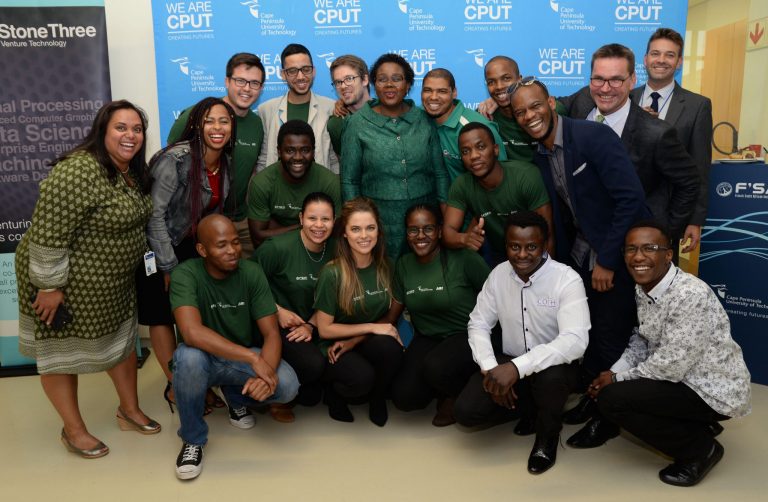
The Minister of Science and Technology, Mmamoloko Kubayi-Ngubane, yesterday participated in a ceremony to send off South Africa’s second nanosatellite to India, where it will be launched on 18 July.

 ZACUBE-2, described as the most advanced on the continent, will provide cutting-edge remote sensing and communication services to South Africa and the region. The 4 kg ZACUBE-2 was developed by the French South African Institute of Technology (F’SATI) at the Cape Peninsula University of Technology (CPUT).

 F’SATI is a French South African postgraduate institute for teaching, research and development with two nodes – one at Tshwane University of Technology and one at CPUT.

 The project was funded by the Department of Science and Technology (DST), and managed by the South African National Space Agency (SANSA), in close cooperation with the University of Montpellier, the French Embassy and the Paris Chamber of Commerce.

 The primary mission objective of ZACUBE-2 is to demonstrate vessel-tracking services in the South African Exclusive Economic Zone in support of the Oceans Economy component of Operation Phakisa. Operation Phakisa is intended to fast-track the implementation of the National Development Plan.

 The 10 x 10 x 10 x 30 cm satellite will track vessels along South Africa’s coasts, with its automatic identification system (AIS) payload providing information on their position, speed and registration.  The AIS will also proactively detect forest fires through an imager payload developed by the Council for Scientific and Industrial Research (CSIR).

 CPUT adopted Operation Phakisa as a key focus area, specifically using research and technology to innovate for marine protection and governance. The university has agreements with both the Department of Science and Technology and the Department of Environmental Affairs for the development of nanosatellite-based solutions for Operation Phakisa.

 In June 2016, the university launched its Research Chair in Oceans Economy, cementing its overall contribution to Operation Phakisa. ZACUBE-2 is a precursor to a constellation of nanosatellites that will be developed to facilitate South African marine domain awareness.  This will support international maritime communications, from the current AIS to the evolving VHF Data Exchange Service.

 Speaking at the send-off, Minister Kubayi-Ngubane welcomed the successful development of the nanosatellite, as monitoring the continental shelf was a critical part of Operation Phakisa and required a dedicated low-cost solution.

 “The Department of Science and Technology saw an opportunity to contribute to Operation Phakisa by ensuring that the country can monitor its 3 000 km coastline effectively,” said the Minister.

 The Minister said space science and technology were capital-intensive, and the government had a role to play in creating an environment in which the local space industry could thrive.  She said that projects like the development of ZACUBE-2 benefited not only the space industry, but also the manufacturing and downstream application development industries.

 Ambassador of France to South Africa, Christophe Farnaud said his country was very proud to be part of this adventure. “Space is about science, economy, innovation and more than that. Space is also a dream – we dream together, we build together.”

 SANSA CEO, Dr Val Munsami, said the agency strove to grow the local space industry through products, services and skills development. “Supporting such programmes as ZACUBE-2 enables the country to benefit from trained and experienced young space engineering experts.”

South Africa’s most powerful nano-satellite sent off today

Veronica Mohapeloa 

The Minister of Science and Technology, Mmamoloko Kubayi-Ngubane, yesterday participated in a ceremony to send off South Africa’s second nanosatellite to India, where it will be launched on 18 July.

 ZACUBE-2, described as the most advanced on the continent, will provide cutting-edge remote sensing and communication services to South Africa and the region. The 4 kg ZACUBE-2 was developed by the French South African Institute of Technology (F’SATI) at the Cape Peninsula University of Technology (CPUT).

 F’SATI is a French South African postgraduate institute for teaching, research and development with two nodes – one at Tshwane University of Technology and one at CPUT.

 The project was funded by the Department of Science and Technology (DST), and managed by the South African National Space Agency (SANSA), in close cooperation with the University of Montpellier, the French Embassy and the Paris Chamber of Commerce.

 The primary mission objective of ZACUBE-2 is to demonstrate vessel-tracking services in the South African Exclusive Economic Zone in support of the Oceans Economy component of Operation Phakisa. Operation Phakisa is intended to fast-track the implementation of the National Development Plan.

 The 10 x 10 x 10 x 30 cm satellite will track vessels along South Africa’s coasts, with its automatic identification system (AIS) payload providing information on their position, speed and registration.  The AIS will also proactively detect forest fires through an imager payload developed by the Council for Scientific and Industrial Research (CSIR).

 CPUT adopted Operation Phakisa as a key focus area, specifically using research and technology to innovate for marine protection and governance. The university has agreements with both the Department of Science and Technology and the Department of Environmental Affairs for the development of nanosatellite-based solutions for Operation Phakisa.

 In June 2016, the university launched its Research Chair in Oceans Economy, cementing its overall contribution to Operation Phakisa. ZACUBE-2 is a precursor to a constellation of nanosatellites that will be developed to facilitate South African marine domain awareness.  This will support international maritime communications, from the current AIS to the evolving VHF Data Exchange Service.

 Speaking at the send-off, Minister Kubayi-Ngubane welcomed the successful development of the nanosatellite, as monitoring the continental shelf was a critical part of Operation Phakisa and required a dedicated low-cost solution.

 “The Department of Science and Technology saw an opportunity to contribute to Operation Phakisa by ensuring that the country can monitor its 3 000 km coastline effectively,” said the Minister.

 The Minister said space science and technology were capital-intensive, and the government had a role to play in creating an environment in which the local space industry could thrive.  She said that projects like the development of ZACUBE-2 benefited not only the space industry, but also the manufacturing and downstream application development industries.

 Ambassador of France to South Africa, Christophe Farnaud said his country was very proud to be part of this adventure. “Space is about science, economy, innovation and more than that. Space is also a dream – we dream together, we build together.”

 SANSA CEO, Dr Val Munsami, said the agency strove to grow the local space industry through products, services and skills development. “Supporting such programmes as ZACUBE-2 enables the country to benefit from trained and experienced young space engineering experts.”

‘I am a product of a black tax,’ says Ronald Lamola

Ngoako Malatji

Former ANC Youth League deputy president Ronald Lamola says the journey of getting education has been a difficult one.

Lamola, who is one of the youngest ANC national executive committee members,
obtained his second master’s degree in law with the University of Pretoria yesterday.

“I am a product of a black tax, and this goes to my elder sister Constance, who used all her salary to take me to school,” Lamola said.

“This motivated me to work hard during my undergraduate years.”

Lamola said his “uneducated” mother used her farming products like maize in her village in Bushbuckridge, Mpumalanga, to ensure that he had something to eat at school.

“Both my parents are retired farmworkers, hence they could not afford to take me to school. My sister is my hero and I hope this will inspire the Fees Must Fall movement and all African children yearning for education.”

ANC spokesman Pule Mabe said Lamola who grew up from humble beginnings on a small farm in Mpumalanga was a living example of what Nelson Mandela said about education.

“We call upon our young people to emulate comrade Lamola and … acquire education,” Mabe said.

Read the original article here

Police fire rubber bullets at Pietermaritzburg students

Nompendulo Ngubane   

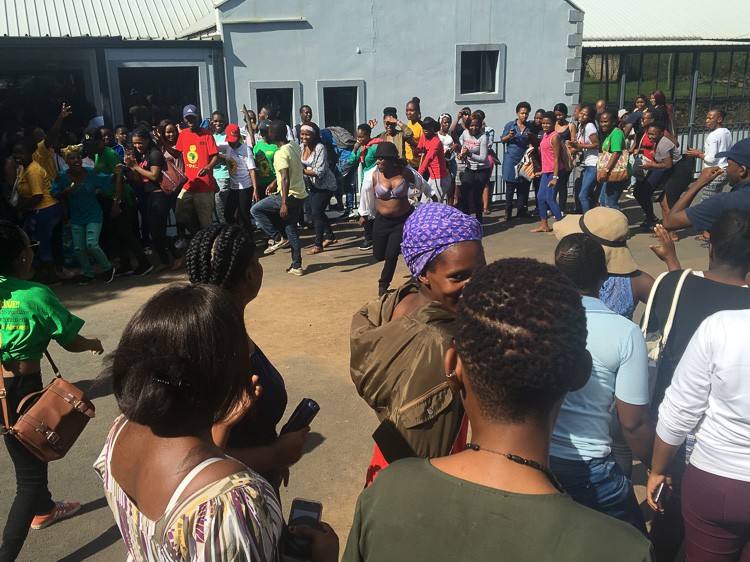
Police used rubber bullets and teargas to disperse students from Msunduzi Tvet College in Pietermaritzburg who marched to the administrative offices on Tuesday. Two students were taken to hospital. They were shot with rubber bullets.

Eight students were injured said SRC president Cleo Ntombela. Students have been protesting since last week, demanding their accommodation fees from the National Student Financial Aid Scheme (Nsfas).

On Tuesday students marched to the central office. They forced themselves into the administrative office where a fire was set. Workers locked themselves in the offices. The tyres of the principal’s car were damaged.

One student said they wanted to “send a strong signal” to university management which had been “ignoring” the students.

“Since last week there has been no solution from the management. They locked themselves inside their offices. They don’t come out. What are we supposed to do? “

Ntombela said students would force their way into the boarding house from which they have been evicted. “Students have no place to stay. They are carrying their blankets and their luggage. They have nowhere to go.”

“We were not armed,” said Nomfundo Shezi.

“They came with their big guns and started shooting. What we want is a solution. Many of us are from a poor background. We are not doing this for entertainment. We need accommodation. I’m from Nquthu [over 200km away]. I cannot sleep under the trees. They must tell us what we should do,” said Shezi.

Police spokesperson Nqobile Gwala said no incident of shooting had been reported to the police.

The principal, Ntombi Ntshangase, could not be reached for comment.

Read the original article here.


Shadow profiles – Facebook knows about you, even if you’re not on Facebook

Andrew Quodling

Facebook’s founder and chief executive Mark Zuckerberg faced two days of grilling before US politicians this week, following concerns over how his company deals with people’s data.

But the data Facebook has on people who are not signed up to the social media giant also came under scrutiny.

During Zuckerberg’s congressional testimony he claimed to be ignorant of what are known as “shadow profiles”.

Zuckerberg: I’m not — I’m not familiar with that.

That’s alarming, given that we have been discussing this element of Facebook’s non-user data collection for the past five years, ever since the practice was brought to light by researchers at Packet Storm Security.

Maybe it was just the phrase “shadow profiles” with which Zuckerberg was unfamiliar. It wasn’t clear, but others were not impressed by his answer.

Tweet by @WillOremus

Facebook’s proactive data-collection processes have been under scrutiny in previous years, especially as researchers and journalists have delved into the workings of Facebook’s “Download Your Information” and “People You May Know” tools to report on shadow profiles.

Shadow profiles

To explain shadow profiles simply, let’s imagine a simple social group of three people – Ashley, Blair and Carmen – who already know one another, and have each others’ email address and phone numbers in their phones.

If Ashley joins Facebook and uploads her phone contacts to Facebook’s servers, then Facebook can proactively suggest friends whom she might know, based on the information she uploaded.

For now, let’s imagine that Ashley is the first of her friends to join Facebook. The information she uploaded is used to create shadow profiles for both Blair and Carmen — so that if Blair or Carmen joins, they will be recommended Ashley as a friend.

Next, Blair joins Facebook, uploading his phone’s contacts too. Thanks to the shadow profile, he has a ready-made connection to Ashley in Facebook’s “People You May Know” feature.

At the same time, Facebook has learned more about Carmen’s social circle — in spite of the fact that Carmen has never used Facebook, and therefore has never agreed to its policies for data collection.

Despite the scary-sounding name, I don’t think there is necessarily any malice or ill will in Facebook’s creation and use of shadow profiles.

It seems like a earnestly designed feature in service of Facebooks’s goal of connecting people. It’s a goal that clearly also aligns with Facebook’s financial incentives for growth and garnering advertising attention.

But the practice brings to light some thorny issues around consent, data collection, and personally identifiable information.

What data?

Some of the questions Zuckerberg faced this week highlighted issues relating to the data that Facebook collects from users, and the consent and permissions that users give (or are unaware they give).

Facebook is often quite deliberate in its characterisations of “your data”, rejecting the notion that it “owns” user data.

That said, there are a lot of data on Facebook, and what exactly is “yours” or just simply “data related to you” isn’t always clear. “Your data” notionally includes your posts, photos, videos, comments, content, and so on. It’s anything that could be considered as copyright-able work or intellectual property (IP).

What’s less clear is the state of your rights relating to data that is “about you”, rather than supplied by you. This is data that is created by your presence or your social proximity to Facebook.

Examples of data “about you” might include your browsing history and data gleaned from cookiestracking pixels, and the like button widget, as well as social graph data supplied whenever Facebook users supply the platform with access to their phone or email contact lists.

Like most internet platforms, Facebook rejects any claim to ownership of the IP that users post. To avoid falling foul of copyright issues in the provision of its services, Facebook demands (as part of its user agreements and Statement of Rights and Responsibilites) a:

…non-exclusive, transferable, sub-licensable, royalty-free, worldwide license to use any IP content that you post on or in connection with Facebook (IP License). This IP License ends when you delete your IP content or your account unless your content has been shared with others, and they have not deleted it.

Data scares

If you’re on Facebook then you’ve probably seen a post that keeps making the rounds every few years, saying:

In response to the new Facebook guidelines I hereby declare that my copyright is attached to all of my personal details…

Part of the reason we keep seeing data scares like this is that Facebook’s lacklustre messaging around user rights and data policies have contributed to confusion, uncertainty and doubt among its users.


Read more: How to stop haemorrhaging data on Facebook


It was a point that Republican Senator John Kennedy raised with Zuckerberg this week (see video).

Senator John Kennedy’s exclamation is a strong, but fair assessment of the failings of Facebook’s policy messaging.

After the grilling

Zuckerberg and Facebook should learn from this congressional grilling that they have struggled and occasionally failed in their responsibilities to users.

It’s important that Facebook now makes efforts to communicate more strongly with users about their rights and responsibilities on the platform, as well as the responsibilities that Facebook owes them.

This should go beyond a mere awareness-style PR campaign. It should seek to truly inform and educate Facebook’s users, and people who are not on Facebook, about their data, their rights, and how they can meaningfully safeguard their personal data and privacy.


Read more: Would regulation cement Facebook’s market power? It’s unlikely


Given the magnitude of Facebook as an internet platform, and its importance to users across the world, the spectre of regulation will continue to raise its head.

Ideally, the company should look to broaden its governance horizons, by seeking to truly engage in consultation and reform with Facebook’s stakeholders – its users — as well as the civil society groups and regulatory bodies that seek to empower users in these spaces.

Andrew Quodling is aPhD candidate researching governance of social media platforms, Queensland University of Technology
Read original article here

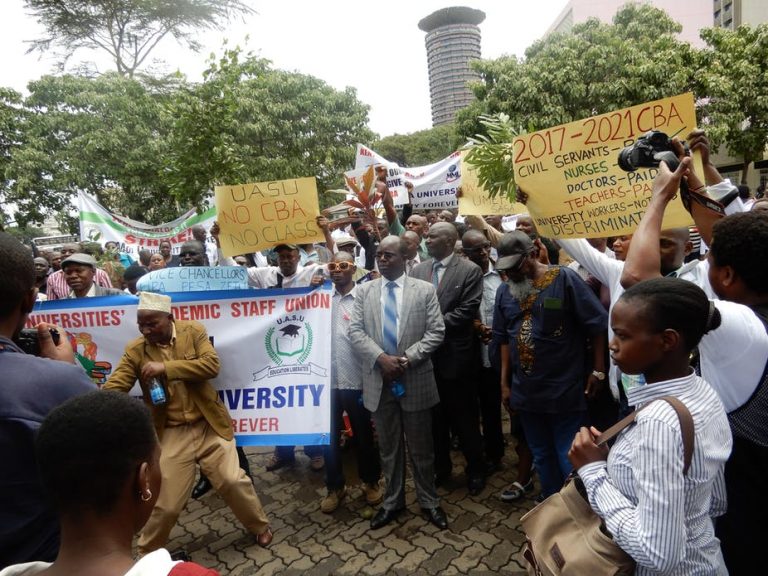
Kenya and its university strike cycle

Ishmael Munene

Kenya’s public university lecturers are on strike, barely three months after another lengthy work stoppage. Ishmael Munene spoke to Moina Spooner from The Conversation Africa about why the strike is happening and what can be done to stop the cycle.

What are the demands of the lecturers from public universities?

Academic staff from Kenya’s public universities have been on strike for over a month now. The issue: an agreement which covers salaries and benefits for 2017-2021 meant to have been negotiated, replacing the expired 2013-2017 agreement.

This new Collective Bargaining Agreement is between the University Academic Staff Union and the Inter-Public Universities Councils’ Consultative Forum, which negotiates on behalf of the state.

The current highest salaries for various academic ranks range from about Ksh 250,000 (USD$ 2,507) for a professor to Ksh 121,000 (USD$1,211) for an assistant lecturer.

Over a year ago, the University Academic Staff Union made its offer for the 2017 – 2021 period. The highest pay range was put at USD$15,626 for a professor and USD$4,704 for an assistant lecturer.

Since then, the Inter-Public Universities Councils’ Consultative Forum has promised to table its own counter offer four times but has failed to do so. The negotiations should have been finalised on 31 May 2017 so that implementation could begin in July 2017.

This has resulted in strikes. The most recent one ended in December after both parties agreed to conclude negotiations by 28 February 2018.

In view of the continued failure by the government to meet its end of the bargain, lecturers have rightly concluded that the state has failed to negotiate in good faith.

To what extent do these demands address the most pressing challenges facing public universities?

Staff wages are a huge challenge facing Kenya’s public universities. But they’re not the only one.

University worker salaries, unlike those of other public sector workers such as judges and legislators, have not kept pace with inflation or remuneration. This leads to brain drain from Kenya’s public higher education institutions. Academic staff departure in critical disciplines is a persistent problem. For instance, between 2004 and 2007, Moi University departures were 31% in law, 18% in information sciences and 14% for business and economics.

And now, due to deep shrinking revenues and an expensive budget, Kenya is slashing budgetary allocations to various sectors. That includes universities. In 2017 public university funding for capital assets was reduced by Ksh 6.7 billion (USD$ 67,000,000). Research allocation went down by Ksh 454 million (USD$ 4,540,000). These cuts put a strain on the maintenance and development of facilities, as well as on the production of academic research.

This financial crisis has been exacerbated by the Commission for University Education’s decision that universities only admit students with a minimum C+ grade. This means those with a lower score will not be admitted in the self-sponsored Module II (parallel) programmes that universities used to admit part-time students paying market rate tuition fees. These programmes have been a veritable cash cow for universities. Their elimination makes a serious dent in the universities’ bottom line.

Low enrollment is a serious challenge to the sustainability of universities. In the most recent enrolment, some universities had less than a quarter of their enrolment capacity taken up. Of the 615,773 candidates who sat exams last year, only 70,000 made the cutoff grade of C+ to join university.

Equally problematic for universities is the overall decline in quality. This is evident in the declining resources for teaching and infrastructure, poor governance and outdated approaches to teaching, curricula and assessment. All of this has left universities unable to maintain high quality teaching and learning.

Strikes by university professors aren’t uncommon in the country. What impact does this have?

A major impact is the disruption of learning. For maximum effect, faculty strikes occur during term time when students are learning. So far in this current strike, students have lost more than half a semester of instruction. This means students will take longer to complete their academic programmes; it will be more expensive for them and the institution.

Faculty strikes also heighten the divide between the academics on one hand, and the university administrators and government on the other. To resolve the numerous problems confronting universities, a cordial and collaborative relationship between the three stakeholders is paramount. However, in a climate defined by militant faculty unions and inflexible administration and government, it’s not possible to forge common ground to address institutional challenges.

Finally, frequent and prolonged strikes are detrimental to the development of industrial labour relations in universities. Labour unions for academic staff were only revived in 2003, having been outlawed in 1979. Since then the relationship between the union and the state has been adversarial. The union has defied court orders to call off the strikes. The government has also failed to honour agreements with unions concluded after protracted negotiations. These violations run counter to the development of good labour practices in universities.

What must be done to avoid future disruptions?

While academic salaries are contentious the world over, the current model of reviewing university salaries in Kenya is outdated. The Collective Bargaining Agreement award salary increases without regard to faculty productivity and market performance of their discipline.

I have suggested a model that takes into account the cost of living, productivity of academic staff, and the competition universities face in attracting and retaining academics in specific disciplines.

This approach requires that salary increases have three components:

  • a cost of living pay which increases salaries to cover the changes in the cost of living
  • performance pay that takes into account an academic member’s output based on an agreed matrix, and
  • the competition that universities face in attracting academics in specific disciplines.

If implemented, disruptions would be a thing of the past since academics would be able to seek salary increases based on performance and market conditions.


Ishmael Munene is Professor of Research, Foundations & Higher Education, Northern Arizona University
Read original article here


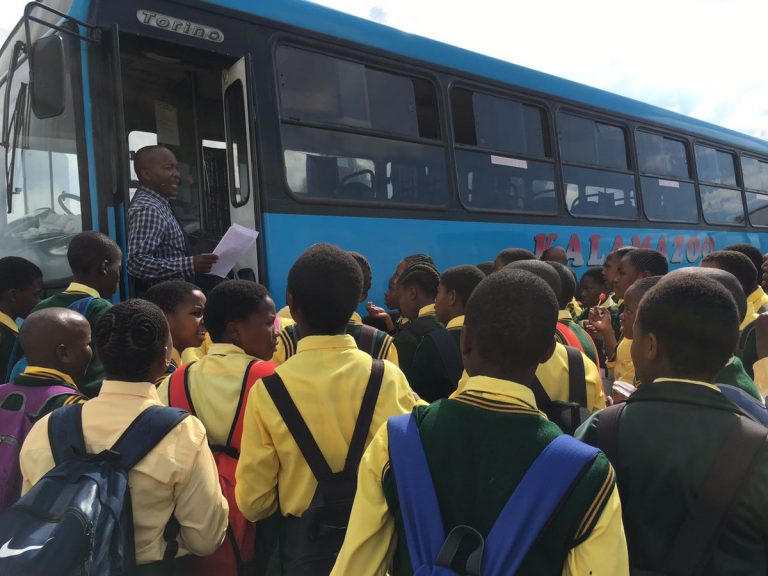
Grants for learner transport

Jan Bornman

National Treasury has confirmed it is looking at making changes to the scholar transport funding model in South Africa.

This comes after inputs from Equal Education to the Select Committee on Appropriations on the 2018 Division of Revenue Bill which highlighted the dire need for a conditional grant directed at the transportation of pupils.

Equal Education said the lack of transport in rural areas was a serious barrier to education, with pupils often having to cross dangerous terrain and threatening situations to get to school.

Steve Kenyon, the director for local government and budget framework within Treasury, said the Department of Planning, Monitoring and Evaluation was leading a performance and expenditure review process on issues relating to scholar transport across all provinces.

Based on these outcomes, he said, the Treasury would look at the required changes to the funding model.

However, he said the belief that a conditional grant would solve the issues around the transportation of pupils was misplaced, highlighting the fact that Treasury had observed numerous challenges in the implementation of conditional grants.

Equal Education’s Philile Ntombela-Masson, who works as a researcher at the organisation, said provincial education departments usually cited inadequate funds as one of the main reasons for not providing transport to all pupils who qualify.

She said Equal Education had observed that budgets for scholar transport were often the first to be cut.

Ntombela-Masson urged National Treasury to provide conditional grants for scholar transport.

News24

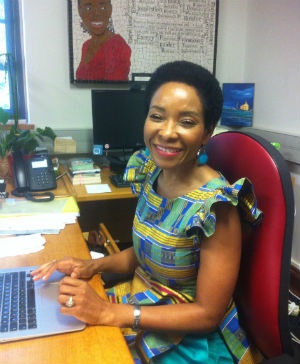
Meet UCT’s incoming Vice-Chancellor, Mamokgethi Phakeng

Jenna Etheridge

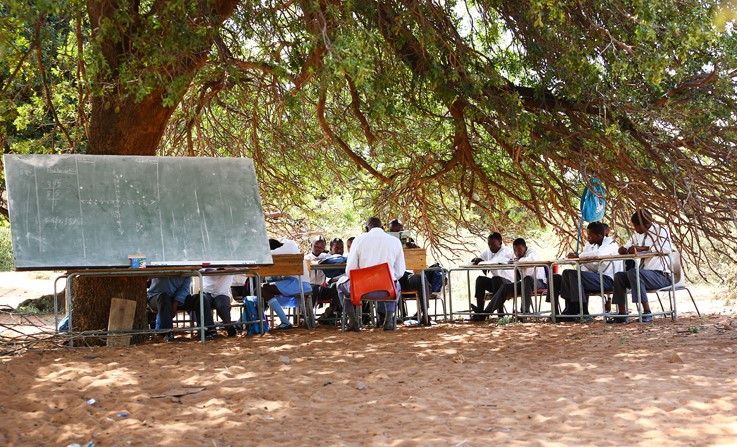
Professor Mamokgethi Phakeng started her education under a tree and had to walk up to 10km just to get to school.

Today, she is a full professor in mathematics education.

She is also preparing to take over from Max Price as the vice-chancellor of the University of Cape Town from July.

Perhaps foretelling good fortune, Phakeng was born still in her amniotic sac, in a Catholic clinic in Eastwood, Pretoria, on November 1, 1966.

Her mother, Wendy, was a domestic and factory worker, while her father Frank was a radio announcer at the SABC.

After giving birth to Phakeng and her siblings, Wendy went back to school and finished her studies so she could work as a teacher.

Eight schools in 12 years

Phakeng recalls being sent to live with her grandparents in Marapyane village in Mpumalanga where as a Grade 1 pupil, on days when it was not raining, she would make the trek with her cousin to a rural school. However, she did not stay there long. Her primary school journey also took her to Ga-Rankuwa.

In her 12 years of basic education she attended eight schools.

“Some of it (the moving around) was (because of) family, some of it was poverty and some of it was politics,” she told News24 in a sit-down interview on Monday.

“Even though my mother argues that I am an introvert, I had to get used to people quickly and speak to people that I didn’t know very well because that was just how life worked.”

She completed matric at a rural school in Hebron and enrolled at the University of Bophuthatswana (now part of North-West University) at just 16 years of age.

Her parents warned her that she had just four years to get her degree.

No time for partying

Phakeng, her brother and sister were at one stage all attending university at the same time.

“So there wasn’t much time, there wasn’t much money.”

Describing herself as nerdy and scared at the time because she was still so young, Phakeng says she did not party it up at university.

She threw herself into tennis, soccer and hockey. She was also well known for demonstrating ballroom and Latin American dancing skills that she picked up while in Ga-Rankuwa.

Phakeng said she was never a student leader but attended mass meetings.

She still has the scars from a protest she took part in to prevent then education minister Andries Treurnicht from speaking in Mafikeng.

‘I focused on what I can do’

“I was a conscious student but a conscientious student. I was committed to getting my degree.”

Phakeng obtained her PhD in mathematics education in 2002.

While she struggled with other subjects, she excelled at mathematics because nobody told her it was hard, she said.

“I just came to terms with what I want, what I can and cannot do.

“I focused on what I can do and I like, and I did it well. And all my life, that’s what I did.”

News24


William Kentridge receives honorary PhD

Christina Pitt

South African artist William Kentridge was awarded an honorary PhD of philosophy from the Faculty of Humanities at the University of Pretoria on Thursday.

Kentridge is well known for his animated expressionist drawings and films exploring time, the history of colonialism and the aspirations and failures of revolutionary politics.

“William Kentridge has been an advocate for the arts in South Africa for decades. His work has been consistently courageous, and he is an inspiration to fellow artists and humanists around the world. We are gladdened by this opportunity to recognise and acknowledge his contribution,” said humanities dean Professor Vasu Reddy.

The artist first achieved international recognition in the 1990s with a series of what he called “drawings for projection”.

These short animated films were based on everyday life under apartheid. He then expanded his thematic range to examine other political conflicts.

“In addressing difficult topics, he evades becoming didactic and instead creates ‘an art of ambiguity, contradiction, uncompleted gestures and uncertain things’, in his own words,” the citation reads in part.

“As the artist increasingly inserts himself through self-reflection in his animations, moving away from a cast of fictional characters, his own reflections take centre stage in what can be termed a ‘theatre of memory’. Kentridge has become an exceptional and outstanding envoy for the arts.”

News24

Jobless matriculants hired to ‘improve’ education in rural schools

Prega Govender

A total of 760 unemployed matriculants will be employed as education assistants in a bid to improve the literacy, numeracy and reading skills of pupils in rural schools.

The Department of Basic Education confirmed this month that it was granted R87.5-million in European Union funding by National Treasury to conduct the three-year project which will be piloted in three provinces.

At least 253 education assistants will be hired to work at schools in the Alfred Nzo East and OR Tambo Coastal districts in the Eastern Cape, while the same number will be employed in the Ilembe and Umzinyathi districts in KwaZulu-Natal.

A further 254 will work in Limpopo’s Sekhukhune and Mopani districts.

At least 40% of those participating in the initiative, which forms part of the department’s rural education assistants project (REAP), will also be “targeted for teacher training qualifications”.

While the education assistants will help to improve the quality of education of pupils in grades R to 9, at the same time, through REAP they will be “empowered with skills that will increase their chances of finding permanent employment and becoming entrepreneurs”.

Troy Martens, spokesperson for the Department of Basic Education, said the education assistants could “hopefully” be attracted into the teaching profession.

In 2016, a total of 11,252 out of the 23,719 state schools in the country were in rural areas. At least 86% of schools in Limpopo, 69% in KwaZulu-Natal, 40% in Free State, 36% in Western Cape and 33% in Eastern Cape are rural schools.

According to the department’s latest annual performance plan, the unemployed matriculants will assist with a variety of “in-class and co-curricular support, particularly improving numeracy, literacy and reading skills”.

They will also be roped in to oversee homework clubs, maths clubs, reading clubs, creative arts clubs and agricultural clubs.

“This type of support is within the capacity of matriculants. It will not be expecting more than what is possible considering the skill levels,” the document stated.

It stated that research showed that “developing a child holistically by striking a balance between curriculum, learner teacher support material and also co-curricular activities improves learner performance”.

Martens said the pilot project was aimed at researching and evaluating the use of education assistants in the GET phase [grades R to 9] “for improving the quality and equity of education in rural schools”.

She said the research findings would assist in the development of a framework for rural education assistants and a strategy for teacher recruitment for rural schools.

In January, Basic Education Minister Angie Motshekga gazetted the rural education policy for public comment which also alluded to the recruitment of young people, including matriculants.

The policy acknowledged that it was difficult “to recruit, retain and develop qualified teachers” in rural areas because of the long distances between schools and towns, poor infrastructure and limited service delivery.

The policy stated that addressing this challenge required creating a package of teacher incentives that did not only include monetary compensation but also teacher development, transport, accommodation, recreation and other essential services.

The Eastern Cape, KwaZulu-Natal and Limpopo education departments did not respond to media queries that were e-mailed to them on Wednesday.

This article was first published here