Home Blog Page 512

Teacher shot dead in front of pupils

0

Inside Education

A teacher was shot dead at a Western Cape primary school on Wednesday.

Education MEC Debbie Schäfer said the woman was allegedly shot at Middelpos Primary School in Saldanha Bay by her ex-husband.

The man then pointed the gun at himself and pulled the trigger.

Both succumbed to their wounds.

“Learners who witnessed the incident are greatly and understandably traumatised‚ as are the teacher’s two children‚” said Schäfer.

“Western Cape Education Department officials‚ including Safe Schools officials‚ were immediately dispatched to the school,” said Schäfer.

She added that the school  made the decision to dismiss learners early.

“A school psychologist and social worker will be dispatched to provide counselling for those who are in need of assistance‚ or witnessed the event,” said Schäfer.

The police are on the scene. Counselling and support has provided by the department.

“I am deeply disturbed by the unspeakably tragic incident. My heartfelt condolences go to the teacher’s family‚ friends and the school community,” said Schäfer.

Website developed to buy and sell second-hand textbooks

Chulumanco Mahamba and Zamayirha Peter 

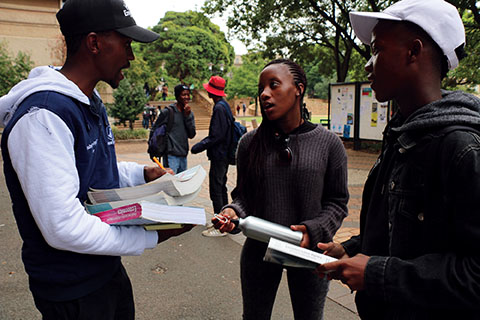
A University of Pretoria student created a website that allows fellow students from all South African universities to buy and sell second-hand textbooks at a discounted price by advertising on the website.

Zach Wolpe, a third-year BCom Investment Management and Statistics student, created a website called Bid4books.co.za in January.

He said he wanted to create “seamless experience” for students to buy and sell second-hand textbooks and that the current ways to sell and buy textbooks were “outright rubbish.”

“Students spend ridiculous sums of money each year on new textbooks. They use a few chapters for a few months and then simply leave the books to collect dust,” said Wolpe.

He added that students who wish to sell  textbooks can do so by posting an advertisement for the textbook they intend to sell on the website. Thereafter, potential buyers can contact the seller and arrange a sale privately.

Wolpe’s said he wants to expand the products that the website trades.

“The goal is to become the one-stop destination for students to exchange textbooks and other relevant material including calculators and etc,” he said.

This initiative comes after a similar online textbook website SIKIO  was launched in September 2017 by 21-year-old Wits student Ndu Nkwanyana.

Nkwanyana is the co-founder and CEO of SIKIO.

He said he was inspired to create the website because, “At the beginning of the year I realized that I had many textbooks from over the years that I was not using. I decided to give them out for free but at times would struggle to find people who wanted them.”

Nkwanyana added that the overflow of textbooks he had, led to him creating a platform where other students could find a mutual site to sell their textbooks or donate them.

“There are many students on campus that rely on second hand textbooks and some who can’t even afford them, so I thought this website would assist in bridging an existing issue on campus,” said Nkwanyana.

SIKIO is not profit driven, instead the site is being developed to assist student entrepreneurs.

“We don’t make any profit from the textbook trade, but rely on marketing strategies to make money which mostly goes towards maintaining the site. We also want to open up the site for student entrepreneurs to advertise their businesses free of charge and intend to open up the site for more established businesses to use the site to advertise at a rate,” he said.

Many were excited about the website.

“I often move around campus looking for textbooks and it sometimes can be exhausting, first looking for people and then being able to get the textbooks at a good price,”  said third year student Siyabulela Manengele.

Nkwanya says students have responded well to SIKIO. “We also got requests from other universities including University of KwaZulu-Natal, University of Cape Town and Rhodes University to name a few. They want us to launch a similar platform for their campuses,” he said.

SIKIO also intends to develop into a website where school leaving students can sell their appliances, such as fridges and lamps. It hopes to become a national student aid for the convenience of students throughout the country.

This article was first published by Wits Vuvuzela.

Theft in schools has reached crisis levels

Sipho Mabena

The theft of electronic gadgets and feeding scheme groceries has reached crisis levels, according to the department of basic education.

Last week thieves broke into two schools in Valhalla and Westonaria, ripping six smart boards off classroom walls and stole dozens of computers.

This came barely a week after thieves broke into four schools in Atteridgeville in Pretoria, stealing computers and groceries meant for underprivileged pupils.

A break-in at the Dr WF Nkomo High School on Monday this week resulted in the loss of seven laptops‚ nine computers‚ and all nutrition stock.

Last week‚ the department reported thefts of computers and nutrition stock during break-ins at the Masizane Primary School‚ Thohoyandou Primary School and Flavius Mareka Secondary School.

“We are convinced that‚ there is a syndicate targeting our schools. We call upon police to conduct a thorough investigation and arrest those responsible. It is really disappointing that criminals are targeting our schools‚ which are meant to benefit communities. How can four schools in the same area suffer in the hands of criminals in this manner? Communities must defend schools‚” said MEC Panyaza Lesufi.

Read the original article here

Zimbabwe: Sweeping changes threaten education system

0

Mako Muzenda

To say Zimbabwe is in a mess would be a severe understatement. Think corruption, pothole-ridden roads, and a flailing economy that has pushed millions of people to live and work elsewhere.

But despite all the gloom and doom, there’s one thing that Zimbabweans treasure and are fiercely proud of: our education system. With one of the highest literacy rates in Africa, and a radical education policy dating from the 1980s that guarantees free primary school education for all citizens, the country’s education system has served as that bright, shiny gem that couldn’t be dimmed by any circumstance.

Until now.

Minister of Basic and Primary Education, Dr Lazarus Dokora, has rolled out several changes to Zimbabwe’s education curriculum, changes which came into effect in January of this year. Critics fear that these changes threaten to dismantle the education system that was once considered the pride of Africa.

Dokora’s new measures banned scripture unions and a national pledge was introduced, to be recited in school assemblies after singing the national anthem. The pledge, initially launched in 2016, has been met with opposition. For some parents it came into conflict with their religious beliefs, and they were uncomfortable with swapping prayer for pledge. For others, it was an unnecessary politicisation of young children. Nevertheless, the education ministry pushed ahead with the addition, and soon other elements would be added to the education curriculum.

Religious education (often centred on Christianity) was removed and replaced with Islamic Studies. The supposed reasoning behind this was to move away from a heavy focus on Christianity and broaden the curriculum to accommodate other religions. Although Zimbabwe is a predominantly Christian country (85% of the population identifies as Christian, according to a 2012 demographic survey), it was considered unfair that other faiths were ignored when it came to religious education.

The response was harsh. Minister Dokora was labelled a Satanist, as someone canoodling with Muslims at the expense of God-fearing Christians. This may seem ludicrous to outsiders, but it’s important to understand the stronghold Christianity has in Zimbabwe. There is religious freedom and tolerance, but Christianity sits at the top of the pyramid. And the decision to remove the study of Christianity from the curriculum of young and impressionable minds was interpreted as a step too far in the name of modernisation.

In the centre of this all is Dokora, who became minister of education in 2013. Many of the criticisms and attacks on the curriculum changes have been personally aimed at the minister. Called a failure and incapable of fulfilling his role as minister, one newspaper has gone so far as to give him the title “Cyclone Dokora”.

Nevertheless, he has persisted in his quest for what he deems a modernised and all-encompassing curriculum. Mathematics shall now be taught in Shona and Ndebele for Grade Zero until Grade Two, a move meant to ensure that pupils can grasp new concepts better in a language that is familiar to them. O Level students doing ZIMSEC (the country’s examination board) will now be required to do seven compulsory subjects, and they’re allowed a maximum of 10. That leaves them only three subjects that they can choose for themselves.

The compulsory subjects include Agriculture, Physical Education, Sport and Mass Display, and Heritage Studies. In addition to this already substantial load, the education minister introduced the study of French, Swahili, Mandarin and Portuguese into secondary schools. These changes are too much, too fast, experts suggest, and the speed of these implementations has caused alarm and concern about just how effectively this new curriculum will affect schoolchildren.

The rushed implementation of the changes to the curriculum is a major concern for Raymond Majongwe from the Progressive Teachers Union of Zimbabwe. “The speed with which the ministry (of education) has implemented the programme is so unbelievable that a crash is inevitable,” he said.

Majongwe agrees that a curriculum review of the Zimbabwean education is long overdue, but his question is, why now, and why is the government in such a rush to implement it? President Mugabe initially ordered a commission of inquiry into the curriculum in 1999, with a complete review of the system due in 2000. That was the same year as the controversial land reform programme, and something as unexciting as a curriculum review took the back seat to the fight for economic independence and land. Only now, a good 17 years later, has the government decided to implement some changes.

However, these changes have been far from efficient and effective, says Majongwe. “The entire process is pregnant with issues of lack of seriousness, lack of consultation and engagement with stakeholders, and a lack of ranking of priorities.”

He points to the removal of science subjects as a requirement, and the new emphasis on Agriculture, Mass Display and Heritage Studies. The last two subjects are a particular point of concern. “Sport and Mass Display has no references, no texts, no teaching materials. It is a form of political hypnotisation, meant to glorify individuals and parties,” says Majongwe, emphasising the absurdity of the whole process. “There is no regard to the budgetary aspect. Who is funding this? How much will it cost? Where is this money coming from? Why are all these issues shrouded in secrecy?”

Change is good, especially when it comes to what and how children are taught in institutions of education in a fast-paced world of learning and unlearning. However, change has to be well thought-out, well planned, and most important, well executed. This has not been the case with the changes in Zimbabwe’s education curriculum. It has been rushed, parents and teachers feel excluded from the process, and it threatens to widen the already large gulf between government schools and the small group of elite private institutions.

Is the unthinkable possible, that the mighty giant that has been Zimbabwe’s education sector will be the next to capitulate?

Read original article here
Theft in schools has reached crisis levels

0

Sipho Mabena

The theft of electronic gadgets and feeding scheme groceries has reached crisis levels, according to the department of basic education.

Last week thieves broke into two schools in Valhalla and Westonaria, ripping six smart boards off classroom walls and stole dozens of computers.

This came barely a week after thieves broke into four schools in Atteridgeville in Pretoria, stealing computers and groceries meant for underprivileged pupils.

A break-in at the Dr WF Nkomo High School on Monday this week resulted in the loss of seven laptops‚ nine computers‚ and all nutrition stock.

Last week‚ the department reported thefts of computers and nutrition stock during break-ins at the Masizane Primary School‚ Thohoyandou Primary School and Flavius Mareka Secondary School.

“We are convinced that‚ there is a syndicate targeting our schools. We call upon police to conduct a thorough investigation and arrest those responsible. It is really disappointing that criminals are targeting our schools‚ which are meant to benefit communities. How can four schools in the same area suffer in the hands of criminals in this manner? Communities must defend schools‚” said MEC Panyaza Lesufi.

Read the original article here

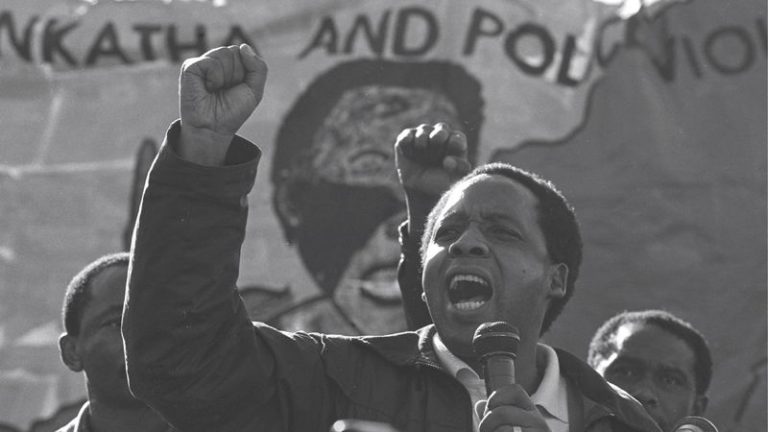
Remembering South African struggle hero Chris Hani

Arianna Lissoni 

The “what if” game is popular with the media and the commentariat in South Africa. A popular example is “what if …” South African Communist Party (SACP) leader Chris Hani were still alive.

What, for example, would he say about the SACP’s tripartate alliance partner, the ANC? What would he say about the state of the alliance after recent calls by both partners, the SACP and union federation Cosatu for President Jacob Zuma to step down?

These questions are being asked again on the anniversary of Hani’s assassination on April 10, 1992 by two rightwing extremists.

But such use, often by the liberal media, of Hani’s name (and those of other fallen cadres of the liberation movement) is problematic. It seeks to isolate Hani from the movement that produced him, presenting him as an exception it can then appropriate.

Hani’s name is also regularly invoked by the SACP and the ANC come election time. Many campaign posters call on supporters to “Do it for Chris Hani”. Here, the summoning of Hani’s memory has become little more than empty rhetoric.

A more useful exercise may be to reflect on Hani’s life, actions and beliefs, and their significance for today.

A popular hero

In his book A Jacana Pocket Biography: Chris Hani historian Hugh Macmillan argues it was Hani’s physical and moral bravery, his compassion and humanity that made him a “popular hero” – the words used by French philosopher Jacques Derrida to describe Hani in his Spectres of Marx lecture.

Hani helped build a culture of internal criticism in the ANC. In 1969 he and six other commissars and commanders of Umkhonto we Sizwe, the ANC’s military wing, signed what became known as the “Hani memorandum”. The memorandum outlined the “frightening depth of the rot in the ANC”, accusing its leadership of careerism, corruption and persecution by the party’s security.

Hani’s memorandum was the catalyst for one of the most significant events in the history of the ANC in exile, a conference in Morogoro, Tanzania. But it was viewed as treacherous by some within the leadership, particularly those it had criticised. Hani and his comrades were expelled from the ANC and only reinstated after the Morogoro conference.

The Morogoro conference opened ANC membership to non-Africans. It also adopted the important “Strategy and Tactics” document. This provided – for the first time since the ANC’s banning in 1960 – a systematic assessment of the conditions of struggle and an overall vision for defeating apartheid in a time of deep political demoralisation.

The conference was a moment of self-reflection. It helped the ANC to overcome the state of crisis and demoralisation that had set in.

The ability of the leadership of both the ANC and its closest ally, the SACP, to reassess circumstances, interrogate these and themselves, and learn from past mistakes to overcome difficult moments is one of the most important lessons from their history. This tradition of internal debate has become eroded, and criticism keeps being silenced as sowing disunity.

Disrupting notions of masculinity

A famous quote by Che Guevara states that “the true revolutionary is guided by great feelings of love”. Leaders like Hani were moved to act by their hearts as well as by reason. The decision to join the liberation struggle was one of reason – a conscious rejection of apartheid oppression and inequality. But it was also a choice informed by “revolutionary love” or a “love for the people” – shaped by a sense of justice and by compassion, as well as by a vision, the ability to imagine a different future.

As struggle veteran and public intellectual Raymond Suttner points out in Recovering Democracy in South Africa, what is new and alarming about many of the ANC’s current leaders is their callousness. The plight of the poor no longer evokes compassion or empathy from a government that is supposed to represent them.

Both Suttner and Macmillan also highlight Hani’s commitment to disrupting notions of heroic masculinity. In his book Macmillan tells the story of one of Hani’s comrades Thenjiwe Mtintso who credited him with introducing her to the gender content of the liberation struggle when she arrived in exile.

Hani’s concern with gender issues can also be seen in his reaction to the abuse of women in MK camps. He introduced a rule that prevented officers from forming relationships with new women recruits.

By looking at the life of people like Hani South Africans can recover the possibility of alternative and gentler types of masculinity to the prevailing models of patriarchal, machoist, militaristic and violent manhood.

Communist for life

At the time of South Africa’s transition to democracy Hani decided to resign from ANC structures and concentrate his efforts on building the SACP. He understood that there would be a need to build the party for it to be a truly democratic and democratising force in a post-apartheid South Africa intent on taking the struggle of the working class and the poor forward.

While the SACP would have to redefine itself in the new South Africa, Hani believed that it should be the main agent of change. That’s where his loyalty to the party was rooted.

Hani was not a communist in passing. He immersed himself completely into the liberation struggle. And it was “a communist as communist”, to quote Derrida again, that his assassins were out to get.

The story of his life –- and that of many others –- is exemplary of this total commitment and willingness to sacrifice one’s life for an ideal. It was ideas, a political project and the movement that counted – not individuals, because no one would have made it on their own.

This may be difficult to imagine in today’s society where individualism and self-interest reign supreme and personalised politics has become the norm. But it was by doing things with, and for others, as part of a collective movement that people like Hani found their self-realisation.

Arianna Lissoni, Researcher at History Workshop, University of the Witwatersrand.
Read the original article here

Social grant payouts go smoothly in Western Cape

Barbara Maregele    

In the days leading up to 1 April, Delft resident Godfrey Classen was worried that he would not receive his pension.

Cash Paymaster Services’s (CPS) contract with the South African Social Security Agency (Sassa) came to an end on 31 March. The South African Post Office (Sapo) is currently being phased in as the new service provider.

It has taken over the payment of grants, except for cash. CPS will continue paying cash recipients until 30 September.

On 28 March, Sassa announced in Parliament that over 5.4 million beneficiaries, who get their grants at merchants and ATMs, will for the first time incur a R10 deduction for banking fees levied by Grindrod Bank.

In a media statement last month, Grindrod stated that the deduction was due to Sassa withdrawing its subsidy.

Sassa has called the claim “disingenuous”.

These changes, announced days before grants were to be paid in April, left many beneficiaries confused about what to expect.

Claasen was among a group of beneficiaries at a Sassa pay point in Delft on Wednesday, 4 April (the day of the second cash payment). He said R10 had been deducted from his old age grant, along with his usual loan repayment and monthly life insurance payment.

“I used to have a green card, but last month I changed back to the Sassa card. I’m just glad we were paid,” he said.

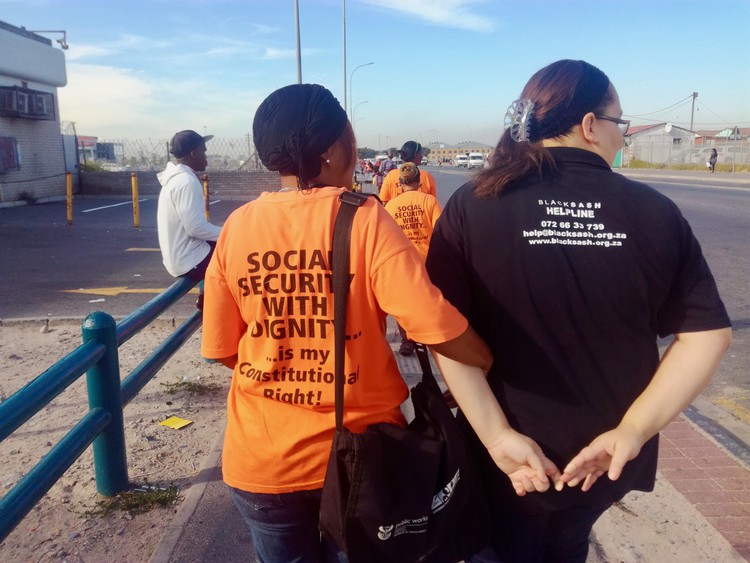
Last week, GroundUp joined the Black Sash at the Delft Community Hall pay point. Since 2013 the Black Sash has been closely monitoring the payment of social grants.

Pensioner, Maggie Pienaar, 66, said she was shocked by the R10 deduction. “I’m meant to get R1,690, but the teller at Shoprite only gave me R1,680. I asked her why it’s R10 less? She told me she couldn’t explain it, but they had to take it off the card. That could be money for a loaf of bread or electricity. They should have told us about this long ago,” she said.

By 9 a.m, over 150 people were seated in snaking queues inside the hall. Mary-Ann Petersen was wearing a conspicuous green bib.

She has worked as an usher at the pay point for the past two years. She said she was “used to the craziness of pay days”. She said many beneficiaries waited outside the hall from as early as 5 a.m.

“It was hectic here [on Tuesday] because disability and pension [grants] were paid. There are usually up to 170 people sitting here waiting. I have to prioritise people who are very old or sickly and that can cause delays,” she said.

Outside the hall, Black Sash monitors noted that there was some confusion around the R10 deduction. Amanda Ismail said they were happy that grants were paid but would continue monitoring the process during the month.

“Some people were still worried that they wouldn’t get their grants and weren’t sure if they now needed to open accounts at the post office or at banks. We still don’t think beneficiaries should bear the brunt for what Sassa decided,” she said.

Leaving the hall were Yvonne Jacobs, 64, and her adult son Tyrone. Jacobs said she had withdrawn her full pension of R1,690 from an ATM earlier in the week, but she was at the hall to reapply for child support grants for her four grandchildren. Her daughter died last month. She had arrived at 5 a.m. and was assisted four hours later, at 9 a.m.

Pensioner Yvonne Jacobs and her son Tyrone outside the SASSA pay point in Delft came to apply for child support grants for her four grandchildren after her daughter died in March. Photo: Barbara Maregele

Loans across the road

The Black Sash also visited a money-lending company called Super Loan Financial Service at the Delft Mall, across the road from the hall.

On the storefront window were National Credit Regulator and Sassa stickers.

Inside, the teller was handing out Sassa-branded forms to be filled out when beneficiaries want their grants paid into a private or commercial bank account. The teller explained that they could only assist beneficiaries with loan applications once the form had been completed.

When we asked to speak to the store’s manager, the teller said there was no manager. He then continued talking to the customers in the store about the Sassa-branded form.

Ismail said, “We have been hearing cases like this where some people, mostly loans sharks, are filling out these banking mandate forms because they [grant recipients] are so desperate to get money. We found this happening at some money lenders in Paarl. We warned them [beneficiaries] not to allow it,” she said.

On Friday, Shivani Wahab, Sassa Western Cape spokesperson, said a total of 910,813 social grant beneficiaries were successfully paid to date. “This was at various payment channels including 262 pay points, merchants and ATMs. There were no glitches reported,” she said.

In response to questions about loan sharks using the banking form to entice beneficiaries, Wahab said that Sassa was aware of companies preying on beneficiaries.

“Sassa has repeatedly appealed to all beneficiaries to not engage with any third party company to secure loans against their social grants. Any third party utilising the Sassa brand for unauthorised marketing purposes must be reported immediately either to the Sassa Toll Free line at 0800601011 or the Sassa Anti-Fraud Hotline at 0800 701 701,” she said.

Loan company, Super Loan, situated in Delft Mall, has clear SASSA branding on its window, which is unlawful as beneficiaries may believe the loans are vetted by the agency. A teller told customers they must first fill in a form stating they want their grants paid into a private or commercial bank account before they can be helped with a loan. Photo: Barbara Maregele

Read original article here

Agriculture training in South Africa badly needs an overhaul

Frans Swanepoel

Agriculture delivers more jobs per rand invested than any other productive sector. If the entire agriculture value chain is considered in South Africa, its contribution to GDP reaches approximately 12%.

South Africa has the ability to meet national food requirements – yet more than 7 million citizens experience hunger. A further 22.6% of households have inadequate access to food.

There are a number of reasons for this. Unsustainable food production practices have led to soil erosion, biodiversity loss, pollution and climate change. There is also increased competition with other industries, like biofuels, for the use of arable land. Declined access to quality water and the failure to address land redistribution are also contributing factors.

Another major reason that the sector is unable to realise its full potential is the fact that education and training is in need of a very serious overhaul.

This is the core finding of a recently published consensus study I chaired for the Academy of Science of South Africa. The study identified three key areas in need of attention: substantial institutional reform, stimulating innovation in the sector and ending the fragmented way in which education and training in the sector is managed.

Fragmented system

There are only a few agricultural secondary schools in the country. At secondary school level, agricultural science as subject is a popular choice. The tertiary sector consists of 12 agricultural colleges that offer specialised training. Ten of the country’s 26 public universities also offer agricultural science degree programmes up to doctoral level.

But the current system of managing education and training is fragmented and in dire need of substantial reform.

For example, responsibility for agricultural education and training is split between research councils and various government departments. On top of this, agricultural colleges are administered at the provincial level and aren’t formally part of the national higher education system.

Postgraduate education, training and research at universities is supported by the Department of Science and Technology through the National Research Foundation. But there’s no formal mechanism to coordinate the work of these various entities.

Recommendations for reform

Reform should be directed towards greater integration, cooperation and accountability.

The panel believes that it’s necessary to establish a National Council for Agricultural Education and Training. Its first responsibility would be to ensure the inclusion and participation of all of the linked departments and other critical stakeholders in the sector. Its work would be to coordinate their various policies and programmes. But, given the current moratorium on establishing statutory bodies, the recommendation is to appoint a Ministerial Committee to oversee this process.

In 2015 the cabinet took a decision to move agricultural colleges from provinces to the national Department of Higher Education and Training. A task team was appointed to investigate the implications of the transfer of authority. But there’s been little progress.

The panel has made a strong recommendation that the task team’s work should be expedited. And that sufficient resources should be allocated to make sure that there is progress.

Attention also needs to be given to institutional capacity and resources.

Exploring land-grant possibilities

The panel has also recommended that South Africa pilot test a land-grant system that links research, education, training and extension. Extension is the application of scientific research and new knowledge through farmer education.

Land-grant systems have been successfully implemented in countries ranging from the US to Brazil and India.

Over the past six decades the US has built 60 land-grant universities. Academics hold appointments with dual responsibilities for teaching, on one hand, and research or extension, on the other. In their capacity as extension officers, academics advise and assist farmers on the ground, with the goal of ensuring sustainable production and rural development. They then bring this experience back to the university. They facilitate the flow of information both ways – bringing new innovative research and technology to farmers, and feeding knowledge about field problems back into the university to inform the research and teaching agenda.

The US has managed to develop one of the most sophisticated agricultural innovation systems in the world using land-grant institutions.

India has also adopted a land-grant system called the State Agricultural University System. It now has a network of 41 institutions that have played a major role in lifting millions out of poverty. The system has also led to crop yield increases of 1.6% a year for 30 years.

Next steps

Some research entities, provinces and universities have already expressed an interest in taking part in the South African pilot.

The three national government departments involved in agricultural education – higher education and training, science and technology, and agriculture, forestry and fisheries all support the findings of the consensus study. And they’ve made a commitment to ensuring support for the ideas to become policy.

The study has also been recognised by the Regional Universities Forum for Capacity Building in Agriculture as having the potential to address challenges faced by agricultural education and training across Africa.

Frans Swanepoel is a Research Fellow in Residence with focus on Future Africa at the Centre for Advancement of Scholarship, University of Pretoria

Read original article here

Financially Literatacy, How to use a credit card

Mduduzi Luthuli

It is all too easy to slide into credit card debt. This can easily affect your credit history, which could make it difficult to buy a car or a home, or even to get a job.

Prospective employers check credit. In my fifth and final lesson about educating children about money, we focus on how to properly manage credit card debt.

Genetics are important.

A mother’s eyes or a father’s big feet are among the countless traits parents pass to their children. The same can be said about creating and managing debt.

Talking to your child about credit cards is as critical as teaching them to drive, instilling good work ethic, and teaching them about drugs and alcohol. No matter what your stance is on credit cards – whether you believe they’re good or bad – it’s your job to teach your children about credit cards before the credit card issuers send them one in the mail.

Many young adults are excited at the prospect of getting a credit card, but often for the wrong reasons. It is important to combat their misconceptions early so they become smart credit card users when the time comes.

Credit cards can be a great tool when they’re used correctly. However, they can destroy your financial life, making other aspects of life much more difficult.

Start with you

Most money lessons are not fun and easy, but credit card debt is an even more difficult conversation. This is especially if you’re struggling to manage your own.

When you’re in the process of getting out of such debt, you should be upfront with your kids. They most likely know something is upsetting you. I suggest you focus on the changes you’re making and how they can support you, rather than going into a detailed explanation of what debt is at this time.

“Mom and Dad bought more than we should have with our credit cards, which was our mistake. The good news is we’re fixing it, and we need your help.”

Subsequent conversations should focus on working together to find ways to save money and on starting good money habits by setting family goals.

Aren’t credit cards kind of a boring topic for kids?

 Not at all. You’re teaching them about money, and your child is interested in money for the same reasons you are. Money is great because you use it buy “stuff”. Tell your child you’re going to teach them how to buy goods and services and pay for them. It really is that simple. Credit cards are only boring when you frame them that way. Don’t start the conversation with, “Now we’re going to talk about important adult things because it’s good for you.” That’ll put anyone to sleep.

Credit costs money

You and I know that credit isn’t free, but children need to understand that borrowing money is not like borrowing a classmate’s pen — unless that classmate charges a fee for lending out pens. Teenagers need a different spin on this lesson. They may know intellectually that credit costs money, but the allure of a shiny card is strong. I’ve found a quick way to cool off a credit-dazzled teen: Have him or her read a card application’s fine print out loud to you — especially the sections about interest rates, late fees, and rate hikes. Now it’s not just you that’s saying that credit costs money. They’re getting it straight from the credit card issuer and hearing it in their own voice.

Real-life practice: Give your kid a loan

Whenever you hear, “Please! I swear I’ll pay you back!” you have an opening for a learning experience.

It’s one thing to talk about debt. It’s another to experience the feelings that come with paying month after month on a purchase. If you feel your kids are ready and their request is worthwhile, offer to spot them a loan — with an interest rate, payment terms, and a penalty clause if they miss a payment.

Show them how much the loan will cost compared to the cash price. Put the payment schedule on your calendar so you don’t accidentally teach your kids that repayment is optional. And lend only as much as they need.

Lending your kids money is not without risks.

They may decide to go on a chore strike or be stricken with borrower’s remorse.

You may even have to temporarily repossess a computer, video game, or other item. But they’ll be smarter consumers and better money managers because of the experience, and they’ll see debt as a tool to be used carefully and not just as a four-letter word.

Debit vs. Credit Card

 The most crucial lesson children and teenagers need to know about using a debit card is that it is attached directly to your bank account and the funds you have available at that time.

They need to know using a debit card means that the money will instantly be deducted from their cheque account. Teens need to know how much they have in their bank account before they shop.  It requires them to know how to maintain and balance a cheque account.

They should also learn how to monitor their accounts online. They should understand that if they use the card at an ATM to get cash, but they cannot get more cash out than they have available in the bank.

The most important lesson children need to know about the difference between credit and debit cards is that instead of the money coming directly from your account as it does with a debit purchase, credit purchases come with a bill at the end of the month. Young adults must understand that a credit card is not a golden ticket to just shop and buy anything they want.  They must realize that it is a temporary loan.  

Unfortunately, the personal finance lessons you teach may go in one ear and out the other.

For older kids, practice is the best lesson. Get them accustomed to using credit while they’re still under your roof. You can monitor their credit use first-hand and help modify bad habits.

Add your kid to your credit card as an authorised user. He or she will receive a credit card in their name, but you remain the primary accountholder. Give them a small monthly spending limit as you would with a prepaid debit card. If you like, make them responsible for their own monthly charges. This approach is slightly dangerous, and you’ll need to stay on top of their charges and make them accountable for their actions. If all goes well, your kid will not only receive hands-on credit card experience, but also establish a credit history.

Mduduzi Luthuli is an investment banker and CEO of Luthuli Capital.

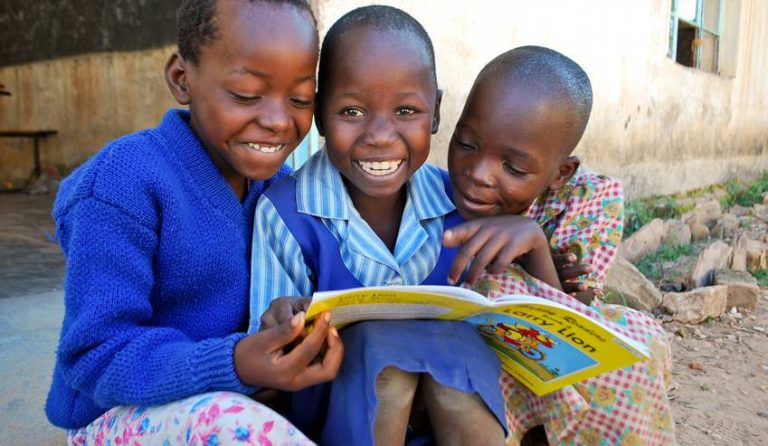
No proof of birth, no education

Bongekile Macupe

Sonia Sigauke was only 10 years old when she dropped out of school in Mozambique.

After seven years at home, aged 17, Sigauke came to South Africa to look for her mother. She had left Mozambique in 1986, leaving Sigauke and her younger siblings to be raised by their grandmother.

“I came to look for my mother because our clinic cards and birth certificates were with her — and the reason I dropped out of school is because I did not have those documents, which were needed at school,” Sigauke said.

“My grandmother tried to get us to school. But eventually we had to drop out because we could not produce the documents that were required. After dropping out, we lived in hope that my mother would one day come back and we could go back to school again, but she never did.”

Sigauke, now 38 years old, came to South Africa illegally in 1997 and the following year met the man who would become the father of her four children.

Even though he is South African and the children were all born in the country, like her they do not have birth certificates. Now Sigauke’s fear is that her children will also be deprived of an education because they do not have the necessary documents. Sigauke managed to get her three older children into school using their immunisation cards but, even as they progress, they face the risk of having to drop out because they have no other form of identification.

Her 17-year-old firstborn, Patrick,is going to matric next year and she fears that, without an ID, he will not be able to register to write his finals.

Her second-born, Bertha, is going into grade eight next year and will need to apply through the Gauteng education department’s online admission system, which requires the IDs of both the parent and the pupil. “All I would like is to see my children having their documents and going to school. I couldn’t go to school because I didn’t have documents but I want my children to have an education,” she said.

Sigauke’s other nightmare has been that of her eight-year-old son, Sipoho, whom she struggled to enrol in grade one last year because he does not have a birth certificate.

“I started applying for school for him in 2016. I went to the district office of the Gauteng department of education and they said they would call me but they never did.  I went again last year and they never helped me. He was supposed to have started school last year.

“There are many children in my area [Kaalfontein, Midrand] who do not go to school because they are undocumented. It hurts,” Sigauke said.

“It was hard seeing other children going to school and mine was not. He had even developed a habit of playing in the dumpsite because he had nothing to do — imagine! It was really hard.”

With the help of the Centre for Child Law, Sigauke’s son is in grade one — for now. But the school has made it clear that, if he does not produce a birth certificate soon, he will be kicked out.

According to the national admission policy for public schools, a pupil can be admitted conditionally if they don’t have a birth certificate but the parent must take steps to rectify the situation within three months.

Anjuli Maistry, a senior attorney at the Centre for Child Law, told the Mail & Guardian this week that, according to the Births and Deaths Registration Act, both parents have to provide valid proof of identity to register the birth of a child, but Sigauke and her partner cannot do so because she does not have any form of identification.

“The father is a South African with a valid South African ID but he is also prevented from being able to register [their children’s] birth because they are not married,” said Maistry.

This week, the Centre for Child Law went to the high court in Grahamstown to challenge the department of home affairs on these regulations. Judgment has been reserved.

“The court might say that those regulations are unconstitutional and home affairs needs to register children like [Sigauke’s son’s] birth,” Maistry said.

This week, the South African Human Rights Commission held a colloquium on undocumented children being denied an education and launched a position paper on the matter. In its paper, the commission said that all children, whether they have documents or not, have a “fundamental and undeniable right” to basic education.

The commission said there is no credible data on the number of undocumented children of school-going age. Although some pupils are helped to get into school, many others are not as fortunate.

“Although the lack of documentation may affect persons from all nationalities, racial and gender groups, as well as those from all geographic areas, the vast majority of learners adversely impacted by a lack of documentation are poor black learners from predominantly rural areas,” reads the paper.

“The effect of the exclusion of undocumented learners, therefore, has notable implications for the eradication of racial and socioeconomic disparities.”

Speaking at the colloquium, the director of legislative services at the department of basic education, advocate Charles Ledwaba, said no South African school is allowed to discriminate against any pupil, whether they are a citizen or not.

He said, however, that the admission of pupils has to be conducted within the confines of the law.

“It’s not a process that operates openly without reference to existing legislative instruments. So, mostly we are being guided by the department of home affairs with regard to immigrants and refugees. We are always in line with their legislative instruments when admitting learners in our schools,” he said.

In its paper, the Human Rights Commission made recommendations to the basic education department on how to handle undocumented pupils, including that:

  • It must issue a directive to public schools outlining the schools’ obligation to admit and retain all undocumented pupils;
  • It must review the laws and policies pertaining to access to public schools for undocumented pupils, and have a law and policy that states that no pupils can be excluded or removed from a school because of his or her status or documentation; and
  • All provincial education departments must review their admission policies and practices, including in online registration systems that exclude undocumented pupils.

Read original article here