Home Blog Page 519

Hungry children can’t concentrate in class

Tiger Brands Foundation

Breakfast remains the most important meal of the day. In a nation constantly plagued by lifestyle related illnesses such as obesity, heart disease, malnutriton and diabetes;  the importance of proper nutrition can no longer be ignored.

Children capture the most information during their school years. These are their formative years, and what is formed here goes on to create the grown up.

However, children in vulnerable areas often struggle to concentrate in class due to hunger and fear of food insecurity. Nutrition and a grasp on its importance during these years is a great stepping stone for health and a brighter future.

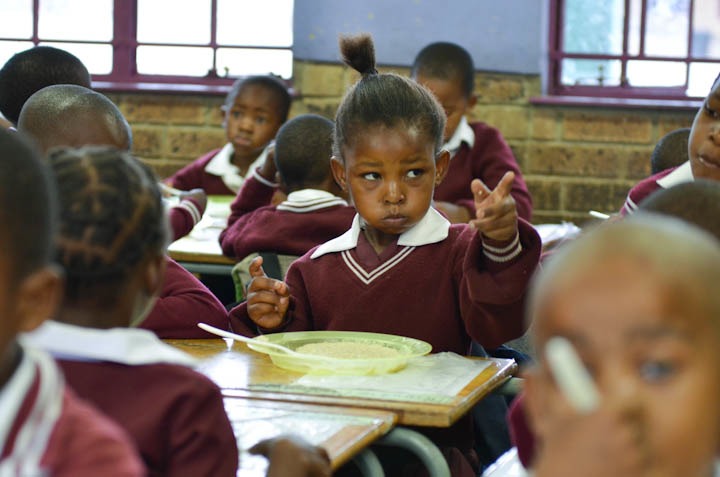
The Tiger Brands Foundation (TBF), through it’s nutrition drive; the in-school breakfast programme, has been serving hot meals at 92 beneficiary schools across the country since 2011 in partnership with the Department of Basic Education (DBE). This complements the department’s National School Nutrition Programme. These meals are prepared at school and served to learners in their classrooms before the start of the school day.

Our vision from the onset was to find a solution to the issue of poor nutrition and its impact on South Africans. The Foundation believes helping to tackle this issue has a positive ripple effect on health, education and the economy in the long-run.

The practical intervention, by means of a healthy and nutritious hot breakfast every school day makes learning enjoyable and impactful for learners who would otherwise be sent to school without any food.  A child who can concentrate on learning and not on their hungry stomach has the power to stop the cycle of poverty through education.

Today the programme feeds 64 080 plus learners daily. It  does not only put an end to a succession of  malnutrition but it also delivers life changing educational tools to schools, learners and parents.

In an effort to involve the family unit in nutritional education, once a year the Foundation takes the programme out of the school and into the home by distributing food hampers to families in various communities during school holidays.

“Many learners come back from the long holidays malnourished because of food insecurity in their community, so we provide food hampers that cover the most basic nutritional needs of a family of four to six people for two or three weeks,” says the Foundation’s executive director Eugene Absolom.

Absolom says the programme is continuing to change people’s lives across the nine provinces. “It has provided jobs for people in various communities; it has opened dialogue in schools, families and amongst learners around the importance of good nutrition; and most importantly it has transformed schools into dynamic and vibrant places of learning,” says Absolom adding that this creates safe learning atmospheres for the children.

The programme is bigger than the delivery of food to the learner, thus far it has built 33 school kitchens and repaired others in order for these meals to be prepared in a more hygienic environment. Five more kitchens are currently under construction. It also assists in the employment of over 360 food handlers at the schools.

Absolom says that the DBE-employed food handlers are parents from schools surrounding communities and their tasks include preparation, cooking and serving breakfast daily.

“In keeping with our education, the food handlers are provided with denim aprons and mop hats and they receive training in food storage, hygiene and preparation,” he says.

“We have also developed a risk management and quality framework that enables quality food products to move from the point of manufacture, to school kitchens, and ultimately into the stomachs of learners’, with minimal risk of non-delivery or food contamination.”

Independent studies done in collaboration with the University of Johannesburg have indicated that absenteesim in schools where the programme is active, has dropped. This has led to improved educational outcomes.

Law enforcement agencies have also reported that there is a drop in petty crimes in the areas where the programme has been implemented because learners are in school instead of roaming the streets, says Absolom.

Having identified nutrition as a major change agent for society Absolom says the programme’s vision has the learner at its centre.

“Ultimately, we would like to see every child receive breakfast so that their future is not compromised by lack of proper nutrition. We would like to see the complete eradication of stunting, obesity and other health challenges that are a result of poor nutrition. We would also like to see young learners perform well in school and where nutrition plays a role in improving educational outcomes.”

However, he says this needs other organisations to come to the party as TBF on its own cannot fulfill the needs of the entire nation.
The Role of Schools and Educators in Combating Bigotry and Hate Crimes

Gugulethu K. Radebe

The Hate Crimes working group recently released a study which inspired a News 24 article headlined ‘Teachers, preachers, doctors, police and politicians to blame for hate crimes’.

This study, among other things, looks at hate incidents suffered by a group of 945 victims.

These results overwhelming speak to the influence that pillars of society, such as those mentioned in the news headline, were actively participating in the marginalisation of individuals in communities.

These trusted members of society were directly and indirectly the cause of the hate crimes that then follow the attitudes of hate and discrimination that are still prominent in the South African society.

2% of the offenders were school or college staff members.

This seemingly small number is further confirmed by the frequency of headlines in the news about the roles of teachers in physical, psychological and sexual abuse that is reported in the news.

These hate crimes are level three and four when looking at the pyramid of hate, a tool often used to teach about the stages leading up to genocide and crimes against a particular group of people.

This tool is often used to teach about how prejudiced attitudes escalate to the point of genocide, though an oversimplified understanding of hate and hate crimes, it helps learners to understand the power of individual thoughts and how, when these ideas are spread through society, can lead to much bigger and more destructive outcomes for both the victims and perpetrators.

With the increase in diversity in South African classrooms and the adoption of a more expressive and liberal culture in our society, it has become increasingly important for teachers to check their own attitudes and fears before standing in front of group of learners.

A lot of the conservative attitudes that often lead up to bigotry can contribute to intentional and unintentional marginalisation of different learners.

As educators we need to find ourselves in a place where we are able to reflect on our own attitudes towards life and see how these attitudes come through in our professional work environment.

In the words of Henry Adam, “A teacher affects eternity; [s]he can never tell where his [her] influence will stop”, the power and influence we have helps to shape society in a massive way. And in having this power, we need to be more intentional and more conscious of how we are not only shaping the faces we see on a daily basis but every single life that they will touch.

With a new wave of diversity and transformation conversations in many school environments, we need to be able to identify what we as individuals may have gotten wrong and approach these spaces as opportunities to connect with our learners at levels that we may have not been able to with attitude that may other[ise] a part of the population in our classes.

We need to be more willing to be open and vulnerable in order to allow ourselves to learn, be corrected and be heard. We need to get to a place where we can listen to learners and members of staff who have suffered as a result of prejudice and bigotry without feeling like we need to defend our own world views.

In recognising the pain caused by bigotry and hate, we are able to empower our learners with tools to check their own prejudice and to create a society that asks more than it judges and that accepts easier than it rejects. We are the agents of change that are necessary for starting conversations about pain, suffering and isolation that so many students suffer.

As teachers, we have the scary and exciting privilege of watching our learners grow and develop. And we need to be intentional about the kind of questions we ask our learners with the hope of allowing them to widen their world view and to encourage dialogue around acceptance, equality and   daring to understand.

Radebe is a teacher, poet and social activist. 

Everything you need to know about fake degrees and the ‘universities’ awarding them

Thomas Lancaster

Would you be fooled into thinking that the University of Devonshire existed? How would you like to own a qualification from the University of Wexford? Or does graduating from the University of Palmers Green appeal?

These were all trading names of the University Degree Programme, set up with websites looking like they were licensed universities. Thankfully, these fake institutions have all long since been shut down, though the qualifications they issued may still be in use.

And this is only the tip of iceberg, because new fake universities appear all the time. The process to set up a fake university can be easy – a convincing domain name with an educational website installed from a template should do it. And with the addition of relevant text, sometimes plagiarised directly from a real university website, the deception is complete.

Recently, more than 40 websites awarding fraudulent and worthless degrees to UK students were closed down as part of a higher education crackdown. The websites allowed those desperate enough, to fork out money for a fake certificate, which would state they had achieved anything up to doctorate level qualifications.

Many of the websites shut down by the Higher Education Degree Datacheck used names close to those of real universities – such as the supposed “Stafford University”. This seemingly operated on the laurels of the legitimate Staffordshire University.

Genuine fake

During my 15 years working in academic integrity research, I’ve come across many methods students use to claim qualifications they don’t deserve. My work on contract cheating, where students pay others to complete their assessments, revealed a network of students looking to build up their degree one fake assignment at a time. Buying a whole qualification outright goes beyond this, circumventing any chance that students have of learning.

Fake universities and diploma mills operate with different levels of subtlety and sophistication. Some fake universities claim to be able to issue awards based on “life experience”. For a fee, they allow people to demonstrate that they’ve already gained the skills needed for a qualification – and they issue a certificate to prove this.

Other fake universities set their site up to look like a real university. Some issue assignments to students. The assignments may never be marked, but could fool people into thinking they were taking a legitimate course. Many fake universities dispense with pretence and just ask for payment for an award.

But a more elaborate business model used by a small group of fake universities has also emerged. These offer subscriptions where they keep up the pretence that their fake qualifications are legitimate. They have also been found to offer services to verify that qualifications they awarded exist, accompanied by fake job references.

Fake it till you make it?

It’s also possible to buy a fake degree certificate for a real university. This certificate often looks identical to the real thing. Fraudsters with access to high quality printing equipment can produce these to order. They can even include the elaborate seals and holograms found on the real documents.

Some sites claim that these certificates are just “novelty items”, but there is no text on the purchased certificates to suggest such a thing. And it is possible for individuals with desktop publishing skills and access to templates or photographs of real degree certificates to knock up their own convincing fake versions.

Reputational damage

With employability at the forefront of many universities, it is the link with the commercial world where the danger of fake degrees needs to be keenly considered. Once an employer has taken on a graduate worker who cannot deliver, they will not wish to engage with that university in the future. Fake degrees bring with them a clear risk of damage to university reputation.

As a sector, we need to do more to combat fake universities and fake degrees. The important work undertaken by the Higher Education Degree Datacheck is a good start, but awareness needs to go further. Every university needs to know about the imposters trading on its name, as well as the sites offering fake qualifications claiming to be from that university.

It is not just universities that are suffering

Employers too need to shoulder some responsibility when recruiting staff. They should not just take every candidate and every document at face value. UK universities offer a service where qualifications can be verified. Some offer this verification directly. Other universities refer employers to the Higher Education Degree Datacheck or similar services that have been set up for this purpose.

Continued alertness and vigilance is needed to preserve academic integrity. We need to stop fake universities trading on commodities that they’re not licensed to award.

Black people beware: don’t let Black Panther joy mask Hollywood’s racism

Alease A. Brown

Black Panther director/co-writer Ryan Coogler has given black people throughout the world an imagined Africa that has been wholeheartedly embraced, earning over USD$1 billion dollars globally so far. This embrace is due, primarily, to the presentation of so many beautiful, black bodies onscreen, including an extravagant representation of fierce, and fashionable, black women.

Also appealing is the portrayal of an Africa of independent authority, spiritual alertness, respect and veneration of ancestors and relationship with animals and plants. This is a portrayal of Africa that is hungered for, especially by ancestrally orphaned African Americans. It is deeply satisfying to view.

But at the same time, it raises questions alert black viewers would be doing themselves a disservice to avoid posing.

Black Panther appears within a broad Hollywood tradition, with over 100 years of history, that portrays Africa as wild, weirdly exotic, and mysterious, and Africans as tribal savages, backwards and subordinate. The framing of Africa and Africans in this way has served to provide the world, including Africans themselves, with a perception of Africa and African people that justified the “saving” and “civilising” mission of Westerners who desired to maintain a colonising influence over the continent.

Hollywood’s history of racism triggers the question, why was the first black superhero identified as an African and a quasi-animal? When the original Black Panther comic appeared in the sixties, featuring a black person who was not inferiorised was groundbreaking.

However, creating an African black panther was unusual. Unusual because it was the Black Panther alone who was not American, and who was instead assigned an African identity. And also unusual because the sixties Marvel universe of superheroes consisted of human-modified characters – Hulk, Iron Man, Thor – and insect characters – Ant Man, Wasp and Spider Man – but not animal characters, other than Black Panther.

Almost 20 years ago philosopher Achille Mbembe astutely commented on this troubling and recurring phenomenon. He wrote, in On the Postcolony,

discourse on Africa is almost always deployed in the framework (or on the fringes) of a meta-text about the animal — to be exact, about the beast: its experience, its world, and its spectacle.

Whether well-intentioned or malicious, the imagination that intertwines the African and the beast has become so commonplace in our minds that it’s hardly questioned. However, when white supremacy is again being boldly asserted in the world, people of African descent who have historically been dehumanised and relegated to the status of animal, must question this association. Especially instances, as in Black Panther, when the association of the African and the howling gorilla is made so explicitly.

The not so super superhero

It’s also noteworthy that the first black man superhero was curiously un-superhero like. The character T’Challa did not possess the scientific brilliance of Tony Stark, who is Ironman‘s genius creator and alter ego. T’Challa’s essence was not transformed at the genetic level such that his body, his selfness, became superhuman and superpowerful, like Bruce Banner’s does when he is transformed into the Hulk. T’Challa was not born a god, like blue-eyed, blonde-haired Thor, the Asgardian god of thunder who wields an enchanted hammer that enables him to fly.

Despite T’Challa’s imbibing of the purple flower potion, viewers never witnessed his transformation from human to superhero. He only dons a powerful suit. Why was Black Panther not written in such a way as to imbue a black man with true superhero dynamism?

Then there are the villains. In Hollywood, there are certain villains that must always be villains, such as Nazis. Then there are heroes, such as white men, who must always be depicted as, in some way, heroic.

The story of Western neo-imperialist resource extraction from Africa is well known. However, in Black Panther, the CIA, who is often the true enemy of Africa, has been transformed into the imaginary state of Wakanda’s friend. It is Africans themselves who are depicted as those who hoard mineral wealth to the detriment of the world.

Why in a film about the Black Panther, who is a black African man, must an actual enemy of African life, go unnamed and an alternate enemy, Killmonger, be manufactured?

Does T’Challa not encounter disrespect on European streets, or suspicion on entering high-end shops, or threats from police on US soil like his black brethren? If he does, then why must there be the creation of hostilities between Pan Africans, when their real-life interests against regime changing global capital and white supremacy are aligned?

Trojan Horse

In other words, Hollywood will allow the world of the Black Panther to be black, only if that world defers to white fragility and does not hurt white people’s feelings. Blackness is allowed only if that blackness likes and supports the values that white people like and support. And only to the extent that black people, though they look good, also exhibit deep cultural flaws.

Why are global audiences led to associate the power and strength of black men with black-on-black hostility and violence? Why must there be the implicit suggestion to audiences that African governance inexorably leads to African tribal warfare?

Philosopher Frantz Fanon wrote a generation ago that black people must not only be black, but that they “must be black in relation to the white man”. This necessity of avoiding global black reality, in deference to white sensibilities, is the film’s super problem.

Hollywood has historically adhered to a racist narrative that portrays black people as inferior. Black people dare not believe that they are being presented with a film that proves that Hollywood now, suddenly, holds them in high esteem. Though the Black Panther film is sumptuous, it is a Trojan Horse. Black people must be careful lest black joy at the gift of the film, blinds to the destructive ideologies embedded within it.

School pleaded for bridge over N2 — now a child has been knocked over

Bernard Chiguvare 

A Grade 7 learner was hit by a motor vehicle while crossing the N2 on Friday. Johnathen Brown a member of the Danie Ackermann Primary School governing board said the learner was rushed to Helderberg Hospital.

She was discharged the same day. The motorist stopped and gave their details.

The 11-year-old relies on public transport to get to school from Macassar. Taxis stop on the opposite side of the national road from the school.

“This is not the first time a learner has been hit at the same spot. Last year another learner was hit,” said Brown.

The school governing board (SGB) said there is an urgent need for a footbridge over N2 at De Beers Avenue for safe crossing of learners and the community.

“We have tried sending emails to the Western Cape Education Department and to the City of Cape Town notifying them of the need but up to now nothing has been done,” said Brown.

“The continuous failure to build the pedestrian bridge is violating children’s rights to education as enshrined in the Constitution,” said Chandre Stuurman, an attorneys at and Equal Education Law Centre (EELC).

After eight months of engagement with South African National Roads Agency Limited (Sanral) and the Western Cape government, construction should commence by the end of the 2018/ 2019 financial year, said Stuurman. “Although EELC welcomes this step it urges the government to provide short term measures until the bridge is erected.”

In an email response to GroundUp, the Department of Transport and Public works said Sanral has the official Environmental Impact Record of Decision for the planned pedestrian bridge. The provincial government is still waiting for the report.

But Sabral said it was not responsible for the portion of road in question; it was under the jurisdiction of the Western Cape Department of Transport.

Community members and learners will hold a picket on 16 March at the crossing.

Read original article here

Is institutional racism at play at Hoërskool Drie Riviere, #LearnerMisconduct

Thuletho Zwane

A short video made rounds on social media on Thursday. It shows a young learner sitting at her desk and looking at her book. She suddenly stands up, walks to the front of the class and hurls her book at her teacher.

This is followed by a mix of laughter and shock from her classmates.

The incident took place at Hoërskool Drie Riviere in Three Rivers, Vereeniging.

On Monday, the MEC for Gauteng Education, Panyaza Lesufi, told the media that the learner had been suspended.

“The school has issued the letter to suspend the learner. We have asked the SGB [School Governing Body] to meet with the parents to plan for the disciplinary hearing.”

“But the learner must not be disadvantaged with her academic studies,” said Lesufi.

He added that while the disciplinary hearing was is in progress, the student will continue to receive study material and support.

Lesufi went on to say, “If the learner is expelled [by the SGB], the parents have the right to come to me and appeal the decision.”

To him, the teacher was the victim, not the learner.

He shares the same sentiments with the South African Democratic Teachers’ Union (Sadtu). They also commented on the issue, condemning the learner’s behaviour as violent. In a statement released on Sunday, the union commended the teacher for having acted in a very professional manner against extreme provocation by the learner.

The union said: “It is our strong view that irrespective of whatever the circumstances that might have led the learner to react in that manner, she had no right to threaten the teacher and expose her to that kind of violence. Being an educator must never be viewed as a dangerous profession if we are to reach our developmental goals as a country utilising education as the main tool.”

Lesufi told the media he had met with the educator, whom he referred to as a “shy person”.

“I feel that she is committed to teaching and education. The mere fact that she is here and still teaching shows commitment. I salute her,” said Lesufi.

The MEC said the learner had committed a very serious offence.

He said he, together with his department,  Hoërskool Drie Riviere’s SGB and the school management, had had to act decisively but did so within the confinements of the law.

“We don’t need to prejudge and preempt,” he told the media.

However, the 17 seconds video clip does not show what happened before the incident nor does it properly capture learner experience at Hoërskool Drie Riviere in the Vaal Triangle.

For one, the sound in the video is not clear.

Soon after, another video made rounds on social media showing the young learner in tears and being consoled by her classmates.

Political commentator and analyst Siyabonga Hadebe said these kinds of quick talk shops aren’t enough to understand daily learner experience at these former Afrikaans schools.

“I have taken issue with the way this young learner in the Vaal has been portrayed. The teacher has been shown as the victim of an unruly and uncultured black child. People have said this is not a racial matter since it’s a black child attacking the teacher, but that is because race relations are complex,” said Hadebe.

“I went to the University of Pretoria where you are systematically oppressed and abused. And when you react, you become the problem,” he said.

Hadebe said learners at these former model c schools and former white Afrikaner schools are often left by their parents with the hope of a attaining better education for their children. These kids have had to fend for themselves and fight in order to survive.

In fact, these kids are not welcome in these schools. We saw with Overvaal and how the MEC [Lusufi] lost out to these enclaves that are the white school governing bodies who dictate to government what can and not be done, said Hadebe.

Hoërskool Overvaal witnessed several violent protests in January when the African National Congress (ANC) and affiliated teacher unions accused the Vereeniging school’s governing body of racism. The school refused an instruction by the Gauteng Education Department to accept 55 English-speaking pupils. The school said it had no capacity to admit the learners‚ and could not set up a parallel stream in the timeframe it was given by the department. Its decision was backed by the High Court.

The learner’s parents also feel the situation should be holistically considered. They believe that the recorded incident was a result of a culmination of events that have not been captured by those quick to condemn their child.

Lesufi told the media that even though the learner’s parents acknowledged that their daughter’s behaviour was wrong, they believe their child was provoked.

“They said their child was not fairly treated. They agreed that their daughter was wrong in attacking her teacher and welcomed the intervention by Gauteng Education, however, they said the provocation must also be looked into,” Lesufi said.

When asked if the department has evidence of racism and anti-black behaviour at the school, Lesufi referred the media to three videos he and the SGB have as evidence of the incident.

“We have access to three videos that filmed the event of last Thursday. You would not believe the kinds of words the learner said. I cannot go into detail or share the video with you,” he said.

Lesufi told the media that the department was making available their psycho social services to the learner, her classmates and the teacher involved.

He said his department had to meet with educators and assure them they are in charge of their classrooms.

“If we can’t assure them then there will be no learning in the province. When it comes to these kinds of areas we want to say, ‘If you do something right, we will cover your back’. We believe the teacher behaved well under extreme provocation. There must be no grey area of support,” he said.

There are others who do not have faith in SGB’s at these white schools. Hadebe does not believe the SGB will do justice to the learner’s case.

“The SGB consists of the same problematic voices that maintain the current status quo at these schools. A historical analysis of the situation would have to be made. It is important we know of former and current black learners experience,” said Hadebe.

The one thing that everyone seemed to agree on was the need to install cameras, CCtv security and biometrics at schools.

“I know schools should be a place where children should be free and not a military camp. But unfortunately, we can’t ignore the realities we are in: crime, violence, other things,” said Lesufi.


Smacking makes children more aggressive and at risk of mental health problems

Raymond Arthur

It might be seen by some as one of the ultimate parenting taboos – to admit that you smack your child. Yet research from the Children’s Society reveals just 14% of adults think slapping children is unacceptable. It’s clear then that a lot of parents still see the odd smack as an acceptable form of punishment – for when all other methods of discipline have failed.

Many parents rationalise this type of punishment with the fact they too were smacked as a child and claim it didn’t do them any harm. But did it?

Recently, researchers in the US examined over 50 years’ of research involving more than 160,000 children and concluded that smacking children does in fact cause more harm than good. The researchers found smacking often “does the opposite” of what parents want and rarely results in increased immediate compliance by children. It was also shown that children who are smacked are more likely to exhibit higher levels of aggression and mental health problems as they grow up.

Smacking and the law

It is legal for a parent or carer to smack their own child in England, Wales, Scotland and Northern Ireland as a form of “reasonable punishment”. This is despite the fact that current laws prohibit adults from smacking, pushing or shoving other adults – and also protect pets from violence.

Under the Children Act 2004, parents can smack their children provided it does not cause bruising, scratching or reddening of the skin. In this sense, the law limits the use of physical punishment, but it also sends out a dangerous message that it is legally acceptable to assault a child.

Spanking usually does more harm than good. Shutterstock

This is at odds with many of our European neighbours – 24 European countries have abolished parents’ right to use any form of physical punishment. And yet unlike Austria, Croatia, Denmark or Norway, in the UK parents can still smack or hit as a form of punishment.

Police, lawyers and prosecutors have the difficult task of deciding when hitting is hurting a child – both physically and mentally. The visibility of bruising is often used as a test of whether a smack has been too hard. But this is ineffective as different children have different colour skin and bruise in different ways. The current law also leaves things vague for parents, and makes it hard for them to know what degree of force (if any) it is okay to use.

Lasting consequences

An outright ban on physical punishment across the whole of the UK would be much easier to police. And it would also be consistent with the country’s obligations under international law that children must be protected from all forms of physical or mental violence.

Technically, the fact that children can still be punished using physical and mental violence is in breach of the UN Convention on the Rights of the Child. This is something the United Nations has urged the UK government to change – instead encouraging and promoting positive, participatory and nonviolent forms of discipline and respect for a child’s equal right to human dignity and physical integrity.

Longitudinal studies show that spanking increases aggression in children. Shutterstock

Although at the time smacking can seem like a quick fix, it is clear it has long-lasting consequences. As the latest research shows, discipline involving the infliction of violence can be damaging to a child – both physically and emotionally. It is clear then that the legal acceptance of beating children must end, thereby putting the child in exactly the same position as adults and pets in respect of the law.

Ultimately, a ban on smacking would not only provide children with greater protection, but it would also let parents know clearly what is and isn’t acceptable when it comes to disciplining a child. But beyond all this, it would also help children to grow up happier and healthier – and what can possibly be more important than that?

Read the original article here

Teach children about money: The importance of delayed gratification

Mduduzi Luthuli

As a parent you can teach your child important financial lessons.

The parents of a child who has kicked and screamed demanding the latest PlayStation game or merchandise from Disney’s latest princess movie, probably haven’t uttered the words “delayed gratification” in their response. However, such terms could become a valuable tool in teaching children about money.

As a parent, I understand that the concept of money and the importance of saving are difficult to explain to a child. You would have to think of how best to illustrate the value of saving and having extra cash on hand, versus just spending everything the minute you get it.

Children are, after all, intent on instant gratification.

Most parents excel when it comes to teaching safety and good manners but have no idea where to begin when teaching about money. Money skills can be a blind spot because many people feel financially inept themselves. As a result, parents subconsciously revert what they know – and inadvertently passing their habits down to children. We have seen this and learn it from our own parents and now we live month-to-month with hardly any money to save or invest.

The latest debt-to-income stats communicate that the wrong habits are being passed on from generation to generation. Credit extension is growing faster than job creation, and the moribund economy cannot carry that burden forever.

The 2014 – 2016 World Bank report on consumer credit-use statistics showed South Africans were the world’s “biggest borrowers”. Consumer credit-use statistics show a comparison between employment and credit consumer numbers. The figures suggest that South Africans are failing to manage their debt responsibly and that some credit providers might be missing the mark regarding their criteria in affordability assessments.

This is a symptomatic problem that will affect future generations.

Studies show children as young as three can grasp financial concepts like saving and spending. It therefore becomes critical for parents to note that their children’s money habits are formed by age 7.  This means that without proper and concerted effort to teach your children lessons in financial management, some damage may have already have been done by the time they reach Grade 1.

Advise to young parents

Financial lessons must be age appropriate to resonate with young children. Lessons should be tailored for their age rather than just made simpler.

Start as soon as they can count and make money the topic of regular family discussions. The key is to turn your day-to-day activities into learning experiences. Trips to the bank, store, or the ATM machine, for instance, can be a perfect opening for a discussion about your values and how you use money. The sooner parents start taking advantage of everyday teachable money moments, the better off our kids will be.

Parents are the number one influence on their children’s financial behaviours,

It should be one of the parent’s primary objectives to raise a generation of mindful consumers, investors, savers, and givers. The first step is to teach your children the importance of patience and discipline. Concepts hard enough to learn at any age but if properly mastered, can be a great foundation for creating sustainable wealth.

The ability to delay gratification can also predict how successful one will be as a grown-up. Children need to learn that if they really want something, they should wait and save to buy it.

Parents must know that it is alright to say no. As adults we are often told no, whether it is from employers or the bank, and children need to hear it. Renowned clinical psychologist, Dr Elizabeth Kilbey, warns against saying you can’t afford it.

It’s easy to use this default response when your child begs you for the latest toy. But doing so sends the message that you’re not in control of your money, which can be scary – and create future anxieties. A more appropriate way is to say: We choose not to spend our money like that.

Marshmallow Test: The famous study in self-control and delayed gratification

Psychologists have studied why some kids seem to excel at demonstrating self-control and delaying gratification, while others struggle for long time. The famous “marshmallow test” conducted by Walter Mischel, an Austrian-born American psychologist specializing in personality theory and social psychology, and a team of researchers at Stanford University in the late 1960’s and early 1970’s, looks at the relationship between self-control, avoiding instant gratification, and how that informs the development of a person’s character into adulthood. In the study, four-year-old children are presented with a marshmallow and informed that they could either eat a marshmallow now or wait 15 minutes and receive two marshmallows. Some children gobbled the marshmallow immediately, while others managed to wait the full 15 minutes and receive the reward of a second marshmallow.

The researchers continued to follow up with the children for the next several decades. They found that the four-year-olds who had successfully waited for 15 minutes differed in significant ways from the children who couldn’t wait. Over the years, the children who had “passed” the marshmallow test developed the following characteristics: better emotional coping skills; higher rates of educational attainment; lower BMI; lower divorce rates and lower rates of addiction

The lesson here is not to show how some people are supposedly born with better self-control or that this trait determines their entire life trajectory, but rather that these skills can be acquired, it takes time to acquire and master them, and if mastered can result in a higher probability in that person being well-rounded and enjoying a better quality of life.

The researchers continue to conduct a lot of variations on the marshmallow test. In some of their studies, more children were able to resist the siren call of the marshmallow because the researchers taught them how to delay gratification and wait for better results.

Walter Mischel concluded that “pre-schoolers” tended to wait longer when they were given effective strategies. In other words, self-control and delayed gratification are essential life skills but they can be learned.

Teaching our children about how to be financially savvy and financially literate should start as early as possible. Setting the foundation with this advice will help your child in the long term. They will know how money can be earned, and how waiting for something bigger can be a good thing. You can even try a version of the marshmallow test with smaller children to explain the concept of delayed gratification. With solid financial foundations, you will be proud when your child grows up a responsible, financially savvy adult who contributes to the economy. Lord knows we need it.

Mduduzi Luthuli is and investment banker and CEO of Luthuli Capital.


Poor parents in Kenya choose private schools over free primary schools

Stephanie Simmons Zuilkowski

The numbers of low cost private schools in low and middle income countries have exploded in recent years. These schools charge fees that are affordable to the poorest segment of the population, and often target these populations specifically.

But, in many countries, these schools have been criticised for failing to meet minimum standards set by the government for facilities, infrastructure, and learning materials. There are also claims that they exacerbate inequality because they are not accessible to the poorest children and tend to be located in urban areas, and allow national governments to abandon their efforts to serve poor students.

Kenya is no exception. Evidence suggests that more than half of primary school students in Nairobi attend private schools. This is despite the fact that 15 years ago the government implemented a free primary education programme. So why do poor parents, struggling to support their families, elect to pay school fees when they could send their children to school without paying fees?

One hypothesis is that there are simply not enough public school seats to accommodate children, particularly in densely populated informal settlement areas like Kibera or Mathare.

But research conducted by myself and my colleagues supports another theory: we found that parents make great sacrifices to avoid public schools and place their children in private schools at significant financial cost. The main reason is that parents believe private schools offer better quality education than public schools. Other contributory reasons included perceptions of superiority and that younger parents were more likely to have children in the private schools than older parents.

Private perceptions

We interviewed more than 1,000 parents and head teachers at 93 public and private schools in Nairobi. We asked them about their schooling decisions and what words they would use to describe low cost private schools and public schools.

Low cost private schools were described as being high quality, with harder-working teachers who were consistently present in the classroom. Homework was assigned regularly and teachers were observed by supervisors.

Public schools were described as corrupt, with lazy teachers who were often absent. Survey participants were more likely to describe public school teachers as well-trained, however, and said that the school had many learning materials available. In interviews, some parents also discussed their concerns about social class issues – such as wanting to keep their children away from the “dirty” children in public schools.

Overall, low cost private schools were seen as the better quality choice, when they were available for parents. For eight in ten parents whose children were in them, quality was a strong motivator. For public school parents, quality was a factor for 56%, with affordability of fees and proximity being the next greatest concerns.

Financial sacrifices

On average, having one child in one low-cost private school cost 12% of the income of the household’s main earner. Given that families in the study had on average three children, this is a significant portion of household spending.

Parents in the survey said that, on average, low-cost private school were twice as expensive.

Our study found that low-cost private school were seen by most parents in Nairobi as superior to the local public schools. We also found evidence of a generational change – younger parents were more likely to have children in the private schools than older parents. This could be because younger parents are more likely to be educated themselves, and are therefore more sensitive to school quality.

Some parents indicated the “flexibility” of head teachers in the low-cost private school, since parents were sometimes allowed to pay fees over a period of time as the children continued learning.

Moving forward

Given that the number of educated parents is expected to grow it’s important for the government to engage with low cost private schools as critical components of the education system, rather than as competitors to the public system. The ministry of education has guidelines in place to govern how low cost private schools are registered, which is a welcome step. For example, to register, private schools must meet basic minimum requirements for teacher training and facilities.

Finally, parents need consistent, verifiable information on the available schools in their area including accurate pupil-teacher ratios, literacy and numeracy outcomes data, and pass rates on the Kenya Certificate of Primary Education examinations. Parents should be making decisions about school quality based on accurate learning data rather than on gut feelings and popular perceptions. When a very poor family makes the choice to pay school fees, it is not able to pay for something else, so it’s important to ensure that families making this choice are actually getting a return for their investment.

_Benjamin Piper, Senior Director in Africa Education for RTI International, contributed to the writing of this article. _

Read the original article here


Proper child care helps poor working women – and it can boost economies

Laura Alfers

On March 8 each year trade unions and women’s rights organisations mark International Women’s Day by calling for policies and legislation that better support working women. Such calls relate to wage equality, maternity leave and early child care programmes.

But these demands tend to overlook the needs of some of the most vulnerable: the millions of poor working women in cities in developing countries who are forced to take their kids with them to work or miss out on better paid opportunities because they’re caring for young children.

Some women take up work out of their homes – from stitching clothes to making snacks to sell at a market – to take care of their children. The earnings may be lower than in formal employment, but they have no other option as both decent work opportunities and quality child care services are rare in poor urban areas.

Across 31 developing countries, less than 1% of women living in poverty have access to a child care service.

Low-cost and unregulated child care services may exist, but are often still too expensive for women informal workers. Public child care services may not be available in informal settlements or poor urban areas. City plans don’t set aside enough designated spaces for child care centres either near workers’ homes or their places of work.

Ultimately, women informal workers earn even less when they have young children in their care. A new report by UN Women has found that, across 89 countries, women are 22% more likely than men to live in extreme poverty during their prime reproductive years (ages 25 – 34). Women are also less likely to receive a pension or will have lower benefit levels than men.

Adequate and quality childcare is not just a critical need for the children involved. It also determines women’s participation in the labour force and the type of work they can take on.

A coherent policy response is needed to bring together women informal workers and their organisations with municipal authorities, urban planners, early childhood development experts and relevant national ministries. There is no doubt that quality public child care services are expensive to set up and run. Yet the returns on investment are great.

In South Africa, for instance, UN Women estimates that a gross annual investment of 3.2% of Gross Domestic Product into child care services would extend universal coverage to all 0-5-year olds. It would also create 2.3 million new jobs and raise female employment rates by 10%. These new jobs would generate new tax and social security revenue of up to USD$3.8 million. These gains offset some of the costs to the state and can reduce inequalities brought on by spatial, class, gender and racial or ethnic segregation.

Women workers demanding change

Women are now calling for change. Informal workers organisations in collaboration with trade unions representing formal sector workers are organising a global campaign for quality public child care services.

Home-based workers, domestic workers, street vendors, market traders and waste pickers are engaging municipalities and governments from Lima to Bangkok, calling attention to their child care needs. They’re also organising to find their own solutions when the state does not listen.

In India the Self-Employed Women’s Association, a trade union representing close to 2 million women informal workers, runs a child care cooperative for its members in Ahmadabad. The Market Traders Association in Accra, Ghana manage a child care centre in a major market for traders, street vendors and others who have to bring their children to work.

However, all of these child care services also require support from a country’s government to be sustainable and remain accessible to the working poor.

We conducted a study on these issues for Women in Informal Employment: Globalizing and Organising (WIEGO), a global research-policy-action network focused on securing livelihoods for the working poor in the informal economy.

One Brazilian waste picker said: “Without day care, I can’t work. When there is no day care, I don’t work.”

Some child care centres in poorer areas may be affordable, but manage this only by not employing enough staff. A street vendor from South Africa told us:

The caregiver had too many children to look after…I used to receive calls notifying me that my child is sitting alone outside our home. The child had left the care facility without the caregiver’s awareness.

Child care for a brighter future

Of course, the provision of quality public child care services is no silver bullet. But it is urgently needed: a quarter of the world’s urban population – close to 1 billion people – lives in slums today without access to basic services and social security.

The number of urban dwellers is expected to double in South Asia and sub-Saharan Africa over the next two decades; more and more people will seek homes in slums and informal settlements. Quality public child care services guarantee a better and healthier future for children in these areas and elsewhere, and the many women who work and care for them.

One street trader we interviewed in Accra, Ghana, had managed to enrol her son in pre-school while she continued to work, secure in the knowledge that he was cared for. She knew just how valuable this was, saying: “I take my child to the school to get a bright future – I don’t want him to be like me.”

Rachel Moussié co-authored this article and the research it is based on. She is the Deputy Director of the Social Protection Programme at WIEGO and leads the Child Care Initiative supporting informal workers’ access to quality child care services as part of social protection systems. For further information please write to childcare@wiego.org.

Find the original article here