Home Blog Page 520

Community rebuilds Motherwell creche after fire

Joseph Chirume    

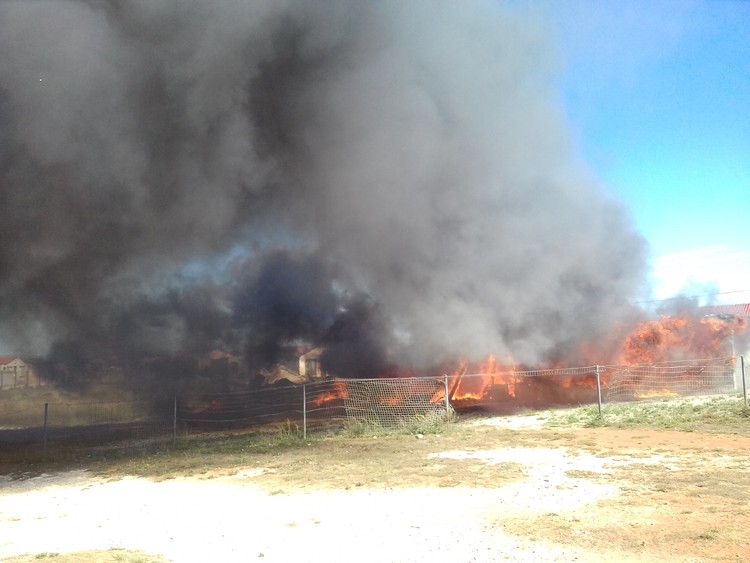
Sinethemba preschool in Motherwell, Port Elizabeth opened its doors this morning. It had to shut down after it caught fire in January when children who played a few metres away lost control of their firecrackers and mistakenly burned down the only creche in the area.

The creche was built from wooden boards, poles and metal sheets

The creche, owned by three elderly women who are educators,did not have sponsors at the time.

It is located on Sakwatcha Street, the crèche is close to the Crossroad taxi rank, making it convenient for working parents from across Motherwell. It charges a nominal fee of R120 per child per month.

There was a lot of concern after the fire accident. One of the owners, Fikiswa Joyi, was worried about where they would get the money to rebuild the creche.

“We can’t charge more because this is a poor community where many people depend on social grants while others work as domestic workers. We don’t receive funding. The books were the first assistance we had,” she said.

Another owner, Mavis Slamse, said furniture, goods and books were burnt. She estimated they would need more than R40 000 to rebuilt the creche and buy the material.

But their luck soon changed.

Donations poured in. St Marks Church in Kabega contributed construction materials. Workers at Discovery Health contributed flooring material, food and children’s toys, among other things.

Sam Huysamen, a representative of the company said, “We have plans to establish a gardening project at the back of the crèche.”

“We were teaching kids at our houses until we opened the place last week. We are really grateful to all people who helped us. The place is now much bigger and safer for children to play,” said Slamse

“However, we are still short of furniture,” she said.

There were 85 children enrolled at the creche.

This story was first published by GroundUp.

We have edited it.

Eleven games and activities for parents to encourage maths in early learning

Sivanes Phillipson and Ann Gervasoni

How can parents best help their children with their schooling without actually doing it for them? This article is part of our series on Parents’ Role in Education, focusing on how best to support learning from early childhood to Year 12.


Before beginning official schooling, parents can give their young children a boost in learning mathematics by noticing, exploring and talking about maths during everyday activities at home or out and about.

New research shows that parents play a key role in helping their children learn mathematics concepts involving time, shape, measurement and number. This mathematical knowledge developed before school is predictive of literacy and numeracy achievements in later grades.

One successful approach for strengthening the role of parents in mathematics learning is Let’s Count, implemented by The Smith Family. This builds on parents’ strengths and capabilities as the first mathematics educators of their children.

The Let’s Count longitudinal evaluation findings show that when early years educators encourage parents and families to confidently notice, explore and talk about mathematics in everyday activities, their young children’s learning flourishes.

Indeed, children whose families had taken part in Let’s Count showed greater mathematical skills than those in a comparison group whose families had not participated. For example, they were more successful with correctly making a group of seven (89% versus 63%); continuing patterns (56% versus 34%); and counting collections of 20 objects (58% versus 37%).

These findings, among many others, are a strong endorsement of the power of families helping their children to learn about mathematics in everyday contexts.

What parents can do to promote maths every day

Discussing and exploring mathematics with children requires no special resources. Instead, what is needed is awareness and confidence for parents about how to engage.

However, our research shows that one of the biggest barriers to this is parents’ lack of confidence in leading maths education at home.

Through examining international research, we identified the type of activities that are important for early maths learning which are easy for parents to use. These include:

  1. Comparing objects and describing which is longer, shorter, heavier, or holds less.
  2. Playing with and describing 2D shapes and 3D objects.
  3. Describing where things are positioned, for example, north, outside, behind, opposite.
  4. Describing, copying, and extending patterns found in everyday situations.
  5. Using time-words to describe points in time, events and routines (including days, months, seasons and celebrations).
  6. Comparing and talking about the duration of everyday events and the sequence in which they occur.
  7. Saying number names forward in sequence to ten (and eventually to 20 and beyond).
  8. Using numbers to describe and compare collections.
  9. Using perceptual and conceptual subitising (recognising quantities based on visual patterns), counting and matching to compare the number of items in one collection with another.
  10. Showing different ways to make a total (at first with models and small numbers).
  11. Matching number names, symbols and quantities up to ten.

Games to play using everyday situations

Neuroscience research has provided crucial evidence about the importance of early nurturing and support for learning, brain development, and the development of positive dispositions for learning.

Early brain development or “learning” is all about the quality of children’s sensory and motor experiences within positive and nurturing relationships and environments. This explains why programs such as Let’s Count are successful.

Sometimes it can be difficult to come up with activities and games to play that boost children’s mathematics learning, but there are plenty. For example, talk with your children as you prepare meals together. Talk about measuring and comparing ingredients and amounts.

You can play children’s card games and games involving dice, such as Snakes and Ladders, or maps, shapes and money. You can also read stories and notice the mathematics – the sequence of events, and the descriptions of characters and settings.

Although these activities may seem simple and informal, they build on what children notice and question, give families the chance to talk about mathematical ideas and language, and show children that maths is used throughout the day.

Make it relevant to them

Most importantly, encouraging maths and numeracy in young children relies on making it appealing and relevant to them.

For example, when you take your child for a walk down the street, in the park or on the beach, bring their attention to the objects around them – houses, cars, trees, signs.

Talk about the shapes and sizes of the objects, talk about and look for similarities and differences (for example: let’s find a taller tree or a heavier rock), count the number of cars parked in the street or time how long it takes to reach the next corner.

Discuss the temperature or the speed of your walking pace.

Collect leaves or shells, and make repeating patterns on the sand or grass, or play Mathematical I Spy (I spy with my little eye, something that’s taller than mum).

It is never too soon to begin these activities. Babies who are only weeks old notice differences in shapes and the number of objects in their line of sight.

So, from the earliest of ages, talk with your child about the world around them, being descriptive and using mathematical words. As they grow, build on what they notice about shapes, numbers, and measures. This is how you teach them mathematics.

For the original article, read here

Learners bullied into using taxis

0

Nompendulo Ngubane

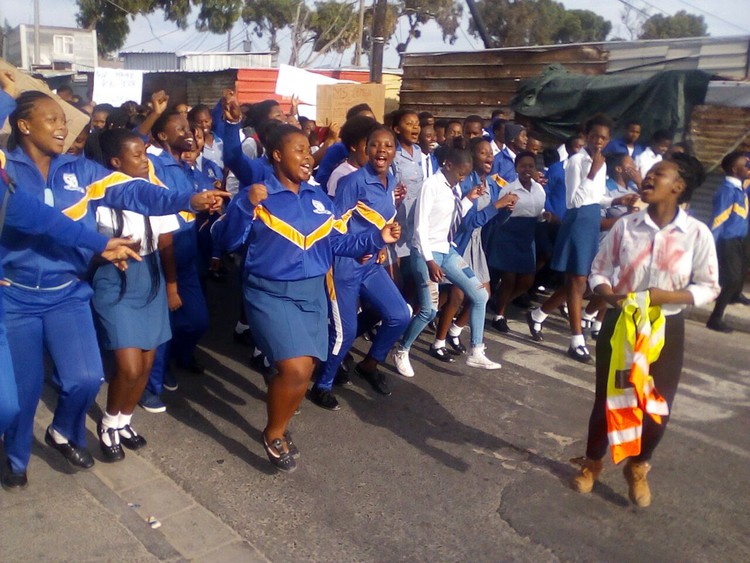
Mandisa Cele was one of a group of high school learners protesting outside the Pietermaritzburg taxi rank on Wednesday, demanding to be left alone to choose their own means of transport.

Learners from schools in the Northdale area said taxi owners were bullying them into using only taxis.

Many learners use private vans or cars driven by “omalume” (uncles) with whom families have contracts.

On Tuesday, uniformed security guards accosted learners and forced them to use taxis. Those who could not pay taxi fares were forced to walk from school in Northdale back to town.

Cele, who is in grade 12, said, “uMalume was forced to leave without us. Some of us had no money for the taxis. We were forced to walk from the school to town. We have the right to use transport that we are comfortable with.”

Sabelo Mtshali from Camperdown said he felt safer in private transport and it was cheaper.

“If I were to use a taxi, I would be taking four taxis daily. With uMalume I’m paying R750 a month. A taxi costs R1,000 or more. I live with a granny and I depend on her grant money for transport. She pays the money in instalments with omalume. They have an understanding which is not an option on daily taxi transport,.” he said.

Thabani Dube, one of the private drivers who transports the learners to school, said he did not understand why taxi owners were fighting with them. “There is no need for a fight. Everyone is doing his or her job in their own space,” he said.

Dube transports children who live in Imbali, Esigodini and Dambuza to school and back home.

“Students have missed school today. Students were removed from their transport by the [taxi] owners. Our cars were not allowed to transport any student,” said Dube.

“We prefer private transport,” said learner Nelile Zondi. “With taxis we are always late … We get detention or we are sent back home … We don’t want to use taxis. Taxis squash us. With our transport we sit comfortably.”

South African National Taxi Council (Santaco) Umgungundlovu Region Chairperson Bheki Sokhela said the taxi industry wanted to work with the private drivers who transport the learners to school.

“All that we want is that they get permits,” he said.

He said some taxi owners might have been “impatient”.

“And I am not aware that security guards stopped learners from using their own preferred transport,” he added.

Deputy General Secretary of Equal Education Ntuthuzo Ndzomo said students should be allowed to exercise their right to education.

Read the original article here

How class and social capital affect university students

Sioux McKenna

There’s a great deal of comfort to be had in the idea that success at university is primarily or exclusively the result of a student’s hard work. All that’s needed is for students to do their best and fairness will prevail. Students who don’t apply themselves will fail. End of story.

Or is it?

A far more complex picture of student success and failure has emerged from a study tracking the influence of higher education on young people’s lives. We worked with 73 people who first registered for a BA or BSc six years before the data was collected. They had pursued these degrees at three South African research-intensive universities.

Many of the participants shared a strong sense that their university years had provided them with access to powerful knowledge. They felt better able to act in ways aligned to their values and goals. But not all had been able to attain this overwhelmingly positive experience equally. Social class – as well as a range of other factors in the institutions themselves – played a huge role in people’s experiences of accessing and succeeding in higher education, and then getting into the workplace.

Those from impoverished rural settlements or towns, or from peri-urban townships, experienced far more significant hurdles than their urban, middle-class counterparts. This was in part about connections: middle-class, urban students were able to draw on networks before, during and after university. So they tended to enjoy shorter, smoother routes through the institution.

This finding is neither new, nor specific to South Africa. The study refutes common sense explanations of higher education success and failure that continue to dominate in our universities. These understand higher education success to be predominantly a function of attributes inherent in the individual. Failure is understood to result from the student’s lack of such attributes.

Similarly, common sense explanations conceptualise universities as being acultural, apolitical spaces where people acquire skills. This maintains the fiction that higher education is a meritocracy which fairly rewards individual students’ hard work, motivation, “language skills” and intelligence.

Our data shows the institutional culture, the curriculum structure, teaching and learning approaches, and family support and relatives’ own knowledge of how universities work all played a role in students’ making their way through the system.

Our findings raise a number of concerns for institutions – and individuals – who would like to see fair opportunities for young people wanting to advance their education.

Family support

In South Africa, as in similar economies, it is a huge investment for a family to have a young person who is not earning for a number of years after school, and who might also add costs to the household during this period.

The families of some of the participants were able to manage this investment. Some funded their studies through a combination of resources from bursaries, family, or part-time work.

Others, though, came from families with absolutely no financial flexibility and were frequently in financial crisis. This pressure took a toll on the students’ academic progress. Even those who had some funding from the National Student Financial Aid Scheme struggled: they had no safety net for any crisis. It took a great deal of energy to manage their basic financial requirements.

But the extent to which the family was able to foster aspirations and engage with the young person’s deliberations and choices was perhaps even more important than financial support.

The data showed that having people with whom to discuss their decisions played a very important role in participants’ higher education journey. This meant having informed people – not necessarily graduates themselves – to talk through their choices.

For instance, a young person might not get access to their first choice of university, and could turn to relatives for discussions and alternative ideas. A more challenging experience for some participants was when they failed academically in their chosen degree and had to figure out a new course of action.

Much of this kind of understanding came from another family member’s experience of going to university. But it was also closely tied to cultural capital: social class played a significant role. The transition to the expectations of the university, to its peculiar and discipline specific knowledge making practices for example, is difficult for all students. But access to these powerful knowledge practices is uneven and it is a disservice to pretend otherwise.

The social side of university life was also enormously important to these young people, as might be expected. Fitting in, making friends and experiencing campus life were often mentioned. Students from less well-off families sometimes struggled, feeling they had to keep up with more affluent friends in a materialistic culture.

Cohesion

How can prospective students from settings where family members or teachers do not have the cultural capital related to university study get support in making decisions? And how can universities assist in attending to these needs once they have made their way into higher education?

While universities can’t attend to all societal problems, the data would suggest that institutions have some role to play in forging social cohesion among their own staff and student body.

_This is an edited abstract from “Going to University: The influence of Higher Education on the lives of young South Africans” (2018) Case, J., Marshall, D., McKenna, S. & Mogashana, D. African Minds. Available for download here.

The other authors of the book from which this piece is extracted are Professor Jenni Case (Head of Department of Engineering Education at Virginia Tech), Professor Delia Marshall (Faculty of Natural Science at the University of the Western Cape) and Dr Disaapele Mogashana (student success coach and consultant at True Success Institute).

Sioux McKenna is a Director of PG Studies & Higher Education Studies PhD Co-ordinator, Rhodes University.

Read the original article here

Youth entrepreneurship and employment threatened by water restrictions

0

Mary-Anne Gontsana  

Informal business operators say car washes are their only form of employment.
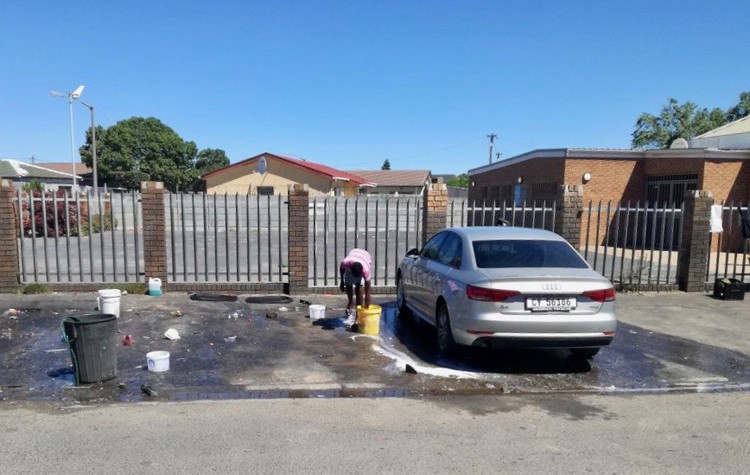
Meet Mandla*. Mandla has to pay R2 000 or serve jail time after he was fined for “wasting water” at his car wash business in Philippi, Cape Town.

Last weekend Metro police, City of Cape Town water and sanitation staff, and law enforcement staff conducted a blitz on car washers in Belhar, Delft and Khayelitsha looking for contraventions of water restrictions.

In a statement the City said 16 car washes had been visited and a number of fines issued. “Numerous hose pipes, drums and car wash equipment” were confiscated.

Mandla was fined last year. “It happened last September, when the water crisis issue started gaining momentum,” he said. “Law enforcement came, told us that we were wasting water, then confiscated our hose pipe and cones. We were given no warning or anything. We were fined R2,000.”

Mandla appeared in court on 7 February after failing to pay the fine. He must pay by 30 April or face prison.

He lives with his unemployed girlfriend and has to also provide for two children, his mother and his sister.

“I didn’t pay the fine because I don’t have that money,” he said. “The car wash was my main source of employment. It was not just a business. It was survival. I am unemployed after losing my job as a security guard in 2016 when my contract ended.”

Mandla ran his car wash with four other men in Philippi on Lansdowne Road.

He said he was offered no alternative, such as advice or help converting to waterless car washing.

Now he has slowly restarted his business, charging R40 to wash small cars and R50 to wash bigger vehicles and taxis. He uses municipal water. One bucket washes about three cars.

“Water is not always available. They turn the water off once you’ve finished the daily litres the City gives you. There is a tap in Block 6 here in Philippi, that we have to walk to which doesn’t run out; so we have to collect all the way over there,” said Mandla.

A car wash owner from Khayelitsha says City officials “are always driving around here checking everything out. One day they stopped and we were using a hose pipe. But they just told us to stop using it and use buckets instead, they didn’t confiscate anything. We use these big black bins now to collect water,” he said.

Wayne Dyason from City Law Enforcement said, “The car washes are illegal when they use water obtained from the municipal supply to wash vehicles in terms of level 6B water restrictions.”

He said car washes were allowed to use “grey or borehole water”. “Grey water is easily identified by sight but in cases of borehole we sometimes take samples to verify their claim”.

Dyason said washing vehicles in the road was also prohibited in terms of the Streets and Public Places By Law.

*He wished to be identified by his first name only.

Read the original article on GroundUp.

Lectures stopped at UKZN’s Pietermarizburg campus

Nompendulo Ngubane 

Students stopped classes at the University of KwaZulu-Natal (UKZN)’s Pietermaritzburg campus on Monday.

They say they have not received their National Student Financial Aid Scheme (Nsfas) allowance for food and accommodation.

Student Representative Council (SRC) member Xola Mehlomakhulu said they could not allow classes to continue while others were being negatively affected by Nsfas. He said it was pertinent that everyone feel the way other students have been made to feel.

“We can’t allow others to study while others are suffering. No one can attend classes on an empty stomach,” he said.

Mahlomakhulu also said some post-graduate students were being excluded from the fund and were thus unable to further their studies.

He said students were squatting with other students while others had no place to stay.

This is what inspired SRC members to take protest action last Thursday and the subsequent shutting down of lecture classes on Monday.

Students who were not part of the protest raised some concerns.

“I’m from Imbali Unit 2. I take four taxis a day. Since Thursday, I’ve been coming to campus for nothing,” said one student who asked not to be named.

“My concern is that tests are resuming next week. What is going to happen? These students don’t want anyone to study. We are starting to feel the pinch,” said the student.

When GroundUp visited the campus, police were visible along Golf Road. Some students were sitting outside the campus. They watched as the police chased a group of protesters. Teargas was used to disperse the protesters.

A student who is part of the group that is disrupting lectures said he had not received his allowance. “I’m currently living with a friend in the township. I survive on cheap bread. I don’t have the money for food and accommodation.”

University spokesperson Normah Zondo said, “The university management is engaging with student leadership to resolve matters. Protesters are urged to allow time for discussions to take place, and desist from causing further disruption.”

GroundUp has got no response Nsfas, despite phoning, emailing and texting.

Read the original article on GroundUp..

52 students forced to study in one container

Thembela Ntongana  

More than 150 learners from Philippi High School marched to Parliament on Tuesday to voice their concerns over conditions at their school and a shortage of teachers.

“We are 52 students in one container [classroom]. The situation is making it difficult for us to learn,” said Grade 10 student Thembaka Silarwa.

“We want to learn but we want to learn in an environment that is good. Those containers are hot when it’s hot and they can be very cold in winter,” she said. “When we have to write exams we write outside, and they have to hire a hall for matric students.”

Learners have been complaining about the school since 2015 when police fired stun grenades at them for protesting over the lack of infrastructure.

In March 2017, the learners marched to the Metro South Education District Office in Mitchells Plain demanding the new school promised to them. Later that month, they marched to the Western Cape provincial legislature.

The schools is made up of 17 prefabricated, mobile classrooms containers. It has no library and no sport field. Classes are overcrowded say learners.

Grade 10 learner Siyanda Gojo said, “We have one teacher who teaches Xhosa and History but we are struggling … We can’t understand him”

“Our Math Literacy teacher comes twice, if we lucky three times, a week. … None of us wants to fail. That is why we are here. We want a school that runs like any other school with teachers and a proper school [building],” said Gojo.

When no one from Parliament would attend to them, the learners left to occupy the provincial department of education offices. Here they were told student representatives would be taken on 18 March to see the site where the new school will be built.

In March, a spokesperson for the Western Cape Education Department told GroundUp that the school was “in the design phase” and that the school should go into construction in the 2017/18 financial year.

Provincial education department spokesperson Jessica Shelver told GroundUp that infrastructure delivery is subject to available budget. She said a contractor had been appointed by the Department of Public Works to build the school and should move onto the site on 28 March according to the project plan. Shelver said the school is due for completion in October 2019.

“District officials have discussed these plans thoroughly with the school governing body, the school management team and the representative council of learners … All parties agree that the school is overcrowded. The new school will relieve this overcrowding considerably,” said Shelver.

Shelver told GroundUp last week that classrooms are becoming overcrowded in the Western Cape due to migration. “The current teacher to learner provincial ratio is 1 to 37.”

“The department does not have budget to allocate additional teachers at this stage,” she said.

This article was first published by GroundUp

Tanzanian Economics PhD student student killed by taxi driver

Zoë Postman 

African Diaspora Forum (ADF) Chairperson Marc Gbaffou, told a crowd of about 50 people gathered outside Sophiatown Residence on Monday that ADF would be sending letters of demand to the police and the University of Johannesburg (UJ).

This comes after a Tanzanian Economics PhD student, Baraka Leonard Nafari, was allegedly bumped and killed by a taxi driver outside Sophiatown Residence on 23 February.

City Press reported on Friday that Nafari’s colleague had seen the CCTV footage from UJ Campus Security. He said it had shown Nafari and his friend being chased by a taxi. He told City Press that the taxi deliberately struck Nafari against the residence’s fence which killed him.

Gbaffou said the letter to UJ would demand that it pays for the transportation of the body back to Tanzania, full cost of the funeral, damage to the family and a private investigation. He said the letter to the police would be a test for the newly appointed Minister, Bheki Cele, on how he deals with crimes against foreign nationals. He said UJ and the police would be given 30 days to respond.

Gbaffou said he wanted to make it clear that Nafari’s death was not an “accident” and that it was a deliberate act of murder. “Baraka was a human being like you and me. Someone decided to take his life and that person cannot be out [of prison] like you and me … we are asking for justice”, said Gbaffou.

He said it was unacceptable that the taxi driver had been arrested for driving without a license and was let off on bail. He also questioned why UJ took about a week to release a statement on Nafari’s death and to provide the CCTV footage to the police.

Student Representative Council (SRC) Chairperson Letlhogonolo Maimane also addressed the crowd. He said the SRC was “highly disappointed in law enforcement’s inability to deal with this case”. He said the case was not receiving the necessary attention but it should not be politicised because a life was lost.

“We will be liaising with the university to ensure that justice is served”, said Maimane.

But Claire Ceruti, a former UJ student, said the case was “highly political”. She said the university had spent “millions if not billions” on security around campus but students were still not safe. “This was not an act of God … his life was ended prematurely”, she said.

GroundUp is awaiting comment from the university.

This article was first published by GroundUp

Land debate in South Africa is about dignity and equality – not the constitution

Steven Friedman

If you want economic change in South Africa, create a crisis – then stand by to negotiate a way out of it.

The country’s current debate over land expropriation without compensation, which has now been endorsed by Parliament, is important. Not because, as some fear, it will radically change the constitution. Rather, it tells South Africans how, in the economy and other spheres, the country deals with its minority ruled past: by crisis followed by compromise.

Crises are the only way change happens because, since the 1970s, the goal of the minority which has called the shots in the society for decades has been to ensure that changes alter as little as possible. Which, of course, means clinging to many of the inequalities which existed before all adults were allowed to vote in 1994.

So most businesses – and professional practices and places of learning – do not change until a crisis forces them to look again at what they need to give up to keep things as much the same as possible. Because this means keeping black demands for change at arm’s length, the crises always happen when black people get angry with current arrangements and make demands which force a reaction.

The negotiations which produced the 1994 constitution began because the costs of black anger at apartheid were growing. They followed reforms to labour law, which were triggered when angry strikers in Durban demanded pay increases in 1973, and the end of curbs which kept black people out of the cities, a reaction to the anger of the 1976 Soweto protests and the refusal of angry migrant workers in the same year to live in single-sex hostels.

Recently, it took angry protests on campuses to trigger discussions at universities on how to change to meet the needs of black students. Race is debated seriously only when black people get angry over racial prejudices in advertising or company behaviour or on social media.

The crises always end in compromises because none of the country’s key interests can impose what they want on the others without severely hurting themselves. This is particularly so in the economy: forcing change on the owners of capital will kill investment and growth – ignoring demands for reform will trigger costly resistance.

The land debate’s message

The land debate illustrates the point.

Moves to change the constitution are dramatic because they threaten the property rights on which the market economy rests. They are, therefore, the most significant expression of black anger at the survival of pre-1994 inequalities since South Africa became a democracy.

Inevitably, they have prompted a crisis: a public debate which has been fixated on former president Jacob Zuma is now discussing economic divides. The debate is polarised and heated – but among middle class black people, support for the change seems overwhelming.

Outsiders might be surprised that tensions caused by economic inequalities focus on land – farming has not been South Africa’s key industry for decades. The reason it triggers such heat is that for South Africans, “land” is a symbol of far more than an expanse of soil. For most people, it has nothing to do with agriculture at all.

Historically, the demand by black freedom movements for the return of the land meant the return of the country to its people – it was directed not only at ownership of farms but at minority control of the economy and society . This is why expropriation without compensation has become a rallying cry for many who have no interest in farming but who feel that a quarter century of democracy has not ended white privilege. It symbolises a much broader demand for change.

It is also why no-one has paid much attention to arguments about the technical merits of land expropriation and why there is such support for a constitutional change despite the fact that there is no need for it because expropriation without compensation is possible now.

Property rights are protected by Section 25 of the constitution which stipulates that compensation must be paid. But it also says that this may not be used to

impede the state from taking legislative and other measures to achieve land, water and related reform, in order to redress the results of past racial discrimination.

So, if the government can show that expropriation redresses race discrimination, it need not pay compensation.

But this has been ignored because the dispute is about dignity and equality, not constitutional clauses.

Compromises will be made

Like all South African crises, this one will end in a compromise – its details have been discussed by lawyers and reported by newspapers. It seems likely that Section 25 will be changed to allow for expropriation without compensation. But the clause will specify very clearly that this can only happen in very particular circumstances, which it will carefully define.

If it does this, property rights will be protected because owners will know that they are entitled to compensation unless they act in a way which forfeits their right. It seems likely that investors will not have to do much to retain the right to compensation.

On the surface, this, like all good compromises, will solve the problem by giving both sides some of what they want. Land owners who hold the state to ransom will risk losing compensation; property rights will be protected, making investment safe. But, if that is all that happens, an opportunity will be missed.

The pattern described here – in which the country’s elites are very good at compromising in the face of crisis but just as good at creating the crises which force them to compromise – is hardly the ideal way to build a fairer economy and society.

Past wrongs need to be addressed

Crisis drives change because elites have avoided negotiating economic reforms which will redress past wrongs while protecting the assets of investors who play by the rules. This forces black people to get angry if they want to be heard and will create new crises if it is not addressed now.

Since the dispute is really about the economy, the solution lies in negotiating the economic changes which cause the anger in the first place.

The dispute’s importance depends not whether it produces a compromise on land but on whether it begins negotiations on opening the economy to the excluded. This alone will reduce the anger which makes crisis the only mode of change and ensure a less dramatic but more lasting way of addressing economic challenges.

Steven Friedman is a Professor of Political Studies, University of Johannesburg

This article was first published by The Conversation Africa

Racist teacher protected by school

Zimbili Vilakazi 

Teaching was disrupted at Parkhill Secondary School in Greenwood Park, north of Durban, on Monday. Learners at the school refused to attend class, demanding that the school address allegations that a teacher made racist insults.

GroundUp spoke to several black learners who said they had reported a coloured teacher for racist remarks a number of times, but the school principal has not taken action.

A Grade 12 learner, Wandile Zuma, said the most recent incident took place on Friday. “We were in the middle of a Life Orientation class when Miss [whose name is known to GroundUp] said she wished it was still apartheid because she would bury all black pupils alive without encountering any problem. It was not the first time she threw racial comments,” said Zuma.

“I remember when one of my classmates brought a cellphone into class last month, Miss held it with her fingertips and she called my classmate a k——r … When she finds a coloured pupil in possession of a cellphone in class, she does not say nasty comments or hold it [the cellphone] as if she was holding some piece of dirt,” said another learner.

The learners said the teacher would make comments such as she did not know why black learners leave schools in their townships and come to schools in the suburbs.

Learners said that when they had reported such incidents to the school principal, they were told to leave the teacher alone.

“We are tired of being treated like this. We are tired of being discriminated against and we want the Department of Education to intervene,” said a third learner.

Philisiwe Mthembu, a parent, said, “Last year my son and his coloured friends were in the wrong by bringing space muffins [made with dagga] onto school premises. Because he is black, he was the only one who was suspended for two weeks. When I went to ask why the teacher punished only him, I did not get an answer.”

The teacher refused to comment. The school principal said GroundUp had no right to be at the school and threatened to call security.

KZN Department of Education spokesperson Kwazi Mthethwa said: “We condemn racism and we are going to make sure that those who continue to promote this barbaric act are punished. Racism does not have a space in our system; it’s satanic and it should be treated as such.”

This article was first published by GroundUp