Home Blog Page 521

#Land: The struggle for liberation in Southern Africa, a lesson in history

Motapo We’Zigidi 

It is time to blow off your gasket again, with the hope that we will not start doubting our identity. Today I tackle the contentious subject of INFORMATION and its purpose in society.

My aim is to show you how elites use information to make us sheep and followers to what is being said and to accept everything as if it was from the holy bible or the Koran. The manner in which society (governments, capital, and others) manage information would make you realise that democracy is a myth, and that elites actually prefer repressive systems of government rather than those that encourage free flow of information.

Elites are always fearful of the power of blacks in South Africa. A revolution by blacks is not around the corner because they are psychologically managed. Imagine if the whole of Soweto and Sebokeng were to occupy farms between Johannesburg and Vereeniging.

Who can stop them?

No one.

Yet blacks stay put in Zone10, Orange Farm and Phiri-Mapetla as if their power is not in their hands. Nobody has a gun or whip to control these masses but they continue to behave.

Information is a great tool to control minds of society. In a democracy, in particular, you don’t need guns or the military to control crowds but words. Let me demonstrate how powerful the use of information is and what propaganda has achieved to date.

The struggle for liberation in Southern Africa and other parts of the was to fight European imperialism and to regain lands lost. Other things were secondary, and I will go as far as saying irrelevant. The first wars fought by the Khoisan and many other tribes or kingdoms residing along the African southernmost east coast, what is today South Africa, were against brutal incursions by Europeans and to drive them out of their lands.

Remember that there were no pounds or rands to worry about. There was also no dependency on whites to feed Africans. So, arguments like a depreciating rand or food security did not hold.

Africans acted out pride and need to protect their lands and people. There was little or no space for brown envelopes. Sekhukhune gallantly battled the Portuguese. Langalibalele, Bhambatha and Basotho tribes fought against English imperialists. Dingane dipped his spear in the heart of Voortrekkers. Labour was needed in mines and agriculture. Land was needed for agriculture and development of a modern capitalist state.

Blacks were hard to conquer until Boers and the English got together to form the Union of South Africa in 1910, under strict instructions from London. This is when the real conquer started, commencing with the Land Act of 1913 and all the way to the creation of the apartheid state in 1961. Britain was instrumental throughout.

In fact, London maintained a double agenda. The English collaborated with Boers to subjugate blacks, this is the part of the story that is known to all of us. Britain also collaborated with black liberation movements to manage aspirations of blacks. The English-speaking community in South Africa was placed in the minds of blacks as “liberal”, meaning that they are or were as not venomous or racist as their Afrikaans-speaking counterparts. That made it easier for them to infiltrate the struggle for liberation by the African majority.

The founding of the African National Congress (ANC) was a splendid idea which had the support of King Dinizulu, whose Zulu monarch had lost large swathes of land to the English and others in northern Natal and Southern Mozambique (Delgoa). The struggle was going to be led by “sanitized” blacks who had received their education abroad. The assumption was that these men still carried the fire of Zulu and Pedi soldiers who had fought Europeans in the 19th century. This assumption was correct but also flawed at the same time.

Indeed some of the leaders still identified with the struggles of ordinary people, but in the main many had been absorbed into the side of Britain. In terms of managing information, it is necessary to manage the “enlightened” (today’s version of clever blacks) and to use them to manage howling crowds, the black majority in South Africa. Blacks had serious aspirations of driving out whites and to regain control over their territories. Their political ideals were however watered down over time using different strategies, primarily force and manipulation of the mind.

The establishment concorts lies and misinformation (also called propaganda) with a view of attaining certain political outcomes.

A progressive theory of liberal democratic thought is based on the premise that there is a need to “manufacture consent” – this is achieved by using sophisticated techniques of propaganda by bringing in “those who are smart enough to figuring things out”. In the black community these smart ones were later roped in to lead the SANNC in 1912. These erudite individuals were smart enough to understand the inner workings of politics, they knew what were white men’s interests in South Africa, and by extension the entire region. They therefore had the capability to know things that “eluded the general public.”

The progressive theory of liberal democratic thought is similar to Leninist thinking that argues “a vanguard of revolutionary intellectuals take over state power, using popular revolutions as the force that brings them close to state power, and then drive the stupid masses toward a future that they are too dumb and incompetent to envision for themselves.” So it was logical to educate enlightened blacks at the time and to solicit their support in containing feisty and warring black tribes.

The likes of Langalibalele Dube, John Tengo Jabavu, Pixley ka Seme and Sol Plaatjie are amongst the most famous names desired for the execution of the project. Jabavu was drawn close to British capital by Cecil John Rhodes in efforts to manage revolutionary aspirations of the black majority.

Jabavu worked closely with white politicians such as James Rose Innes, who was later elected to the Cape Parliament. He also worked with Rhodes in the creation of a Xhosa language newspaper called “Izwi Labantu“. This collaboration did not end there. The duo of Rhodes and Jabavu were instrumental in the establishment of the University of Fort Hare.

Fort Hare was instrumental in the expansion of the elite political class that was going to govern in post-colonial Southern Africa.

Moeletsi Mbeki in his book titled: Architects of Poverty: why African capitalism need changing notes that English capital did not trust blacks enough to create a black capitalist class to run the economy. Instead, this was reserved for Afrikaners – the English injected capital to Boerevolk companies and government to continue safeguarding British interests. The attempt to share the pie with blacks created via BEE has flopped. Hence, the agitation to see economic transformation now.

The ANC was fully “captured” long before the Second World War.

One doesn’t need to take a wild guess which side they supported, General Jan Smuts and the allies. Towards the end of the war, a document titled: “Africans Claims in South Africa” was unanimously adopted by the ANC’s annual conference on 16 December 1943 to declare, “full aspirations of the African peoples so that their point of view will also be presented at the Peace Conference.” Under Dr A.B. Xuma the ANC tried to re-occupy its space the voice for African people. Xuma’s tenure saw the birth of the ANC Youth League and the Women’s League.

The emergence of the “young Turks” with the formation of the ANCYL in the 1940s was an attempt to catch the rot within as a result of the British agenda. The “pacificist” ANC had been in the pockets of English capital for too long and the wheels of the revolution were too slow as a result. Mzwakhe Anton Lembede, Nelson Mandela, Walter Sisulu and Oliver Tambo rose into prominence because they felt that they needed to redirect the struggle. These young leaders were instrumental in the adoption of the Programme of Action in 1949.

The Programme of Action “called on the ANC to embark on mass action, involving civil disobedience, strikes, boycotts and other forms of non-violent resistance, similar to the 1946 Passive resistance campaign mounted by the South African Indian Conference (SAIC).”   Notwithstanding the fact that the Programme of Action was adopted and that the trio of CYL members Sisulu, Tambo and Mandela were elected to the party’s national executive body, the key brains behind the internal revolution in the ANC Lembede had died under mysterious circumstances in 1947.

Lembede died with his Africanist element which disliked the presence of white liberals and communists, who by the way, represented the antithesis of the British continued control of the South African state as it were. English capital supported the struggle as it supported Afrikaner nationalism. The radicalisation of the ANC took place at the same time as the rise of the Nationalist Party, which finally took over the reigns in 1948. Still not to be deterred, British capital persisted in managing the ANC through the white-only South African Communist Party (SACP).

The SACP played a key role in two areas. Firstly, it managed to sway the clever blacks of the time into accepting that South Africa was not black by declaring that it “belonged to all who lived in it”. The Freedom Charter was adopted in 1955 as a blueprint to guide the struggle going forward. Nonetheless, the Freedom Charter was a significant victory for the British because this meant that the ANC (as a leader of black masses) had accepted land ownership by whites as de facto. Lembede’s colleagues such as Robert Sobukhwe and Zeph Mothopeng did not agree, and established the Pan Africanist Congress in 1959.

Secondly, it was instrumental in the ‘militarization’ of the ANC with the formation of the armed wing Umkhonto weSizwe (MK) in December 1961. The adoption of the 1949 Programme of Action and formation of the PAC and MK was supposed to follow the upward trajectory of removing the black struggle from white influence. But it was never to be. British capital was worried about militant erudite blacks who already did what Lenin despised. For example, the opposition of Pass Laws had to be met with a barrel of gun. The Sharpeville Massacre in 1961 was a response to cooperation between smart blacks (the vanguard of the revolution) and the masses.

A second plan was devised to divide the revolution through banning of the PAC and MK (miliritarised smart blacks), in particular. The ANC was back in the hands of white capital but it had to be banned nevertheless. Otherwise, the propaganda to claim that both the PAC and militant blacks within the ANC were dangerous would have been defeated had the ANC remained unbanned.

Albert John Mvumbi Luthuli, president of the then banned ANC, was awarded the Nobel Peace Prize in 1960 “for advocating non-violent resistance…” Clearly, this was the first recognition that he played his part in toning down the liberation struggle, and this also indicated that the ANC was forever going to steer away the masses from their political ideals. Militants were banned, killed or jailed. But this does not present the real going-ons in the struggle for freedom in South Africa.

To this day people still ask pertinent questions:

(a) What led to the PAC’s demise in exile?

(b) Why was the anti-apartheid movement strong in England and less in other parts of the world, especially in the Non-Aligned Movement countries? Why was the ANC a preferred partner by the anti-apartheid movement to other liberation movements?

(c) Why capitalists approached only the ANC in efforts to negotiate talks with the apartheid government? The ANC was not the only organization representing blacks in exile. There was also the PAC and Azapo, among others.

(d) What were direct links between the ANC and the unbanned United Democratic Front (UDF)? The UDF inexplicably ceased to exist as soon as the ANC was unbanned, and “donated” its leaders to the ANC.

(e) Why Mandela’s imprisonment appears to have been much more easier than that of most political prisoners like Harry Gwala who lost functionality of his arms, or many PAC cadres who still served their terms after 1994? It is possible that the pact reached in the 1940s to 1950s spared Mandela and others from harsh prison life. In anyway, the onslaught of liberation movements was to kill militants and Africanists. As for the rest of us, we were impacted by “friendly fire”.

(f) Also related to the UDF was the rise of the labour union movement, particularly Cosatu. Cosatu grew in the margins of English capital in mining areas and industry in the metropolitan regions such as Durban, PE-Uitenhage-EL industrial complex, Witwatersrand and Cape Town. It is inconceivable that capital would have allowed trade unions to grow without supervision because they always represented political and economic interests. Cosatu went on to join forces with the ANC and the SACP after their unbanning in 1990. In addition, Cosatu-affiliated unions went on to be major shareholders in companies operating in sectors where they organised. Trade unionists also became members of the political ruling class; and some are serious proponents of free-markets.

The propaganda of the establishment helped us to understand the political struggle in South Africa the way we do today. The main aim was to control “bewildered herds” (or masses) to follow a specific pre-determined destination rather than what their forefathers yearned for when they fought the Battle of the Blood River, among others. At the end, the struggle for liberation delivered democracy and no land. Isn’t suspicious that blacks have to demand “expropriation of land without compensation” from the Constitution that they never wrote or formally adopted by means of a vote?

Also, one tends to question why did black people engage in a very prolonged struggle for liberation if land, control of the means of production, and restoration of their dignity were excluded in the Bill of Rights?

The release of Mandela and subsequent push for him to be elected as president and the adoption of a neoliberal constitution that does not speak to the aspirations of the Black majority were major achievements for British capital. Although blacks were said to have won political power, which I doubt, the economy and were left intact under English capital. The “servitude” housing Afrikaner capital was equally protected.

The black masses walk under tight management and supervision of the ANC. Capital and the Fourth Estate simply compliments the mind rape of the unsuspecting black majority.

Since taking over in 1994, the ANC has avoided real and tangible discussions with the black majority in order to divert the struggle. Instead the focus has always been turning South Africa into an exemplary free-market state where rights of investors rank ahead of the black majority, that continues to be poor to this day. From GEAR to courting ruthless global corporations, the ANC still uses old-style propaganda that it is a true vanguard of revolutionary masses.

American left-leaning political scientist Noam Chomsky sheds some light on how the propaganda machinery works. It works from the premise that “masses of the public are too stupid to be able to understand things. If they try to manage their own affairs they would cause trouble. Therefore, it would be immoral and improper to permit them to do this.”

As such the elites have a compelling reason and duty to manage “bewildered herd,” by not allowing them “to rage and trample and destroy things.” This is basically the same logic to say it would be irresponsible to allow a three-year old to run across the busy M1 highway, linking Johannesburg and Pretoria, on his own. Blacks cannot handle their own freedom!

Starting from the 1900, then the Freedom Charter, the banning of the PAC and militant blacks, the negotiations for black freedom initiated by white capital, the neoliberal constitution and all the way to the democracy of free-markets, the British/English capital kept everything together through information. The propaganda is a glue to join what appear disconnected, unrelated and even contrasting together. Struggle for liberation and apartheid government had a single boss, British capital. Britain facilitated the negotiations to end apartheid, and already knew what path liberated South Africa had to follow. The direction was always going to advance or protect British interests.

A democracy works on information but such information must be sifted and controlled. Masses have to be given what they need to know, and nothing more. Every media gives the value of the rand and prices for major commodity prices. That is enough to manage your mind. Once masses are told that, for example Britain has no single gold mine but sets the price of the bullion masses would demand reasons to this anomaly. Also, nobody will tell you that minerals get mined in South Africa but only those in America and Europe get to enjoy profits on the backs of African labour.

Propaganda means that the masses have to be entertained. No wonder International sporting bodies decided to award rights to South Africa to hold the rugby and soccer games, in 1995 and 2010 respectively. The masses thought our country had finally arrived while they were being managed away from asking too many questions about what really happened to their struggle for liberation. On top of that popular culture helped to keep the masses entertained and to forget about politics. Political consciousness must be muted.

In a democracy, the bewildered herd have to distracted and also “indoctrinated in the values and interests of private power and the state-corporate nexus that represents it.” Elites see themselves as best judges of public interests. Gupta shenanigans were promoted ahead of the Steinhoff scandal. Evergreen contracts at SOEs continue to be hidden as corruption but Nkandla and Trillian sagas were reported on for many weeks and months. Without the use of force, the public followed suit and believed all they were told.

That is a masterstroke of propaganda.

In a totalitarian state it is easier to control information flow, by either restricting it or punishing anyone who accesses “bad materials”. In places like Russia, North Korea and Saudi Arabia, you just hold a bludgeon over the heads of people who act on the basis of their misjudgements. In Saudi, beheadings and stoning’s are used as capital punishment. However, as society becomes free and democratic, this capacity is lost when you want to silent masses. But can you do to make them keep quiet? “You have to turn to propaganda,” Chomsky suggests.

Propaganda is to democracy what bludgeoning is to a totalitarian state. Just walk around in your neighbourhood and living area and see if you can’t see open skulls. Television, newspapers, advertisements, syllabi in schools and universities, political rallies and other forms of communication have damaged our heads for the benefit of the powers to be.

Motapo We’Zigidi holds qualifications in global affairs, economics and management. He is a political commentator. He manages the international relations portfolio for the department. His scope includes dealing with governments, government organisations, business, trade unions and non-state actors. He is a PhD candidate at the University of KwaZulu-Natal

Twitter: @siyazi)
Eighth week on strike at Durban University of Technology

Zimbili Vilakazi, Bonile Khanyi and Thabo Mohlala

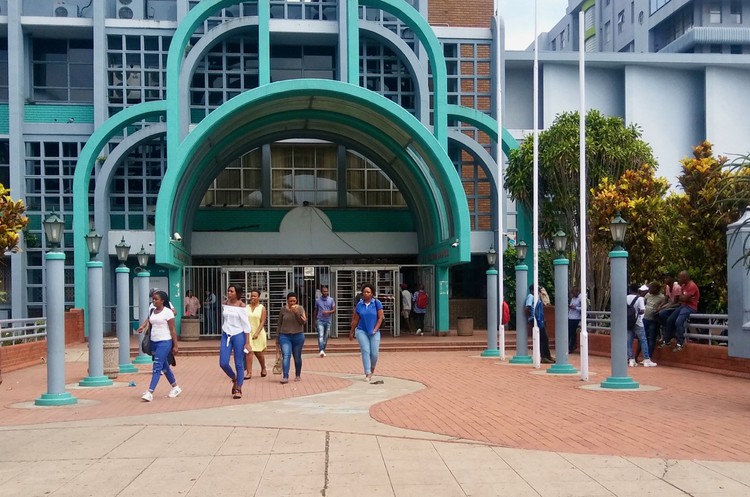
The strike over pay by staff at the Durban University of Technology (DUT) has entered its eighth week.

A statement issued by Senior Director of Corporate Affairs Alan Khan on Friday read: “After three days of another mediation process presided over by the Commissioners from the CCMA, negotiations between the DUT and the three labour unions (Nehawu, Tenusa, Nteu) could not be concluded … All stakeholders will report to their principals on Monday … All negotiating parties will reconvene again on Wednesday morning, 7 March 2018. Lectures at DUT will resume on Monday, 5 March 2018.”

But on Monday, lectures did not take place.

In February, the Deputy Minister for Higher Education, Buti Manamela, took to Twitter to announce a breakthrough in the DUT strike.

“DUT and the Unions agree to go back to negotiations after a five-hour meeting. The parties will resume talks tomorrow morning. Classes will resume by the end of the week and registration will be finalised ASAP,” said Manamela.

The deputy minister was asked to intervene after the university implemented a lockout last Friday. His involvement came after calls were made from the public that DHET should mediate to end the protracted strike which is entering its 7th week.

However, on Monday, the Regional Secretary of Nehawu Ayanda Zulu addressed employees at Cane Growers’ Hall  and distanced the union from Khan’s statement which claimed, “Lectures at DUT will resume on Monday, 5 March 2018″.

Zulu said, “The university offered a 7% salary increase, R200 housing allowance increase and zero once-off bonus. The employees have rejected that offer.” He said the employees are demanding 8.5% salary increase, R400 housing allowance increase, and a R9 000 once-off bonus.

“If the university does not give in to our demand on Wednesday latest, we will be going on a full blown strike on Friday where we will march from King Dinizulu Park to the Durban City Hall,” said Zulu.

Inside Education is waiting for comment from higher education’s deputy minister.

The ongoing strike has seen more than 21,000 students unable to go to lectures at DUT campuses – City, ML Sultan, Ritson, Steve Biko, Indumiso, Riverside and Brickfield.

Parts of the story were reported by GroundUp

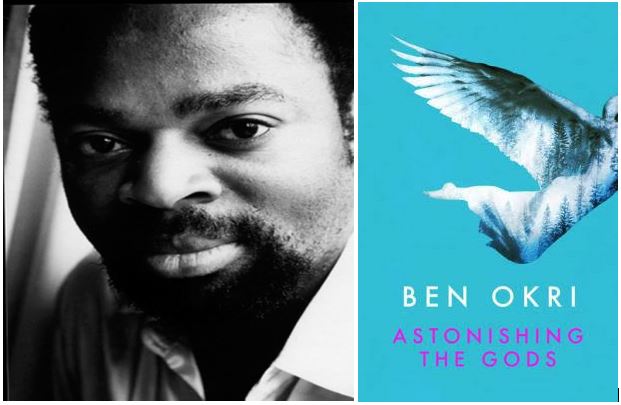
A book review: Astonishing the Gods by Ben Okri

Pfungwa wekwa Nyamukachi

I got my 2-minutes of fame on national radio (SAfm). A first for me. I had been asked
to contribute a book review of one of my recent reads, Astonishing the Gods by Nigerian author, Ben Okri.

I was both extremely excited and extremely nervous at the prospects of being on radio but I had to say yes. This has been my favorite read of this year! In preparation, I re-read the novel and again I just fell in love. I fell in love with Okri’s poetic, masterful weaving of words and story.

The novel is about a young man’s journey of discovery which begins with him discovering that he is in fact invisible and lives in this world of invisibles! At school he finds that the world he lives in, is nowhere in the books he reads.

Ha! How could this be?

This becomes his consuming passion, his quest to be “seen”, to become “visible”. He runs away from home on his search and the novel details this pilgrimage. He encounters things, many things – beautiful women, beautiful art, and beautiful music. He encounters other invisibles, invisible guides, angels and spaces. Places where people don’t name things, because naming things makes things lose their true meaning. Places and people who store treasure quite apart from what he knows.

He asks questions like: If you don’t want things to disappear, what do you do?
He is answered: We think of them. We dwell in them. We let them dwell in us.

He encounters his fears and comes to know his courage. In one of the most profound scenes in the novel, he encounters a terrifying suspended bridge that is held in place by “only the person crossing it”.

Oi.

To help him make his decision, to cross or not to cross, the young man asks; “And what lies below? I mean, if I should fail to hold it (the bridge) up while crossing what would I fall into? I ask because I do not see any water underneath.”

He is told there is indeed no water underneath. He weighs his options and asks, “What if I do not cross the bridge?”

He is answered, “You will be nowhere. In fact you will be worse than nowhere. Everything around you will slowly disappear. Soon you will find yourself in an empty space. Then you will stiffen. You will lose all life. You will become the image of what you essentially are. Then, not long afterwards, half dead and half alive, unable to breathe and unable to die, you will become the statue of your worst and weakest self.”

The lesson there in being that, we are the substance that holds our world. Grace favours the courageous.

He encounters other sojourners. He learns much.

On the theme of love; seeking and finding love, the young man learns – “Happy are those who are still, and to whom things come.

Answers are like that. They go to those who expect them. So, if you want to find something find it first. But how? (Asks the young man). His invisible guide replies: “Find it in yourself, I suppose”.

“You talk in riddles” (the young man remarks).

Guide replies: “The simplest things are riddles and paradoxes. Have you heard about people looking for love? They never find the love they are looking for. Those who find love, find it in themselves….for them it was always there. Love was always alive in them. It was always there. Everywhere. They merely invited it and it came. They merely were, and it was attracted. Love goes to where love is. And where love is, love is never lost. Lucky are those who know how to find, for they will never lose things”.

On the themes of defining time, significance, value/worth and how to “astonish the Gods”, the young man learns: “Time is different here. We measure time differently, not by the passing of moments or hours, but by lovely deeds, creative accomplishments, beautiful transformations, by little and great perfections. Size is also measured differently here. For us, something is great if it is beautiful, if it is true, and if it has life. Something is small if it has none of these things.

“A little perfection is large for us. A large thing without beauty or truth is small for us. A creative seed is greater than a mountainous lump……Hence the invisible things are the smallest and the highest amongst us. If a thing, a quality, an art, a gesture, a form becomes so refined and pure as to become invisible then it has ascended into the eternal…….On the whole, big things are small for us.

“Great fame, great visibility, great temporal power are the easiest things for us to accomplish, according to our way. Hence we deem them small, and not worthy of our efforts……….The most difficult thing for us is to do things which achieve permanence in the higher universe, and which are unseen, and can never therefore be destroyed.

“Our highest acts of creativity are in the empty spaces, in the air, in dreams, in unseen realms. There we have our cities, our castles, our greatest books, our great music, our art, science, our truest love, our fullest sustenance.

If you are lucky you will partake of this higher condition, and delight in its power that transcends all boundaries…..And sometimes – very rarely – but sometimes nonetheless our highest creative acts, our highest playfulness, our self-overcoming, our purest art, our ascending songs, by some mysterious grace, transcend so many boundaries and enter so many realms that we occasionally astonish the gods.”

Astonishing the Gods is beautifully written. Ben Okri writes in this enchanting, fairytale, whimsical way. It is funny. It is poetic and full of “quotable quotes”.

Mostly though, it is deeply profound. It asks poignant questions, ‘the meaning of life” type of questions.

In it Okri offers pearls of wisdom, that I find useful and enlightening in the season of life that I find myself, where I am seeking to define what time, age, beauty, love, worth/value, fear and power, mean to me.

The novel explores so many of these and other themes. The dominant being the themes of visibility vs. invisibility; ego vs. egolessness; significance vs insignificance – the power and place of each these opposites, these dualities which we inhabit all the time.

Best of all it is Okri that everyone will understand and finish! My first encounter with Okri was a couple of years ago, with his novel Songs of Enchantment, which when I started reading, flew over my head. I didn’t understand it. I have no shame admitting this, as I will attempt again. So it was wonderful to find another book of his that I fell deeply for, and can now highly recommend.

So, if you are in the market for a new and great read, do make Astonishing the Gods by Ben Okri, your next one.

Schools should teach more than ‘just getting a job’

Mduduzi Luthuli

One of the main irritations with our current schooling system is its insistence on providing students the knowledge needed to acquire a job instead of teaching skills to manage or maximise income generated from those jobs.

A holistic approach to education is necessary because too many South Africans are managing their financial resources by chance or luck. Often the financial decisions made by individuals who lack financial education have negative consequences that impact their lives for many years, causing unnecessary depletion of financial resources from households’ week after week, month after month and year after year.

It is important to increase the financial literacy of South Africans because this knowledge offers individuals and families the opportunity to enhance or maintain their long-term financial well-being and economic security. In fact, raising the level of financial literacy of South Africans allows everyone to participate in a broader spectrum of the economy and creates a more stable and robust marketplace.

Moreover, increasing one’s financial literacy can yield economic security, which can eliminate the financial stress that leads to other socio-economic problems that have a negative impact on society. This statement is further amplified by multiple studies globally that indicate that financial stress leads to bad financial decision-making such as acquiring too much debt in the use of available financial resources and in other matters such as divorce that are detrimental to one’s financial well-being or economic security.

The number one mission in South Africa must be a joint venture aimed at finding a sustainable and effective solution to reducing indebtedness and improving savings in South Africa. This is a major socio-economic challenge facing us as a society and we’re truly failing to address it.

Statistics show that South Africans continue to face an enduring issue of debt and poor financial management.

Those living in our metros spend an average of 19% of their salaries on paying back debt, according to the 2017 Old Mutual Savings & Investment Monitor, while the National Credit Monitor reports that only 48% of the 24 million credit active consumers in the country were up to date with their credit repayments in the first quarter of 2017.

We also now have more people on social grants than there are people working. This is not because South Africa lacks the resources to create an inclusive economy for all, but rather we have failed to equip people with the knowledge to properly make use of those resources.

Put simply, our problem is not having enough, but rather wasting what we have. The current topic of land expropriation without compensation is a symptom of this ailment.

The current economic environment and rising living costs, is directly fuelled by a lack of financial literacy. Knowing this, one must ask why such education is commoditised. Is it the fear that a financially literate society will cause a collapse in the need for financial advisers? Surely this can’t be the case. Surely a financially literate society would result in a society that understands the importance of financial planning and commitment? By scaling up practical financial education we can empower South Africans to take control of their future and make it more financially secure. Healthy, financially stable economies are built largely on the savings of financially literate individuals.

What is financial literacy

Financial literacy  is defined as the citizens’ ability to make rational judgements and decisions with respect to the use and management of their financial assets, commonly money. It involves both the understanding of basic financial concepts and the ability and discipline to use that information to make informative personal decisions including; when to spend, when to save, budget preparation and implementation, choosing the right financial products, among others.

It goes an extra mile to determine one’s ability to exercise proper judgement when offered access to credit. It has a great bearing on the level of financial inclusion in the economy. Our economy suffers from the disease of financial illiteracy, a situation that has significantly dimmed our growth potential, development agenda and poverty alleviation efforts. Empirical studies on financial literacy show that consumers in most African countries do not have adequate financial knowledge, skills and understanding to make informed decisions. Yet we wonder why the continent continues to be one of potential as opposed to realisation.

Nations with high financial literacy levels tend to record high growth rates and minimal poverty levels too. What this means is that financial illiteracy is a huge burden to a nation. As a result, financial illiteracy remains a major drawback for economic growth, development and poverty alleviation efforts.

According to a policy brief by the Organization for Economic Co-operation and Development (OECD), it dissuades the initial overemphasis on financial education for investors and instead underscores the need for individuals and families to embrace financial literacy for prudent financial management.

Testing the theory

I wonder that if we were to do a national survey and asked the questions below, what would be the results of that survey:

  • Do you know and understand economic cycles?
  • Do you know, understand, and are willing to act on your current financial situation?
  • Do you know how to use personal money management concepts, such as how to manage credit, budget, save and invest, establish financial goals and risk management?
  • Do you know and understand two fundamental concepts—present value and future value of money.
  • Do you know how to choose investments to suit financial goals and life stages?
  • Do you know what tax deductions are available to you and how to determine their monetary value?

Each day we make financial decisions consciously or unconsciously, and how we approach those decisions has a tremendous impact on our ability to maintain economic security, which is the endgame. Therefore, it is imperative that we acquire the financial knowledge and skills needed to make informed financial decisions regarding the use of our financial resources.


School protest rocks Limpopo

Benson Ntlemo

A traditional leader has been lauded by teachers and the school’s governing body after he stopped a class boycott at Gidjana High School in Collins Chabane Local Municipality, in Limpopo.

Chief Hosi Busa Nxumalo of the Gidjana Traditional Authority at Magona stepped in to calm tensions between learners and school management. Learners were protesting against the departure of popular and favourite teacher Hasani Richard Mdaka who transferred to another school.

They threatened to shut down the school until Mdaka was reinstated.

Both teachers and members of the School Governing Body (SGB) spoken to said problems started when Mdaka failed to get the position of deputy principal recently and was pipped to the post by his colleague  John Mkhomazi,  now former friend.

When asked about the situation, Mkhomazi said he was not at liberty to talk about the matter but referred Inside Education to School Governing Body Chairperson Elisa Ntshani.

Ntshani confirmed that Mdaka was not happy with being overlooked for the position of deputy principal.

Because of this, Mdaka made applications to other schools and was admitted at Nghezimani High on horizontal transfer. This left a void.

Pupils at the school became angered by this and decided on the shutdown of the school until Mdaka came back.

The chairperson of the Learners’ Representative Council, Masocha Smangu, said learners felt the government was unfair when it approved the transfer of a good teacher and not cared to look into the matter of replacing him.

“How are we expected to pass and perform well? We need a good teacher. I don’t know how the department allowed this to happen,” said Smangu.

Ntshani said when teachers went to school they were greeted by locked gates while learners protested outside.

“Learners led by the Grade 12 pupils became uncontrollable and led the school to shut down. We are happy the chief intervened,” she said.

Ntshani said both Mdaka and Mkhomazi are great educators who produced good results in their subjects.

“We were very disappointed to see Mdaka go to another school,” she said and declined to give  reasons why Mkhomazi was chosen over Mdaka even though Mkhomazi himself was also a veteran Xitsonga teacher at the school.

Inside Education contacted Mdaka on Tuesday to hear his side of the story. He  he was at church and would grant an us an interview after service. However, he did not answer his phone.

Both the provincial Basic Education Department and the SGB were unable to calm the tension.

Nxumalo told Inside Education he was called to the school on the third day of the shutdown. On arrival, he asked the police not to force pupils into class but instead organise a meeting with them and the teachers.

Nxumalo summoned the school management team, the governing body and the learners’ representative council to the traditional office to talk about the matter.

“This yielded the desired results because they agreed to suspend the shutdown,” he said.

Nxumalo said he found the grievances of the learners genuine because they want to learn and be taught by a good teacher.

The Limpopo Department of Education Spokesperson Sam Makondo said he is aware of the situation at Gidjana.

“We are waiting for a formal report from the district and we will then be in a position to know that which we are going to do in addressing the matter,” said Makondo.

He said he was concerned that since the administrative block was burnt down in 2015 during the community’s demand for a new municipality, the government has not repaired the damaged blocked whereas it has moved swiftly to repair some schools in Vuwani in the unrest that came after

Police spokesperson sergeant Jimmy Ndou confirmed the police went to the school to monitor the situation.

“We ensured that the gates were opened and that teachers  would have access to the staff room. The students still refused to attend class. There were no nasty incidents that happened and no one was arrested,” he said.

At the meeting, learners agreed to revise their demands and said if Mdaka did not come back they needed someone “as good as Mdaka”.

“What we agreed with the chief is the temporary suspension of the shutdown. This will give the department enough time to act. They have  until March 7 to get a teacher who is as good as Mdaka, “said Smangu

The leaners said they would only resume the boycott if the department of education did not fill the vacancy left by Mdaka.

Inside Education is monitoring the situation.

African mothers in science need more support

Bernard Slippers and Smeetha Singh

There are a number of discussions to be had about women scientists in Africa: why there are so few, for instance; or how more can be drawn into science, technology, engineering and maths careers. And, crucially, how can existing women researchers be retained once they’ve embarked on scientific careers – particularly when they have become mothers?

Women may often leave the workforce entirely once their child is born. The cost of childcare may outweigh the financial benefit of working, or women simply want to spend most of their time with their child. Inflexible jobs that don’t accommodate the realities of parenting are another issue. Some women will stop working temporarily, but the return to work is not always smooth.

Women may find that they miss out on potentially life-changing career opportunities because of their maternal obligations. That in turn deepens the gender gap.

In the case of science in Africa, the World Health Organisation and UNESCO have done a great deal of work to close this gap. But not much attention has been given to how mothers who want to attend workshops, conferences and similar networking opportunities are supported. This simple intervention can boost the presence of women in science.

The Africa Science Leadership Programme set about finding out how the demands and realities of motherhood are affecting women scientists on the continent. We conducted a survey of 118 African women researchers from a range of institutions to find out about their career goals and barriers to success.

Many talked about how hard it was to balance family life and career. A number said their obligations as mothers kept them from attending workshops or similarly useful meetings.

The survey responses, along with the experiences of a new mother who’d been selected as a programme fellow, have offered new insights into how organisations and institutions can create supportive spaces for women researchers.

A mother’s experience

Dr Dalia Saad is a Sudanese researcher who focuses on environmental chemistry. She was selected as a fellow for 2017, the third year of the Africa Science Leadership Programme. But she had just given birth.

The programme aims to grow mid-career African academics. Part of the fellowship involves a week-long meeting, a valuable opportunity for networking and career development.

Dr Saad said she wanted to take up the fellowship, but would need to travel to South Africa with her mother and would require a baby cot and extra space in her room. This turned out to be easy to arrange, and meant that an excellent scientist did not have to miss out. Reflecting on the experience, she said:

I was able to bring my baby along with someone to take care of her, so I had peace of mind to effectively participate in the programme while checking on my baby during breaks. This was a special experience for me and I wish that such arrangements were always made to accommodate women researchers’ needs to support their career progression.

Dr Saad suggests that institutions and organisations should consider in-house creches, flexible working hours and more flexible funding time frames to support new mothers who want to continue pursuing their scientific careers. This is borne out by women’s experiences elsewhere in the world.

There are some organisations in the US, London and Canada which offer such support, among them the Society for Molecular Biology and Evolution, the London Mathematical Society and the American Academy of Religion. The Consortium for Advanced Research Training in Africafully supports women who are pregnant or breast feeding to ensure they can take advantage of opportunities within that programme.

This shows that the challenges for new mothers attending workshops are starting to be recognised on the continent. But spreading this support more widely could potentially help to close the gender gap.

Our interaction with Dr Saad and feedback from the survey have presented an opportunity for the Africa Science Leadership Programme to restructure its support systems. We’re committed to allocating resources towards supporting women who would like to attend our workshops with a newborn and a caregiver. This support will be explicitly announced in all future calls, and on our online and social media pages, so that women know it’s available.

We believe this is an approach that other organisations, institutions and fellowship programmes should consider adopting to encourage more women scientists to stay the course despite the demands of motherhood.

A worthwhile investment

The cost implications involved with these suggestions may worry some, since different organisations work with different budget constraints. In our experience, we were able to arrange a cot and a double room for Dr Saad at no extra cost. This suggests it is worth negotiating requirements like room space, baby facilities or even a local, trusted caretaker – some hotels or venues may offer childcare facilities at little or no extra cost.

But, we’d argue that any cost is a small investment with a potentially high output: institutions and organisations will be able to offer truly inclusive programmes for young mothers and an opportunity for more women to remain in science in Africa.

This article was first published by The Conversation Africa

Charges dropped against UWC students after 16 months

Ashleigh Furlong 

After 16 months of delays in court proceedings, charges have been dropped against a group of 23 students from the University of the Western Cape, who had spent a week in jail.

One of the students, Nwabisa Zenani, told GroundUp that she wasn’t involved in the Fees Must Fall protest. She said she had been studying for upcoming exams on the day she was arrested in October 2016.

Investigations by the Legal Resources Centre (LRC) led the students’ Legal Aid attorney to make representations to the prosecution. Charges of public violence were withdrawn on Monday.

Zenani, who is studying accounting, said that being falsely accused and imprisoned was “terrifying”.

“Never in a million years do you expect to find yourself in that situation,” she said.

Fellow accused Jabulani Ngobeni, also studying accounting, said he “was devastated” when he was charged with public violence.

Zenani and Ngobeni said that when they were arrested they were inside a university residence watching the protest escalating outside. Zenani said someone had thrown a stone at the police from the building.

“They [the police] just started banging down all the doors,” said Zenani. “They beat some of us; they swore at us; and then they moved us to Bellville police station.”

The students appeared in court two days after their arrest and were denied bail. They were told to return to court the following week. In the meantime they would be held in Pollsmoor and Goodwood prisons.

Zenani said that the experience of going to Pollsmoor was one that she “wouldn’t wish on anyone”.

“The only light you see is through a small window that has burglar bars … I felt that I had been cheated, victimised by a system,” said Zenani. “You always hear how the system fails people. You only understand when you are the victim.”

Ngobeni was sent to Goodwood prison. “The mind shuts down … You don’t feel like it’s real,” he said.

When they appeared in court again, their bail was set at R3,000. With help from sympathetic staff and the Student Representative Council, the money was eventually raised.

The students are now in the process of returning the money to the people who donated.

Associate professor Shirley Brooks, who supported the students, said they feared their degrees would be rendered useless, but they kept on studying, believing they would be proved innocent eventually. “No firm would take them on for a vacation job or internship,” she said.

Zenani and some of the students approached the LRC. Bathandwa Xhallie, a candidate attorney, advised the students to replace their attorney with one from Legal Aid. “Over an entire year their previous attorney hadn’t managed to get a police docket. It was ridiculous,” said Xhallie.

“The allegations [against them] were firstly false and secondly none of it made sense. We compared the students’ statements and looked at what the police dockets said and we came to the conclusion that there wasn’t a case.”

She said that the police’s statements didn’t add up.

The National Prosecuting Authority (NPA) didn’t respond to requests for comment.

As a result of the court case, a number of the students had to repeat modules and some of their scholarships were withdrawn, said Xhallie.

The university had also put a “hold” on the students’ transcripts (proof of their results), which stated that they were facing disciplinary hearings. The LRC helped to get these removed.

“Most of the students that we were representing were not part of the protests,” said Xhallie.

Ngobeni said he was relieved the charges had finally been withdrawn. “I’m finally cleared of all this mess that I wasn’t supposed to be in in the first place,” he said.

“I’m looking forward to suing the state,” says Zenani. “I feel that a part of myself was stolen from me.”

This article was first published by GroundUp

Khayelitsha school learners march for more teachers

Bernard Chiguvare 

On Friday several hundred learners from Bulumko Secondary School in Khayelitsha marched to the Western Cape Education Department (WCED) to demand more teachers at Khayelitsha schools.

The march was organised by Congress of South African Student (COSAS).

They protesters marched from Keizersgacht street, down Darling street, and then gathered in front of the WCED.

Although the Deputy Director of the WCED came to receive the memorandum COSAS refused to hand it over to him. Protesters instead demanded Education MEC Debbie Schafer.

“The MEC has been neglecting our schools for a long time. If she does not intervene now then we are going to intensify this struggle. We will make sure she leaves the office,” said Michael Mayazo, COSAS chairperson Western Cape region.

Mayazo said: “We want the department, to deploy teachers at Bulumko and other schools in Khayelitsha. Since opening of the schools this year the learners have gone for months without some subject teachers.”

Jessica Shelver, spokesperson for Schafer, told GroundUp the WCED was aware of the shortage, but that the school had “extremely high growth” this year. “The school needs five additional posts. The department granted this request on 14 February, and has provided four substitute teachers and one growth post from the district’s allocation of posts. Our circuit manager visited the school immediately when learners protested at the school on 8 February, and has continued to liaise with the school. The circuit addressed the school management team, the representative council of learners, and learners.”

Shelver said that classrooms are becoming overcrowded in the Western Cape. “The current teacher to learner provincial ratio is 1 to 37.”

“More than 130,000 learners have relocated to the Western Cape from other provinces and countries over the past five years, mainly from the Eastern Cape. This trend has continued,” Shelver said. “A total of 21 962 learners relocated to the Western Cape last year, representing a cost of about R337.7 million, at today’s costs, excluding infrastructure.”

After waiting for the MEC for about an hour, the organisers called an end to the protest.

This article was first published by GroundUp

HOW MANY MORE PUPILS WILL BE HURT OR KILLED AS THEY ATTEMPT TO REACH SCHOOL?

Equal Education

In August 2017 alone, seven pupils died and 21 more were injured as they made their way to and from public schools in KwaZulu-Natal.

Fifteen of those learners are from Ngwane High in Nquthu – a school that the KwaZulu-Natal Education Department admits qualifies for government-subsidised scholar transport.

However, the department is currently refusing to provide buses to the school, claiming that it does not have money to do so.

In the absence of safe, government-subsidised scholar transport, pupils and Equal Education members are transported in private taxis that are often overcrowded and unsafe. For many others, taking a taxi is simply unaffordable.

According to Statistics South Africa, KwaZulu-Natal is the province with the highest proportion of pupils who walk to school and back for more than two hours each day.

And according to the basic education department’s data (which underestimates the problem), only about half of KwaZulu-Natal learners in need will be provided with scholar transport in 2017-2018. Walking long distances comes with its own set of safety risks.

Zama Bhengu*, a high school pupil and Equal Education member, walked two and a half hours to get to school each morning. She witnessed the death of a learner en route.

“We were walking together from school to home, just us two, and she decided to try to cross [the river] and she drowned – I was there and saw it all. She was a student at Maduladula Primary, in Grade 6.”

Zama continued to walk that route, across the same river, the loss of her friend haunting her. “When I cross the river now,” Zama said, “there is a pain every time.”

Learners who walk long distances to school are also vulnerable to theft and sexual violence. An Equal Education member was raped on her way home from school: “Every time when school is about to end I am worried and scared because I have to walk home.”

Another pupil, from the same school, also feared for her safety, saying: “Every day I feel afraid when I am walking. I am afraid that they will rape me”.

When these learners arrive at school, emotionally and physically exhausted, they find it incredibly difficult to learn.

In 2014, at the behest of our members, Equal Education began campaigning for:

• Government-subsidised scholar transport to be provided to schools in Nquthu (including Ngwane High) and in KwaZulu-Natal more broadly;

• For a national scholar transport policy to be adopted by national government; and

• Additional, ring-fenced funding (a conditional grant) to be made available for the implementation of the national scholar transport policy.

Equal Education members, through years of advocacy and campaigning, and with the support of the Equal Education Law Centre, have secured critical victories.

Three of the Nquthu schools that we have worked with since 2014 were provided with scholar transport, a national scholar transport policy and implementation plan was published in 2015, and Basic Education Minister Angie Motshekga this year finally publicly committed to working with Treasury to explore a conditional grant to fund scholar transport.

Motshekga’s commitment follows a series of submissions made to Parliament by Equal Education since 2013, advocating for a conditional grant for scholar transport, and impressing upon parliamentarians the rationale for this much-needed additional, ring-fenced funding.

Equal Education and the law centre have made multiple submissions before the standing committee on appropriations, and in May this year we again made a case for a conditional grant in a written submission to the portfolio committee on basic education.

A conditional grant will ensure additional funding specifically for scholar transport, subject to strict levels of accountability and transparent monitoring of spending. It will ensure that the specific needs of provinces are provided for, assisting those with the greatest demand.

It is unacceptable to cite budget constraints when learners are denied access to education, and also have their right to equality, human dignity, life, security of person, as well as the best interests of the child, violated.

How many more pupils will be hurt or killed this year as they attempt to reach school? After numerous engagements with provincial government officials, Equal Education has taken legal steps toward providing scholar transport for 12 schools in Nquthu and in KwaZulu-Natal generally.

For members such as Simphiwe Hlophe*, who must leave home at 5.30am to get to school on time, the injustice is clear: “I feel it is unfair that my education must suffer because I have to walk so far to school and it is the department’s responsibility to make sure we all have equal access to education.”

And so our members continue to fight for their right to education to be realised. As our scholar transport case unfolds in the Pietermaritzburg High Court, we vow to hold Motshekga to her recent commitment.

We expect her department to provide substantive progress reports on its engagement with Treasury, and to design and implement a conditional grant to help put an end to the #LongWalkToSchool.

* Not their real names

This article was published by Equal Education

How corrupt local officials kill decent education in Africa

Maty Konte

There’s no disputing that many African countries’ education systems are in trouble. Despite significant investment and some improvementslinked to the push to achieve the Millennium Development Goals, children in large parts of Africa are simply not being well taught or learning what is needed as they progress through the school system.

A lot of the discussion around this problem centres on resources: people argue that teachers must be trained better. More money must be spent. This is, of course, correct.

And governance is sometimes discussed, though mostly only as it relates to central governments and their responsibilities. But the quality of local governance matters, too. Local governments – those at a regional, provincial level, district or village level – are closer to communities. They are more likely to understand particular populations’ needs. At a practical level, they are often in charge of providing or distributing goods and services. In education this would mean textbooks, furniture and repairs to classrooms.

This suggests that local governance can have a real effect – positive or negative – on the quality of learning resources in a community and, by association, on how children perform?

I set out to explore this effect by using a series of surveys conducted by Afrobarometer in 33 African countries. This is an independent and non-partisan research network which conducts nationally representative surveys in Africa measuring public attitudes on economic, political and social matters. More than 50,000 citizens have been interviewed in the selected surveys I used for this study.

My study showed a strong link between the quality of local governance and the quality of the educational resources in Africa’s public schools.

In fact, I found that corrupt behaviour by local government councillors increased the likelihood that schools would lack textbooks, have poor facilities and overcrowded classrooms, have poor quality of teaching, and would record high levels of teacher absenteeism. This finding stands no matter how much money a particular country’s central government had invested in education.

If Africa is serious about improving its schooling systems (and meeting the Sustainable Development Goal related to education), it must tackle corruption among local councillors.

What the data shows

My research was based on survey data Afrobarometer collected between 2005 and 2013. Some of the questions related to education; others to people’s perceptions of their local government councillors’ performance and ability.

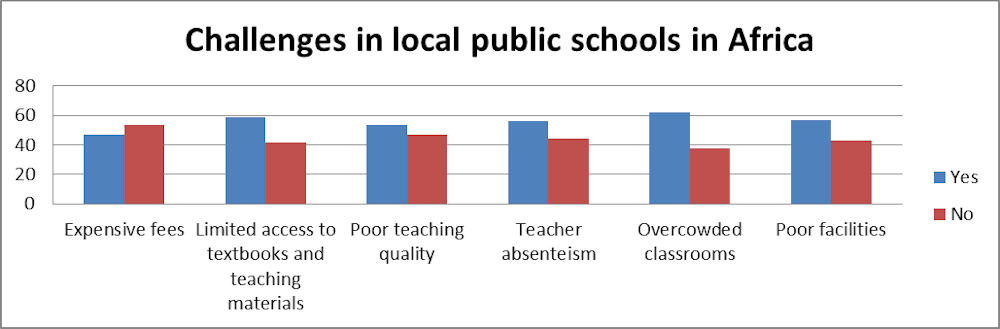
Among the questions about education, interviewees were asked whether they had encountered the following challenges in their local public schools: expensive school fees; lack of textbooks or other learning supplies; poor teaching; teacher absenteeism; overcrowded classrooms; and facilities that were in poor condition.

For almost each of the items listed, more than 50% of the respondents had encountered the challenge in the question.

Most interviewees complained particularly about a lack of textbooks and teaching materials; poor teaching quality and teacher absenteeism. These are all key determinants of what students can achieve by the end of an academic year.

A crisis of corruption

Corruption, like low-quality education, is a real problem across Africa. In its 2017 Ibrahim Index of African Governance, the Mo Ibrahim Foundation warned that the level of corruption on the continent had risen between 2007 and 2016.

This is borne out by what interviewees told Afrobarometer in the surveys I studied. More than 80% of those surveyed on the subject said that at least some of their local government councillors were involved in corrupt activities. Less than 10% of those surveyed believed that their local councillors listened to their communities.

Afrobarometer Round 5 (2011 – 2013)

The study shows that a 1% increase in the measure of local government corruption is associated with an increase of about 0.4% to 0.9% in the percentage of people who face poor human or physical school resources in local public schools. This statistical evidence suggests tackling issues in local governance can help education systems in Africa.

And it matters because good local governance can ensure that textbooks and learning materials are available and that they reach the students at public schools. The behaviours and attitudes of local government councillor’s may affect the way public sector employees, like teachers, are hired and treated.

The performance of teachers in public schools depends on many factors, and their degree of accountability depends also on the degree of accountability and responsiveness of those in charge of the management of the schools that include local government councillors.

Taking action

Improving the quality of education systems will have huge benefits for Africa’s present and future generations. Part of this improvement must involve tackling people’s negative perceptions about their local councillors, whether those relate to corruption, effectiveness or responsiveness.

Central governance remains important. It should be coupled with careful plans and actions to fix local governance, make councillors more accountable and ensure they’re providing the services schools need to thrive.

This article was first published by The Conversation Africa