Home Blog Page 527

DUT campus opening delayed by a week due to workers’ strike

Bonile Khanyi

Thousands of Durban University of Technology (DUT) students will not be returning to campus on Monday after the university’s management team announced its decision to delay the start of the academic year by a week.

According to media reports, DUT said on Thursday that its 2018 academic year would be delayed due to an ongoing strike.

Lectures are now expected to begin on Monday, 12 February 2018.

This comes after wage negotiations between three labour unions and the university’s management reached a deadlock on Wednesday.

Last week, The National Education, Health and Allied Workers Union (Nehawu), the Tertiary Education National Union of South Africa (Tenusa) and National Tertiary Education Union (NTEU) demanded an initial 10% salary hike, a R400 increase on their monthly housing allowance and a R9,000 once-off bonus.

The three unions have since dropped their demands to an 8% salary hike, a R350 housing allowance and no once-off bonus.

However, DUT is offering a 6.5% increase for both basic salaries and housing allowances and no once-off bonus.

DUT’s spokesperson Alan Khan said the unions also rejected the university’s request for the Commission for Conciliation, Mediation and Arbitration to assist them in the matter.

He also said despite the disruptions caused by the striking workers, students could still register online or on campus as the university remains open.

“While protestors have tried to disrupt student registration‚ the university remains open. Students are registering online,” said Khan.

Best-performing schools in NSC exams hailed by portfolio committee on basic education

0

Bonile Khanyi

The Portfolio Committee on Basic Education has expressed its appreciation and satisfaction with the schools that have continued to perform well in the National Senior Certificate exams.

This comes after the committee concluded its visit to the Bohlabela Education District in Mpumalanga on Wednesday where it visited several schools over three days, according to a statement issued by the parliamentary communication services on behalf of the committee chairperson, Nomalungelo Gina.

Gina pointed to how well the class of 2017 performed by highlighting the case of Magigwana Secondary School which obtained a 100% pass rate in Mathematics, Physical Sciences and Business studies despite having a large enrolment.

“This is highly commendable. It is a best practice model that should be replicated by other schools,” said Gina.

She also gave thanks to the educators and learners of Moses Mnisi Secondary school where four of the five grades obtained 100% pass rates and the Grade 12 learners who obtained a 99.3% pass rate for the 2017 NSC examinations.

“In both cases, strong leadership was demonstrated. This was coupled with good support from the Senior Management Teams at the schools, other teachers, the School Governing Bodies and involvement of parents. Learner discipline has also been found to be of a high standard at good performing school,” said Gina.

Meanwhile, the committee issued a stern warning to the schools who have not been performing well and appealed to the school’s educators to prioritise the learners’ needs.

“It is important that teaching and learning should take place. All other issues are secondary but should be ironed out to ensure the existence of conducive environment for teaching and learning at schools,” said Gina.

“These young learners are our future, the future of the country. We have to ensure that they are properly educated.”

The Committee also appealed to education authorities to assist and monitor those schools to ensure that they meet their potential.

The beauty of informal education – Why teacher learners need a day out

0

Gugulethu K. Radebe

After spending just over three years of my life as a teacher or a teacher’s aide, I learned a lot of lessons about the school system and how it works. I had the great pleasure of watching learners light up as they finally figured out a concept they previously did not understand and watched them learn to probe more into an issue and ask the “right” questions.

I spent a lot of this time pondering about how I could make learning a more meaningful experience for my learners and one that they find pleasurable and rewarding. A lot of these questions were answered in one way or another in some workshop somewhere but many of these answers applied to some learners but not to others. I then had the privilege of pursuing a different way of teaching in the form of facilitating learning at the Durban Holocaust and Genocide Centre.

This move, amongst other things, was fuelled by my passion for learning and teaching that went beyond the school curriculum. I got into a space that valued human rights, difficult conversations and community building as much -if not more- than I do.

The South African Holocaust and Genocide Foundation, which is the body in charge of the Durban, Johannesburg and Cape Town centres, aims to provide a space where learners and communities can look at the Holocaust and other genocides as a case-study for teaching humanity, equality, and the importance of human rights and democracy.

The museum space allows me to interact with learners in a very different manner than I could in a traditional teaching classroom. Though we don’t have the luxury of building relationships with learners, we have the gift of anonymity which allows learners to feel safer and to feel like they can own their opinions without fear of judgement and punishment. They have an opportunity to look at, sometimes, familiar content in a way that’s different from the tradition teacher and whiteboard scene they’ve learned to get used to.

They can ask questions and wonder about issues that far exceed what is required for a test or an exam at the end of the school term. It allows them the opportunity to be immersed in information and allows them to pick an area of interest within that area, that way making it feel more relevant to them and their everyday.

Teachers often teach how they learn, which means that students taught by an auditory learner often do a lot of listening and are often expected to verbally communicate what they learn. Many museum spaces allow learners to be exposed to a healthy mix of all learning styles, from activities for kinesthetic learners to videos, audio and art for auditory and visual learners. These spaces allow learners to grasp information in ways that feel most comfortable to them.

They allow all learners to work with new information and process it how they deem fit without the pressure to express themselves in a certain way by the guide or facilitator. This experience allows learners to have a sense of control over their learning, making it a much more meaningful and rewarding experience for them. These spaces, with the right preparation from the teacher, can allow learners to better engage with concepts they may have previously struggled with and may make engaging with the same content at a later stage more comfortable to learners.

Aside from the educational benefits, informal learning environments allow learners to interact with one another in a different space, this may be in the form of casual socialising between the learning experiences or in the form of discussions and activities in the learning sessions. Learners get the chance to learn about one another and learn to interact in a manner that may differ from how they interact in their comfort zones.

Excursions and school outings allow learners to explore the width and depth of any topic and learning with the hope that they find something meaningful and significant for themselves in the content they are exposed to. It allows their brains to experience familiar content in an unfamiliar way which brings the content to life for them and it’s with this fresh understanding that learners are able to cognitively and emotively process content that many may have just remembered for a test and forgotten.

As teachers, we need to more conscious of the importance of this informal learning to afford our learners the opportunity to learn lessons for a lifetime and not just until the end of the exam period.

Gugulethu K. Radebe is a teacher, poet and social activist. 

Lebogang Maile: Encouraging township entrepreneurship is important for communities

0

Ido Lekota

Providing skills to township entrepreneurs will go a long way in nurturing the much-needed culture of small businesses in these communities. This is what the Gauteng MEC of Economic Development, Agriculture, Environment and Rural Development Lebogang Maile believes.

On Wednesday Maile launched the applications for this year’s Township Entrepreneurship Award – a R500 000 winning prize competition aimed at honouring and encouraging entrepreneurs who are running successful businesses in the various Gauteng Townships.

Speaking to Inside Education on Wednesday, Maile decried the fact that there are economic activities in the township worth approximately R100 billion – “but the money generated through these activities does not go into the pockets of our people.”

This, Maile says, is because instead of being centres of production, townships are mainly centres of consumption. He blamed this on the low entrepreneurial activity in the areas.

He says it is through entrepreneurial training and support from the government and big business that the townships can be transformed into sites of production producing what residents consume.

To achieve this, the government has support programmes for township entrepreneurs which include the development of economic infrastructures – such as industrial parks; providing access to the internet; funding and enhancing access to the markets as well as support for innovation.

“Our commitment is definitely to encourage the culture of entrepreneurship and teaching young people while they are still in school about becoming entrepreneurs through subjects such as life skills.”

The MEC says programmes such as Tshepo One Million are aimed at tackling youth unemployment by providing skills to the youth and encouraging them to become innovative.

Launched by the Gauteng Provincial government in partnership with the big business, the programme  is aimed at giving the youth work opportunities and offering those involved in small business ventures some business development opportunities.

The programme is also about youth skills development focusing on sectors such as manufacturing, creative industries, ICT and construction to enhance youth economic development.

Teddy Bear Clinic offers help for Reiger Park High learners traumatised by sex video

1

Thabo Mohlala

The Teddy Bear Clinic has made contact with Reiger Park High School to assist learners and teachers left traumatised after a video of principal having sex with some learners went viral.

The clinic’s director, Shaheda Omar, yesterday told Inside Education they would provide support for learners to enable them to overcome the shock brought about by the incident.  The clinic also provided counselling to the 87 learners who were molested at AB Xuma Primary School in Orlando Soweto in October last year.

The Gauteng education MEC yesterday removed three more teachers allegedly involved in the video saga. The Principal also resigned. Although it was later discovered the principal left the system already, Lesufi said he would report him to the South African Council of Educators.

“We will employ a wide range of intervention strategies to assist the learners to get through the effects of this traumatic experience. We will be working with learners on an individual basis and then in group sessions. Our intervention also encompasses creating awareness among the learners about appropriate behaviour, how to report abuse; what is an acceptable and unacceptable behaviour and the reporting mechanisms. The whole idea is to enable the learners to get the right support that they deserve because it is part of our duty to ensure children are protected,” said Omar.

Speaking about the progress at AB Xuma Primary School, Omar said there was a lot of progress and that learners also responded well to their interventions.

Omar said they used widespread intervention techniques to ensure learners affected by the abuse, including those who were not, also benefit from the sessions.

“[At AB Xuma]We also used the one-on-one approach as well as group sessions to help learners deal better with the pain. The initial response we received from the learners was a normal reaction to an abnormal situation. But if we look at where they were then and where they are now, I must say they showed a great deal of improvement. We feel they have been empowered and given a voice; a platform they can use in future to report any incident of abuse,” said Omar.

She said they also worked with teachers through their ‘Educators’ Training Programme’ aimed at empowering them on what to do when they noticed abuse. Omar said she noticed during her interactions with most teachers that they had no clue what to do in such a situation.

“We remind them that reporting these incidents is part of their responsibility and we also share with them reporting mechanisms and procedures. But others may be aware of incidences of abuse but may decide not to stick their necks out in terms of reporting the matter for fear of reprisals,” Omar said.

She said it was crucial that both teachers and learners were in a position to not only identify abuse but to also understand procedures to be followed. Omar said the clinic was always proactive and worked closely with schools throughout the year to raise awareness about issues of abuse.

Hard work pays off: Top achieving Free State Schools receive top-notch facilities

0

Thabo Mohlala

Three schools based in the Fezile Dabi district in the Free State yesterday scored big following their good performance in the 2017 grade 12 results. They have each been rewarded with renovated science and computer laboratories.

This is part of the “Incentivised Infrastructure Award”, a partnership between Kagiso Shanduka Trust (KST) and the Free State Department of Education (FSDoE). Recipients of the awards are schools that have attained or exceeded 90% pass rate benchmark.

The three schools are Matlwangtlwang Secondary School in Steynruss, Konanelo Secondary School in Kroonstad and Bodibeng Secondary School, also based in Kroonstad.

Free State education MEC, Tate Makgoe, recently heaped praise on the Fezile Dabi as one of the districts that have contributed more passes which catapulted the province to the number one spot nationally.

Michael Phutsisi and Thabiso Ratsomo, representing FSDoE and KST respectively, unveiled the facilities.

KST’s communications head, Nontando Mthethwa, said in the media release that the three schools received the award based on the class of 2015’s academic performance.

Mthethwa said the initiative is part of the KST’s District Whole Schools Development Programme (DWSDP) which is being implemented in the Fezile Dabi and Motheo districts in the Free State province.

A distinctive feature of the programme is the development of schools’ infrastructure to motivate learners and teachers to produce good academic results. The awards are preceded by a thorough school’s needs analysis and the outcome of the analysis will determine what infrastructure facility the school will get.

These include classrooms, administration and ablution blocks, libraries, Grade R facilities, kitchen and eating area. Lack of proper and decent infrastructure in most rural based schools has been highlighted as one of the key contributory factors to poor learner performance.

The other key component of the programme is its emphasis on the active role of parents and communities in which the schools are based. Communities and parents are encouraged and empowered to help secure and maintain the schools infrastructure as well as combat vandalism and theft.

“We encourage community members to protect this infrastructure so that generations to come can also benefit from it. The matric class of 2015 performed well and as a result the class of 2018 are benefiting from the fruits of their hard work, it is now in the hands of the class of 2018 to work hard and leave a legacy for other learners,” said Phutsisi.

The collaboration between KST and FSDoE is heralded as the best model of leveraging public-private partnerships aimed at identifying key projects that can drive the transformation of the education system as well as improve the culture of teaching and learning.

Phutsisi said their partnership with KST has so far yielded positive outcomes such as delivering basic school infrastructure in both Fezile Dabi and Motheo districts. He said they were also able to provide a holistic and integrated programme geared towards improving performance, adding this is what is contributed to making the Free State as the leading province in the matric results.

“We hope that learners, parents and community members will find value in the investment in education and continue to support learners.” concluded Mthethwa.

Northern Cape to be the first province to teach the Nama language at schools

0

Thabo Mohlala

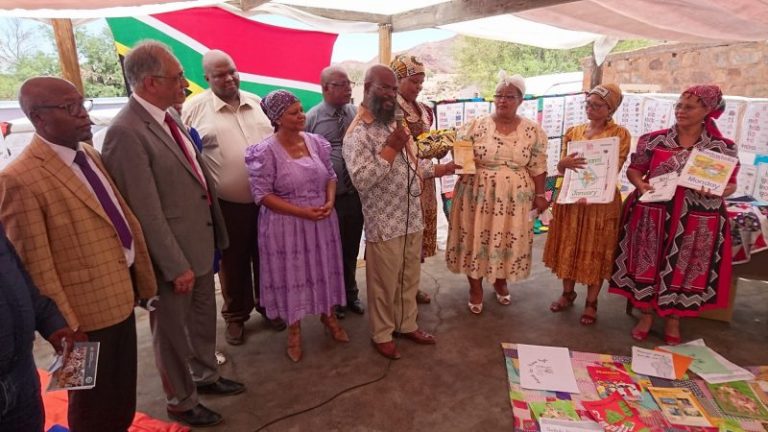
The Premier of the Northern Cape, Sylvia Lucas, on Monday officially launched Nama, an indigenous Khoi language to be taught at schools in the province. Accompanied by her Members of Executive Council and a delegation from Namibia, Lucas officiated at the august ceremony held at Riemvasmaak Primary School.

The language was first introduced in two schools in Riemvasmaak and Khuboes as an extramural activity and later phased in from Grade R. Lucas said initially the project presented many challenges one of which was the use of too large a sample but this time around they decided to pilot it in the two schools.

She said introducing the Nama language at schools in the province is part of their plans to preserve and develop the rich history and heritage of all indigenous languages in the country with the provincial department of education being an implementing agency.

She said Nama is part of Khoekhoe, a Khoisan language spoken by about 250,000 people in parts of South Africa, Botswana and Namibia. It is spoken mostly by three groups namely, Nama, Damar and Hailom. In South Africa Nama speaking people are confined to parts of the Northern Cape such as Upington, Kakamas, Riemvasmaak, Pella, Kuboes, Steinkopf, Augrabies and Marchand.

“Strengthening and protection of the indigenous languages of our province has been an area in which the Department of Education has played an active role in empowering especially the communities of Platfontein and the Namakwa region in the development of these languages,” said Lucas.

The Provincial Government has also roped in the Pan African South African Languages Board (Pansalb), a statutory body created to, among others, help promote all indigenous and marginalised languages and ensure they enjoy equal status and respect.

Lucas praised the Department of Basic Education by making sure due recognition, preservation and promotion of the Nama language is guaranteed.

Inside Education spoke to two prominent members of the Khoi community, Christian Martin and Khoi Mo Blouw, who welcome the development. They said the initiative made them feel like an integral part of the South African society.

Martin said this was great news for the Khoi community.

“New life has been blown into the Khoi and San people. This is because language embodies culture, tradition and rites. Language differentiates animals from human beings. Today we can say this government restored our dignity. We are Khoi and San again not the other or Coloured or mixed people. This is Khoi in its true meaning,” said Martin, who is also an MP in the Eastern Cape.

Mo Blouw said he was moved to tears when he found out.

“I felt moved that morning and I couldn’t stop the tears from welling in my eyes. I realised that I am very fortunate to belong to a group whose members were present at the launch of the first official Khoi language to be implemented. Let us put our differences aside and move forward and break this Colouredness that was designed to divide and seems to haunt us even within our different Khoi movements,” Mo Blouw said.

Lucas said the idea to preserve and develop the language was given impetus by the twinning agreement with the Karas regional Council in Namibia. The Northern Cape and Namibia share a border and as such, they have a lot in common such particularly in culture, languages and the economy.

Lucas said the agreement was designed in such a way that it paid particular attention to trade and investment (economic), transport, environment, tourism and conservation, fisheries and aquaculture, basic education, tertiary education, sports, arts and culture, local government matters, safety and security issues.

She said currently they had developed an action plan and workstreams to implement and expand the agreement to include areas such as sports interaction, culture and heritage.

Panyaza Lesufi says he’s taking the Hoërskool Overvaal matter to the Constitutional Court

0

The department of education in Gauteng will be approaching the Constitutional Court over the Hoërskool Overvaal matter.

This was what the MEC Panyaza Lesufi told media at a press briefing in Boksburg on Tuesday.

This comes after the Gauteng Department of Education and its legal team met with the National Department of Basic Education on Monday to discuss a way forward with regards to Overvaal.

“We are also filing our appeal this Friday and we believe we have good grounds to appeal this matter.

Earlier this month, the North Gauteng High Court ruled against the department’s instruction for the school to accept an additional 55 English-speaking pupils.

The school claimed it had no capacity to admit the learners‚ and could not set up a parallel stream in the timeframe it was given by the department.

However, the department argued that the matter had nothing to do with capacity but the fact that the learners could not speak Afrikaans.

Lesufi said he had been meeting with several stakeholders in an attempt to restore calm at the school and rebuild relationships.

“We are pleading with community structures to back off that institution and allow learning to take place,” said Lesufi.

Panyaza Lesufi says final 3 336 learners will find a place in a Gauteng school

0

Bonile Khanyi

The Gauteng Department of Education (GDE) on Tuesday announced that the number of learners who still need to be placed in a school was reduced to 3,366 from 31,000 at the start of the academic year.

“The Gauteng Department of Education can now report that the number of unplaced learners has drastically been reduced to 3,366. This brings the number of all placed learners to 318,544 learners, of which 176,702 is Grade 1 and 141 842 is Grade 8,” said Gauteng MEC for Education Panyaza Lesufi.

During a press briefing at the Reiger Park High school in Boksburg on Tuesday morning, Lesufi said that since January 13 the department received an additional 13,155 new applications and of that number, 10,780 learners have already been placed.

Lesufi also said the department found that more than 350 learners relocated to Gauteng from other provinces and countries.

“The department received 395 relocations from other province and countries. These include learners from relocations from Zimbabwe, Burundi and India collectively. The highest number of relocations is from the Free State at 61, followed by Kwa-Zulu Natal with 56 applications and Limpopo with 51,” said Lesufi.

“The Admission Centres at districts helped reduce the backlog and will cease operating from tomorrow on 31 January 2018.”

Lesufi appealed to all the parents whose children have not been placed to be patient until the department finds their children space in a school.

He said parents are, however, advised to accept offers of placements that may not be their first choice as many schools can no longer accommodate additional learners.


Three teachers dismissed after implication in Reiger Park High School sex scandal

0

Bonile Khanyi

Three teachers who were implicated in the sex scandal in Reiger Park NR2 High School have been removed with immediate effect.

Gauteng MEC for Education Panyaza Lesufi on Tuesday announced that in addition to the school’s Principal who resigned from his position in October, three teachers also implicated in the videos have been removed.

This comes after videos and pictures were leaked on social media, showing the principal having sex with learners on the school premises.

Lesufi also said all the school’s administrators and food handlers who were depicted in the videos have been withdrawn from the school.

“All the officials, have been requested to report at the district offices while we are putting all the relevant charges against them,” said Lesufi.

“We have now formally requested the police to investigate the principal and they’ve already started speaking to us both at a criminal level but also at the level of sexual offences.”

Lesufi said as part of the department’s resolution, a team of social workers will be stationed at the school on a permanent basis to go through the report back during the investigation.

He also announced that the educator has been reported to the South African Council of Educators (SACE) for his name to be struck off the educator’s roll.

“Our immediate task is that the school goes back to normality as quickly as possible,” said Lesufi.

Gauteng’s FCS Serial Electronic Crime Investigation Unit Spokesperson Heila Niemand confirmed that the police is currently dealing with the investigation.

Niemand said no criminal charges have yet been laid and that their investigations were still at an early stage.

“We have identified the teachers implicated in those videos, at this stage we are trying to identify the victims that were involved,” said Niemand.

“From our side as soon as we get a victim we’ll definitely open charges for the manufacturing, possession and distribution of child pornography as well as the sexual charges that will arise in the investigation.”

In a statement issued by the department on Tuesday, Lesufi said no sexual assault case was opened with the police because no learners or parents disclosed any incidents to the officials.

He also said that the incident happened about three years ago.

“Sadly learners depicted on the videos or picture are no longer at the school and the actually matriculated in 2015/ 2016,” said Lesufi.