Home Blog Page 528

Motshekga in a bid to persuade Lesufi to let go of the Hoërskool Overvaal court appeal

1

Thabo Mohlala

Sharp differences have emerged between basic education minister, Angie Motshekga, and her provincial counterpart, Gauteng MEC Panyaza Lesufi over the Hoêrskool Overvaal debacle.

This raises concerns about whether the problem will be resolved anytime soon if the two education authorities view the matter differently. Both have expressed their frustrations about the on-going protest at the school.

But Lesufi took what others describe as a hardline position vowing to pursue the matter all the way to the Constitutional Court if need be, while Motshekga struck a reconciliatory tone.

Lesufi strongly feels Judge Bill Prinsloo was biased when he found in favour of the school, saying a different judge would arrive have placed the 55 learners who are at the centre of the dispute.

“We will appeal this decision all the way to the Constitutional Court if necessary. We want to see if the Constitutional Court will also legalise racism,” Lesufi said. He also described the ruling as devastating and a major setback for the transformation agenda.

The Federation of Governing Bodies of South Africa (Fedsas) and the South African Teachers’ Union (Saou) blamed the current standoff at the school on Lesufi’s alleged political statements following the ruling. They said he played to the gallery and to deliberately inflame political emotions adding that the whole issue has been turned into a political football match.

Political formations such as the local ANC, ANCYL, Economic Freedom Fighters, including Congress of South African Students (Cosas) and South African Democratic Teachers’ Union (Sadtu) staged protests outside the school’s gates accusing the school management of racism.

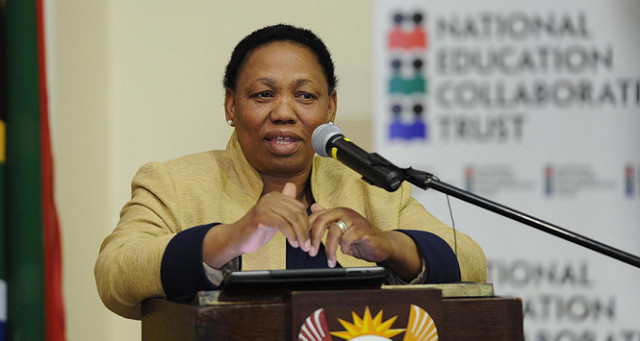
Yesterday Motshekga called for the Gauteng Department of Education (GDE) to reconsider its stance to appeal. She said the ruling issue was not necessarily about the language policy but more about an administrative issue.

“I said [to the province] let us not necessarily go and fight. This school belongs to us; the schooling is not resisting to have a parallel medium. It is a resource issue,” she told eNCA.

Motshekga added: “the judge is not raising the issue that English-speaking children can’t attend Afrikaans school or policy issues. The judge is raising administrative errors…let’s deal with them and see if we can address them.”  

She said she agreed the GDE was under pressure to place learners and that by ordering the school to place the 55 grade 8 learners, the government is not violating the language rights to use Afrikaans. She said there was place for every language in the country and that they invested so much in Afrikaans.

“There are more people who are not white who speak Afrikaans. There has been a lot of investment in those languages and we don’t want to throw that away,” she said.

But the GDE is adamant to appeal the ruling with MEC Lesufi saying he would not back down until he won the case. Motshekga is under pressure to resolve the impasse and normalises the situation at the school as soon as possible so that the tension does not spill into the classroom. It is believed a meeting is on the cards so that both Motshekga and MEC can harmonise their views on the matter.

And that is just how far she can go. In terms of the Constitution, she was not allowed to intervene as provinces are autonomous from the national departments. The only way ministers can intervene is when the lower structure fails to discharge one of its Constitutional obligations. The minister can then invoke Section 100 of the Constitution which empowers the national executive to intervene in in order to remedy the situation. And indications are it may not reach this stage at least for now.

Mpumalanga Education struggles to place over 600 learners

0

Bonile Khanyi

The Mpumalanga Department of Education had its hands full on Monday morning, trying to place more than 600 learners in school.

Speaking to Inside Education, the department’s spokesperson Jasper Zwane said a total number of 676 learners still needed to be placed in a school and that the issue was only constrained to Witbank, Middleburg and Mbombela.

Zwane said the department is confident that all learners will be placed by the end of the week.

“Last week Friday, there were 676 learners who had not been placed in a school,” said Zwane.

“We have been working around the clock to ensure that these learners are accommodated in a school come Friday on February 2.”

Zwane also urged parents whose children did not get space at a school, to play their part and contact their circuit offices.

“If parents are facing problems at schools, they must go to the Education Department’s district office in their area.

“Officials there will assist you to find placement at the next available school.

Meanwhile, there are more than 31,000 learners who still need to be placed in Gauteng and 11,000 in the Western Cape.

Gauteng education MEC Panyaza Lesufi has also assured frustrated parents that all pupils would be placed.

Principal encourages parents to be more involved in matric learners’ schooling

0

Thabo Mohlala

Greater parental involvement is very crucial in enhancing children’s academic work, said education experts. Not only does this lead to better academic performance, they contend, but it also contributes to lesser behavioural problems and the children are likely to complete their high school.

This is what inspired Nhlakaniso Faku, principal of Raphela Secondary School, based in Orange Farm Extension 3, south of Johannesburg.

Yesterday Faku called a meeting of parents whose children are in grade 12 this year. He told Inside Education the purpose of the meeting was to appeal for closer collaboration between parents and teachers, saying this would lead to better grade 12 results at the end of the year.

“It has been our school’s tradition that every year when schools re-open we meet with parents of the grade 12s to share our vision and plans for the year with them. Sometimes children present certain problems which we as teachers cannot resolve with the parents’ involvement. Most problems emanate from home and we believe that if we can hold hands, we can overcome most of these problems,” said Faku. He said similar meetings are held with parents from lower grades as well though their focus is on the exit class.

He said in the past his school produced around 96% and above but they had since regressed and got below 90%.

“Last year was bad because we got an overall pass rate of 75% pass and the reason for this was mainly because our maths and science learners performed badly. This dragged down our overall pass rate. But despite this we managed to produce 41 maths and science learners with bachelors passes,” he said.

Faku said this year he planned better to ensure maths and science learners would get priority.

“This is the only area that needs special attention because in other subjects our learners did exceptionally well with some getting 100% passes. What we will be doing this year is to continue with our Saturday and Sunday classes and also enlist the services of a local maths and science private tutor. We roped him last year but it was very late, in August but still he managed to give us 41 bachelors passes. This means if we can bring him in early we can achieve more and I am confident we would go back to our glory days,” said Faku.

He said they scheduled another parents’ meeting at the end in April to analyse their children’s performance.

“The idea is to identify areas of weaknesses of learners and discuss this with each parent. We would then plan around how we are going to help the concerned learner troubleshoot those challenges he or she has,” said Faku.

Most parents who spoke during the meeting welcomed the idea of the meeting and committed themselves to get more involved and assist their children with school work. They assured teachers of their support and that teachers should also alert them if their children were not co-operating with them.

Free higher education in South Africa: cutting through the lies and statistics

Seán Mfundza Muller

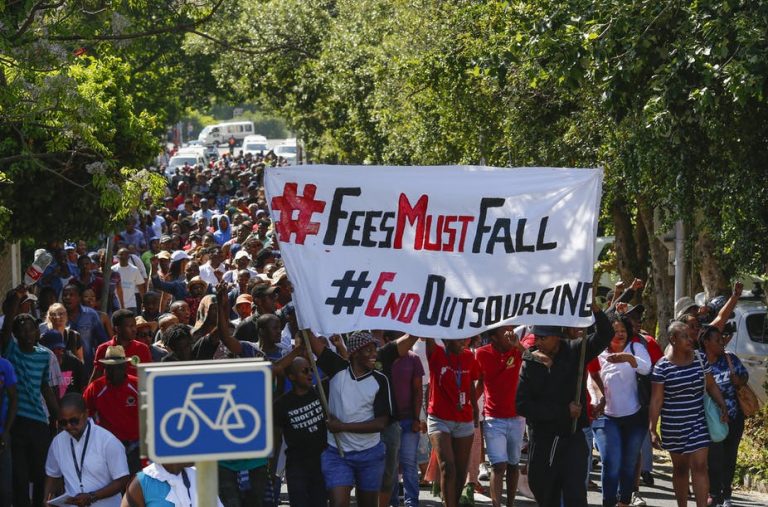
Public discussion about higher education funding in South Africa has been beset by numerous fictions and misunderstandings since the Fees Must Fall movement emerged in 2015. These have been compounded by the political opportunism of President Jacob Zuma and his advisors.

In mid-December 2017, with relatively little consultation or planning, Zuma announced that in 2018 free higher education would be provided to all new first year students from families that earn less than R350,000 per year.

Having participated in the 20-year review of South African higher education in 2013, advised parliamentarians on different funding proposals in 2015, and engaged with a report by the commission Zuma set up to examine fee structures, it’s become apparent to me that it is critical to debunk a number of prevalent myths around higher education funding.

The current public “debates” contain many myths or misconceptions about what free tertiary education would mean, ranging from the implications of free higher education proposals for poverty and inequality to the feasibility of funding such proposals. Unless these myths are unmasked the free higher education debate will remain misguided and likely lead to very different, negative outcomes.

In many respects, Zuma’s free higher education proposal is the worst kind of populism. It’s been sold as a radically progressive policy that can be achieved with no negative consequences. But it will actually do very little for the neediest South Africans. And it could have negative consequences for the stability and progressiveness of public expenditure.

Busting myths

Myth 1: Spending on higher education is about helping the poor

When the Fees Must Fall movement emerged, it insisted its fundamental demands were based on concern for poor South Africans. The movement argued that this group was effectively excluded from higher education or disadvantaged in their studies because they could not afford the fees and other costs of studying.

The idea that the movement for free higher education is based on a concern for poor youth is clearly absurd when you consider that only 5% of South Africans aged between 15 and 34 are students in universities, while 34% are unemployed.

A recent, comprehensive evaluation by South African and international academic economists for the World Bank, examined the effect of government spending and taxation on inequality. Using data on who pays taxes and who benefits from different kinds of public spending, it found that higher education was the least progressive of all social expenditure. It did the least to reduce inequality, since higher education benefits only a very small proportion of the population and those who do benefit tend to come from wealthier households than the vast majority of South Africans.

Myth 2: There are no consequences for increasing taxes or increasing borrowing

Even if higher education is not the most progressive way to use public money, some supporters of free higher education have argued that it could be more progressive than existing studies suggest – provided the money is raised from wealthier South Africans.

Strictly speaking, this is true. The problem is that supporters of Fees Must Fall have written about possible ways of raising revenue as if the money is effectively free. Proposals such as “double the skills levy on companies” or “increase income taxes” are empty; they fail to address the negative consequences of tax increases.

A higher skills levy, paid by firms to fund national training initiatives, means lower profits for firms and potentially less investment. Higher income taxes could lead to greater tax avoidance measures, shifts in how employers remunerate employees, or a reduction in people’s working hours. All these could lead to revenue decreasing. Such dynamics need to at least be taken into account when tabling such proposals. But this has not happened.

The result could be a reliance on taxes, like VAT, that are harder to avoid because they are paid by the vast majority of South Africans. There’s a perverse consequence to all this: “free higher education” could actually increase inequality.

This myth-making has recently been compounded by Zuma’s proposal and its advocacy by one of his advisors, Morris Masutha.

Myth 3: Free higher education will reduce youth unemployment and save on future social spending

Masutha claims that free higher education will “fund itself”, primarily by reducing future social security spending on social grants and government-built houses. He insists that abolishing fees will lead to higher economic growth.

Given the tiny proportion of poor youth who can access higher education through their basic education results, the claim about social expenditure is clearly false.

There is a positive relationship between higher education and economic growth. But the current proposal could only “pay for itself” if it produced dramatically more graduates and so increased their economic contribution. There is no reason to believe an effect of that scale is likely and no modelling has been provided to support such claims.

Myth 4: Zuma’s December 2017 proposal is the best way to help poor and needy students

Zuma’s proposal contains two extremely dishonest components: the definition of “poor and working class” students and the limiting of the policy in 2018 to new first year students.

It effectively proposes that in 2018 a first year student from a family earning R340,000 per year will get full government support. But a second year student from a family earning R130,000 will get no support. And a student from the R340,000/year family will get the same support as a student from a R20,000/year family.

This clearly doesn’t prioritise poor students.

A rough costing by the Department of Higher Education and Training in 2015 suggested that the threshold could be raised to R217,000 per year for all students. This would benefit more needy students and, at an estimated cost of R12.5billion, been far more feasible than what Zuma has proposed.

Myth 5: Zuma’s proposal is feasible because it “only” costs R12billion – R15billion

Current estimates put the cost of Zuma’s proposal in 2018 at between R12 billion and R15 billion. Some commentators have suggested this cost will remain static in future. That is almost certainly false.

It would only be true if such funding was either not extended to students entering universities in 2019 or was taken away from the 2018 cohort. Neither scenario makes any sense. Instead, funding is likely to be extended to second years in 2019 and third years in 2020. That will likely lead to an annual cost of R40billion or more.

An increase of R12 to R15 billion may be affordable. But a R40billion increase is an entirely different proposition.

Critical decisions

Thousands of new students are being registered at universities right now. The 2018 Budget is set to be tabled next month with public finances under extreme pressure. Given this reality, it’s critical that all the myths surrounding “free” higher education are laid to rest.The ConversationOnly then can difficult decisions be taken in the best interests of all South Africans.

Seán Mfundza Muller, Senior Lecturer in Economics and Research Associate at the Public and Environmental Economics Research Centre (PEERC), University of Johannesburg

This article was originally published on The Conversation. Read the original article.

Fedsas: Radicals have turned the Hoërskool Overvaal furore into political football

0

Thabo Mohlala

The unabating protest action outside Hoërskool Overvaal which resulted in a march yesterday is extremely disturbing and does not bode well for the future, said Paul Colditz, a chief executive officer of the Federation of the Governing Bodies of South Africa (Fedsas).

Colditz was reacting to the march staged by the South African Democratic Teachers’ Union (Sadtu) Gauteng and its mass democratic movement allies to hand a memorandum to the school’s governing body.

The protest started last week Wednesday on the first day of the academic year following the North Gauteng High Court ruling that went against the Gauteng Department of Education’s instruction to Hoërskool Overvaal to place 55 grade 8 learners.  The department has appealed the judgment.

Colditz also expressed concerns that the protest may escalate and descend into anarchy reminiscent of the Vuwani debacle. Colditz said what worries him most is the protesters’ defiance of Minister Angie Motshekga’s call to stop their protest campaign and pursue the matter through legitimate legal means.

Earlier this week Motshekga visited the school to douse the fires and met teachers and representatives of the protesters to ensure school functions normally. She said those who were unhappy with the recent court judgment should halt their protest and join Gauteng Education Department in its appeal as friends of the court.

“It [protest] does not bode well for the future of the country. It has the potential to develop into a full-blown anarchy, people must respect the rule of law; the court has made a ruling on the matter and they must raise their objections through the courts and stop disrupting schooling,” said Colditz

“I was there on Monday with Minister Motshekga and we saw learners sitting on the floor because of lack of space. The school’s actual capacity is 598 while the learner enrolment currently stands at 610. Clearly, the school is over-subscribed, what must the SGB do in this situation?” Colditz asked.

He said the protest was fuelled by political considerations and was carried out by a few radical elements bent on disrupting learning at the school.

Meanwhile, South African Teachers’ Union (Saou) has laid a formal charge of hate speech and racism with the Human Rights Commission following a Facebook posting by an Aubrey Thamsanqa. The posting reads: “Please Zuma give us the guns to defend our democracy… ‘one bullet, een Boere kind.’

In a statement yesterday, the union said the posting was racist and intended to disrupt and incite murder. Said Saou: “the “matter has degenerated into a political ‘playing field’ which directly and negatively impacts the learners not only at Hoërskool Overvaal but all learners in the area and disrupts education across the board.”

The union also said it was seriously considering approaching the office of the Public Protector “to audit the leave records of those educators who have joined the protests”. The union said there was a strong case to be made that teachers who took part in the protest during working hours took “unauthorised leave and are guilty of deserting their posts”, that the teachers “have prejudiced the education rights of those learners who were forced to join the protest action”.

Such violations, said the union, were sufficient grounds for the employer to take disciplinary actions against the teachers who took part in the march.

Alarming number of students are squatting at WSU and King Dalindyebo TVET College

0

Bonile Khanyi

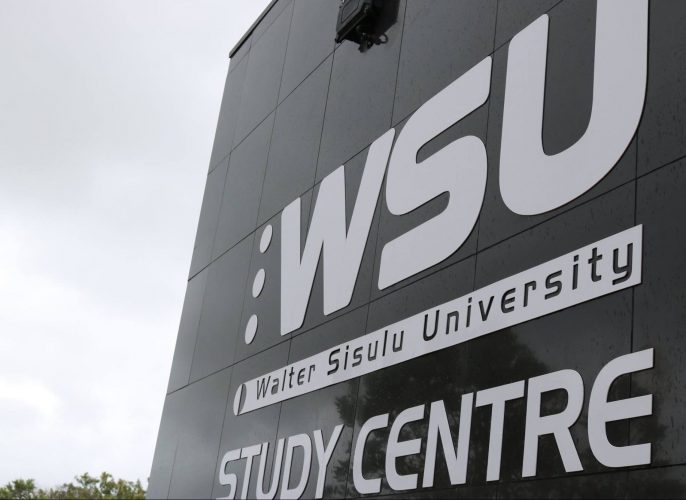
The Portfolio Committee on Higher Education and Training on Thursday expressed its shock at the vast number of students squatting in residences at Walter Sisulu University (WSU) and King Sabata Dalindyebo TVET College in Mthatha in the Eastern Cape.

In a statement issued on Thursday, the committee said it made the discovery during a week-long oversight trip to the province.

“The Committee received a first-hand experience of the situation at WSU’s Nelson Mandela Drive Campus where a single room accommodates three or more students due to limited student accommodation and the non-existence of access controls in the student residences,” read the statement.

“Also, both WSU’s Zamukulungisa and Nelson Mandela Drive Campuses have decaying student residence, lecture rooms and recreational facilities something that poses a grave challenge to student development.”

The committee said that during its visit, members of the Student Representative Council (SRC); the National Education‚ Health and Allied Workers’ Union (NEHAWU) and the National Tertiary Education Union (NTEU) raised their concerns about overcrowding and a lack of maintenance at residences.

“WSU’s SRC President, Mr Siphelo Mkhuzangwe indicated that the communication breakdown between the university management and students hinders the processes of resolving many issues relating to student development. NEHAWU and NTEU representatives expressed similar views, stating that labour unions are not consulted on important issues and that there is no transparency and the university management is not accountable,” read the statement.

During his presentation on Tuesday, the Vice-Chancellor, Professor Rob Midgley briefed the Committee on the maintenance backlog faced by the university, the plans to expand student accommodation and on progress on the 2018 registration process.

Meanwhile, KSD TVET College SRC Chairperson Mgweba Yanelisa refused to comment on students squatting at the institution.

Instead, Yanelisa said that students should not be forced to travel up and down to register, due to the lack of staff.

It is unclear what constituency plans both institutions have put in place to ensure that students won’t suffer when school starts. Registration at both WSU and KSD TVET College, however, is said to be running smoothly.


Learner stabbed to death at a school in KwaMhlanga, Mpumalanga

Thabo Mohlala

A 16-year-old learner was stabbed to death by his peer at a school, which is yet to be identified, in Kwamhlanga, Mpumalanga. 

Although details are still sketchy, police revealed the incident took place on Tuesday after the two learners were involved a fierce fight.

Police did not want to disclose the name of the school at which the incident took place.

The deceased sustained multiple stabbing wounds and was rushed to a hospital but he pronounced dead on arrival. The police have since launched a manhunt for the suspect who fled the scene. The public is requested to contact the local police about his whereabouts.

Earlier this month the South African Democratic Teachers’ Union (Sadtu) Mpumalanga released a statement lamenting the rising levels of school-based violence in the province. The statement referred to an incident where a teacher assaulted a female learner and the union called upon the police to arrest the culprit.

Speaking to Inside Education about the incident this afternoon, Sadtu’s Walter Hlaise, said violence at schools happens all the time and most incidents go unreported.

“It is only when there is death that the issue makes it to the media. What I can say is that violence in the province takes place quite often just like it does in others,” he said.

Hlaise said the findings of a research conducted by Sadtu showed that violence at schools mirrors what happens in the broader society.

“We should not look at it in isolation from what happens outside of our schools. Until society has dealt sufficiently with the issue of violence there is no way we can expect schools not be affected by it. As adults were are prone to resolving our differences through violent means and our children do likewise,” said Hlaise.

He said they were currently piloting a gender-based violence and bullying programme to try and educating learners and teachers about adverse effects of violence. He said it was still too early to determine if it was successful or not.


Sadtu Gauteng hand over memorandum to Hoërskool Overvaal SGB

0

Thabo Mohlala

Multitudes of South African Democratic Teachers Union (Sadtu) Gauteng members joined by members from the tripartite alliance marched earlier today to hand over a memorandum to the chairperson of the Hoërskool Overvaal school governing body to demand the placement of 55 grade 8 learners.

Representatives from head office and district offices were also present to receive the memorandum, according to Sadtu’s Tseliso Ledimo.

“I think the march was successful and incident-free. The chairperson of the school’s SGB came to receive the memorandum, albeit initially reluctant. But he did come to receive it eventually. Also in attendance were officials from head-office and the district office. We have given the school seven working days within which to respond to our demands,” said Ledimo.

He said they invited members of the tripartite alliance because this was not only an educational issue but also a community matter. He said the presence of the unions added to weight to their demands.

Asked what will happen if the school did not respond within the prescribed time, Ledimo told Inside Education that they would pile on the pressure.

“Remember this is a rolling campaign, we will not stop until the SGB has reconsidered its position on our demand,” he said.

Regarding the potential impact the march will have on teaching and learning at the school, Ledimo said: “this is a fundamental transformation issue in the country. We take this matter [the continued use of Afrikaans as a medium of instruction) seriously. It carries the same significance as the June 1976 Soweto uprising.”

Yesterday the union told Inside Education that Hoërskool Overvaal was using the lack of capacity as a pretext to exclude kids who do not speak Afrikaans. It was said according to its investigations, the school had enough capacity to accommodate the 55 grade 8 learners. It further said the school is a public asset and must admit learners who live in the vicinity of the school instead of them travelling long distances to attend English medium schools.

Gauteng education department’s spokesperson, Steve Mabona, has reportedly warned the marchers to tread carefully as their actions may impact negatively on the learning and teaching.

“Disruption or bullying, is not taking us anywhere. We will call on all members of the community to say if we have issues raised, we just have to bear in mind that when we take a day from our learners or educators, this must have a recovery plan,” Mabona told EWN on Thursday.

Kraaifontein parents demand places in school for their children

0

Vincent Lali

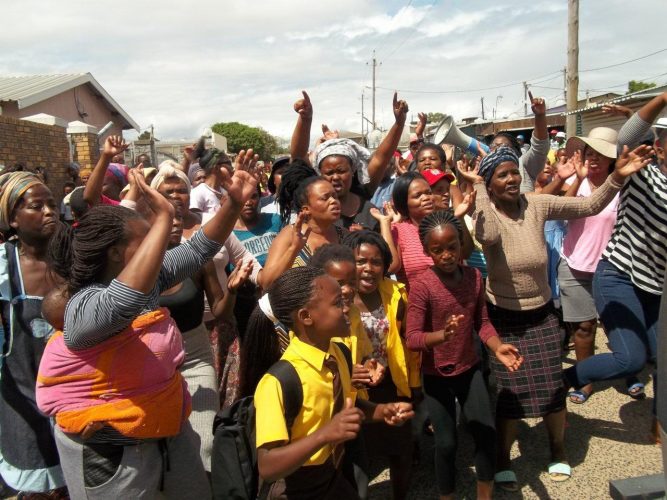
Angry parents demonstrated outside Bloekombos Primary School in Kraaifontein on Monday, demanding that the Western Cape Education Department put up prefab classrooms for children who were turned away from local schools.

The Department said the parents had failed to enrol their children in time. But officials would work with the parents to place these learners in schools. “We are looking at placing mobile classrooms at nearby schools to accommodate the unexpected growth,” said Jessica Shelver, spokesperson for Debbie Schafer, MEC for education.

Singing “amandla awasoze aphele,” (our power will never die) parents locked the main gate of the school to prevent teachers and learners from going home.

Community leader Linda Phito said the parents wanted the department to set up prefab classrooms in all primary schools in Wallacedene and Bloekombos to accommodate children who could not find places at local schools.

“We identified an open space near Bloekombos Clinic where the department can place the temporary classrooms,” he said.

Phito said there were about 500 children from Grade one to seven who could not find places at schools in Wallacedene and Bloekombos.

Bloekombos Primary School principal Thula Batyi said there were 298 children on the school’s waiting list. “We have no space. We can accommodate more learners only if the department gives us prefab classrooms and nine teachers,” he said.

Batyi said classrooms were already overcrowded. “We are supposed to have 38 learners in each classroom, but some classrooms have 46 to 57 learners,” he said.

Batyi said the demonstration outside the school gate filled teachers with fear.

“We are locked inside the school yard. How do we get out?” he asked.

Mhlakaza Malehloholo said she had registered her children aged 5, 10 and 13, at Bloekombos Primary School in December last year.

She said: “When I brought the kids’ final reports and testimonials in January, the teachers told me that the kids have been accepted and I must just wait for their call. The teachers also gave me a list of the stationery the learners would need.”

“I have already bought stationery and uniforms for the kids, but now the teachers tell me the school is full. I have wasted my money,” said Malehloholo.

Sinazo Vena said she had registered her child in Grade five at nearby Ekuthuleni Primary School in October last year. “The school principal now says my kid is on the waiting list even though I registered her on time. I want my kid to attend school and study to become a nurse,” she said.

Moses Nkosemntu said he wanted his daughter to attend Grade two at Bloekombos Primary School because it is close to where he lives. “I want my kid to study and become a professional. I don’t want her to be a general worker like me,” he said.

Shelver said: “The parents protesting at Bloekombos Primary on Monday are parents of learners who reportedly failed to enrol their children on time. This means that they are late applications.”

“The parents’ failure to enrol their children on time made it impossible for the WCED to foresee and plan accordingly,” she said.

“Our officials will work with the parents to place these learners in schools. We are looking at placing mobile classrooms at nearby schools to accommodate the unexpected growth. We now urge parents to work with us to ensure that the learners are placed as quickly as possible.”

This article was originally published on GroundUp.


The drought will not affect schools says Western Cape education

0

Thabo Mohlala

The Western Cape Education Department (WCED) is confident it has put the necessary contingency plans in place to avert the possible disruption of schooling in the province due to the worsening drought in the province.

The situation is so dire authorities were forced to revise a date for the dreaded Day Zero – a day on which the taps in the city of Cape Town its surrounds will run dry – and brought it forward to April.  

WCED’s spokesperson Jessica Shelver said they were working towards finalising plans for the scheduled day zero and these would be announced to the public once they have been completed. She said it is the provincial government’s intention to keep the schools open and functional when Day Zero is reached in the metro.

Shelver said Premier Helen Zille is scheduled to meet with the principals of around 1000 schools in the greater Cape Town next week. The schools rely on the water from the province’s main supply system and these include Drakenstein, Stellenbosch and West Coast municipalities. Shelver said the meeting with the leadership of these sectors will discuss in detail how to secure water supply to schools.

She said the provincial government has conducted an assessment of the approximately 400 schools with existing boreholes and that the majority of these boreholes require minimal work to operationalize for hygiene and fire safety purposes.

“We are also finalising plans for schools that require additional support to secure their water supply. A range of measures are under consideration, including additional water storage and the distribution of water to schools,” said Shelver.

“WCED also identified schools as strategic agencies to spread the message and contribute to water saving measures,” said Shelver.

Last November and early this year, the department issued guidelines to schools to notify them about Level 6 water restrictions.

“[The] schools are well placed to contribute to water saving, given the learner population in the Western Cape. They are also well placed to educate families about water saving, via their children,” said Shelver.

Some of the water management plans (focusing mainly on saving water in ablution facilities) that schools are encouraged to implement include:

  • Schools need to close certain taps in ablution facilities and may procure hand sanitizers using funds allocated to them in terms of national norms and standards.
  • They must attend to leaks immediately and record water meters twice a day. The department issued a programmed spread sheet to schools last year for monitoring water usage.
  • Schools must prepare for water outages, including storing water on site for emergency use. The department is advising schools with swimming pools to use public facilities, including schools using water from boreholes.
  • Schools must keep parents informed of their water management strategies and encourage learners and teachers to bring their own drinking water to school, for example, in 500 ml bottles.
  • Schools should mobilise parent support for water saving, and should advise parents on the possible impact of the drought on teaching and learning.
  • The department is encouraging every teacher to be water champions and is placing water restrictors and smart meters at schools.
  • Schools with access to alternative sources of water must secure these resources. About 480 schools already have boreholes.