Home Blog Page 539

Wits EFFSC refused to protest without student buy-in

Thabo Mohlala

ANALYSIS

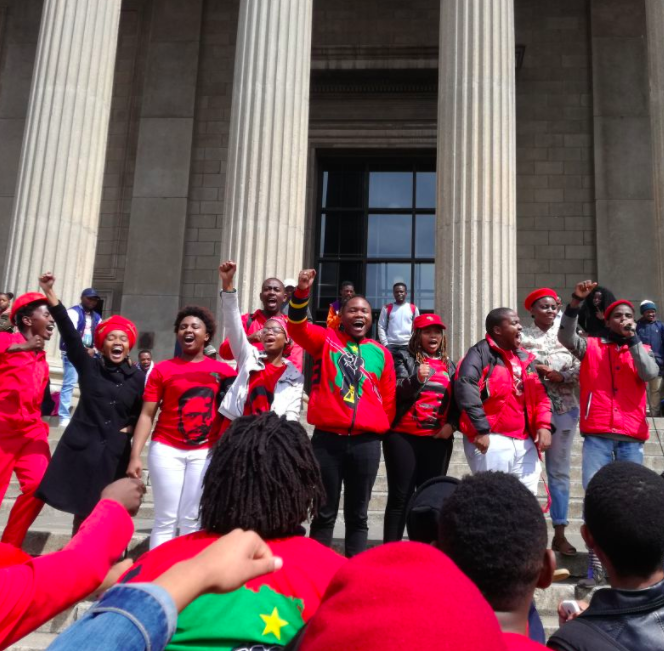
The newly-elected and EFF-controlled student representative council (SRC) not to embark on university shutdown operation has taken many by surprise.

The Economic Freedom Fighters’ Student Command (EFFSC) was very instrumental in the 2015/16 campus-wide student protest for free university education. Given its mother body’s radical rhetoric and often confrontational approach, particularly in parliament, many anticipated it would readily intensify the campaign to disrupt classes and examinations.

The decision signals a new and nuanced strategic approach that EFFSC will adopt on campuses. It also suggests that the organisation is revisiting and exploring progressive ways in which it can still pursue the objectives of the #FeesMustFall campaign without alienating and losing public support.

The decision by the Wits SRC under EFFSC to seek students’ views by calling a mass meeting must be seen within this context. In the meeting, an overwhelming majority of students decided against shutting down the university and this decision was carried.

Wits SRC president, Orediretse Masebe, said canvassing students’ views before embarking on such a big operation is part of a tradition forged during #FeesMustFall campaign. “We have always engaged in robust and comprehensive debates with Wits student body during the campaign,” Masebe said.

“We are not going to allow a shutdown pronounced via WhatsApp groups,” said Masebe.

We are tired of creating [political] pop stars out of every protest; we don’t want to create political elites who get access to resources they would not ordinarily access. There are a number of processes that must be gone into before shutting down the university and one of this is to consult with students,” Masebe.

He continued: “Right now students are in the middle of their examinations and we are saying it would be quite careless, reckless and selfish of us to announce a shutdown via social media. However, this should not be confused or misinterpreted to mean that EFF is against the call for free education for all.

Although the situation was calm at Wits east campus on Friday, there were widespread fears that a disgruntled group of students, allegedly belonging to Progressive Youth Alliance (PYA) were agitating for a shutdown. The alliance – an umbrella body of ANC-aligned youth structures including primarily South African Students Organisation, ANCYL and Young Communist League – lost the elections to EFF. Their alleged insistence to call for disruptions of the academic programme and examinations was seen as a calculated attempt to project the EFF as a weak organisation to take on the Wits administration.

On Friday Inside Education visited the campus and spoke to an EFFSC member, who did not want to mention his name because he was not authorised to speak on behalf EFFSC. He described PYA’s failed attempts to call for a shutdown as “sour grapes”.  

“These guys have been in office and they have done nothing to mobilise students for any protest. These things are organised in advance, say in September or thereabouts. That way you build a moment. You cannot wait until when students sit for their examination and try to call for a shutdown. What they are trying to do is damage control if not, saving their face,” he said.

Other students expressed relief and praised EFF for handling the situation in a “responsible” manner.

Keegan, a first year BA student said: “I am very happy and surprised at the way EFF has handled the matter. I mean let us face it, this is the time that if you want to get the government to pay attention you do a shutdown now.”

Ziyaad and Shi, also BA first students, agreed with Keegan. “I personally agree; I particularly like their motto: high morale and high discipline.”

Shi added: “I must say I don’t know a lot about student politics but I must say I was worried there would be a shutdown this time. I am happy with the way it was handled; that there is no shutdown and it is peaceful as opposed to last year which was tumultuous.”

 

Taxi owner juggled two jobs and studying to get her qualification

Bonile Khanyi

It’s never too late to learn something new and this is something 64-year-old taxi owner Veronica Mosiapoa knows all too well. Mosiapoa just completed a programme aimed at changing people’s mindset about the taxi industry.

Mosiapoa who is the secretary at the Dobsonville-Roodeport-Leratong-Johannesburg taxi association, was among 98 taxi bosses who graduated from the programme at the end of October, which was funded by the City of Johannesburg. The course was facilitated by the Universtiy of the Witwatersrand’s School of Governance. 

Speaking to Inside Education on Friday, Mosiapoa said if she had not attended the course this year, she wouldn’t have been able to understand why she wasn’t making profit. 

“I get money from Monday to Sunday, however this isn’t reflected on my bank statements at the end of the month. After taking this course, I realised that the reason why I wasn’t making any profits or why I didn’t have money in my pockets, was because I did not do money management properly,” said Mosiapoa.

Having a day job at the association from 10am – 3pm and working nightshifts for Rea Vaya, Mosiapoa said it was a mission juggling her daily routine and making the time to study and attending classes.

“It was such an incredible challenge for me, sometimes I felt like not going to school, but I persevered,” said Mosiapoa.

Executive Director for transport in the City of Johannesburg, Lisa Seftel, said the purpose of the course was to build the capacity of taxi owners and shareholders in Rea Vaya bus operating companies to run their businesses, participate in negotiations with the City and understand transport matters.

She said the City of Johannesburg will be running the course again next year and hopes that taxi owners will take the advantage of learning something new which will help them run their businesses well.

“We will register another 100 taxi bosses next year who will be attending the course for seven months,” said Seftel.

Panyaza Lesufi is determined to make the GDE a success story

Thabo Mohlala

Despite being forced to play a role of ‘Mr. Fix it’, Gauteng education department, Panyaza Lesufi said he is on course to execute his department’s mission of ensuring that all the schools in the province are functional and modernised to provide quality learning and teaching.

He has recently been kept on his toes, traversing the province to resolve crises like racism, rape and violence. He has received plenty praise from people for his agility and promptness in personally getting involved in these matters.

But Lesufi said although these are a distraction, there is a lot of work that his team is carrying out in the background. He said the problems he has been wrestling with accounted for only 13%, which means 87% was dedicated to delivering on his mandate. Lesufi said there was no way he would be derailed.

Speaking on 702 this week, the MEC said his department’s programme is anchored on three key areas: ICT, building schools of specialisation, and school twinning.

Lesufi’s mantra since taking office was to revolutionalise education in the province through a deliberate integration process of ICT. He said the days of chalks and boards are over and these are now being replaced by paperless classrooms.

Since then most townships have adopted the latest technologies such as smart-boards, tablets and laptops. He said Gauteng must not only lead the way as an economic hub but also when it comes to technological advances. “Gone are the days when our economy relied on minerals and other natural resources as well as agriculture,” said Lesufi, adding that the country must invest in human capital instead.  

He said they were currently in talks with strategic industry players to leverage their resources and skills base. Lesufi said they are negotiating with Nuclear Energy Corporation of South Africa (Necsa) to get them to avail their technical skills particularly in areas such as physics, engineering, chemistry and electronics.

Similarly, they are in consultation with BMW which is about to release one of its latest models. Lesufi said the objective was to get learners exposed to all the different aspects involved in assembling the car. This involves mechanical engineering, electronics, painting, welding, upholstery and other related critical components. South African Airways would also take learners under its wings and provide them with a whole range of aviation skills.

One example of such specialised schools was built at Emdeni – right at the heart of Soweto. Named after the struggle veteran, Curtis Nkondo, the state-of-the-art school focuses on engineering, mathematics, science, ICT, commerce and entrepreneurship, performing and creative arts and sports.  

Lesufi said his department is determined to break racial barriers and promote racial cohesion. And to achieve this they have adopted a school twinning programme. “Our education system is like Irish coffee: black at the bottom, white on top with sprinkles of chocolate on the foam. We need to break those barriers,” Lesufi said when launching the project. The programme aims to ensure the well-resourced schools are twinned with poor schools. Alexandra High School has partnered with its neighbouring Sandown High School.

Lesufi was asked if thinks the ICT programme can be said to be successful even when schools are broken into and learners and teachers get attacked for their laptops and tablets. “I think the country was not ready, the resources were limited and yet the needs were massive and the fiscus was also not ready to provide the necessary capital,” Lesufi said.

But, he said, he will not allow theft and attacks to deter him from forging ahead with his ICT project.

“We need to prepare our children for the 4th industrial revolution, they really need to be part of this world, otherwise they will be left behind,” said Lesufi.

Kholofelo Sono paid for her university fees via a Twitter campaign

Bonile Khanyi

When Kholofelo Sono received a message from her university, asking her to settle a student debt of just over R40 000, she quickly took it to social media. She was willing to do whatever it took to raise money to cover her debt.

The tweet quickly grabbed the attention of the Masingita Masunga Foundation, which was established to empower women, facilitate the development of communities and educate the next generation on the African continent.

“Instead of feeling pity for myself, I knew that if I offer a service, someone would actually say, come clean my house and that would help me raise funds,” Sono told Inside Education on Wednesday.

The 24-year-old who is a BSC graduate is currently pursuing a degree in Pharmacy at the University of Limpopo.

She said she tried to apply for a couple of bursaries, but was unsuccessful.

“My parents are struggling and they are no longer working, and after I tried applying for funding and failed, I thought it be easier to offer someone a service and get paid for it,” said Sono.

Sono said she had no idea that her tweet would gain so much attention and said she was thankful to the Masingita Masungu foundation for helping her settle her fees.

“It’s funny that I haven’t received any offers from people asking me to clean their homes or to come and babysit. Instead, I’ve had people offering to help me pay off my debts,” said Sono.

“Yesterday someone paid R700 into my student account and people continue asking me for my details to help cover this year’s debts. I so grateful to everyone.”

Speaking to Inside Education, the foundation’s founder, Masingita Masungu said she was touched when she saw Kholofelo’s tweet and was impressed to see that she was willing to do anything to pay off her debts.

“We help people who help themselves. The reason we chose to help Kholofelo, was that she showed initiative and was willing to make an effort to pay for her fees,” said Masungu.

The Masingita Masungu Foundation runs a campaign called #40440.

“Earlier this year, I launched my 40440 Campaign, representing my commitment to undertake 40 worthy initiatives for my 40th year. And when we saw that Kholofelo needed R40 620 to pay off her debts, we decided to pay the R40 000,” said Masungu.

In Conclusion, Masungu said she is heartbroken by the number of requests for funding for school fees the foundation has received and hopes that her foundation can continue making a positive impact in people’s lives.

“We don’t have much, but our foundation will continue doing the best it can in making a difference in people’s lives,” said Masunga.


KZN children writing exams on empty stomachs

0

Thabo Mohlala

The National Teachers Union (Natu) is calling for a forensic probe into a protracted legal wrangling that involves the KwaZulu-Natal department of education and feeding scheme service providers in the province.

Natu’s Alan Thompson said the matter has been dragging on for long and that while the parties fight over who should be providing the service, millions of school children across the province are starving.

“Learners are currently writing their final examinations with empty stomachs. There is no way they can prepare adequately and focus while they are hungry. Whatever the problems, let us not involve the children especially at this time of the year,” said Thompson.

He expressed disappointment with the way the provincial education department is dealing with the matter. “We feel strongly that only a forensic investigation can help address the problem,” said Thompson.

He said the feeding scheme has become a lucrative business running into billions. According to the latest figures, the cost of a nutrition programme per annum is R1.4 billion and this involves 5 250 schools and 2.2 million learners.

National School Nutrition Programme is a national policy which seeks to promote healthy eating habits and healthy lifestyles among learners. Several research studies conducted by the department of basic education and other organisations have highlighted the benefits of providing meals to children at school.

Some of the benefits include reduced levels of absenteeism and increased learner participation in school work. Majority of learners in black communities come from impoverished households and cannot afford to buy basic food. They struggle to concentrate in class and some end up dropping out of school.

The nature of the problem around the feeding scheme mirrors the ongoing SASSA debacle currently playing out in parliament. It is all about the principle of protecting the vulnerable when two elephants fight. The old service provider’s contract came to an end and the new service providers wanted to take over. However, a dispute ensued between the parties resulting in the matter being referred to court. In the end, the Pietermaritzburg high court ruled that while the matter is being considered, the old service providers must be allowed to feed the learners.

But the newly-appointed service providers ignored the order and went to schools to feed learners. This caused chaos and disrupted schooling in some areas. The new service providers argued they had already spent a lot of money buying food items and that most of these are perishable.

The department of education called the police to calm the situation and to enforce the court order. Thompson said their pleas to the department fell on deaf ears while children remained disadvantaged.

Inside Education’s attempts to get a comment from the department failed.


Gauteng education department hailed for putting the interests of the learners first

0

Thabo Mohlala

The Gauteng Department of Education (GDE) always puts the interests of the learners first where it is possible to do so, said Steve Mabona, the department’s spokesperson.

This follows the special concessions that education MEC, Panyaza Lesufi, granted to learners who arrived late yesterday for their final examinations after they were caught up in a severe traffic due to the ‘Black Monday’ protest.

After initially leaving the matter in the hands of chief invigilators, Lesufi had to intervene to ensure the problem is speedily resolved so that learners can continue to write their examinations on the same day.

Under normal circumstances, chief invigilators take charge of the entire examination process including exercising discretionary powers where extra-ordinary circumstances such as yesterday’s incident arise.

Asked if this is the policy position of the department or just a simple gesture of kindness to accommodate the unique circumstances of the stranded learners, Mabona said the policy does allow them to make such interventions.

He said while they will apply policies, “we also have to make sure our learners do not get disadvantaged where the situation is beyond their control. What is of paramount importance in this instance is that no learner was disqualified from writing the examination yesterday,” said Mabona. He said he does not have information about the specific number of centres and learners affected by the march.

“It is regrettable that, they had to write this important paper under this tormenting condition,” Lesufi said adding that “administrative prescripts” would be invoked to all those who may have missed the examinations.

Lesufi added that according to their report, all learners who arrived late were afforded an opportunity to write and that there “were minimal exceptional cases” of learners who have missed their papers.

According to the policy, a learner who missed final examinations would have to provide strong motivation before a dedicated committee who would then decide whether the learner can write supplementary examinations.

Several people hailed Lesufi for responding timeously and particularly allowed the learners to sit for the examination. Calling on KayaFM, some parents and the members of the public expressed anger and criticised the organisers of the march, saying it was ill-timed and nearly caused learners their futures.

They also pointed out that the march had racial undertones as it focused mainly on the deaths of white farmers.

Campuses on knife edge as the president dithers and universities set to increase fees

Thabo Mohlala

Universities will probably know how last year’s 8% fee increase will be adjusted before the end of the year. This is according to Professor Ahmed Bawa, chief executive of Universities South Africa (Usaf). This comes after a meeting with the newly-appointed Minister of Higher Education and Training, Hlengiwe Mkhize.

Most universities hold their council meetings by the end of November and the issue of budgeting for the next academic year, particularly the fee increment, would receive special attention.  

“It was an excellent meeting and we agreed that this matter of how we would deal with the fact that the universities require an 8% increase in income as an inflationary adjustment will be discussed this week,” said Bawa.

He added that Mkhize said she would engage Treasury on the issue. In his medium-term budget policy statement, Minister of Finance, Malusi Gigaba did not mention how much would be allocated to fund tertiary education.

Bawa said Usaf, which represents 26 public higher education institutions, would take the leaked report with a pinch of salt until the president formally announced the report of the commission of inquiry. 

“We don’t really know whether the leaked report upon which City Press based its coverage is the final complete report or not. We are anxiously awaiting the formal release of a report of the Presidential Commission of Inquiry,” Bawa said. 

The leaked report suggested that government would not deliver on free education for all, one of the students’ core demands during the #FeesMustFall campaign. Most students have reacted to the leaked report with anger and feel cheated. They say nothing short of government acceding to their call to for a universal education would appease them. They vowed to embark on widespread and full-blown protest marches similar to those that crippled the 2015/16 academic year programme.   

Last week, University of Cape Town (UCT) disrupted classes and examinations forcing management to call the police and subsequently close the campus for two days. Students at the University of Free State (UFS) also held similar protests while the University of the Witwatersrand (Wits) has issued a statement pledging their solidarity with the protesting students.

Vice-chancellors have also said their institutions would not survive and are compelled to hike their fees to sustain their operations. Max Price, UCT’s vice-chancellor, said if they increase their fees they expected the government to avail more funding so the increase would not be passed on to students.  

Bawa expressed disappointment about the Presidency’s failure to meet university management and the student representative councils as key stakeholders before the report was released. However, he was optimistic they would hear from the President’s Office’s office before the end of the week. He said the greatest fear for Usaf is that the leaked report would inflame the already volatile situation on various campuses and disrupt examinations.

In an attempt to buy time on Friday the presidency released a statement saying it is “now finalizing the processing of the report which requires, among other things, the Presidency consults with the relevant Ministers to ensure that government is ready to implement the President’s decision as soon he releases the report”. The statement further said the consultations with relevant stakeholders were at an advanced stage and would be finalised this week. It remains to be seen if President Zuma will keep his word and release the highly anticipated report.

Matrics miss exams because of “Black Monday” protests

Thabo Mohlala

Scores of matric learners missed their examinations while others arrived late following a blockade of the major freeways in Gauteng as part of a “Black Monday” protest against farm killings. Trucks and cars were used to blockade the highways.

According to reports, the main highways severely affected in Gauteng were the R59 in Vereeniging and N14 which carries traffic from Krugersdorp to Pretoria. Thousands also gathered in the Western Cape to convoy from Klapmuts near Stellenbosch to Cape Town.

Some frantic learners called Talk Radio 702 on Monday morning to express their anger and frustration. One learner said she was left with 30 minutes – she called at 8:30am and the examination was scheduled to commence at 9:00am – before she could sit for her maths paper examination. Sounding dejected, she had all but given up as traffic was not moving at all, she said.

Motorists stuck in traffic praised some Good Samaritan bikers who picked up some of the hapless learners and ferried them to their various examination centres. Regrettably, a good number of them were never lucky and would have to write supplementary next year subject to applicable rules and conditions of the department.

Gauteng education spokesperson, Steve Mabona told 702 that in situations such as this, chief district invigilators are given discretionary powers to look into learners’ specific circumstances. He said learners who, through no fault of their own, arrived late for the exam may be allowed to write if the invigilator is satisfied with their motivation for the delay. Mabona added that the invigilator should always ensure this does not violate the rights of learners who arrived early.

If a learner fails to arrive, said Mabona, to write and their reasons are subsequently considered legitimate, they would be allowed to write supplementary examinations early next year.

The protest is organised under a banner of a farmers’ movement called “Genoeg is Genoeg” (Enough is Enough) and it was launched after the murder of Joubert Conradie on his farm earlier this month.

With the old apartheid flag flying high at these protests, many on social media have branded the movement as racist.

Some, however, have contended that this march was not about white farmers only but about murders in general.

AfriForum, said although it supports the protests; it was not involved in organising it. The forum said since January this year there have been 70 fatal attacks on farmers and blamed the increasing deaths of farmers on poor policing.

We celebrate OR Tambo as a dedicated maths and science teacher

Thabo Mohlala

Today marks the day Oliver Reginald Tambo, affectionately known as OR, would have turned 100 years old. He is by common consent a political colossal whose enduring influence and impact still reverberates globally 24 years after his passing.

But he had another admirable side that is seldom highlighted and celebrated: a passion for maths and science including many students who passed through his hands and went on to make it in their adult life.

In his home village Nkantalo in Mbizana, the community will be joined by President Jacob Zuma who will speak at the celebrations. In Johannesburg at the University of the Witwatersrand, former President Thabo Mbeki will deliver the centenary memorial lecture.

Zuma acknowledged Tambo’s contribution as a notable maths and science teacher during this year’s State of the Nation address. He said South Africa will this year prioritise mathematics and science subjects more than ever before, in memory of OR Tambo.

It is believed that by creating awareness about OR Tambo as a maths and science genius would inspire and galvanise learners and their teachers to emulate him. South Africa has identified maths and science as strategically vital subjects that can significantly help the country overcome and deal with a myriad of its developmental
challenges. Sadly though, the performance of the South African learners across the country has been uninspiring as they consistently scored poorly in international tests, lagging behind their continental counterparts.

But, according to Zuma, South Africa is slowly turning the corner. He said the recent international test results released by the Trends in International Mathematics and Science Study and  Southern and East African Consortium for Monitoring Educational Quality, showed that the performance of South African learners is improving.

Zuma said the results show that South Africa has shown the largest improvement of 87 points in mathematics and 90 points in science.

One of OR Tambo’s admirers is the South African Democratic Teachers’ Union (Sadtu)’s general secretary, Mugwena Maluleke. He said: “OR
Tambo was an African who stood for what was right and taught Verwoerd a lesson that mathematics and science were gateway subjects that can be taught and learned by anyone. He taught him that his racist theory that a black man cannot learn mathematics because he couldn’t use it on a daily basis was just but an insult to humanity.”

Maluleke laments the failure of the country’s education system to “liberate our people from mental slavery in honour of the sacrifices of our struggle heroes and heroines”.

Maluleke said this year, as part of the OR Tambo centenary celebrations it would be fitting to teach learners about “the vital lessons of history so that we can guide our present and future”.

More importantly, Maluleke said, we need to teach our children that OR Tambo was mathematics and science teacher, adding that Sadtu has been making calls for the teaching of African languages in all the schools.

“Other nations are immortalizing their glorious dead and we help them through our history books in our schools. They eloquently write about their heroes and heroines and we help them by teaching our children about them,” Maluleke said.

A brief history culled from the pages of Class Act – a digital educational training and development site, shows that OR Tambo started teaching maths and science at St Peter’s Secondary School, in Rosettenville, Johannesburg. He taught the subject for ten years producing excellent results. He continued to do well in his academic
endeavours and in December 1938, he sat for his matriculation examinations and passed with first class.He then went on to study for a science degree, a field he deliberately

He then went on to study for a science degree, a field he deliberately chose because he felt too a disproportionate number of blacks pursued BA degree studies. He later graduated with BSc degree maths and science – although his first choice was medicine – which he could do based on race considerations. He enrolled for a higher diploma in
education at the University of Fort Hare but got expelled in his final year due to his political activism.

In 1953 OR Tambo made a career switch and decided to do law, a move that brought him in contact with Nelson Mandela, who was to become his political and personal ally. They opened a law practice helping black people deal with equality and race-related cases.

Deputy President Cyril Ramaphosa also paid tribute to OR Tambo during his recent address to Sadtu’s national general council, saying he had no doubt that had he lived, OR would be a proud member of Sadtu.

He said the best tribute to pay to him was for teachers to re-affirm their commitment to the education of the South African child.

His teachings, continued Maluleke, were about equality and freedom. His teachings were about love for one’s country and its people. His teachings were about hard work, discipline, self-development amongst many traits that we have learned from him.

“We have to emulate him and share with humanity his humility in the service of the people. We have to teach our children about him and all our martyrs in order to take charge of our presence and direct our future,” he said.

University of Pretoria students suspended for calling black people f**king ka**irs

Bonile Khanyi

Two University of Pretoria students filmed using the k-word in a now-viral video on social media have been suspended, said university management.

Catherine Reynders and Bodene Benade filmed themselves using the K-word in a local bar after one of their phones was stolen.

It is understood Benade, accidentally sent the video to her final year Physiotherapy WhatsApp group when a friend used her phone to record the racial slurs.

In a statement issued on Friday, university spokesperson Candice Jooster said an investigation into the matter was underway.

“We can confirm that the two women in the video are students at the University of Pretoria. An investigation into the matter is underway and the students will be suspended today pending a disciplinary inquiry,” said Jooster.

This means the two students will have no access to campus and that they’re subject to a disciplinary inquiry. The students are in their final year and may have completed exams already. Inside Education could not confirm this without their student numbers. Jooster said she was uncertain of what the consequences of their actions would be if they did not return next year. 

The university said it strongly condemns the use of such derogatory and racist language.

In the video, two women can be heard. One shouts “a f**king ka**ir stole my phone” while the other says “you hear that? A ka**ir stole this phone…” Both women then continue to shout the k-word and refer to whoever stole the phone as a whore.

“Don’t play this in front of Zamani,” one of them says.

The video ends with them smiling at the camera.

In the WhatsApp group screenshots posted on social media, Benade asked her classmates to ignore the message saying she was just helping a drunk friend. 

She wrote: “I really apologize from the bottom of my heart to anyone that’s been offended – so sorry, completely unacceptable 💔 she’s been sent home!”

Her classmates were not impressed and voiced their anger making it clear they could not ignore the video and its contents. It was then that Benade apologised again – this time referring to herself and not the friend.

“I’m so sorry 💔 please forgive me – we are all human and have made mistakes and this is an awful one on my part – I’m truelly (sic) sorry,” she wrote.

Other students voiced their anger, discontent and hurt about the incident on social media calling for the institution to take the necessary action against the two students.

Here is a thread of the conversation below: