




By Thebe Mabanga
Skills are more than just an ability to perform a task well. Rather, they shape livelihoods and responsible citizens, enhance a country’s competitiveness and are a crucial ingredient for achieving inclusive growth and tackling unemployment, poverty and inequality.
As South Africa looks at ways to tackle the skills deficit, it is exploring the possibility of sending its young unskilled and unemployed people to China to acquire artisan skills.
This emerged at the National Skills Dialogue hosted by the Chemical Industries Education and Training Authority (Chieta) and Inside Education. The dialogue focused on bridging the skills gap to build sustainable livelihoods taking skills, and the job they give access to, beyond mere survival.
The dialogue’s keynote address was delivered by Higher Education and Training Minister Nobuhle Nkabane.
Chieta CEO Yershen Pillay called on attendees to look at skills broadly.
“Skills do not meet a market demand; they satisfy a human need.” said Pillay, who added that stakeholders must look “at the needs of society, not just demand”.
He said this allowed society to view skills as a means to a job.
“A job can change a day; livelihoods can change a lifetime,” he said.
Promoting partnerships
Nkosinathi Sishi, the director-general of the Department of Higher Education and Training, said the dialogue must promote partnerships among different Sector Education and Training Authorities and between SETAs and other role players.
Nkabane argued that skills were enablers of inclusive growth and critical for the implementation of the Medium-Term Development Programme for the period to 2029.
She called on SETAs to embrace digital education into their training to prepare workers for the future.
The minister also reiterated her call, first made at the beginning of the month at the board induction for the National Skills Authority (NSA), for the country to focus on the 3,8 million young people who were not in employment, education or training.
She noted that her department had a fruitful preliminary discussion with her counterparts in China about the possibility of sending young people to China to acquire some skills
Panel discussion
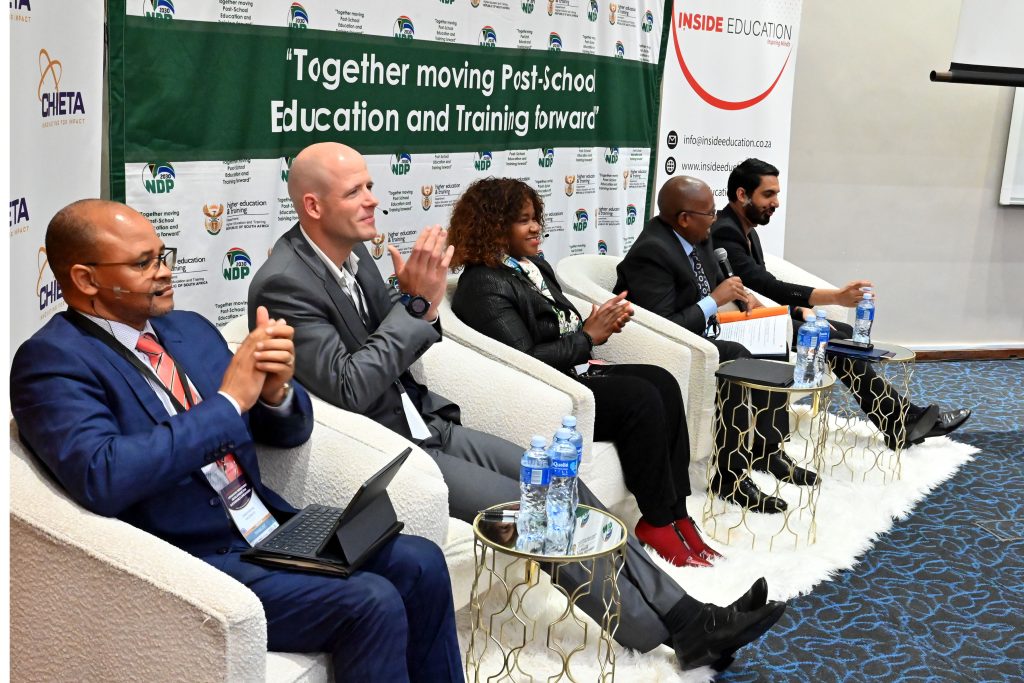
The dialogue included a panel discussion following the minister’s address.
Department director-general Nkosinathi Sishi said: “Workforce development is no longer just a policy imperative; it’s a national survival strategy. We must change how we measure success if we are to become globally competitive.”
Sishi argued that livelihoods take many forms including those of digital nomads and the self-employed and South Africa must update its Master Skills Plan to reflect this.
Sithembile Mbuyisa, the General Executive for Human Capital at the South African Nuclear Energy Corporation (NECSA), said it offered training in portable artisanal skills that could be used in different environments, not just in nuclear, where South Africa was building a multi-Purpose reactor.
NECSA has capacity to train about 450 artisans at a time. South Africa has a target of producing 30,000 artisans per year and in the 2023/24 financial year, it produced 26,500 artisans.
The development skills should start sooner than later, said Myuyisa and National Student Financial Aid Scheme (NSFAS) interim CEO Waseem Carrim.
Carrim told the dialogue that skills development must be viewed holistically, starting at Early Childhood Development (ECD), or even the first four years of a child’s life which the United Nation’s referred to as the first 1000 days, to allow them to progress through the schooling system.
He noted that 70% of NSFAS beneficiaries were social grants recipients, which suggested that the scheme funding gave social mobility to an important group that may not have access to it.
Mbuyisa said that NECSA had found gaps in foundation education and cognitive skills.
NSA executive officer Zamokwakhe Khuzwayo estimated that SETAs have assisted three million people to access the job market.
However, to increase these numbers, they needed to understand provincial economic drivers to design programmes that suited provincial needs.
Afrox Africa managing director Sebastian Satchleben said during the panel discussion that South Africa’s private sector offered a good skills training programme that allowed learners to “apply their knowledge”.
However, the success of the programme was dependent on the learning culture in a workplace.
Like Mbuyisa, he said the one of the most important skills students should be taught is critical thinking.
Issues from the floor
One of the issues raised by the delegates was entrepreneurship and how current skills development curricula did not place emphasis on driving candidates towards starting their own businesses.
Sishi responded by saying that his department has a R1 billion entrepreneurship training programme that it ran in conjunction with the Department of Small Business Development.
Another conference participant, who holds a master’s in mathematics, said a shortcoming for South Africa’s skills development programme was that there was no clear agenda why the country was developing. For example was it to develop skills to industrialise the economy or was the country plugging gaps to meet an immediate need? The delegate said that without a clear guide, skills programmes would respond to varying needs without focus.
According to Nkabane, the Medium-Term Development Programme was supposed to guide the skills development agenda.
Another delegate asked whether there was funding in the system for post graduate studies?
Carrim admitted that if he and the Higher Education and Training Department motivated for post graduate funding, they would likely be turned down by the National Treasury.
“It is simply not a priority,” he said.
This was because post graduate studies could be funded in several other ways, starting with working and saving up to fund studies. Employers and the private sector as well as institutions also offered higher level funding through grants and scholarships.
A principal for a Soweto-based Technical and Vocational Education and Training college pointed out that funding by SETAs for TVET colleges was simply inadequate.
He said that in his institution, there was a programme where a SETA funded a handful of students, which was a drop in the ocean compared to his overall need, even just for that programme.
Pillay conceded that resources were limited, and funding must be spread across cooperatives, community colleges and other training institutions, not just TVET colleges.
He noted that a bigger problem with TVET funding was that the colleges offered 30% of the training, which was theory. A total of 70% came from practical or workplace training, and these placement opportunities were limited due to poor economic growth.
The NSA’s Khuzwayo said it was challenging to find host employers to match trainees. In some instances, there were declining positions, especially in factories as many of them had closed.
In another instance, “employers are willing to host learners, but there are no willing participants”, he said.
JET Skills Desk
Sishi told participants that one of the ways the department was responding to changing skills needs was by establishing a Just Energy Transition (JET) Skills Desk to understand the skills needed in areas such as renewable energy.
He called on South Africa to assume a global leadership role in skills development just as it had in areas such as climate change and sustainability for example.
“Everywhere we go, the world is looking for answers for existence from us,” Sishi said.
Skills was one area where South Africa could take the lead, he said.
A report on the dialogue will be compiled for the Higher Education and Training Department with the aim of helping chart forward the country’s workplace development agenda.
INSIDE EDUCATION