
By Johnathan Paoli
Parliament’s portfolio committees on basic education and police have welcomed the recent signing of a Collaborative Implementation Protocol on School Safety as a significant move in addressing the growing crisis of school violence in South Africa.
Basic Education Portfolio Committee chairperson Joy Maimela described the initiative as a “bold step” in responding to the worsening safety situation in education environments.
“The murder of Lethabo Mokonyane… underscores the trend of violent crime in and around school premises that requires a concerted effort by all stakeholders to bring an end to this worrying trend. School environments should be safe spaces for teaching and learning and nothing else,” she said.
Mokonyane was stabbed to death outside Lesedi Secondary School in Lethabong informal settlement in Tshewane on 17 June.
The agreement is aimed at intensifying security measures in schools, particularly in hotspot provinces where violence, drug abuse and sexual crimes have become increasingly prevalent.
The initial implementation will be in Gauteng, KwaZulu-Natal, the Eastern Cape and the Western Cape, which have been identified through crime data analysis as the most affected by school-based violence.
This targeted, data-driven approach is intended to create safer school zones by linking schools to nearby police stations, boosting patrols and increasing police visibility in areas where crime levels are highest.
Police Portfolio Committee chairperson Ian Cameron said that effective enforcement at a local level was key to the initiative’s success.
“The approach to target hotspots has the potential of stemming the tide of crime in schools. But it is up to station-level management to implement the protocols effectively to ensure success,” he said.
According to the fourth-quarter crime statistics released earlier this year, South Africa recorded six murders and 80 rapes in school settings, a stark reminder of the dangers learners and educators face.
The protocol also includes a renewed commitment to thoroughly vetting school staff against the National Register for Sex Offenders and the National Child Protection Register, a safeguard which has existed on paper but, according to Maimela, was too often “neglected”.
“This has long been a requirement to obtain a position in schools to safeguard vulnerable groups. It is important that such safeguards are adhered to without fail,” Maimela noted.
Substance abuse was highlighted as another urgent area of concern.
Cameron noted that the issue must be addressed with a “society-wide approach” and called on municipalities to enforce existing bylaws that restricted the operation of liquor outlets near school premises.
“Municipalities must also play their role in enforcing municipal bylaws that prohibit the establishment of liquor-selling premises near schools,” he stressed.
The two portfolio committees have committed to providing ongoing oversight to ensure the effective implementation of the protocols and to hold accountable those responsible for their enforcement.
Reacting to the development, the SA Democratic Teachers’ Union (Sadtu) cautiously welcomed the renewed commitment to school safety, but reminded the public that such protocols were not new.
A similar agreement between the Basic Education Department and the South African Police Service was signed in 2011 and implemented in schools from 2015.
“While we acknowledge this renewed commitment, we wish to emphasise that such a partnership is not new. The 2011 protocol established collaborative frameworks across all nine provinces and ensured every school was linked to a local police station,” Sadtu spokesperson Nomusa Cembi said.
The union, whose “I Am a School Fan” campaign also champions safe school environments, called for the current protocols to result in tangible action rather than policy rhetoric.
“We hope the signing of this protocol will not only reaffirm previous efforts but lead to more effective and consistent implementation,” Cembi stated.
While Sadtu supports the focus on hotspot provinces, it urges equal attention to schools in other provinces, noting that violence may go unreported in more rural or under-resourced areas where police presence is limited.
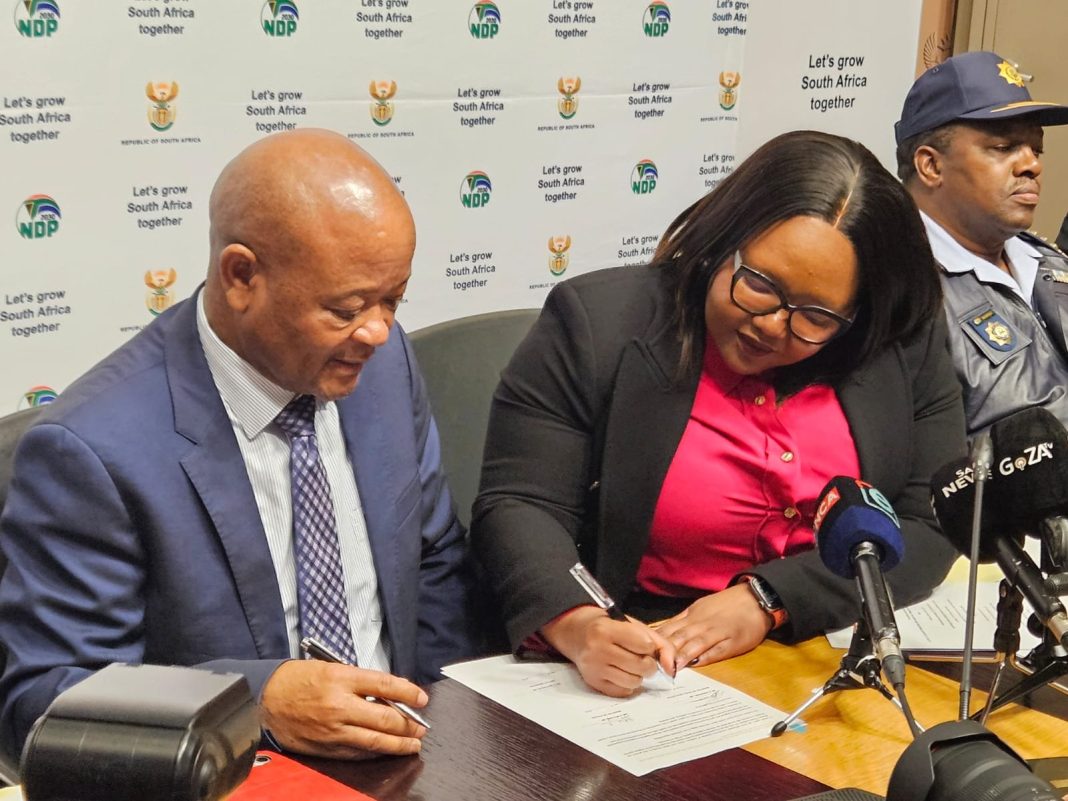
The protocol was signed by basic Education Minister Siviwe Gwarube and Police Minister Senzo Mchunu.
INSIDE EDUCATION