
By Johnathan Paoi
Higher Education and Training Minister Nobuhle Nkabane has unveiled a series of ambitious investments aimed at building a skilled, empowered generation of South Africans.
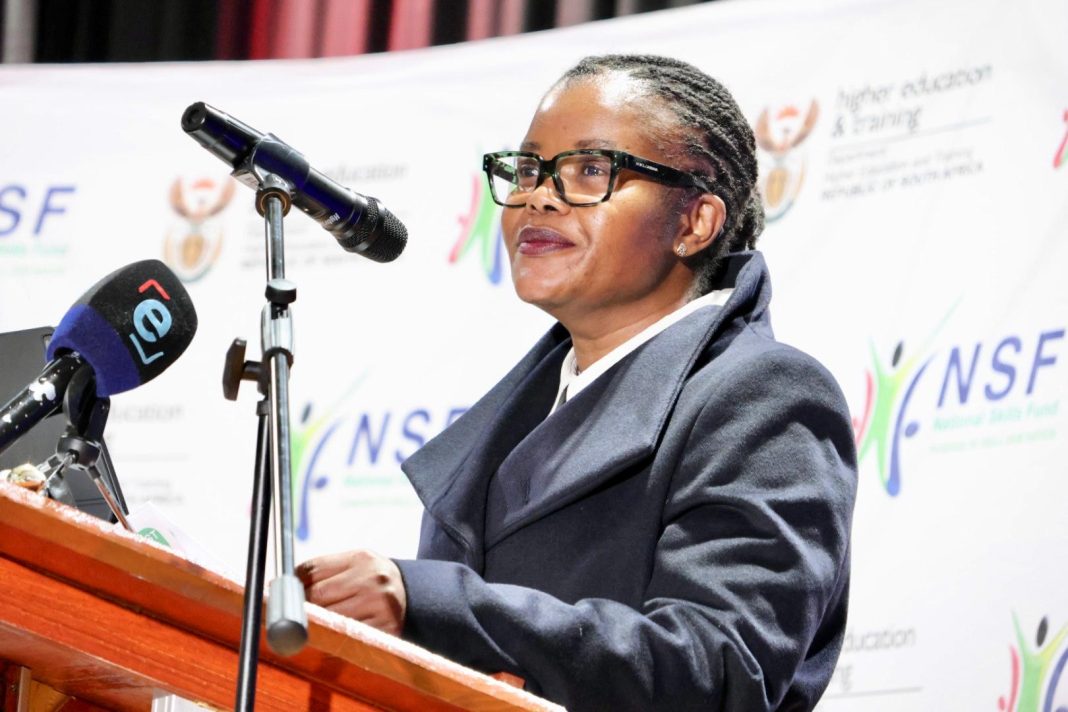
Addressing hundreds of beneficiaries, academics, artisans and future researchers in attendance at the National Skills Fund (NSF) Beneficiaries Budget Vote Breakfast at Northlink College’s Protea Campus, Nkabane used the platform to reaffirm the department’s commitment to expanding access to post-school education and tackling the country’s critical and scarce skills shortages.
“Our presence here today is not just symbol; it is a celebration of your resilience and an affirmation of our government’s commitment to education as a vehicle for change. We are here to honour your commitment, and we are positive that out of this, more young people will be motivated to grab the opportunities made available by the government to transform not only their own lives, but their communities and families too,” Nkabane said.
The minister announced that for the 2025 academic year, the National Skills Fund had allocated R3 billion through its Bursaries Directorate to fund students studying qualifications listed as critical or scarce skills at public higher learning institutions.
The funding targets deserving students from quintile one and two schools in disadvantaged communities. It recently expanded to support the “missing middle”, who are students whose household income ranges between R350,000 and R650,000 annually.
“We are actively addressing the funding gap by implementing the Missing Middle Funding Policy approved in 2024,” Nkabane explained.
The minister highlighted the growing international reach of South Africa’s scholarship programmes.
Through collaboration with the Department’s International Scholarships Directorate, over 300 students are now studying abroad in countries including Hungary, Mauritius, Russia, China, Ireland, Serbia and Germany, supported by bilateral agreements.
“These students are studying advanced fields such as nuclear engineering, artificial intelligence, cyber technology, and aeronautical engineering. Through our University Capacity Development Programme, we’re building the next generation of academics — the pipeline for 5000 PhDs a year envisioned by the National Development Plan,” Nkabane said.
She also noted that R254 million had been allocated to support over 1500 postgraduate students (Honours to Post-Doctoral), in partnership with the National Research Foundation to expand South Africa’s research and innovation ecosystem.
In a nod to inclusive growth, the minister revealed that the NSF had allocated R241 million to support 1966 students at South Africa’s 11 agricultural colleges, offering short and full-length training in farming and agri-business skills.
“This initiative boosts food security and economic opportunity in rural areas. It has a multiplier effect of empowering communities and promoting sustainability,” Nkabane said.
Deputy director-general for TVET colleges, Sam Zungu, praised the inspiring testimonies of students in attendance.
“We echo the minister’s sentiments, today reminded us why we must never relent in our commitment to youth development. Listening to students’ stories reminds us how far we’ve come and affirms the critical role they play in shaping our economy. To our young people: stay the course. We are with you,” Zungu said.
He called for more frequent engagements like the breakfast event, noting that these spaces allowed the government to showcase its work and be reminded of the powerful impact young South Africans are making.
Deputy director-general for skills development, Zukile Mvalo, echoed this optimism, calling the NSF “a catalyst for change”.
He stressed the fund’s transformational role in empowering communities, while also cautioning against ongoing social challenges.
“We must also confront issues like gender-based violence on campuses. By listening to students and working together, we can make progress. Every artisan trained and learner funded brings us closer to a stronger, fairer South Africa,” Mvalo said.
Nkabane reaffirmed her department’s mission of investing in young people and opening every door possible for them to actively participate in building the economy.
She urged the beneficiaries to become “ambassadors of change”, educating others about opportunities offered by the state.
“We rely on you to spread the word about what is possible when we work together to unlock potential,” she said.
INSIDE EDUCATION