
By Johnathan Paoli
In a significant diplomatic and educational development, Higher Education and Training Minister Nobuhle Nkabane has signed a Memorandum of Understanding on Technical and Vocational Education and Training (TVET) with Austria.
It is aimed at aligning South Africa’s vocational training priorities with Austria’s globally respected dual education system.
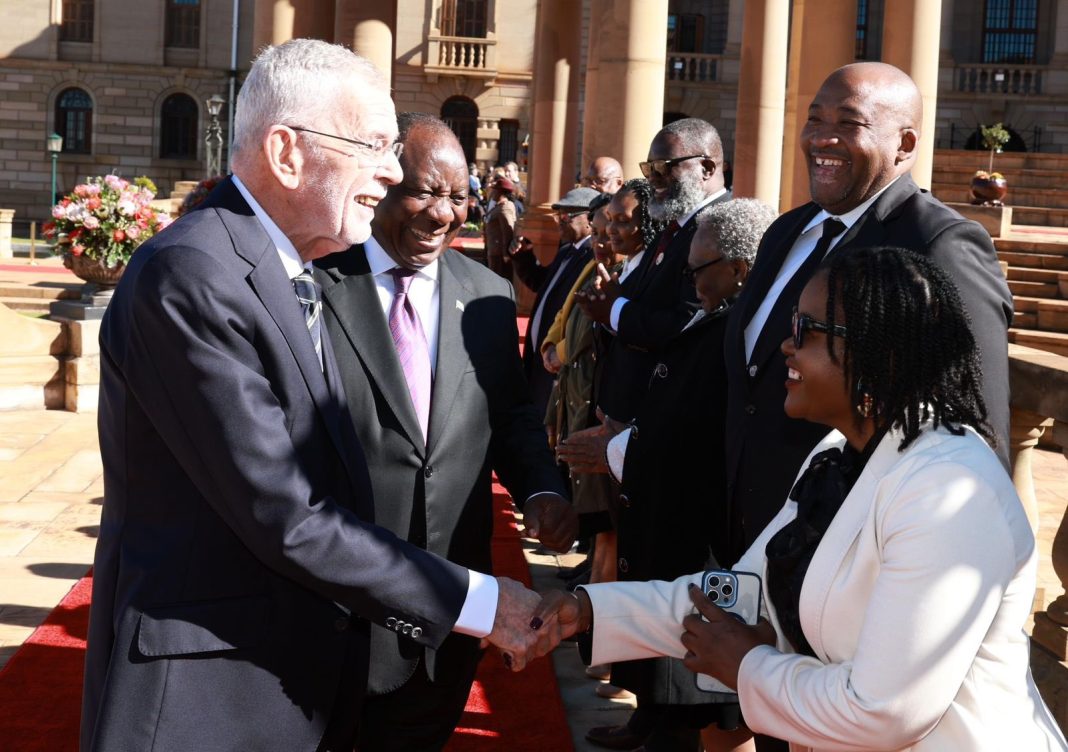
Nkabane signed the MOU during the State Visit of Austrian President Alexander van der Bellen to South Africa, with the Austrian Foreign Affairs Secretary-General Nikolaus Marschik co-signing at his country’s Federal Ministry for European and International Affairs.
“Working with both the Austrian Federal Ministry of Economy, Energy and Tourism, together with the Federal Ministry of Education, we look forward to placing TVET students at the Austrian companies operating in South Africa and vice versa,” the minister said.
The new agreement paves the way for transformative collaboration in skills development and youth employability.
It commits both nations to structured cooperation in work-based learning, institutional partnerships and cross-border student placements.
South African TVET students will have increased access to Austrian businesses operating locally and, in select cases, abroad.
The partnership will also support curriculum design that aligns classroom instruction with practical, on-the-job training.
Key focus areas include the exchange of TVET delegations, collaboration between vocational colleges and training companies, joint development of work-based learning methodologies, and fostering an efficient, practice-oriented dual training system in cooperation with employers.
“This agreement affirms our belief that vocational education must be industry-responsive, practical and internationally benchmarked. It reflects our commitment to addressing youth unemployment by equipping our students with the right skills for the right jobs,” Nkabane said.
During the high-level discussions, Nkabane emphasised the importance of strengthening ties not only in TVET but across the broader higher education and training sector.
She acknowledged and praised the longstanding partnerships between South African and Austrian universities, including the University of the Western Cape’s MoU with Kepler University of Linz, the University of Cape Town’s academic cooperation with Kepler University, and the University of Pretoria’s collaboration with the Vienna University of Economics and Business and the Technical University of Vienna.
Additionally, universities such as Durban University of Technology, Walter Sisulu University and the University of the Free State were commended for their progress in forming international linkages with Austrian institutions.
Nkabane also highlighted a promising initiative underway at North-West University, which was negotiating a MoU with Austria’s Karl Landsteiner University of Health Sciences. The planned partnership, expected to be signed later in the year, is part of North-West University’s internationalisation strategy and forms the foundation for South Africa’s 10th medical university.
“These institutional collaborations are vital in promoting joint research, curriculum development, academic mobility and joint degrees. They also support our Presidential PhD Programme, which we run in partnership with the Department of Science, Technology and Innovation,” Nkabane said.
In her official address during the state visit, Nkabane reiterated that South Africa’s TVET colleges were at the core of the national strategy to skill, reskill and upskill youth for both employment and entrepreneurship.
She stressed the importance of focusing on scarce skills that were urgently needed by the South African economy, such as in green technology, mechatronics, engineering and hospitality.
As part of the long-term vision, the minister proposed expanding the cooperation to include Community Education and Training (CET) colleges and South Africa’s network of Sector Education and Training Authorities (SETAs).
This would broaden the reach of the agreement, offering more inclusive access to skills development opportunities.
“We want to create a dynamic, accessible vocational education system that leaves no community behind. This is how we ensure that skills development supports inclusive economic growth,” Nkabane said.
The Austrian state visit has elevated diplomatic relations between the two countries and reinforced the shared commitment to youth empowerment, workforce readiness and green economic development.
Austria’s dual education model, praised globally for integrating theoretical instruction with real-world training, presents a blueprint for South Africa’s evolving TVET strategy.
President Cyril Ramaphosa welcomed the agreement as a pillar of the broader cooperation between the two nations, which also spans trade, investment and sustainable development.
Both leaders affirmed their intention to turn agreements into action and deliver tangible benefits to their citizens.
As the world grapples with shifting labour markets, digital disruption, and a rapidly advancing green economy, partnerships like this offer hope for a more prepared, skilled, and competitive youth workforce
INSIDE EDUCATION